Networking Basics
1
Prepared By:
Aditi Nandi Tokder
Assistant Professor
ECE Department
Techno Main Salt Lake
Network Topologies
What Is Networking?
1
2
3
4
Types Of Networks
2
What Is Networking?
3
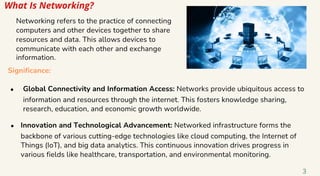
Networking refers to the practice of connecting
computers and other devices together to share
resources and data. This allows devices to
communicate with each other and exchange
information.
Significance:
Global Connectivity and Information Access: Networks provide ubiquitous access to
information and resources through the internet. This fosters knowledge sharing,
research, education, and economic growth worldwide.
Innovation and Technological Advancement: Networked infrastructure forms the
backbone of various cutting-edge technologies like cloud computing, the Internet of
Things (IoT), and big data analytics. This continuous innovation drives progress in
various fields like healthcare, transportation, and environmental monitoring.
4
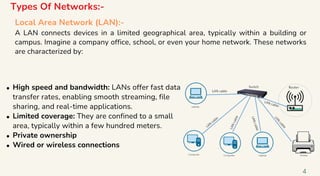
Local Area Network (LAN):-
A LAN connects devices in a limited geographical area, typically within a building or
campus. Imagine a company office, school, or even your home network. These networks
are characterized by:
High speed and bandwidth: LANs offer fast data
transfer rates, enabling smooth streaming, file
sharing, and real-time applications.
Limited coverage: They are confined to a small
area, typically within a few hundred meters.
Private ownership
Wired or wireless connections
Types Of Networks:-
Wide Area Network (WAN) :-
5
A WAN spans a much larger geographical area, often across cities, states, or even
continents. Think of the internet itself, connecting devices worldwide. WANs are defined by:
Lower speeds and bandwidth: Compared to LANs, WANs have lower data transfer
rates due to the larger distances involved.
Complex infrastructure
A MAN bridges the gap between LANs and WANs, covering a metropolitan area like a city or
large town. Think of a network connecting government offices, universities, or hospitals within
a city. MANs share some characteristics with both LANs and WANs:
Moderate speed and bandwidth
Medium-sized coverage
Wired or wireless connections
Metropolitan Area Network (MAN):
6
Personal Area Network (PAN):
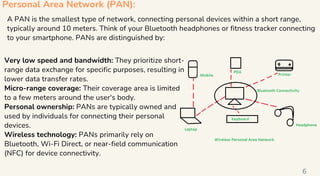
Very low speed and bandwidth: They prioritize short-
range data exchange for specific purposes, resulting in
lower data transfer rates.
Micro-range coverage: Their coverage area is limited
to a few meters around the user's body.
Personal ownership: PANs are typically owned and
used by individuals for connecting their personal
devices.
Wireless technology: PANs primarily rely on
Bluetooth, Wi-Fi Direct, or near-field communication
(NFC) for device connectivity.
A PAN is the smallest type of network, connecting personal devices within a short range,
typically around 10 meters. Think of your Bluetooth headphones or fitness tracker connecting
to your smartphone. PANs are distinguished by:
Network Topologies :-
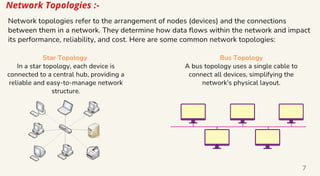
Star Topology
In a star topology, each device is
connected to a central hub, providing a
reliable and easy-to-manage network
structure.
Bus Topology
A bus topology uses a single cable to
connect all devices, simplifying the
network's physical layout.
7
Network topologies refer to the arrangement of nodes (devices) and the connections
between them in a network. They determine how data flows within the network and impact
its performance, reliability, and cost. Here are some common network topologies:
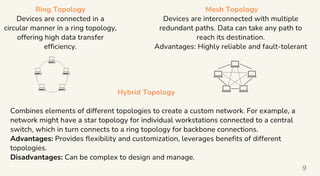
Ring Topology
Devices are connected in a
circular manner in a ring topology,
offering high data transfer
efficiency.
Hybrid Topology
Combines elements of different topologies to create a custom network. For example, a
network might have a star topology for individual workstations connected to a central
switch, which in turn connects to a ring topology for backbone connections.
Advantages: Provides flexibility and customization, leverages benefits of different
topologies.
Disadvantages: Can be complex to design and manage.
Mesh Topology
Devices are interconnected with multiple
redundant paths. Data can take any path to
reach its destination.
Advantages: Highly reliable and fault-tolerant
9
Thank You
9

Networking Basics .pdf

  • 1.
    Networking Basics 1 Prepared By: AditiNandi Tokder Assistant Professor ECE Department Techno Main Salt Lake
  • 2.
    Network Topologies What IsNetworking? 1 2 3 4 Types Of Networks 2
  • 3.
    What Is Networking? 3 Networkingrefers to the practice of connecting computers and other devices together to share resources and data. This allows devices to communicate with each other and exchange information. Significance: Global Connectivity and Information Access: Networks provide ubiquitous access to information and resources through the internet. This fosters knowledge sharing, research, education, and economic growth worldwide. Innovation and Technological Advancement: Networked infrastructure forms the backbone of various cutting-edge technologies like cloud computing, the Internet of Things (IoT), and big data analytics. This continuous innovation drives progress in various fields like healthcare, transportation, and environmental monitoring.
  • 4.
    4 Local Area Network(LAN):- A LAN connects devices in a limited geographical area, typically within a building or campus. Imagine a company office, school, or even your home network. These networks are characterized by: High speed and bandwidth: LANs offer fast data transfer rates, enabling smooth streaming, file sharing, and real-time applications. Limited coverage: They are confined to a small area, typically within a few hundred meters. Private ownership Wired or wireless connections Types Of Networks:-
  • 5.
    Wide Area Network(WAN) :- 5 A WAN spans a much larger geographical area, often across cities, states, or even continents. Think of the internet itself, connecting devices worldwide. WANs are defined by: Lower speeds and bandwidth: Compared to LANs, WANs have lower data transfer rates due to the larger distances involved. Complex infrastructure A MAN bridges the gap between LANs and WANs, covering a metropolitan area like a city or large town. Think of a network connecting government offices, universities, or hospitals within a city. MANs share some characteristics with both LANs and WANs: Moderate speed and bandwidth Medium-sized coverage Wired or wireless connections Metropolitan Area Network (MAN):
  • 6.
    6 Personal Area Network(PAN): Very low speed and bandwidth: They prioritize short- range data exchange for specific purposes, resulting in lower data transfer rates. Micro-range coverage: Their coverage area is limited to a few meters around the user's body. Personal ownership: PANs are typically owned and used by individuals for connecting their personal devices. Wireless technology: PANs primarily rely on Bluetooth, Wi-Fi Direct, or near-field communication (NFC) for device connectivity. A PAN is the smallest type of network, connecting personal devices within a short range, typically around 10 meters. Think of your Bluetooth headphones or fitness tracker connecting to your smartphone. PANs are distinguished by:
  • 7.
    Network Topologies :- StarTopology In a star topology, each device is connected to a central hub, providing a reliable and easy-to-manage network structure. Bus Topology A bus topology uses a single cable to connect all devices, simplifying the network's physical layout. 7 Network topologies refer to the arrangement of nodes (devices) and the connections between them in a network. They determine how data flows within the network and impact its performance, reliability, and cost. Here are some common network topologies:
  • 8.
    Ring Topology Devices areconnected in a circular manner in a ring topology, offering high data transfer efficiency. Hybrid Topology Combines elements of different topologies to create a custom network. For example, a network might have a star topology for individual workstations connected to a central switch, which in turn connects to a ring topology for backbone connections. Advantages: Provides flexibility and customization, leverages benefits of different topologies. Disadvantages: Can be complex to design and manage. Mesh Topology Devices are interconnected with multiple redundant paths. Data can take any path to reach its destination. Advantages: Highly reliable and fault-tolerant 9
  • 9.