CLASSFUL ADDRESSING
An IPv4 address is a 32-bit address that uniquely
and universally defines the connection of a
device to the internet.
(for example, a computer or a router)
Two devices on the internet can never have the
same address at the same time
Address spaces:- it is the total no of address
used by the protocol.
N bits a address
2n address
Address space ipv4 = 32 bit
N=32
Address spaces ipv4 = 232 = 4,294,967,296
Notations:-
(a)Binary notations:- in this ipv4 is displayed as
32 bits or 4 bytes.
01110101 10010101 00011101 11101010
(b) Dotted –decimal Notation:-
it is used to make ipv4 more compact and
easier to read.
10000000 00001011 00000011 00011111
128.11.3.31
(c) Hexadecimal Notation:- Each hexadecimal
digit is equivalent to four bits. This means
that 32 bit address has 8 hexadecimal digits.
Classful addressing :- in this address space is divided in
to five class.
Class A
Class B
Class C
Class D
Class E
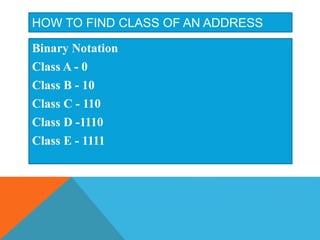
HOW TO FIND CLASS OF AN ADDRESS
Binary Notation
Class A - 0
Class B - 10
Class C - 110
Class D -1110
Class E - 1111
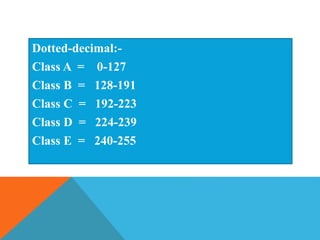
Dotted-decimal:-
Class A = 0-127
Class B = 128-191
Class C = 192-223
Class D = 224-239
Class E = 240-255
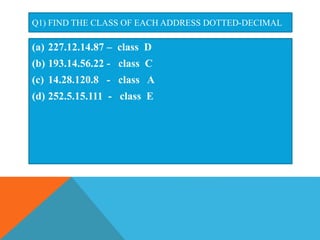
Q1) FIND THE CLASS OF EACH ADDRESS DOTTED-DECIMAL
(a) 227.12.14.87 – class D
(b) 193.14.56.22 - class C
(c) 14.28.120.8 - class A
(d) 252.5.15.111 - class E
Q2) FIND THE CLASS EACH ADDRESS BINARY NOTATION
(A)00000001 00 ……………..  class A
(B)11000001 100……………  class C
(C)10100111 10…………….  class B
(D)11110011 100……………  class E
NETID & HOSTID
Only class A , B or C is divided in to netid and
hostid.
Class Byte 1 Byte2 Byte3 Byte4
Class A Netid Hostid Hostid Hostid
Class B Netid Netid Hostid Hostid
Class C Netid Netid Netid Hostid
CLASSLESS ADDRESSING
In this variable length blocks are used that belongs to no
class.
Restrictions :-
(1) address in a block must be contigous.
(2) No of address in a block must be a power of 2
(3) The first address must be evenly divisible by the no
of address.
Block first block second
205.16.37.32 16 = 24
205.16.37.33
205.16.37.34
205.16.37.35
…………….
…………….
205.16.37.47
. Mask in classless addressing :- Can take any
value from 0 to 32.
N=1
32-n=0
Slash/CIDR Notation
x.y.z.t/n
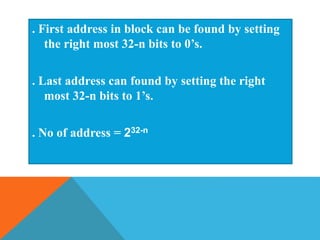
. First address in block can be found by setting
the right most 32-n bits to 0’s.
. Last address can found by setting the right
most 32-n bits to 1’s.
. No of address = 232-n
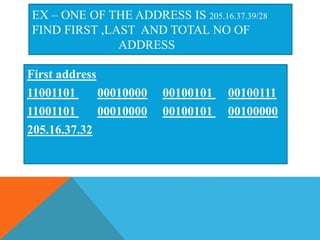
EX – ONE OF THE ADDRESS IS 205.16.37.39/28
FIND FIRST ,LAST AND TOTAL NO OF
ADDRESS
First address
11001101 00010000 00100101 00100111
11001101 00010000 00100101 00100000
205.16.37.32
. Last address - 205.16.37.39/28
11001101 00010000 00100101 00100111
11001101 00010000 00100101 00101111
205.16.37.47
. No of address= 24 = 16

Network layer,ipv4, Classful Addressing,notations, Classless addressing,classful and classless addressing, netid and hostid

  • 2.
    CLASSFUL ADDRESSING An IPv4address is a 32-bit address that uniquely and universally defines the connection of a device to the internet. (for example, a computer or a router) Two devices on the internet can never have the same address at the same time
  • 3.
    Address spaces:- itis the total no of address used by the protocol. N bits a address 2n address Address space ipv4 = 32 bit N=32 Address spaces ipv4 = 232 = 4,294,967,296
  • 4.
    Notations:- (a)Binary notations:- inthis ipv4 is displayed as 32 bits or 4 bytes. 01110101 10010101 00011101 11101010
  • 5.
    (b) Dotted –decimalNotation:- it is used to make ipv4 more compact and easier to read. 10000000 00001011 00000011 00011111 128.11.3.31 (c) Hexadecimal Notation:- Each hexadecimal digit is equivalent to four bits. This means that 32 bit address has 8 hexadecimal digits.
  • 6.
    Classful addressing :-in this address space is divided in to five class. Class A Class B Class C Class D Class E
  • 7.
    HOW TO FINDCLASS OF AN ADDRESS Binary Notation Class A - 0 Class B - 10 Class C - 110 Class D -1110 Class E - 1111
  • 8.
    Dotted-decimal:- Class A =0-127 Class B = 128-191 Class C = 192-223 Class D = 224-239 Class E = 240-255
  • 9.
    Q1) FIND THECLASS OF EACH ADDRESS DOTTED-DECIMAL (a) 227.12.14.87 – class D (b) 193.14.56.22 - class C (c) 14.28.120.8 - class A (d) 252.5.15.111 - class E
  • 10.
    Q2) FIND THECLASS EACH ADDRESS BINARY NOTATION (A)00000001 00 ……………..  class A (B)11000001 100……………  class C (C)10100111 10…………….  class B (D)11110011 100……………  class E
  • 11.
    NETID & HOSTID Onlyclass A , B or C is divided in to netid and hostid. Class Byte 1 Byte2 Byte3 Byte4 Class A Netid Hostid Hostid Hostid Class B Netid Netid Hostid Hostid Class C Netid Netid Netid Hostid
  • 12.
    CLASSLESS ADDRESSING In thisvariable length blocks are used that belongs to no class. Restrictions :- (1) address in a block must be contigous. (2) No of address in a block must be a power of 2 (3) The first address must be evenly divisible by the no of address.
  • 13.
    Block first blocksecond 205.16.37.32 16 = 24 205.16.37.33 205.16.37.34 205.16.37.35 ……………. ……………. 205.16.37.47
  • 14.
    . Mask inclassless addressing :- Can take any value from 0 to 32. N=1 32-n=0 Slash/CIDR Notation x.y.z.t/n
  • 15.
    . First addressin block can be found by setting the right most 32-n bits to 0’s. . Last address can found by setting the right most 32-n bits to 1’s. . No of address = 232-n
  • 16.
    EX – ONEOF THE ADDRESS IS 205.16.37.39/28 FIND FIRST ,LAST AND TOTAL NO OF ADDRESS First address 11001101 00010000 00100101 00100111 11001101 00010000 00100101 00100000 205.16.37.32
  • 17.
    . Last address- 205.16.37.39/28 11001101 00010000 00100101 00100111 11001101 00010000 00100101 00101111 205.16.37.47 . No of address= 24 = 16