UNIVERSITY OF ABOMEY-CALAVI
                 -o-o-o-o-o-o-o-o-
         ABOMEY-CALAVI POLYTECHNIC
                  -o-o-o-o-o-o-o-
 COMPUTER SCIENCE AND TELECOMMUNICATIONS
               DEPARTEMENT
OPTION: NETWORKS AND TELECOMMUNICATIONS 5
                     -o-o-o-
           Discipline: ENGLISH


           Network Basic Security


Presented by:                   Under the baton of:
RADJI Mohamed                   Mr Bienvenu OLORY
                                                 RADJI Mohamed
                  01/01/2013                                     1
Outline
                   INTRODUCTION
            1.   NETWORKING THREATS
            2.   METHODS OF ATTACK
            3.   SECURITY POLICY
            4.   USING FIREWALLS
                   CONCLUSION

Network Basic Security                 RADJI Mohamed
                          01/01/2013                   2
INTRODUCTION


 1. NETWORKING
     THREATS


  2. METHODS OF
      ATTACK

                            INTRODUCTION
3. SECURITY POLICY


4. USING FIREWALLS


  CONCLUSION


   Network Basic Security                  RADJI Mohamed
                            01/01/2013                     3
NETWORKING THREATS (1)
 INTRODUCTION
                        ď‚§   Hackers are intruders who gain access to a
                            network through the carelessness of network
 1. NETWORKING
     THREATS
                            users.
                        ď‚§   Attacks can come from both internal and
                            external sources. Internal attacks account for
  2. METHODS OF
      ATTACK                70% of security incidents.
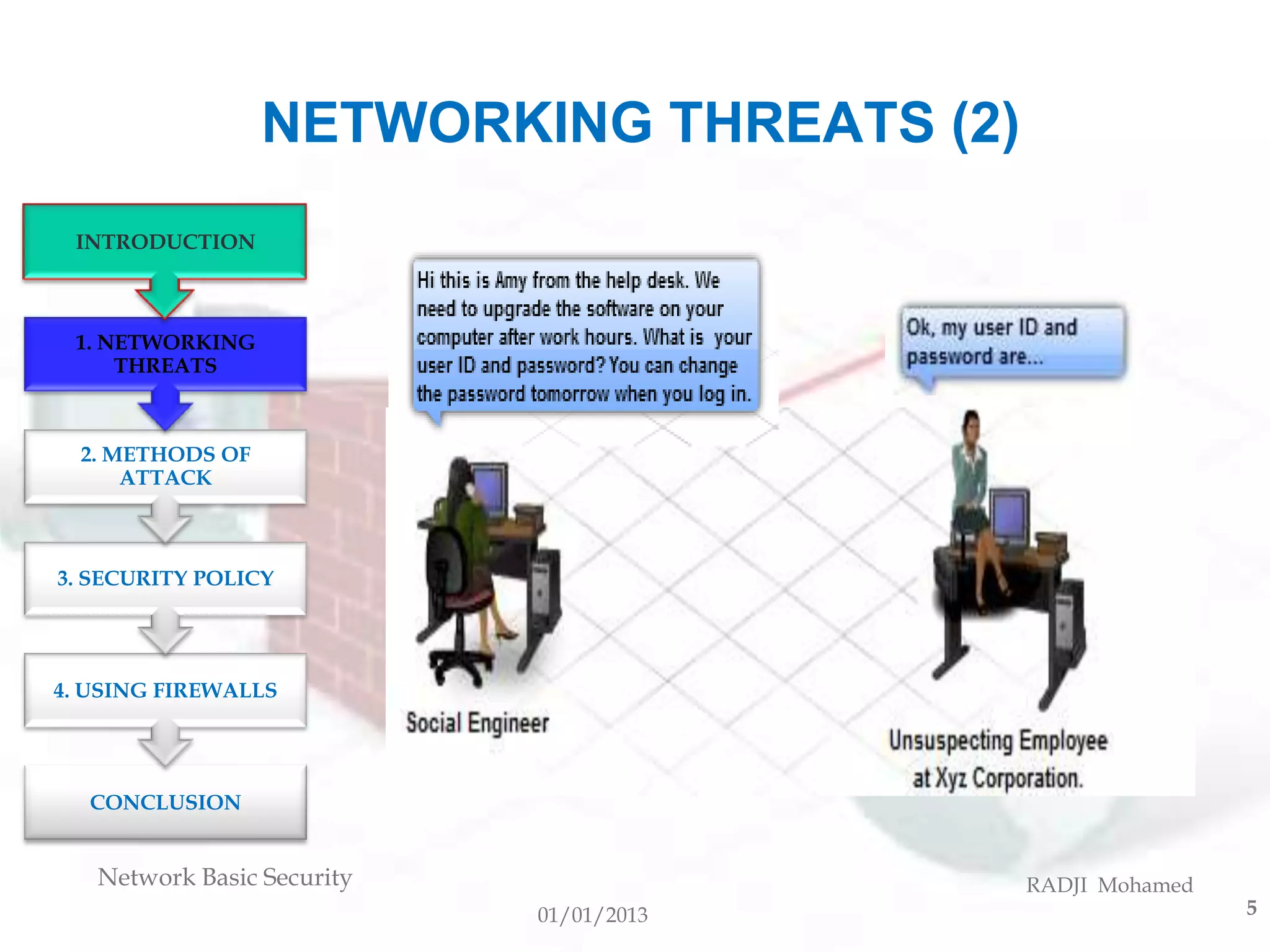
                        ď‚§   Social engineering is a group of techniques
                            used to deceive internal users into performing
3. SECURITY POLICY
                            specific actions or revealing confidential
                            information.
4. USING FIREWALLS
                        ď‚§   Three types of social engineering attacks are:
                            pretexting, phishing and vishing.

  CONCLUSION


   Network Basic Security                                       RADJI Mohamed
                                    01/01/2013                                  4
NETWORKING THREATS (2)
 INTRODUCTION


 1. NETWORKING
     THREATS


  2. METHODS OF
      ATTACK


3. SECURITY POLICY


4. USING FIREWALLS


  CONCLUSION


   Network Basic Security                  RADJI Mohamed
                            01/01/2013                     5
METHODS OF ATTACK
 INTRODUCTION

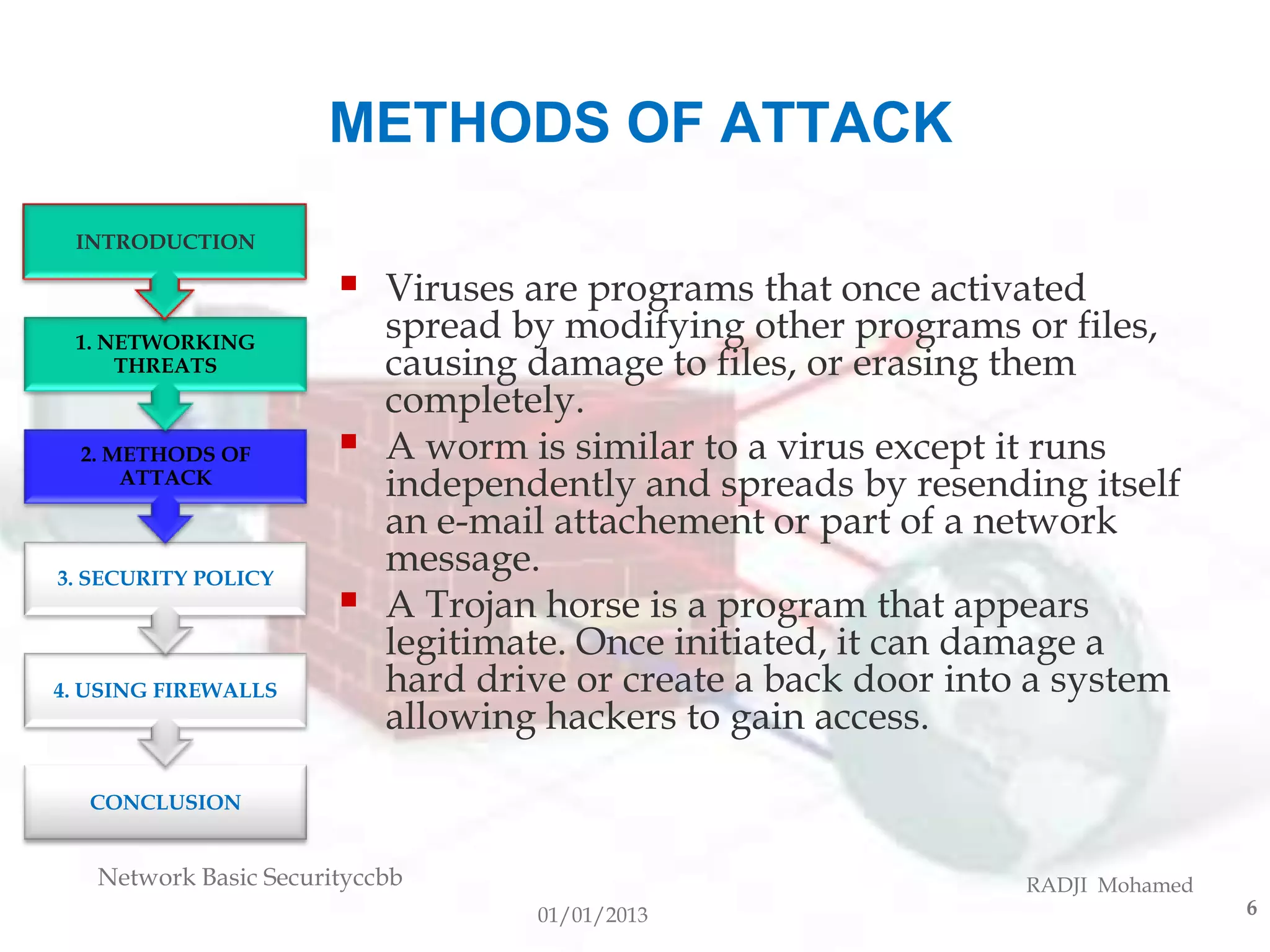
                       ď‚§   Viruses are programs that once activated
 1. NETWORKING
                           spread by modifying other programs or files,
     THREATS               causing damage to files, or erasing them
                           completely.
  2. METHODS OF        ď‚§   A worm is similar to a virus except it runs
      ATTACK
                           independently and spreads by resending itself
                           an e-mail attachement or part of a network
3. SECURITY POLICY
                           message.
                       ď‚§   A Trojan horse is a program that appears
                           legitimate. Once initiated, it can damage a
4. USING FIREWALLS         hard drive or create a back door into a system
                           allowing hackers to gain access.

  CONCLUSION


   Network Basic Securityccbb                                   RADJI Mohamed
                                   01/01/2013                                   6
SECURITY POLICY (1)

 INTRODUCTION
                        ď‚§   A security policy should include identification
 1. NETWORKING
                            and authentication policies, password policies,
     THREATS                acceptable use policies, remote access policies,
                            and incident handling procedures.
  2. METHODS OF
      ATTACK
                        ď‚§   All users of network must support and follow
                            the security policy in order for it to be effective.
3. SECURITY POLICY
                        ď‚§   Keep software applications up-to-date with the
                            latest security patches and updates to help deter
                            threats.
4. USING FIREWALLS


  CONCLUSION


   Network Basic Security                                           RADJI Mohamed
                                     01/01/2013                                     7
SECURITY POLICY (2)

 INTRODUCTION


                        ď‚§   Antivirus software, installed on every computer,
 1. NETWORKING
     THREATS
                            detects and removes known viruses, worms and
                            Trojan horses.
  2. METHODS OF         ď‚§   Anti-spam software identifies spam and places it
      ATTACK
                            into a junk folder or deletes it.
                        ď‚§   Tools and applications used in securing a
3. SECURITY POLICY
                            network include: Software patches and updates –
                            Virus protection – Spyware protection – Spam
4. USING FIREWALLS          blockers – Pop-up blockers – Firewalls.


  CONCLUSION


   Network Basic Security                                        RADJI Mohamed
                                    01/01/2013                                   8
USING FIREWALLS (1)

 INTRODUCTION


 1. NETWORKING
     THREATS


  2. METHODS OF
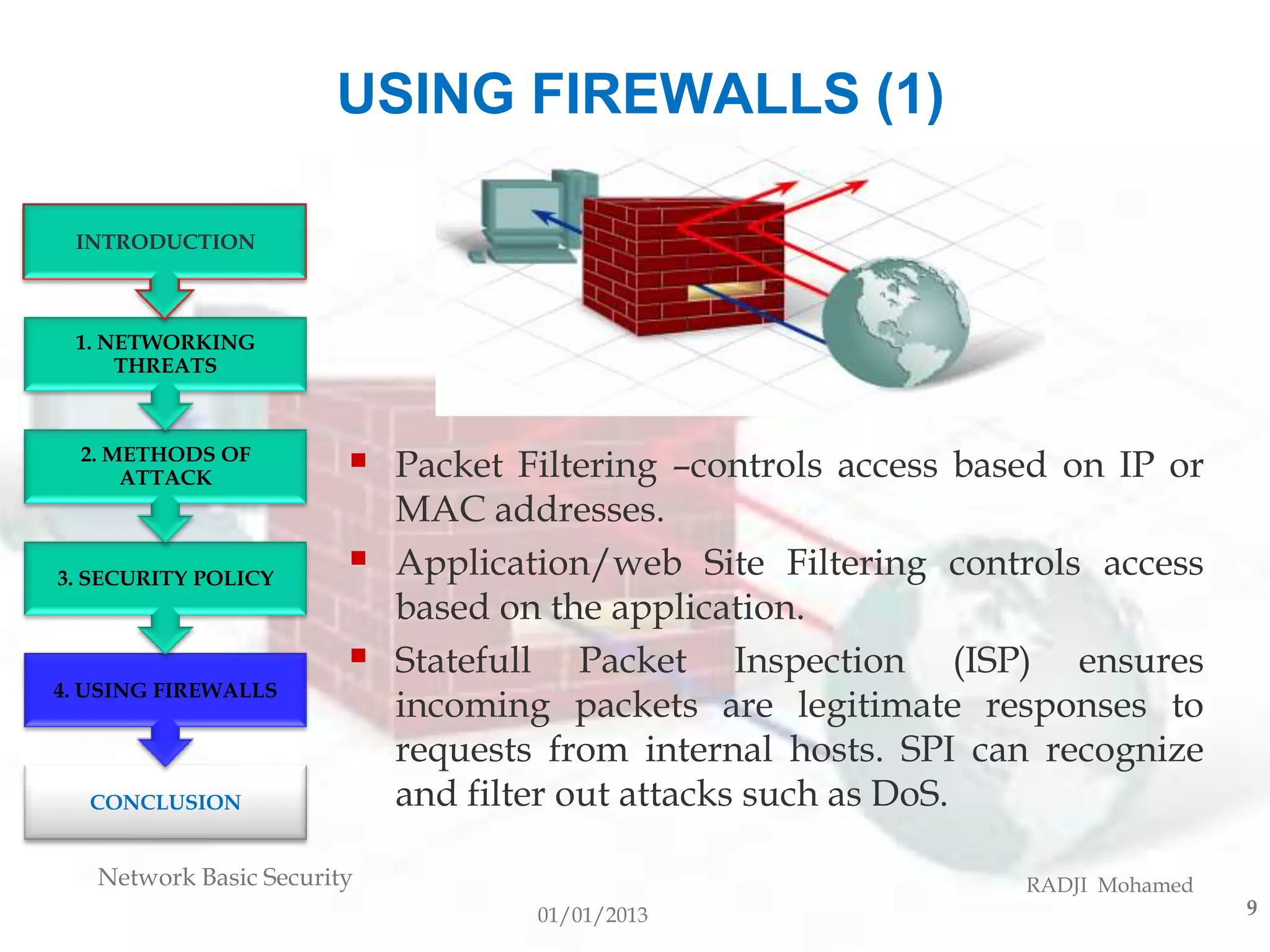
      ATTACK               Packet Filtering –controls access based on IP or
                            MAC addresses.
3. SECURITY POLICY
                        ď‚§   Application/web Site Filtering controls access
                            based on the application.
                        ď‚§   Statefull Packet Inspection (ISP) ensures
4. USING FIREWALLS
                            incoming packets are legitimate responses to
                            requests from internal hosts. SPI can recognize
  CONCLUSION                and filter out attacks such as DoS.

   Network Basic Security                                        RADJI Mohamed
                                    01/01/2013                                   9
USING FIREWALLS (2)

 INTRODUCTION


 1. NETWORKING
                         ď‚§   A DMZ is an area of the network that is
     THREATS                 accessible to both internal and external users.
                         ď‚§   If the wireless access point is unsecured, anyone
  2. METHODS OF
      ATTACK                 who connects to it is considered part of the
                             internal network and is on the protected side of
3. SECURITY POLICY
                             the firewall.


4. USING FIREWALLS


  CONCLUSION


   Network Basic Securityc                                        RADJI Mohamed
                                     01/01/2013                                   10
INTRODUCTION


 1. NETWORKING
     THREATS


  2. METHODS OF
      ATTACK                 CONCLUSION
3. SECURITY POLICY


4. USING FIREWALLS


  CONCLUSION


   Network Basic Security                 RADJI Mohamed
                            01/01/2013                    11
INTRODUCTION

                            THANK YOU FOR YOUR KIND
 1. NETWORKING
     THREATS                       ATTENTION.
  2. METHODS OF
      ATTACK


3. SECURITY POLICY       YOUR QUESTIONS AND
                      SUGGESTIONS ARE WELCOME.
4. USING FIREWALLS


  CONCLUSION


   Network Basic Security                     RADJI Mohamed
                                01/01/2013                    12

Network basic security

  • 1.
    UNIVERSITY OF ABOMEY-CALAVI -o-o-o-o-o-o-o-o- ABOMEY-CALAVI POLYTECHNIC -o-o-o-o-o-o-o- COMPUTER SCIENCE AND TELECOMMUNICATIONS DEPARTEMENT OPTION: NETWORKS AND TELECOMMUNICATIONS 5 -o-o-o- Discipline: ENGLISH Network Basic Security Presented by: Under the baton of: RADJI Mohamed Mr Bienvenu OLORY RADJI Mohamed 01/01/2013 1
  • 2.
    Outline INTRODUCTION 1. NETWORKING THREATS 2. METHODS OF ATTACK 3. SECURITY POLICY 4. USING FIREWALLS CONCLUSION Network Basic Security RADJI Mohamed 01/01/2013 2
  • 3.
    INTRODUCTION 1. NETWORKING THREATS 2. METHODS OF ATTACK INTRODUCTION 3. SECURITY POLICY 4. USING FIREWALLS CONCLUSION Network Basic Security RADJI Mohamed 01/01/2013 3
  • 4.
    NETWORKING THREATS (1) INTRODUCTION ď‚§ Hackers are intruders who gain access to a network through the carelessness of network 1. NETWORKING THREATS users. ď‚§ Attacks can come from both internal and external sources. Internal attacks account for 2. METHODS OF ATTACK 70% of security incidents. ď‚§ Social engineering is a group of techniques used to deceive internal users into performing 3. SECURITY POLICY specific actions or revealing confidential information. 4. USING FIREWALLS ď‚§ Three types of social engineering attacks are: pretexting, phishing and vishing. CONCLUSION Network Basic Security RADJI Mohamed 01/01/2013 4
  • 5.
    NETWORKING THREATS (2) INTRODUCTION 1. NETWORKING THREATS 2. METHODS OF ATTACK 3. SECURITY POLICY 4. USING FIREWALLS CONCLUSION Network Basic Security RADJI Mohamed 01/01/2013 5
  • 6.
    METHODS OF ATTACK INTRODUCTION ď‚§ Viruses are programs that once activated 1. NETWORKING spread by modifying other programs or files, THREATS causing damage to files, or erasing them completely. 2. METHODS OF ď‚§ A worm is similar to a virus except it runs ATTACK independently and spreads by resending itself an e-mail attachement or part of a network 3. SECURITY POLICY message. ď‚§ A Trojan horse is a program that appears legitimate. Once initiated, it can damage a 4. USING FIREWALLS hard drive or create a back door into a system allowing hackers to gain access. CONCLUSION Network Basic Securityccbb RADJI Mohamed 01/01/2013 6
  • 7.
    SECURITY POLICY (1) INTRODUCTION ď‚§ A security policy should include identification 1. NETWORKING and authentication policies, password policies, THREATS acceptable use policies, remote access policies, and incident handling procedures. 2. METHODS OF ATTACK ď‚§ All users of network must support and follow the security policy in order for it to be effective. 3. SECURITY POLICY ď‚§ Keep software applications up-to-date with the latest security patches and updates to help deter threats. 4. USING FIREWALLS CONCLUSION Network Basic Security RADJI Mohamed 01/01/2013 7
  • 8.
    SECURITY POLICY (2) INTRODUCTION  Antivirus software, installed on every computer, 1. NETWORKING THREATS detects and removes known viruses, worms and Trojan horses. 2. METHODS OF  Anti-spam software identifies spam and places it ATTACK into a junk folder or deletes it.  Tools and applications used in securing a 3. SECURITY POLICY network include: Software patches and updates – Virus protection – Spyware protection – Spam 4. USING FIREWALLS blockers – Pop-up blockers – Firewalls. CONCLUSION Network Basic Security RADJI Mohamed 01/01/2013 8
  • 9.
    USING FIREWALLS (1) INTRODUCTION 1. NETWORKING THREATS 2. METHODS OF ATTACK  Packet Filtering –controls access based on IP or MAC addresses. 3. SECURITY POLICY  Application/web Site Filtering controls access based on the application.  Statefull Packet Inspection (ISP) ensures 4. USING FIREWALLS incoming packets are legitimate responses to requests from internal hosts. SPI can recognize CONCLUSION and filter out attacks such as DoS. Network Basic Security RADJI Mohamed 01/01/2013 9
  • 10.
    USING FIREWALLS (2) INTRODUCTION 1. NETWORKING ď‚§ A DMZ is an area of the network that is THREATS accessible to both internal and external users. ď‚§ If the wireless access point is unsecured, anyone 2. METHODS OF ATTACK who connects to it is considered part of the internal network and is on the protected side of 3. SECURITY POLICY the firewall. 4. USING FIREWALLS CONCLUSION Network Basic Securityc RADJI Mohamed 01/01/2013 10
  • 11.
    INTRODUCTION 1. NETWORKING THREATS 2. METHODS OF ATTACK CONCLUSION 3. SECURITY POLICY 4. USING FIREWALLS CONCLUSION Network Basic Security RADJI Mohamed 01/01/2013 11
  • 12.
    INTRODUCTION THANK YOU FOR YOUR KIND 1. NETWORKING THREATS ATTENTION. 2. METHODS OF ATTACK 3. SECURITY POLICY YOUR QUESTIONS AND SUGGESTIONS ARE WELCOME. 4. USING FIREWALLS CONCLUSION Network Basic Security RADJI Mohamed 01/01/2013 12