Neonatal
hematological
disorders
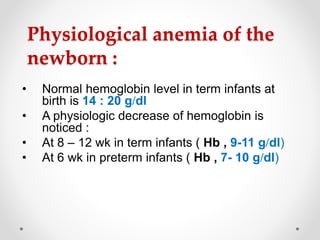
Physiological anemia of the
newborn :
• Normal hemoglobin level in term infants at
birth is 14 : 20 g/dl
• A physiologic decrease of hemoglobin is
noticed :
• At 8 – 12 wk in term infants ( Hb , 9-11 g/dl)
• At 6 wk in preterm infants ( Hb , 7- 10 g/dl)
Etiology :
• In utero , fetal O2 saturation is low, and level of
erythropoietin is high, result in stimulation of
erythropoiesis.
• After birth, O2 saturation is high and level of
erythropoietin is low, result in decrease of
erythropoiesis, so Hb level is decreased .
Treatment :
• No treatment ( It is physiological anemia )
Pathological anemia in
the neonate
1. Blood loss
• Prenatal:
Placenta previa
Feto-maternal bleeding
Twin – to – twin transfusion .
• Postnatal :
Hemorrhagic disease of the NB.
• Natal:
Birth Trauma .
Frequent blood sampling for investigations .
2. Hemolysis
3. Diminished RBC production
A . Infection (Rubella).
B . Congenital leukemia .
c . Congenital pure red cell anemia.
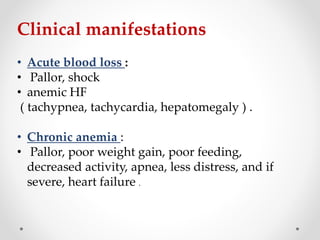
Clinical manifestations
• Acute blood loss :
• Pallor, shock
• anemic HF
( tachypnea, tachycardia, hepatomegaly ) .
• Chronic anemia :
• Pallor, poor weight gain, poor feeding,
decreased activity, apnea, less distress, and if
severe, heart failure .
Investigations:
1-Complete blood pictures
2-Reticulocytic count
2-Blood indices
3-Coomb’s tests
4-S.bilirubin
Treatment
I. Blood transfusion
• Blood should be fresh ( less than 3 days )
• Tests for CMV antibody, antibody to
HIV, and those for Hepatitis B and C.
• Irradiated blood in case of immune
compromised infant.
• Volume : 10-20 ml/kg
II.Treatment underlying cause
A. Deficient clotting factors
1.Transitory deficiencies of the vitamin K-dependent
factors ( hemorrhagic disease
of the newborn )
2.With associated diseases : DIC, and significant liver
disease .
3.Inherited abnormalities of clotting factors: Classic
hemophilia ( F8 deficiency .
B. Platelet problems
Thrombocytopenia and defective platelet function.
C- Vascular problems: Hypoxia, acidosis
D- Fibrinolysis: DIC
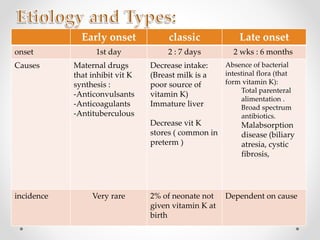
Late onsetclassicEarly onset
2 wks : 6 months2 : 7 days1st dayonset
Absence of bacterial
intestinal flora (that
form vitamin K):
Total parenteral
alimentation .
Broad spectrum
antibiotics.
Malabsorption
disease (biliary
atresia, cystic
fibrosis,
Decrease intake:
(Breast milk is a
poor source of
vitamin K)
Immature liver
Decrease vit K
stores ( common in
preterm )
Maternal drugs
that inhibit vit K
synthesis :
-Anticonvulsants
-Anticoagulants
-Antituberculous
Causes
Dependent on cause2% of neonate not
given vitamin K at
birth
Very rareincidence
Clinical picture :
• Hemorrhagic anemia ( pallor, up to
shock )
• Site of hemorrhage: GIT, Ear, Nose,
Throat , Intracranial, Circumcision ,
Injection site.
Investigations:
• PT, PTT, and clotting time are prolonged.
• Levels of factors 2, 7, 9, 10 are reduced.
• Bleeding time, platelets count are normal.
Prevention :
1mg vitamin K1 ( konakion ) I.M at time of birth
Treatment :
• I.V. infusion of 1-5 mg vit K will lead
to cessation of bleeding within a few
hours.
• Fresh frozen plasma (10 ml/ kg) in
cases of serious bleeding, prematures,
those with liver diseases and
ineffective vit K therapy.
• Whole blood transfusion (in case of
marked hemorrhage ) may be required
.
1- causes of hemorrhage in the newborn
2- swallowed blood syndrome :-
Clinically: Blood vomiting or bloody stools are passed
during the 2nd or 3rd day of life
cause: swallowing of maternal blood during delivery or
from a fissure in the mother’s nipple .
DD: It may be confused with hemorrhage from GIT of
the newborn .
Diagnosis: The Apt test is used to DD, based on the fact
that the infant’s blood containing hemoglobin mostly
HbF is alkali-resistant , stay pink
maternal blood ( HbA ) forms alkaline hematin , turns
yellow
Thank You

Neonatal hematological disorders

  • 1.
  • 2.
    Physiological anemia ofthe newborn : • Normal hemoglobin level in term infants at birth is 14 : 20 g/dl • A physiologic decrease of hemoglobin is noticed : • At 8 – 12 wk in term infants ( Hb , 9-11 g/dl) • At 6 wk in preterm infants ( Hb , 7- 10 g/dl)
  • 3.
    Etiology : • Inutero , fetal O2 saturation is low, and level of erythropoietin is high, result in stimulation of erythropoiesis. • After birth, O2 saturation is high and level of erythropoietin is low, result in decrease of erythropoiesis, so Hb level is decreased . Treatment : • No treatment ( It is physiological anemia )
  • 4.
  • 5.
    1. Blood loss •Prenatal: Placenta previa Feto-maternal bleeding Twin – to – twin transfusion . • Postnatal : Hemorrhagic disease of the NB. • Natal: Birth Trauma . Frequent blood sampling for investigations . 2. Hemolysis 3. Diminished RBC production A . Infection (Rubella). B . Congenital leukemia . c . Congenital pure red cell anemia.
  • 6.
    Clinical manifestations • Acuteblood loss : • Pallor, shock • anemic HF ( tachypnea, tachycardia, hepatomegaly ) . • Chronic anemia : • Pallor, poor weight gain, poor feeding, decreased activity, apnea, less distress, and if severe, heart failure .
  • 7.
    Investigations: 1-Complete blood pictures 2-Reticulocyticcount 2-Blood indices 3-Coomb’s tests 4-S.bilirubin
  • 8.
    Treatment I. Blood transfusion •Blood should be fresh ( less than 3 days ) • Tests for CMV antibody, antibody to HIV, and those for Hepatitis B and C. • Irradiated blood in case of immune compromised infant. • Volume : 10-20 ml/kg II.Treatment underlying cause
  • 9.
    A. Deficient clottingfactors 1.Transitory deficiencies of the vitamin K-dependent factors ( hemorrhagic disease of the newborn ) 2.With associated diseases : DIC, and significant liver disease . 3.Inherited abnormalities of clotting factors: Classic hemophilia ( F8 deficiency . B. Platelet problems Thrombocytopenia and defective platelet function. C- Vascular problems: Hypoxia, acidosis D- Fibrinolysis: DIC
  • 10.
    Late onsetclassicEarly onset 2wks : 6 months2 : 7 days1st dayonset Absence of bacterial intestinal flora (that form vitamin K): Total parenteral alimentation . Broad spectrum antibiotics. Malabsorption disease (biliary atresia, cystic fibrosis, Decrease intake: (Breast milk is a poor source of vitamin K) Immature liver Decrease vit K stores ( common in preterm ) Maternal drugs that inhibit vit K synthesis : -Anticonvulsants -Anticoagulants -Antituberculous Causes Dependent on cause2% of neonate not given vitamin K at birth Very rareincidence
  • 11.
    Clinical picture : •Hemorrhagic anemia ( pallor, up to shock ) • Site of hemorrhage: GIT, Ear, Nose, Throat , Intracranial, Circumcision , Injection site.
  • 12.
    Investigations: • PT, PTT,and clotting time are prolonged. • Levels of factors 2, 7, 9, 10 are reduced. • Bleeding time, platelets count are normal. Prevention : 1mg vitamin K1 ( konakion ) I.M at time of birth
  • 13.
    Treatment : • I.V.infusion of 1-5 mg vit K will lead to cessation of bleeding within a few hours. • Fresh frozen plasma (10 ml/ kg) in cases of serious bleeding, prematures, those with liver diseases and ineffective vit K therapy. • Whole blood transfusion (in case of marked hemorrhage ) may be required .
  • 14.
    1- causes ofhemorrhage in the newborn 2- swallowed blood syndrome :- Clinically: Blood vomiting or bloody stools are passed during the 2nd or 3rd day of life cause: swallowing of maternal blood during delivery or from a fissure in the mother’s nipple . DD: It may be confused with hemorrhage from GIT of the newborn . Diagnosis: The Apt test is used to DD, based on the fact that the infant’s blood containing hemoglobin mostly HbF is alkali-resistant , stay pink maternal blood ( HbA ) forms alkaline hematin , turns yellow
  • 15.