Legal Aspects Of Business
PRESENTATION ON
NEGOTIABLE INSTRUMENTS
SUBMITTED BY:
ANISH
NEGOTIABLE INSTRUMENTS
 The term ‘negotiable’ means “transferable from one
person to another in return for consideration” and
‘instrument’ means “a written document by which a
right is created in favour of some person.”
 For example promissory note, bills of exchange and
cheques.
 Thus a negotiable instument means an instrument the
property which is acquired by anyone who takes it
bonafide and for the value notwithstanding any defect
in the title of the prior party.
 Negotiable instruments act 1881
CHARACTERISTICS OF NEGOTIABLE INSTRUMENTS
 Freely transferable
 Title of holder free from all defects
 Recovery
 Presumptions ( Sec.118 and 119)
Consideration
Date
Time of acceptance
Time of transfer
Order of indorsements
Stamp
Holder presumed to be a holder in due course
Proof of protest
Types of negotiable instruments
 Negotiable by statute( promissory notes,
bill of exchange and cheques)
 Negotiable by custom or usage( hundis ,pay
orders , banker’s drafts etc.)
PROMISSORY NOTE
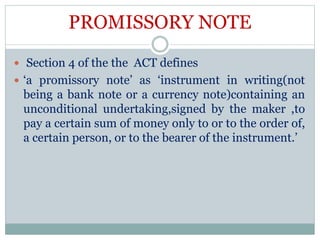
 Section 4 of the the ACT defines
 ‘a promissory note’ as ‘instrument in writing(not
being a bank note or a currency note)containing an
unconditional undertaking,signed by the maker ,to
pay a certain sum of money only to or to the order of,
a certain person, or to the bearer of the instrument.’
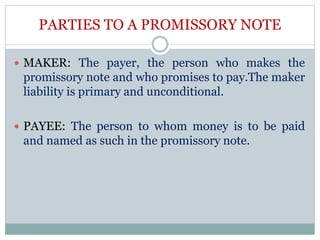
PARTIES TO A PROMISSORY NOTE
 MAKER: The payer, the person who makes the
promissory note and who promises to pay.The maker
liability is primary and unconditional.
 PAYEE: The person to whom money is to be paid
and named as such in the promissory note.
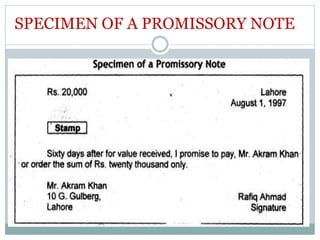
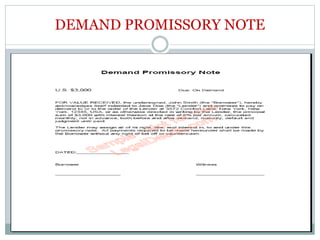
SPECIMEN OF A PROMISSORY NOTE
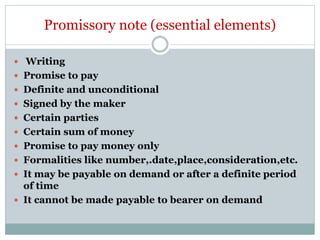
Promissory note (essential elements)
 Writing
 Promise to pay
 Definite and unconditional
 Signed by the maker
 Certain parties
 Certain sum of money
 Promise to pay money only
 Formalities like number,.date,place,consideration,etc.
 It may be payable on demand or after a definite period
of time
 It cannot be made payable to bearer on demand
DEMAND PROMISSORY NOTE
BILL OF EXCHANGE
 Section 5 of the Negotiable Instrument Act 1881
defines a ‘Bill of Exchange’ as ‘an Instrument in
writing containing an unconditional order,signed by
maker,directing a certain person to pay a certain
sum of money only to, or to the order of a certain
person or to the bearer of the instrument’.
PARTIES TO A BILL OF EXCHANGE
DRAWER
DRAWEE
PAYEE
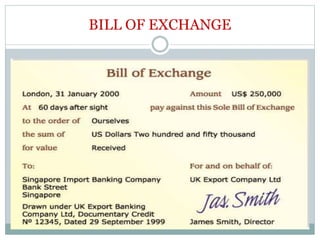
Bill of exchange
 It is an instrument in writing containing an
unconditional order, signed by the maker,directing a
certain person to pay a certain sum of money only to,or
to the order of, a certain person or to the bearer of the
instrument.
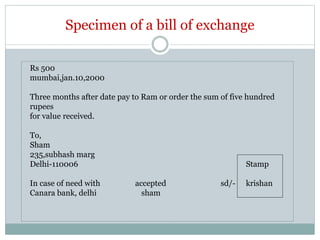
 Suppose sham of Delhi buys goods on credit from
Krishan of Bombay for Rs 500 to be paid 3 months after
date. Krishan buys goods from Ram of Delhi for Rs 500
on similar terms. Now Krishan may order Sham to pay
the sum of Rs 500 to Ram. This order will be a bill of
exchange.
Specimen of a bill of exchange
Rs 500
mumbai,jan.10,2000
Three months after date pay to Ram or order the sum of five hundred
rupees
for value received.
To,
Sham
235,subhash marg
Delhi-110006
In case of need with accepted sd/-
Canara bank, delhi sham
Stamp
krishan
BILL OF EXCHANGE
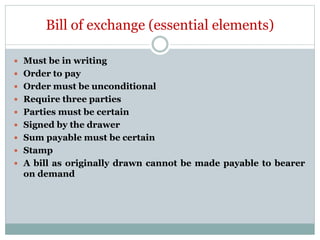
Bill of exchange (essential elements)
 Must be in writing
 Order to pay
 Order must be unconditional
 Require three parties
 Parties must be certain
 Signed by the drawer
 Sum payable must be certain
 Stamp
 A bill as originally drawn cannot be made payable to bearer
on demand
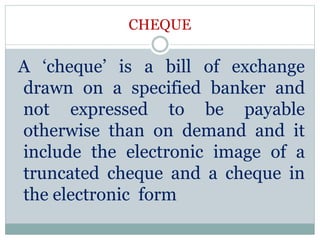
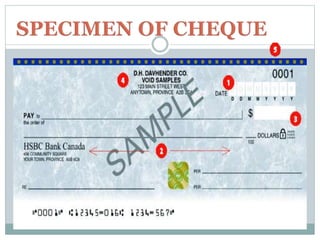
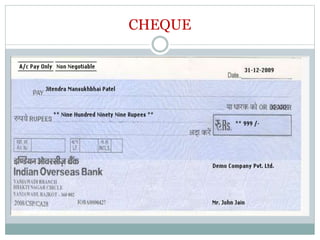
CHEQUE
A ‘cheque’ is a bill of exchange
drawn on a specified banker and
not expressed to be payable
otherwise than on demand and it
include the electronic image of a
truncated cheque and a cheque in
the electronic form
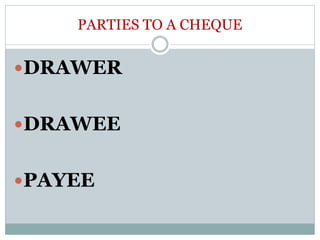
PARTIES TO A CHEQUE
DRAWER
DRAWEE
PAYEE
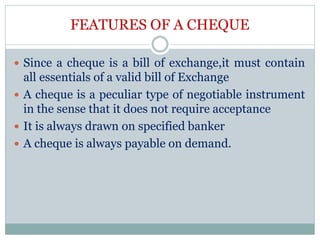
FEATURES OF A CHEQUE
 Since a cheque is a bill of exchange,it must contain
all essentials of a valid bill of Exchange
 A cheque is a peculiar type of negotiable instrument
in the sense that it does not require acceptance
 It is always drawn on specified banker
 A cheque is always payable on demand.
CHEQUE
THANKS
TO
ALL OF YOU

Negotiable instruments

  • 1.
    Legal Aspects OfBusiness PRESENTATION ON NEGOTIABLE INSTRUMENTS SUBMITTED BY: ANISH
  • 2.
    NEGOTIABLE INSTRUMENTS  Theterm ‘negotiable’ means “transferable from one person to another in return for consideration” and ‘instrument’ means “a written document by which a right is created in favour of some person.”  For example promissory note, bills of exchange and cheques.  Thus a negotiable instument means an instrument the property which is acquired by anyone who takes it bonafide and for the value notwithstanding any defect in the title of the prior party.  Negotiable instruments act 1881
  • 3.
    CHARACTERISTICS OF NEGOTIABLEINSTRUMENTS  Freely transferable  Title of holder free from all defects  Recovery  Presumptions ( Sec.118 and 119) Consideration Date Time of acceptance Time of transfer Order of indorsements Stamp Holder presumed to be a holder in due course Proof of protest
  • 4.
    Types of negotiableinstruments  Negotiable by statute( promissory notes, bill of exchange and cheques)  Negotiable by custom or usage( hundis ,pay orders , banker’s drafts etc.)
  • 5.
    PROMISSORY NOTE  Section4 of the the ACT defines  ‘a promissory note’ as ‘instrument in writing(not being a bank note or a currency note)containing an unconditional undertaking,signed by the maker ,to pay a certain sum of money only to or to the order of, a certain person, or to the bearer of the instrument.’
  • 6.
    PARTIES TO APROMISSORY NOTE  MAKER: The payer, the person who makes the promissory note and who promises to pay.The maker liability is primary and unconditional.  PAYEE: The person to whom money is to be paid and named as such in the promissory note.
  • 7.
    SPECIMEN OF APROMISSORY NOTE
  • 8.
    Promissory note (essentialelements)  Writing  Promise to pay  Definite and unconditional  Signed by the maker  Certain parties  Certain sum of money  Promise to pay money only  Formalities like number,.date,place,consideration,etc.  It may be payable on demand or after a definite period of time  It cannot be made payable to bearer on demand
  • 9.
  • 10.
    BILL OF EXCHANGE Section 5 of the Negotiable Instrument Act 1881 defines a ‘Bill of Exchange’ as ‘an Instrument in writing containing an unconditional order,signed by maker,directing a certain person to pay a certain sum of money only to, or to the order of a certain person or to the bearer of the instrument’.
  • 11.
    PARTIES TO ABILL OF EXCHANGE DRAWER DRAWEE PAYEE
  • 12.
    Bill of exchange It is an instrument in writing containing an unconditional order, signed by the maker,directing a certain person to pay a certain sum of money only to,or to the order of, a certain person or to the bearer of the instrument.  Suppose sham of Delhi buys goods on credit from Krishan of Bombay for Rs 500 to be paid 3 months after date. Krishan buys goods from Ram of Delhi for Rs 500 on similar terms. Now Krishan may order Sham to pay the sum of Rs 500 to Ram. This order will be a bill of exchange.
  • 13.
    Specimen of abill of exchange Rs 500 mumbai,jan.10,2000 Three months after date pay to Ram or order the sum of five hundred rupees for value received. To, Sham 235,subhash marg Delhi-110006 In case of need with accepted sd/- Canara bank, delhi sham Stamp krishan
  • 14.
  • 15.
    Bill of exchange(essential elements)  Must be in writing  Order to pay  Order must be unconditional  Require three parties  Parties must be certain  Signed by the drawer  Sum payable must be certain  Stamp  A bill as originally drawn cannot be made payable to bearer on demand
  • 16.
    CHEQUE A ‘cheque’ isa bill of exchange drawn on a specified banker and not expressed to be payable otherwise than on demand and it include the electronic image of a truncated cheque and a cheque in the electronic form
  • 17.
    PARTIES TO ACHEQUE DRAWER DRAWEE PAYEE
  • 18.
    FEATURES OF ACHEQUE  Since a cheque is a bill of exchange,it must contain all essentials of a valid bill of Exchange  A cheque is a peculiar type of negotiable instrument in the sense that it does not require acceptance  It is always drawn on specified banker  A cheque is always payable on demand.
  • 20.
  • 21.