Physiological homeostasis:
Negative FEEDBack
DR SUTAPA DATTA, WBES
ASSISTANT PROFESSOR OF ZOOLOGY
BETHUNE COLLEGE
KOLKATA, WEST BENGAL
INDIA
1
Part 2
Homeostasis
 The dynamic physiological processes that
maintain a balance (set point) in the internal
variables upon stimulation from any sources
for proper functioning of the body by
hormonal or neuronal or both coordination.
This is known as homeostasis.
2
Feedback loop
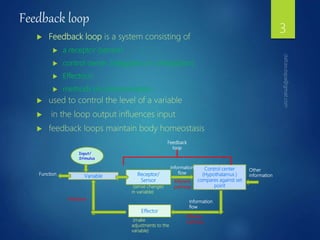
 Feedback loop is a system consisting of
 a receptor (sensor)
 control center (integrator or comparator)
 Effector/s
 methods of communication.
 used to control the level of a variable
 in the loop output influences input
 feedback loops maintain body homeostasis
3
Input/
Stimulus
Receptor/
Sensor
Effector
Control center
(Hypothalamus )
compares against set
point
Variable
Function
Other
information
Information
flow
Information
flow
Feedback
loop
Afferent
pathway
Efferent
pathway
Feedback
(make
adjustments to the
variable)
(sense changes
in variable)
Feedback loops:
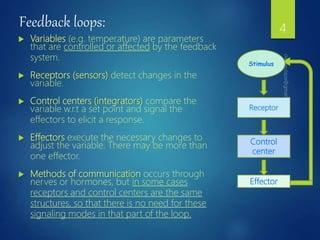
 Variables (e.g. temperature) are parameters
that are controlled or affected by the feedback
system.
 Receptors (sensors) detect changes in the
variable.
 Control centers (integrators) compare the
variable w.r.t a set point and signal the
effectors to elicit a response.
 Effectors execute the necessary changes to
adjust the variable. There may be more than
one effector.
 Methods of communication occurs through
nerves or hormones, but in some cases
receptors and control centers are the same
structures, so that there is no need for these
signaling modes in that part of the loop.
4
Stimulus
Receptor
Control
center
Effector
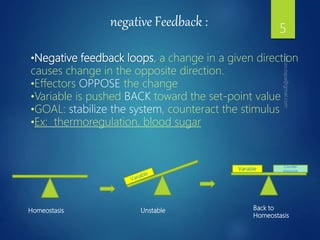
•Negative feedback loops, a change in a given direction
causes change in the opposite direction.
•Effectors OPPOSE the change
•Variable is pushed BACK toward the set-point value
•GOAL: stabilize the system, counteract the stimulus
•Ex: thermoregulation, blood sugar
Variable
Counter
response
Homeostasis Back to
Homeostasis
Unstable
negative Feedback : 5
6
summary:
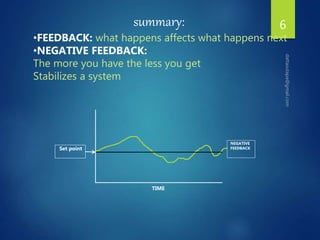
•FEEDBACK: what happens affects what happens next
•NEGATIVE FEEDBACK:
The more you have the less you get
Stabilizes a system
Set point
NEGATIVE
FEEDBACK
TIME
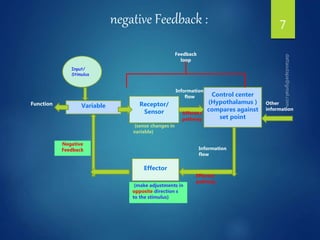
7
Input/
Stimulus
Receptor/
Sensor
Effector
Control center
(Hypothalamus )
compares against
set point
Variable
Function Other
information
Information
flow
Information
flow
Feedback
loop
Afferent
pathway
Efferent
pathway
Negative
Feedback
(make adjustments in
opposite direction s
to the stimulus)
(sense changes in
variable)
negative Feedback :
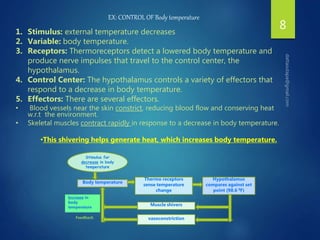
1. Stimulus: external temperature decreases
2. Variable: body temperature.
3. Receptors: Thermoreceptors detect a lowered body temperature and
produce nerve impulses that travel to the control center, the
hypothalamus.
4. Control Center: The hypothalamus controls a variety of effectors that
respond to a decrease in body temperature.
5. Effectors: There are several effectors.
• Blood vessels near the skin constrict, reducing blood flow and conserving heat
w.r.t the environment.
• Skeletal muscles contract rapidly in response to a decrease in body temperature.
•This shivering helps generate heat, which increases body temperature.
8
EX: CONTROL OF Body temperature
Stimulus for
decrease in body
temperature
Thermo receptors
sense temperature
change
Muscle shivers
vasoconstriction
Hypothalamus
compares against set
point (98.6 0F)
Body temperature
Feedback
Increase in
body
temperature
9
Conditions cause body
temperature to
increase
Thermo receptors
sense temperature
change
Sweat glands secrete
sweat
Vasodilation
Hypothalamus
compares against set
point (98.6 0F)
Body temperature
Decrease in
body
temperature
EX: CONTROL OF Body temperature
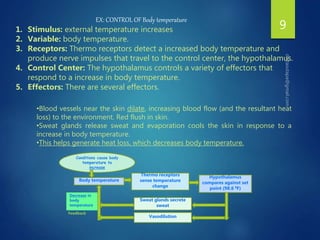
1. Stimulus: external temperature increases
2. Variable: body temperature.
3. Receptors: Thermo receptors detect a increased body temperature and
produce nerve impulses that travel to the control center, the hypothalamus.
4. Control Center: The hypothalamus controls a variety of effectors that
respond to a increase in body temperature.
5. Effectors: There are several effectors.
•Blood vessels near the skin dilate, increasing blood flow (and the resultant heat
loss) to the environment. Red flush in skin.
•Sweat glands release sweat and evaporation cools the skin in response to a
increase in body temperature.
•This helps generate heat loss, which decreases body temperature.
Feedback
10
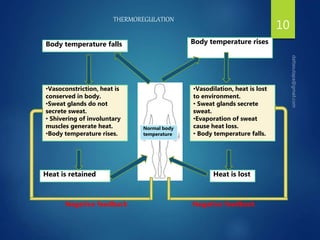
Body temperature falls Body temperature rises
•Vasoconstriction, heat is
conserved in body.
•Sweat glands do not
secrete sweat.
• Shivering of involuntary
muscles generate heat.
•Body temperature rises.
•Vasodilation, heat is lost
to environment.
• Sweat glands secrete
sweat.
•Evaporation of sweat
cause heat loss.
• Body temperature falls.
Heat is retained Heat is lost
Normal body
temperature
Negative feedback Negative feedback
THERMOREGULATION
11
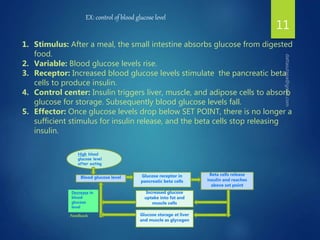
High blood
glucose level
after eating
Glucose receptor in
pancreatic beta cells
Increased glucose
uptake into fat and
muscle cells
Glucose storage at liver
and muscle as glycogen
Beta cells release
insulin and reaches
above set point
Blood glucose level
Decrease in
blood
glucose
level
EX: control of blood glucose level
1. Stimulus: After a meal, the small intestine absorbs glucose from digested
food.
2. Variable: Blood glucose levels rise.
3. Receptor: Increased blood glucose levels stimulate the pancreatic beta
cells to produce insulin.
4. Control center: Insulin triggers liver, muscle, and adipose cells to absorb
glucose for storage. Subsequently blood glucose levels fall.
5. Effector: Once glucose levels drop below SET POINT, there is no longer a
sufficient stimulus for insulin release, and the beta cells stop releasing
insulin.
Feedback
12
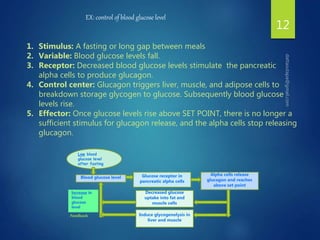
Low blood
glucose level
after fasting
Glucose receptor in
pancreatic alpha cells
Decreased glucose
uptake into fat and
muscle cells
Induce glycogenolysis in
liver and muscle
Alpha cells release
glucagon and reaches
above set point
Blood glucose level
Increase in
blood
glucose
level
EX: control of blood glucose level
1. Stimulus: A fasting or long gap between meals
2. Variable: Blood glucose levels fall.
3. Receptor: Decreased blood glucose levels stimulate the pancreatic
alpha cells to produce glucagon.
4. Control center: Glucagon triggers liver, muscle, and adipose cells to
breakdown storage glycogen to glucose. Subsequently blood glucose
levels rise.
5. Effector: Once glucose levels rise above SET POINT, there is no longer a
sufficient stimulus for glucagon release, and the alpha cells stop releasing
glucagon.
Feedback
13
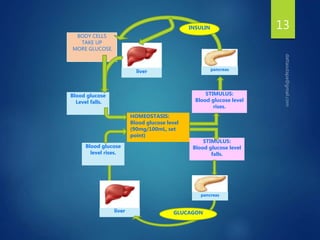
liver
BODY CELLS
TAKE UP
MORE GLUCOSE.
Blood glucose
Level falls.
Blood glucose
level rises.
STIMULUS:
Blood glucose level
falls.
STIMULUS:
Blood glucose level
rises.
HOMEOSTASIS:
Blood glucose level
(90mg/100mL, set
point)
GLUCAGON
INSULIN
liver pancreas
pancreas
14
Lack of
Calcium in diet
Calcium receptor in
sensory cells of
parathyroid gland
Kidneys stop calcium
secretion in urine
Bone cells (Osteoclasts)
release calcium from
bone
Parathyroid gland
secretes parathyroid
hormone (PTH)
Blood calcium level
Increase in
blood
calcium
level
EX: control of blood calcium level
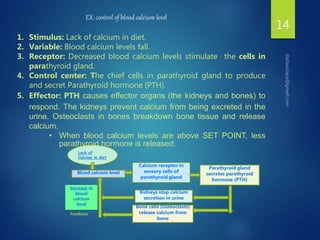
1. Stimulus: Lack of calcium in diet.
2. Variable: Blood calcium levels fall.
3. Receptor: Decreased blood calcium levels stimulate the cells in
parathyroid gland.
4. Control center: The chief cells in parathyroid gland to produce
and secret Parathyroid hormone (PTH).
5. Effector: PTH causes effector organs (the kidneys and bones) to
respond. The kidneys prevent calcium from being excreted in the
urine. Osteoclasts in bones breakdown bone tissue and release
calcium.
• When blood calcium levels are above SET POINT, less
parathyroid hormone is released.
Feedback
15
High calcium
level
Calcium receptor in
thyroid gland
Kidneys stop calcium
absorption from urine
Bone cells (Osteoblasts)
deposit calcium in bone
Parafollicular cells in
Thyroid gland release
Calcitonin
Blood calcium level
Decrease in
blood
calcium
level
EX: control of blood calcium level
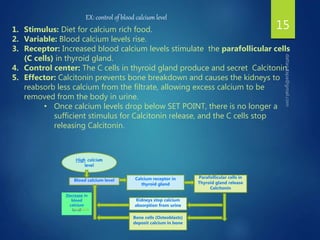
1. Stimulus: Diet for calcium rich food.
2. Variable: Blood calcium levels rise.
3. Receptor: Increased blood calcium levels stimulate the parafollicular cells
(C cells) in thyroid gland.
4. Control center: The C cells in thyroid gland produce and secret Calcitonin.
5. Effector: Calcitonin prevents bone breakdown and causes the kidneys to
reabsorb less calcium from the filtrate, allowing excess calcium to be
removed from the body in urine.
• Once calcium levels drop below SET POINT, there is no longer a
sufficient stimulus for Calcitonin release, and the C cells stop
releasing Calcitonin.
Feedback
16
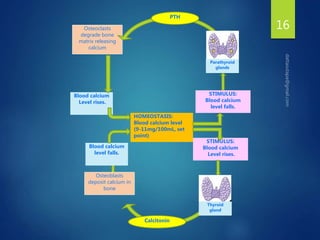
Osteoclasts
degrade bone
matrix releasing
calcium
Blood calcium
Level rises.
Blood calcium
level falls.
STIMULUS:
Blood calcium
Level rises.
STIMULUS:
Blood calcium
level falls.
HOMEOSTASIS:
Blood calcium level
(9-11mg/100mL, set
point)
Calcitonin
PTH
Osteoblasts
deposit calcium in
bone
Parathyroid
glands
Thyroid
gland
17
https://www.slideshare.net/SutapaDatta6/physiological-homeostasis-part-1
Link of part-1 homeostasis

Negative feedback loops

  • 1.
    Physiological homeostasis: Negative FEEDBack DRSUTAPA DATTA, WBES ASSISTANT PROFESSOR OF ZOOLOGY BETHUNE COLLEGE KOLKATA, WEST BENGAL INDIA 1 Part 2
  • 2.
    Homeostasis  The dynamicphysiological processes that maintain a balance (set point) in the internal variables upon stimulation from any sources for proper functioning of the body by hormonal or neuronal or both coordination. This is known as homeostasis. 2
  • 3.
    Feedback loop  Feedbackloop is a system consisting of  a receptor (sensor)  control center (integrator or comparator)  Effector/s  methods of communication.  used to control the level of a variable  in the loop output influences input  feedback loops maintain body homeostasis 3 Input/ Stimulus Receptor/ Sensor Effector Control center (Hypothalamus ) compares against set point Variable Function Other information Information flow Information flow Feedback loop Afferent pathway Efferent pathway Feedback (make adjustments to the variable) (sense changes in variable)
  • 4.
    Feedback loops:  Variables(e.g. temperature) are parameters that are controlled or affected by the feedback system.  Receptors (sensors) detect changes in the variable.  Control centers (integrators) compare the variable w.r.t a set point and signal the effectors to elicit a response.  Effectors execute the necessary changes to adjust the variable. There may be more than one effector.  Methods of communication occurs through nerves or hormones, but in some cases receptors and control centers are the same structures, so that there is no need for these signaling modes in that part of the loop. 4 Stimulus Receptor Control center Effector
  • 5.
    •Negative feedback loops,a change in a given direction causes change in the opposite direction. •Effectors OPPOSE the change •Variable is pushed BACK toward the set-point value •GOAL: stabilize the system, counteract the stimulus •Ex: thermoregulation, blood sugar Variable Counter response Homeostasis Back to Homeostasis Unstable negative Feedback : 5
  • 6.
    6 summary: •FEEDBACK: what happensaffects what happens next •NEGATIVE FEEDBACK: The more you have the less you get Stabilizes a system Set point NEGATIVE FEEDBACK TIME
  • 7.
    7 Input/ Stimulus Receptor/ Sensor Effector Control center (Hypothalamus ) comparesagainst set point Variable Function Other information Information flow Information flow Feedback loop Afferent pathway Efferent pathway Negative Feedback (make adjustments in opposite direction s to the stimulus) (sense changes in variable) negative Feedback :
  • 8.
    1. Stimulus: externaltemperature decreases 2. Variable: body temperature. 3. Receptors: Thermoreceptors detect a lowered body temperature and produce nerve impulses that travel to the control center, the hypothalamus. 4. Control Center: The hypothalamus controls a variety of effectors that respond to a decrease in body temperature. 5. Effectors: There are several effectors. • Blood vessels near the skin constrict, reducing blood flow and conserving heat w.r.t the environment. • Skeletal muscles contract rapidly in response to a decrease in body temperature. •This shivering helps generate heat, which increases body temperature. 8 EX: CONTROL OF Body temperature Stimulus for decrease in body temperature Thermo receptors sense temperature change Muscle shivers vasoconstriction Hypothalamus compares against set point (98.6 0F) Body temperature Feedback Increase in body temperature
  • 9.
    9 Conditions cause body temperatureto increase Thermo receptors sense temperature change Sweat glands secrete sweat Vasodilation Hypothalamus compares against set point (98.6 0F) Body temperature Decrease in body temperature EX: CONTROL OF Body temperature 1. Stimulus: external temperature increases 2. Variable: body temperature. 3. Receptors: Thermo receptors detect a increased body temperature and produce nerve impulses that travel to the control center, the hypothalamus. 4. Control Center: The hypothalamus controls a variety of effectors that respond to a increase in body temperature. 5. Effectors: There are several effectors. •Blood vessels near the skin dilate, increasing blood flow (and the resultant heat loss) to the environment. Red flush in skin. •Sweat glands release sweat and evaporation cools the skin in response to a increase in body temperature. •This helps generate heat loss, which decreases body temperature. Feedback
  • 10.
    10 Body temperature fallsBody temperature rises •Vasoconstriction, heat is conserved in body. •Sweat glands do not secrete sweat. • Shivering of involuntary muscles generate heat. •Body temperature rises. •Vasodilation, heat is lost to environment. • Sweat glands secrete sweat. •Evaporation of sweat cause heat loss. • Body temperature falls. Heat is retained Heat is lost Normal body temperature Negative feedback Negative feedback THERMOREGULATION
  • 11.
    11 High blood glucose level aftereating Glucose receptor in pancreatic beta cells Increased glucose uptake into fat and muscle cells Glucose storage at liver and muscle as glycogen Beta cells release insulin and reaches above set point Blood glucose level Decrease in blood glucose level EX: control of blood glucose level 1. Stimulus: After a meal, the small intestine absorbs glucose from digested food. 2. Variable: Blood glucose levels rise. 3. Receptor: Increased blood glucose levels stimulate the pancreatic beta cells to produce insulin. 4. Control center: Insulin triggers liver, muscle, and adipose cells to absorb glucose for storage. Subsequently blood glucose levels fall. 5. Effector: Once glucose levels drop below SET POINT, there is no longer a sufficient stimulus for insulin release, and the beta cells stop releasing insulin. Feedback
  • 12.
    12 Low blood glucose level afterfasting Glucose receptor in pancreatic alpha cells Decreased glucose uptake into fat and muscle cells Induce glycogenolysis in liver and muscle Alpha cells release glucagon and reaches above set point Blood glucose level Increase in blood glucose level EX: control of blood glucose level 1. Stimulus: A fasting or long gap between meals 2. Variable: Blood glucose levels fall. 3. Receptor: Decreased blood glucose levels stimulate the pancreatic alpha cells to produce glucagon. 4. Control center: Glucagon triggers liver, muscle, and adipose cells to breakdown storage glycogen to glucose. Subsequently blood glucose levels rise. 5. Effector: Once glucose levels rise above SET POINT, there is no longer a sufficient stimulus for glucagon release, and the alpha cells stop releasing glucagon. Feedback
  • 13.
    13 liver BODY CELLS TAKE UP MOREGLUCOSE. Blood glucose Level falls. Blood glucose level rises. STIMULUS: Blood glucose level falls. STIMULUS: Blood glucose level rises. HOMEOSTASIS: Blood glucose level (90mg/100mL, set point) GLUCAGON INSULIN liver pancreas pancreas
  • 14.
    14 Lack of Calcium indiet Calcium receptor in sensory cells of parathyroid gland Kidneys stop calcium secretion in urine Bone cells (Osteoclasts) release calcium from bone Parathyroid gland secretes parathyroid hormone (PTH) Blood calcium level Increase in blood calcium level EX: control of blood calcium level 1. Stimulus: Lack of calcium in diet. 2. Variable: Blood calcium levels fall. 3. Receptor: Decreased blood calcium levels stimulate the cells in parathyroid gland. 4. Control center: The chief cells in parathyroid gland to produce and secret Parathyroid hormone (PTH). 5. Effector: PTH causes effector organs (the kidneys and bones) to respond. The kidneys prevent calcium from being excreted in the urine. Osteoclasts in bones breakdown bone tissue and release calcium. • When blood calcium levels are above SET POINT, less parathyroid hormone is released. Feedback
  • 15.
    15 High calcium level Calcium receptorin thyroid gland Kidneys stop calcium absorption from urine Bone cells (Osteoblasts) deposit calcium in bone Parafollicular cells in Thyroid gland release Calcitonin Blood calcium level Decrease in blood calcium level EX: control of blood calcium level 1. Stimulus: Diet for calcium rich food. 2. Variable: Blood calcium levels rise. 3. Receptor: Increased blood calcium levels stimulate the parafollicular cells (C cells) in thyroid gland. 4. Control center: The C cells in thyroid gland produce and secret Calcitonin. 5. Effector: Calcitonin prevents bone breakdown and causes the kidneys to reabsorb less calcium from the filtrate, allowing excess calcium to be removed from the body in urine. • Once calcium levels drop below SET POINT, there is no longer a sufficient stimulus for Calcitonin release, and the C cells stop releasing Calcitonin. Feedback
  • 16.
    16 Osteoclasts degrade bone matrix releasing calcium Bloodcalcium Level rises. Blood calcium level falls. STIMULUS: Blood calcium Level rises. STIMULUS: Blood calcium level falls. HOMEOSTASIS: Blood calcium level (9-11mg/100mL, set point) Calcitonin PTH Osteoblasts deposit calcium in bone Parathyroid glands Thyroid gland
  • 17.