What is the relationship between initial velocity and braking distance? In today’s lab, we will be looking at the relationship between initial velocity and braking distance. On the next clean lab page in your lab notebook, write “Section 5 – Negative Acceleration”  Don’t forget to make an entry in your Table of Contents
What is the relationship between initial velocity and braking distance? Before we do the lab, form a hypothesis with your group about the relationship between initial velocity and braking distance. Remember: A good hypothesis always contains an “ if ” and a “ then ”
What is the relationship between initial velocity and braking distance? With your lab group, answer all eight questions in the right-hand column on pg 76 in your lab books. After you have answered all eight questions, create a numbered procedure for how your group will conduct the investigation. You must get approval before conducting your investigation.
What is the relationship between initial velocity and braking distance? For your plan to be approved, your group will need to have an answer for all eight questions on pg 76 as well as at least one well-constructed data table with which to collect your data.
What is the relationship between initial velocity and braking distance? For the first 10 minutes of class, we will be working on interpreting our lab results (on page 77, #5a, 5b) You  may  work in your lab group, but you must be working or you will be separated.
Negative Acceleration Review: What is acceleration? acceleration is a change in velocity Review: What are three ways velocity can change? speed up slow down change direction
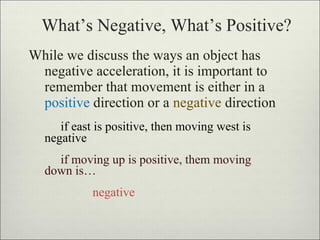
What’s Negative, What’s Positive? While we discuss the ways an object has negative acceleration, it is important to remember that movement is either in a  positive  direction or a  negative  direction if east is positive, then moving west is  negative if moving up is positive, them moving  down is… negative
What’s Negative, What’s Positive? It will also be helpful to keep in mind that if an object is decreasing its speed, it will have “negative” speed (V f  – V i )
Negative Acceleration An object can have a negative acceleration when it:   1. decreases its speed when moving in the positive direction
Negative Acceleration An object can have a negative acceleration when it: 2. increases its speed when moving in the negative direction
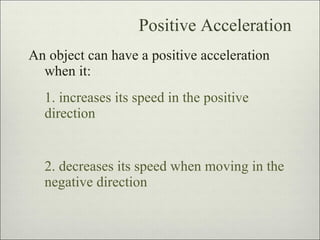
Positive Acceleration An object can have a positive acceleration when it: 1. increases its speed in the positive direction 2. decreases its speed when moving in the negative direction
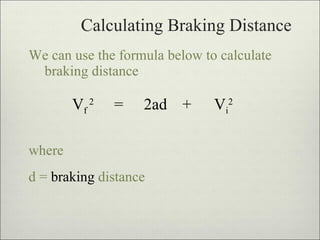
Calculating Braking Distance We can use the formula below to calculate braking distance where d =  braking  distance V f  2 = 2ad + V i 2
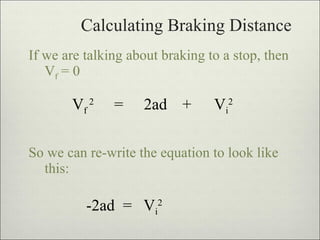
Calculating Braking Distance If we are talking about braking to a stop, then V f  = 0 So we can re-write the equation to look like this: V f  2 = 2ad + V i 2 -2ad = V i 2

Negative acceleration

  • 1.
  • 2.
    What is therelationship between initial velocity and braking distance? In today’s lab, we will be looking at the relationship between initial velocity and braking distance. On the next clean lab page in your lab notebook, write “Section 5 – Negative Acceleration” Don’t forget to make an entry in your Table of Contents
  • 3.
    What is therelationship between initial velocity and braking distance? Before we do the lab, form a hypothesis with your group about the relationship between initial velocity and braking distance. Remember: A good hypothesis always contains an “ if ” and a “ then ”
  • 4.
    What is therelationship between initial velocity and braking distance? With your lab group, answer all eight questions in the right-hand column on pg 76 in your lab books. After you have answered all eight questions, create a numbered procedure for how your group will conduct the investigation. You must get approval before conducting your investigation.
  • 5.
    What is therelationship between initial velocity and braking distance? For your plan to be approved, your group will need to have an answer for all eight questions on pg 76 as well as at least one well-constructed data table with which to collect your data.
  • 6.
    What is therelationship between initial velocity and braking distance? For the first 10 minutes of class, we will be working on interpreting our lab results (on page 77, #5a, 5b) You may work in your lab group, but you must be working or you will be separated.
  • 7.
    Negative Acceleration Review:What is acceleration? acceleration is a change in velocity Review: What are three ways velocity can change? speed up slow down change direction
  • 8.
    What’s Negative, What’sPositive? While we discuss the ways an object has negative acceleration, it is important to remember that movement is either in a positive direction or a negative direction if east is positive, then moving west is negative if moving up is positive, them moving down is… negative
  • 9.
    What’s Negative, What’sPositive? It will also be helpful to keep in mind that if an object is decreasing its speed, it will have “negative” speed (V f – V i )
  • 10.
    Negative Acceleration Anobject can have a negative acceleration when it: 1. decreases its speed when moving in the positive direction
  • 11.
    Negative Acceleration Anobject can have a negative acceleration when it: 2. increases its speed when moving in the negative direction
  • 12.
    Positive Acceleration Anobject can have a positive acceleration when it: 1. increases its speed in the positive direction 2. decreases its speed when moving in the negative direction
  • 13.
    Calculating Braking DistanceWe can use the formula below to calculate braking distance where d = braking distance V f 2 = 2ad + V i 2
  • 14.
    Calculating Braking DistanceIf we are talking about braking to a stop, then V f = 0 So we can re-write the equation to look like this: V f 2 = 2ad + V i 2 -2ad = V i 2