NFPA 1 Chapter 18: Fire Department
Access and Water Supply
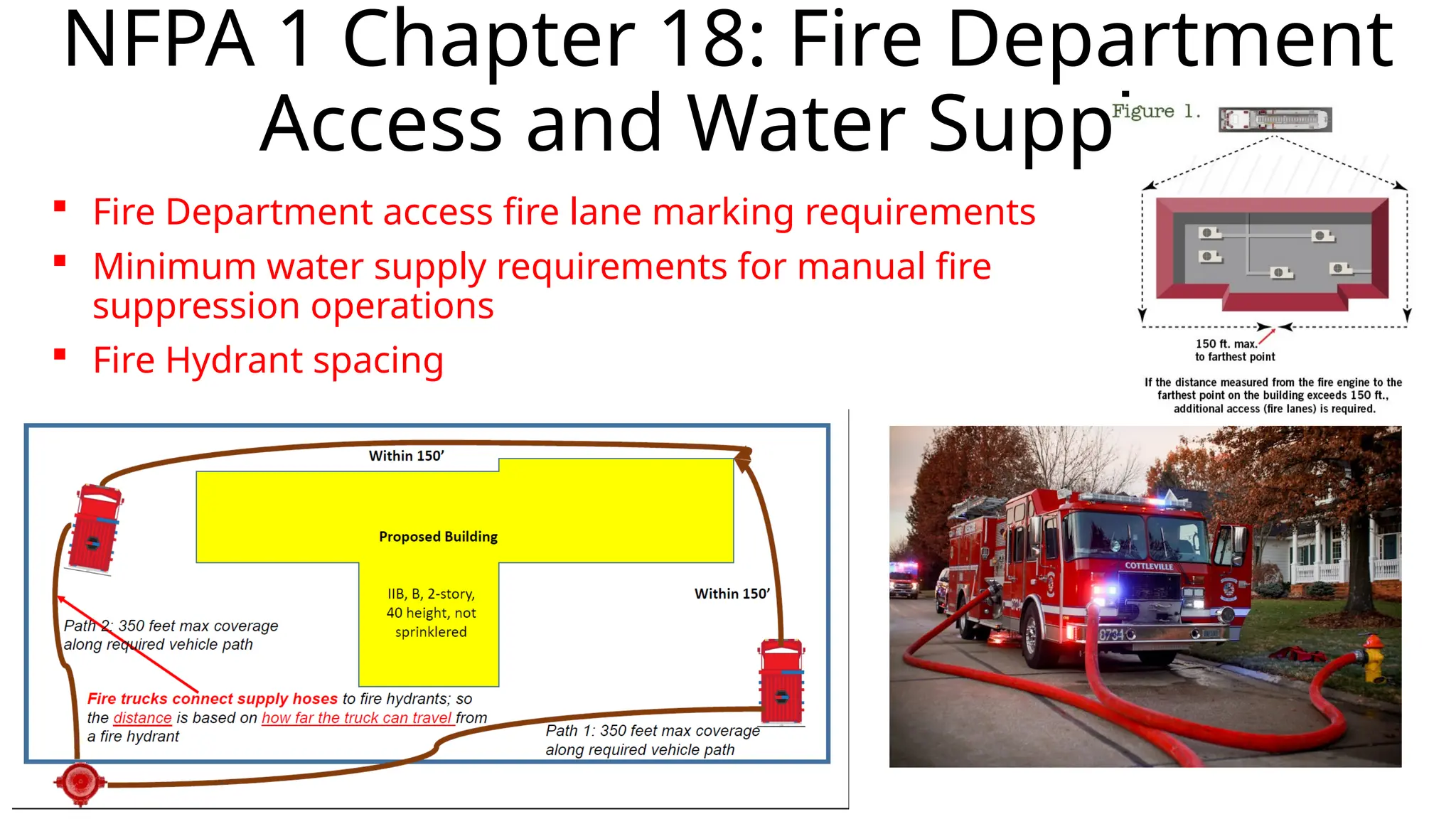
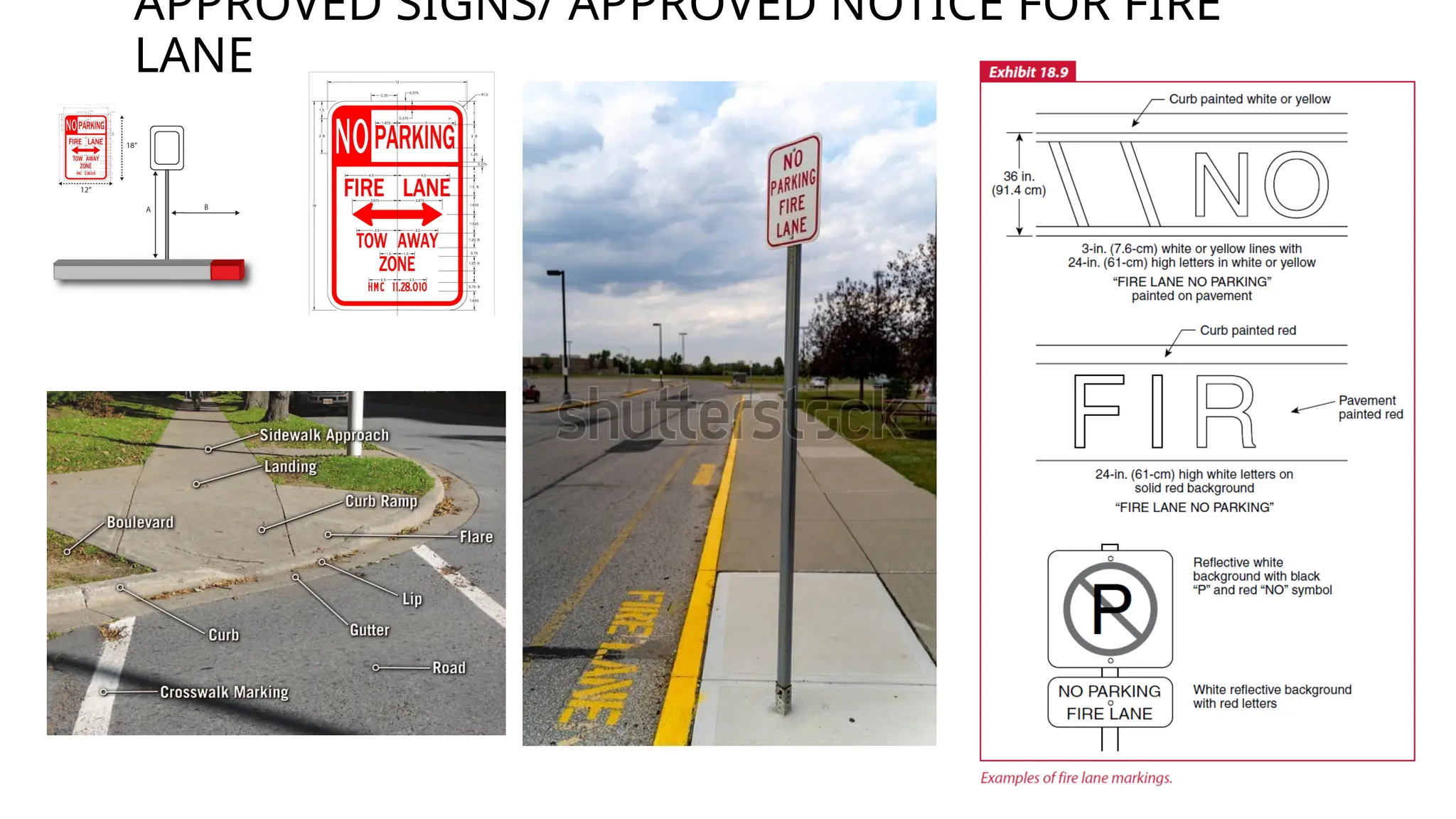
 Fire Department access fire lane marking requirements
 Minimum water supply requirements for manual fire
suppression operations
 Fire Hydrant spacing
• Section 18 Applies to both public and privately owned fire apparatus access roads.
• Section 18.2 for fire department access and access road provision and maintenance.
Access Box Definition as per NFPA 1:
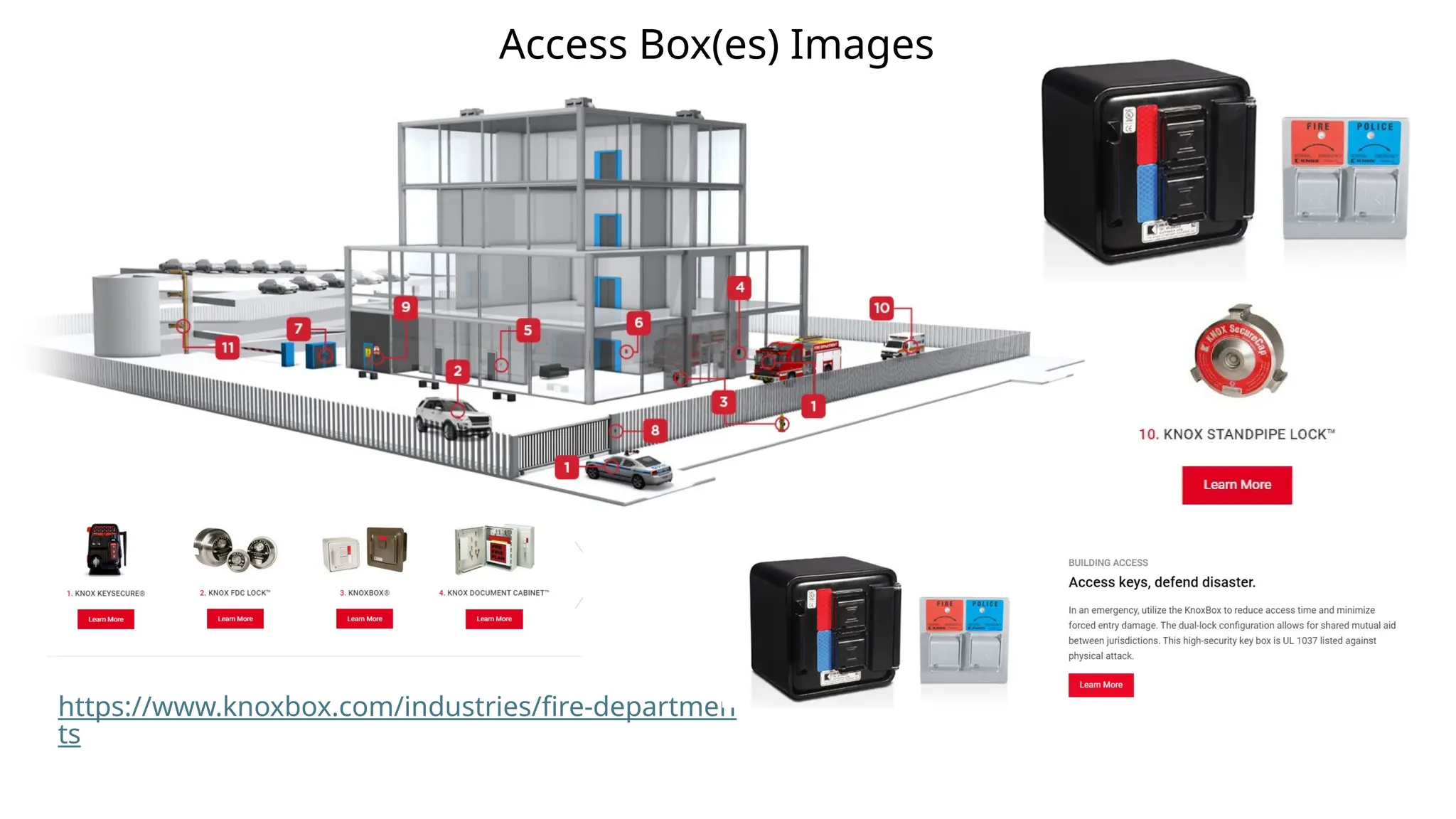
• 3.3.2: An approved secure box, accessible by the AHJ’s master key or control, containing
entrance keys or other devices to gain access to a structure or area.
Access Box(es):
• 18.2.2.1: Access Box(es): AHJ shall have authority to require an access box(es) to be
installed in accessible location, where access to structure or area is difficult because of
security
• Access box(es): Approved type listed in accordance with UL 1037
• Heavy duty key repository boxes provide a high security system that ensures that only
fire department can access the keys or other devices within them.
• Some fire department require access boxes to be mounted on the wall at a height of 3m
to 3.66m to prevent lock from being vandalized. Fire department can quickly access the
box using a ladder from the apparatus
Access Box(es) Images
https://www.knoxbox.com/industries/fire-departmen
ts
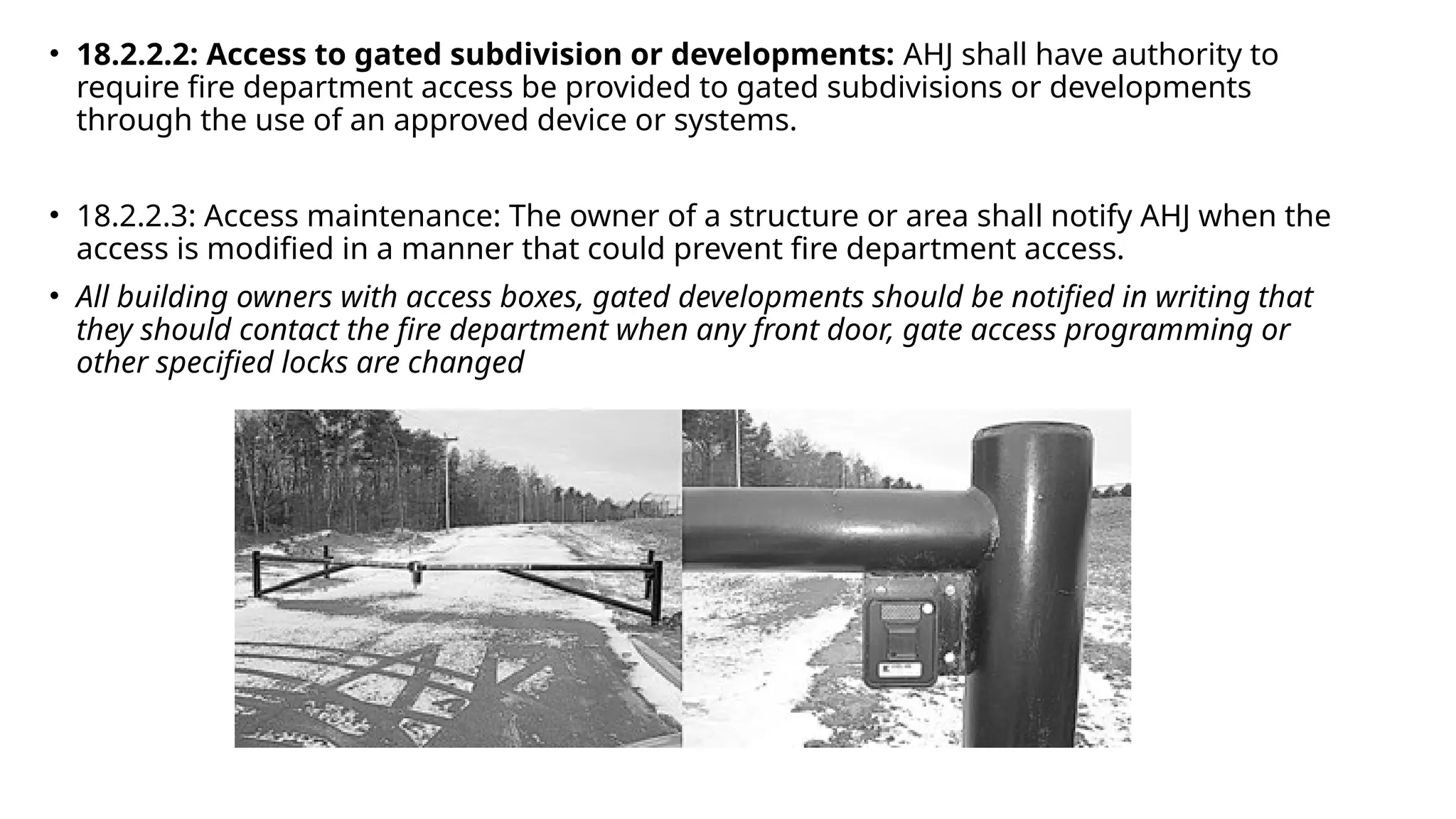
• 18.2.2.2: Access to gated subdivision or developments: AHJ shall have authority to
require fire department access be provided to gated subdivisions or developments
through the use of an approved device or systems.
• 18.2.2.3: Access maintenance: The owner of a structure or area shall notify AHJ when the
access is modified in a manner that could prevent fire department access.
• All building owners with access boxes, gated developments should be notified in writing that
they should contact the fire department when any front door, gate access programming or
other specified locks are changed
18.2.3 FIRE DEPARTMENT ACCESS ROADS
• 18.2.3.1: Required Access
• 18.2.3.1.1: Approved fire department access roads shall be provided for every facility, building
or portion of a building hereafter constructed or relocated.
• This is to provide effective manual fire suppression operations. And applicable for both public and
private roadway.
• Code does not require modification of previously approved access to existing buildings
• Refer 16.1.4 for Fire department access road in Building under Construction
• 16.1.4 Fire department access roads provided in accordance with 18.2.3 shall be provided at the start of
a project and shall be maintained throughout construction.
• 3.3.126* Fire Lane. A fire department access road, which is marked with approved signs or other
approved notices.
• A.3.3.126 Fire Lane. The traditional term fire lane is no longer utilized in this Code. However, a fire
department access road that is marked and prohibits obstructions in accordance with 18.2.3.6 would
meet the traditional intent of a fire lane.
APPROVED SIGNS/ APPROVED NOTICE FOR FIRE
LANE
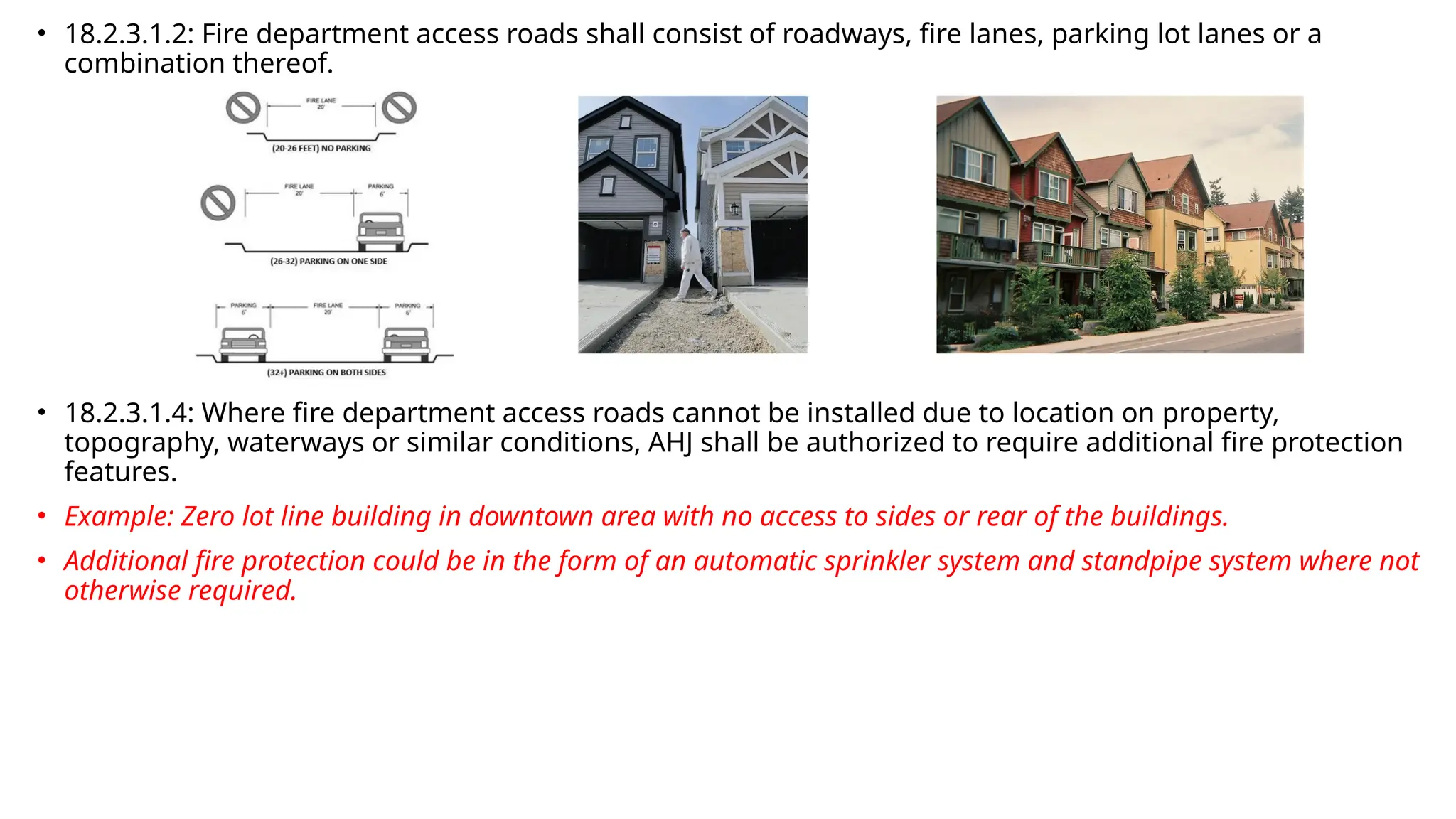
• 18.2.3.1.2: Fire department access roads shall consist of roadways, fire lanes, parking lot lanes or a
combination thereof.
• 18.2.3.1.4: Where fire department access roads cannot be installed due to location on property,
topography, waterways or similar conditions, AHJ shall be authorized to require additional fire protection
features.
• Example: Zero lot line building in downtown area with no access to sides or rear of the buildings.
• Additional fire protection could be in the form of an automatic sprinkler system and standpipe system where not
otherwise required.
18.2.3.2: FIRE DEPARTMENT ACCESS TO BUILDING
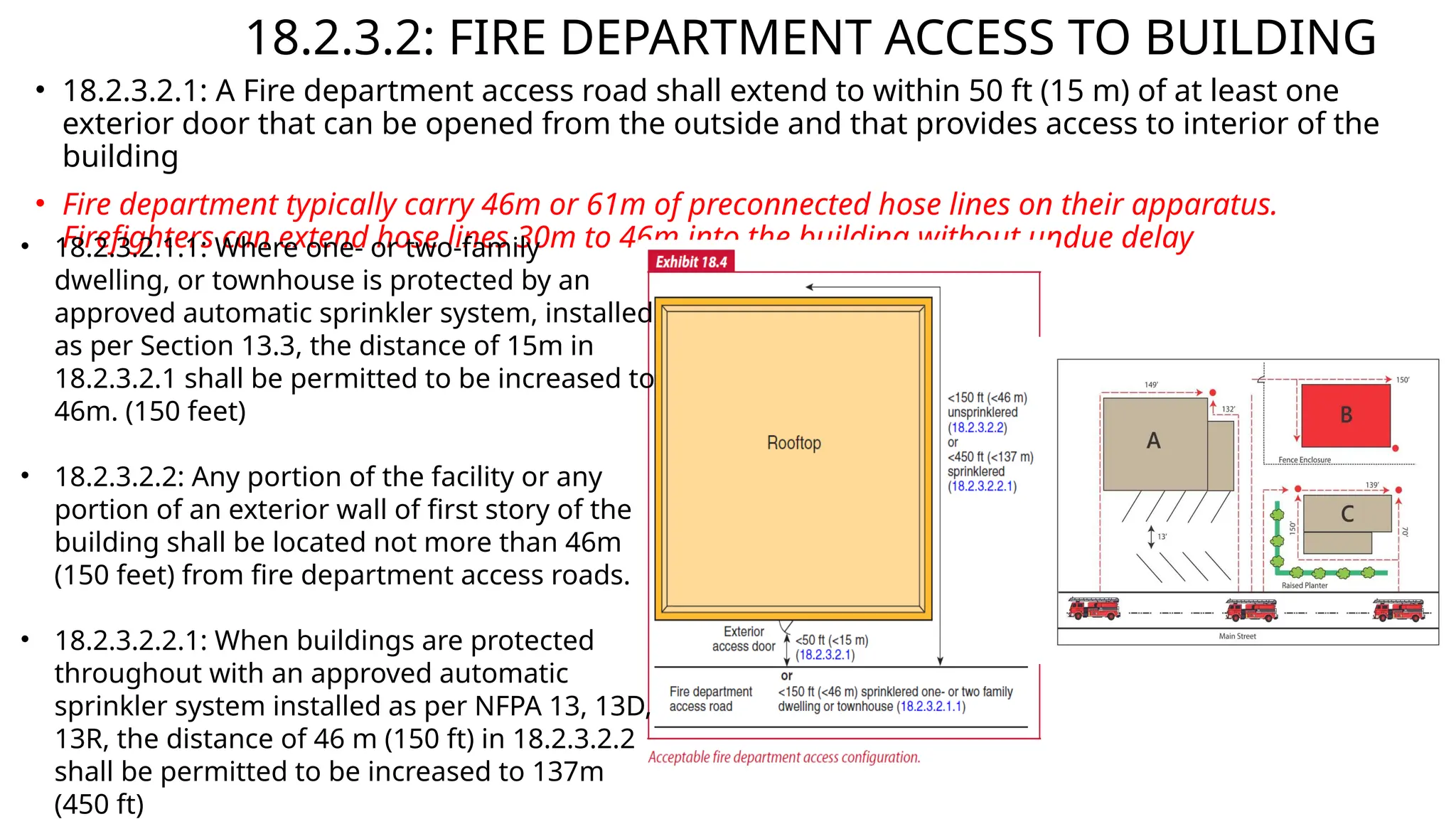
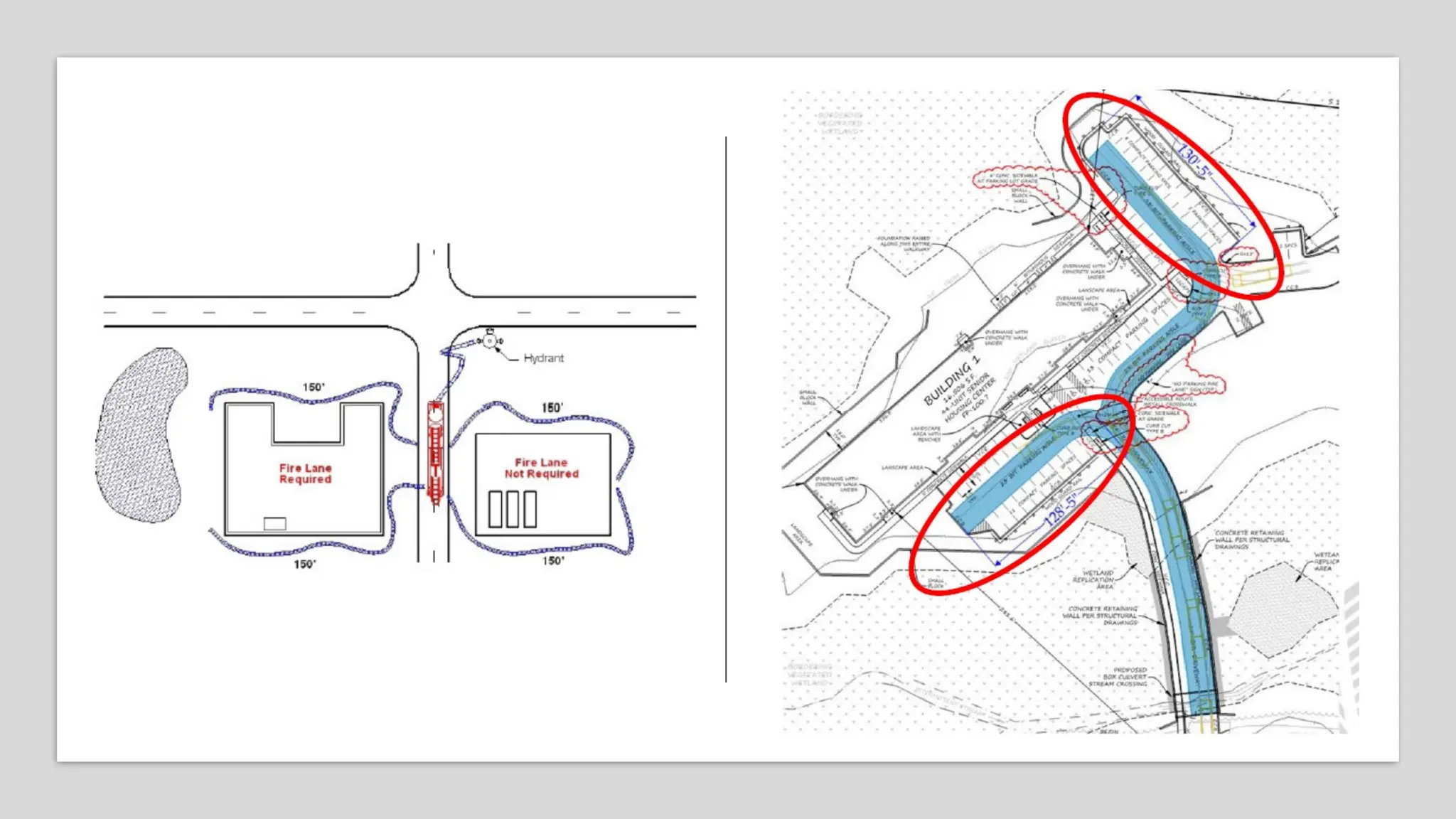
• 18.2.3.2.1: A Fire department access road shall extend to within 50 ft (15 m) of at least one
exterior door that can be opened from the outside and that provides access to interior of the
building
• Fire department typically carry 46m or 61m of preconnected hose lines on their apparatus.
Firefighters can extend hose lines 30m to 46m into the building without undue delay
• 18.2.3.2.1.1: Where one- or two-family
dwelling, or townhouse is protected by an
approved automatic sprinkler system, installed
as per Section 13.3, the distance of 15m in
18.2.3.2.1 shall be permitted to be increased to
46m. (150 feet)
• 18.2.3.2.2: Any portion of the facility or any
portion of an exterior wall of first story of the
building shall be located not more than 46m
(150 feet) from fire department access roads.
• 18.2.3.2.2.1: When buildings are protected
throughout with an approved automatic
sprinkler system installed as per NFPA 13, 13D,
13R, the distance of 46 m (150 ft) in 18.2.3.2.2
shall be permitted to be increased to 137m
(450 ft)
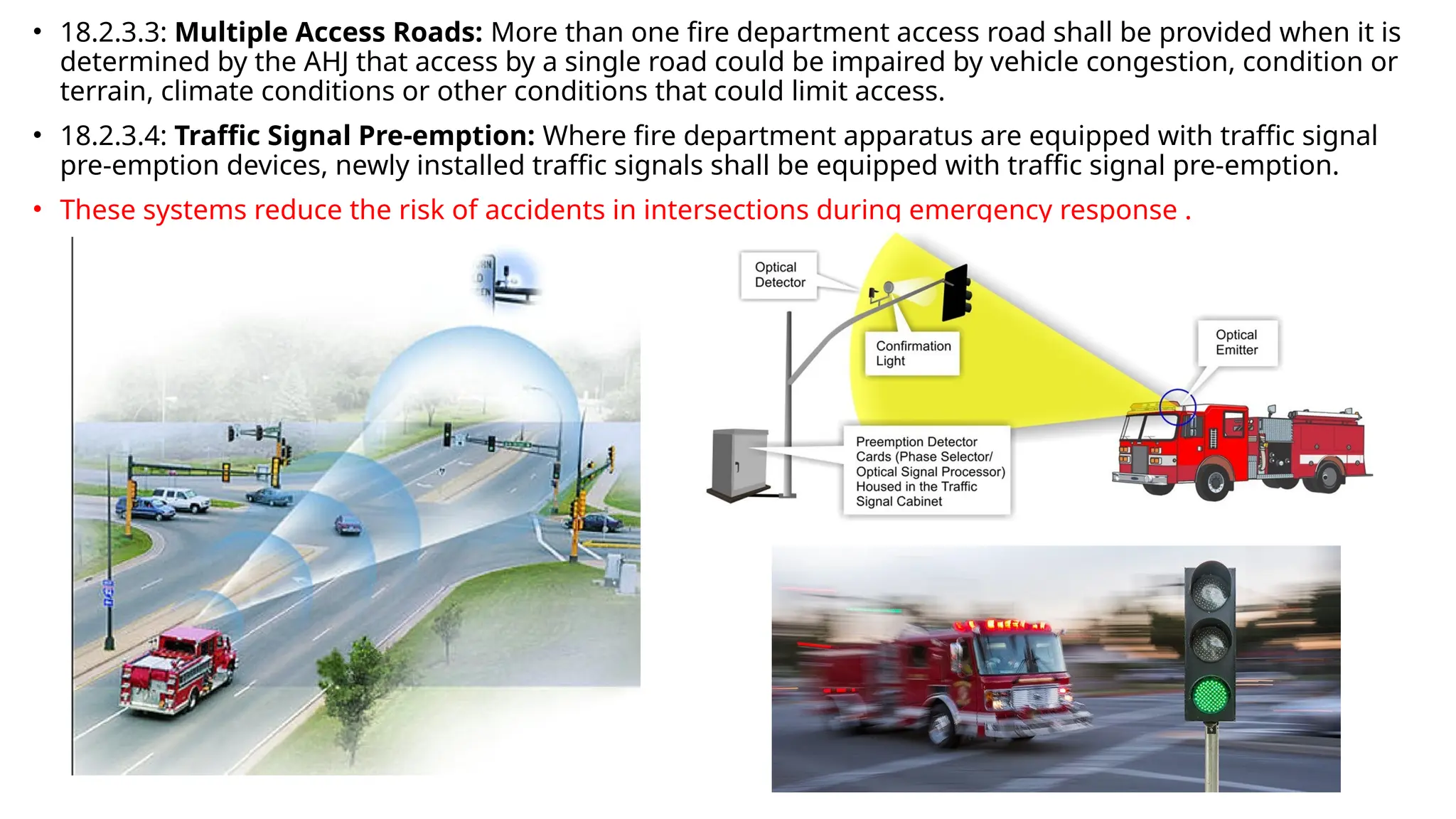
• 18.2.3.3: Multiple Access Roads: More than one fire department access road shall be provided when it is
determined by the AHJ that access by a single road could be impaired by vehicle congestion, condition or
terrain, climate conditions or other conditions that could limit access.
• 18.2.3.4: Traffic Signal Pre-emption: Where fire department apparatus are equipped with traffic signal
pre-emption devices, newly installed traffic signals shall be equipped with traffic signal pre-emption.
• These systems reduce the risk of accidents in intersections during emergency response .
18.2.3.5: FIRE DEPARTMENT ACCESS SPECIFICATIONS
Refer A policy on geometric design of Highways and Streets published by AASHTO. (transportation.org)
• 18.2.3.5.1 Dimensions:
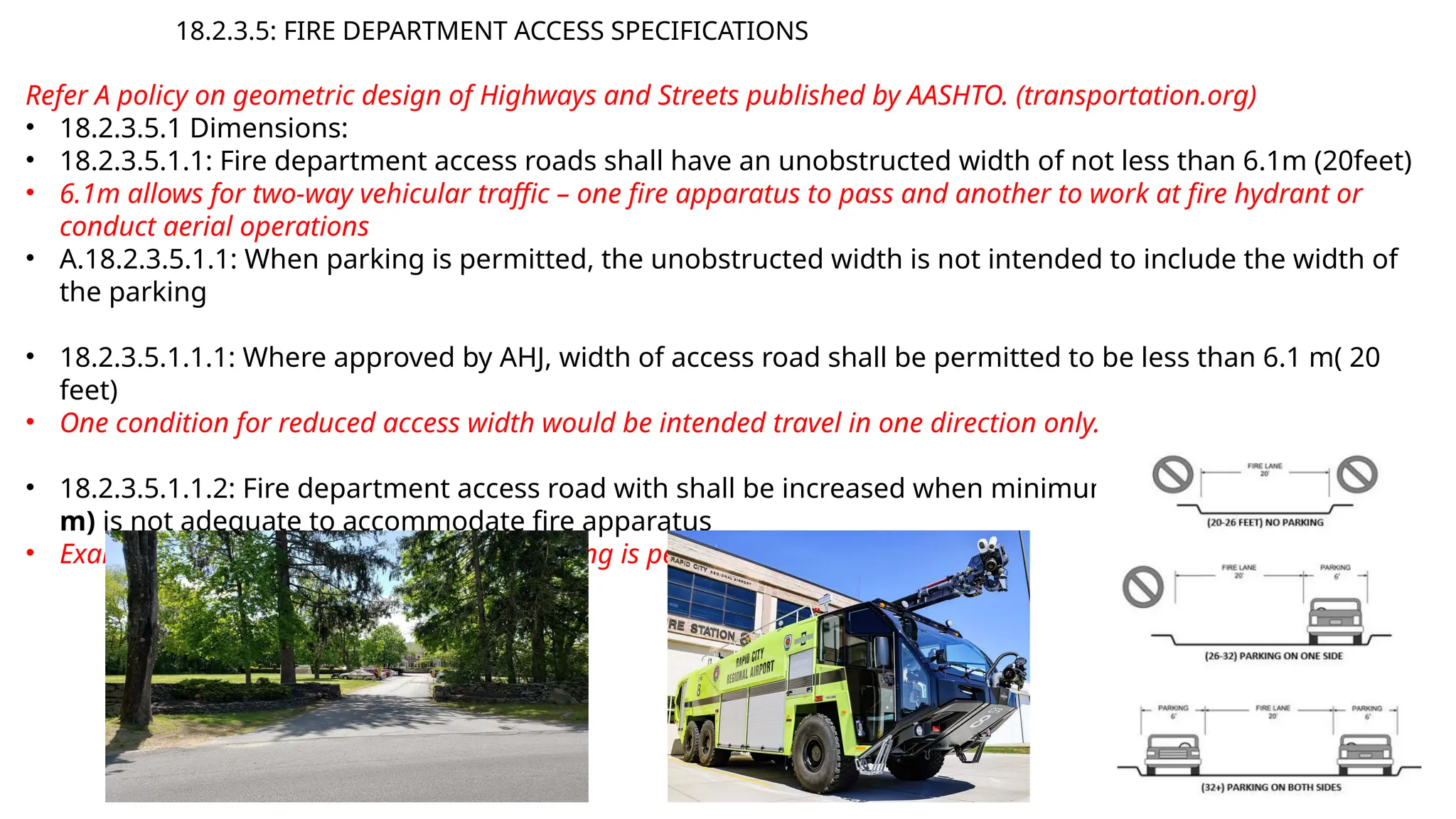
• 18.2.3.5.1.1: Fire department access roads shall have an unobstructed width of not less than 6.1m (20feet)
• 6.1m allows for two-way vehicular traffic – one fire apparatus to pass and another to work at fire hydrant or
conduct aerial operations
• A.18.2.3.5.1.1: When parking is permitted, the unobstructed width is not intended to include the width of
the parking
• 18.2.3.5.1.1.1: Where approved by AHJ, width of access road shall be permitted to be less than 6.1 m( 20
feet)
• One condition for reduced access width would be intended travel in one direction only.
• 18.2.3.5.1.1.2: Fire department access road with shall be increased when minimum width 18.2.3.5.1.1 (6.1
m) is not adequate to accommodate fire apparatus
• Example: Access road where on-street parking is permitted
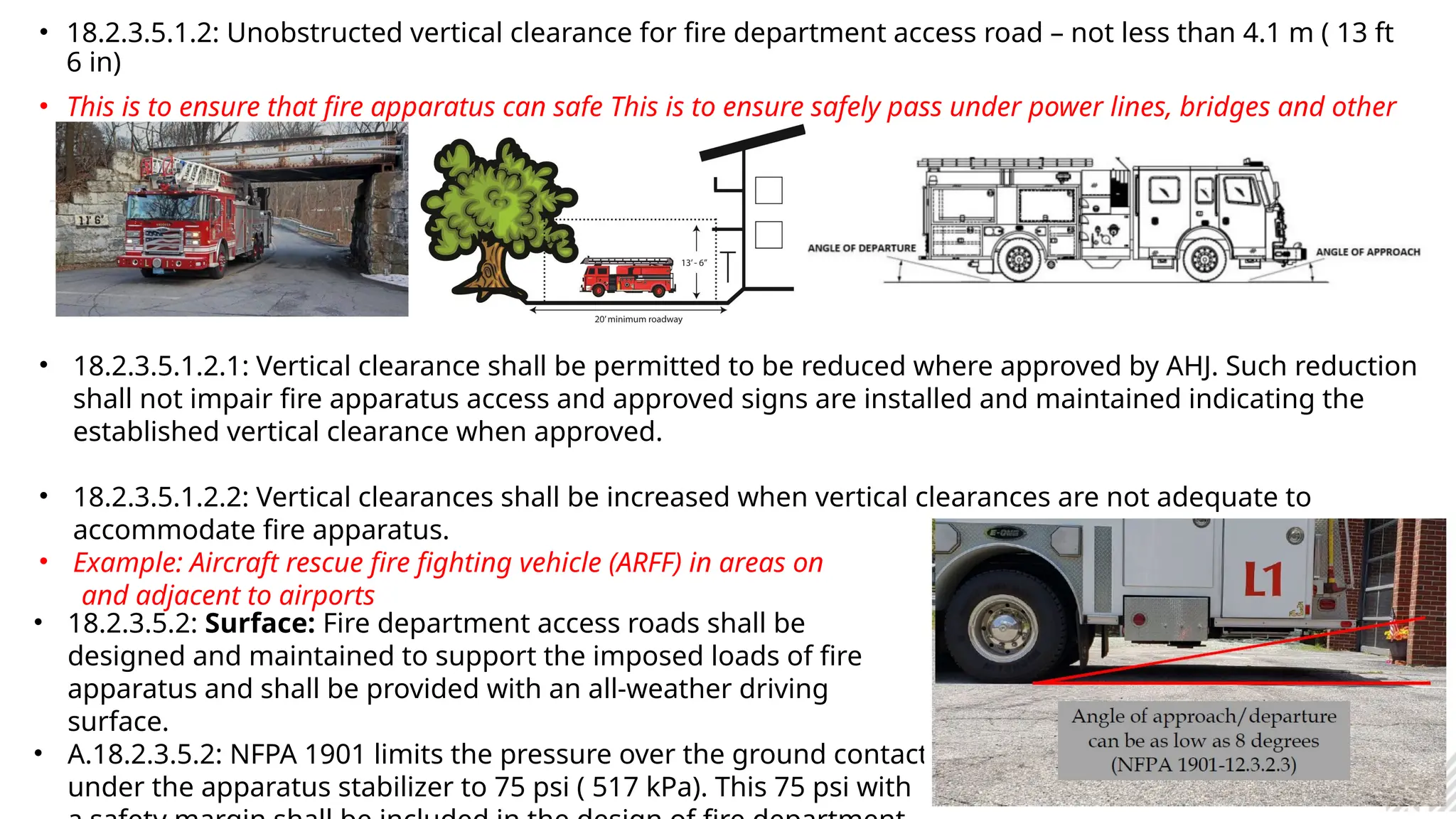
• 18.2.3.5.1.2: Unobstructed vertical clearance for fire department access road – not less than 4.1 m ( 13 ft
6 in)
• This is to ensure that fire apparatus can safe This is to ensure safely pass under power lines, bridges and other
obstructions.
• 18.2.3.5.1.2.1: Vertical clearance shall be permitted to be reduced where approved by AHJ. Such reduction
shall not impair fire apparatus access and approved signs are installed and maintained indicating the
established vertical clearance when approved.
• 18.2.3.5.1.2.2: Vertical clearances shall be increased when vertical clearances are not adequate to
accommodate fire apparatus.
• Example: Aircraft rescue fire fighting vehicle (ARFF) in areas on
and adjacent to airports
• 18.2.3.5.2: Surface: Fire department access roads shall be
designed and maintained to support the imposed loads of fire
apparatus and shall be provided with an all-weather driving
surface.
• A.18.2.3.5.2: NFPA 1901 limits the pressure over the ground contact
under the apparatus stabilizer to 75 psi ( 517 kPa). This 75 psi with
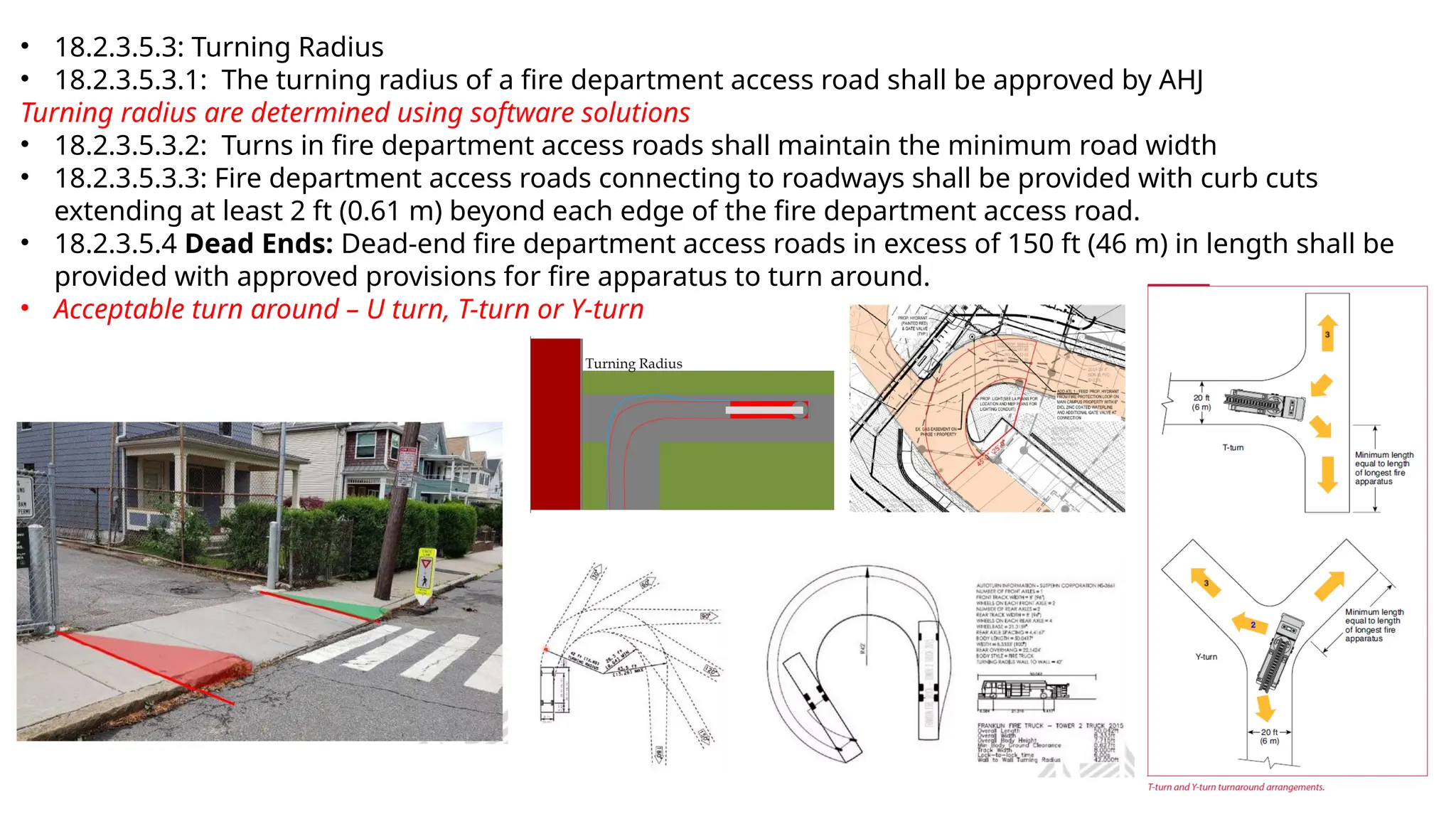
• 18.2.3.5.3: Turning Radius
• 18.2.3.5.3.1: The turning radius of a fire department access road shall be approved by AHJ
Turning radius are determined using software solutions
• 18.2.3.5.3.2: Turns in fire department access roads shall maintain the minimum road width
• 18.2.3.5.3.3: Fire department access roads connecting to roadways shall be provided with curb cuts
extending at least 2 ft (0.61 m) beyond each edge of the fire department access road.
• 18.2.3.5.4 Dead Ends: Dead-end fire department access roads in excess of 150 ft (46 m) in length shall be
provided with approved provisions for fire apparatus to turn around.
• Acceptable turn around – U turn, T-turn or Y-turn
• 18.2.3.5.5: Bridges:
• 18.2.3.5.5.1: Where bridge is required, it shall be constructed and maintained in accordance with
nationally recognized standards.
• Most used NRS is Standard specifications for Highway bridges – AASHTO.
• 18.2.3.5.5.2: Bridge shall be designed to support the live load of heaviest piece of Fire apparatus.
• 18.2.3.5.5.3: Vehicle load limits shall be posted at both entrance to bridges where required by AHJ.
• 18.2.3.5.6: Grade:
• 18.2.3.5.6.1: The gradient shall not exceed the design limitations of fire apparatus of the
fire department and subject to AHJ approval.
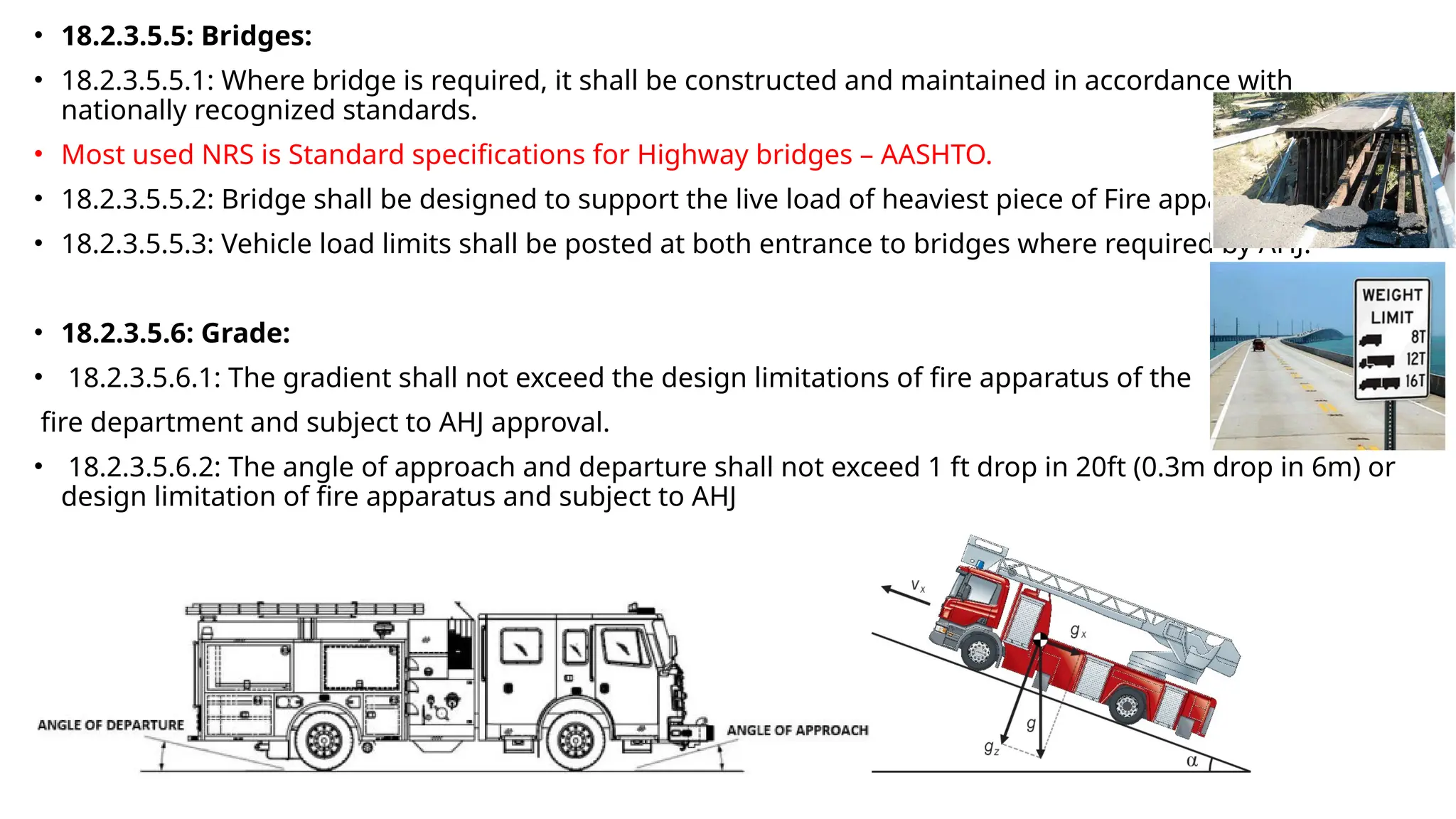
• 18.2.3.5.6.2: The angle of approach and departure shall not exceed 1 ft drop in 20ft (0.3m drop in 6m) or
design limitation of fire apparatus and subject to AHJ
• 18.2.3.5.7: Traffic calming devices:
• The design and use of traffic calming devices shall be approved by the AHJ.
• 18.2.3.6 :Marking of Fire Apparatus access road:
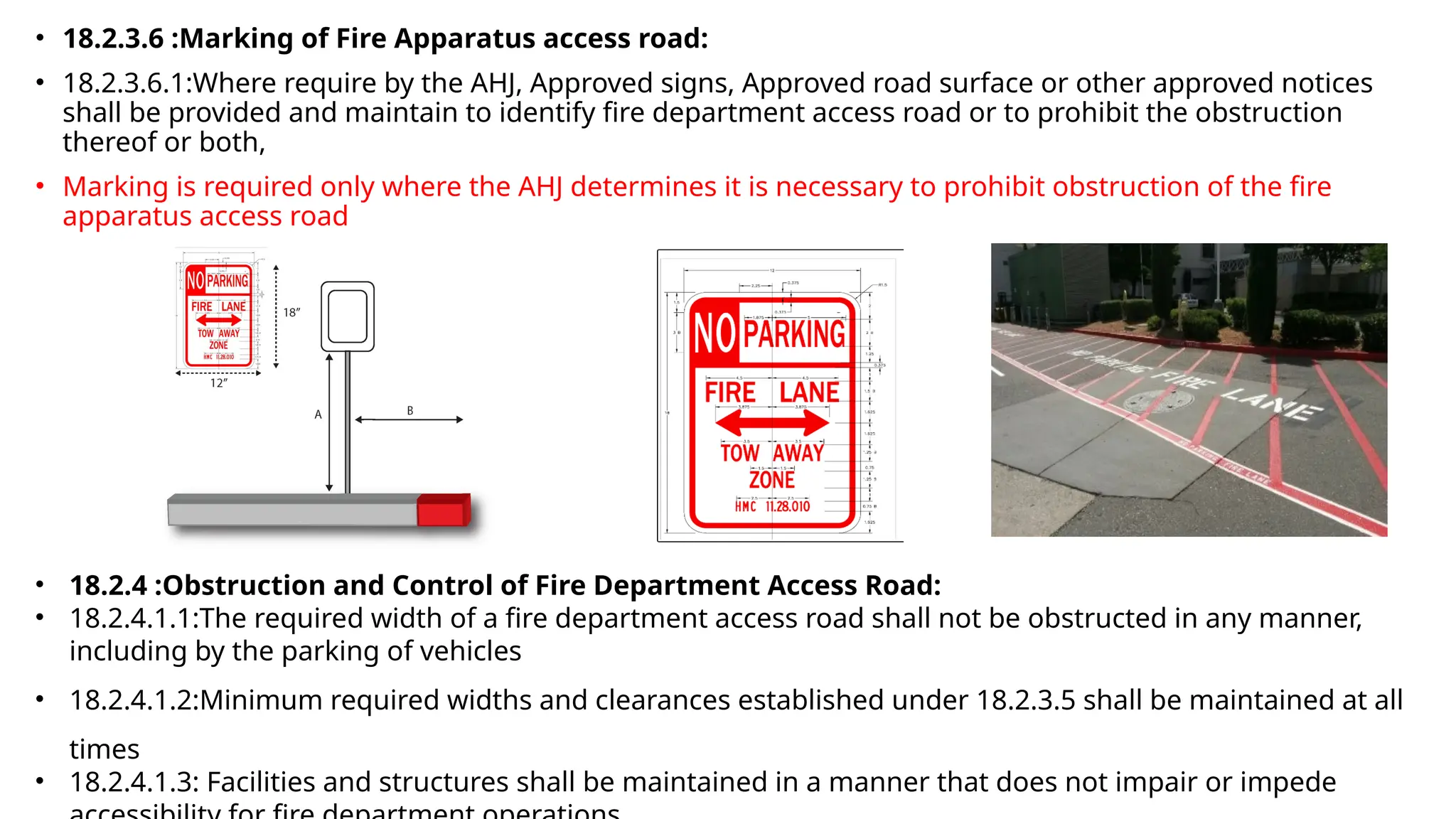
• 18.2.3.6.1:Where require by the AHJ, Approved signs, Approved road surface or other approved notices
shall be provided and maintain to identify fire department access road or to prohibit the obstruction
thereof or both,
• Marking is required only where the AHJ determines it is necessary to prohibit obstruction of the fire
apparatus access road
• 18.2.4 :Obstruction and Control of Fire Department Access Road:
• 18.2.4.1.1:The required width of a fire department access road shall not be obstructed in any manner,
including by the parking of vehicles
• 18.2.4.1.2:Minimum required widths and clearances established under 18.2.3.5 shall be maintained at all
times
• 18.2.4.1.3: Facilities and structures shall be maintained in a manner that does not impair or impede
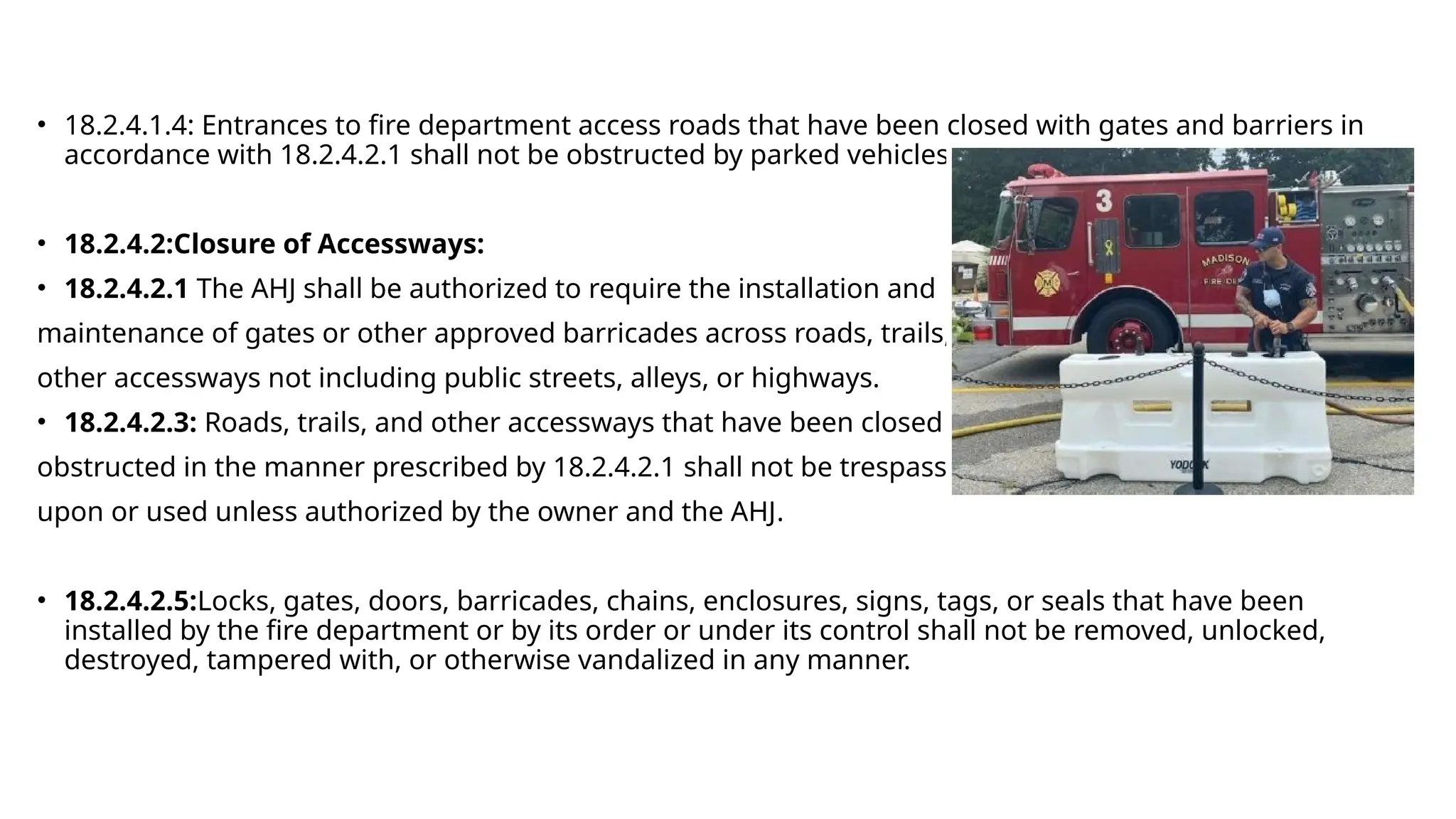
• 18.2.4.1.4: Entrances to fire department access roads that have been closed with gates and barriers in
accordance with 18.2.4.2.1 shall not be obstructed by parked vehicles
• 18.2.4.2:Closure of Accessways:
• 18.2.4.2.1 The AHJ shall be authorized to require the installation and
maintenance of gates or other approved barricades across roads, trails, or
other accessways not including public streets, alleys, or highways.
• 18.2.4.2.3: Roads, trails, and other accessways that have been closed and
obstructed in the manner prescribed by 18.2.4.2.1 shall not be trespassed
upon or used unless authorized by the owner and the AHJ.
• 18.2.4.2.5:Locks, gates, doors, barricades, chains, enclosures, signs, tags, or seals that have been
installed by the fire department or by its order or under its control shall not be removed, unlocked,
destroyed, tampered with, or otherwise vandalized in any manner.
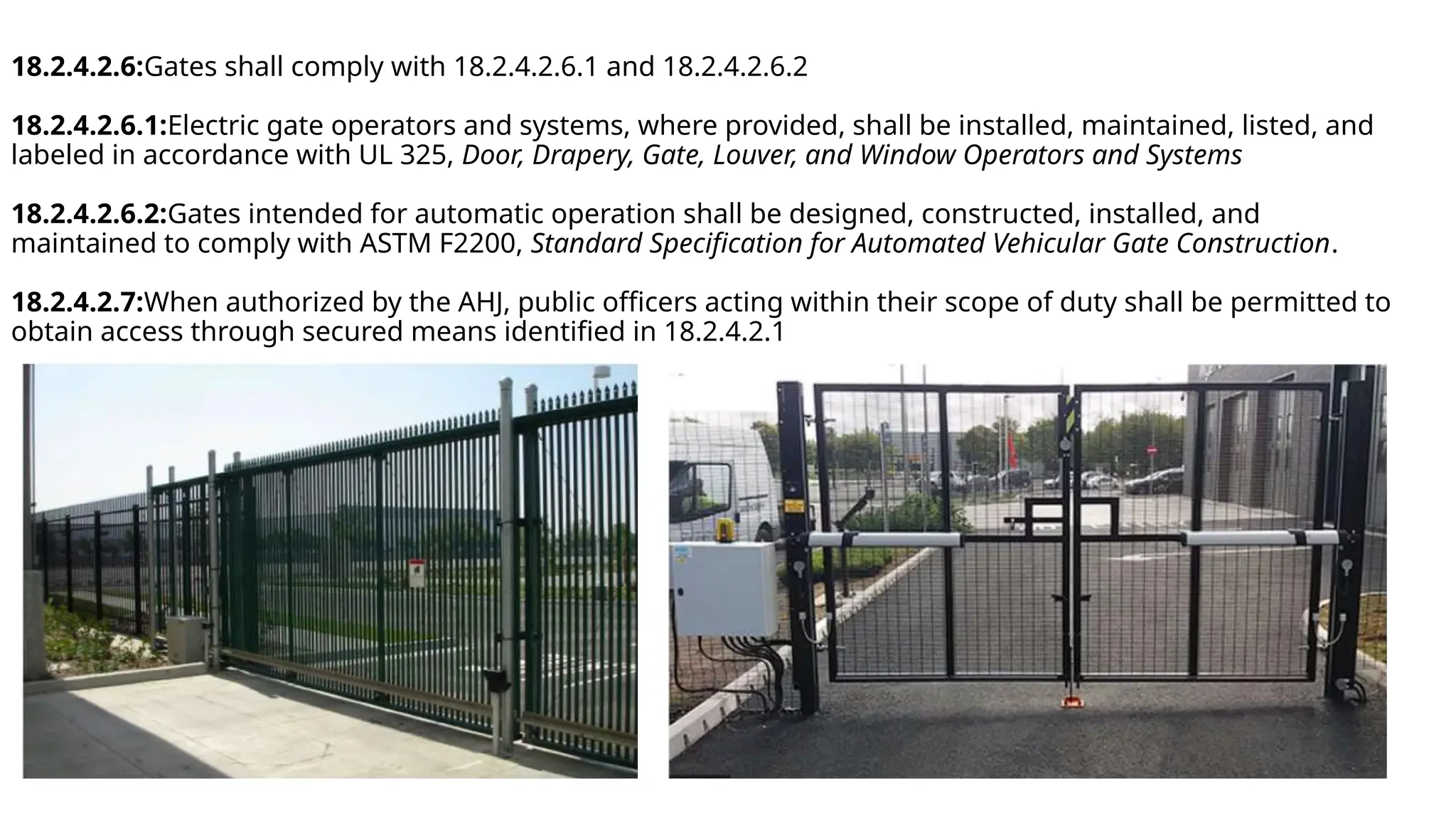
18.2.4.2.6:Gates shall comply with 18.2.4.2.6.1 and 18.2.4.2.6.2
18.2.4.2.6.1:Electric gate operators and systems, where provided, shall be installed, maintained, listed, and
labeled in accordance with UL 325, Door, Drapery, Gate, Louver, and Window Operators and Systems
18.2.4.2.6.2:Gates intended for automatic operation shall be designed, constructed, installed, and
maintained to comply with ASTM F2200, Standard Specification for Automated Vehicular Gate Construction.
18.2.4.2.7:When authorized by the AHJ, public officers acting within their scope of duty shall be permitted to
obtain access through secured means identified in 18.2.4.2.1
18.3 Water Supplies for Fire Flow
• 18.3.1: An approved water supply capable of supplying the required fire flow for fire protection shall be
provided to all premises upon which buildings are constructed or moved into the jurisdiction. Approved
water supply shall be in accordance with Section 18.4
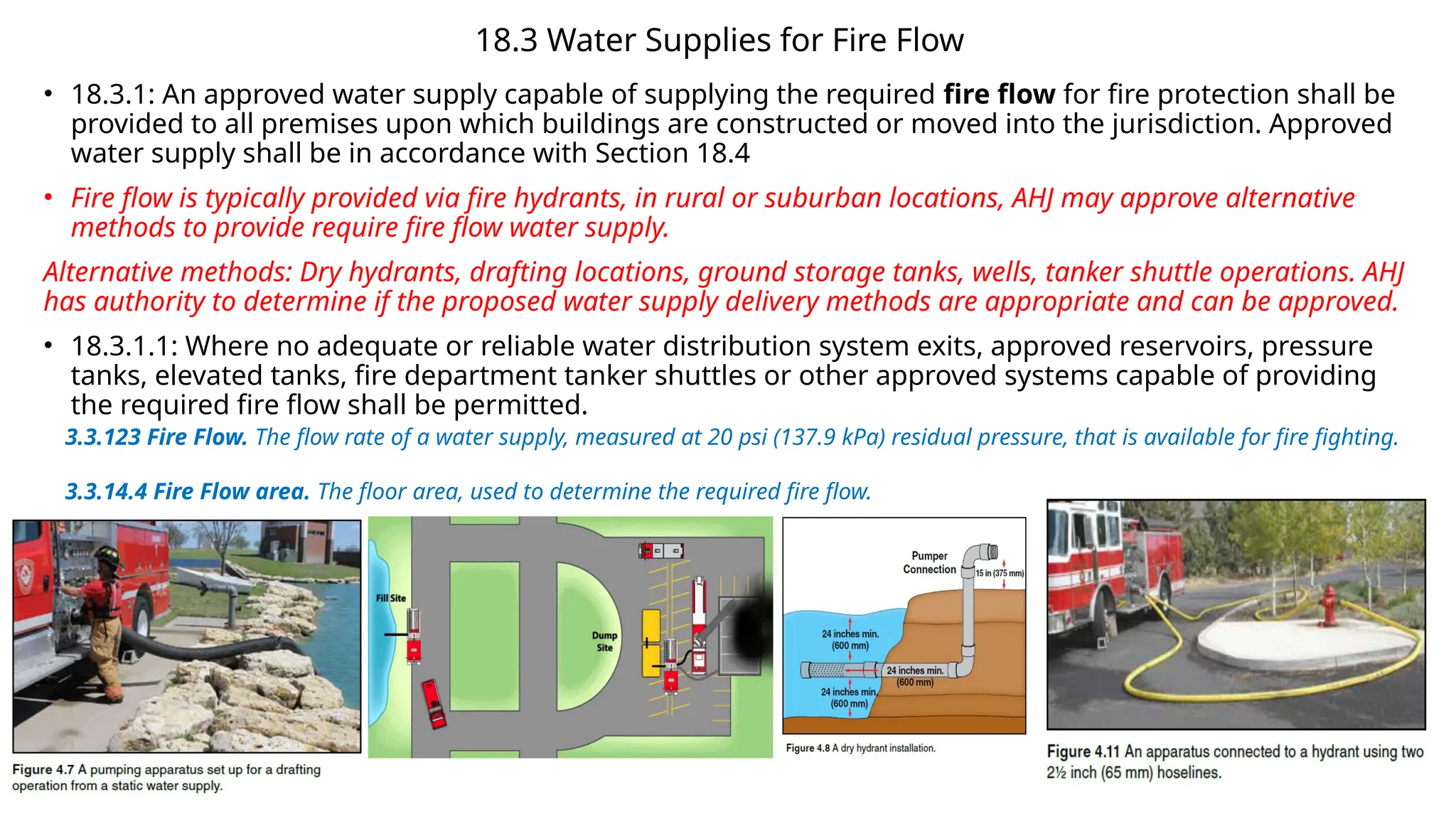
• Fire flow is typically provided via fire hydrants, in rural or suburban locations, AHJ may approve alternative
methods to provide require fire flow water supply.
Alternative methods: Dry hydrants, drafting locations, ground storage tanks, wells, tanker shuttle operations. AHJ
has authority to determine if the proposed water supply delivery methods are appropriate and can be approved.
• 18.3.1.1: Where no adequate or reliable water distribution system exits, approved reservoirs, pressure
tanks, elevated tanks, fire department tanker shuttles or other approved systems capable of providing
the required fire flow shall be permitted.
3.3.123 Fire Flow. The flow rate of a water supply, measured at 20 psi (137.9 kPa) residual pressure, that is available for fire fighting.
3.3.14.4 Fire Flow area. The floor area, used to determine the required fire flow.
18.4 Fire Flow requirements for Buildings
• AHJ has the final authority to determine if the proposed water supply delivery method are appropriate and can
be approved.
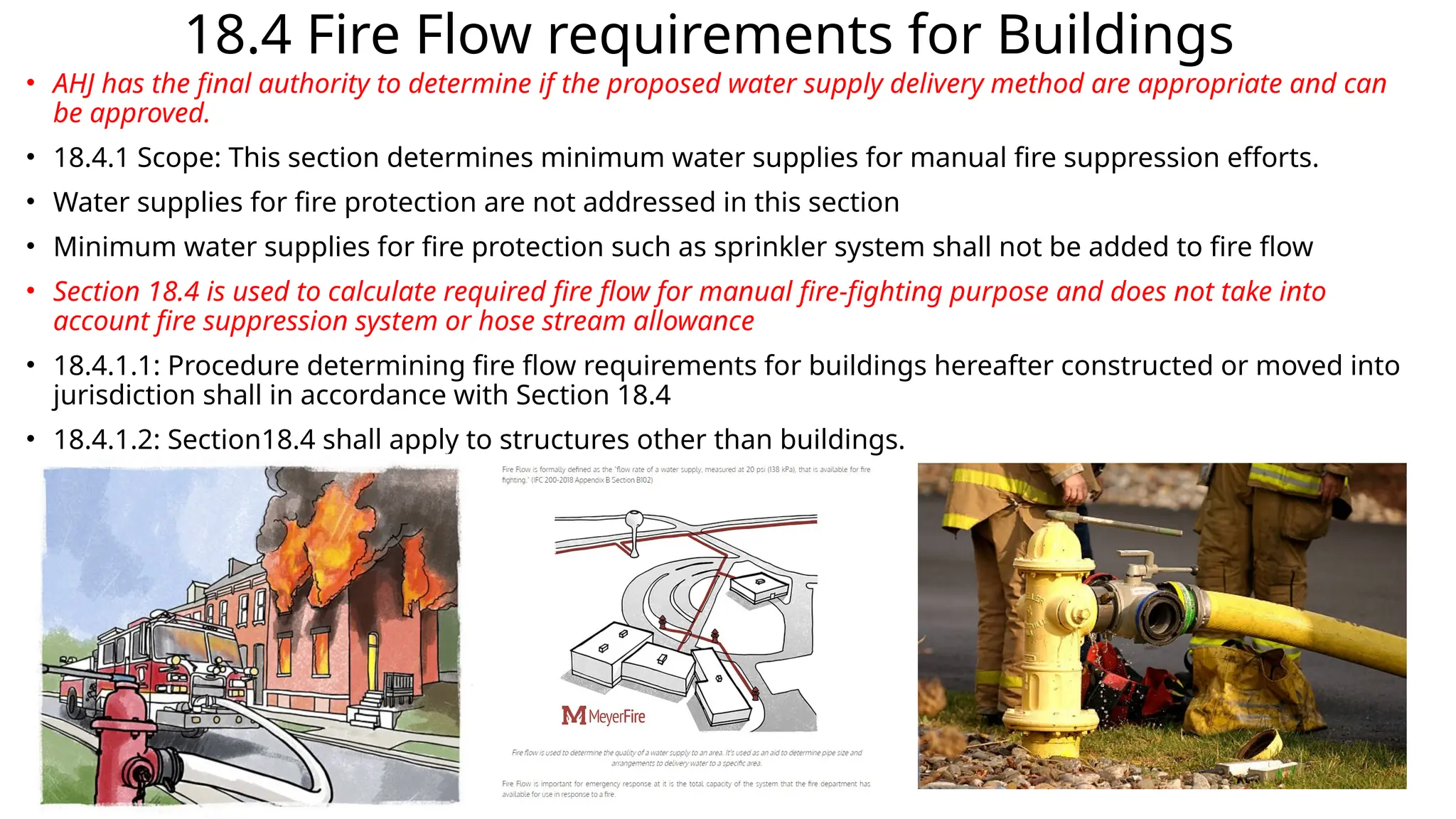
• 18.4.1 Scope: This section determines minimum water supplies for manual fire suppression efforts.
• Water supplies for fire protection are not addressed in this section
• Minimum water supplies for fire protection such as sprinkler system shall not be added to fire flow
• Section 18.4 is used to calculate required fire flow for manual fire-fighting purpose and does not take into
account fire suppression system or hose stream allowance
• 18.4.1.1: Procedure determining fire flow requirements for buildings hereafter constructed or moved into
jurisdiction shall in accordance with Section 18.4
• 18.4.1.2: Section18.4 shall apply to structures other than buildings.
• 18.4.3.1: Decrease in Fire Flow Requirements
• Reducing the fire flow is at the sole discretion of the AHJ
• 18.4.3.1.1 Fire flow requirements shall be permitted to be decreased by AHJ for:
- Isolated building or group of buildings in rural or suburban areas where development of full fire flow
requirements is impractical as determined by AHJ.
- The intent of 18.4.3.1.1 is to provide limited flexibility in those circumstances where there is no water supply
available and fire department capability to deliver water via a tanker shuttle or drafting operations are also
limited.
- 18.4.3.1.2: The AHJ shall be authorized to establish conditions on fire flow reductions approved in
accordance with 18.4.3.1.1
- 18.4.3.1: Increase in Fire Flow Requirements
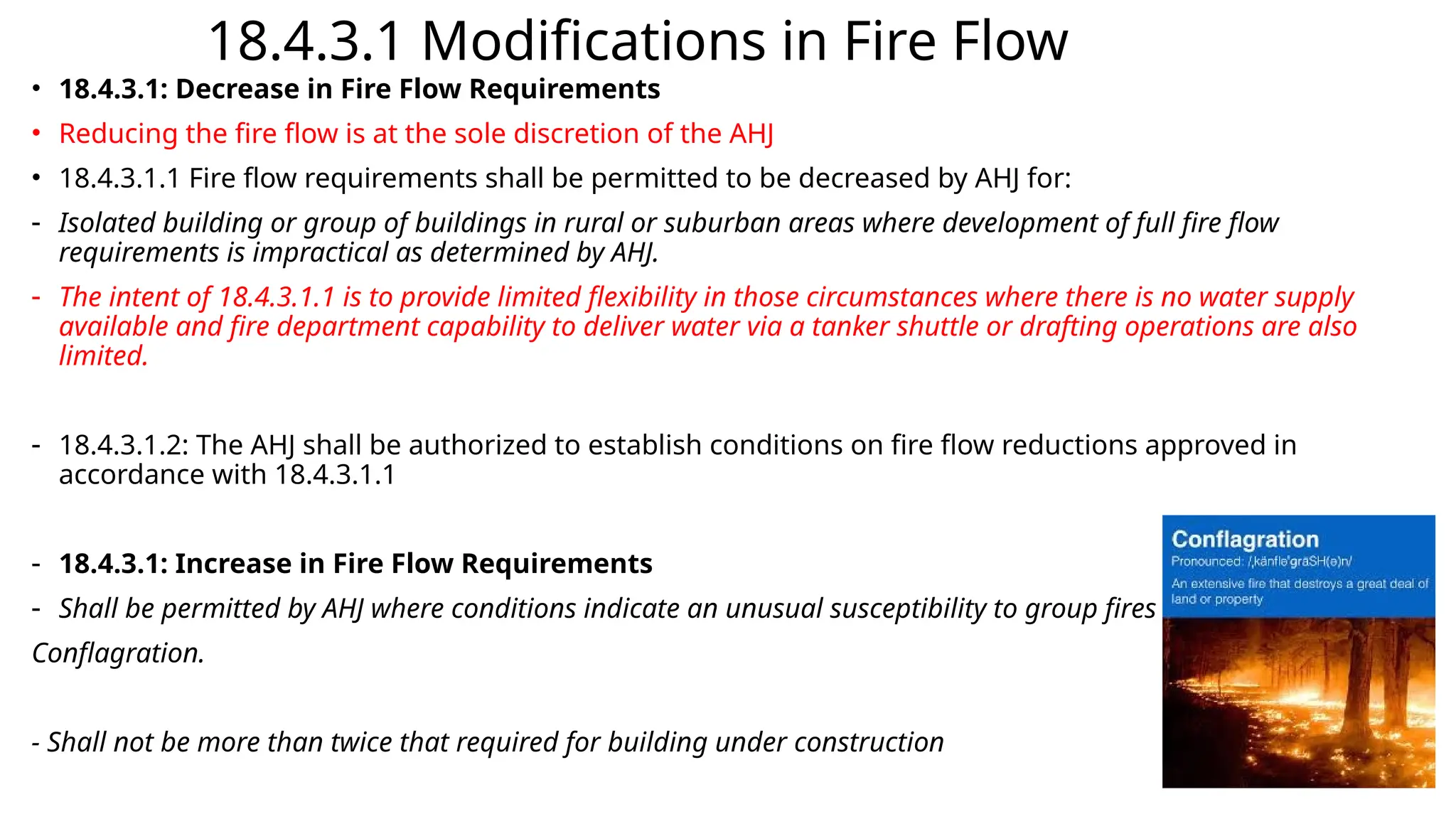
- Shall be permitted by AHJ where conditions indicate an unusual susceptibility to group fires or
Conflagration.
- Shall not be more than twice that required for building under construction
18.4.3.1 Modifications in Fire Flow
18.4.4 Fire Flow Area
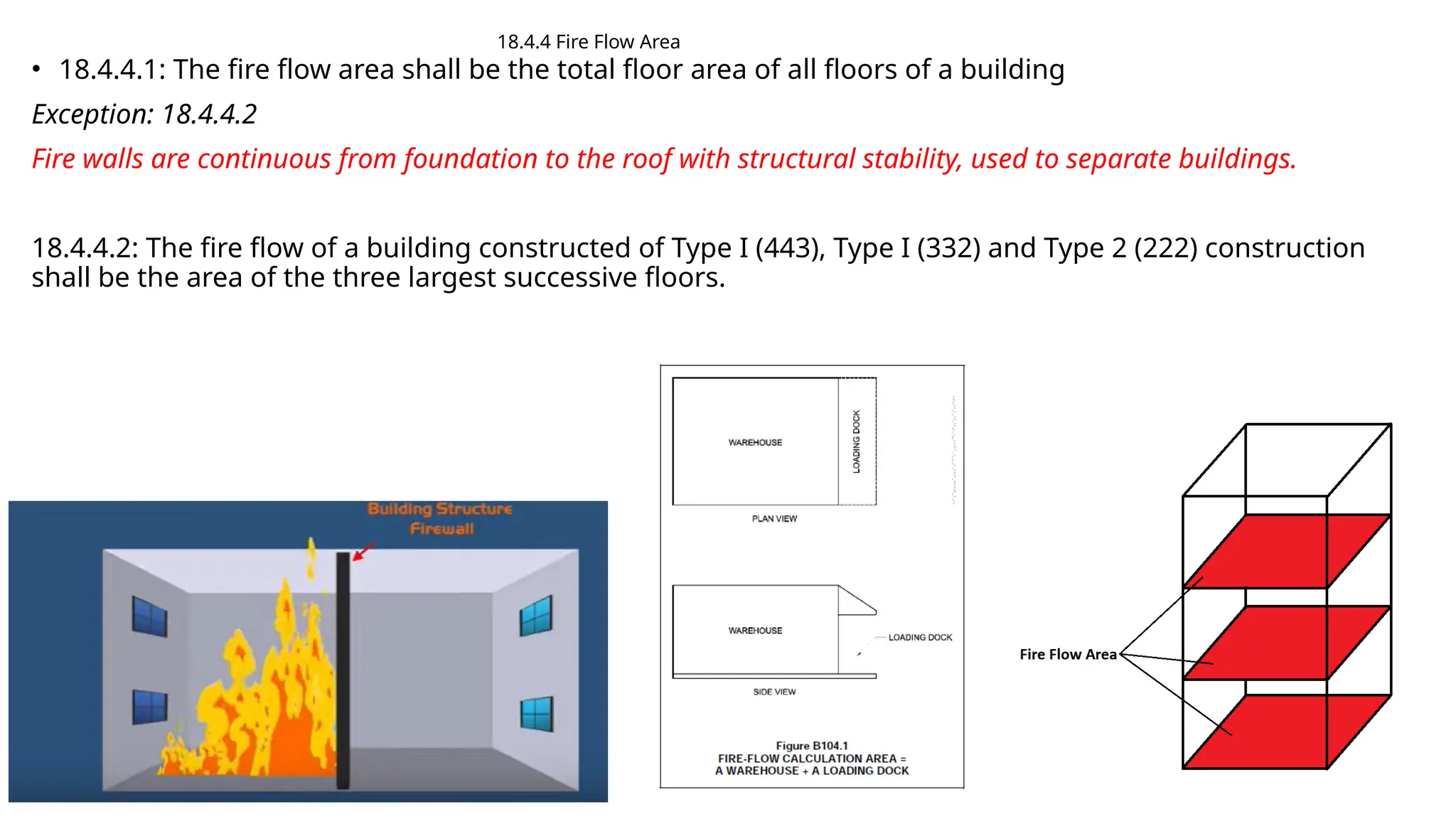
• 18.4.4.1: The fire flow area shall be the total floor area of all floors of a building
Exception: 18.4.4.2
Fire walls are continuous from foundation to the roof with structural stability, used to separate buildings.
18.4.4.2: The fire flow of a building constructed of Type I (443), Type I (332) and Type 2 (222) construction
shall be the area of the three largest successive floors.
18.4.5 Fire Flow Requirements for
Buildings
• 18.4.5.1 One- and Two-Family Dwellings fire flow area not exceeding 464.5 m2:
- Minimum fire flow and flow duration shall be 1000 GPM for 1 hour.
- A reduction in required fire flow of 75% shall be permitted where one- and two-family dwellings is
provided with an approved automatic sprinkler system
- Approved automatic sprinkler system shall meet NFPA 13, 13D and 13R
• 18.4.5.1.3: Where one- and two-family dwellings are proposed to be constructed in areas where water
distribution system providing fire flow were designed and installed prior to effective date of this code, AHJ
shall be authorized to accept previously designed fire flow where one- and two-family dwellings are
provided with approved automatic sprinkler systems.
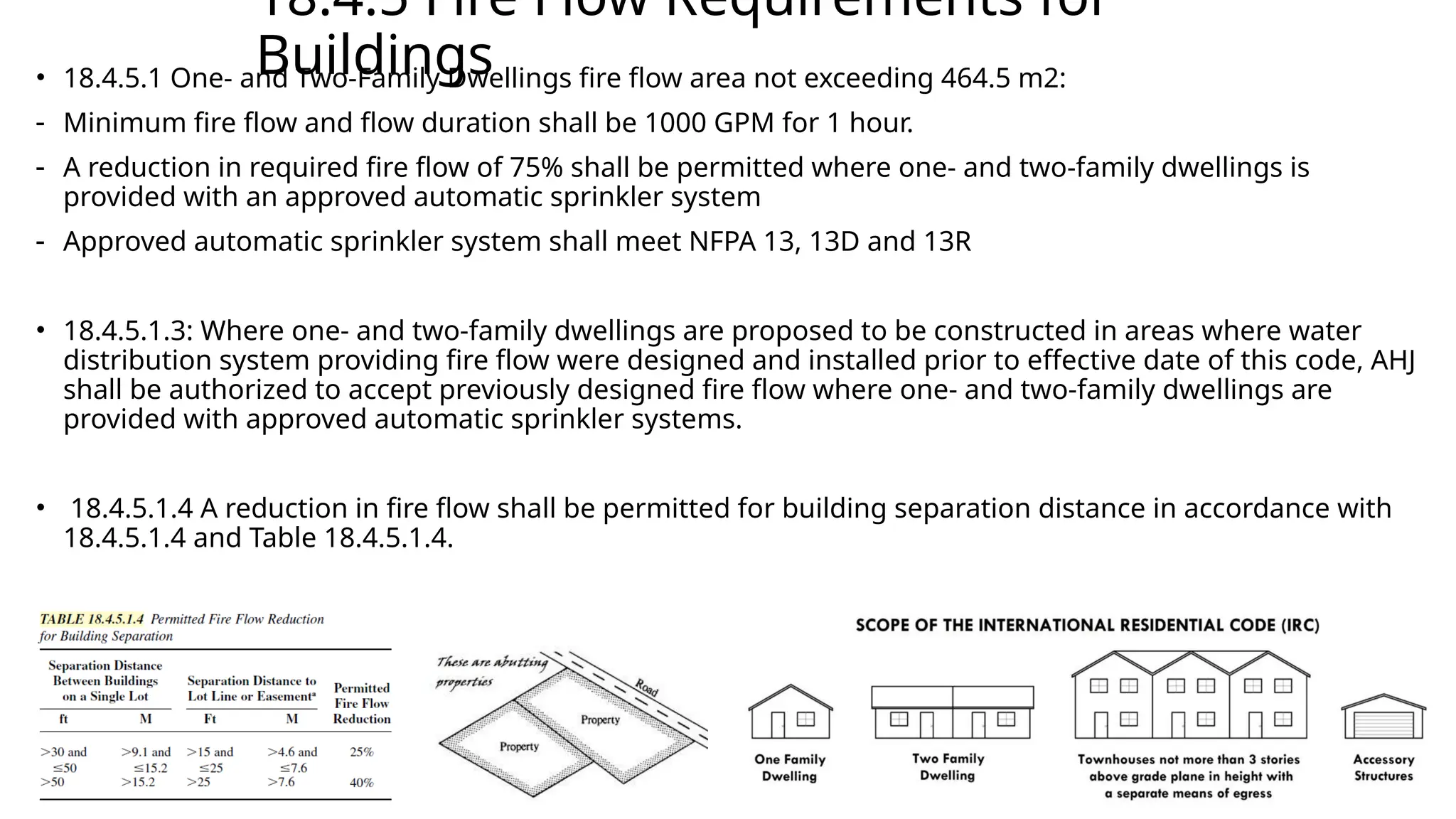
• 18.4.5.1.4 A reduction in fire flow shall be permitted for building separation distance in accordance with
18.4.5.1.4 and Table 18.4.5.1.4.
• 18.4.5.1.5* The reductions in 18.4.5.1.2, 18.4.5.1.3, and 18.4.5.1.4 shall not reduce the required fire flow to
less than 500 gpm (1900 L/min)
• A.18.4.5.1.5 The fire flow reductions specified in 18.4.5.1.2,18.4.5.1.3, and 18.4.5.1.4 are permitted to be
combined. However, where the reductions are combined, the resulting required fire flow is not permitted to
be reduced to less than 500 gpm (1900 L/min) for 1 hour
• 18.4.5.2 One- and Two-Family Dwellings Exceeding 5000 ft2 (464.5 m2).
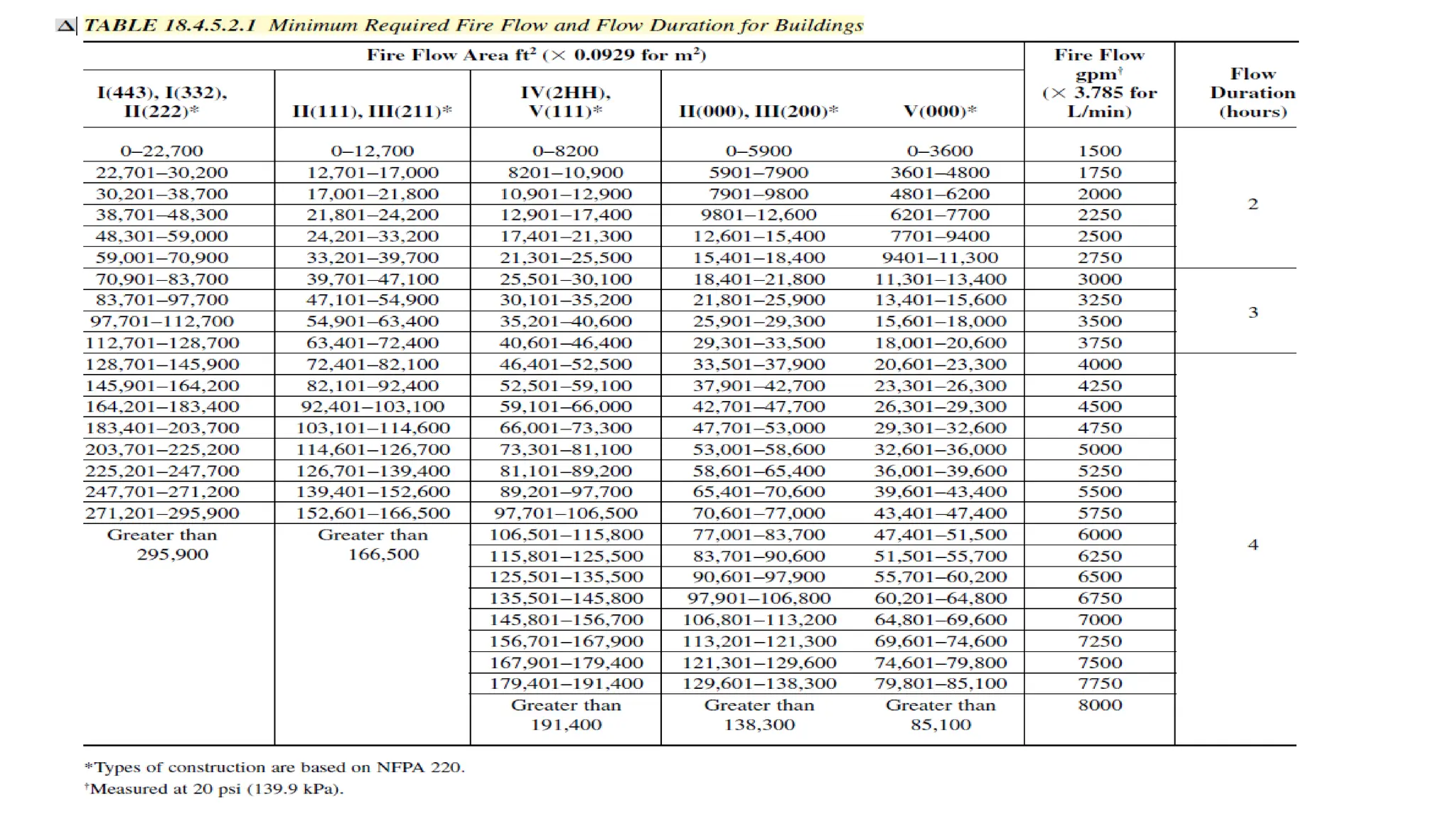
• 18.4.5.2.1 Fire flow and flow duration for dwellings having a fire flow area in excess of 5000 ft2 (464.5 m2)
shall not be less than that specified in Table 18.4.5.2.1.
• 18.4.5.2.2 Required fire flow shall be reduced by 75 percent and the duration reduced to 1 hour where the
one- and two-family dwelling is provided with an approved automatic sprinkler system.
• 18.4.5.2.3 A reduction in the required fire flow shall be permitted where a one- and two-family dwelling is
separated from all lot lines in accordance with Table 18.4.5.1.4.
• 18.4.5.2.4 Required fire flow for one- and two-family dwellings protected by an approved automatic sprinkler
system shall not exceed 2000 gpm (7571 L/min) for 1 hour.
• 18.4.5.2.5* The reductions in 18.4.5.2.2, and 18.4.5.2.3 shall not reduce the required fire flow to less than 500
gpm (1900 L/min) for 1 hour.
• A.18.4.5.2.5 The fire flow reductions specified in 18.4.5.2.2 and 18.4.5.2.3 are permitted to be combined.
However, where the reductions are combined, the resulting required fire flow is not permitted to be reduced
to less than 500 gpm (1900 L/min) for 1 hour.
• 18.4.5.3 Buildings Other Than One- and Two-Family Dwellings.
• Example
• Determine the required fire flow for a building of Type II (000) construction with a fire flow area of 26,000 ft2
(2415 m2) that is sprinklered with standard response sprinklers in accordance with NFPA 13.
• 18.4.5.3.3 Required fire flow shall be reduced by 75 percent when the building is protected throughout by an
approved automatic sprinkler system, which utilizes quick response sprinklers throughout. The resulting fire
flow shall not be less than 600 gpm (2270 L/min).
• 18.4.5.3.4* Required fire flow for buildings protected by an approved automatic sprinkler system shall not
exceed 2000 gpm (7571 L/min) for 2 hours.
• A.18.4.5.3.4 The provision of 18.4.5.3.4 is intended to limit the required fire flow duration to not more than 2
hours where the building is sprinklered. The 2000 gpm (7571 L/min) limit is based on a 75% reduction of
8000 gpm (30,283 L/min), which is the maximum fire flow required by Table 18.4.5.2.1. The required 2-hour
duration is consistent with the maximum hose stream duration requirements of NFPA 13.
• 18.4.5.3.5 Required fire flow for open parking structures that are not protected throughout by an approved
automatic sprinkler system shall be reduced by 75 percent where all of the following conditions are met:
(1) The structure complies with the building code.
(2) The structure is of Type I or Type II construction.
(3) The structure is provided with a Class I standpipe system in accordance with NFPA 14. Class I standpipe
systems of the manual dry type shall be permitted.
(4) The resulting fire flow is not less than 1000 gpm (3785 L/min).

NFPA 1 Chapter 18 Fire Department Access.pptx

  • 1.
    NFPA 1 Chapter18: Fire Department Access and Water Supply  Fire Department access fire lane marking requirements  Minimum water supply requirements for manual fire suppression operations  Fire Hydrant spacing
  • 2.
    • Section 18Applies to both public and privately owned fire apparatus access roads. • Section 18.2 for fire department access and access road provision and maintenance. Access Box Definition as per NFPA 1: • 3.3.2: An approved secure box, accessible by the AHJ’s master key or control, containing entrance keys or other devices to gain access to a structure or area. Access Box(es): • 18.2.2.1: Access Box(es): AHJ shall have authority to require an access box(es) to be installed in accessible location, where access to structure or area is difficult because of security • Access box(es): Approved type listed in accordance with UL 1037 • Heavy duty key repository boxes provide a high security system that ensures that only fire department can access the keys or other devices within them. • Some fire department require access boxes to be mounted on the wall at a height of 3m to 3.66m to prevent lock from being vandalized. Fire department can quickly access the box using a ladder from the apparatus
  • 3.
  • 4.
    • 18.2.2.2: Accessto gated subdivision or developments: AHJ shall have authority to require fire department access be provided to gated subdivisions or developments through the use of an approved device or systems. • 18.2.2.3: Access maintenance: The owner of a structure or area shall notify AHJ when the access is modified in a manner that could prevent fire department access. • All building owners with access boxes, gated developments should be notified in writing that they should contact the fire department when any front door, gate access programming or other specified locks are changed
  • 5.
    18.2.3 FIRE DEPARTMENTACCESS ROADS • 18.2.3.1: Required Access • 18.2.3.1.1: Approved fire department access roads shall be provided for every facility, building or portion of a building hereafter constructed or relocated. • This is to provide effective manual fire suppression operations. And applicable for both public and private roadway. • Code does not require modification of previously approved access to existing buildings • Refer 16.1.4 for Fire department access road in Building under Construction • 16.1.4 Fire department access roads provided in accordance with 18.2.3 shall be provided at the start of a project and shall be maintained throughout construction. • 3.3.126* Fire Lane. A fire department access road, which is marked with approved signs or other approved notices. • A.3.3.126 Fire Lane. The traditional term fire lane is no longer utilized in this Code. However, a fire department access road that is marked and prohibits obstructions in accordance with 18.2.3.6 would meet the traditional intent of a fire lane.
  • 6.
    APPROVED SIGNS/ APPROVEDNOTICE FOR FIRE LANE
  • 7.
    • 18.2.3.1.2: Firedepartment access roads shall consist of roadways, fire lanes, parking lot lanes or a combination thereof. • 18.2.3.1.4: Where fire department access roads cannot be installed due to location on property, topography, waterways or similar conditions, AHJ shall be authorized to require additional fire protection features. • Example: Zero lot line building in downtown area with no access to sides or rear of the buildings. • Additional fire protection could be in the form of an automatic sprinkler system and standpipe system where not otherwise required.
  • 8.
    18.2.3.2: FIRE DEPARTMENTACCESS TO BUILDING • 18.2.3.2.1: A Fire department access road shall extend to within 50 ft (15 m) of at least one exterior door that can be opened from the outside and that provides access to interior of the building • Fire department typically carry 46m or 61m of preconnected hose lines on their apparatus. Firefighters can extend hose lines 30m to 46m into the building without undue delay • 18.2.3.2.1.1: Where one- or two-family dwelling, or townhouse is protected by an approved automatic sprinkler system, installed as per Section 13.3, the distance of 15m in 18.2.3.2.1 shall be permitted to be increased to 46m. (150 feet) • 18.2.3.2.2: Any portion of the facility or any portion of an exterior wall of first story of the building shall be located not more than 46m (150 feet) from fire department access roads. • 18.2.3.2.2.1: When buildings are protected throughout with an approved automatic sprinkler system installed as per NFPA 13, 13D, 13R, the distance of 46 m (150 ft) in 18.2.3.2.2 shall be permitted to be increased to 137m (450 ft)
  • 9.
    • 18.2.3.3: MultipleAccess Roads: More than one fire department access road shall be provided when it is determined by the AHJ that access by a single road could be impaired by vehicle congestion, condition or terrain, climate conditions or other conditions that could limit access. • 18.2.3.4: Traffic Signal Pre-emption: Where fire department apparatus are equipped with traffic signal pre-emption devices, newly installed traffic signals shall be equipped with traffic signal pre-emption. • These systems reduce the risk of accidents in intersections during emergency response .
  • 10.
    18.2.3.5: FIRE DEPARTMENTACCESS SPECIFICATIONS Refer A policy on geometric design of Highways and Streets published by AASHTO. (transportation.org) • 18.2.3.5.1 Dimensions: • 18.2.3.5.1.1: Fire department access roads shall have an unobstructed width of not less than 6.1m (20feet) • 6.1m allows for two-way vehicular traffic – one fire apparatus to pass and another to work at fire hydrant or conduct aerial operations • A.18.2.3.5.1.1: When parking is permitted, the unobstructed width is not intended to include the width of the parking • 18.2.3.5.1.1.1: Where approved by AHJ, width of access road shall be permitted to be less than 6.1 m( 20 feet) • One condition for reduced access width would be intended travel in one direction only. • 18.2.3.5.1.1.2: Fire department access road with shall be increased when minimum width 18.2.3.5.1.1 (6.1 m) is not adequate to accommodate fire apparatus • Example: Access road where on-street parking is permitted
  • 11.
    • 18.2.3.5.1.2: Unobstructedvertical clearance for fire department access road – not less than 4.1 m ( 13 ft 6 in) • This is to ensure that fire apparatus can safe This is to ensure safely pass under power lines, bridges and other obstructions. • 18.2.3.5.1.2.1: Vertical clearance shall be permitted to be reduced where approved by AHJ. Such reduction shall not impair fire apparatus access and approved signs are installed and maintained indicating the established vertical clearance when approved. • 18.2.3.5.1.2.2: Vertical clearances shall be increased when vertical clearances are not adequate to accommodate fire apparatus. • Example: Aircraft rescue fire fighting vehicle (ARFF) in areas on and adjacent to airports • 18.2.3.5.2: Surface: Fire department access roads shall be designed and maintained to support the imposed loads of fire apparatus and shall be provided with an all-weather driving surface. • A.18.2.3.5.2: NFPA 1901 limits the pressure over the ground contact under the apparatus stabilizer to 75 psi ( 517 kPa). This 75 psi with
  • 12.
    • 18.2.3.5.3: TurningRadius • 18.2.3.5.3.1: The turning radius of a fire department access road shall be approved by AHJ Turning radius are determined using software solutions • 18.2.3.5.3.2: Turns in fire department access roads shall maintain the minimum road width • 18.2.3.5.3.3: Fire department access roads connecting to roadways shall be provided with curb cuts extending at least 2 ft (0.61 m) beyond each edge of the fire department access road. • 18.2.3.5.4 Dead Ends: Dead-end fire department access roads in excess of 150 ft (46 m) in length shall be provided with approved provisions for fire apparatus to turn around. • Acceptable turn around – U turn, T-turn or Y-turn
  • 14.
    • 18.2.3.5.5: Bridges: •18.2.3.5.5.1: Where bridge is required, it shall be constructed and maintained in accordance with nationally recognized standards. • Most used NRS is Standard specifications for Highway bridges – AASHTO. • 18.2.3.5.5.2: Bridge shall be designed to support the live load of heaviest piece of Fire apparatus. • 18.2.3.5.5.3: Vehicle load limits shall be posted at both entrance to bridges where required by AHJ. • 18.2.3.5.6: Grade: • 18.2.3.5.6.1: The gradient shall not exceed the design limitations of fire apparatus of the fire department and subject to AHJ approval. • 18.2.3.5.6.2: The angle of approach and departure shall not exceed 1 ft drop in 20ft (0.3m drop in 6m) or design limitation of fire apparatus and subject to AHJ
  • 15.
    • 18.2.3.5.7: Trafficcalming devices: • The design and use of traffic calming devices shall be approved by the AHJ.
  • 16.
    • 18.2.3.6 :Markingof Fire Apparatus access road: • 18.2.3.6.1:Where require by the AHJ, Approved signs, Approved road surface or other approved notices shall be provided and maintain to identify fire department access road or to prohibit the obstruction thereof or both, • Marking is required only where the AHJ determines it is necessary to prohibit obstruction of the fire apparatus access road • 18.2.4 :Obstruction and Control of Fire Department Access Road: • 18.2.4.1.1:The required width of a fire department access road shall not be obstructed in any manner, including by the parking of vehicles • 18.2.4.1.2:Minimum required widths and clearances established under 18.2.3.5 shall be maintained at all times • 18.2.4.1.3: Facilities and structures shall be maintained in a manner that does not impair or impede
  • 17.
    • 18.2.4.1.4: Entrancesto fire department access roads that have been closed with gates and barriers in accordance with 18.2.4.2.1 shall not be obstructed by parked vehicles • 18.2.4.2:Closure of Accessways: • 18.2.4.2.1 The AHJ shall be authorized to require the installation and maintenance of gates or other approved barricades across roads, trails, or other accessways not including public streets, alleys, or highways. • 18.2.4.2.3: Roads, trails, and other accessways that have been closed and obstructed in the manner prescribed by 18.2.4.2.1 shall not be trespassed upon or used unless authorized by the owner and the AHJ. • 18.2.4.2.5:Locks, gates, doors, barricades, chains, enclosures, signs, tags, or seals that have been installed by the fire department or by its order or under its control shall not be removed, unlocked, destroyed, tampered with, or otherwise vandalized in any manner.
  • 18.
    18.2.4.2.6:Gates shall complywith 18.2.4.2.6.1 and 18.2.4.2.6.2 18.2.4.2.6.1:Electric gate operators and systems, where provided, shall be installed, maintained, listed, and labeled in accordance with UL 325, Door, Drapery, Gate, Louver, and Window Operators and Systems 18.2.4.2.6.2:Gates intended for automatic operation shall be designed, constructed, installed, and maintained to comply with ASTM F2200, Standard Specification for Automated Vehicular Gate Construction. 18.2.4.2.7:When authorized by the AHJ, public officers acting within their scope of duty shall be permitted to obtain access through secured means identified in 18.2.4.2.1
  • 19.
    18.3 Water Suppliesfor Fire Flow • 18.3.1: An approved water supply capable of supplying the required fire flow for fire protection shall be provided to all premises upon which buildings are constructed or moved into the jurisdiction. Approved water supply shall be in accordance with Section 18.4 • Fire flow is typically provided via fire hydrants, in rural or suburban locations, AHJ may approve alternative methods to provide require fire flow water supply. Alternative methods: Dry hydrants, drafting locations, ground storage tanks, wells, tanker shuttle operations. AHJ has authority to determine if the proposed water supply delivery methods are appropriate and can be approved. • 18.3.1.1: Where no adequate or reliable water distribution system exits, approved reservoirs, pressure tanks, elevated tanks, fire department tanker shuttles or other approved systems capable of providing the required fire flow shall be permitted. 3.3.123 Fire Flow. The flow rate of a water supply, measured at 20 psi (137.9 kPa) residual pressure, that is available for fire fighting. 3.3.14.4 Fire Flow area. The floor area, used to determine the required fire flow.
  • 20.
    18.4 Fire Flowrequirements for Buildings • AHJ has the final authority to determine if the proposed water supply delivery method are appropriate and can be approved. • 18.4.1 Scope: This section determines minimum water supplies for manual fire suppression efforts. • Water supplies for fire protection are not addressed in this section • Minimum water supplies for fire protection such as sprinkler system shall not be added to fire flow • Section 18.4 is used to calculate required fire flow for manual fire-fighting purpose and does not take into account fire suppression system or hose stream allowance • 18.4.1.1: Procedure determining fire flow requirements for buildings hereafter constructed or moved into jurisdiction shall in accordance with Section 18.4 • 18.4.1.2: Section18.4 shall apply to structures other than buildings.
  • 21.
    • 18.4.3.1: Decreasein Fire Flow Requirements • Reducing the fire flow is at the sole discretion of the AHJ • 18.4.3.1.1 Fire flow requirements shall be permitted to be decreased by AHJ for: - Isolated building or group of buildings in rural or suburban areas where development of full fire flow requirements is impractical as determined by AHJ. - The intent of 18.4.3.1.1 is to provide limited flexibility in those circumstances where there is no water supply available and fire department capability to deliver water via a tanker shuttle or drafting operations are also limited. - 18.4.3.1.2: The AHJ shall be authorized to establish conditions on fire flow reductions approved in accordance with 18.4.3.1.1 - 18.4.3.1: Increase in Fire Flow Requirements - Shall be permitted by AHJ where conditions indicate an unusual susceptibility to group fires or Conflagration. - Shall not be more than twice that required for building under construction 18.4.3.1 Modifications in Fire Flow
  • 22.
    18.4.4 Fire FlowArea • 18.4.4.1: The fire flow area shall be the total floor area of all floors of a building Exception: 18.4.4.2 Fire walls are continuous from foundation to the roof with structural stability, used to separate buildings. 18.4.4.2: The fire flow of a building constructed of Type I (443), Type I (332) and Type 2 (222) construction shall be the area of the three largest successive floors.
  • 23.
    18.4.5 Fire FlowRequirements for Buildings • 18.4.5.1 One- and Two-Family Dwellings fire flow area not exceeding 464.5 m2: - Minimum fire flow and flow duration shall be 1000 GPM for 1 hour. - A reduction in required fire flow of 75% shall be permitted where one- and two-family dwellings is provided with an approved automatic sprinkler system - Approved automatic sprinkler system shall meet NFPA 13, 13D and 13R • 18.4.5.1.3: Where one- and two-family dwellings are proposed to be constructed in areas where water distribution system providing fire flow were designed and installed prior to effective date of this code, AHJ shall be authorized to accept previously designed fire flow where one- and two-family dwellings are provided with approved automatic sprinkler systems. • 18.4.5.1.4 A reduction in fire flow shall be permitted for building separation distance in accordance with 18.4.5.1.4 and Table 18.4.5.1.4.
  • 24.
    • 18.4.5.1.5* Thereductions in 18.4.5.1.2, 18.4.5.1.3, and 18.4.5.1.4 shall not reduce the required fire flow to less than 500 gpm (1900 L/min) • A.18.4.5.1.5 The fire flow reductions specified in 18.4.5.1.2,18.4.5.1.3, and 18.4.5.1.4 are permitted to be combined. However, where the reductions are combined, the resulting required fire flow is not permitted to be reduced to less than 500 gpm (1900 L/min) for 1 hour • 18.4.5.2 One- and Two-Family Dwellings Exceeding 5000 ft2 (464.5 m2). • 18.4.5.2.1 Fire flow and flow duration for dwellings having a fire flow area in excess of 5000 ft2 (464.5 m2) shall not be less than that specified in Table 18.4.5.2.1. • 18.4.5.2.2 Required fire flow shall be reduced by 75 percent and the duration reduced to 1 hour where the one- and two-family dwelling is provided with an approved automatic sprinkler system. • 18.4.5.2.3 A reduction in the required fire flow shall be permitted where a one- and two-family dwelling is separated from all lot lines in accordance with Table 18.4.5.1.4. • 18.4.5.2.4 Required fire flow for one- and two-family dwellings protected by an approved automatic sprinkler system shall not exceed 2000 gpm (7571 L/min) for 1 hour. • 18.4.5.2.5* The reductions in 18.4.5.2.2, and 18.4.5.2.3 shall not reduce the required fire flow to less than 500 gpm (1900 L/min) for 1 hour. • A.18.4.5.2.5 The fire flow reductions specified in 18.4.5.2.2 and 18.4.5.2.3 are permitted to be combined. However, where the reductions are combined, the resulting required fire flow is not permitted to be reduced to less than 500 gpm (1900 L/min) for 1 hour.
  • 26.
    • 18.4.5.3 BuildingsOther Than One- and Two-Family Dwellings. • Example • Determine the required fire flow for a building of Type II (000) construction with a fire flow area of 26,000 ft2 (2415 m2) that is sprinklered with standard response sprinklers in accordance with NFPA 13. • 18.4.5.3.3 Required fire flow shall be reduced by 75 percent when the building is protected throughout by an approved automatic sprinkler system, which utilizes quick response sprinklers throughout. The resulting fire flow shall not be less than 600 gpm (2270 L/min). • 18.4.5.3.4* Required fire flow for buildings protected by an approved automatic sprinkler system shall not exceed 2000 gpm (7571 L/min) for 2 hours. • A.18.4.5.3.4 The provision of 18.4.5.3.4 is intended to limit the required fire flow duration to not more than 2 hours where the building is sprinklered. The 2000 gpm (7571 L/min) limit is based on a 75% reduction of 8000 gpm (30,283 L/min), which is the maximum fire flow required by Table 18.4.5.2.1. The required 2-hour duration is consistent with the maximum hose stream duration requirements of NFPA 13. • 18.4.5.3.5 Required fire flow for open parking structures that are not protected throughout by an approved automatic sprinkler system shall be reduced by 75 percent where all of the following conditions are met: (1) The structure complies with the building code. (2) The structure is of Type I or Type II construction. (3) The structure is provided with a Class I standpipe system in accordance with NFPA 14. Class I standpipe systems of the manual dry type shall be permitted. (4) The resulting fire flow is not less than 1000 gpm (3785 L/min).