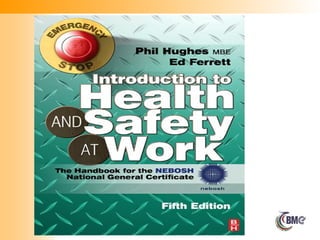
NEBOSH
NEBOSH
(The
(The N
National
ational E
Examination
xamination B
Board in
oard in O
Occupational
ccupational S
Safety and
afety and H
Health)
ealth)
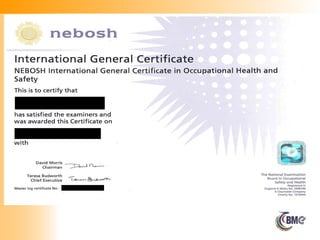
International General
Certificate in Occupational
Safety and Health (IGC)
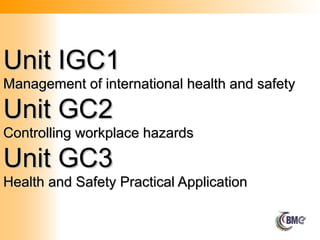
Unit IGC1
Unit IGC1
Management of international health and safety
Unit GC2
Unit GC2
Controlling workplace hazards
Unit GC3
Unit GC3
Health and Safety Practical Application
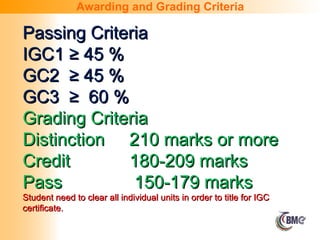
Passing Criteria
Passing Criteria
IGC1 ≥ 45 %
IGC1 ≥ 45 %
GC2 ≥ 45 %
GC2 ≥ 45 %
GC3 ≥ 60 %
GC3 ≥ 60 %
Grading Criteria
Grading Criteria
Distinction
Distinction 210 marks or more
210 marks or more
Credit
Credit 180-209 marks
180-209 marks
Pass
Pass 150-179 marks
150-179 marks
Student need to clear all individual units in order to title for IGC
certificate.
certificate.
Awarding and Grading Criteria
Unit IGC1
Unit IGC1
Management of
Management of
international health
and safety
and safety
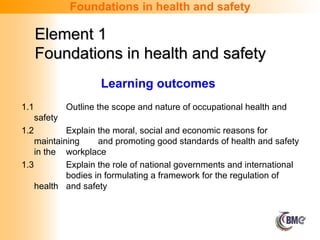
Learning outcomes
1.1 Outline the scope and nature of occupational health and
safety
1.2 Explain the moral, social and economic reasons for
maintaining and promoting good standards of health and safety
in the workplace
1.3 Explain the role of national governments and international
bodies in formulating a framework for the regulation of
health and safety
Foundations in health and safety
Element 1
Element 1
Foundations in health and safety
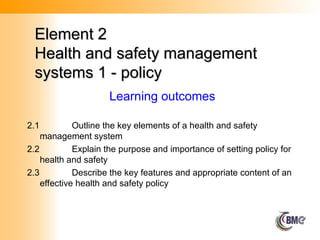
Element 2
Element 2
Health and safety management
systems 1 - policy
systems 1 - policy
2.1 Outline the key elements of a health and safety
management system
2.2 Explain the purpose and importance of setting policy for
health and safety
2.3 Describe the key features and appropriate content of an
effective health and safety policy
Learning outcomes
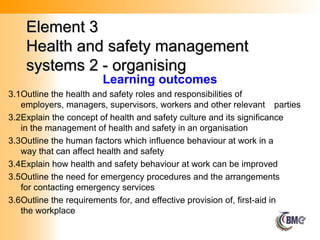
Element 3
Element 3
Health and safety management
systems 2 - organising
Learning outcomes
3.1Outline the health and safety roles and responsibilities of
employers, managers, supervisors, workers and other relevant parties
3.2Explain the concept of health and safety culture and its significance
in the management of health and safety in an organisation
3.3Outline the human factors which influence behaviour at work in a
way that can affect health and safety
3.4Explain how health and safety behaviour at work can be improved
3.5Outline the need for emergency procedures and the arrangements
for contacting emergency services
3.6Outline the requirements for, and effective provision of, first-aid in
the workplace
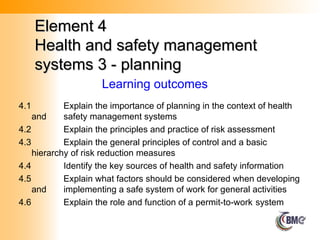
Element 4
Element 4
Health and safety management
systems 3 - planning
4.1 Explain the importance of planning in the context of health
and safety management systems
4.2 Explain the principles and practice of risk assessment
4.3 Explain the general principles of control and a basic
hierarchy of risk reduction measures
4.4 Identify the key sources of health and safety information
4.5 Explain what factors should be considered when developing
and implementing a safe system of work for general activities
4.6 Explain the role and function of a permit-to-work system
Learning outcomes
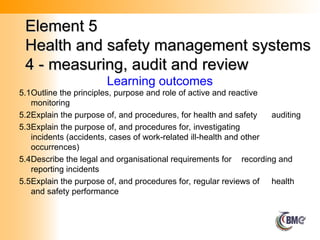
Element 5
Element 5
Health and safety management systems
4 - measuring, audit and review
Learning outcomes
5.1Outline the principles, purpose and role of active and reactive
monitoring
5.2Explain the purpose of, and procedures, for health and safety auditing
5.3Explain the purpose of, and procedures for, investigating
incidents (accidents, cases of work-related ill-health and other
occurrences)
5.4Describe the legal and organisational requirements for recording and
reporting incidents
5.5Explain the purpose of, and procedures for, regular reviews of health
and safety performance
Unit GC2
Unit GC2
Controlling workplace
hazards
hazards
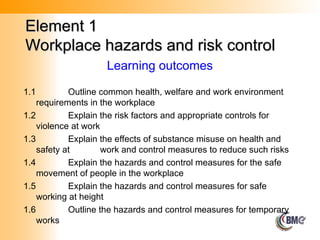
Element 1
Element 1
Workplace hazards and risk control
1.1 Outline common health, welfare and work environment
requirements in the workplace
1.2 Explain the risk factors and appropriate controls for
violence at work
1.3 Explain the effects of substance misuse on health and
safety at work and control measures to reduce such risks
1.4 Explain the hazards and control measures for the safe
movement of people in the workplace
1.5 Explain the hazards and control measures for safe
working at height
1.6 Outline the hazards and control measures for temporary
works
Learning outcomes
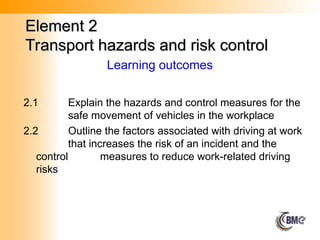
Element 2
Element 2
Transport hazards and risk control
2.1 Explain the hazards and control measures for the
safe movement of vehicles in the workplace
2.2 Outline the factors associated with driving at work
that increases the risk of an incident and the
control measures to reduce work-related driving
risks
Learning outcomes
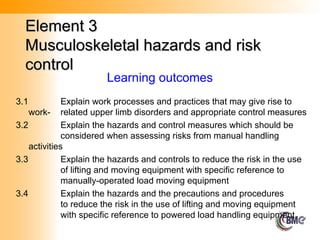
Element 3
Element 3
Musculoskeletal hazards and risk
control
control
Learning outcomes
3.1 Explain work processes and practices that may give rise to
work- related upper limb disorders and appropriate control measures
3.2 Explain the hazards and control measures which should be
considered when assessing risks from manual handling
activities
3.3 Explain the hazards and controls to reduce the risk in the use
of lifting and moving equipment with specific reference to
manually-operated load moving equipment
3.4 Explain the hazards and the precautions and procedures
to reduce the risk in the use of lifting and moving equipment
with specific reference to powered load handling equipment
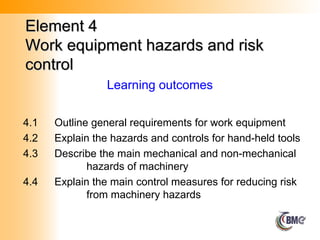
Element 4
Element 4
Work equipment hazards and risk
control
control
Learning outcomes
4.1 Outline general requirements for work equipment
4.2 Explain the hazards and controls for hand-held tools
4.3 Describe the main mechanical and non-mechanical
hazards of machinery
4.4 Explain the main control measures for reducing risk
from machinery hazards
Element 5
Element 5
Electrical safety
Electrical safety
5.1 Outline the principles, hazards and risks
associated with the use of electricity in the workplace
5.2 Outline the control measures that should be taken
when working with electrical systems or using
electrical equipment in all workplace conditions
Learning outcomes
Element 6
Element 6
Fire safety
Fire safety
6.1 Describe the principles of fire initiation,
classification and spread
6.2 Outline the principles of fire risk assessment
6.3 Describe the basic principles of fire prevention
and the prevention of fire spread in buildings
6.4 Outline the appropriate fire alarm system and fire-
fighting arrangements for a simple workplace
6.5 Outline the factors which should be considered
when implementing a successful evacuation of a
workplace in the event of a fire
Learning outcomes
Element 7
Element 7
Chemical and biological health hazards
and risk control
and risk control
7.1 Outline the forms of, the classification of, and health risks from
exposure to hazardous substances
7.2 Explain the factors to be considered when undertaking an
assessment of the health risks from substances commonly
encountered in the workplace
7.3 Explain the use and limitations of occupational exposure limits
including the purpose of long term and short term exposure limits
7.4 Outline control measures that should be used to reduce the risk of
ill-health from exposure to hazardous substances
7.5 Outline the hazards, risks and controls associated with specific
agents
7.6 Outline the basic requirements related to the safe handling and
Learning outcomes
Element 8
Element 8
Physical and psychological health
hazards and risk control
8.1 Outline the health effects associated with
exposure to noise and appropriate control measures
8.2 Outline the health effects associated with
exposure to vibration and appropriate control
measures
8.3 Outline the health effects associated with ionising
and non-ionising radiation and appropriate control
measures
8.4 Outline the meaning, causes and effects of work
related stress and appropriate control measures
Learning outcomes
Examination
Examination
IGC1 & GC2
IGC1 & GC2
IGC1
IGC1 Morning 9:00 AM to 11:00 AM
Morning 9:00 AM to 11:00 AM
GC2
GC2 Afternoon 2:00 PM to 4:00 PM
Afternoon 2:00 PM to 4:00 PM
30 minutes extra for non native English language
Question Paper Format
Total Questions 11
1st
Question of 20 marks
10 Question of 8 marks each
Mandatory to attend all questions
Examinations
Result
Result
Notification
Notification
70 days from the examination date
Certificates issued within 8 weeks from the date of
result notification.
Unit GC3
Unit GC3
Health and Safety
Health and Safety
Practical Application
Consist of practical workplace
observation sheets and
Management Report
Management Report
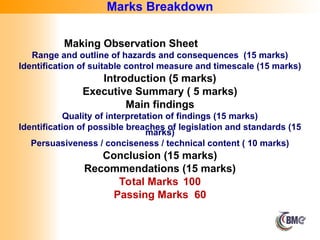
Marks Breakdown
Making Observation Sheet
Range and outline of hazards and consequences (15 marks)
Identification of suitable control measure and timescale (15 marks)
Introduction (5 marks)
Executive Summary ( 5 marks)
Main findings
Quality of interpretation of findings (15 marks)
Identification of possible breaches of legislation and standards (15
marks)
Persuasiveness / conciseness / technical content ( 10 marks)
Conclusion (15 marks)
Recommendations (15 marks)
Total Marks 100
Passing Marks 60
Professional Memberships
Affiliate Member
Everyone joins as an Affiliate Member.
Associate Member (AIOSH)
Certificate (NEBOSH),
Technical Member (Tech IOSH)
Certificate (NEBOSH)
Graduate Member (Grad IOSH)
Diploma (NEBOSH)
Chartered Member (CMIOSH)
Experience for progression to Chartered status is assessed
according to qualification route
Chartered Fellow CFIOSH
Minimum five years as Chartered Member Successful
application including portfolio and interview
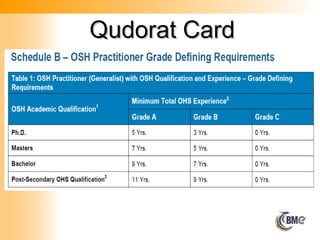
Qudorat Card
Qudorat Card
Qudorat Card
Qudorat Card
Qudorat Card
Qudorat Card
Thank
Thank
You
You

NEBOSH Internationl General Certificate.ppt

  • 1.
    NEBOSH NEBOSH (The (The N National ational E Examination xaminationB Board in oard in O Occupational ccupational S Safety and afety and H Health) ealth) International General International General Certificate in Occupational Certificate in Occupational Safety and Health (IGC) Safety and Health (IGC)
  • 3.
    Unit IGC1 Unit IGC1 Managementof international health and safety Management of international health and safety Unit GC2 Unit GC2 Controlling workplace hazards Controlling workplace hazards Unit GC3 Unit GC3 Health and Safety Practical Application Health and Safety Practical Application
  • 4.
    Passing Criteria Passing Criteria IGC1≥ 45 % IGC1 ≥ 45 % GC2 ≥ 45 % GC2 ≥ 45 % GC3 ≥ 60 % GC3 ≥ 60 % Grading Criteria Grading Criteria Distinction Distinction 210 marks or more 210 marks or more Credit Credit 180-209 marks 180-209 marks Pass Pass 150-179 marks 150-179 marks Student need to clear all individual units in order to title for IGC Student need to clear all individual units in order to title for IGC certificate. certificate. Awarding and Grading Criteria
  • 6.
    Unit IGC1 Unit IGC1 Managementof Management of international health international health and safety and safety
  • 7.
    Learning outcomes 1.1 Outlinethe scope and nature of occupational health and safety 1.2 Explain the moral, social and economic reasons for maintaining and promoting good standards of health and safety in the workplace 1.3 Explain the role of national governments and international bodies in formulating a framework for the regulation of health and safety Foundations in health and safety Element 1 Element 1 Foundations in health and safety Foundations in health and safety
  • 8.
    Element 2 Element 2 Healthand safety management Health and safety management systems 1 - policy systems 1 - policy 2.1 Outline the key elements of a health and safety management system 2.2 Explain the purpose and importance of setting policy for health and safety 2.3 Describe the key features and appropriate content of an effective health and safety policy Learning outcomes
  • 9.
    Element 3 Element 3 Healthand safety management Health and safety management systems 2 - organising systems 2 - organising Learning outcomes 3.1Outline the health and safety roles and responsibilities of employers, managers, supervisors, workers and other relevant parties 3.2Explain the concept of health and safety culture and its significance in the management of health and safety in an organisation 3.3Outline the human factors which influence behaviour at work in a way that can affect health and safety 3.4Explain how health and safety behaviour at work can be improved 3.5Outline the need for emergency procedures and the arrangements for contacting emergency services 3.6Outline the requirements for, and effective provision of, first-aid in the workplace
  • 10.
    Element 4 Element 4 Healthand safety management Health and safety management systems 3 - planning systems 3 - planning 4.1 Explain the importance of planning in the context of health and safety management systems 4.2 Explain the principles and practice of risk assessment 4.3 Explain the general principles of control and a basic hierarchy of risk reduction measures 4.4 Identify the key sources of health and safety information 4.5 Explain what factors should be considered when developing and implementing a safe system of work for general activities 4.6 Explain the role and function of a permit-to-work system Learning outcomes
  • 11.
    Element 5 Element 5 Healthand safety management systems Health and safety management systems 4 - measuring, audit and review 4 - measuring, audit and review Learning outcomes 5.1Outline the principles, purpose and role of active and reactive monitoring 5.2Explain the purpose of, and procedures, for health and safety auditing 5.3Explain the purpose of, and procedures for, investigating incidents (accidents, cases of work-related ill-health and other occurrences) 5.4Describe the legal and organisational requirements for recording and reporting incidents 5.5Explain the purpose of, and procedures for, regular reviews of health and safety performance
  • 12.
    Unit GC2 Unit GC2 Controllingworkplace Controlling workplace hazards hazards
  • 13.
    Element 1 Element 1 Workplacehazards and risk control Workplace hazards and risk control 1.1 Outline common health, welfare and work environment requirements in the workplace 1.2 Explain the risk factors and appropriate controls for violence at work 1.3 Explain the effects of substance misuse on health and safety at work and control measures to reduce such risks 1.4 Explain the hazards and control measures for the safe movement of people in the workplace 1.5 Explain the hazards and control measures for safe working at height 1.6 Outline the hazards and control measures for temporary works Learning outcomes
  • 14.
    Element 2 Element 2 Transporthazards and risk control Transport hazards and risk control 2.1 Explain the hazards and control measures for the safe movement of vehicles in the workplace 2.2 Outline the factors associated with driving at work that increases the risk of an incident and the control measures to reduce work-related driving risks Learning outcomes
  • 15.
    Element 3 Element 3 Musculoskeletalhazards and risk Musculoskeletal hazards and risk control control Learning outcomes 3.1 Explain work processes and practices that may give rise to work- related upper limb disorders and appropriate control measures 3.2 Explain the hazards and control measures which should be considered when assessing risks from manual handling activities 3.3 Explain the hazards and controls to reduce the risk in the use of lifting and moving equipment with specific reference to manually-operated load moving equipment 3.4 Explain the hazards and the precautions and procedures to reduce the risk in the use of lifting and moving equipment with specific reference to powered load handling equipment
  • 16.
    Element 4 Element 4 Workequipment hazards and risk Work equipment hazards and risk control control Learning outcomes 4.1 Outline general requirements for work equipment 4.2 Explain the hazards and controls for hand-held tools 4.3 Describe the main mechanical and non-mechanical hazards of machinery 4.4 Explain the main control measures for reducing risk from machinery hazards
  • 17.
    Element 5 Element 5 Electricalsafety Electrical safety 5.1 Outline the principles, hazards and risks associated with the use of electricity in the workplace 5.2 Outline the control measures that should be taken when working with electrical systems or using electrical equipment in all workplace conditions Learning outcomes
  • 18.
    Element 6 Element 6 Firesafety Fire safety 6.1 Describe the principles of fire initiation, classification and spread 6.2 Outline the principles of fire risk assessment 6.3 Describe the basic principles of fire prevention and the prevention of fire spread in buildings 6.4 Outline the appropriate fire alarm system and fire- fighting arrangements for a simple workplace 6.5 Outline the factors which should be considered when implementing a successful evacuation of a workplace in the event of a fire Learning outcomes
  • 19.
    Element 7 Element 7 Chemicaland biological health hazards Chemical and biological health hazards and risk control and risk control 7.1 Outline the forms of, the classification of, and health risks from exposure to hazardous substances 7.2 Explain the factors to be considered when undertaking an assessment of the health risks from substances commonly encountered in the workplace 7.3 Explain the use and limitations of occupational exposure limits including the purpose of long term and short term exposure limits 7.4 Outline control measures that should be used to reduce the risk of ill-health from exposure to hazardous substances 7.5 Outline the hazards, risks and controls associated with specific agents 7.6 Outline the basic requirements related to the safe handling and Learning outcomes
  • 20.
    Element 8 Element 8 Physicaland psychological health Physical and psychological health hazards and risk control hazards and risk control 8.1 Outline the health effects associated with exposure to noise and appropriate control measures 8.2 Outline the health effects associated with exposure to vibration and appropriate control measures 8.3 Outline the health effects associated with ionising and non-ionising radiation and appropriate control measures 8.4 Outline the meaning, causes and effects of work related stress and appropriate control measures Learning outcomes
  • 21.
  • 22.
    IGC1 IGC1 Morning 9:00AM to 11:00 AM Morning 9:00 AM to 11:00 AM GC2 GC2 Afternoon 2:00 PM to 4:00 PM Afternoon 2:00 PM to 4:00 PM 30 minutes extra for non native English language 30 minutes extra for non native English language Question Paper Format Total Questions 11 1st Question of 20 marks 10 Question of 8 marks each Mandatory to attend all questions Examinations
  • 23.
    Result Result Notification Notification 70 days fromthe examination date Certificates issued within 8 weeks from the date of result notification.
  • 24.
    Unit GC3 Unit GC3 Healthand Safety Health and Safety Practical Application Practical Application Consist of practical workplace Consist of practical workplace observation sheets and observation sheets and Management Report Management Report
  • 25.
    Marks Breakdown Making ObservationSheet Range and outline of hazards and consequences (15 marks) Identification of suitable control measure and timescale (15 marks) Introduction (5 marks) Executive Summary ( 5 marks) Main findings Quality of interpretation of findings (15 marks) Identification of possible breaches of legislation and standards (15 marks) Persuasiveness / conciseness / technical content ( 10 marks) Conclusion (15 marks) Recommendations (15 marks) Total Marks 100 Passing Marks 60
  • 26.
    Professional Memberships Professional Memberships AffiliateMember Everyone joins as an Affiliate Member. Associate Member (AIOSH) Certificate (NEBOSH), Technical Member (Tech IOSH) Certificate (NEBOSH) Graduate Member (Grad IOSH) Diploma (NEBOSH) Chartered Member (CMIOSH) Experience for progression to Chartered status is assessed according to qualification route Chartered Fellow CFIOSH Minimum five years as Chartered Member Successful application including portfolio and interview
  • 27.
  • 28.
  • 29.
  • 30.