Proceedings of TheNational Conference
On Undergraduate Research (NCUR) 2015
Eastern Washington University, Cheney, WA
April16-18, 2015
Analysis of the Feeding and Exchange Currents Generated by the Cassiopea
Jellyfish with Changing Bell-Diameters in the Absence of Background Flow
Matthew Takyi-Micah
Mechanical Engineering
Oklahoma State University
Stillwater, Oklahoma, 74078 USA
Faculty Advisor: Dr. Santhanakrishnan
ABSTRACT
The objective of this study was to quantify the feeding and exchange currents generated by Cassiopea jellyfish under
changing organismal size and background flow. Patchy aggregations of Cassiopea medusa, commonly referred to as
the “upside-down” jellyfish, are seen in sheltered marine environments such as mangrove forests and coral reefs
within shallow regions saturated with sunlight. They exhibit a sessile, non-swimming lifestyle, and are oriented such
that their bells are attached to the substrate and oral arms are directed toward the free surface. Pulsations of their
bells drive flow toward and away from the body, assisting in filter feeding and for the exchange of inorganic and
organic matter across the water column. While several studies have examined the basic functional morphology and
fluid interaction in individual Cassiopea, the effects of body size and background flow on currents generated by
these medusa are unclear. We investigated the effects of body size and background flow on currents generated using
three experimental approaches.Bell pulsation kinematics were quantified from digitized videos.Fluorescein dye
injected underneath the substrate via gravity feed was used to investigate the release of pore water via bell motion.
Quantitative flow visualization studies ofCassiopea currents were conducted using 2D high-speed particle image
velocimetry (PIV). The medusas were positioned in a low-speed recirculating water tunnel to replicate the
background flows observed in the Cassiopea sp.natural environment. The results of the study suggest an inverse
dependence of bell diameter on pulsing frequencies and peak induced jet velocities . Vertical mixing of medusa-
induced jets were observed in the presence of background flow. The implications of the study’s findings on
organism-induced mixing in only quiescent flow will be discussed.
Keywords: Cassiopea, Jet, Feeding
INTRODUCTION
Unlike most commonly known jellyfish, the Cassiopea species are unique for their sessile nature and their strong
preference for orienting themselves with their bells resting against the sea floor. Unless disturbed, the Cassiopea
medusa will remain in an upside-down orientation where they will feed passively by pulsing their bells. This
species, particularly in large colonies, can have a significant impact on the benthic mangroves, seagrass beds or
coral reefs they inhabit. With each pulse of the bell, the medusa draws in the surrounding water and drives the fluid
through its oral arms in order to potentially capture passing prey. However, with every pulse, they also create a jet
above their oral arms where excretion, food and other organic and inorganic material from above and below the
substrate mix and are carried away with shallow water currents on the order of 0.1 – 10 cms-1 (Christina and Laura
2012; Wild and Naumann 2013). It has even been shown that Cassiopea can draw organic and inorganic material
that is pore-locked within the substrate (Jantzen et al. 2010). More recent experiments have specifically studied the
hydrodynamics of the medusa without any background flow. In these experiments it was found that during a pulsing
cycle an individual medusa draws in water along the substrate creating a vortex that travels along the bell margins
and into the subumbrellar cavity before filtering and ejecting the entrained water into the vertical column above
(Santhanakrishnan et al., 2012). This paper will focus on building upon the experiments previously published by
investigating: (1) How do the peak centerline velocities compare for induced jets between medusa of different size
(2) how is water drawn in from the substrate and filtered through the oral arms acting as a porous boundary layer.
METHODOLOGY
Similar to most marine organisms, Cassiopea jellyfish are highly sensitive to sudden changes in the their tanks ’
water conditions such as salinity, pH, and temperature. Before moving the medusa from their aquarium into the
flume, the salinity and temperature were recorded for both the flume and aquarium and were found to be 1.023 ±
.001 SG and 23 ± 1º C respectively. It was important to ensure there were minimal differences between the
aquarium and flume in order to reduce the amount of stress the medusa would experience during the transfer
process. All experiments were conducted using a flume with a 96-inch test section and a 12-inch by 12-inch channel
cross-section. For analyzing the medusas interactions with the surrounding water, 2 methods were employed:
particle image velocimetry and qualitative flow visualization.
Figure 1. Low-speed recirculating flume where all of the experiments for this study were conducted in the absence
of background flow. Glass test section dimensions: 96”x12”x12”.
2-D particle image velocimetry
Particle image velocimetry was the experimental method employed in order to capture the fluid velocities generated
from the bell pulses and the resulting jet. To do this, a Photonics Industries 1kHz Nd: YLF single cavity double-
pulse laser [Model#DM30-527] was used for illuminating LaVision hollow glass sphere seeding particles with a
diameter of 8-12 μm. This laser was positioned above the flume (Figure 2), upstreamof the medusa. Operating at 22
amps, the laser beam emitted by the laser was then spread into a thin sheet using THORLABS CM1-K13 right angle
mirror and a LaVision concave lens. This laser sheet bisected the medusa positioned in the center of the flume. A 1
megapixel PhantomMiro LC110 CMOS camera and an AF Micro Nikkon 60 mm lens operating at 890 frames-per-
second with full 1280x800 pixel resolution were used to capture the illuminated particles in the test section. A
LaVision high-speed controller adjusted the timing between each pulse of the laser and the instance each image was
captured. This high-speed controller connected both the high-speed camera and double-pulse laser to a central
computer. After recording video, the image files were then processed in DaVis 8 (LaVision GmbH) software using
cross-correlation with a 32 x 32 pixel interrogation window, 50 percent overlap, and 2 passes followed by a 12 x 12
pixel interrogation window with 50 percent overlap, and 3 passes.
Figure 2. Schematic of the particle image velocimetry experimental setup (not to scale). The laser and mirror were
positioned above the flume. A laser sheet from the mirror= bisected the medusa and was parallel to the flume walls.
The laser sheet was also perpendicular to the PhantomMiro LC110 CMOS camera used for recording.
qualitative flow visualization
Pink and white food coloring [Sunny Side Up Bakery] were mixed together with 500 mL of water from the water
tunnel. Food coloring was continuously added into a 1000 mL beaker until a bright pink color was achieved. White
cardboard paper was added onto the backside of the tank to increase the contrast. A Canon EOS 6D DSLR 20.2
megapixel camera with a Canon EFS 60 mm macro lens was used to record the dye propagation. After waiting
approximately 30 minutes for the medusa to settle in the tank, dye was injected approximately 3 inches away from
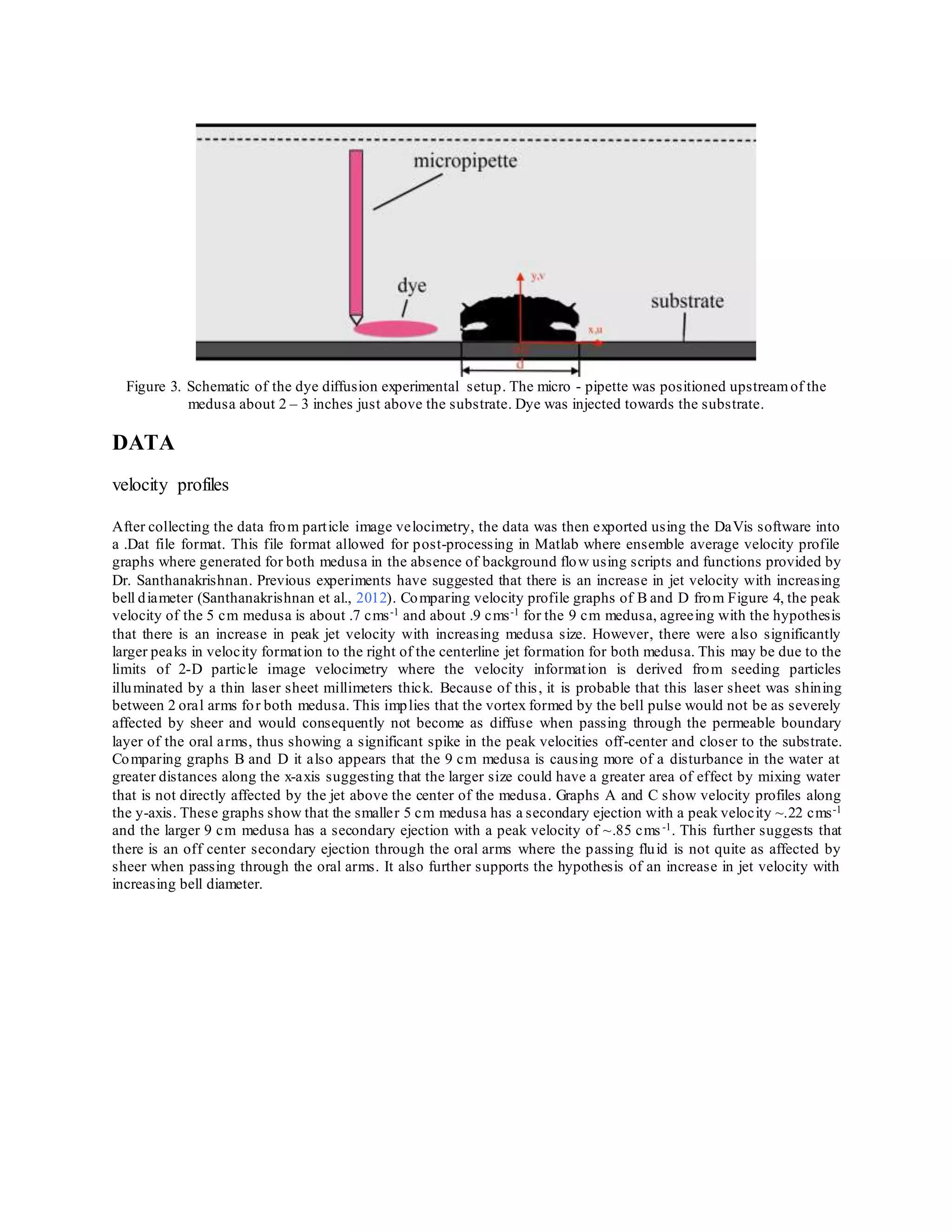
the medusa towards the substrate as shown in Figure 3. The dye was injected by hand,using a 10 mL micropipette.
Figure 3. Schematic of the dye diffusion experimental setup. The micro - pipette was positioned upstreamof the
medusa about 2 – 3 inches just above the substrate. Dye was injected towards the substrate.
DATA
velocity profiles
After collecting the data from particle image velocimetry, the data was then exported using the DaVis software into
a .Dat file format. This file format allowed for post-processing in Matlab where ensemble average velocity profile
graphs where generated for both medusa in the absence of background flow using scripts and functions provided by
Dr. Santhanakrishnan. Previous experiments have suggested that there is an increase in jet velocity with increasing
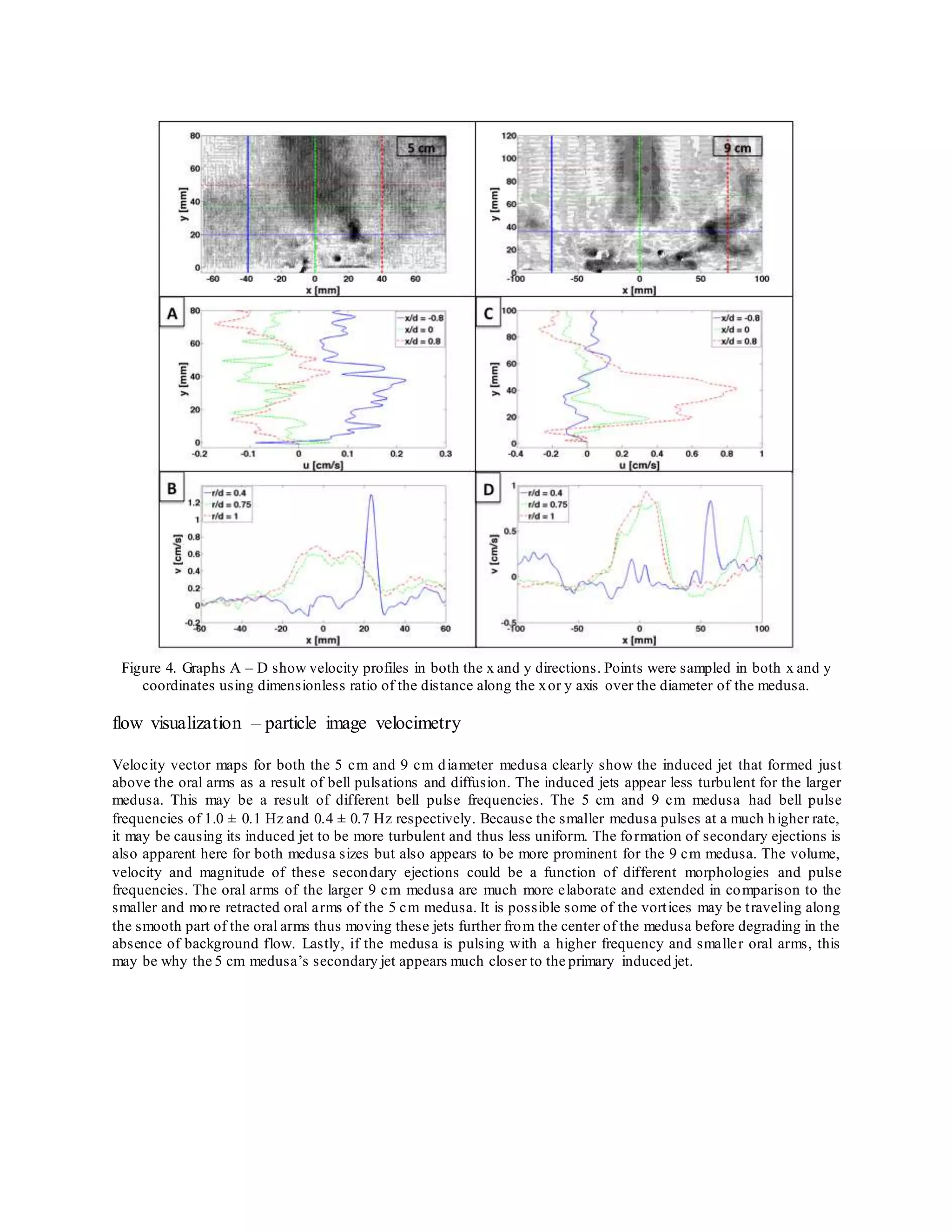
bell diameter (Santhanakrishnan et al., 2012). Comparing velocity profile graphs of B and D from Figure 4, the peak
velocity of the 5 cm medusa is about .7 cms-1 and about .9 cms-1 for the 9 cm medusa, agreeing with the hypothesis
that there is an increase in peak jet velocity with increasing medusa size. However, there were also significantly
larger peaks in velocity formation to the right of the centerline jet formation for both medusa. This may be due to the
limits of 2-D particle image velocimetry where the velocity information is derived from seeding particles
illuminated by a thin laser sheet millimeters thick. Because of this, it is probable that this laser sheet was shining
between 2 oral arms for both medusa. This implies that the vortex formed by the bell pulse would not be as severely
affected by sheer and would consequently not become as diffuse when passing through the permeable boundary
layer of the oral arms, thus showing a significant spike in the peak velocities off-center and closer to the substrate.
Comparing graphs B and D it also appears that the 9 cm medusa is causing more of a disturbance in the water at
greater distances along the x-axis suggesting that the larger size could have a greater area of effect by mixing water
that is not directly affected by the jet above the center of the medusa. Graphs A and C show velocity profiles along
the y-axis. These graphs show that the smaller 5 cm medusa has a secondary ejection with a peak velocity ~.22 cms-1
and the larger 9 cm medusa has a secondary ejection with a peak velocity of ~.85 cms-1. This further suggests that
there is an off center secondary ejection through the oral arms where the passing fluid is not quite as affected by
sheer when passing through the oral arms. It also further supports the hypothesis of an increase in jet velocity with
increasing bell diameter.
Figure 4. Graphs A – D show velocity profiles in both the x and y directions. Points were sampled in both x and y
coordinates using dimensionless ratio of the distance along the xor y axis over the diameter of the medusa.
flow visualization – particle image velocimetry
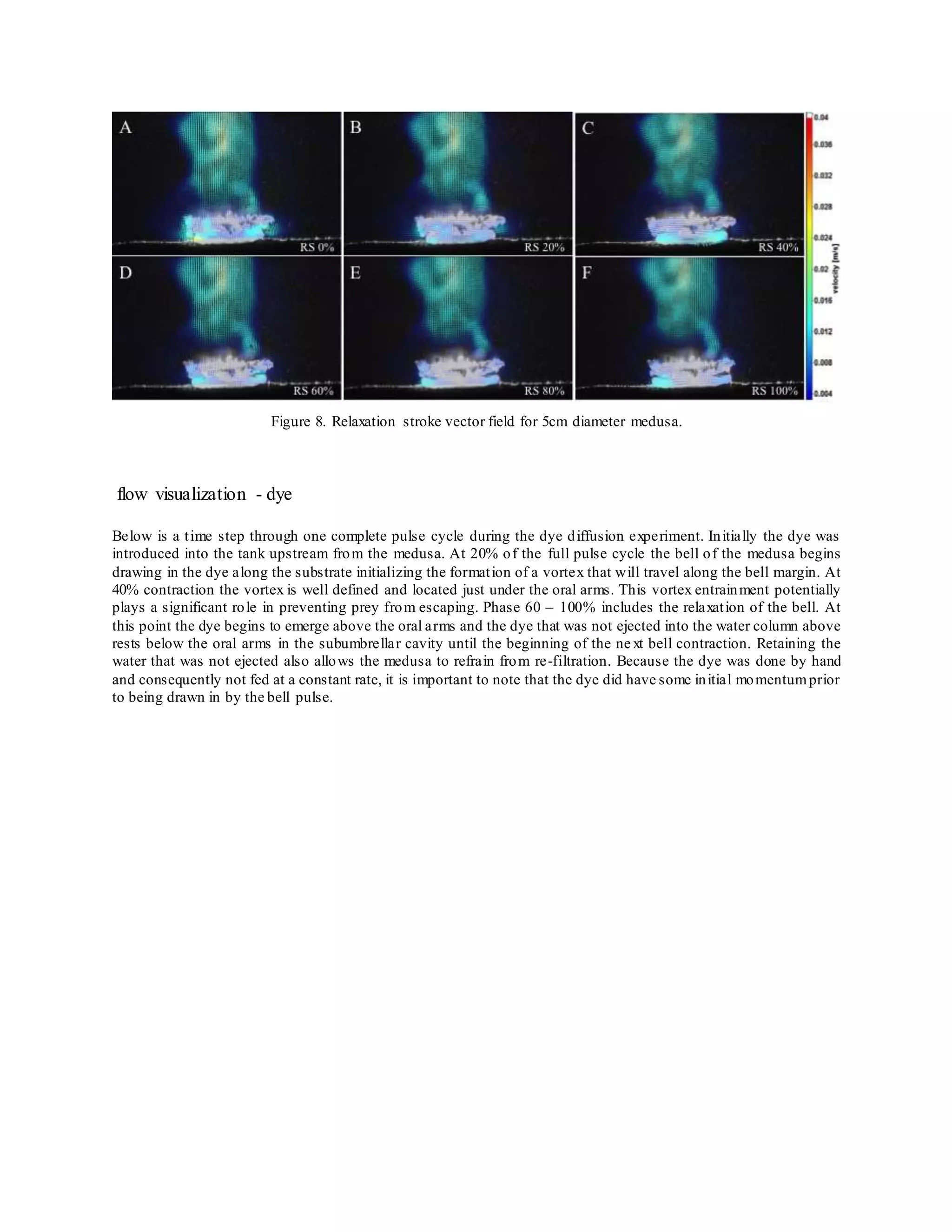
Velocity vector maps for both the 5 cm and 9 cm diameter medusa clearly show the induced jet that formed just
above the oral arms as a result of bell pulsations and diffusion. The induced jets appear less turbulent for the larger
medusa. This may be a result of different bell pulse frequencies. The 5 cm and 9 cm medusa had bell pulse
frequencies of 1.0 ± 0.1 Hz and 0.4 ± 0.7 Hz respectively. Because the smaller medusa pulses at a much higher rate,
it may be causing its induced jet to be more turbulent and thus less uniform. The formation of secondary ejections is
also apparent here for both medusa sizes but also appears to be more prominent for the 9 cm medusa. The volume,
velocity and magnitude of these secondary ejections could be a function of different morphologies and pulse
frequencies. The oral arms of the larger 9 cm medusa are much more elaborate and extended in comparison to the
smaller and more retracted oral arms of the 5 cm medusa. It is possible some of the vortices may be traveling along
the smooth part of the oral arms thus moving these jets further from the center of the medusa before degrading in the
absence of background flow. Lastly, if the medusa is pulsing with a higher frequency and smaller oral arms, this
may be why the 5 cm medusa’s secondary jet appears much closer to the primary induced jet.
Figure 5. Power stroke vector field for 9cm diameter medusa.
Figure 6. Relaxation stroke vector field for 9cm diameter medusa.
Figure 7. Power stroke vector field for 5cm diameter medusa.
Figure 8. Relaxation stroke vector field for 5cm diameter medusa.
flow visualization - dye
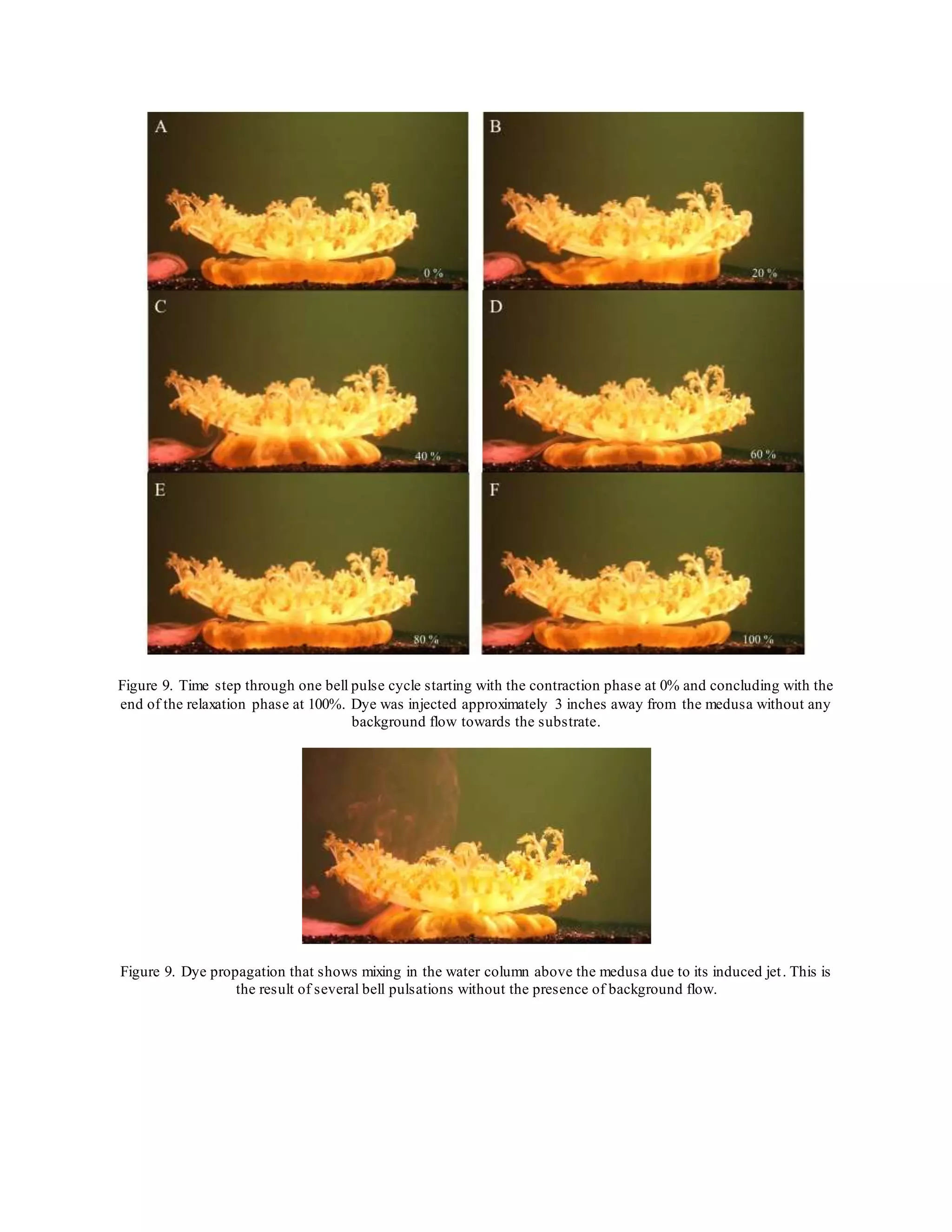
Below is a time step through one complete pulse cycle during the dye diffusion experiment. Initially the dye was
introduced into the tank upstream from the medusa. At 20% of the full pulse cycle the bell of the medusa begins
drawing in the dye along the substrate initializing the formation of a vortex that will travel along the bell margin. At
40% contraction the vortex is well defined and located just under the oral arms. This vortex entrainment potentially
plays a significant role in preventing prey from escaping. Phase 60 – 100% includes the relaxation of the bell. At
this point the dye begins to emerge above the oral arms and the dye that was not ejected into the water column above
rests below the oral arms in the subumbrellar cavity until the beginning of the ne xt bell contraction. Retaining the
water that was not ejected also allows the medusa to refrain from re-filtration. Because the dye was done by hand
and consequently not fed at a constant rate, it is important to note that the dye did have some initial momentumprior
to being drawn in by the bell pulse.
Figure 9. Time step through one bell pulse cycle starting with the contraction phase at 0% and concluding with the
end of the relaxation phase at 100%. Dye was injected approximately 3 inches away from the medusa without any
background flow towards the substrate.
Figure 9. Dye propagation that shows mixing in the water column above the medusa due to its induced jet. This is
the result of several bell pulsations without the presence of background flow.
CONCLUSION
Water close to the substrate is drawn toward the medusa during the contraction phase of the bell pulse cycle. During
this contraction phase, a vortex is formed and travels upward along the bell margin. This vortex would prevent prey
from escaping before being filtered through the oral arm structure. The water that the Cassiopea draws in is mixed
with the water above, which could have significant environmental implications over time. There is an increase in
peak jet velocities formed in the water columns above with increasing medusa size. Lastly, sharp velocity increases
to the right of both medusas suggest that there is a considerably large increase cowin velocity when vortices pass
between the oral arms. Future work includes studying the impact of medusa in groups with different individual sizes
and in varying speeds of background flow.
ACKNOWLEDGEMENTS
The author would like to thank Dr. Santhanakrishnan for allowing me to work with himon this study. Also, a special
thanks to the undergraduate and graduate students who also worked in the Applied Fluid Mechanics Lab and
assisted me in this study:Mekala Pritam, Gaddam Manikantam, James Nick, Mathur Naman, Fields Julian.
REFERENCES
1. Hamlet, L. Christina, Miller, A. Laura, 2012, Feeding Currents of the Upside Down Jellyfish in the
Presence of Background Flow,Society of Mathematical Biology, 74: 2547 – 2569
2. Santhanakrishnan, Arvind, Dollinger, Makani, Hamlet, L. Christina, Colin, P. Sean, Miller, A. Laura, 2012,
Flow structure and transport characteristics of feeding and exchange currents generated by upside-down
Cassiopea jellyfish, The Journal of Experimental Biology, 215: 2369 – 2381
3. Jantzen, Carin, Wild, Christian, Rasheed, Mohammed, El-Zibdah, Mohammed, Richter, Claudio, 2010,
Enhanced pore-water nutrient fluxes by the upside-down jellyfish Cassiopea sp. in a Red Sea coral reef,
Marine Ecology Progress Series, Vol. 411: 117 – 125
4. Wild, Christian, Naumann, S. Malik, 2013, Effect of active water movement on energy and nutrient
acquisition in coral reef-associated benthic organisms, Proceedings of the National Academy of Sciences
of the United States of America, Vol. 110: 8767-8768

NCUR PAPER_FINAL DRAFT

  • 1.
    Proceedings of TheNationalConference On Undergraduate Research (NCUR) 2015 Eastern Washington University, Cheney, WA April16-18, 2015 Analysis of the Feeding and Exchange Currents Generated by the Cassiopea Jellyfish with Changing Bell-Diameters in the Absence of Background Flow Matthew Takyi-Micah Mechanical Engineering Oklahoma State University Stillwater, Oklahoma, 74078 USA Faculty Advisor: Dr. Santhanakrishnan ABSTRACT The objective of this study was to quantify the feeding and exchange currents generated by Cassiopea jellyfish under changing organismal size and background flow. Patchy aggregations of Cassiopea medusa, commonly referred to as the “upside-down” jellyfish, are seen in sheltered marine environments such as mangrove forests and coral reefs within shallow regions saturated with sunlight. They exhibit a sessile, non-swimming lifestyle, and are oriented such that their bells are attached to the substrate and oral arms are directed toward the free surface. Pulsations of their bells drive flow toward and away from the body, assisting in filter feeding and for the exchange of inorganic and organic matter across the water column. While several studies have examined the basic functional morphology and fluid interaction in individual Cassiopea, the effects of body size and background flow on currents generated by these medusa are unclear. We investigated the effects of body size and background flow on currents generated using three experimental approaches.Bell pulsation kinematics were quantified from digitized videos.Fluorescein dye injected underneath the substrate via gravity feed was used to investigate the release of pore water via bell motion. Quantitative flow visualization studies ofCassiopea currents were conducted using 2D high-speed particle image velocimetry (PIV). The medusas were positioned in a low-speed recirculating water tunnel to replicate the background flows observed in the Cassiopea sp.natural environment. The results of the study suggest an inverse dependence of bell diameter on pulsing frequencies and peak induced jet velocities . Vertical mixing of medusa- induced jets were observed in the presence of background flow. The implications of the study’s findings on organism-induced mixing in only quiescent flow will be discussed. Keywords: Cassiopea, Jet, Feeding
  • 2.
    INTRODUCTION Unlike most commonlyknown jellyfish, the Cassiopea species are unique for their sessile nature and their strong preference for orienting themselves with their bells resting against the sea floor. Unless disturbed, the Cassiopea medusa will remain in an upside-down orientation where they will feed passively by pulsing their bells. This species, particularly in large colonies, can have a significant impact on the benthic mangroves, seagrass beds or coral reefs they inhabit. With each pulse of the bell, the medusa draws in the surrounding water and drives the fluid through its oral arms in order to potentially capture passing prey. However, with every pulse, they also create a jet above their oral arms where excretion, food and other organic and inorganic material from above and below the substrate mix and are carried away with shallow water currents on the order of 0.1 – 10 cms-1 (Christina and Laura 2012; Wild and Naumann 2013). It has even been shown that Cassiopea can draw organic and inorganic material that is pore-locked within the substrate (Jantzen et al. 2010). More recent experiments have specifically studied the hydrodynamics of the medusa without any background flow. In these experiments it was found that during a pulsing cycle an individual medusa draws in water along the substrate creating a vortex that travels along the bell margins and into the subumbrellar cavity before filtering and ejecting the entrained water into the vertical column above (Santhanakrishnan et al., 2012). This paper will focus on building upon the experiments previously published by investigating: (1) How do the peak centerline velocities compare for induced jets between medusa of different size (2) how is water drawn in from the substrate and filtered through the oral arms acting as a porous boundary layer. METHODOLOGY Similar to most marine organisms, Cassiopea jellyfish are highly sensitive to sudden changes in the their tanks ’ water conditions such as salinity, pH, and temperature. Before moving the medusa from their aquarium into the flume, the salinity and temperature were recorded for both the flume and aquarium and were found to be 1.023 ± .001 SG and 23 ± 1º C respectively. It was important to ensure there were minimal differences between the aquarium and flume in order to reduce the amount of stress the medusa would experience during the transfer process. All experiments were conducted using a flume with a 96-inch test section and a 12-inch by 12-inch channel cross-section. For analyzing the medusas interactions with the surrounding water, 2 methods were employed: particle image velocimetry and qualitative flow visualization. Figure 1. Low-speed recirculating flume where all of the experiments for this study were conducted in the absence of background flow. Glass test section dimensions: 96”x12”x12”.
  • 3.
    2-D particle imagevelocimetry Particle image velocimetry was the experimental method employed in order to capture the fluid velocities generated from the bell pulses and the resulting jet. To do this, a Photonics Industries 1kHz Nd: YLF single cavity double- pulse laser [Model#DM30-527] was used for illuminating LaVision hollow glass sphere seeding particles with a diameter of 8-12 μm. This laser was positioned above the flume (Figure 2), upstreamof the medusa. Operating at 22 amps, the laser beam emitted by the laser was then spread into a thin sheet using THORLABS CM1-K13 right angle mirror and a LaVision concave lens. This laser sheet bisected the medusa positioned in the center of the flume. A 1 megapixel PhantomMiro LC110 CMOS camera and an AF Micro Nikkon 60 mm lens operating at 890 frames-per- second with full 1280x800 pixel resolution were used to capture the illuminated particles in the test section. A LaVision high-speed controller adjusted the timing between each pulse of the laser and the instance each image was captured. This high-speed controller connected both the high-speed camera and double-pulse laser to a central computer. After recording video, the image files were then processed in DaVis 8 (LaVision GmbH) software using cross-correlation with a 32 x 32 pixel interrogation window, 50 percent overlap, and 2 passes followed by a 12 x 12 pixel interrogation window with 50 percent overlap, and 3 passes. Figure 2. Schematic of the particle image velocimetry experimental setup (not to scale). The laser and mirror were positioned above the flume. A laser sheet from the mirror= bisected the medusa and was parallel to the flume walls. The laser sheet was also perpendicular to the PhantomMiro LC110 CMOS camera used for recording. qualitative flow visualization Pink and white food coloring [Sunny Side Up Bakery] were mixed together with 500 mL of water from the water tunnel. Food coloring was continuously added into a 1000 mL beaker until a bright pink color was achieved. White cardboard paper was added onto the backside of the tank to increase the contrast. A Canon EOS 6D DSLR 20.2 megapixel camera with a Canon EFS 60 mm macro lens was used to record the dye propagation. After waiting approximately 30 minutes for the medusa to settle in the tank, dye was injected approximately 3 inches away from the medusa towards the substrate as shown in Figure 3. The dye was injected by hand,using a 10 mL micropipette.
  • 4.
    Figure 3. Schematicof the dye diffusion experimental setup. The micro - pipette was positioned upstreamof the medusa about 2 – 3 inches just above the substrate. Dye was injected towards the substrate. DATA velocity profiles After collecting the data from particle image velocimetry, the data was then exported using the DaVis software into a .Dat file format. This file format allowed for post-processing in Matlab where ensemble average velocity profile graphs where generated for both medusa in the absence of background flow using scripts and functions provided by Dr. Santhanakrishnan. Previous experiments have suggested that there is an increase in jet velocity with increasing bell diameter (Santhanakrishnan et al., 2012). Comparing velocity profile graphs of B and D from Figure 4, the peak velocity of the 5 cm medusa is about .7 cms-1 and about .9 cms-1 for the 9 cm medusa, agreeing with the hypothesis that there is an increase in peak jet velocity with increasing medusa size. However, there were also significantly larger peaks in velocity formation to the right of the centerline jet formation for both medusa. This may be due to the limits of 2-D particle image velocimetry where the velocity information is derived from seeding particles illuminated by a thin laser sheet millimeters thick. Because of this, it is probable that this laser sheet was shining between 2 oral arms for both medusa. This implies that the vortex formed by the bell pulse would not be as severely affected by sheer and would consequently not become as diffuse when passing through the permeable boundary layer of the oral arms, thus showing a significant spike in the peak velocities off-center and closer to the substrate. Comparing graphs B and D it also appears that the 9 cm medusa is causing more of a disturbance in the water at greater distances along the x-axis suggesting that the larger size could have a greater area of effect by mixing water that is not directly affected by the jet above the center of the medusa. Graphs A and C show velocity profiles along the y-axis. These graphs show that the smaller 5 cm medusa has a secondary ejection with a peak velocity ~.22 cms-1 and the larger 9 cm medusa has a secondary ejection with a peak velocity of ~.85 cms-1. This further suggests that there is an off center secondary ejection through the oral arms where the passing fluid is not quite as affected by sheer when passing through the oral arms. It also further supports the hypothesis of an increase in jet velocity with increasing bell diameter.
  • 5.
    Figure 4. GraphsA – D show velocity profiles in both the x and y directions. Points were sampled in both x and y coordinates using dimensionless ratio of the distance along the xor y axis over the diameter of the medusa. flow visualization – particle image velocimetry Velocity vector maps for both the 5 cm and 9 cm diameter medusa clearly show the induced jet that formed just above the oral arms as a result of bell pulsations and diffusion. The induced jets appear less turbulent for the larger medusa. This may be a result of different bell pulse frequencies. The 5 cm and 9 cm medusa had bell pulse frequencies of 1.0 ± 0.1 Hz and 0.4 ± 0.7 Hz respectively. Because the smaller medusa pulses at a much higher rate, it may be causing its induced jet to be more turbulent and thus less uniform. The formation of secondary ejections is also apparent here for both medusa sizes but also appears to be more prominent for the 9 cm medusa. The volume, velocity and magnitude of these secondary ejections could be a function of different morphologies and pulse frequencies. The oral arms of the larger 9 cm medusa are much more elaborate and extended in comparison to the smaller and more retracted oral arms of the 5 cm medusa. It is possible some of the vortices may be traveling along the smooth part of the oral arms thus moving these jets further from the center of the medusa before degrading in the absence of background flow. Lastly, if the medusa is pulsing with a higher frequency and smaller oral arms, this may be why the 5 cm medusa’s secondary jet appears much closer to the primary induced jet.
  • 6.
    Figure 5. Powerstroke vector field for 9cm diameter medusa. Figure 6. Relaxation stroke vector field for 9cm diameter medusa. Figure 7. Power stroke vector field for 5cm diameter medusa.
  • 7.
    Figure 8. Relaxationstroke vector field for 5cm diameter medusa. flow visualization - dye Below is a time step through one complete pulse cycle during the dye diffusion experiment. Initially the dye was introduced into the tank upstream from the medusa. At 20% of the full pulse cycle the bell of the medusa begins drawing in the dye along the substrate initializing the formation of a vortex that will travel along the bell margin. At 40% contraction the vortex is well defined and located just under the oral arms. This vortex entrainment potentially plays a significant role in preventing prey from escaping. Phase 60 – 100% includes the relaxation of the bell. At this point the dye begins to emerge above the oral arms and the dye that was not ejected into the water column above rests below the oral arms in the subumbrellar cavity until the beginning of the ne xt bell contraction. Retaining the water that was not ejected also allows the medusa to refrain from re-filtration. Because the dye was done by hand and consequently not fed at a constant rate, it is important to note that the dye did have some initial momentumprior to being drawn in by the bell pulse.
  • 8.
    Figure 9. Timestep through one bell pulse cycle starting with the contraction phase at 0% and concluding with the end of the relaxation phase at 100%. Dye was injected approximately 3 inches away from the medusa without any background flow towards the substrate. Figure 9. Dye propagation that shows mixing in the water column above the medusa due to its induced jet. This is the result of several bell pulsations without the presence of background flow.
  • 9.
    CONCLUSION Water close tothe substrate is drawn toward the medusa during the contraction phase of the bell pulse cycle. During this contraction phase, a vortex is formed and travels upward along the bell margin. This vortex would prevent prey from escaping before being filtered through the oral arm structure. The water that the Cassiopea draws in is mixed with the water above, which could have significant environmental implications over time. There is an increase in peak jet velocities formed in the water columns above with increasing medusa size. Lastly, sharp velocity increases to the right of both medusas suggest that there is a considerably large increase cowin velocity when vortices pass between the oral arms. Future work includes studying the impact of medusa in groups with different individual sizes and in varying speeds of background flow. ACKNOWLEDGEMENTS The author would like to thank Dr. Santhanakrishnan for allowing me to work with himon this study. Also, a special thanks to the undergraduate and graduate students who also worked in the Applied Fluid Mechanics Lab and assisted me in this study:Mekala Pritam, Gaddam Manikantam, James Nick, Mathur Naman, Fields Julian. REFERENCES 1. Hamlet, L. Christina, Miller, A. Laura, 2012, Feeding Currents of the Upside Down Jellyfish in the Presence of Background Flow,Society of Mathematical Biology, 74: 2547 – 2569 2. Santhanakrishnan, Arvind, Dollinger, Makani, Hamlet, L. Christina, Colin, P. Sean, Miller, A. Laura, 2012, Flow structure and transport characteristics of feeding and exchange currents generated by upside-down Cassiopea jellyfish, The Journal of Experimental Biology, 215: 2369 – 2381 3. Jantzen, Carin, Wild, Christian, Rasheed, Mohammed, El-Zibdah, Mohammed, Richter, Claudio, 2010, Enhanced pore-water nutrient fluxes by the upside-down jellyfish Cassiopea sp. in a Red Sea coral reef, Marine Ecology Progress Series, Vol. 411: 117 – 125 4. Wild, Christian, Naumann, S. Malik, 2013, Effect of active water movement on energy and nutrient acquisition in coral reef-associated benthic organisms, Proceedings of the National Academy of Sciences of the United States of America, Vol. 110: 8767-8768