HUMAN
REPRODUCTION,
GROWTH, &
DEVELOPMENT
OCS Biology
Mrs. Bonifay
Human Reproduction
 Humans reproduce sexually.
 A male parent fertilizes an egg inside the
female body.
 The fertilized egg develops inside the
female body.
The Human Male
Reproductive System
 The testes produce sperm cells.
 The testes are outside the body in a sac
called the scrotum. It is about 2 degrees
Celsius cooler than the rest of the body.
This helps keep the sperm cells alive
because they are sensitive to heat.
The Human Male
Reproductive System
 The testes also produce testosterone, the
male sex hormone which is important to the
development of male sexual traits and the
production of sperm.
 Beginning at puberty, the testes make more
than 200 million sperm cells every day.
 Males are usually able to produce sperm
from puberty through the rest of their lives.
The Human Male
Reproductive System
 The penis is the external male organ which
delivers the sperm to the female body.
 Before this happens, blood flows into the
tissues of the penis causing it to lengthen
and become rigid, or erect.
 The erect penis is inserted into a tube-like
canal in the female’s body called the
vagina.
The Human Male
Reproductive System
 Sperm cells leave the male body through a tube in
the penis called the urethra.
 The prostate gland, which produces fluid that
mixes with the sperm cells, connects to the
urethra. The mixture of fluid and sperm cells is
called semen.
 Urine also leaves the male body through the
urethra; HOWEVER, urine and semen do NOT
leave at the same time.
The Human Female
Reproductive System
 Females are born with about 400,000 egg
cells that are produced and stored in the
ovaries.
 The ovaries also produce estrogen and
progesterone which are female sex
hormones that regulate female reproductive
development.
The Human Female
Reproductive System
 One egg is usually released from one of the two
ovaries about every 28 days. This is called
ovulation.
 The egg travels down the fallopian tube, and if
sperm are present, a sperm cell may fertilize the
egg in the fallopian tube.
 The fertilized egg will develop into an embryo
which then travels to the uterus, attaching to the
blood-rich lining of the uterus.
The Human Female
Reproductive System
 If the egg is not fertilized, it will pass out of
the female body.
 When the unfertilized egg, blood, and
pieces of the lining of the uterus pass out of
the female body through the vagina, this is
called menstruation.
The Human Female
Reproductive System: PREGNANCY
 The time a fertilized egg develops into a baby
inside the female body is called pregnancy.
 The embryo forms a placenta. The umbilical cord
connects the placenta to the embryo. This where
the food and oxygen pass from the mother’s body
to the embryo.
 The embryo’s wastes pass out of the mother’s
body along with her own wastes.
The Human Female
Reproductive System: PREGNANCY
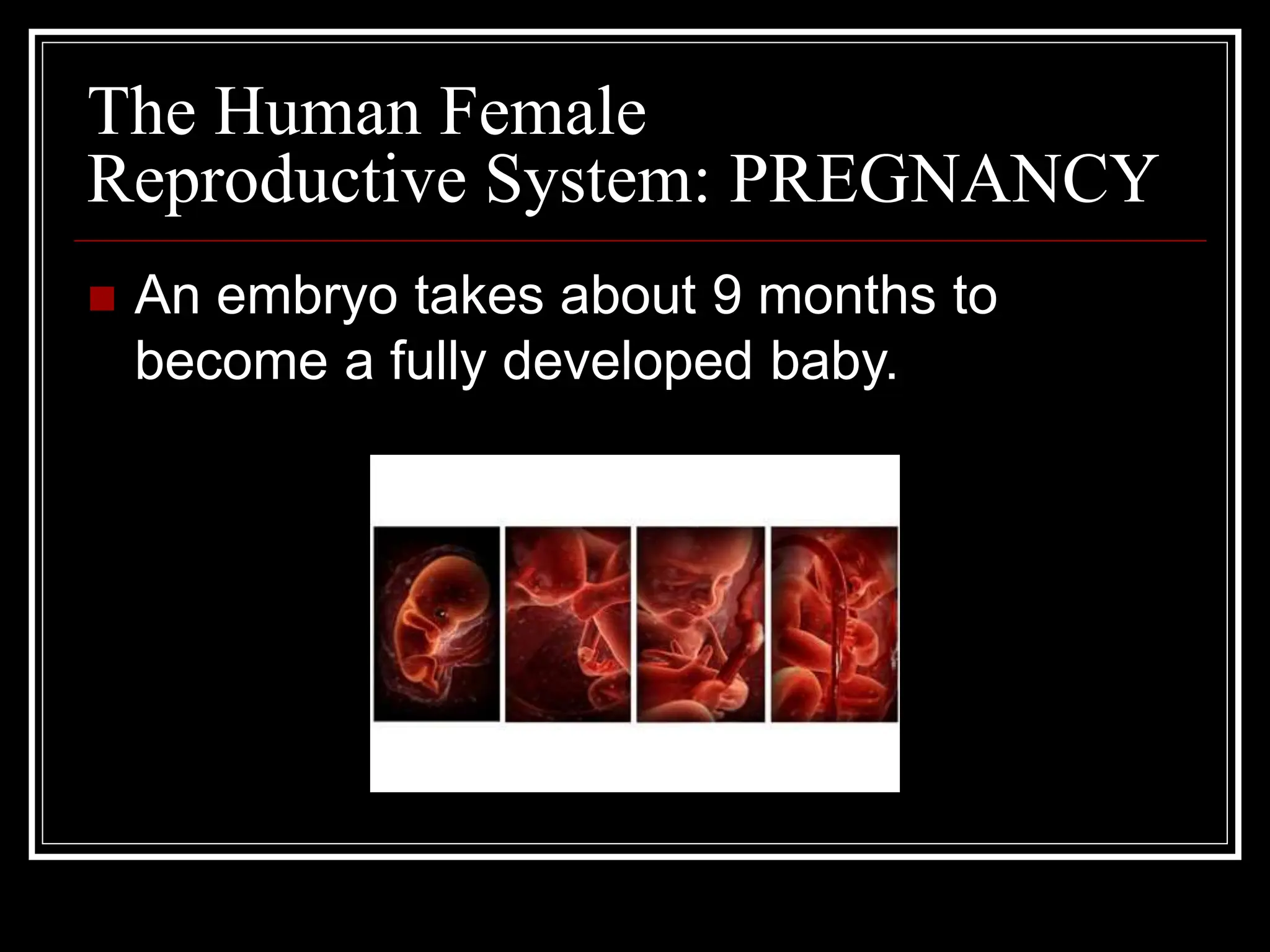
 An embryo takes about 9 months to
become a fully developed baby.
The Human Female
Reproductive System: PREGNANCY
 After about 3 weeks, the embryo’s heart
begins to beat; blood vessels form rapidly;
the body has a head and buds for arms and
legs. The embryo is smaller than a
fingernail.
 All vertebrates look similar in the early
stages of development.
The Human Female
Reproductive System: PREGNANCY
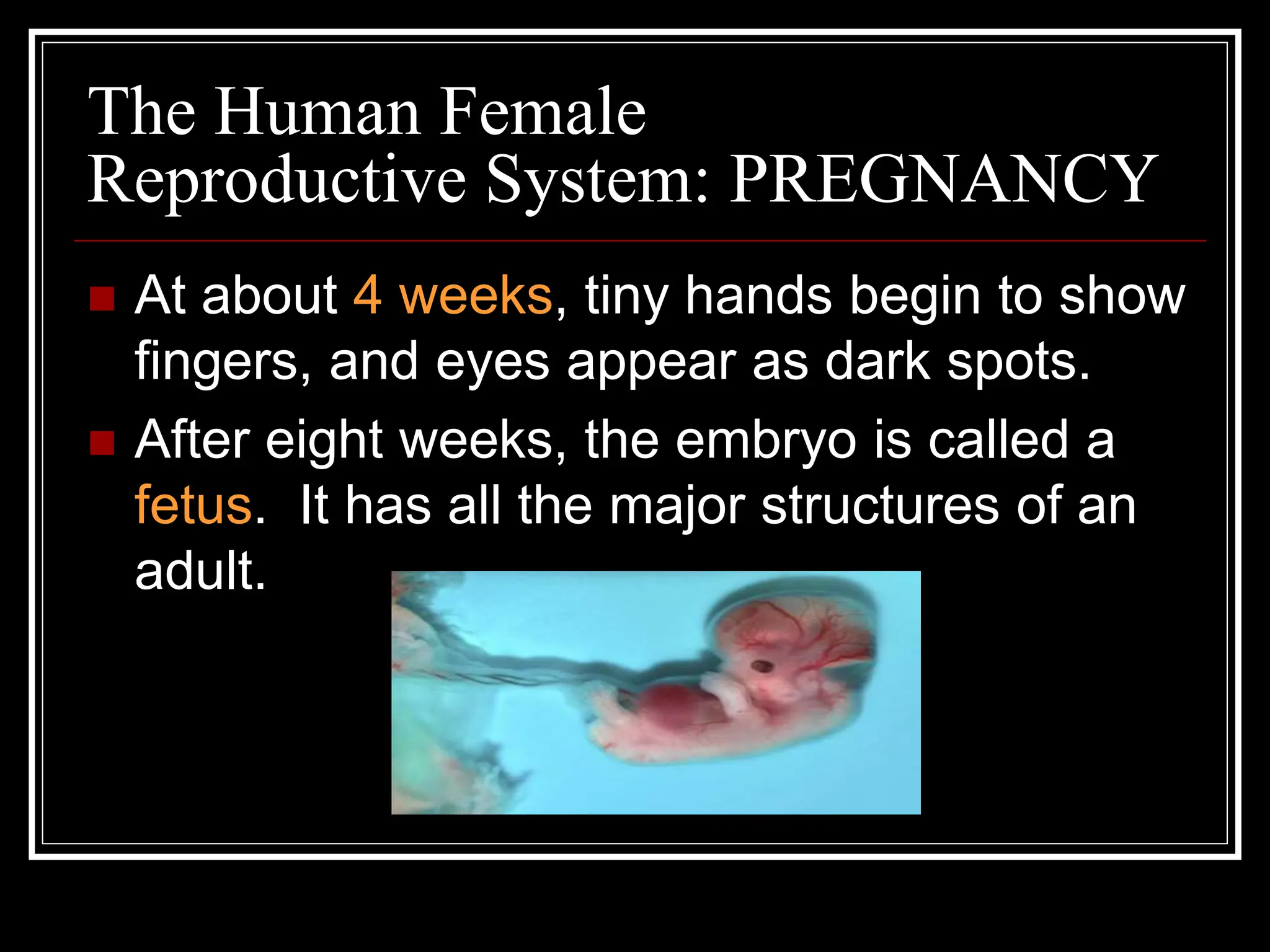
 At about 4 weeks, tiny hands begin to show
fingers, and eyes appear as dark spots.
 After eight weeks, the embryo is called a
fetus. It has all the major structures of an
adult.
Birth of a Baby
 Usually, when the fetus reaches full size,
the uterus begins to contract (squeeze
together).
 These contractions push the baby out of
the uterus through the vagina.
 The mother pushes the placenta out soon
after the birth of the baby.
Parental Care
 A human baby is born helpless. They are
not able to take care of themselves for
many years.
 The care humans give their offspring is one
reason for the high survival rate of humans
after birth.
Adolescence
 The teenage years for a human is called
adolescence.
 Rapid growth and physical changes take
place during puberty, which occurs at the
beginning of adolescence.
 Name some changes that occur during
adolescence.

Human Reproduction.ppt

  • 1.
  • 2.
    Human Reproduction  Humansreproduce sexually.  A male parent fertilizes an egg inside the female body.  The fertilized egg develops inside the female body.
  • 3.
    The Human Male ReproductiveSystem  The testes produce sperm cells.  The testes are outside the body in a sac called the scrotum. It is about 2 degrees Celsius cooler than the rest of the body. This helps keep the sperm cells alive because they are sensitive to heat.
  • 4.
    The Human Male ReproductiveSystem  The testes also produce testosterone, the male sex hormone which is important to the development of male sexual traits and the production of sperm.  Beginning at puberty, the testes make more than 200 million sperm cells every day.  Males are usually able to produce sperm from puberty through the rest of their lives.
  • 5.
    The Human Male ReproductiveSystem  The penis is the external male organ which delivers the sperm to the female body.  Before this happens, blood flows into the tissues of the penis causing it to lengthen and become rigid, or erect.  The erect penis is inserted into a tube-like canal in the female’s body called the vagina.
  • 6.
    The Human Male ReproductiveSystem  Sperm cells leave the male body through a tube in the penis called the urethra.  The prostate gland, which produces fluid that mixes with the sperm cells, connects to the urethra. The mixture of fluid and sperm cells is called semen.  Urine also leaves the male body through the urethra; HOWEVER, urine and semen do NOT leave at the same time.
  • 7.
    The Human Female ReproductiveSystem  Females are born with about 400,000 egg cells that are produced and stored in the ovaries.  The ovaries also produce estrogen and progesterone which are female sex hormones that regulate female reproductive development.
  • 8.
    The Human Female ReproductiveSystem  One egg is usually released from one of the two ovaries about every 28 days. This is called ovulation.  The egg travels down the fallopian tube, and if sperm are present, a sperm cell may fertilize the egg in the fallopian tube.  The fertilized egg will develop into an embryo which then travels to the uterus, attaching to the blood-rich lining of the uterus.
  • 9.
    The Human Female ReproductiveSystem  If the egg is not fertilized, it will pass out of the female body.  When the unfertilized egg, blood, and pieces of the lining of the uterus pass out of the female body through the vagina, this is called menstruation.
  • 10.
    The Human Female ReproductiveSystem: PREGNANCY  The time a fertilized egg develops into a baby inside the female body is called pregnancy.  The embryo forms a placenta. The umbilical cord connects the placenta to the embryo. This where the food and oxygen pass from the mother’s body to the embryo.  The embryo’s wastes pass out of the mother’s body along with her own wastes.
  • 11.
    The Human Female ReproductiveSystem: PREGNANCY  An embryo takes about 9 months to become a fully developed baby.
  • 12.
    The Human Female ReproductiveSystem: PREGNANCY  After about 3 weeks, the embryo’s heart begins to beat; blood vessels form rapidly; the body has a head and buds for arms and legs. The embryo is smaller than a fingernail.  All vertebrates look similar in the early stages of development.
  • 13.
    The Human Female ReproductiveSystem: PREGNANCY  At about 4 weeks, tiny hands begin to show fingers, and eyes appear as dark spots.  After eight weeks, the embryo is called a fetus. It has all the major structures of an adult.
  • 14.
    Birth of aBaby  Usually, when the fetus reaches full size, the uterus begins to contract (squeeze together).  These contractions push the baby out of the uterus through the vagina.  The mother pushes the placenta out soon after the birth of the baby.
  • 15.
    Parental Care  Ahuman baby is born helpless. They are not able to take care of themselves for many years.  The care humans give their offspring is one reason for the high survival rate of humans after birth.
  • 16.
    Adolescence  The teenageyears for a human is called adolescence.  Rapid growth and physical changes take place during puberty, which occurs at the beginning of adolescence.  Name some changes that occur during adolescence.