Impact of Privatization of Public Sector Banks
in India
AIMS 20 PAPER ID : A2278 - BANKING
Presentation by:
Prof.(Dr.) Narinder Kumar Bhasin, Amity University , Noida
Dr. Sunil Kadyan , Amity University, Noida
Dr. Richa Bhatia , The Bhopal School of Social Sciences
2
Introduction
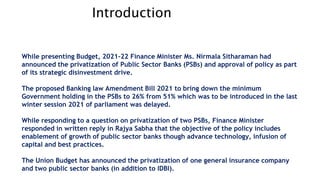
While presenting Budget, 2021-22 Finance Minister Ms. Nirmala Sitharaman had
announced the privatization of Public Sector Banks (PSBs) and approval of policy as part
of its strategic disinvestment drive.
The proposed Banking law Amendment Bill 2021 to bring down the minimum
Government holding in the PSBs to 26% from 51% which was to be introduced in the last
winter session 2021 of parliament was delayed.
While responding to a question on privatization of two PSBs, Finance Minister
responded in written reply in Rajya Sabha that the objective of the policy includes
enablement of growth of public sector banks though advance technology, infusion of
capital and best practices.
The Union Budget has announced the privatization of one general insurance company
and two public sector banks (in addition to IDBI).
Introduction
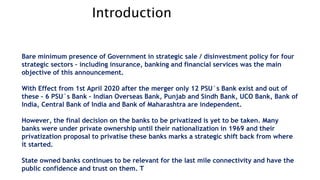
Bare minimum presence of Government in strategic sale / disinvestment policy for four
strategic sectors – including insurance, banking and financial services was the main
objective of this announcement.
With Effect from 1st April 2020 after the merger only 12 PSU`s Bank exist and out of
these – 6 PSU`s Bank – Indian Overseas Bank, Punjab and Sindh Bank, UCO Bank, Bank of
India, Central Bank of India and Bank of Maharashtra are independent.
However, the final decision on the banks to be privatized is yet to be taken. Many
banks were under private ownership until their nationalization in 1969 and their
privatization proposal to privatise these banks marks a strategic shift back from where
it started.
State owned banks continues to be relevant for the last mile connectivity and have the
public confidence and trust on them. T
Background of the Study
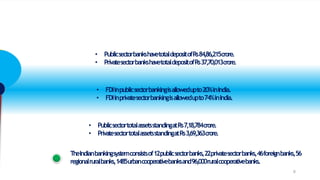
Huge market size.
• PublicsectorbankshavetotaldepositofRs84,86,215crore.
• PrivatesectorbankshavetotaldepositofRs37,70,013crore.
• FDIinpublicsectorbankingisallowedupto20%inIndia.
• FDIinprivatesectorbankingisallowedupto74%inIndia.
• PublicsectortotalassetsstandingatRs7,18,784crore.
• PrivatesectortotalassetsstandingatRs3,69,363crore.
TheIndianbankingsystemconsistsof12publicsectorbanks,22privatesectorbanks,46foreignbanks,56
regionalruralbanks,1485urbancooperativebanksand96,000ruralcooperativebanks.
6
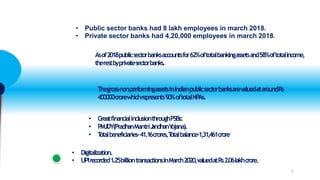
• Public sector banks had 8 lakh employees in march 2018.
• Private sector banks had 4,20,000 employees in march 2018.
Asof2018publicsectorbanksaccountsfor62%oftotalbankingassetsand58%oftotalincome,
therestbyprivatesectorbanks.
Thegross-nonperformingassetsinIndianpublicsectorbanksarevaluedataroundRs
400000crorewhichre
presents90%oftotalNP
As.
• GreatfinancialinclusionthroughPSBs:
• PMJDY(PradhanMantriJ
andhanY
ojana).
• T
otalbeneficiaries-41.1
6crores,T
otalbalance-1,31,461crore
• Digitalization.
• UPIrecorded1.25billiontransactionsinMarch2020,valuedatRs2.06lakhcrore.
7
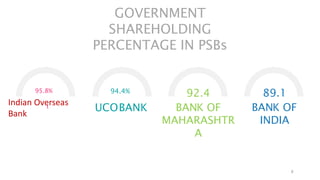
Indian Overseas
Bank
95.8%
8
I
94.4%
UCOBANK
92.4
BANK OF
MAHARASHTR
A
89.1
BANK OF
INDIA
GOVERNMENT
SHAREHOLDING
PERCENTAGE IN PSBs
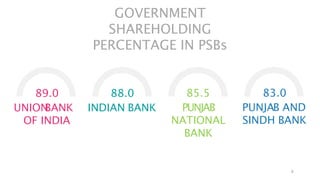
89.0 88.0
UNION
BANK INDIAN BANK
OF INDIA
9
85.5
PUNJAB
NATIONAL
BANK
83.0
PUNJAB AND
SINDH BANK
GOVERNMENT
SHAREHOLDING
PERCENTAGE IN PSBs
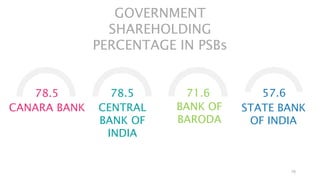
78.5
10
CANARA BANK
78.5
CENTRAL
BANK OF
INDIA
71.6
BANK OF
BARODA
57.6
STATE BANK
OF INDIA
GOVERNMENT
SHAREHOLDING
PERCENTAGE IN PSBs
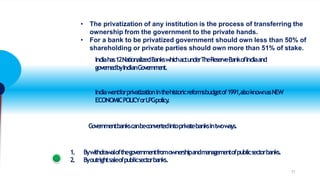
• The privatization of any institution is the process of transferring the
ownership from the government to the private hands.
• For a bank to be privatized government should own less than 50% of
shareholding or private parties should own more than 51% of stake.
Indiahas12NationalizedBankswhichactunderTheReserveBankofIndiaand
governedbyIndianGovernm
e
nt.
Indiawentforprivatizationinthehistoricreformsbudgetof1991,alsoknownasNEW
ECONOMICPOLICYorLPGpolicy
.
Governmentbankscanbeconvertedintoprivatebanksintwoways.
1. Bywithdrawalofthegovernmentfromownershipandmanagementofpublicsectorbanks.
2. Byoutrightsaleofpublicsectorbanks.
11
Reasons for Privatization
Privatization is considered to bring more efficiency and objectivity to
the bank.
Privatizationisimportant to economyandscale upa healthy competition in the
marketandreducestheprice.
Havingprivate ownershipof bankswill bring changesin structuring incentives
andaccountability.
Mainpurpose behindtheplan of privatization of PSBs istostall future bailouts byusing
taxpayersmoney.
Big economiceventslike demonetizationandbankmergersbrought alot ofuncertaintyandchanges
withthem.
13
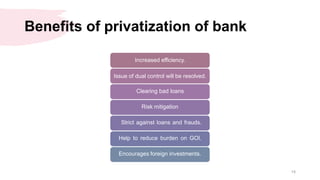
Benefits of privatization of bank
Increased efficiency.
Issue of dual control will be resolved.
Clearing bad loans
Risk mitigation
Strict against loans and frauds.
Help to reduce burden on GOI.
Encourages foreign investments.
14
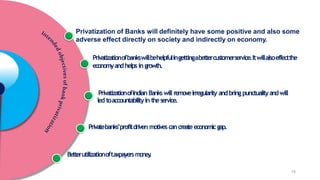
Privatization of Banks will definitely have some positive and also some
adverse effect directly on society and indirectly on economy.
Privatizationofbankswillbehelpfulingettingabettercustomerservice.Itwillalsoeffectthe
economyandhelps in growth.
PrivatizationofIndian Bankswill removeirregularity andbringpunctualityandwill
led toaccountabilityin theservice.
Privatebanks’profitdriven motivescancreateeconomicgap.
Betterutilizationoftaxpayersmoney
.
15
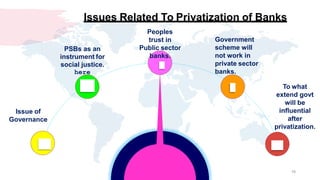
Issue of
Governance
PSBs as an
instrument for
social justice.
here
16
Peoples
trust in
Public sector
banks.
Government
scheme will
not work in
private sector
banks.
To what
extend govt
will be
influential
after
privatization.
Issues Related To Privatization of Banks
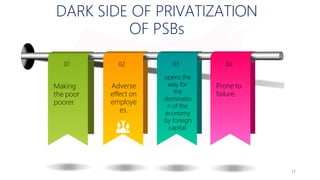
01
Making
the poor
poorer
.
Adverse
effect on
employe
es.
02 03
opens the
way for
the
dominatio
n of the
economy
by foreign
capital.
Prone to
failure.
04
DARK SIDE OF PRIVATIZATION
OF PSBs
17
02
Governance
For better governance
interference and
intervention from
government should be
minimal.
03
Structure
Instead of rapid re-
privatization of public
sector banks
government should
come up with better
governance structure.
01
NPAs
Quick resolution of
NPAs beyond NCLT
and IBC.
Recommendations
18
CONCLUSION
19
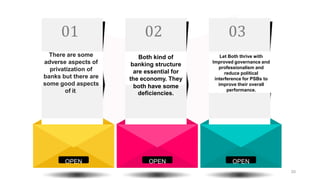
01
There are some
adverse aspects of
privatization of
banks but there are
some good aspects
of it.
02
Both kind of
banking structure
are essential for
the economy. They
both have some
deficiencies.
Let Both thrive with
Improved governance and
professionalism and
reduce political
interference for PSBs to
improve their overall
performance.
03
OPEN OPEN OPEN
20
THANK YOU
16

FINAL AIMS 20 BANKING PPT.pptx

  • 1.
    Impact of Privatizationof Public Sector Banks in India AIMS 20 PAPER ID : A2278 - BANKING Presentation by: Prof.(Dr.) Narinder Kumar Bhasin, Amity University , Noida Dr. Sunil Kadyan , Amity University, Noida Dr. Richa Bhatia , The Bhopal School of Social Sciences
  • 2.
  • 3.
    Introduction While presenting Budget,2021-22 Finance Minister Ms. Nirmala Sitharaman had announced the privatization of Public Sector Banks (PSBs) and approval of policy as part of its strategic disinvestment drive. The proposed Banking law Amendment Bill 2021 to bring down the minimum Government holding in the PSBs to 26% from 51% which was to be introduced in the last winter session 2021 of parliament was delayed. While responding to a question on privatization of two PSBs, Finance Minister responded in written reply in Rajya Sabha that the objective of the policy includes enablement of growth of public sector banks though advance technology, infusion of capital and best practices. The Union Budget has announced the privatization of one general insurance company and two public sector banks (in addition to IDBI).
  • 4.
    Introduction Bare minimum presenceof Government in strategic sale / disinvestment policy for four strategic sectors – including insurance, banking and financial services was the main objective of this announcement. With Effect from 1st April 2020 after the merger only 12 PSU`s Bank exist and out of these – 6 PSU`s Bank – Indian Overseas Bank, Punjab and Sindh Bank, UCO Bank, Bank of India, Central Bank of India and Bank of Maharashtra are independent. However, the final decision on the banks to be privatized is yet to be taken. Many banks were under private ownership until their nationalization in 1969 and their privatization proposal to privatise these banks marks a strategic shift back from where it started. State owned banks continues to be relevant for the last mile connectivity and have the public confidence and trust on them. T
  • 5.
  • 6.
    Huge market size. •PublicsectorbankshavetotaldepositofRs84,86,215crore. • PrivatesectorbankshavetotaldepositofRs37,70,013crore. • FDIinpublicsectorbankingisallowedupto20%inIndia. • FDIinprivatesectorbankingisallowedupto74%inIndia. • PublicsectortotalassetsstandingatRs7,18,784crore. • PrivatesectortotalassetsstandingatRs3,69,363crore. TheIndianbankingsystemconsistsof12publicsectorbanks,22privatesectorbanks,46foreignbanks,56 regionalruralbanks,1485urbancooperativebanksand96,000ruralcooperativebanks. 6
  • 7.
    • Public sectorbanks had 8 lakh employees in march 2018. • Private sector banks had 4,20,000 employees in march 2018. Asof2018publicsectorbanksaccountsfor62%oftotalbankingassetsand58%oftotalincome, therestbyprivatesectorbanks. Thegross-nonperformingassetsinIndianpublicsectorbanksarevaluedataroundRs 400000crorewhichre presents90%oftotalNP As. • GreatfinancialinclusionthroughPSBs: • PMJDY(PradhanMantriJ andhanY ojana). • T otalbeneficiaries-41.1 6crores,T otalbalance-1,31,461crore • Digitalization. • UPIrecorded1.25billiontransactionsinMarch2020,valuedatRs2.06lakhcrore. 7
  • 8.
  • 9.
    89.0 88.0 UNION BANK INDIANBANK OF INDIA 9 85.5 PUNJAB NATIONAL BANK 83.0 PUNJAB AND SINDH BANK GOVERNMENT SHAREHOLDING PERCENTAGE IN PSBs
  • 10.
    78.5 10 CANARA BANK 78.5 CENTRAL BANK OF INDIA 71.6 BANKOF BARODA 57.6 STATE BANK OF INDIA GOVERNMENT SHAREHOLDING PERCENTAGE IN PSBs
  • 11.
    • The privatizationof any institution is the process of transferring the ownership from the government to the private hands. • For a bank to be privatized government should own less than 50% of shareholding or private parties should own more than 51% of stake. Indiahas12NationalizedBankswhichactunderTheReserveBankofIndiaand governedbyIndianGovernm e nt. Indiawentforprivatizationinthehistoricreformsbudgetof1991,alsoknownasNEW ECONOMICPOLICYorLPGpolicy . Governmentbankscanbeconvertedintoprivatebanksintwoways. 1. Bywithdrawalofthegovernmentfromownershipandmanagementofpublicsectorbanks. 2. Byoutrightsaleofpublicsectorbanks. 11
  • 12.
  • 13.
    Privatization is consideredto bring more efficiency and objectivity to the bank. Privatizationisimportant to economyandscale upa healthy competition in the marketandreducestheprice. Havingprivate ownershipof bankswill bring changesin structuring incentives andaccountability. Mainpurpose behindtheplan of privatization of PSBs istostall future bailouts byusing taxpayersmoney. Big economiceventslike demonetizationandbankmergersbrought alot ofuncertaintyandchanges withthem. 13
  • 14.
    Benefits of privatizationof bank Increased efficiency. Issue of dual control will be resolved. Clearing bad loans Risk mitigation Strict against loans and frauds. Help to reduce burden on GOI. Encourages foreign investments. 14
  • 15.
    Privatization of Bankswill definitely have some positive and also some adverse effect directly on society and indirectly on economy. Privatizationofbankswillbehelpfulingettingabettercustomerservice.Itwillalsoeffectthe economyandhelps in growth. PrivatizationofIndian Bankswill removeirregularity andbringpunctualityandwill led toaccountabilityin theservice. Privatebanks’profitdriven motivescancreateeconomicgap. Betterutilizationoftaxpayersmoney . 15
  • 16.
    Issue of Governance PSBs asan instrument for social justice. here 16 Peoples trust in Public sector banks. Government scheme will not work in private sector banks. To what extend govt will be influential after privatization. Issues Related To Privatization of Banks
  • 17.
    01 Making the poor poorer . Adverse effect on employe es. 0203 opens the way for the dominatio n of the economy by foreign capital. Prone to failure. 04 DARK SIDE OF PRIVATIZATION OF PSBs 17
  • 18.
    02 Governance For better governance interferenceand intervention from government should be minimal. 03 Structure Instead of rapid re- privatization of public sector banks government should come up with better governance structure. 01 NPAs Quick resolution of NPAs beyond NCLT and IBC. Recommendations 18
  • 19.
  • 20.
    01 There are some adverseaspects of privatization of banks but there are some good aspects of it. 02 Both kind of banking structure are essential for the economy. They both have some deficiencies. Let Both thrive with Improved governance and professionalism and reduce political interference for PSBs to improve their overall performance. 03 OPEN OPEN OPEN 20
  • 21.