Germany Timeline
    Samantha Lesyk
    Harm Philipsen
1929

                                             http://library.thinkquest.org/C005121/data/germany.htm

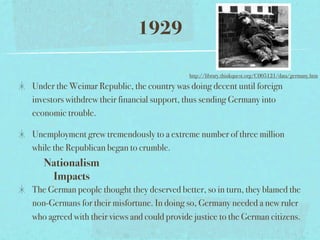
Under the Weimar Republic, the country was doing decent until foreign
investors withdrew their financial support, thus sending Germany into
economic trouble.

Unemployment grew tremendously to a extreme number of three million
while the Republican began to crumble.
   Nationalism
    Impacts
The German people thought they deserved better, so in turn, they blamed the
non-Germans for their misfortune. In doing so, Germany needed a new ruler
who agreed with their views and could provide justice to the German citizens.
1930
http://www.antifascistencyclopedia.com/allposts/utah-former-hitler-youth-still-finds-it-hard-to-understand-his-past

             The Nazi party gained greatest popularity and became the second largest
             party with 107 seats in the Reichstag.

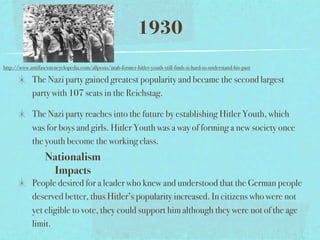
             The Nazi party reaches into the future by establishing Hitler Youth, which
             was for boys and girls. Hitler Youth was a way of forming a new society once
             the youth become the working class.
                   Nationalism
                    Impacts
             People desired for a leader who knew and understood that the German people
             deserved better, thus Hitler’s popularity increased. In citizens who were not
             yet eligible to vote, they could support him although they were not of the age
             limit.
1931
                                       http://www.standlikearock.net/category/economy/page/2/

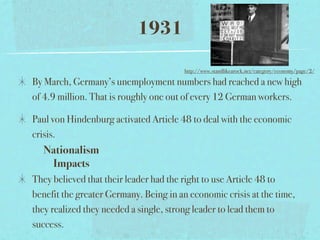
By March, Germany’s unemployment numbers had reached a new high
of 4.9 million. That is roughly one out of every 12 German workers.

Paul von Hindenburg activated Article 48 to deal with the economic
crisis.
  Nationalism
   Impacts
They believed that their leader had the right to use Article 48 to
benefit the greater Germany. Being in an economic crisis at the time,
they realized they needed a single, strong leader to lead them to
success.
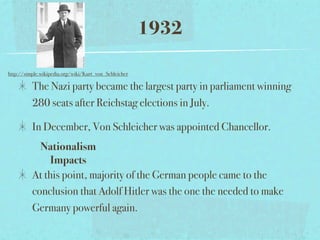
1932

http://simple.wikipedia.org/wiki/Kurt_von_Schleicher

          The Nazi party became the largest party in parliament winning
          280 seats after Reichstag elections in July.

          In December, Von Schleicher was appointed Chancellor.
            Nationalism
               Impacts
          At this point, majority of the German people came to the
          conclusion that Adolf Hitler was the one the needed to make
          Germany powerful again.
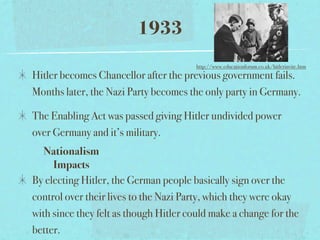
1933
                                       http://www.educationforum.co.uk/hitlerinvite.htm
Hitler becomes Chancellor after the previous government fails.
Months later, the Nazi Party becomes the only party in Germany.

The Enabling Act was passed giving Hitler undivided power
over Germany and it’s military.
   Nationalism
     Impacts
By electing Hitler, the German people basically sign over the
control over their lives to the Nazi Party, which they were okay
with since they felt as though Hitler could make a change for the
better.
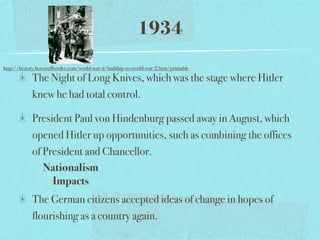
1934
http://history.howstuffworks.com/world-war-ii/buildup-to-world-war-2.htm/printable

            The Night of Long Knives, which was the stage where Hitler
            knew he had total control.

            President Paul von Hindenburg passed away in August, which
            opened Hitler up opportunities, such as combining the offices
            of President and Chancellor.
               Nationalism
                 Impacts
            The German citizens accepted ideas of change in hopes of
            flourishing as a country again.
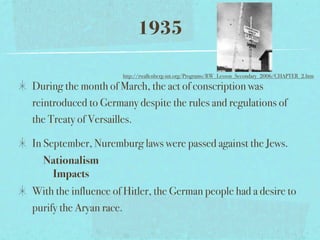
1935

                     http://rwallenberg-int.org/Programs/RW_Lesson_Secondary_2006/CHAPTER_2.htm

During the month of March, the act of conscription was
reintroduced to Germany despite the rules and regulations of
the Treaty of Versailles.

In September, Nuremburg laws were passed against the Jews.
   Nationalism
     Impacts
With the influence of Hitler, the German people had a desire to
purify the Aryan race.
1936
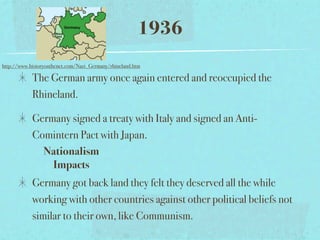
http://www.historyonthenet.com/Nazi_Germany/rhineland.htm

            The German army once again entered and reoccupied the
            Rhineland.

            Germany signed a treaty with Italy and signed an Anti-
            Comintern Pact with Japan.
              Nationalism
                Impacts
            Germany got back land they felt they deserved all the while
            working with other countries against other political beliefs not
            similar to their own, like Communism.
1937
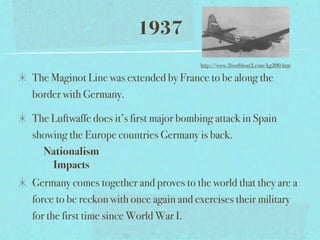
                                        http://www.2worldwar2.com/kg200.htm

The Maginot Line was extended by France to be along the
border with Germany.

The Luftwaffe does it’s first major bombing attack in Spain
showing the Europe countries Germany is back.
  Nationalism
    Impacts
Germany comes together and proves to the world that they are a
force to be reckon with once again and exercises their military
for the first time since World War I.
1938
http://www.ushmm.org/outreach/en/article.php?ModuleId=10007697


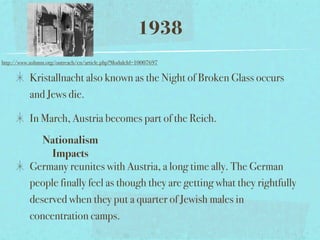
           Kristallnacht also known as the Night of Broken Glass occurs
           and Jews die.

           In March, Austria becomes part of the Reich.
              Nationalism
                Impacts
           Germany reunites with Austria, a long time ally. The German
           people finally feel as though they are getting what they rightfully
           deserved when they put a quarter of Jewish males in
           concentration camps.
1939
                                        http://www.toptenz.net/top-10-influential-firsts-in-history.php
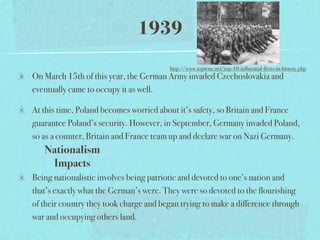
On March 15th of this year, the German Army invaded Czechoslovakia and
eventually came to occupy it as well.

At this time, Poland becomes worried about it’s safety, so Britain and France
guarantee Poland’s security. However, in September, Germany invaded Poland,
so as a counter, Britain and France team up and declare war on Nazi Germany.
   Nationalism
    Impacts
Being nationalistic involves being patriotic and devoted to one’s nation and
that’s exactly what the German’s were. They were so devoted to the flourishing
of their country they took charge and began trying to make a difference through
war and occupying others land.
Bibliography

"1929." Wikipedia, the Free Encyclopedia. 24 Jan. 2011. Web.
31 Jan. 2011. <http://en.wikipedia.org/wiki/1929>.

Panczyk, Pamela. "HSC Online." NSW HSC Online. Web. 31
Jan. 2011. <http://hsc.csu.edu.au/modern_history/
national_studies/germany/2435/page97.htm#anchor1565672>.

Simkin, John. "Nazi Germany Timeline." Spartacus
Educational - Home Page. Web. 31 Jan. 2011. <http://
www.spartacus.schoolnet.co.uk/GERchron.htm>.

Nazi timeline

  • 1.
    Germany Timeline Samantha Lesyk Harm Philipsen
  • 2.
    1929 http://library.thinkquest.org/C005121/data/germany.htm Under the Weimar Republic, the country was doing decent until foreign investors withdrew their financial support, thus sending Germany into economic trouble. Unemployment grew tremendously to a extreme number of three million while the Republican began to crumble. Nationalism Impacts The German people thought they deserved better, so in turn, they blamed the non-Germans for their misfortune. In doing so, Germany needed a new ruler who agreed with their views and could provide justice to the German citizens.
  • 3.
    1930 http://www.antifascistencyclopedia.com/allposts/utah-former-hitler-youth-still-finds-it-hard-to-understand-his-past The Nazi party gained greatest popularity and became the second largest party with 107 seats in the Reichstag. The Nazi party reaches into the future by establishing Hitler Youth, which was for boys and girls. Hitler Youth was a way of forming a new society once the youth become the working class. Nationalism Impacts People desired for a leader who knew and understood that the German people deserved better, thus Hitler’s popularity increased. In citizens who were not yet eligible to vote, they could support him although they were not of the age limit.
  • 4.
    1931 http://www.standlikearock.net/category/economy/page/2/ By March, Germany’s unemployment numbers had reached a new high of 4.9 million. That is roughly one out of every 12 German workers. Paul von Hindenburg activated Article 48 to deal with the economic crisis. Nationalism Impacts They believed that their leader had the right to use Article 48 to benefit the greater Germany. Being in an economic crisis at the time, they realized they needed a single, strong leader to lead them to success.
  • 5.
    1932 http://simple.wikipedia.org/wiki/Kurt_von_Schleicher The Nazi party became the largest party in parliament winning 280 seats after Reichstag elections in July. In December, Von Schleicher was appointed Chancellor. Nationalism Impacts At this point, majority of the German people came to the conclusion that Adolf Hitler was the one the needed to make Germany powerful again.
  • 6.
    1933 http://www.educationforum.co.uk/hitlerinvite.htm Hitler becomes Chancellor after the previous government fails. Months later, the Nazi Party becomes the only party in Germany. The Enabling Act was passed giving Hitler undivided power over Germany and it’s military. Nationalism Impacts By electing Hitler, the German people basically sign over the control over their lives to the Nazi Party, which they were okay with since they felt as though Hitler could make a change for the better.
  • 7.
    1934 http://history.howstuffworks.com/world-war-ii/buildup-to-world-war-2.htm/printable The Night of Long Knives, which was the stage where Hitler knew he had total control. President Paul von Hindenburg passed away in August, which opened Hitler up opportunities, such as combining the offices of President and Chancellor. Nationalism Impacts The German citizens accepted ideas of change in hopes of flourishing as a country again.
  • 8.
    1935 http://rwallenberg-int.org/Programs/RW_Lesson_Secondary_2006/CHAPTER_2.htm During the month of March, the act of conscription was reintroduced to Germany despite the rules and regulations of the Treaty of Versailles. In September, Nuremburg laws were passed against the Jews. Nationalism Impacts With the influence of Hitler, the German people had a desire to purify the Aryan race.
  • 9.
    1936 http://www.historyonthenet.com/Nazi_Germany/rhineland.htm The German army once again entered and reoccupied the Rhineland. Germany signed a treaty with Italy and signed an Anti- Comintern Pact with Japan. Nationalism Impacts Germany got back land they felt they deserved all the while working with other countries against other political beliefs not similar to their own, like Communism.
  • 10.
    1937 http://www.2worldwar2.com/kg200.htm The Maginot Line was extended by France to be along the border with Germany. The Luftwaffe does it’s first major bombing attack in Spain showing the Europe countries Germany is back. Nationalism Impacts Germany comes together and proves to the world that they are a force to be reckon with once again and exercises their military for the first time since World War I.
  • 11.
    1938 http://www.ushmm.org/outreach/en/article.php?ModuleId=10007697 Kristallnacht also known as the Night of Broken Glass occurs and Jews die. In March, Austria becomes part of the Reich. Nationalism Impacts Germany reunites with Austria, a long time ally. The German people finally feel as though they are getting what they rightfully deserved when they put a quarter of Jewish males in concentration camps.
  • 12.
    1939 http://www.toptenz.net/top-10-influential-firsts-in-history.php On March 15th of this year, the German Army invaded Czechoslovakia and eventually came to occupy it as well. At this time, Poland becomes worried about it’s safety, so Britain and France guarantee Poland’s security. However, in September, Germany invaded Poland, so as a counter, Britain and France team up and declare war on Nazi Germany. Nationalism Impacts Being nationalistic involves being patriotic and devoted to one’s nation and that’s exactly what the German’s were. They were so devoted to the flourishing of their country they took charge and began trying to make a difference through war and occupying others land.
  • 13.
    Bibliography "1929." Wikipedia, theFree Encyclopedia. 24 Jan. 2011. Web. 31 Jan. 2011. <http://en.wikipedia.org/wiki/1929>. Panczyk, Pamela. "HSC Online." NSW HSC Online. Web. 31 Jan. 2011. <http://hsc.csu.edu.au/modern_history/ national_studies/germany/2435/page97.htm#anchor1565672>. Simkin, John. "Nazi Germany Timeline." Spartacus Educational - Home Page. Web. 31 Jan. 2011. <http:// www.spartacus.schoolnet.co.uk/GERchron.htm>.

Editor's Notes