Navigating the Media World
  with Consumer Centric
         Research
                Dirk Engel
        Universal McCann Germany
  SEMPL II, Portorož , November 28th 2008
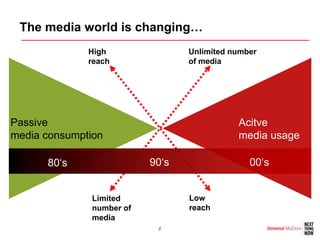
The media world is changing…
              High               Unlimited number
              reach              of media


Passive                                     Acitve
media consumption                           media usage

      80‘s                90‘s                 00‘s


              Limited            Low
              number of          reach
              media
                           2
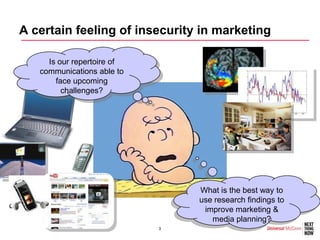
A certain feeling of insecurity in marketing

     Is our repertoire of
   communications able to
       face upcoming
         challenges?


                                What is the best way to
                                use research findings to
                                 improve marketing &
                                   media planning?
                            3
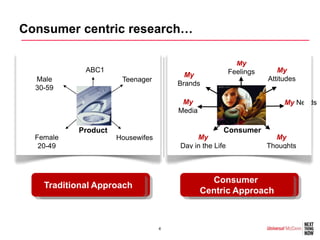
Consumer centric research…

                                                          My
             ABC1                                       Feelings      My
                                        My
  Male                Teenager                                     Attitudes
                                      Brands
  30-59

                                       My                               My Needs
                                      Media

           Product                                  Consumer
  Female             Housewifes            My                        My
   20-49                              Day in the Life              Thoughts


                                                 Consumer
                                                  Consumer
    Traditional Approach
     Traditional Approach
                                              Centric Approach
                                               Centric Approach


                                  4
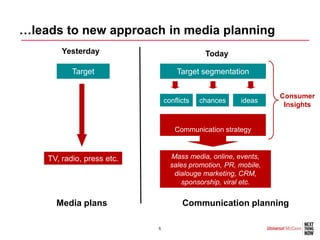
…leads to new approach in media planning
        Yesterday                            Today

           Target                   Target segmentation


                                                                 Consumer
                                conflicts   chances    ideas
                                                                  Insights


                                   Communication strategy


    TV, radio, press etc.         Mass media, online, events,
                                  sales promotion, PR, mobile,
                                   dialouge marketing, CRM,
                                      sponsorship, viral etc.


      Media plans                     Communication planning

                            5
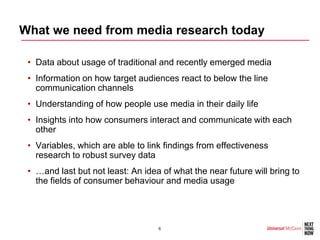
What we need from media research today

 • Data about usage of traditional and recently emerged media
 • Information on how target audiences react to below the line
   communication channels
 • Understanding of how people use media in their daily life
 • Insights into how consumers interact and communicate with each
   other
 • Variables, which are able to link findings from effectiveness
   research to robust survey data
 • …and last but not least: An idea of what the near future will bring to
   the fields of consumer behaviour and media usage


                                   6
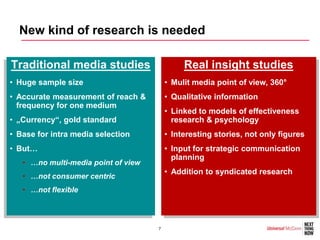
New kind of research is needed

Traditional media studies                     Real insight studies
• Huge sample size                       • Mulit media point of view, 360°
• Accurate measurement of reach &        • Qualitative information
  frequency for one medium
                                         • Linked to models of effectiveness
• „Currency“, gold standard                research & psychology
• Base for intra media selection         • Interesting stories, not only figures
• But…                                   • Input for strategic communication
                                           planning
   • …no multi-media point of view
                                         • Addition to syndicated research
   • …not consumer centric
   • …not flexible


                                     7
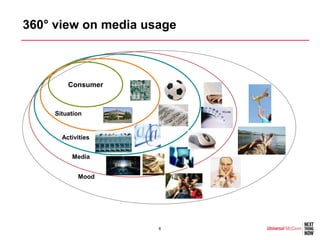
360° view on media usage


         Consumer


     Situation


       Activities


          Media


            Mood


                     8
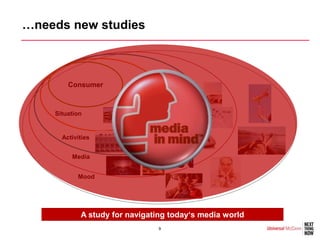
…needs new studies


        Consumer


    Situation


      Activities


         Media


           Mood


            A study for navigating today‘s media world
                                9
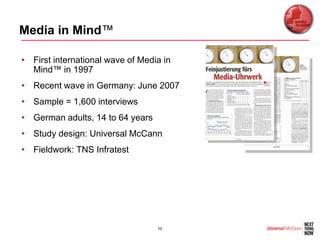
Media in Mind™

• First international wave of Media in
  Mind™ in 1997
• Recent wave in Germany: June 2007
• Sample = 1,600 interviews
• German adults, 14 to 64 years
• Study design: Universal McCann
• Fieldwork: TNS Infratest


                                  10
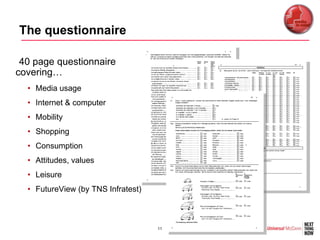
The questionnaire

•40 page questionnaire
covering…
  • Media usage
  • Internet & computer
  • Mobility
  • Shopping
  • Consumption
  • Attitudes, values
  • Leisure
  • FutureView (by TNS Infratest)


                                    11
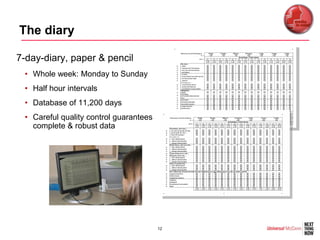
The diary

•7-day-diary, paper & pencil
  • Whole week: Monday to Sunday
  • Half hour intervals
  • Database of 11,200 days
  • Careful quality control guarantees
    complete & robust data


                                         12
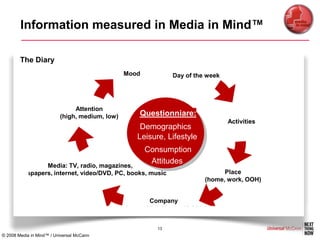
Information measured in Media in Mind™

        The Diary
                                                 Mood             Day of the week


                               Attention
                          (high, medium, low)          Questionniare:
                                                                                    Activities
                                                       Demographics
                                                      Leisure, Lifestyle
                                                        Consumption
                                                         Attitudes
              Media: TV, radio, magazines,
     Newspapers, internet, video/DVD, PC, books, music                              Place
                                                                              (home, work, OOH)


                                                          Company
                                                (alone, with others, with kids)


                                                             13
© 2008 Media in Mind™ / Universal McCann
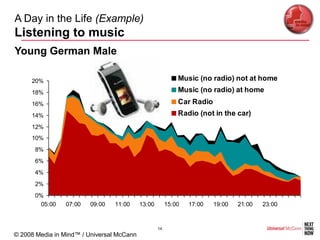
A Day in the Life (Example)
Listening to music
Young German Male

     20%                                                    Music (no radio) not at home
     18%                                                    Music (no radio) at home
     16%                                                    Car Radio
     14%                                                    Radio (not in the car)
     12%
     10%
      8%
      6%
      4%
      2%
      0%
        05:00   07:00   09:00   11:00      13:00        15:00   17:00   19:00   21:00   23:00


                                                   14
© 2008 Media in Mind™ / Universal McCann
Input for strategy & marketing communications
 • Which is the best mix of ad media?
 • Which are the most effective time periods and days for advertising?
 • Which other communication channels are appropriate?
 • Which media are best to stimulate short-term sales because of
   reaching the target audience close to the purchase?
 • What information sources are valued the most and used for purchasing
   products?
 • How do activities like computer and video gaming affect the time
   budget of specific target audiences?
 • Which media, topics, products will become more relevant in the future?


                                 15
How consumers cope with information overload?
•Consumers are not overwhelmed by the today’s media output, they developed
mechanisms to deal with it.
   • Three examples:

   • On psychological level
                = Selective attention management

   • On sociological level
                = Division of labor in information processing

   • Strategy for marketing communication
                = Finding the best moment to deliver relevant messages


                                      16
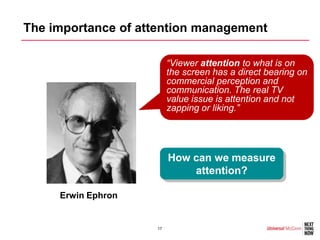
The importance of attention management

                         “Viewer attention to what is on
                         the screen has a direct bearing on
                         commercial perception and
                         communication. The real TV
                         value issue is attention and not
                         zapping or liking.”


                         How can we measure
                             attention?

     Erwin Ephron


                    17
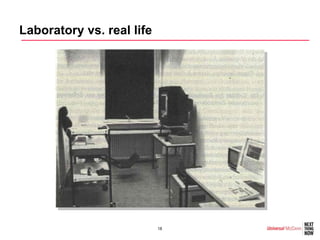
Laboratory vs. real life


                           18
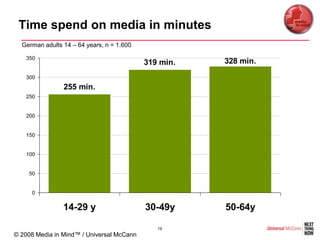
Time spend on media in minutes
  German adults 14 – 64 years, n = 1.600

   350
                                           319 min.   328 min.
   300
                255 min.
   250


   200


   150


   100


    50


     0

                14-29 y                    30-49y     50-64y

                                              19
© 2008 Media in Mind™ / Universal McCann
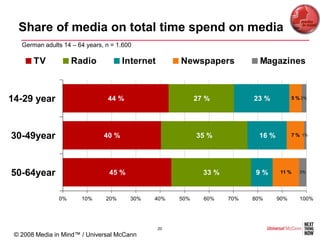
Share of media on total time spend on media
   German adults 14 – 64 years, n = 1.600

       TV           Radio             Internet        Newspapers             Magazines


14-29 year                      44 %                        27 %           23 %          5 % 2%


30-49year                      40 %                         35 %            16 %         7 % 1%


50-64year                        45 %                         33 %          9%      11 %    3%


               0%      10%      20%     30%   40%     50%     60%    70%   80%     90%      100%


                                                 20
 © 2008 Media in Mind™ / Universal McCann
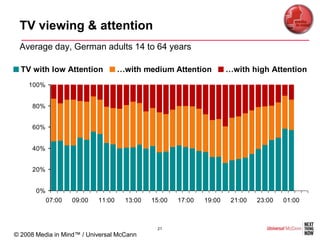
TV viewing & attention
 Average day, German adults 14 to 64 years

  TV with low Attention             …with medium Attention           …with high Attention
    100%


      80%


      60%


      40%


      20%


       0%
            07:00   09:00   11:00    13:00   15:00   17:00   19:00    21:00   23:00   01:00


                                              21
© 2008 Media in Mind™ / Universal McCann
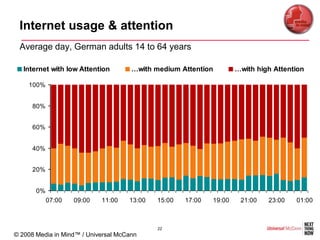
Internet usage & attention
 Average day, German adults 14 to 64 years

   Internet with low Attention        …with medium Attention         …with high Attention

    100%


      80%


      60%


      40%


      20%


       0%
            07:00   09:00   11:00    13:00   15:00   17:00   19:00    21:00   23:00   01:00


                                             22
© 2008 Media in Mind™ / Universal McCann
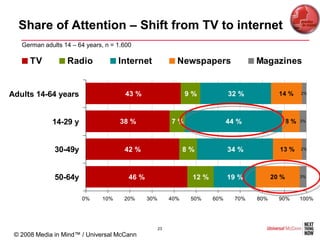
Share of Attention – Shift from TV to internet
   German adults 14 – 64 years, n = 1.600

      TV          Radio             Internet                Newspapers                Magazines


Adults 14-64 years                    43 %                      9%            32 %            14 %      2%


             14-29 y                 38 %                 7%                  44 %                 8%   3%


              30-49y                  42 %                      8%            34 %            13 %      2%


              50-64y                    46 %                     12 %         19 %          20 %        3%


                       0%     10%     20%      30%        40%    50%    60%     70%   80%     90%       100%


                                                     23
 © 2008 Media in Mind™ / Universal McCann
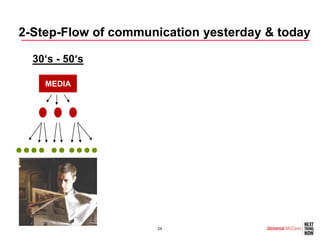
2-Step-Flow of communication yesterday & today

  30‘s - 50‘s

    MEDIA


                     24
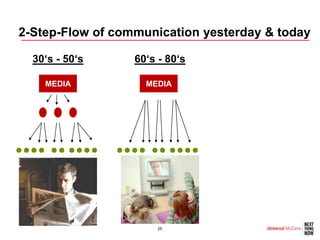
2-Step-Flow of communication yesterday & today

  30‘s - 50‘s     60‘s - 80‘s

    MEDIA           MEDIA


                      25
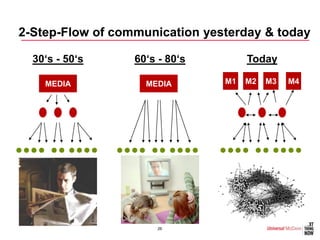
2-Step-Flow of communication yesterday & today

  30‘s - 50‘s     60‘s - 80‘s        Today

    MEDIA           MEDIA       M1   M2   M3   M4


                      26
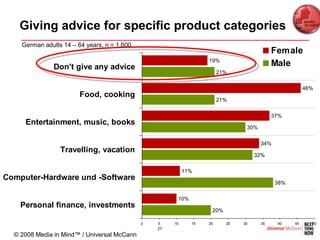
Giving advice for specific product categories
    German adults 14 – 64 years, n = 1.600
                                                                                          Female
                                                                  19%
               Don't give any advice                                                      Male
                                                                       21%


                                                                                                      46%
                        Food, cooking
                                                                       21%

                                                                                          37%
     Entertainment, music, books
                                                                               30%

                                                                                     34%
                 Travelling, vacation
                                                                                   32%

                                                           11%
Computer-Hardware und -Software
                                                                                           38%

                                                       10%
    Personal finance, investments
                                                                   20%

                                             0   5    10     15   20     25   30     35    40    45     50
                                                 27
  © 2008 Media in Mind™ / Universal McCann
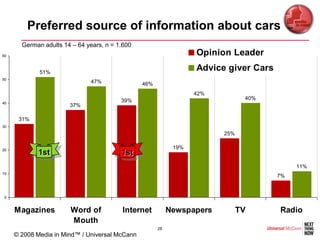
Preferred source of information about cars
       German adults 14 – 64 years, n = 1.600
60                                                                Opinion Leader

             51%
                                                                  Advice giver Cars
50
                              47%               46%
                                                                  42%
                                         39%                                   40%
40
                       37%

      31%
30
                                                                        25%


20
                                                            19%
            1st                          1st
                                                                                           11%
10
                                                                                      7%


0


     Magazines         Word of           Internet          Newspapers         TV      Radio
                       Mouth
                                                      28
     © 2008 Media in Mind™ / Universal McCann
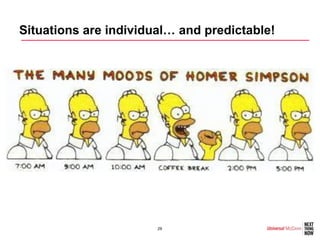
Situations are individual… and predictable!


                       29
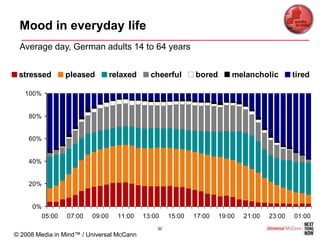
Mood in everyday life
 Average day, German adults 14 to 64 years


 stressed          pleased         relaxed     cheerful       bored       melancholic         tired

   100%


    80%


    60%


    40%


    20%


      0%
           05:00   07:00   09:00     11:00   13:00    15:00   17:00   19:00   21:00   23:00   01:00
                                                 30
© 2008 Media in Mind™ / Universal McCann
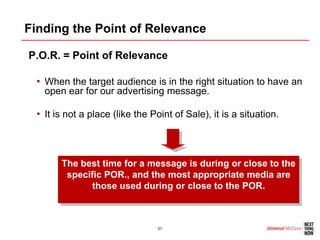
Finding the Point of Relevance

•P.O.R. = Point of Relevance

  • When the target audience is in the right situation to have an
    open ear for our advertising message.

  • It is not a place (like the Point of Sale), it is a situation.


        The best time for a message is during or close to the
         specific POR., and the most appropriate media are
              those used during or close to the POR.


                                 31
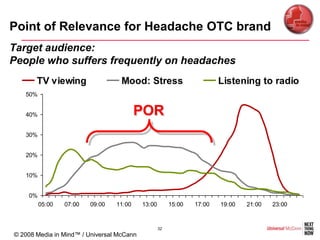
Point of Relevance for Headache OTC brand
Target audience:
People who suffers frequently on headaches
       TV viewing                  Mood: Stress                         Listening to radio
   50%


   40%                                   POR
   30%


   20%


   10%


    0%
         05:00   07:00   09:00   11:00     13:00        15:00   17:00   19:00   21:00   23:00


                                                   32
© 2008 Media in Mind™ / Universal McCann
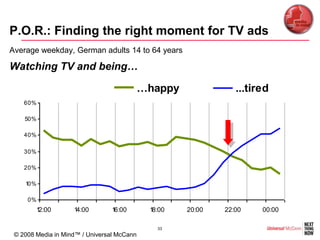
P.O.R.: Finding the right moment for TV ads
Average weekday, German adults 14 to 64 years

Watching TV and being…

                                            …happy              ...tired
    60%

    50%

    40%

    30%

    20%

    10%

     0%
        12:00       14:00       16:00        18:00   20:00   22:00    00:00

                                               33
 © 2008 Media in Mind™ / Universal McCann
Navigating the Media World

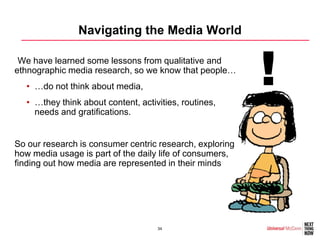
•We have learned some lessons from qualitative and
ethnographic media research, so we know that people…
  • …do not think about media,
  • …they think about content, activities, routines,
                                                          !
    needs and gratifications.


So our research is consumer centric research, exploring
how media usage is part of the daily life of consumers,
finding out how media are represented in their minds


                                    34
dirk.engel@umww.com

      Dirk Engel                             Tel.:    + 49 - (0)69 – 79 404 - 110
     Head of Research
Universal McCann Knowledge


                 Universal McCann GmbH, Speicherstrasse 57-59, D 60327 Frankfurt

                         http://www.universalmccann.de
www.dirkengel.org

Navigating The Media World

  • 1.
    Navigating the MediaWorld with Consumer Centric Research Dirk Engel Universal McCann Germany SEMPL II, Portorož , November 28th 2008
  • 2.
    The media worldis changing… High Unlimited number reach of media Passive Acitve media consumption media usage 80‘s 90‘s 00‘s Limited Low number of reach media 2
  • 3.
    A certain feelingof insecurity in marketing Is our repertoire of communications able to face upcoming challenges? What is the best way to use research findings to improve marketing & media planning? 3
  • 4.
    Consumer centric research… My ABC1 Feelings My My Male Teenager Attitudes Brands 30-59 My My Needs Media Product Consumer Female Housewifes My My 20-49 Day in the Life Thoughts Consumer Consumer Traditional Approach Traditional Approach Centric Approach Centric Approach 4
  • 5.
    …leads to newapproach in media planning Yesterday Today Target Target segmentation Consumer conflicts chances ideas Insights Communication strategy TV, radio, press etc. Mass media, online, events, sales promotion, PR, mobile, dialouge marketing, CRM, sponsorship, viral etc. Media plans Communication planning 5
  • 6.
    What we needfrom media research today • Data about usage of traditional and recently emerged media • Information on how target audiences react to below the line communication channels • Understanding of how people use media in their daily life • Insights into how consumers interact and communicate with each other • Variables, which are able to link findings from effectiveness research to robust survey data • …and last but not least: An idea of what the near future will bring to the fields of consumer behaviour and media usage 6
  • 7.
    New kind ofresearch is needed Traditional media studies Real insight studies • Huge sample size • Mulit media point of view, 360° • Accurate measurement of reach & • Qualitative information frequency for one medium • Linked to models of effectiveness • „Currency“, gold standard research & psychology • Base for intra media selection • Interesting stories, not only figures • But… • Input for strategic communication planning • …no multi-media point of view • Addition to syndicated research • …not consumer centric • …not flexible 7
  • 8.
    360° view onmedia usage Consumer Situation Activities Media Mood 8
  • 9.
    …needs new studies Consumer Situation Activities Media Mood A study for navigating today‘s media world 9
  • 10.
    Media in Mind™ •First international wave of Media in Mind™ in 1997 • Recent wave in Germany: June 2007 • Sample = 1,600 interviews • German adults, 14 to 64 years • Study design: Universal McCann • Fieldwork: TNS Infratest 10
  • 11.
    The questionnaire •40 pagequestionnaire covering… • Media usage • Internet & computer • Mobility • Shopping • Consumption • Attitudes, values • Leisure • FutureView (by TNS Infratest) 11
  • 12.
    The diary •7-day-diary, paper& pencil • Whole week: Monday to Sunday • Half hour intervals • Database of 11,200 days • Careful quality control guarantees complete & robust data 12
  • 13.
    Information measured inMedia in Mind™ The Diary Mood Day of the week Attention (high, medium, low) Questionniare: Activities Demographics Leisure, Lifestyle Consumption Attitudes Media: TV, radio, magazines, Newspapers, internet, video/DVD, PC, books, music Place (home, work, OOH) Company (alone, with others, with kids) 13 © 2008 Media in Mind™ / Universal McCann
  • 14.
    A Day inthe Life (Example) Listening to music Young German Male 20% Music (no radio) not at home 18% Music (no radio) at home 16% Car Radio 14% Radio (not in the car) 12% 10% 8% 6% 4% 2% 0% 05:00 07:00 09:00 11:00 13:00 15:00 17:00 19:00 21:00 23:00 14 © 2008 Media in Mind™ / Universal McCann
  • 15.
    Input for strategy& marketing communications • Which is the best mix of ad media? • Which are the most effective time periods and days for advertising? • Which other communication channels are appropriate? • Which media are best to stimulate short-term sales because of reaching the target audience close to the purchase? • What information sources are valued the most and used for purchasing products? • How do activities like computer and video gaming affect the time budget of specific target audiences? • Which media, topics, products will become more relevant in the future? 15
  • 16.
    How consumers copewith information overload? •Consumers are not overwhelmed by the today’s media output, they developed mechanisms to deal with it. • Three examples: • On psychological level = Selective attention management • On sociological level = Division of labor in information processing • Strategy for marketing communication = Finding the best moment to deliver relevant messages 16
  • 17.
    The importance ofattention management “Viewer attention to what is on the screen has a direct bearing on commercial perception and communication. The real TV value issue is attention and not zapping or liking.” How can we measure attention? Erwin Ephron 17
  • 18.
  • 19.
    Time spend onmedia in minutes German adults 14 – 64 years, n = 1.600 350 319 min. 328 min. 300 255 min. 250 200 150 100 50 0 14-29 y 30-49y 50-64y 19 © 2008 Media in Mind™ / Universal McCann
  • 20.
    Share of mediaon total time spend on media German adults 14 – 64 years, n = 1.600 TV Radio Internet Newspapers Magazines 14-29 year 44 % 27 % 23 % 5 % 2% 30-49year 40 % 35 % 16 % 7 % 1% 50-64year 45 % 33 % 9% 11 % 3% 0% 10% 20% 30% 40% 50% 60% 70% 80% 90% 100% 20 © 2008 Media in Mind™ / Universal McCann
  • 21.
    TV viewing &attention Average day, German adults 14 to 64 years TV with low Attention …with medium Attention …with high Attention 100% 80% 60% 40% 20% 0% 07:00 09:00 11:00 13:00 15:00 17:00 19:00 21:00 23:00 01:00 21 © 2008 Media in Mind™ / Universal McCann
  • 22.
    Internet usage &attention Average day, German adults 14 to 64 years Internet with low Attention …with medium Attention …with high Attention 100% 80% 60% 40% 20% 0% 07:00 09:00 11:00 13:00 15:00 17:00 19:00 21:00 23:00 01:00 22 © 2008 Media in Mind™ / Universal McCann
  • 23.
    Share of Attention– Shift from TV to internet German adults 14 – 64 years, n = 1.600 TV Radio Internet Newspapers Magazines Adults 14-64 years 43 % 9% 32 % 14 % 2% 14-29 y 38 % 7% 44 % 8% 3% 30-49y 42 % 8% 34 % 13 % 2% 50-64y 46 % 12 % 19 % 20 % 3% 0% 10% 20% 30% 40% 50% 60% 70% 80% 90% 100% 23 © 2008 Media in Mind™ / Universal McCann
  • 24.
    2-Step-Flow of communicationyesterday & today 30‘s - 50‘s MEDIA 24
  • 25.
    2-Step-Flow of communicationyesterday & today 30‘s - 50‘s 60‘s - 80‘s MEDIA MEDIA 25
  • 26.
    2-Step-Flow of communicationyesterday & today 30‘s - 50‘s 60‘s - 80‘s Today MEDIA MEDIA M1 M2 M3 M4 26
  • 27.
    Giving advice forspecific product categories German adults 14 – 64 years, n = 1.600 Female 19% Don't give any advice Male 21% 46% Food, cooking 21% 37% Entertainment, music, books 30% 34% Travelling, vacation 32% 11% Computer-Hardware und -Software 38% 10% Personal finance, investments 20% 0 5 10 15 20 25 30 35 40 45 50 27 © 2008 Media in Mind™ / Universal McCann
  • 28.
    Preferred source ofinformation about cars German adults 14 – 64 years, n = 1.600 60 Opinion Leader 51% Advice giver Cars 50 47% 46% 42% 39% 40% 40 37% 31% 30 25% 20 19% 1st 1st 11% 10 7% 0 Magazines Word of Internet Newspapers TV Radio Mouth 28 © 2008 Media in Mind™ / Universal McCann
  • 29.
    Situations are individual…and predictable! 29
  • 30.
    Mood in everydaylife Average day, German adults 14 to 64 years stressed pleased relaxed cheerful bored melancholic tired 100% 80% 60% 40% 20% 0% 05:00 07:00 09:00 11:00 13:00 15:00 17:00 19:00 21:00 23:00 01:00 30 © 2008 Media in Mind™ / Universal McCann
  • 31.
    Finding the Pointof Relevance •P.O.R. = Point of Relevance • When the target audience is in the right situation to have an open ear for our advertising message. • It is not a place (like the Point of Sale), it is a situation. The best time for a message is during or close to the specific POR., and the most appropriate media are those used during or close to the POR. 31
  • 32.
    Point of Relevancefor Headache OTC brand Target audience: People who suffers frequently on headaches TV viewing Mood: Stress Listening to radio 50% 40% POR 30% 20% 10% 0% 05:00 07:00 09:00 11:00 13:00 15:00 17:00 19:00 21:00 23:00 32 © 2008 Media in Mind™ / Universal McCann
  • 33.
    P.O.R.: Finding theright moment for TV ads Average weekday, German adults 14 to 64 years Watching TV and being… …happy ...tired 60% 50% 40% 30% 20% 10% 0% 12:00 14:00 16:00 18:00 20:00 22:00 00:00 33 © 2008 Media in Mind™ / Universal McCann
  • 34.
    Navigating the MediaWorld •We have learned some lessons from qualitative and ethnographic media research, so we know that people… • …do not think about media, • …they think about content, activities, routines, ! needs and gratifications. So our research is consumer centric research, exploring how media usage is part of the daily life of consumers, finding out how media are represented in their minds 34
  • 35.
    dirk.engel@umww.com Dirk Engel Tel.: + 49 - (0)69 – 79 404 - 110 Head of Research Universal McCann Knowledge Universal McCann GmbH, Speicherstrasse 57-59, D 60327 Frankfurt http://www.universalmccann.de
  • 36.