IES MARIA BELLIDO BAILÉN
                                     UNIT 1 EARTH IN UNIVERSE             José Cayetano Bautista Expósito


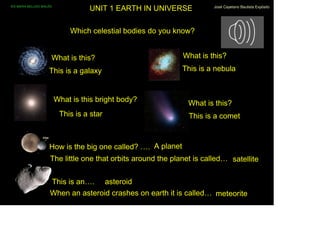
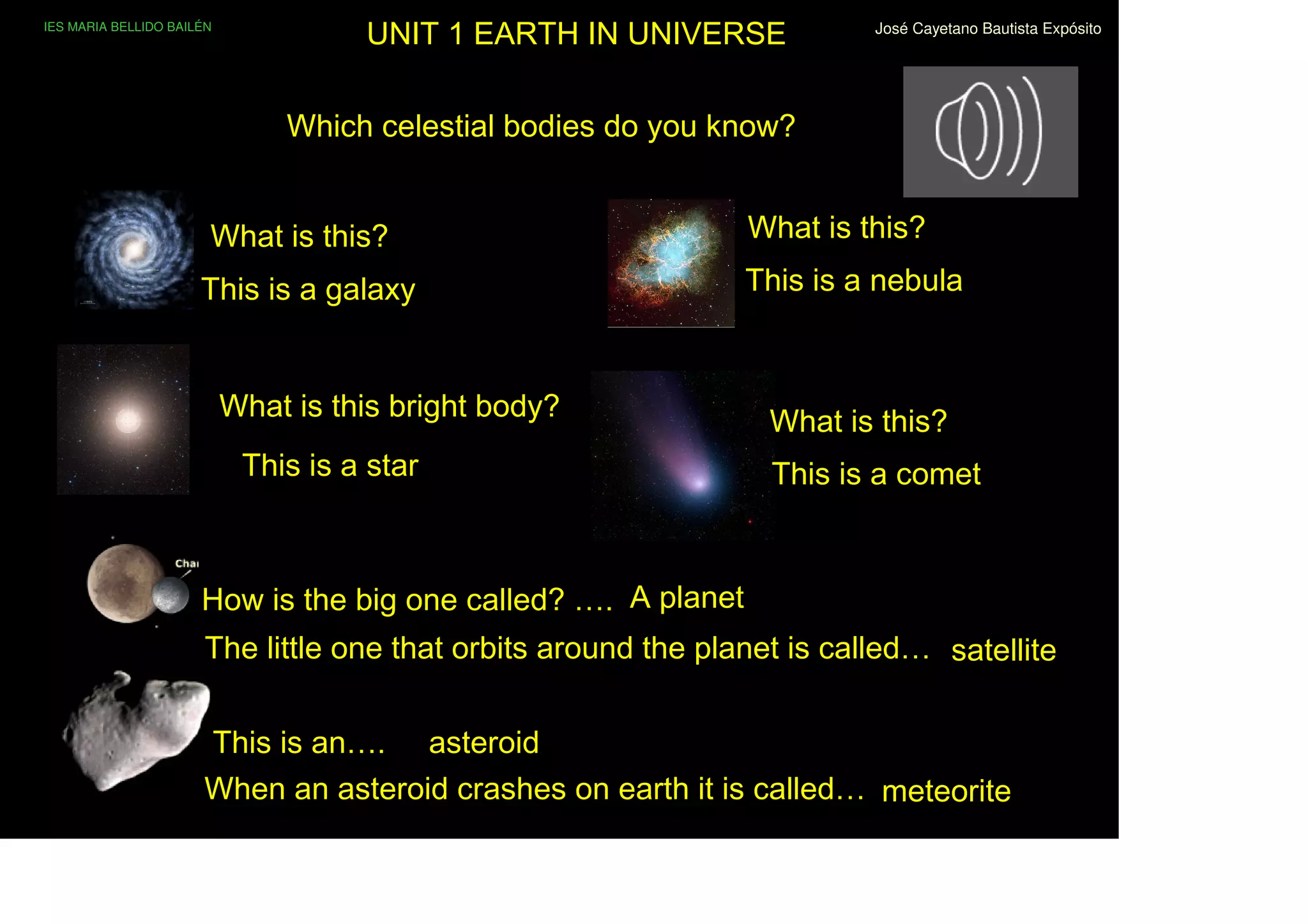
                               Which celestial bodies do you know?


                       What is this?                            What is this?
                      This is a galaxy                          This is a nebula


                           What is this bright body?              What is this?
                            This is a star                        This is a comet


                      How is the big one called? …. A planet
                       The little one that orbits around the planet is called… satellite


                      This is an…. asteroid
                      When an asteroid crashes on earth it is called… meteorite
IES MARIA BELLIDO BAILÉN
                             UNIT 1 EARTH IN UNIVERSE    José Cayetano Bautista Expósito


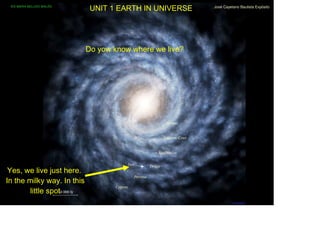
                            Do yow know where we live?


 Yes, we live just here.
In the milky way. In this
        little spot
IES MARIA BELLIDO BAILÉN
                              UNIT 1 EARTH IN UNIVERSE                José Cayetano Bautista Expósito


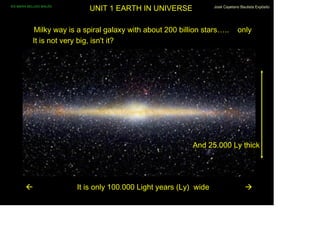
            Milky way is a spiral galaxy with about 200 billion stars…..           only
            It is not very big, isn't it?


                                                              And 25.000 Ly thick


                           It is only 100.000 Light years (Ly) wide
IES MARIA BELLIDO BAILÉN
                                    UNIT 1 EARTH IN UNIVERSE           José Cayetano Bautista Expósito


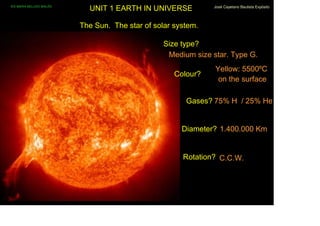
                                  The Sun. The star of solar system.

                                                          Size type?
                                                           Medium size star. Type G.
                                                                        Yellow: 5500ºC
                                                             Colour?
                                                                         on the surface

                                                                Gases? 75% H / 25% He


                                                               Diameter? 1.400.000 Km


                                                               Rotation? C.C.W.


José Cayetano Bautista Expósito
IES MARIA BELLIDO BAILÉN
                                     UNIT 1 EARTH IN UNIVERSE              José Cayetano Bautista Expósito


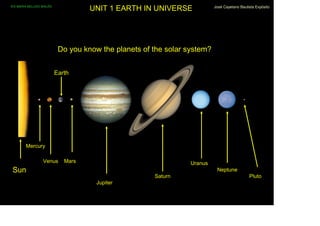
                            Do you know the planets of the solar system?


                           Earth


        Mercury

                  Venus       Mars                                Uranus
 Sun                                                                        Neptune
                                                       Saturn                                 Pluto
                                       Jupiter
IES MARIA BELLIDO BAILÉN
                                UNIT 1 EARTH IN UNIVERSE               José Cayetano Bautista Expósito


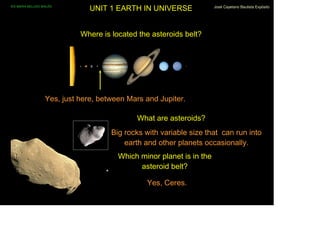
                             Where is located the asteroids belt?


                   Yes, just here, between Mars and Jupiter.

                                             What are asteroids?
                                      Big rocks with variable size that can run into
                                          earth and other planets occasionally.
                                        Which minor planet is in the
                                              asteroid belt?

                                                Yes, Ceres.
IES MARIA BELLIDO BAILÉN
                                    UNIT 1 EARTH IN UNIVERSE            José Cayetano Bautista Expósito


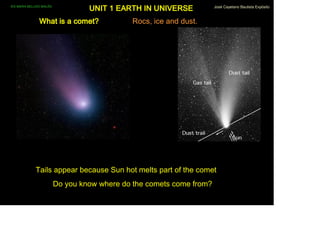
                What is a comet?               Rocs, ice and dust.


              Tails appear because Sun hot melts part of the comet
                           Do you know where do the comets come from?
IES MARIA BELLIDO BAILÉN
                                  UNIT 1 EARTH IN UNIVERSE              José Cayetano Bautista Expósito


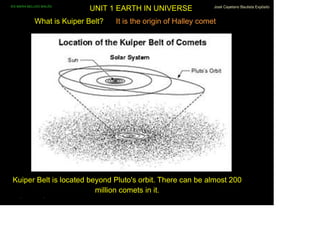
                  What is Kuiper Belt?   It is the origin of Halley comet


 Kuiper Belt is located beyond Pluto's orbit. There can be almost 200
                          million comets in it.
José Cayetano Bautista Expósito
IES MARIA BELLIDO BAILÉN
                                     UNIT 1 EARTH IN UNIVERSE                 José Cayetano Bautista Expósito


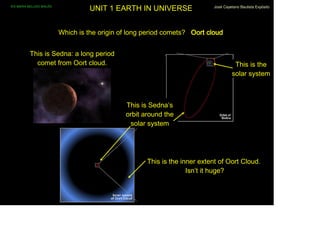
                           Which is the origin of long period comets? Oort cloud


           This is Sedna: a long period
             comet from Oort cloud.                                                     This is the
                                                                                       solar system


                                                This is Sedna’s
                                                orbit around the
                                                 solar system


                                                       This is the inner extent of Oort Cloud.
                                                                     Isn’t it huge?
IES MARIA BELLIDO BAILÉN
                           UNIT 1 EARTH IN UNIVERSE   José Cayetano Bautista Expósito
                                                                                1/10


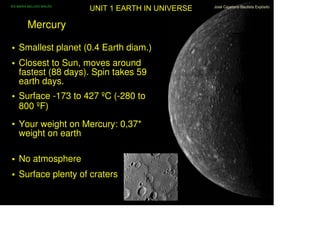
         Mercury

• Smallest planet (0.4 Earth diam.)
• Closest to Sun, moves around
  fastest (88 days). Spin takes 59
  earth days.
• Surface -173 to 427 ºC (-280 to
  800 ºF)
• Your weight on Mercury: 0,37*
  weight on earth

• No atmosphere
• Surface plenty of craters
IES MARIA BELLIDO BAILÉN
                            UNIT 1 EARTH IN UNIVERSE    José Cayetano Bautista Expósito


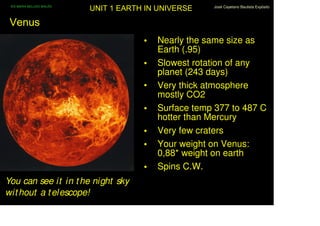
 Venus
                                        •   Nearly the same size as
                                            Earth (.95)
                                        •   Slowest rotation of any
                                            planet (243 days)
                                        •   Very thick atmosphere
                                            mostly CO2
                                        •   Surface temp 377 to 487 C
                                            hotter than Mercury
                                        •   Very few craters
                                        •   Your weight on Venus:
                                            0,88* weight on earth
                                        •   Spins C.W.
You can see it in t he night sky
wit hout a t elescope!
IES MARIA BELLIDO BAILÉN
                           UNIT 1 EARTH IN UNIVERSE       José Cayetano Bautista Expósito


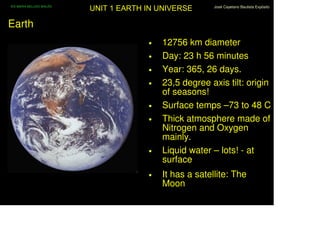
Earth
                                        •   12756 km diameter
                                        •   Day: 23 h 56 minutes
                                        •   Year: 365, 26 days.
                                        •   23,5 degree axis tilt: origin
                                            of seasons!
                                        •   Surface temps –73 to 48 C
                                        •   Thick atmosphere made of
                                            Nitrogen and Oxygen
                                            mainly.
                                        •   Liquid water – lots! - at
                                            surface
                                        •   It has a satellite: The
                                            Moon
IES MARIA BELLIDO BAILÉN
                           UNIT 1 EARTH IN UNIVERSE   José Cayetano Bautista Expósito


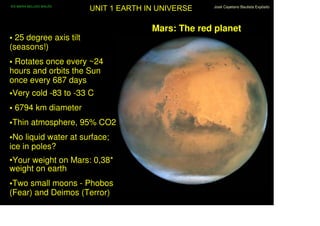
                                         Mars: The red planet
• 25 degree axis tilt
(seasons!)
• Rotates once every ~24
hours and orbits the Sun
once every 687 days
•Very cold -83 to -33 C
• 6794 km diameter
•Thin atmosphere, 95% CO2
•No liquid water at surface;
ice in poles?
•Your weight on Mars: 0,38*
weight on earth
•Two small moons - Phobos
(Fear) and Deimos (Terror)
IES MARIA BELLIDO BAILÉN
                             UNIT 1 EARTH IN UNIVERSE   José Cayetano Bautista Expósito


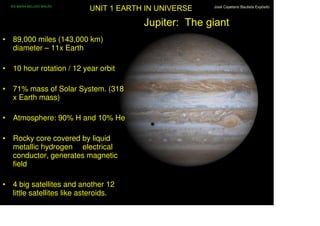
                                         Jupiter: The giant
• 89,000 miles (143,000 km)
  diameter – 11x Earth

• 10 hour rotation / 12 year orbit

• 71% mass of Solar System. (318
  x Earth mass)

• Atmosphere: 90% H and 10% He

• Rocky core covered by liquid
  metallic hydrogen electrical
  conductor, generates magnetic
  field

• 4 big satellites and another 12
  little satellites like asteroids.
IES MARIA BELLIDO BAILÉN
                           UNIT 1 EARTH IN UNIVERSE   José Cayetano Bautista Expósito


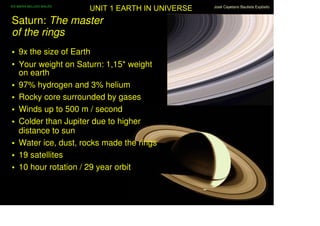
Saturn: The master
of the rings
• 9x the size of Earth
• Your weight on Saturn: 1,15* weight
  on earth
• 97% hydrogen and 3% helium
• Rocky core surrounded by gases
• Winds up to 500 m / second
• Colder than Jupiter due to higher
  distance to sun
• Water ice, dust, rocks made the rings
• 19 satellites
• 10 hour rotation / 29 year orbit
IES MARIA BELLIDO BAILÉN
                           UNIT 1 EARTH IN UNIVERSE      José Cayetano Bautista Expósito


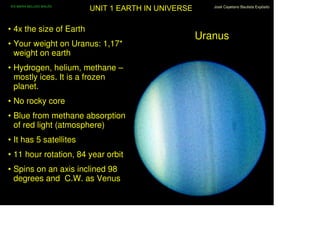
• 4x the size of Earth
                                                      Uranus
• Your weight on Uranus: 1,17*
  weight on earth
• Hydrogen, helium, methane –
  mostly ices. It is a frozen
  planet.
• No rocky core
• Blue from methane absorption
  of red light (atmosphere)
• It has 5 satellites
• 11 hour rotation, 84 year orbit
• Spins on an axis inclined 98
  degrees and C.W. as Venus
IES MARIA BELLIDO BAILÉN
                            UNIT 1 EARTH IN UNIVERSE      José Cayetano Bautista Expósito


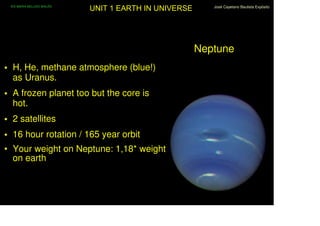
                                                       Neptune
• H, He, methane atmosphere (blue!)
  as Uranus.
• A frozen planet too but the core is
  hot.
• 2 satellites
• 16 hour rotation / 165 year orbit
• Your weight on Neptune: 1,18* weight
  on earth
IES MARIA BELLIDO BAILÉN
                                  UNIT 1 EARTH IN UNIVERSE           José Cayetano Bautista Expósito


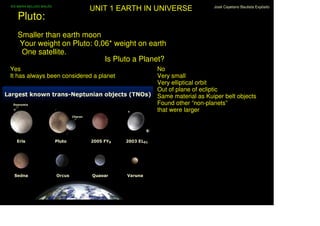
     Pluto:
     Smaller than earth moon
     Your weight on Pluto: 0,06* weight on earth
      One satellite.
                              Is Pluto a Planet?
Yes                                              No
It has always been considered a planet           Very small
                                                 Very elliptical orbit
                                                 Out of plane of ecliptic
                                                 Same material as Kuiper belt objects
                                                 Found other “non-planets”
                                                 that were larger


José Cayetano Bautista Expósito
IES MARIA BELLIDO BAILÉN
                           UNIT 1 EARTH IN UNIVERSE   José Cayetano Bautista Expósito


                                 END

Natural Sciences Unit 1 The Solar System And Earth

  • 1.
    IES MARIA BELLIDOBAILÉN UNIT 1 EARTH IN UNIVERSE José Cayetano Bautista Expósito Which celestial bodies do you know? What is this? What is this? This is a galaxy This is a nebula What is this bright body? What is this? This is a star This is a comet How is the big one called? …. A planet The little one that orbits around the planet is called… satellite This is an…. asteroid When an asteroid crashes on earth it is called… meteorite
  • 2.
    IES MARIA BELLIDOBAILÉN UNIT 1 EARTH IN UNIVERSE José Cayetano Bautista Expósito Do yow know where we live? Yes, we live just here. In the milky way. In this little spot
  • 3.
    IES MARIA BELLIDOBAILÉN UNIT 1 EARTH IN UNIVERSE José Cayetano Bautista Expósito Milky way is a spiral galaxy with about 200 billion stars….. only It is not very big, isn't it? And 25.000 Ly thick It is only 100.000 Light years (Ly) wide
  • 4.
    IES MARIA BELLIDOBAILÉN UNIT 1 EARTH IN UNIVERSE José Cayetano Bautista Expósito The Sun. The star of solar system. Size type? Medium size star. Type G. Yellow: 5500ºC Colour? on the surface Gases? 75% H / 25% He Diameter? 1.400.000 Km Rotation? C.C.W. José Cayetano Bautista Expósito
  • 5.
    IES MARIA BELLIDOBAILÉN UNIT 1 EARTH IN UNIVERSE José Cayetano Bautista Expósito Do you know the planets of the solar system? Earth Mercury Venus Mars Uranus Sun Neptune Saturn Pluto Jupiter
  • 6.
    IES MARIA BELLIDOBAILÉN UNIT 1 EARTH IN UNIVERSE José Cayetano Bautista Expósito Where is located the asteroids belt? Yes, just here, between Mars and Jupiter. What are asteroids? Big rocks with variable size that can run into earth and other planets occasionally. Which minor planet is in the asteroid belt? Yes, Ceres.
  • 7.
    IES MARIA BELLIDOBAILÉN UNIT 1 EARTH IN UNIVERSE José Cayetano Bautista Expósito What is a comet? Rocs, ice and dust. Tails appear because Sun hot melts part of the comet Do you know where do the comets come from?
  • 8.
    IES MARIA BELLIDOBAILÉN UNIT 1 EARTH IN UNIVERSE José Cayetano Bautista Expósito What is Kuiper Belt? It is the origin of Halley comet Kuiper Belt is located beyond Pluto's orbit. There can be almost 200 million comets in it. José Cayetano Bautista Expósito
  • 9.
    IES MARIA BELLIDOBAILÉN UNIT 1 EARTH IN UNIVERSE José Cayetano Bautista Expósito Which is the origin of long period comets? Oort cloud This is Sedna: a long period comet from Oort cloud. This is the solar system This is Sedna’s orbit around the solar system This is the inner extent of Oort Cloud. Isn’t it huge?
  • 10.
    IES MARIA BELLIDOBAILÉN UNIT 1 EARTH IN UNIVERSE José Cayetano Bautista Expósito 1/10 Mercury • Smallest planet (0.4 Earth diam.) • Closest to Sun, moves around fastest (88 days). Spin takes 59 earth days. • Surface -173 to 427 ºC (-280 to 800 ºF) • Your weight on Mercury: 0,37* weight on earth • No atmosphere • Surface plenty of craters
  • 11.
    IES MARIA BELLIDOBAILÉN UNIT 1 EARTH IN UNIVERSE José Cayetano Bautista Expósito Venus • Nearly the same size as Earth (.95) • Slowest rotation of any planet (243 days) • Very thick atmosphere mostly CO2 • Surface temp 377 to 487 C hotter than Mercury • Very few craters • Your weight on Venus: 0,88* weight on earth • Spins C.W. You can see it in t he night sky wit hout a t elescope!
  • 12.
    IES MARIA BELLIDOBAILÉN UNIT 1 EARTH IN UNIVERSE José Cayetano Bautista Expósito Earth • 12756 km diameter • Day: 23 h 56 minutes • Year: 365, 26 days. • 23,5 degree axis tilt: origin of seasons! • Surface temps –73 to 48 C • Thick atmosphere made of Nitrogen and Oxygen mainly. • Liquid water – lots! - at surface • It has a satellite: The Moon
  • 13.
    IES MARIA BELLIDOBAILÉN UNIT 1 EARTH IN UNIVERSE José Cayetano Bautista Expósito Mars: The red planet • 25 degree axis tilt (seasons!) • Rotates once every ~24 hours and orbits the Sun once every 687 days •Very cold -83 to -33 C • 6794 km diameter •Thin atmosphere, 95% CO2 •No liquid water at surface; ice in poles? •Your weight on Mars: 0,38* weight on earth •Two small moons - Phobos (Fear) and Deimos (Terror)
  • 14.
    IES MARIA BELLIDOBAILÉN UNIT 1 EARTH IN UNIVERSE José Cayetano Bautista Expósito Jupiter: The giant • 89,000 miles (143,000 km) diameter – 11x Earth • 10 hour rotation / 12 year orbit • 71% mass of Solar System. (318 x Earth mass) • Atmosphere: 90% H and 10% He • Rocky core covered by liquid metallic hydrogen electrical conductor, generates magnetic field • 4 big satellites and another 12 little satellites like asteroids.
  • 15.
    IES MARIA BELLIDOBAILÉN UNIT 1 EARTH IN UNIVERSE José Cayetano Bautista Expósito Saturn: The master of the rings • 9x the size of Earth • Your weight on Saturn: 1,15* weight on earth • 97% hydrogen and 3% helium • Rocky core surrounded by gases • Winds up to 500 m / second • Colder than Jupiter due to higher distance to sun • Water ice, dust, rocks made the rings • 19 satellites • 10 hour rotation / 29 year orbit
  • 16.
    IES MARIA BELLIDOBAILÉN UNIT 1 EARTH IN UNIVERSE José Cayetano Bautista Expósito • 4x the size of Earth Uranus • Your weight on Uranus: 1,17* weight on earth • Hydrogen, helium, methane – mostly ices. It is a frozen planet. • No rocky core • Blue from methane absorption of red light (atmosphere) • It has 5 satellites • 11 hour rotation, 84 year orbit • Spins on an axis inclined 98 degrees and C.W. as Venus
  • 17.
    IES MARIA BELLIDOBAILÉN UNIT 1 EARTH IN UNIVERSE José Cayetano Bautista Expósito Neptune • H, He, methane atmosphere (blue!) as Uranus. • A frozen planet too but the core is hot. • 2 satellites • 16 hour rotation / 165 year orbit • Your weight on Neptune: 1,18* weight on earth
  • 18.
    IES MARIA BELLIDOBAILÉN UNIT 1 EARTH IN UNIVERSE José Cayetano Bautista Expósito Pluto: Smaller than earth moon Your weight on Pluto: 0,06* weight on earth One satellite. Is Pluto a Planet? Yes No It has always been considered a planet Very small Very elliptical orbit Out of plane of ecliptic Same material as Kuiper belt objects Found other “non-planets” that were larger José Cayetano Bautista Expósito
  • 19.
    IES MARIA BELLIDOBAILÉN UNIT 1 EARTH IN UNIVERSE José Cayetano Bautista Expósito END