NATURAL METHOD
By Dr RAUHAH
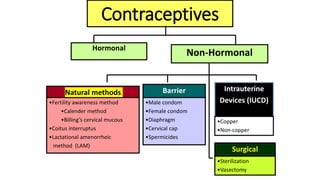
Contraceptives
Hormonal
Intrauterine
Devices (IUCD)
•Copper
•Non-copper
Non-Hormonal
Barrier
Natural methods
•Fertility awareness method
•Calender method
•Billing’s cervical mucous
•Coitus interruptus
•Lactational amenorrheic
method (LAM)
•Male condom
•Female condom
•Diaphragm
•Cervical cap
•Spermicides
Surgical
•Sterilization
•Vasectomy
FERTILITY AWARENESS
METHOD
What is Fertility Awareness Method (FAM)
• Means that a women knows how to tell when the fertile time of her menstrual
calendar starts and ends
• Also known as periodic abstinence or natural planning method
• A women can use several ways, alone or in combination to tell when the fertile time
begins
• Types of FAM
• Calendar method
• Basal body temperature
• Cervical secretions
Effectiveness
Depends on user
Risk is greatest when couple have sex during
fertile period
Pregnancy rates with consistent and correct use
vary for different types of FAM
In the first year estimated about 15 pregnancies
out of 100 with couple practicing periodic
abstinence. Mostly were on calendar method.
In general, abstaining during fertile method is
more effective as compared using other method
Mode of action
• Works by helping a women know
when their fertile period
• Avoid unprotected vaginal sex
during fertile period usually by
abstaining or using barrier method
Calendar Method
• Applicable only for woman with regular menstrual cycle if most of her menstrual cycles about 26-32
days
• Assumptions:
• Ovulation occurs 12-16 days before onset of next menses
• Sperm remain viable for up to 5 days
• Oocyte survives unfertilized for 24 hours
• Calculate fertile period:
• Keep menstrual calendar for 6 months
• Fertile period is between day (length of shortest cycles minus 18) and day (of longest cycle minus
11)
• Avoid unprotected sexual intercourse during the fertile phase
Cont.
• Calculate:
• 6 cycles: 28,26,29,27,29,27 days
• 1st day of fertile phase= 26-18=8
• Last day of fertile phase= 29-11=18
• Avoid sexual intercourse from day 8-18 of the menstrual cycle
Billing’s Method
• Observation of cervical mucus
• During the fertile period, the cervical mucus is profuse, clear
and stretches easily
• During the non fertile period, the mucus will be scant, thick,
sticky and adherent
• Avoid unprotected vaginal sex on each day of secretions and
the following day
• Couple can resume unprotected sex after 2 dry days (days
without secretions of any type) in a row
Basal Body Temperature
Difficult and not practical
The women must take her temperature every morning,
watched for sustained rise which indicates ovulation
Assumption:
• 24hrs are allowed for ovum survival
• 3 days – survival time of sperms in genital tract
• Thus avoid +/- 3-4 days from the assume day of ovulation
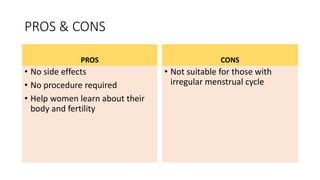
PROS & CONS
PROS
• No side effects
• No procedure required
• Help women learn about their
body and fertility
CONS
• Not suitable for those with
irregular menstrual cycle
COITUS INTERRUPTUS
Coitus Interruptus
• Withdrawal of the penis just before ejaculation
• High failure rate
• 20 pregnancies per 100 women whose partner use withdrawal over the first year.
• If use correctly about 4 out of 100 pregnancies during the first year.
• Need for man to have good self control and timely withdrawal before ejaculation
• Not reliable, pre-ejaculatory secretions may contain millions of sperm and young
men find it hard to judge timing of withdrawal
• Use of emergency contraception should be considered
PROS & CONS
PROS
• No side effects
• No procedure required
• Always available in every
situation
• Promotes male involvement and
couple communication
CONS
• High failure rate
• No protection against STI
LACTATIONAL AMENORRHEA
METHOD
Lactational Amenorrhea Method
• Temporary family planning
method based on natural effect of
breastfeeding on fertility.
• Need to fulfill 3 criteria:
• Monthly bleeding has not
returned
• Baby is under 6 months
• Fully or nearly fully
breastfeeding on demand,
day and night.
Fully Breastfeeding & nearly fully
breastfeeding
• Fully breastfeeding :
• Infant receives no other liquid or food, water, juice or vitamin
other than breastmilk
• Nearly fully breastfeeding:
• Infant receives some liquid or food in addition to the breastmilk
but the majority of feeding (> three fourth of all feeds ) are
breast milk
• Ideal pattern of BFOD
• 10-12 times a day in the first few weeks
• Thereafter 8-10 times a day including at least once at night in
the first months.
• Daytime should be no more than 4 hours apart
• Nightime feeding should be no more than 8 hours
Mechanism
of action
Effectiveness
• Depends on user
• Risk of pregnancies greatest if women cannot fully or nearly fully breastfeeding her
child
• As commonly used, 2 pregnancies out of 100 women practicing LAM in the first 6
months.
• If used correctly about 1 pregnancy out of 100 women.
Mother with
following
conditions
may not be
suitable for
LAM
• HIV mother
• Using certain medications
• Mood altering drugs, ergotamine, high dose
corticosteroids, cyclosporine, bromocriptine,
reserpine, radioactive drugs, lithium, certain anti
coagulants
• Baby condition that make it difficult for
sucking (premature baby, deformities of
mouth or jaw)
LAM for women
with HIV
• Can use LAM. However, there is still risk of transmitting HIV to
their infants through breastfeeding if they are not taking ART.
• Women taking ART can use LAM. Among women who are not
on ART the risk of transmitting is about 14% after 2 years of
breastfeeding. Risk reduces to less than 1% among women
taking ART.
• Exclusive breastfeeding reduce the risk of death from
common childhood illness and improves the health and
development of child and health of mother .
• Urge women with HIV to use condom along with LAM. Use
consistently and correctly to prevent HIV and STI.
PROS & CONS
PROS
• No side effects
• No procedure required
• Always available in every
situation
• Provide health benefits for
mother and baby
CONS
• Applicable for 6 months only
THANK YOU

NATURAL METHOD .pptx

  • 1.
  • 2.
    Contraceptives Hormonal Intrauterine Devices (IUCD) •Copper •Non-copper Non-Hormonal Barrier Natural methods •Fertilityawareness method •Calender method •Billing’s cervical mucous •Coitus interruptus •Lactational amenorrheic method (LAM) •Male condom •Female condom •Diaphragm •Cervical cap •Spermicides Surgical •Sterilization •Vasectomy
  • 3.
  • 4.
    What is FertilityAwareness Method (FAM) • Means that a women knows how to tell when the fertile time of her menstrual calendar starts and ends • Also known as periodic abstinence or natural planning method • A women can use several ways, alone or in combination to tell when the fertile time begins • Types of FAM • Calendar method • Basal body temperature • Cervical secretions
  • 5.
    Effectiveness Depends on user Riskis greatest when couple have sex during fertile period Pregnancy rates with consistent and correct use vary for different types of FAM In the first year estimated about 15 pregnancies out of 100 with couple practicing periodic abstinence. Mostly were on calendar method. In general, abstaining during fertile method is more effective as compared using other method
  • 6.
    Mode of action •Works by helping a women know when their fertile period • Avoid unprotected vaginal sex during fertile period usually by abstaining or using barrier method
  • 7.
    Calendar Method • Applicableonly for woman with regular menstrual cycle if most of her menstrual cycles about 26-32 days • Assumptions: • Ovulation occurs 12-16 days before onset of next menses • Sperm remain viable for up to 5 days • Oocyte survives unfertilized for 24 hours • Calculate fertile period: • Keep menstrual calendar for 6 months • Fertile period is between day (length of shortest cycles minus 18) and day (of longest cycle minus 11) • Avoid unprotected sexual intercourse during the fertile phase
  • 8.
    Cont. • Calculate: • 6cycles: 28,26,29,27,29,27 days • 1st day of fertile phase= 26-18=8 • Last day of fertile phase= 29-11=18 • Avoid sexual intercourse from day 8-18 of the menstrual cycle
  • 9.
    Billing’s Method • Observationof cervical mucus • During the fertile period, the cervical mucus is profuse, clear and stretches easily • During the non fertile period, the mucus will be scant, thick, sticky and adherent • Avoid unprotected vaginal sex on each day of secretions and the following day • Couple can resume unprotected sex after 2 dry days (days without secretions of any type) in a row
  • 10.
    Basal Body Temperature Difficultand not practical The women must take her temperature every morning, watched for sustained rise which indicates ovulation Assumption: • 24hrs are allowed for ovum survival • 3 days – survival time of sperms in genital tract • Thus avoid +/- 3-4 days from the assume day of ovulation
  • 11.
    PROS & CONS PROS •No side effects • No procedure required • Help women learn about their body and fertility CONS • Not suitable for those with irregular menstrual cycle
  • 12.
  • 13.
    Coitus Interruptus • Withdrawalof the penis just before ejaculation • High failure rate • 20 pregnancies per 100 women whose partner use withdrawal over the first year. • If use correctly about 4 out of 100 pregnancies during the first year. • Need for man to have good self control and timely withdrawal before ejaculation • Not reliable, pre-ejaculatory secretions may contain millions of sperm and young men find it hard to judge timing of withdrawal • Use of emergency contraception should be considered
  • 14.
    PROS & CONS PROS •No side effects • No procedure required • Always available in every situation • Promotes male involvement and couple communication CONS • High failure rate • No protection against STI
  • 15.
  • 16.
    Lactational Amenorrhea Method •Temporary family planning method based on natural effect of breastfeeding on fertility. • Need to fulfill 3 criteria: • Monthly bleeding has not returned • Baby is under 6 months • Fully or nearly fully breastfeeding on demand, day and night.
  • 17.
    Fully Breastfeeding &nearly fully breastfeeding • Fully breastfeeding : • Infant receives no other liquid or food, water, juice or vitamin other than breastmilk • Nearly fully breastfeeding: • Infant receives some liquid or food in addition to the breastmilk but the majority of feeding (> three fourth of all feeds ) are breast milk • Ideal pattern of BFOD • 10-12 times a day in the first few weeks • Thereafter 8-10 times a day including at least once at night in the first months. • Daytime should be no more than 4 hours apart • Nightime feeding should be no more than 8 hours
  • 18.
  • 19.
    Effectiveness • Depends onuser • Risk of pregnancies greatest if women cannot fully or nearly fully breastfeeding her child • As commonly used, 2 pregnancies out of 100 women practicing LAM in the first 6 months. • If used correctly about 1 pregnancy out of 100 women.
  • 20.
    Mother with following conditions may notbe suitable for LAM • HIV mother • Using certain medications • Mood altering drugs, ergotamine, high dose corticosteroids, cyclosporine, bromocriptine, reserpine, radioactive drugs, lithium, certain anti coagulants • Baby condition that make it difficult for sucking (premature baby, deformities of mouth or jaw)
  • 21.
    LAM for women withHIV • Can use LAM. However, there is still risk of transmitting HIV to their infants through breastfeeding if they are not taking ART. • Women taking ART can use LAM. Among women who are not on ART the risk of transmitting is about 14% after 2 years of breastfeeding. Risk reduces to less than 1% among women taking ART. • Exclusive breastfeeding reduce the risk of death from common childhood illness and improves the health and development of child and health of mother . • Urge women with HIV to use condom along with LAM. Use consistently and correctly to prevent HIV and STI.
  • 22.
    PROS & CONS PROS •No side effects • No procedure required • Always available in every situation • Provide health benefits for mother and baby CONS • Applicable for 6 months only
  • 23.

Editor's Notes

  • #10 A woman learns to track the changing features of her cervical mucus to predict ovulation
  • #17 1. Baby’s suckling stimulates the nipple 2. nipple’s stimulation triggers signals to mother’s brain 3. Signals disrupt hormone production 4. Disruption of hormone suppress ovulation