making an impact
                                                               Learning from ESPA research

 September 2011
                                                   Do ecosystem
                                                   conservation
 ABOUT THIS PROJECT
 Name


                                                   projects work?
 What types of investment can most
 cost-effectively ensure ecosystem
 service provision? A randomised program
 evaluation
                                                   How can NGOs and donors measure the impact of work
 Principal investigator
 Nigel Asquith, Fundación Natura Bolivia           on forest conservation and poverty?
 Partners
 Kelsey Jack, Sustainability Science
 Program, Harvard University; Sampurno
 Bruijnzeel, Vrije University Amsterdam

 Time frame
 July 2010 to June 2012

 ESPA regions
 Amazonia

 ESPA themes
 Biodiversity, Forests, Political Economy, Water

 Objective
 Using a controlled experimental design
 modelled on the natural sciences, this
 project is evaluating the impact of a
 payments for ecosystem services (PES)
 scheme on water quality, biodiversity, forest
 cover and the socioeconomic welfare of the        Imagine running an pharmaceutical trial in           large-scale, controlled tests of a programme
 poor in Bolivia’s farming communities.            which you take a patient suffering from a fever      that compensates local people for conserving
                                                   and give them an aspirin. If the patient gets        forests in south-eastern Bolivia.
 Summary                                           better, you’ll conclude the aspirin worked. If the   With funds from the European Union and
 Despite the billions spent on programmes          patient’s condition worsens or becomes fatal,        other donors, Natura Bolivia has successfully
 to conserve ecosystems and help poor              you’ll conclude the aspirin was not the best         piloted reciprocal watershed agreements
 communities, there is rarely good evidence        treatment. Of course, the patient might have         — small-scale, locally-managed payments
 that these projects have their intended           improved without the drug, and if their condition    for ecosystem services (PES) initiatives —
 impacts. In the Santa Cruz valleys of             had worsened you wouldn’t know if the aspirin        since 2003. The NGO has worked with local
 Bolivia, a unique large-scale experiment          had slowed the decline — that’s why real drug        governments and water cooperatives to explain
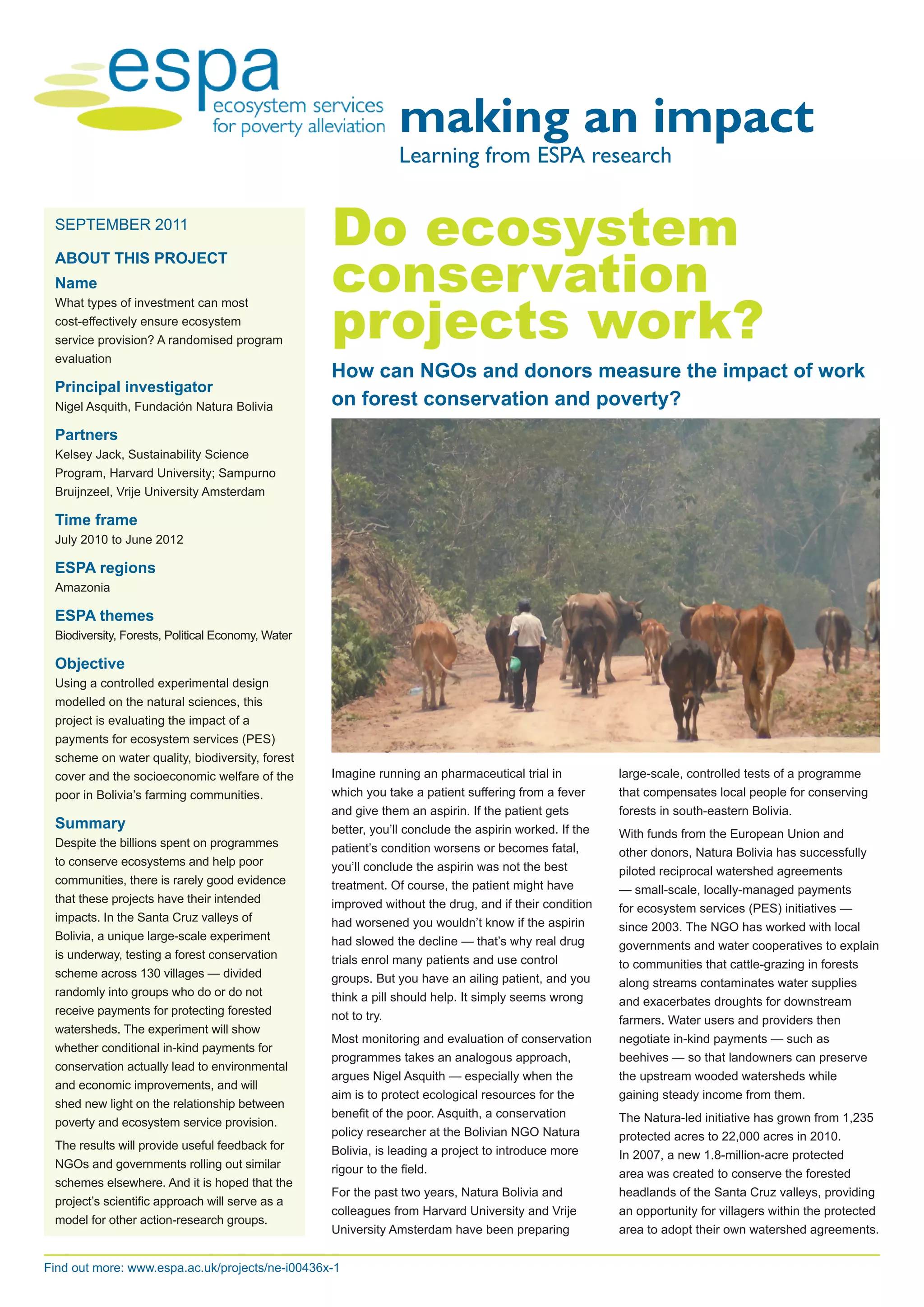
 is underway, testing a forest conservation        trials enrol many patients and use control           to communities that cattle-grazing in forests
 scheme across 130 villages — divided              groups. But you have an ailing patient, and you      along streams contaminates water supplies
 randomly into groups who do or do not             think a pill should help. It simply seems wrong      and exacerbates droughts for downstream
 receive payments for protecting forested          not to try.                                          farmers. Water users and providers then
 watersheds. The experiment will show
                                                   Most monitoring and evaluation of conservation       negotiate in-kind payments — such as
 whether conditional in-kind payments for
                                                   programmes takes an analogous approach,              beehives — so that landowners can preserve
 conservation actually lead to environmental
                                                   argues Nigel Asquith — especially when the           the upstream wooded watersheds while
 and economic improvements, and will
                                                   aim is to protect ecological resources for the       gaining steady income from them.
 shed new light on the relationship between
                                                   benefit of the poor. Asquith, a conservation         The Natura-led initiative has grown from 1,235
 poverty and ecosystem service provision.
                                                   policy researcher at the Bolivian NGO Natura         protected acres to 22,000 acres in 2010.
 The results will provide useful feedback for      Bolivia, is leading a project to introduce more      In 2007, a new 1.8-million-acre protected
 NGOs and governments rolling out similar          rigour to the field.                                 area was created to conserve the forested
 schemes elsewhere. And it is hoped that the
                                                   For the past two years, Natura Bolivia and           headlands of the Santa Cruz valleys, providing
 project’s scientific approach will serve as a
                                                   colleagues from Harvard University and Vrije         an opportunity for villagers within the protected
 model for other action-research groups.
                                                   University Amsterdam have been preparing             area to adopt their own watershed agreements.


Find out more: www.espa.ac.uk/projects/ne-i00436x-1
making an impact
Facing the opportunity for a huge scale-            way to judge cost-effectiveness. As Paul
up, Natura wanted evidence that reciprocal          Ferraro and Subhrendu Pattanayak — two               New knowledge
agreements not only brought forest areas            environmental economists who have long                 When NGOs and donors evaluate
                                                                                                         l 
under contract, but that the conservation of        proposed the use of program evaluations in             conservation programmes — in particular
these forests, watersheds, and the livelihoods      the environmental field — note, “If we want            efforts to protect ecological resources for
depending on them was both additional and           to ensure that our limited resources make              the benefit of the poor — they usually ask
effective. Experts at Harvard’s Sustainability      a difference, we must accept that testing              the wrong questions, measure outputs
Science programme designed an evidence-             hypotheses about which policies protect                rather than outcomes and exclude
based evaluation, including the complex             biological diversity requires the same scientific      appropriate ‘no-intervention’ controls.
statistical formulas needed to analyse and          rigour and state-of-the-art methods that we            This project explores how to rigorously
compare 130 villages across the protected area.     invest in testing ecological hypotheses.”              measure the impact of conservation and
In this way, ESPA funding has enabled               The ESPA-supported project’s rigorous                  development programmes.
Natura Bolivia to borrow approaches from            results will be equally useful to experts              This study is perhaps the first to apply a
                                                                                                         l 
experimental economics to generate new              and practitioners asking broader questions             classic scientific approach to conservation
knowledge and evidence. This highly                 about whether poor communities gain when               and development, testing a PES scheme
innovative project is one example of how            ecosystem services such as watersheds are              over a large sample of communities and
ESPA’s framework grants can pioneer new             protected.                                             comparing ‘experimental’ to ‘control’ sites.
approaches linking ecosystem services and           There are side benefits to the ESPA-supported          Project partners have gathered baseline
                                                                                                         l 
poverty alleviation.                                project. Asquith reports that in the process            data on forest biodiversity, water quality
                                                    of designing a well-controlled evaluation —             and socioeconomics in 130 communities,
A tale of two samples                               asking which key elements for impact should             which will be useful to other researchers,
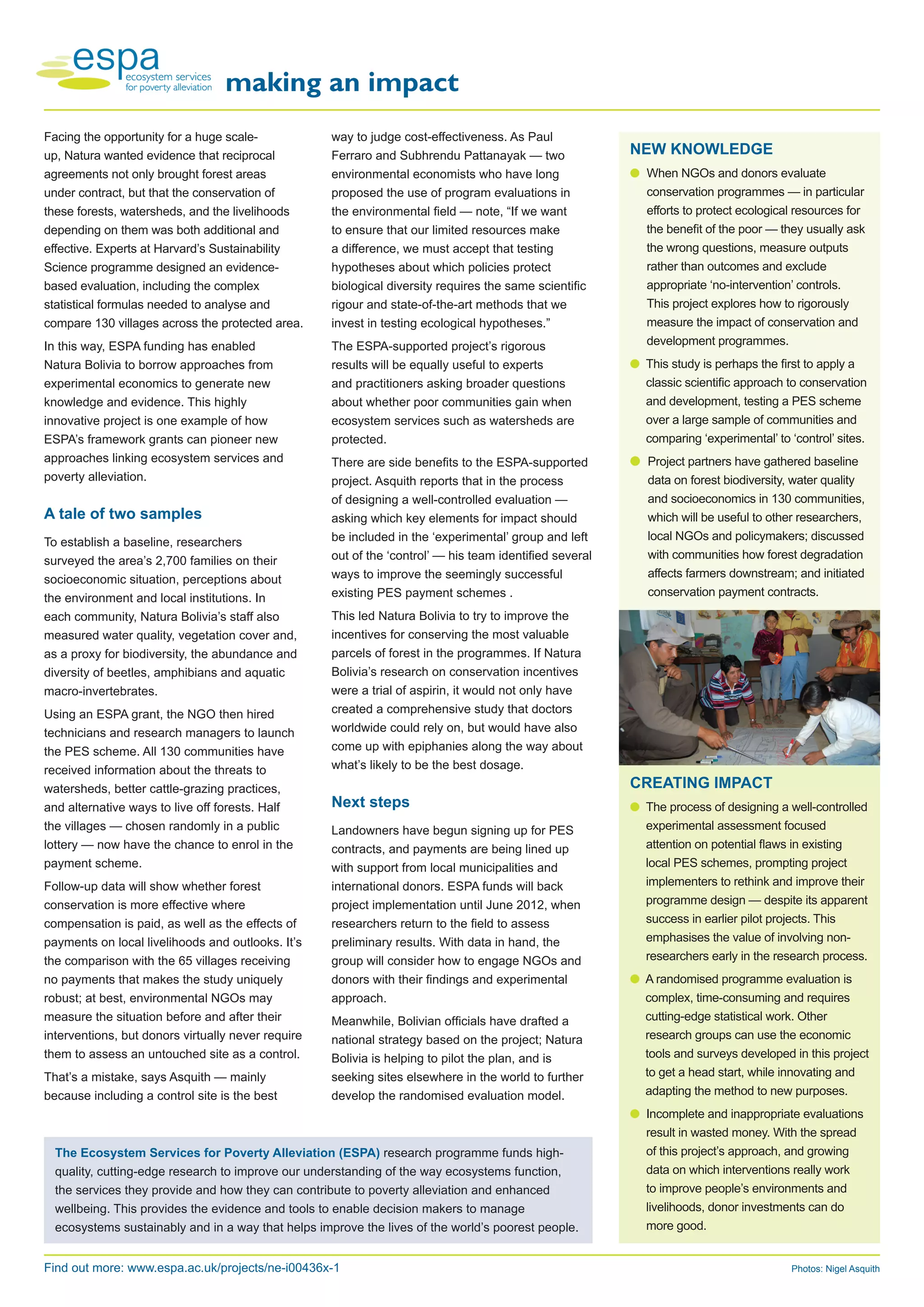
To establish a baseline, researchers                be included in the ‘experimental’ group and left        local NGOs and policymakers; discussed
surveyed the area’s 2,700 families on their         out of the ‘control’ — his team identified several      with communities how forest degradation
socioeconomic situation, perceptions about          ways to improve the seemingly successful                affects farmers downstream; and initiated
the environment and local institutions. In          existing PES payment schemes .                          conservation payment contracts.
each community, Natura Bolivia’s staff also         This led Natura Bolivia to try to improve the
measured water quality, vegetation cover and,       incentives for conserving the most valuable
as a proxy for biodiversity, the abundance and      parcels of forest in the programmes. If Natura
diversity of beetles, amphibians and aquatic        Bolivia’s research on conservation incentives
macro-invertebrates.                                were a trial of aspirin, it would not only have
Using an ESPA grant, the NGO then hired             created a comprehensive study that doctors
technicians and research managers to launch         worldwide could rely on, but would have also
the PES scheme. All 130 communities have            come up with epiphanies along the way about
received information about the threats to           what’s likely to be the best dosage.
watersheds, better cattle-grazing practices,                                                             CREATING IMPACT
and alternative ways to live off forests. Half      Next steps                                           l The process of designing a well-controlled
the villages — chosen randomly in a public          Landowners have begun signing up for PES               experimental assessment focused
lottery — now have the chance to enrol in the       contracts, and payments are being lined up             attention on potential flaws in existing
payment scheme.                                     with support from local municipalities and             local PES schemes, prompting project
Follow-up data will show whether forest             international donors. ESPA funds will back             implementers to rethink and improve their
conservation is more effective where                project implementation until June 2012, when           programme design — despite its apparent
compensation is paid, as well as the effects of     researchers return to the field to assess              success in earlier pilot projects. This
payments on local livelihoods and outlooks. It’s    preliminary results. With data in hand, the            emphasises the value of involving non-
the comparison with the 65 villages receiving       group will consider how to engage NGOs and             researchers early in the research process.
no payments that makes the study uniquely           donors with their findings and experimental          l  randomised programme evaluation is
                                                                                                           A
robust; at best, environmental NGOs may             approach.                                              complex, time-consuming and requires
measure the situation before and after their        Meanwhile, Bolivian officials have drafted a           cutting-edge statistical work. Other
interventions, but donors virtually never require   national strategy based on the project; Natura         research groups can use the economic
them to assess an untouched site as a control.      Bolivia is helping to pilot the plan, and is           tools and surveys developed in this project
That’s a mistake, says Asquith — mainly             seeking sites elsewhere in the world to further        to get a head start, while innovating and
because including a control site is the best        develop the randomised evaluation model.               adapting the method to new purposes.
                                                                                                           Incomplete and inappropriate evaluations
                                                                                                         l 
                                                                                                           result in wasted money. With the spread
  The Ecosystem Services for Poverty Alleviation (ESPA) research programme funds high-                     of this project’s approach, and growing
  quality, cutting-edge research to improve our understanding of the way ecosystems function,              data on which interventions really work
  the services they provide and how they can contribute to poverty alleviation and enhanced                to improve people’s environments and
  wellbeing. This provides the evidence and tools to enable decision makers to manage                      livelihoods, donor investments can do
  ecosystems sustainably and in a way that helps improve the lives of the world’s poorest people.          more good.


Find out more: www.espa.ac.uk/projects/ne-i00436x-1                                                                                     Photos: Nigel Asquith

Natura espa dfid

  • 1.
    making an impact Learning from ESPA research September 2011 Do ecosystem conservation ABOUT THIS PROJECT Name projects work? What types of investment can most cost-effectively ensure ecosystem service provision? A randomised program evaluation How can NGOs and donors measure the impact of work Principal investigator Nigel Asquith, Fundación Natura Bolivia on forest conservation and poverty? Partners Kelsey Jack, Sustainability Science Program, Harvard University; Sampurno Bruijnzeel, Vrije University Amsterdam Time frame July 2010 to June 2012 ESPA regions Amazonia ESPA themes Biodiversity, Forests, Political Economy, Water Objective Using a controlled experimental design modelled on the natural sciences, this project is evaluating the impact of a payments for ecosystem services (PES) scheme on water quality, biodiversity, forest cover and the socioeconomic welfare of the Imagine running an pharmaceutical trial in large-scale, controlled tests of a programme poor in Bolivia’s farming communities. which you take a patient suffering from a fever that compensates local people for conserving and give them an aspirin. If the patient gets forests in south-eastern Bolivia. Summary better, you’ll conclude the aspirin worked. If the With funds from the European Union and Despite the billions spent on programmes patient’s condition worsens or becomes fatal, other donors, Natura Bolivia has successfully to conserve ecosystems and help poor you’ll conclude the aspirin was not the best piloted reciprocal watershed agreements communities, there is rarely good evidence treatment. Of course, the patient might have — small-scale, locally-managed payments that these projects have their intended improved without the drug, and if their condition for ecosystem services (PES) initiatives — impacts. In the Santa Cruz valleys of had worsened you wouldn’t know if the aspirin since 2003. The NGO has worked with local Bolivia, a unique large-scale experiment had slowed the decline — that’s why real drug governments and water cooperatives to explain is underway, testing a forest conservation trials enrol many patients and use control to communities that cattle-grazing in forests scheme across 130 villages — divided groups. But you have an ailing patient, and you along streams contaminates water supplies randomly into groups who do or do not think a pill should help. It simply seems wrong and exacerbates droughts for downstream receive payments for protecting forested not to try. farmers. Water users and providers then watersheds. The experiment will show Most monitoring and evaluation of conservation negotiate in-kind payments — such as whether conditional in-kind payments for programmes takes an analogous approach, beehives — so that landowners can preserve conservation actually lead to environmental argues Nigel Asquith — especially when the the upstream wooded watersheds while and economic improvements, and will aim is to protect ecological resources for the gaining steady income from them. shed new light on the relationship between benefit of the poor. Asquith, a conservation The Natura-led initiative has grown from 1,235 poverty and ecosystem service provision. policy researcher at the Bolivian NGO Natura protected acres to 22,000 acres in 2010. The results will provide useful feedback for Bolivia, is leading a project to introduce more In 2007, a new 1.8-million-acre protected NGOs and governments rolling out similar rigour to the field. area was created to conserve the forested schemes elsewhere. And it is hoped that the For the past two years, Natura Bolivia and headlands of the Santa Cruz valleys, providing project’s scientific approach will serve as a colleagues from Harvard University and Vrije an opportunity for villagers within the protected model for other action-research groups. University Amsterdam have been preparing area to adopt their own watershed agreements. Find out more: www.espa.ac.uk/projects/ne-i00436x-1
  • 2.
    making an impact Facingthe opportunity for a huge scale- way to judge cost-effectiveness. As Paul up, Natura wanted evidence that reciprocal Ferraro and Subhrendu Pattanayak — two New knowledge agreements not only brought forest areas environmental economists who have long When NGOs and donors evaluate l  under contract, but that the conservation of proposed the use of program evaluations in conservation programmes — in particular these forests, watersheds, and the livelihoods the environmental field — note, “If we want efforts to protect ecological resources for depending on them was both additional and to ensure that our limited resources make the benefit of the poor — they usually ask effective. Experts at Harvard’s Sustainability a difference, we must accept that testing the wrong questions, measure outputs Science programme designed an evidence- hypotheses about which policies protect rather than outcomes and exclude based evaluation, including the complex biological diversity requires the same scientific appropriate ‘no-intervention’ controls. statistical formulas needed to analyse and rigour and state-of-the-art methods that we This project explores how to rigorously compare 130 villages across the protected area. invest in testing ecological hypotheses.” measure the impact of conservation and In this way, ESPA funding has enabled The ESPA-supported project’s rigorous development programmes. Natura Bolivia to borrow approaches from results will be equally useful to experts This study is perhaps the first to apply a l  experimental economics to generate new and practitioners asking broader questions classic scientific approach to conservation knowledge and evidence. This highly about whether poor communities gain when and development, testing a PES scheme innovative project is one example of how ecosystem services such as watersheds are over a large sample of communities and ESPA’s framework grants can pioneer new protected. comparing ‘experimental’ to ‘control’ sites. approaches linking ecosystem services and There are side benefits to the ESPA-supported Project partners have gathered baseline l  poverty alleviation. project. Asquith reports that in the process data on forest biodiversity, water quality of designing a well-controlled evaluation — and socioeconomics in 130 communities, A tale of two samples asking which key elements for impact should which will be useful to other researchers, To establish a baseline, researchers be included in the ‘experimental’ group and left local NGOs and policymakers; discussed surveyed the area’s 2,700 families on their out of the ‘control’ — his team identified several with communities how forest degradation socioeconomic situation, perceptions about ways to improve the seemingly successful affects farmers downstream; and initiated the environment and local institutions. In existing PES payment schemes . conservation payment contracts. each community, Natura Bolivia’s staff also This led Natura Bolivia to try to improve the measured water quality, vegetation cover and, incentives for conserving the most valuable as a proxy for biodiversity, the abundance and parcels of forest in the programmes. If Natura diversity of beetles, amphibians and aquatic Bolivia’s research on conservation incentives macro-invertebrates. were a trial of aspirin, it would not only have Using an ESPA grant, the NGO then hired created a comprehensive study that doctors technicians and research managers to launch worldwide could rely on, but would have also the PES scheme. All 130 communities have come up with epiphanies along the way about received information about the threats to what’s likely to be the best dosage. watersheds, better cattle-grazing practices, CREATING IMPACT and alternative ways to live off forests. Half Next steps l The process of designing a well-controlled the villages — chosen randomly in a public Landowners have begun signing up for PES experimental assessment focused lottery — now have the chance to enrol in the contracts, and payments are being lined up attention on potential flaws in existing payment scheme. with support from local municipalities and local PES schemes, prompting project Follow-up data will show whether forest international donors. ESPA funds will back implementers to rethink and improve their conservation is more effective where project implementation until June 2012, when programme design — despite its apparent compensation is paid, as well as the effects of researchers return to the field to assess success in earlier pilot projects. This payments on local livelihoods and outlooks. It’s preliminary results. With data in hand, the emphasises the value of involving non- the comparison with the 65 villages receiving group will consider how to engage NGOs and researchers early in the research process. no payments that makes the study uniquely donors with their findings and experimental l  randomised programme evaluation is A robust; at best, environmental NGOs may approach. complex, time-consuming and requires measure the situation before and after their Meanwhile, Bolivian officials have drafted a cutting-edge statistical work. Other interventions, but donors virtually never require national strategy based on the project; Natura research groups can use the economic them to assess an untouched site as a control. Bolivia is helping to pilot the plan, and is tools and surveys developed in this project That’s a mistake, says Asquith — mainly seeking sites elsewhere in the world to further to get a head start, while innovating and because including a control site is the best develop the randomised evaluation model. adapting the method to new purposes. Incomplete and inappropriate evaluations l  result in wasted money. With the spread The Ecosystem Services for Poverty Alleviation (ESPA) research programme funds high- of this project’s approach, and growing quality, cutting-edge research to improve our understanding of the way ecosystems function, data on which interventions really work the services they provide and how they can contribute to poverty alleviation and enhanced to improve people’s environments and wellbeing. This provides the evidence and tools to enable decision makers to manage livelihoods, donor investments can do ecosystems sustainably and in a way that helps improve the lives of the world’s poorest people. more good. Find out more: www.espa.ac.uk/projects/ne-i00436x-1 Photos: Nigel Asquith