Spring 2009                          Newsletter of the Fundación Natura Bolivia

             Contents                       Compensation for environmental services
1 Compensation for environmental services
  in the El Chape watershed, Mairana
                                            in the El Chape watershed, Mairana
  Maurizio Forno                                                                                   The Conservation
                                            Maurizio Forno                                          Food & Health
                                                                                                     Foundation
3 Towards the creation of a
  departamental law                         The El Chape microwatershed is located 21 km to the north of the town of Mairana,
  Josefina Marín
                                            in the Florida Province of the Department of Santa Cruz. It occupies an area of
3 The Río Grande - Cruceño Valleys          6,520 ha, equivalent to 10.3% of the total area of the Mairana municipality. Its flora
  Reserve fron the viewpoint of the DIAP    is characterized by evergreen forest with a high diversity of species, varying in accordance
  Roxana Valdéz Z.
                                            with the altitudinal levels between the cloud forest, humid montane forest and semi-
4 The lowlands agricultural sector is       deciduous dry forest, which are home to species of great commercial value such as
  willing to support the conservation of    cedar, walnut, tajibo and laurel; species currently endangered due to over exploitation.
  the Río Grande middle watershed
  Huascar Azurduy                           The watershed is the main source of water for human consumption and for the
                                            agricultural production of Mairana.
5 The fertile valley of Los Negros
  produces vegetables in abundance...
  but something is changing                 A large part of the El Chape watershed shows signs of human intervention, such as
  Roxana Valdéz Z.                          slash and burn sites, landslides, misuse of soil, overgrazing, and timber exploitation,
                                            etc. which have a negative impact on the capacities of these forests to generate
6 First Congress of Environmental
  Services Networks in Ibero- América       hydrological resources, resulting in a reduction in the availability of water in the dry
  Stephanie Secomb                          season for the population and productive sectors.

6 Meeting of the Compensation for           To solve these problems, the main local institutions, seeking to conserve the
  Environmental Services Learning
  Network (RACSA)                           environmental services of the microwatershed, restore the ecosystems and ensure
  Stephanie Secomb                          the provision of water in the long term, approved the creation of a compensation for
7 The Bellagio Conversations: balancing
                                            hydrological environmental services scheme in August 2007. This scheme created a
  efficiency with fairness.                 credible and transparent local institutional framework, constituted by the Municipality
  Nigel Asquith & Sven Wunder (eds)         of Mairana, the Mairana Public Services Cooperative Ltd. (COOSMAI) and the Fundación
10 Getting to know the Natura family
                                            Natura Bolivia, to develop a local fund destined to finance conservation activities.

                                            The water fund is administered by the COOSMAI cooperative, an entity with local
                                            legitimacy and the administrative capacity to manage the resources, which come from
                                            annual contributions from the municipal government, Fundación Natura and the
                                            members of the water cooperative. However, the sustainability of this mechanism
Fundación Natura Bolivia specializes        depends on the contributions made by the drinking water users through their monthly
  in the development of financial
mechanisms—such as compensation
  for environmental services—to
    sustainably conserve critical
    ecosystems and improve the
wellbeing of the Bolivian population.
water bills. It is easy to see the result of the fund’s creation, but this agreement involved an arduous work of debate and
    negotiation until the incorporation of a tariff for “Environmental Services” was finally approved in a meeting of the
    members of the cooperative. This tariff involves increasing the value of water consumption by 7%, which in real terms
    implies an additional payment which usually fluctuates between 1.5 and 3 bolivianos.

    In this way the partners in the initiative were able to implement a compensation for environmental services system which
    ensures water flow in quality and quantity, persuading final users to support and compensate efforts to conserve native
    forest in the upper watershed.

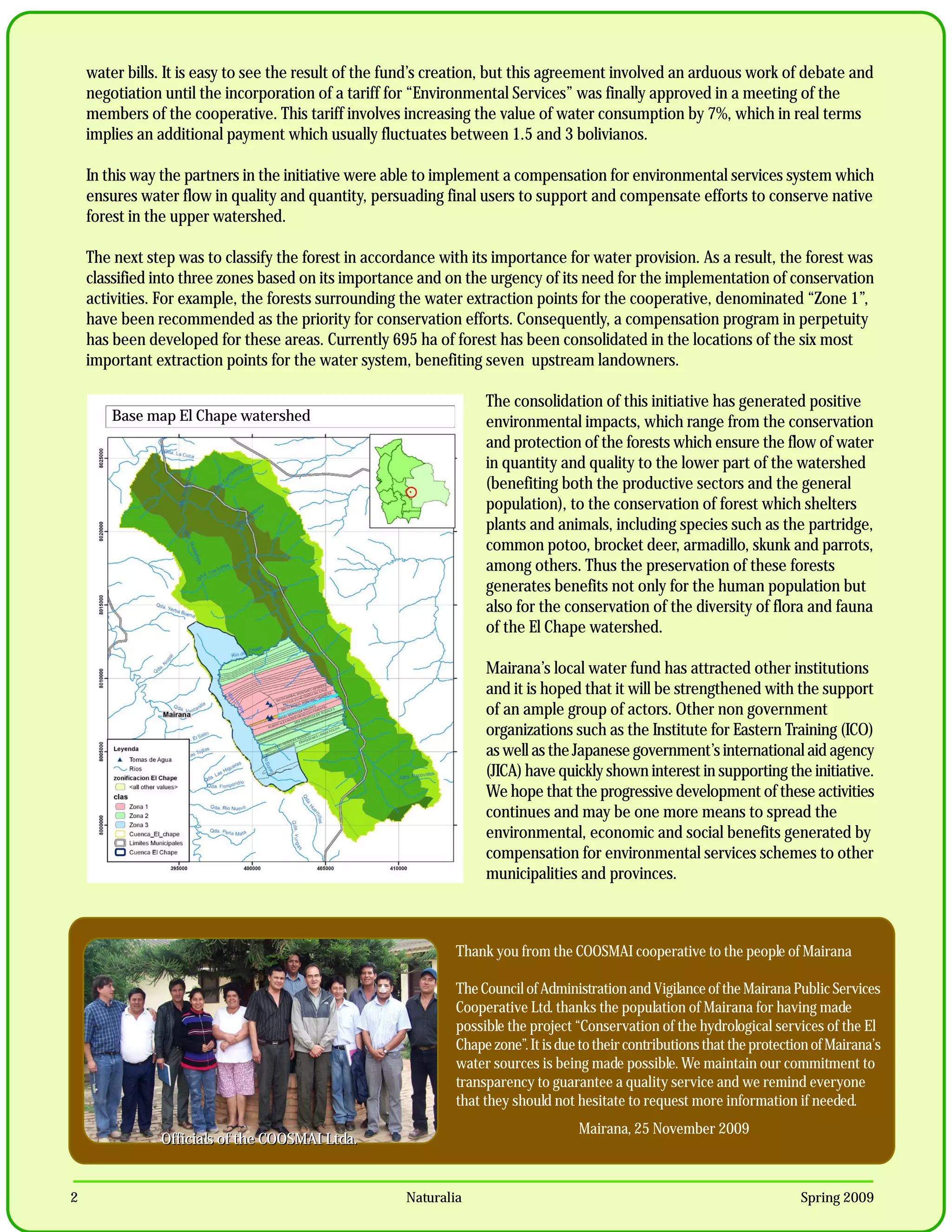
    The next step was to classify the forest in accordance with its importance for water provision. As a result, the forest was
    classified into three zones based on its importance and on the urgency of its need for the implementation of conservation
    activities. For example, the forests surrounding the water extraction points for the cooperative, denominated “Zone 1”,
    have been recommended as the priority for conservation efforts. Consequently, a compensation program in perpetuity
    has been developed for these areas. Currently 695 ha of forest has been consolidated in the locations of the six most
    important extraction points for the water system, benefiting seven upstream landowners.

                                                                   The consolidation of this initiative has generated positive
        Base map El Chape watershed                                environmental impacts, which range from the conservation
                                                                   and protection of the forests which ensure the flow of water
                                                                   in quantity and quality to the lower part of the watershed
                                                                   (benefiting both the productive sectors and the general
                                                                   population), to the conservation of forest which shelters
                                                                   plants and animals, including species such as the partridge,
                                                                   common potoo, brocket deer, armadillo, skunk and parrots,
                                                                   among others. Thus the preservation of these forests
                                                                   generates benefits not only for the human population but
                                                                   also for the conservation of the diversity of flora and fauna
                                                                   of the El Chape watershed.

                                                                   Mairana’s local water fund has attracted other institutions
                                                                   and it is hoped that it will be strengthened with the support
                                                                   of an ample group of actors. Other non government
                                                                   organizations such as the Institute for Eastern Training (ICO)
                                                                   as well as the Japanese government’s international aid agency
                                                                   (JICA) have quickly shown interest in supporting the initiative.
                                                                   We hope that the progressive development of these activities
                                                                   continues and may be one more means to spread the
                                                                   environmental, economic and social benefits generated by
                                                                   compensation for environmental services schemes to other
                                                                   municipalities and provinces.


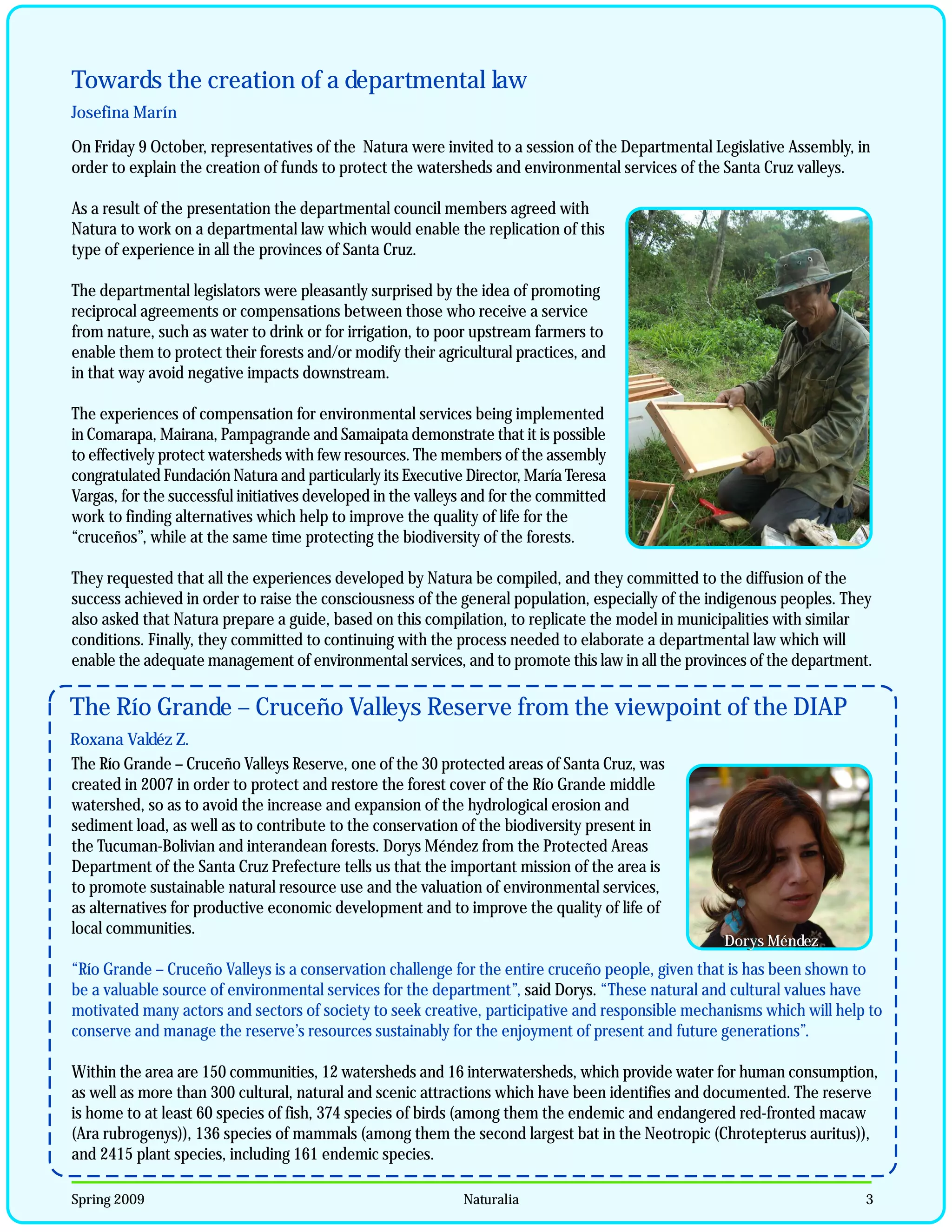
                                                              Thank you from the COOSMAI cooperative to the people of Mairana

                                                              The Council of Administration and Vigilance of the Mairana Public Services
                                                              Cooperative Ltd. thanks the population of Mairana for having made
                                                              possible the project “Conservation of the hydrological services of the El
                                                              Chape zone”. It is due to their contributions that the protection of Mairana’s
                                                              water sources is being made possible. We maintain our commitment to
                                                              transparency to guarantee a quality service and we remind everyone
                                                              that they should not hesitate to request more information if needed.
                                                                                    Mairana, 25 November 2009
               Officials of the COOSMAI Ltda.


2                                                     Naturalia                                                              Spring 2009
Towards the creation of a departmental law
Josefina Marín

On Friday 9 October, representatives of the Natura were invited to a session of the Departmental Legislative Assembly, in
order to explain the creation of funds to protect the watersheds and environmental services of the Santa Cruz valleys.

As a result of the presentation the departmental council members agreed with
Natura to work on a departmental law which would enable the replication of this
type of experience in all the provinces of Santa Cruz.

The departmental legislators were pleasantly surprised by the idea of promoting
reciprocal agreements or compensations between those who receive a service
from nature, such as water to drink or for irrigation, to poor upstream farmers to
enable them to protect their forests and/or modify their agricultural practices, and
in that way avoid negative impacts downstream.

The experiences of compensation for environmental services being implemented
in Comarapa, Mairana, Pampagrande and Samaipata demonstrate that it is possible
to effectively protect watersheds with few resources. The members of the assembly
congratulated Fundación Natura and particularly its Executive Director, María Teresa
Vargas, for the successful initiatives developed in the valleys and for the committed
work to finding alternatives which help to improve the quality of life for the
“cruceños”, while at the same time protecting the biodiversity of the forests.

They requested that all the experiences developed by Natura be compiled, and they committed to the diffusion of the
success achieved in order to raise the consciousness of the general population, especially of the indigenous peoples. They
also asked that Natura prepare a guide, based on this compilation, to replicate the model in municipalities with similar
conditions. Finally, they committed to continuing with the process needed to elaborate a departmental law which will
enable the adequate management of environmental services, and to promote this law in all the provinces of the department.

The Río Grande – Cruceño Valleys Reserve from the viewpoint of the DIAP
Roxana Valdéz Z.
The Río Grande – Cruceño Valleys Reserve, one of the 30 protected areas of Santa Cruz, was
created in 2007 in order to protect and restore the forest cover of the Río Grande middle
watershed, so as to avoid the increase and expansion of the hydrological erosion and
sediment load, as well as to contribute to the conservation of the biodiversity present in
the Tucuman-Bolivian and interandean forests. Dorys Méndez from the Protected Areas
Department of the Santa Cruz Prefecture tells us that the important mission of the area is
to promote sustainable natural resource use and the valuation of environmental services,
as alternatives for productive economic development and to improve the quality of life of
local communities.
                                                                                                   Dorys Méndez
                                                                                                   Dorys Méndez
“Río Grande – Cruceño Valleys is a conservation challenge for the entire cruceño people, given that is has been shown to
be a valuable source of environmental services for the department”, said Dorys. “These natural and cultural values have
motivated many actors and sectors of society to seek creative, participative and responsible mechanisms which will help to
conserve and manage the reserve’s resources sustainably for the enjoyment of present and future generations”.

Within the area are 150 communities, 12 watersheds and 16 interwatersheds, which provide water for human consumption,
as well as more than 300 cultural, natural and scenic attractions which have been identifies and documented. The reserve
is home to at least 60 species of fish, 374 species of birds (among them the endemic and endangered red-fronted macaw
(Ara rubrogenys)), 136 species of mammals (among them the second largest bat in the Neotropic (Chrotepterus auritus)),
and 2415 plant species, including 161 endemic species.

Spring 2009                                                   Naturalia                                                 3
The lowlands agricultural sector is willing to support
    the conservation of the Río Grande middle watershed
    Huascar Azurduy
    Together with the Sustainable Development Secretariat and mayors of Vallegrande, Pucará,
    Moro Moro, Postrervalle, Cabezas y Gutiérrez—the municipalities of the Río Grande middle
    watershed—Fundación Natura organized the 1st Public-Private Forum for the Environmental
    Services and Hydrological Resources of the Río Grande-Cruceño Valleys Reserve, realized
    17 October 2009 in Vallegrande. The event’s purpose was to discuss with representatives
    of the agricultural sector how to maintain the pristine forest remaining in the middle
    watershed, given that an increase of deforestation could lead to an even greater increase
    in the sediment load in the Río Grande lower watershed, affecting large agricultural areas.

    Mayors, council members, authorities of the prefectural government and private businessmen
    participated enthusiastically in this forum, aimed at bringing the agricultural sector of the
    Río Grande lower watershed together with the seven municipalities of the reserve. This
    opportunity enabled the preparation of a document demonstrating the willingness of those
    present to support efforts to create a “regional compensation fund”, which would channel
    contributions and resources from the private sector affected by the yearly floods of the Río
    Grande, and other institutions (such as non government organizations). These resources
    could be used to realize conservation activities in the Río Grande middle watershed, avoiding
    the production of sediment as a means of mitigating the overflow of the river downstream.

    Dorys Méndez, Departmental Director for Protected Areas, explained about the Río Grande
    Reserve and the importance of this area for the protection of the “cruceño” agricultural
    production in the lower part of the watershed. When his turn came, Nelson Ojeda,
    representative of the National Association of Oilseed Growers (ANAPO), manifested the
    willingness of the soy growers to participate in a regional fund and support the conservation
    of the area. Ojeda said that around 500,000 ha (or half the soy production) is affected each
    year by the floods and the increase of sediment in the river.

    Later, the Honorable Mayor of Comarapa, Noel Rojas, explained how his municipality has
    developed a conservation fund for the Río Comarapa watershed. The Mayor of Moro Moro,
    Tania Gutiérrez, indicated that the forum was an opportunity for her municipality to
    consolidate conservation activities, specifically in relation to hydrological resources. Finally
    Huascar Azurduy, Director of Natura, presented the proposal to create a public-private fund
    to enable the development of effective conservation activities in the Río Grande Reserve.

    The event concluded with two typical dances, from Vallegrande and Cabezas, demonstrating
    that the Río Grande-Cruceño Valleys Reserve is not only rich in biodiversity and environmental
    services, but also in culture, which shows that a watershed may unite cultures and peoples.


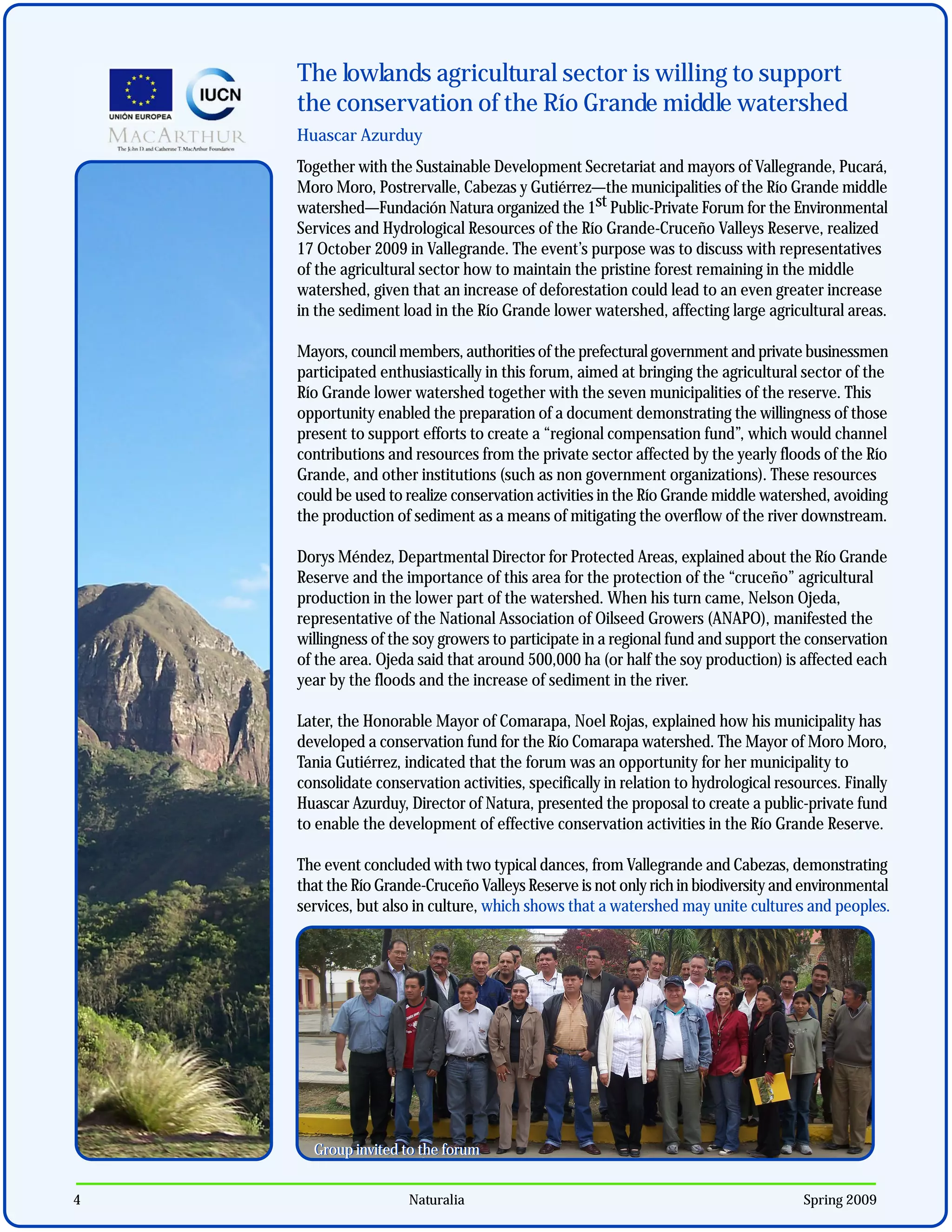
      Group invited to the forum


4                     Naturalia                                                       Spring 2009
The fertile valley of Los Negros produces vegetables
in abundance… but something is changing
Don Andres Rojas, President of the Irrigators Association,
tells us the story
Roxana Valdéz Zamorano
The town of Los Negros is located in the Florida Province,
Pampagrande Municipality, at the southern limit of the
Amboró National Park, one of the most biodiverse protected
areas on earth. Los Negros is characterized by is temperate
climate and above all by its fertile valleys. Upon reaching
the town one is welcomed by a sign declaring Los Negros
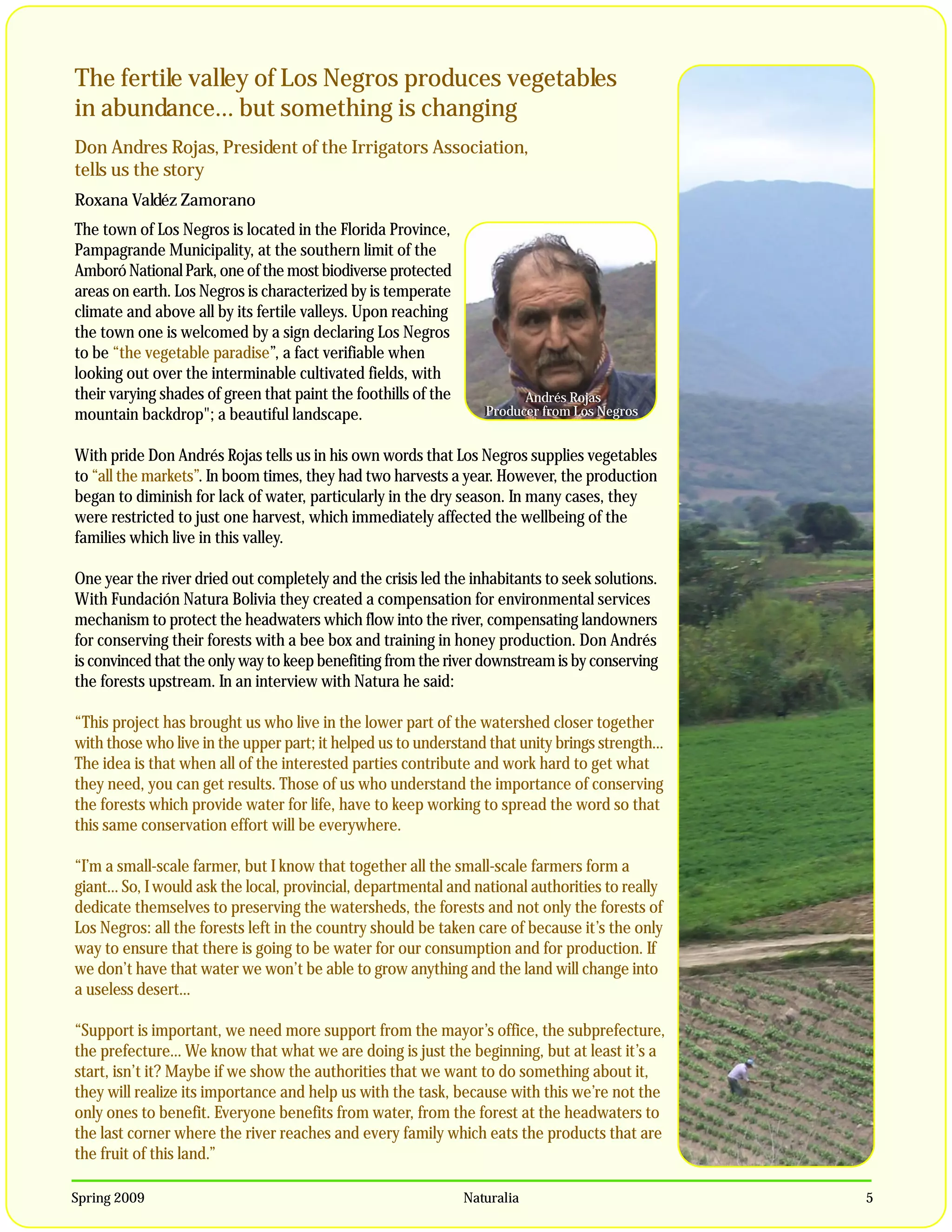
to be “the vegetable paradise”, a fact verifiable when
looking out over the interminable cultivated fields, with
their varying shades of green that paint the foothills of the            Andrés Rojas
                                                                         Andrés Rojas,
mountain backdrop"; a beautiful landscape.                         Producer from Los Negros
                                                                   Producer from Los Negros


With pride Don Andrés Rojas tells us in his own words that Los Negros supplies vegetables
to “all the markets”. In boom times, they had two harvests a year. However, the production
began to diminish for lack of water, particularly in the dry season. In many cases, they
were restricted to just one harvest, which immediately affected the wellbeing of the
families which live in this valley.

One year the river dried out completely and the crisis led the inhabitants to seek solutions.
With Fundación Natura Bolivia they created a compensation for environmental services
mechanism to protect the headwaters which flow into the river, compensating landowners
for conserving their forests with a bee box and training in honey production. Don Andrés
is convinced that the only way to keep benefiting from the river downstream is by conserving
the forests upstream. In an interview with Natura he said:

“This project has brought us who live in the lower part of the watershed closer together
with those who live in the upper part; it helped us to understand that unity brings strength…
The idea is that when all of the interested parties contribute and work hard to get what
they need, you can get results. Those of us who understand the importance of conserving
the forests which provide water for life, have to keep working to spread the word so that
this same conservation effort will be everywhere.

“I’m a small-scale farmer, but I know that together all the small-scale farmers form a
giant… So, I would ask the local, provincial, departmental and national authorities to really
dedicate themselves to preserving the watersheds, the forests and not only the forests of
Los Negros: all the forests left in the country should be taken care of because it’s the only
way to ensure that there is going to be water for our consumption and for production. If
we don’t have that water we won’t be able to grow anything and the land will change into
a useless desert…

“Support is important, we need more support from the mayor’s office, the subprefecture,
the prefecture… We know that what we are doing is just the beginning, but at least it’s a
start, isn’t it? Maybe if we show the authorities that we want to do something about it,
they will realize its importance and help us with the task, because with this we’re not the
only ones to benefit. Everyone benefits from water, from the forest at the headwaters to
the last corner where the river reaches and every family which eats the products that are
the fruit of this land.”

Spring 2009                                                     Naturalia                       5
Stephanie Secomb
The number of compensation for environmental services schemes in Bolivia is increasing and the value of this tool as a means
of protecting natural resources, particularly our forests, is gaining recognition. To consider this theme 49 people participated
in the “Meeting of the Compensation for Environmental Services Learning Network (RACSA)”, to learn of developments relating
to initiatives and concepts of compensation for environmental services (CES) in our country. This meeting was held on
10 November 2009 in La Paz, where the progress of the initiatives of the Comarapa municipality and of the Institute for Eastern
Training (ICO) was presented, as well as projects and ideas which were largely new for the majority of participants, such as
those being developed by the Alcalá municipality, Tunari National Park, the Socioagua strategy of the National Protected Areas
Service (SERNAP) and the lessons from the publication The Bellagio Conversations. Efforts to promote the development of
public policies related to the issue were boosted by the presence of the natural resources heads of the Beni and Oruro
prefectures, representatives of the prefectures of La Paz and Santa Cruz, and mayors or council presidents from Moro Moro,
Comarapa and Alcalá, as well as representatives of SERNAP and the Development Planning Ministry. The recommendations
to move forward include: the conformation of a working group to define a short and medium term agenda for RACSA; make
a greater effort to involve national government bodies and the national park administrations/SERNAP in CES; and make the
most of the current national context to promote the development of policies and laws which may influence the management
of environmental services. To receive a copy of the report of the event, please contact Natura.

First Congress of Environmental Services Networks in Ibero-America
Stephanie Secomb
From the 11th to the 13th of November the First Congress of Environmental Services Networks in Ibero-America was held, also
in La Paz, with the objective to initiate a process of joint articulation between networks of professionals interested in the use
of the concept of “environmental services” in Ibero-American countries. The 50 participants formulated the following message:

    The degradation of the environment which sustains human life through crucial environmental services, such as the regulation of
    hydrological cycles, the benefits of biological diversity and the capacity of forests to regulate climates, represents a threat to the
    quality of life in many rural and urban areas of the Ibero-American countries and at the global level. However, the region has
    originated innovative incentives for environmental conservation based on incentives, principally for the protection of its watersheds.

    Among the professionals of 13 countries who met for this congress, there is a consensus that the conservation of environmental
    services requires the incorporation of financial mechanisms which complement environmental policy programs, at all administrative
    levels.

    As a contribution to the discussion about the issue, three main challenges were identified:
      1. The improvement and adaption of the existing legal frameworks, to enable flexible solutions adapted for the diverse activities
          related to the conservation of environmental services and to local conditions.
      2. The strengthening of the institutions responsible for formulating and implementing environmental policy, improving the
          articulation between these and civil society, making possible transparency and participation. Additionally, involve other
          governmental sectors responsible for the formulation of development policy in harmony with environmental policy.
      3. Ensure that conservation incentives generate processes for sustainable and equitable local development.

    The 1st Congress of Environmental Services Networks in Ibero-America reached the conclusion that the existing environmental
    services networks may complement each other, for joint activities to transfer and increase knowledge at the regional level, and
    support decision-makers to face these challenges. This Congress represents the first step towards the realization of a strategy of
    collaboration between the networks.


6                                                         Naturalia                                                        Spring 2009
The Bellagio Conversations                             Nigel Asquith and Sven Wunder (eds)


The publication Payments for Watershed Services: the Bellagio Conversations (Asquith
and Wunder, eds, 2008), seeks to share lessons learned by implementers of payments
for watershed services (PWS) initiatives at the global level. This is the seventh reduced
excerpt to be published in Natura’s tri-monthly newsletter.

¿How can PWS schemes designed to balance efficiency with fairness?


   Designing clear and effective contracts that avoid the exploitation of the seller
   by the buyer (and vice versa) is crucial if PWS programs are to be sustainable in
   the long-term. Buyers of hydrological services may desire PWS contracts in
   perpetuity, when land purchase is not a practical alternative. As such, the perceived
   fairness of schemes will be an important determinant of whether the agreement
   is maintained, and buyers may thus want to make an effort to ensure that contracts
   are both fair and efficient.


Q1. Why is it important to have a written contract?
A contract is an agreement between the buyer and seller (the parties to the agreement)
on the terms of a transaction. Contracts clarify roles and responsibilities of the parties.
The advantages of having a written contract are that:
 * Buyers and sellers have a clear and physical record of the terms of the deal.
 * Intermediaries have physical evidence of the transaction to offer to buyers.
 * Third parties and evaluators are informed of the key elements of the deal.
 * The agreement could potentially be officially recorded in the relevant property
   registry.

Q2. Under what conditions should a buyer enter into a contract with a prospective
seller?
The seller should at a minimum be the proprietor or recognized user of the land, that
is have the de facto right to manage and control activities on the contracted lands—
notably including the ability to exclude third party access. Note that the right of alienation
(right to sell) is not required for environmental service provision.

Q3. What are the critical aspects of a contract that the buyer must convey to the seller?
It is incumbent on the buyer or the intermediary to ensure that the seller understands:
      The contract’s consensual character.
  * The nature of a contract (payments are contingent).
  * The timeline (the duration and termination/renewal options).
 *
Q4. What is the deliverable under a PWS contract?
Property rights for specific hydrological services produced by land management do not
exist. Therefore, contracts typically call for the seller to undertake a specific land use
or management activity.

As verification of land/water interactions is difficult, costly, and not under the provider’s
full control, contracts instead tend to specify certain desirable land management practices
(e.g. maintenance of forest cover) as the conditional deliverable.


Spring 2009                                                     Naturalia                        7
Q5. What studies are needed to determine payments?
Most schemes to date have focused on identifying the opportunity cost of net benefits
foregone by the landowner from their prior or intended use of the land, which represents
a floor for payments. Most programs have relied on approximate opportunity cost
estimates for setting payments—because these are easier to calculate, and because the
buyers tend to be more powerful, pressing payments towards the lower boundaries. An
upper ceiling would be the full value of the hydrological services provided. However,
mainly due to the biophysical uncertainties involved, it is often difficult or impossible to
assign a reliable monetary value to the watershed services in question. Hence, the
sometimes encountered idea that one can only do PWS after having done an exhaustive
economic valuation study is also deceptive: PWS payments are a negotiated outcome,
and service values—whether well-defined or fuzzy—are but one of the parameters to
inform these negotiations.

Q6. How should contracts be priced?
For both national-level and site-specific schemes, negotiations between buyers and sellers have often taken place in advance
of the onset of a program. For government-financed PWS, prices are often thus set through political processes (national)
or cooperative negotiation (local) instead. In such PWS schemes, political or legal-administrative concerns over price
discrimination across different regions or recipient groups have typically led to the selection of standard, relatively fixed
prices, or at most a limited tiered pricing system. For user-financed schemes, negotiations between buyers and sellers
usually take place in advance. Efficiency is usually more critical here, and buyers have been more eager to differentiate
prices and target payments in space, based on the variable service potential of lands. In Los Negros, Bolivia, a fixed price
system was negotiated in the first year, but later substituted by a differentiated system based on forest types and expected
service benefits. In terms of the actual payments, PWS schemes have used cash, goods and services as compensation, in
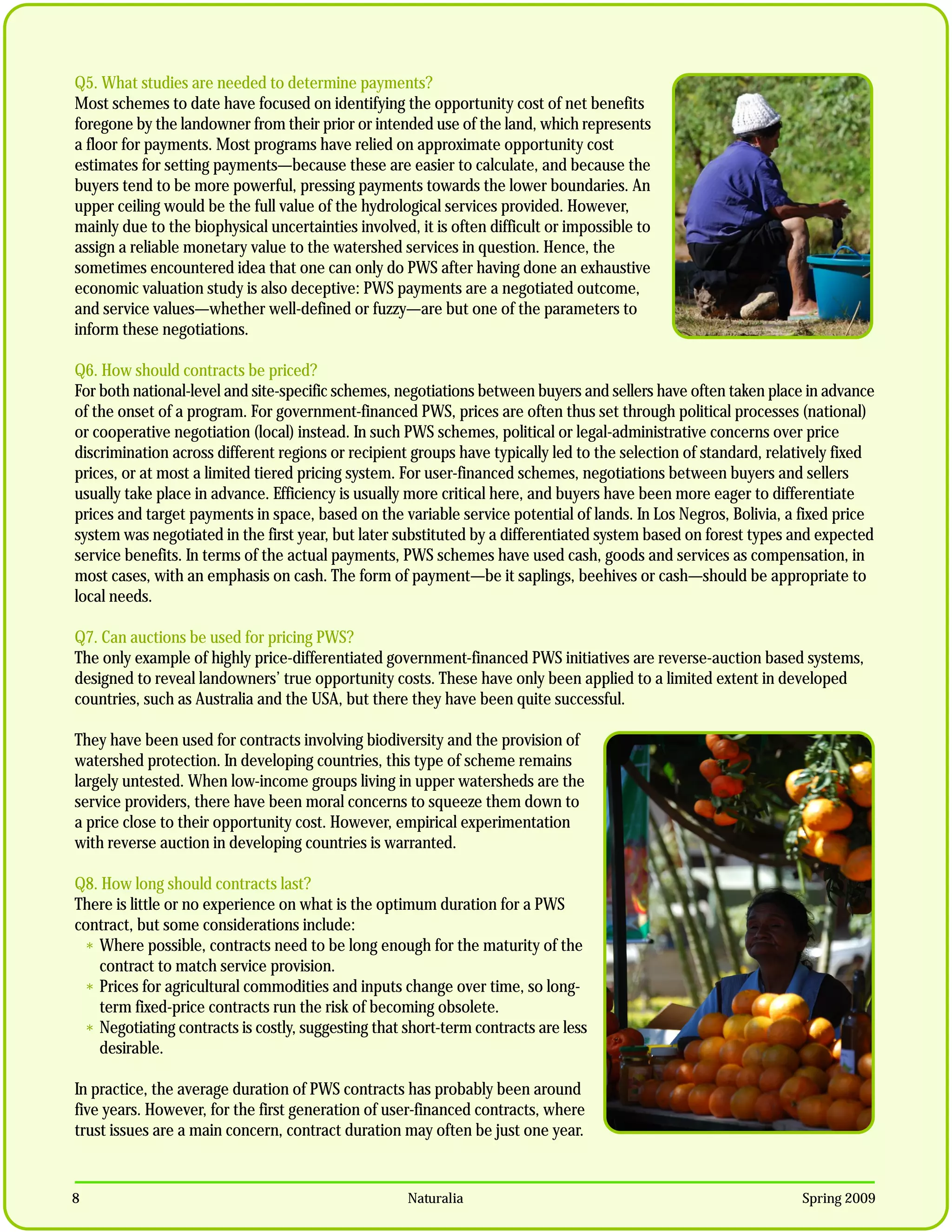
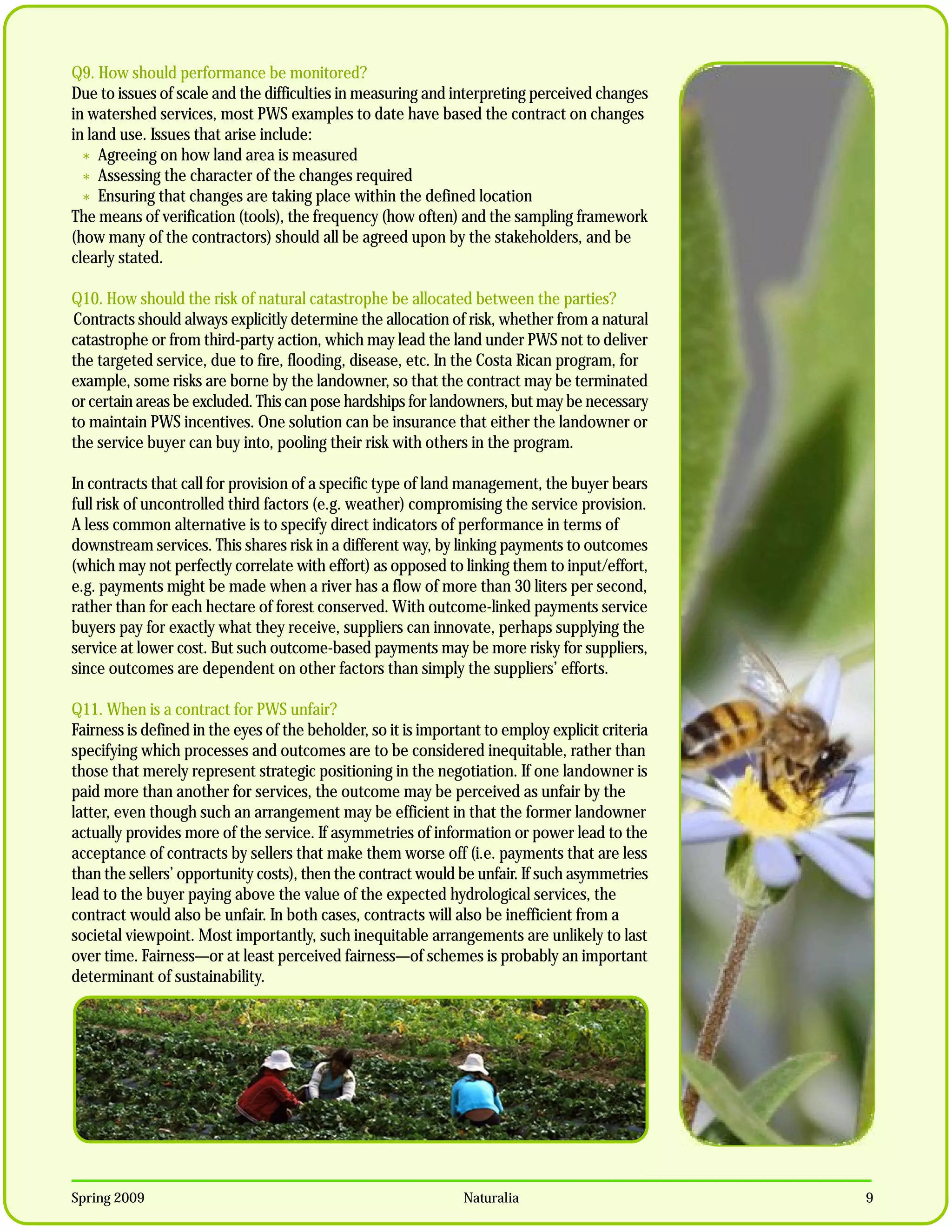
most cases, with an emphasis on cash. The form of payment—be it saplings, beehives or cash—should be appropriate to
local needs.

Q7. Can auctions be used for pricing PWS?
The only example of highly price-differentiated government-financed PWS initiatives are reverse-auction based systems,
designed to reveal landowners’ true opportunity costs. These have only been applied to a limited extent in developed
countries, such as Australia and the USA, but there they have been quite successful.

They have been used for contracts involving biodiversity and the provision of
watershed protection. In developing countries, this type of scheme remains
largely untested. When low-income groups living in upper watersheds are the
service providers, there have been moral concerns to squeeze them down to
a price close to their opportunity cost. However, empirical experimentation
with reverse auction in developing countries is warranted.

Q8. How long should contracts last?
There is little or no experience on what is the optimum duration for a PWS
contract, but some considerations include:
 * Where possible, contracts need to be long enough for the maturity of the
   contract to match service provision.
 * Prices for agricultural commodities and inputs change over time, so long-
   term fixed-price contracts run the risk of becoming obsolete.
 * Negotiating contracts is costly, suggesting that short-term contracts are less
   desirable.

In practice, the average duration of PWS contracts has probably been around
five years. However, for the first generation of user-financed contracts, where
trust issues are a main concern, contract duration may often be just one year.


8                                                    Naturalia                                                   Spring 2009
Q9. How should performance be monitored?
Due to issues of scale and the difficulties in measuring and interpreting perceived changes
in watershed services, most PWS examples to date have based the contract on changes
in land use. Issues that arise include:
  * Agreeing on how land area is measured
  * Assessing the character of the changes required
  * Ensuring that changes are taking place within the defined location
The means of verification (tools), the frequency (how often) and the sampling framework
(how many of the contractors) should all be agreed upon by the stakeholders, and be
clearly stated.

Q10. How should the risk of natural catastrophe be allocated between the parties?
Contracts should always explicitly determine the allocation of risk, whether from a natural
catastrophe or from third-party action, which may lead the land under PWS not to deliver
the targeted service, due to fire, flooding, disease, etc. In the Costa Rican program, for
example, some risks are borne by the landowner, so that the contract may be terminated
or certain areas be excluded. This can pose hardships for landowners, but may be necessary
to maintain PWS incentives. One solution can be insurance that either the landowner or
the service buyer can buy into, pooling their risk with others in the program.

In contracts that call for provision of a specific type of land management, the buyer bears
full risk of uncontrolled third factors (e.g. weather) compromising the service provision.
A less common alternative is to specify direct indicators of performance in terms of
downstream services. This shares risk in a different way, by linking payments to outcomes
(which may not perfectly correlate with effort) as opposed to linking them to input/effort,
e.g. payments might be made when a river has a flow of more than 30 liters per second,
rather than for each hectare of forest conserved. With outcome-linked payments service
buyers pay for exactly what they receive, suppliers can innovate, perhaps supplying the
service at lower cost. But such outcome-based payments may be more risky for suppliers,
since outcomes are dependent on other factors than simply the suppliers’ efforts.

Q11. When is a contract for PWS unfair?
Fairness is defined in the eyes of the beholder, so it is important to employ explicit criteria
specifying which processes and outcomes are to be considered inequitable, rather than
those that merely represent strategic positioning in the negotiation. If one landowner is
paid more than another for services, the outcome may be perceived as unfair by the
latter, even though such an arrangement may be efficient in that the former landowner
actually provides more of the service. If asymmetries of information or power lead to the
acceptance of contracts by sellers that make them worse off (i.e. payments that are less
than the sellers’ opportunity costs), then the contract would be unfair. If such asymmetries
lead to the buyer paying above the value of the expected hydrological services, the
contract would also be unfair. In both cases, contracts will also be inefficient from a
societal viewpoint. Most importantly, such inequitable arrangements are unlikely to last
over time. Fairness—or at least perceived fairness—of schemes is probably an important
determinant of sustainability.


Spring 2009                                                     Naturalia                         9
Getting to know the Natura family
Maria Teresa Vargas         Executive Director
                              Maria Teresa Vargas has more than 15 years of experience working in natural resource
                              management and since 2005 has occupied the position of Executive Director of the Fundación
                              Natura Bolivia. Since 2003, she had led a pioneering project in the Los Negros watershed, Bolivia,
                              which compensates poor farmers for conserving cloud forest for its role in the production of
                              water for irrigation and domestic water use downstream. Thanks to successful experiences such
                              as that of Los Negros, developed under her direction, Natura’s initiatives have been able to be
                              replicated in other municipalities of the Cruceño Valleys, with hopes to extend even further.


Josefina Marin                Environmental Economist
                              Josefina Marin is an economist with a degree from the Gabriel René Moreno Autonomous
                              University. She also has a Masters in Business Administration from the same university and a
                              Diploma in Rural Business Development from the Private University of Bolivia. Currently she
                              works as an Environmental Economist, supporting the Amboró and Río Grande departments of
                              Fundación Natura in their efforts to create local funds and realize investigations. Previously, she
                              worked as a consultant with organizations such as: ASOPEC, Friends of Nature Foundation,
                              Conservation International, CEPAC, PROMARENA and the World Bank’s Rural Alliances Project.


                                                          Edition and design Roxana Valdéz, translation Stephanie Secomb


                                                                                 Contact
                                                                                 Dir.: Calle Moldes No. 620
                                                                                 Tel./fax: +591 3 3395133
                                                                                 Email: naturabolivia@naturabolivia.org
                                                                                 Web: www.naturabolivia.org
                                                                                 Santa Cruz, Bolivia

             Happy Holidays!

 Natura thanks our donors for their support and confidence, which has made possible the implementation of our initiatives:


10                                                     Naturalia                                                         Spring 2009

Spring 2009

  • 1.
    Spring 2009 Newsletter of the Fundación Natura Bolivia Contents Compensation for environmental services 1 Compensation for environmental services in the El Chape watershed, Mairana in the El Chape watershed, Mairana Maurizio Forno The Conservation Maurizio Forno Food & Health Foundation 3 Towards the creation of a departamental law The El Chape microwatershed is located 21 km to the north of the town of Mairana, Josefina Marín in the Florida Province of the Department of Santa Cruz. It occupies an area of 3 The Río Grande - Cruceño Valleys 6,520 ha, equivalent to 10.3% of the total area of the Mairana municipality. Its flora Reserve fron the viewpoint of the DIAP is characterized by evergreen forest with a high diversity of species, varying in accordance Roxana Valdéz Z. with the altitudinal levels between the cloud forest, humid montane forest and semi- 4 The lowlands agricultural sector is deciduous dry forest, which are home to species of great commercial value such as willing to support the conservation of cedar, walnut, tajibo and laurel; species currently endangered due to over exploitation. the Río Grande middle watershed Huascar Azurduy The watershed is the main source of water for human consumption and for the agricultural production of Mairana. 5 The fertile valley of Los Negros produces vegetables in abundance... but something is changing A large part of the El Chape watershed shows signs of human intervention, such as Roxana Valdéz Z. slash and burn sites, landslides, misuse of soil, overgrazing, and timber exploitation, etc. which have a negative impact on the capacities of these forests to generate 6 First Congress of Environmental Services Networks in Ibero- América hydrological resources, resulting in a reduction in the availability of water in the dry Stephanie Secomb season for the population and productive sectors. 6 Meeting of the Compensation for To solve these problems, the main local institutions, seeking to conserve the Environmental Services Learning Network (RACSA) environmental services of the microwatershed, restore the ecosystems and ensure Stephanie Secomb the provision of water in the long term, approved the creation of a compensation for 7 The Bellagio Conversations: balancing hydrological environmental services scheme in August 2007. This scheme created a efficiency with fairness. credible and transparent local institutional framework, constituted by the Municipality Nigel Asquith & Sven Wunder (eds) of Mairana, the Mairana Public Services Cooperative Ltd. (COOSMAI) and the Fundación 10 Getting to know the Natura family Natura Bolivia, to develop a local fund destined to finance conservation activities. The water fund is administered by the COOSMAI cooperative, an entity with local legitimacy and the administrative capacity to manage the resources, which come from annual contributions from the municipal government, Fundación Natura and the members of the water cooperative. However, the sustainability of this mechanism Fundación Natura Bolivia specializes depends on the contributions made by the drinking water users through their monthly in the development of financial mechanisms—such as compensation for environmental services—to sustainably conserve critical ecosystems and improve the wellbeing of the Bolivian population.
  • 2.
    water bills. Itis easy to see the result of the fund’s creation, but this agreement involved an arduous work of debate and negotiation until the incorporation of a tariff for “Environmental Services” was finally approved in a meeting of the members of the cooperative. This tariff involves increasing the value of water consumption by 7%, which in real terms implies an additional payment which usually fluctuates between 1.5 and 3 bolivianos. In this way the partners in the initiative were able to implement a compensation for environmental services system which ensures water flow in quality and quantity, persuading final users to support and compensate efforts to conserve native forest in the upper watershed. The next step was to classify the forest in accordance with its importance for water provision. As a result, the forest was classified into three zones based on its importance and on the urgency of its need for the implementation of conservation activities. For example, the forests surrounding the water extraction points for the cooperative, denominated “Zone 1”, have been recommended as the priority for conservation efforts. Consequently, a compensation program in perpetuity has been developed for these areas. Currently 695 ha of forest has been consolidated in the locations of the six most important extraction points for the water system, benefiting seven upstream landowners. The consolidation of this initiative has generated positive Base map El Chape watershed environmental impacts, which range from the conservation and protection of the forests which ensure the flow of water in quantity and quality to the lower part of the watershed (benefiting both the productive sectors and the general population), to the conservation of forest which shelters plants and animals, including species such as the partridge, common potoo, brocket deer, armadillo, skunk and parrots, among others. Thus the preservation of these forests generates benefits not only for the human population but also for the conservation of the diversity of flora and fauna of the El Chape watershed. Mairana’s local water fund has attracted other institutions and it is hoped that it will be strengthened with the support of an ample group of actors. Other non government organizations such as the Institute for Eastern Training (ICO) as well as the Japanese government’s international aid agency (JICA) have quickly shown interest in supporting the initiative. We hope that the progressive development of these activities continues and may be one more means to spread the environmental, economic and social benefits generated by compensation for environmental services schemes to other municipalities and provinces. Thank you from the COOSMAI cooperative to the people of Mairana The Council of Administration and Vigilance of the Mairana Public Services Cooperative Ltd. thanks the population of Mairana for having made possible the project “Conservation of the hydrological services of the El Chape zone”. It is due to their contributions that the protection of Mairana’s water sources is being made possible. We maintain our commitment to transparency to guarantee a quality service and we remind everyone that they should not hesitate to request more information if needed. Mairana, 25 November 2009 Officials of the COOSMAI Ltda. 2 Naturalia Spring 2009
  • 3.
    Towards the creationof a departmental law Josefina Marín On Friday 9 October, representatives of the Natura were invited to a session of the Departmental Legislative Assembly, in order to explain the creation of funds to protect the watersheds and environmental services of the Santa Cruz valleys. As a result of the presentation the departmental council members agreed with Natura to work on a departmental law which would enable the replication of this type of experience in all the provinces of Santa Cruz. The departmental legislators were pleasantly surprised by the idea of promoting reciprocal agreements or compensations between those who receive a service from nature, such as water to drink or for irrigation, to poor upstream farmers to enable them to protect their forests and/or modify their agricultural practices, and in that way avoid negative impacts downstream. The experiences of compensation for environmental services being implemented in Comarapa, Mairana, Pampagrande and Samaipata demonstrate that it is possible to effectively protect watersheds with few resources. The members of the assembly congratulated Fundación Natura and particularly its Executive Director, María Teresa Vargas, for the successful initiatives developed in the valleys and for the committed work to finding alternatives which help to improve the quality of life for the “cruceños”, while at the same time protecting the biodiversity of the forests. They requested that all the experiences developed by Natura be compiled, and they committed to the diffusion of the success achieved in order to raise the consciousness of the general population, especially of the indigenous peoples. They also asked that Natura prepare a guide, based on this compilation, to replicate the model in municipalities with similar conditions. Finally, they committed to continuing with the process needed to elaborate a departmental law which will enable the adequate management of environmental services, and to promote this law in all the provinces of the department. The Río Grande – Cruceño Valleys Reserve from the viewpoint of the DIAP Roxana Valdéz Z. The Río Grande – Cruceño Valleys Reserve, one of the 30 protected areas of Santa Cruz, was created in 2007 in order to protect and restore the forest cover of the Río Grande middle watershed, so as to avoid the increase and expansion of the hydrological erosion and sediment load, as well as to contribute to the conservation of the biodiversity present in the Tucuman-Bolivian and interandean forests. Dorys Méndez from the Protected Areas Department of the Santa Cruz Prefecture tells us that the important mission of the area is to promote sustainable natural resource use and the valuation of environmental services, as alternatives for productive economic development and to improve the quality of life of local communities. Dorys Méndez Dorys Méndez “Río Grande – Cruceño Valleys is a conservation challenge for the entire cruceño people, given that is has been shown to be a valuable source of environmental services for the department”, said Dorys. “These natural and cultural values have motivated many actors and sectors of society to seek creative, participative and responsible mechanisms which will help to conserve and manage the reserve’s resources sustainably for the enjoyment of present and future generations”. Within the area are 150 communities, 12 watersheds and 16 interwatersheds, which provide water for human consumption, as well as more than 300 cultural, natural and scenic attractions which have been identifies and documented. The reserve is home to at least 60 species of fish, 374 species of birds (among them the endemic and endangered red-fronted macaw (Ara rubrogenys)), 136 species of mammals (among them the second largest bat in the Neotropic (Chrotepterus auritus)), and 2415 plant species, including 161 endemic species. Spring 2009 Naturalia 3
  • 4.
    The lowlands agriculturalsector is willing to support the conservation of the Río Grande middle watershed Huascar Azurduy Together with the Sustainable Development Secretariat and mayors of Vallegrande, Pucará, Moro Moro, Postrervalle, Cabezas y Gutiérrez—the municipalities of the Río Grande middle watershed—Fundación Natura organized the 1st Public-Private Forum for the Environmental Services and Hydrological Resources of the Río Grande-Cruceño Valleys Reserve, realized 17 October 2009 in Vallegrande. The event’s purpose was to discuss with representatives of the agricultural sector how to maintain the pristine forest remaining in the middle watershed, given that an increase of deforestation could lead to an even greater increase in the sediment load in the Río Grande lower watershed, affecting large agricultural areas. Mayors, council members, authorities of the prefectural government and private businessmen participated enthusiastically in this forum, aimed at bringing the agricultural sector of the Río Grande lower watershed together with the seven municipalities of the reserve. This opportunity enabled the preparation of a document demonstrating the willingness of those present to support efforts to create a “regional compensation fund”, which would channel contributions and resources from the private sector affected by the yearly floods of the Río Grande, and other institutions (such as non government organizations). These resources could be used to realize conservation activities in the Río Grande middle watershed, avoiding the production of sediment as a means of mitigating the overflow of the river downstream. Dorys Méndez, Departmental Director for Protected Areas, explained about the Río Grande Reserve and the importance of this area for the protection of the “cruceño” agricultural production in the lower part of the watershed. When his turn came, Nelson Ojeda, representative of the National Association of Oilseed Growers (ANAPO), manifested the willingness of the soy growers to participate in a regional fund and support the conservation of the area. Ojeda said that around 500,000 ha (or half the soy production) is affected each year by the floods and the increase of sediment in the river. Later, the Honorable Mayor of Comarapa, Noel Rojas, explained how his municipality has developed a conservation fund for the Río Comarapa watershed. The Mayor of Moro Moro, Tania Gutiérrez, indicated that the forum was an opportunity for her municipality to consolidate conservation activities, specifically in relation to hydrological resources. Finally Huascar Azurduy, Director of Natura, presented the proposal to create a public-private fund to enable the development of effective conservation activities in the Río Grande Reserve. The event concluded with two typical dances, from Vallegrande and Cabezas, demonstrating that the Río Grande-Cruceño Valleys Reserve is not only rich in biodiversity and environmental services, but also in culture, which shows that a watershed may unite cultures and peoples. Group invited to the forum 4 Naturalia Spring 2009
  • 5.
    The fertile valleyof Los Negros produces vegetables in abundance… but something is changing Don Andres Rojas, President of the Irrigators Association, tells us the story Roxana Valdéz Zamorano The town of Los Negros is located in the Florida Province, Pampagrande Municipality, at the southern limit of the Amboró National Park, one of the most biodiverse protected areas on earth. Los Negros is characterized by is temperate climate and above all by its fertile valleys. Upon reaching the town one is welcomed by a sign declaring Los Negros to be “the vegetable paradise”, a fact verifiable when looking out over the interminable cultivated fields, with their varying shades of green that paint the foothills of the Andrés Rojas Andrés Rojas, mountain backdrop"; a beautiful landscape. Producer from Los Negros Producer from Los Negros With pride Don Andrés Rojas tells us in his own words that Los Negros supplies vegetables to “all the markets”. In boom times, they had two harvests a year. However, the production began to diminish for lack of water, particularly in the dry season. In many cases, they were restricted to just one harvest, which immediately affected the wellbeing of the families which live in this valley. One year the river dried out completely and the crisis led the inhabitants to seek solutions. With Fundación Natura Bolivia they created a compensation for environmental services mechanism to protect the headwaters which flow into the river, compensating landowners for conserving their forests with a bee box and training in honey production. Don Andrés is convinced that the only way to keep benefiting from the river downstream is by conserving the forests upstream. In an interview with Natura he said: “This project has brought us who live in the lower part of the watershed closer together with those who live in the upper part; it helped us to understand that unity brings strength… The idea is that when all of the interested parties contribute and work hard to get what they need, you can get results. Those of us who understand the importance of conserving the forests which provide water for life, have to keep working to spread the word so that this same conservation effort will be everywhere. “I’m a small-scale farmer, but I know that together all the small-scale farmers form a giant… So, I would ask the local, provincial, departmental and national authorities to really dedicate themselves to preserving the watersheds, the forests and not only the forests of Los Negros: all the forests left in the country should be taken care of because it’s the only way to ensure that there is going to be water for our consumption and for production. If we don’t have that water we won’t be able to grow anything and the land will change into a useless desert… “Support is important, we need more support from the mayor’s office, the subprefecture, the prefecture… We know that what we are doing is just the beginning, but at least it’s a start, isn’t it? Maybe if we show the authorities that we want to do something about it, they will realize its importance and help us with the task, because with this we’re not the only ones to benefit. Everyone benefits from water, from the forest at the headwaters to the last corner where the river reaches and every family which eats the products that are the fruit of this land.” Spring 2009 Naturalia 5
  • 6.
    Stephanie Secomb The numberof compensation for environmental services schemes in Bolivia is increasing and the value of this tool as a means of protecting natural resources, particularly our forests, is gaining recognition. To consider this theme 49 people participated in the “Meeting of the Compensation for Environmental Services Learning Network (RACSA)”, to learn of developments relating to initiatives and concepts of compensation for environmental services (CES) in our country. This meeting was held on 10 November 2009 in La Paz, where the progress of the initiatives of the Comarapa municipality and of the Institute for Eastern Training (ICO) was presented, as well as projects and ideas which were largely new for the majority of participants, such as those being developed by the Alcalá municipality, Tunari National Park, the Socioagua strategy of the National Protected Areas Service (SERNAP) and the lessons from the publication The Bellagio Conversations. Efforts to promote the development of public policies related to the issue were boosted by the presence of the natural resources heads of the Beni and Oruro prefectures, representatives of the prefectures of La Paz and Santa Cruz, and mayors or council presidents from Moro Moro, Comarapa and Alcalá, as well as representatives of SERNAP and the Development Planning Ministry. The recommendations to move forward include: the conformation of a working group to define a short and medium term agenda for RACSA; make a greater effort to involve national government bodies and the national park administrations/SERNAP in CES; and make the most of the current national context to promote the development of policies and laws which may influence the management of environmental services. To receive a copy of the report of the event, please contact Natura. First Congress of Environmental Services Networks in Ibero-America Stephanie Secomb From the 11th to the 13th of November the First Congress of Environmental Services Networks in Ibero-America was held, also in La Paz, with the objective to initiate a process of joint articulation between networks of professionals interested in the use of the concept of “environmental services” in Ibero-American countries. The 50 participants formulated the following message: The degradation of the environment which sustains human life through crucial environmental services, such as the regulation of hydrological cycles, the benefits of biological diversity and the capacity of forests to regulate climates, represents a threat to the quality of life in many rural and urban areas of the Ibero-American countries and at the global level. However, the region has originated innovative incentives for environmental conservation based on incentives, principally for the protection of its watersheds. Among the professionals of 13 countries who met for this congress, there is a consensus that the conservation of environmental services requires the incorporation of financial mechanisms which complement environmental policy programs, at all administrative levels. As a contribution to the discussion about the issue, three main challenges were identified: 1. The improvement and adaption of the existing legal frameworks, to enable flexible solutions adapted for the diverse activities related to the conservation of environmental services and to local conditions. 2. The strengthening of the institutions responsible for formulating and implementing environmental policy, improving the articulation between these and civil society, making possible transparency and participation. Additionally, involve other governmental sectors responsible for the formulation of development policy in harmony with environmental policy. 3. Ensure that conservation incentives generate processes for sustainable and equitable local development. The 1st Congress of Environmental Services Networks in Ibero-America reached the conclusion that the existing environmental services networks may complement each other, for joint activities to transfer and increase knowledge at the regional level, and support decision-makers to face these challenges. This Congress represents the first step towards the realization of a strategy of collaboration between the networks. 6 Naturalia Spring 2009
  • 7.
    The Bellagio Conversations Nigel Asquith and Sven Wunder (eds) The publication Payments for Watershed Services: the Bellagio Conversations (Asquith and Wunder, eds, 2008), seeks to share lessons learned by implementers of payments for watershed services (PWS) initiatives at the global level. This is the seventh reduced excerpt to be published in Natura’s tri-monthly newsletter. ¿How can PWS schemes designed to balance efficiency with fairness? Designing clear and effective contracts that avoid the exploitation of the seller by the buyer (and vice versa) is crucial if PWS programs are to be sustainable in the long-term. Buyers of hydrological services may desire PWS contracts in perpetuity, when land purchase is not a practical alternative. As such, the perceived fairness of schemes will be an important determinant of whether the agreement is maintained, and buyers may thus want to make an effort to ensure that contracts are both fair and efficient. Q1. Why is it important to have a written contract? A contract is an agreement between the buyer and seller (the parties to the agreement) on the terms of a transaction. Contracts clarify roles and responsibilities of the parties. The advantages of having a written contract are that: * Buyers and sellers have a clear and physical record of the terms of the deal. * Intermediaries have physical evidence of the transaction to offer to buyers. * Third parties and evaluators are informed of the key elements of the deal. * The agreement could potentially be officially recorded in the relevant property registry. Q2. Under what conditions should a buyer enter into a contract with a prospective seller? The seller should at a minimum be the proprietor or recognized user of the land, that is have the de facto right to manage and control activities on the contracted lands— notably including the ability to exclude third party access. Note that the right of alienation (right to sell) is not required for environmental service provision. Q3. What are the critical aspects of a contract that the buyer must convey to the seller? It is incumbent on the buyer or the intermediary to ensure that the seller understands: The contract’s consensual character. * The nature of a contract (payments are contingent). * The timeline (the duration and termination/renewal options). * Q4. What is the deliverable under a PWS contract? Property rights for specific hydrological services produced by land management do not exist. Therefore, contracts typically call for the seller to undertake a specific land use or management activity. As verification of land/water interactions is difficult, costly, and not under the provider’s full control, contracts instead tend to specify certain desirable land management practices (e.g. maintenance of forest cover) as the conditional deliverable. Spring 2009 Naturalia 7
  • 8.
    Q5. What studiesare needed to determine payments? Most schemes to date have focused on identifying the opportunity cost of net benefits foregone by the landowner from their prior or intended use of the land, which represents a floor for payments. Most programs have relied on approximate opportunity cost estimates for setting payments—because these are easier to calculate, and because the buyers tend to be more powerful, pressing payments towards the lower boundaries. An upper ceiling would be the full value of the hydrological services provided. However, mainly due to the biophysical uncertainties involved, it is often difficult or impossible to assign a reliable monetary value to the watershed services in question. Hence, the sometimes encountered idea that one can only do PWS after having done an exhaustive economic valuation study is also deceptive: PWS payments are a negotiated outcome, and service values—whether well-defined or fuzzy—are but one of the parameters to inform these negotiations. Q6. How should contracts be priced? For both national-level and site-specific schemes, negotiations between buyers and sellers have often taken place in advance of the onset of a program. For government-financed PWS, prices are often thus set through political processes (national) or cooperative negotiation (local) instead. In such PWS schemes, political or legal-administrative concerns over price discrimination across different regions or recipient groups have typically led to the selection of standard, relatively fixed prices, or at most a limited tiered pricing system. For user-financed schemes, negotiations between buyers and sellers usually take place in advance. Efficiency is usually more critical here, and buyers have been more eager to differentiate prices and target payments in space, based on the variable service potential of lands. In Los Negros, Bolivia, a fixed price system was negotiated in the first year, but later substituted by a differentiated system based on forest types and expected service benefits. In terms of the actual payments, PWS schemes have used cash, goods and services as compensation, in most cases, with an emphasis on cash. The form of payment—be it saplings, beehives or cash—should be appropriate to local needs. Q7. Can auctions be used for pricing PWS? The only example of highly price-differentiated government-financed PWS initiatives are reverse-auction based systems, designed to reveal landowners’ true opportunity costs. These have only been applied to a limited extent in developed countries, such as Australia and the USA, but there they have been quite successful. They have been used for contracts involving biodiversity and the provision of watershed protection. In developing countries, this type of scheme remains largely untested. When low-income groups living in upper watersheds are the service providers, there have been moral concerns to squeeze them down to a price close to their opportunity cost. However, empirical experimentation with reverse auction in developing countries is warranted. Q8. How long should contracts last? There is little or no experience on what is the optimum duration for a PWS contract, but some considerations include: * Where possible, contracts need to be long enough for the maturity of the contract to match service provision. * Prices for agricultural commodities and inputs change over time, so long- term fixed-price contracts run the risk of becoming obsolete. * Negotiating contracts is costly, suggesting that short-term contracts are less desirable. In practice, the average duration of PWS contracts has probably been around five years. However, for the first generation of user-financed contracts, where trust issues are a main concern, contract duration may often be just one year. 8 Naturalia Spring 2009
  • 9.
    Q9. How shouldperformance be monitored? Due to issues of scale and the difficulties in measuring and interpreting perceived changes in watershed services, most PWS examples to date have based the contract on changes in land use. Issues that arise include: * Agreeing on how land area is measured * Assessing the character of the changes required * Ensuring that changes are taking place within the defined location The means of verification (tools), the frequency (how often) and the sampling framework (how many of the contractors) should all be agreed upon by the stakeholders, and be clearly stated. Q10. How should the risk of natural catastrophe be allocated between the parties? Contracts should always explicitly determine the allocation of risk, whether from a natural catastrophe or from third-party action, which may lead the land under PWS not to deliver the targeted service, due to fire, flooding, disease, etc. In the Costa Rican program, for example, some risks are borne by the landowner, so that the contract may be terminated or certain areas be excluded. This can pose hardships for landowners, but may be necessary to maintain PWS incentives. One solution can be insurance that either the landowner or the service buyer can buy into, pooling their risk with others in the program. In contracts that call for provision of a specific type of land management, the buyer bears full risk of uncontrolled third factors (e.g. weather) compromising the service provision. A less common alternative is to specify direct indicators of performance in terms of downstream services. This shares risk in a different way, by linking payments to outcomes (which may not perfectly correlate with effort) as opposed to linking them to input/effort, e.g. payments might be made when a river has a flow of more than 30 liters per second, rather than for each hectare of forest conserved. With outcome-linked payments service buyers pay for exactly what they receive, suppliers can innovate, perhaps supplying the service at lower cost. But such outcome-based payments may be more risky for suppliers, since outcomes are dependent on other factors than simply the suppliers’ efforts. Q11. When is a contract for PWS unfair? Fairness is defined in the eyes of the beholder, so it is important to employ explicit criteria specifying which processes and outcomes are to be considered inequitable, rather than those that merely represent strategic positioning in the negotiation. If one landowner is paid more than another for services, the outcome may be perceived as unfair by the latter, even though such an arrangement may be efficient in that the former landowner actually provides more of the service. If asymmetries of information or power lead to the acceptance of contracts by sellers that make them worse off (i.e. payments that are less than the sellers’ opportunity costs), then the contract would be unfair. If such asymmetries lead to the buyer paying above the value of the expected hydrological services, the contract would also be unfair. In both cases, contracts will also be inefficient from a societal viewpoint. Most importantly, such inequitable arrangements are unlikely to last over time. Fairness—or at least perceived fairness—of schemes is probably an important determinant of sustainability. Spring 2009 Naturalia 9
  • 10.
    Getting to knowthe Natura family Maria Teresa Vargas Executive Director Maria Teresa Vargas has more than 15 years of experience working in natural resource management and since 2005 has occupied the position of Executive Director of the Fundación Natura Bolivia. Since 2003, she had led a pioneering project in the Los Negros watershed, Bolivia, which compensates poor farmers for conserving cloud forest for its role in the production of water for irrigation and domestic water use downstream. Thanks to successful experiences such as that of Los Negros, developed under her direction, Natura’s initiatives have been able to be replicated in other municipalities of the Cruceño Valleys, with hopes to extend even further. Josefina Marin Environmental Economist Josefina Marin is an economist with a degree from the Gabriel René Moreno Autonomous University. She also has a Masters in Business Administration from the same university and a Diploma in Rural Business Development from the Private University of Bolivia. Currently she works as an Environmental Economist, supporting the Amboró and Río Grande departments of Fundación Natura in their efforts to create local funds and realize investigations. Previously, she worked as a consultant with organizations such as: ASOPEC, Friends of Nature Foundation, Conservation International, CEPAC, PROMARENA and the World Bank’s Rural Alliances Project. Edition and design Roxana Valdéz, translation Stephanie Secomb Contact Dir.: Calle Moldes No. 620 Tel./fax: +591 3 3395133 Email: naturabolivia@naturabolivia.org Web: www.naturabolivia.org Santa Cruz, Bolivia Happy Holidays! Natura thanks our donors for their support and confidence, which has made possible the implementation of our initiatives: 10 Naturalia Spring 2009