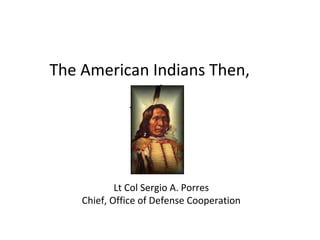
The American Indians Then,
           and
          Today


            Lt Col Sergio A. Porres
    Chief, Office of Defense Cooperation
Background

• Who Are they?
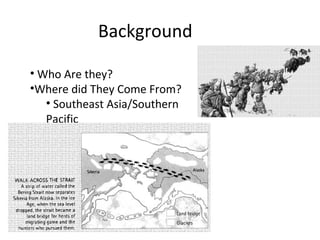
•Where did They Come From?
   • Southeast Asia/Southern
   Pacific
Background
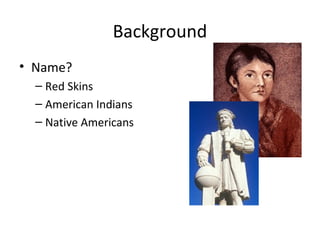
• Name?
  – Red Skins
  – American Indians
  – Native Americans
Were they All The Same?
• Commonalities:
  – History = Story telling
                                         One with Mother Nature
  – Land Gatherers = Nomads
  – Crops = Villages
  – Hunters: Bison, Elk, etc
    •   Meat for Food
    •   Furs and Skin Clothing/Shelter
    •   Stomach for liquids
    •   Bones for weapons
• Commonalities:
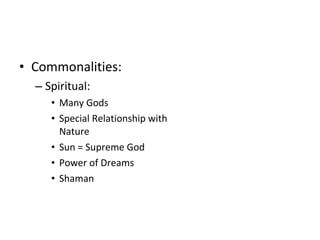
  – Spiritual:
     • Many Gods
     • Special Relationship with
       Nature
     • Sun = Supreme God
     • Power of Dreams
     • Shaman
• Commonalities:
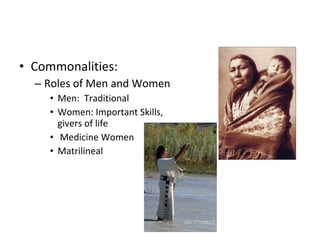
  – Roles of Men and Women
    • Men: Traditional
    • Women: Important Skills,
      givers of life
    • Medicine Women
    • Matrilineal
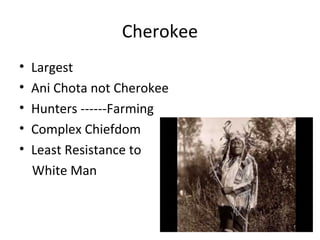
Cherokee
•   Largest
•   Ani Chota not Cherokee
•   Hunters ------Farming
•   Complex Chiefdom
•   Least Resistance to
    White Man
European Encounter
•   Disease
•   Expansion
•   Cultural Differences
•   Religion
•   Civilizing
    – Manifest Destiny
    – 1830--Indian Removal Act
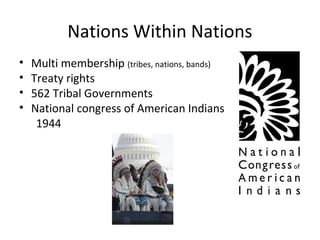
Nations Within Nations
•   Multi membership (tribes, nations, bands)
•   Treaty rights
•   562 Tribal Governments
•   National congress of American Indians
     1944
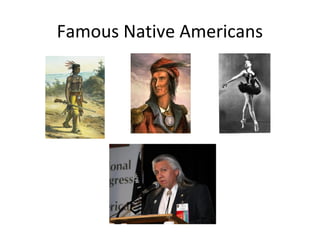
Famous Native Americans

Native americans

  • 1.
    The American IndiansThen, and Today Lt Col Sergio A. Porres Chief, Office of Defense Cooperation
  • 2.
    Background • Who Arethey? •Where did They Come From? • Southeast Asia/Southern Pacific
  • 3.
    Background • Name? – Red Skins – American Indians – Native Americans
  • 4.
    Were they AllThe Same? • Commonalities: – History = Story telling One with Mother Nature – Land Gatherers = Nomads – Crops = Villages – Hunters: Bison, Elk, etc • Meat for Food • Furs and Skin Clothing/Shelter • Stomach for liquids • Bones for weapons
  • 6.
    • Commonalities: – Spiritual: • Many Gods • Special Relationship with Nature • Sun = Supreme God • Power of Dreams • Shaman
  • 8.
    • Commonalities: – Roles of Men and Women • Men: Traditional • Women: Important Skills, givers of life • Medicine Women • Matrilineal
  • 9.
    Cherokee • Largest • Ani Chota not Cherokee • Hunters ------Farming • Complex Chiefdom • Least Resistance to White Man
  • 10.
    European Encounter • Disease • Expansion • Cultural Differences • Religion • Civilizing – Manifest Destiny – 1830--Indian Removal Act
  • 11.
    Nations Within Nations • Multi membership (tribes, nations, bands) • Treaty rights • 562 Tribal Governments • National congress of American Indians 1944
  • 12.

Editor's Notes

  • #3 North American Indians people living in NA when the Europeans discovered. Stone-age people who were to become American Indians entered America 10,000 -30,000 or more years ago It is supposed that the early Indians crossed into Alaska at what is now the narrow channel of open sea called the Bering Strait. Or, they took boats to cross the pacific.
  • #4 They used to paint themselves red because the Beothuks considered red a sacred and royal color and wore it all year long They were named Indians because Columbus thought that he had reached the East Indies in his voyage across the Atlantic. A teenage girl named Shawnadithit the last Beothuk. Starving and alone, surrendered to the British. Shawnadithit lived for six years as an English slave known as "Nancy," drawing pictures and telling stories of her lost tribe.
  • #5 1,000,000 at the arrival of the white man 100s of Tribes All of the Native American tribes had some things in common. They lived off the land by gathering food (NOMADS) in the earliest times and then planting crops later in history. Once they began planting crops, they were able to begin creating villages that were permanent. They all hunted and eventually domesticated animals. Most of the tribes used as much of the animal as they could. Meat was used for food. Furs and skins were used for clothing and shelters. The stomach was used to carry and hold water. Bones were used for needles and weapons. Animals had powerful spirits and it was necessary to thank them and placate them if you wanted to make a meal of them 4
  • #7 All Native American people were very spiritual and they had many religious customs and rituals. They also had many gods. They believed in a special relationship with nature. For most, the Sun was the supreme god. They worshiped the sun because they needed it to grow their crops. They also needed rain, so many had a Rain god. Other elements in nature were also worshipped. Most tribes believed in the power of their dreams They were considered to be revelations made by the gods. Most had an important religious leader which some called Shaman, or medicine man. According to Native Americans, dreams that humans have while they sleep, are sent by sacred spirits as messages. According to their Legend, in the center of the Dream Catcher there is a hole. Good dreams are permitted to reach the sleeper through this hole in the web. As for the bad dreams, the web traps them and they disappear at dawn with the first light. For some, they try to determine what messages are being past onto them and what the message represents.
  • #8 Some of the children of the people were having strange, frightening dreams. As the children talked to other children, the troubling dreams spread among them like a plague. The people went to talk to the shaman. Shaman could help. But he would need to spend some time in counsel with the spirits before he would have a solution. The shaman would have to enter the dream world to find the answer. Upon entering the dream world the shaman was approached by the four elements: Air, Earth, Water and Fire. Air had already heard of the parent’s concern, and had carried the message on the wind to the other elements. All the spirits in the dream world loved the children and wanted to help return the children to their state of peaceful sleep. The elements and the shaman dreamed together for a long time. They finally came to understand that: Air could carry the children’s dreams. Earth could hold the dreams within her hoop. Water could wash and separate dreams - the wanted from the unwanted. Fire could use the morning sun to burn up the unwanted dreams that are caught in the web. Now all they needed was something to capture the dreams as they were carried by the air. Try as they might, the shaman and the elements could not think of a way to catch the dreams. Grandmother Spider had been listening! She said, "Beautiful, loving elements, I can help you as you help me every day." Grandmother Spider continued, "I can weave a special web that only wanted dreams can escape down to the dreamer." And so she did, and the first Dreamcatcher was made. The shaman brought the dreamcatcher with him when he made his journey back from the dream world. All of the families of the people made dreamcatchers. The families hung them above where the children slept, in a place that was seen by the sun.
  • #9 The roles men and women in most Native American tribes were the same. The men hunted and provided protection for their people. The women prepared the food, made clothing and shelters and cared for the children. They were builders, warriors, farmers, and craftswomen. Their strength was essential to the survival of the tribes. They maintained their homes’ roof, and created new houses for tribes to live in. This is an astonishing achievement, particularly for the women of their time. The men knew that women were the source of life, and provided a feeling of strength and consistency to their lives. The men used bows and arrows, spears and knives to hunt. The women would make it. They would also work together to move herds of animals into enclosures or off cliffs to kill them. In some tribes, women believed to have specials healing gifts Matrilineality is a system in which descent is traced through the mother and maternal ancestors. both had power in decisionmaking within the tribe. the Haudenosaunee Five Nations and the Southeast Muskogean tribes, had matrilineal systems, in which property and hereditary leadership were controlled by and passed through the maternal lines. The children belong to the mother's clan and achieved status within it. When the tribe adopted war captives, the children became part of their mother's clan and accepted in the tribe. In Cherokee and other matrilineal cultures, wives owned the family property. When young women married, their husbands joined them in their mother's household.
  • #10 The Cherokee nation was the largest, and probably the most important, nation of eastern North America. They did not call themselves the Cherokee - the Ani Chota, which means the people of Chota, their capital, or the Ani Yunwiya, which means "the main people". Probably Cherokee people were originally part of the Iroquois people , because their language is related to Iroquois and they themselves believed that they came from the north-east, but they split off and moved south, probably about 1500 BC , in the Late Archaic period . After that, during the Woodland period , the Cherokee lived in south-eastern North America (mainly modern Tennessee, North Carolina, and Arkansas, but also South Carolina, Virginia, Georgia and Alabama). Cherokee people were not united under one chief. They lived in a bunch of small independent city-states . Probably these city-states were unified as a confederacy, like the Iroquois confederacy , where they considered themselves one people, and often made decisions as a group by consensus or by voting. We might consider this to be a complex chiefdom . There were at least sixty Cherokee towns, and there may have been more. Each town had about 300 to 400 people living in it. In the early 1800s, Northwestern Georgia was home to over 20,000 Cherokee Indians. Unlike other tribes, the Cherokees made a significant effort to adopt white ways. They created a form of government based on the U.S. Constitution, created a capitol city in New Echota, GA in 1825, and published their own newspaper. Christian missionaries, including the Moravians, were welcomed in Cherokee territory.
  • #11 After the established the United States of America, President George Washington conceived of the idea of "civilizing" Native Americans in preparation for assimilation as U.S. citizens. Assimilation (whether voluntary or forced) became a consistent policy through American administrations. During the 19th century, the ideology of manifest destiny became integral to the American nationalist movement. Expansion of European-American populations to the west after the American Revolution resulted in increasing pressure on Native American lands, warfare between the groups, and rising tensions. In 1830, the U.S. Congress passed the Indian Removal Act , authorizing the government to relocate Native Americans from their homelands within established states to lands west of the Mississippi River , accommodating European-American expansion. Indians carried out strong resistance to United States incursions in the decades after the American Civil War , in a series of Indian Wars , which were frequent up until the 1890s, but continued into the 20th century. The transcontinental railroad brought more non-Natives into tribal land in the west. Over time, the U.S. forced a series of treaties and land cessions by the tribes, and established reservations for them in many western states. U.S. agents encouraged Native Americans to adopt European-style farming and similar pursuits, but European-American agricultural technology of the time was inadequate for often dry reservation lands. In 1924, Native Americans who were not already U.S. citizens were granted citizenship by Congress .
  • #12 Contemporary Native Americans have a unique relationship with the United States because they may be members of nations, tribes, or bands with sovereignty and treaty rights . Since the late 1960s, Native American activism has led to the building of cultural infrastructure and wider recognition: they have founded independent newspapers and online media; , the first Native American television channel (2011), 12 community schools, tribal colleges , and tribal museums and language programs; increasingly published books; they work as academics, policymakers, doctors, and in a wide variety of occupations. teach and preserve indigenous languages for younger generations. Contemporary Native Americans have a unique relationship with the United States because they may be members of nations, tribes, or bands with sovereignty and treaty rights . Since the late 1960s, Native American activism has led to the building of cultural infrastructure and wider recognition: they have founded independent newspapers and online media; , the first Native American television channel (2011), 12 community schools, tribal colleges , and tribal museums and language programs; Native American studies programs in major universities; and national and state museums. Native American and Alaskan Native authors have been increasingly published; they work as academics, policymakers, doctors, and in a wide variety of occupations. Cultural activism has led to an expansion of efforts to teach and preserve indigenous languages for younger generations. Casinos operated by many Native American governments in the United States are creating a stream of gambling revenue that some communities are beginning to use as leverage to build diversified economies. Native American communities have waged and prevailed in legal battles to assure recognition of rights to self-determination and to use of natural resources. Some of those rights, known as treaty rights, are enumerated in early treaties signed with the young United States government. These casinos have brought an influx of money to the tribes; according to tribal accounting firm Joseph Eve, CPAs, the average net profit of Indian casinos is 38.85%
  • #13 Born Elizabeth Marie Tall Chief to an Osage Nation father, she became an eventually well-know ballerina. In 1947 Maria began dancing with the New York City Ballet until her retirement in 1965. Soon after she founded the Chicago City Ballet and remained it’s artistic director for many years. Since 1997 she has been an adviser in the Chicago dance schools Assisting the Pilgrims during their first, harsh winter, the Patuxet, Tasquantum (Squanto) befriended the group in order to see them safely through to spring. In 1608, alas, Squanto and several others were kidnapped by Georgie Weymouth and taken aboard ship to England. Though eventually earning a living and learning the English language, Squanto made his return home in 1613 aboard John Smith’s ship only to find his tribe completely wiped out by the plague. A Shawnee leader whose name means, “Panther in the Sky”, Tecumseh became well known for taking disparate tribes folk and maintaining hold on the land that was rightfully theirs. In 1805, a religious native rebirth led by Tenskwatawa emerged. Tenskwatawa urged natives to reject the ways of the English, and to stop handing over land to the United States