Cindy Alvarez
  3/13/2013
 Forth graders have studied about the
  Native American cultures. They have
  focused in the Native American
  environments, lifestyles, and art.
 California has many different
  environmental zones. Naturally the
  environment has a big influence on
  people’s lives and their ways of living.
  Students will see the differences and
  similarities in the California Indian
  cultures.
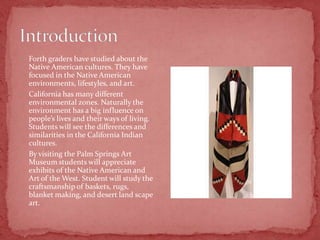
 By visiting the Palm Springs Art
  Museum students will appreciate
  exhibits of the Native American and
  Art of the West. Student will study the
  craftsmanship of baskets, rugs,
  blanket making, and desert land scape
  art.
 Subject: History and Social Studies, Art and Geography
 Grade Level: Fourth Grade
 Topic: Native American and Art of the West
 Length of Session: 3 hours
 Field Trip: The Palm Springs Art Museum
   History and Social Studies                                       Geography
   4.1 Students demonstrate an understanding of                         Places and Regions
    the physical and human geographic features                                The Physical and human characteristics of
    that define places and regions in California.                              places.
        1. Explain and use the coordinate grid system of                Human Systems
         latitude and longitude to determine the absolute                     The characteristics, distribution, and migration
         locations of places in California and on Earth.                       of human populations on Earth’s surface.
                                                                              The process, patterns, and functions of human
        3. Identify the state capital and describe the various                settlement.
         regions of California, including how their                      Environment and Society
         characteristics and physical environments (e.g.,
         water, landforms, vegetation, climate) affect human                  How physical systems affect human systems.
         activity.                                                       The Uses of Geography
                                                                              To apply geography to interpret the past.

   4.2 Students describe the social, political,
    cultural, and economic life and interactions
    among people of California from the pre-
    Columbian societies to the Spanish mission
    and Mexican rancho periods.
        1. Discuss the major nations of California Indians,
         including their geographic distribution, economic
         activities, legends, and religious beliefs; and
         describe how they depended on, adapted to, and
         modified the physical environment by cultivation of
         land and use of sea resources.
 Sketch Notebook
 Pencils
 Color pencils
 Map of the Palm
  Springs Museum
 Sack Lunch
 Before departure to Palm Springs Art Museum students
  will be provided with their sketch notebooks, pencils, color
  pencils, and maps of the Palm Springs Museum.
 At arrival students will be given a worksheet with
  exhibitions they are to visit. In sketchbooks student are to
  draw a simple sketch of their most favorite and least
  favorite exhibits and explain why. They are to provide
  information of what it is, of when the art piece was created
  and by who or what tribe, where it comes from, what
  materials were used to make the piece, and any new
  information they may have learned.
 Once the students of a group have completed their
  museum assignment they will then be allowed to enjoy the
  rest of the museum’s exhibitions.
 Each student will receive an empty map of California. On
  the map they will label the physical characteristic's of
  California. They will also plot the locations of the tribes
  that had exhibits in the Museum. In addition, students are
  required to mention a few facts of art work, craftsmanship,
  types of plants from each of the tribes. Students can use
  the notes they wrote in their sketchbooks to complete their
  California map assignment.
 For homework students are to write three paragraphs about
  what they liked best of their field trip, what tribe artifacts
  were most interesting , describe how that artifact was used,
  and if it had any special meaning.
Rubric       Name of Student :
             Completed    Partially completed   Not completed
             Assignment

Sketch
Notebook
California
map

Written
Homework
Assignment
Native american p.p.

Native american p.p.

  • 1.
    Cindy Alvarez 3/13/2013
  • 2.
     Forth gradershave studied about the Native American cultures. They have focused in the Native American environments, lifestyles, and art.  California has many different environmental zones. Naturally the environment has a big influence on people’s lives and their ways of living. Students will see the differences and similarities in the California Indian cultures.  By visiting the Palm Springs Art Museum students will appreciate exhibits of the Native American and Art of the West. Student will study the craftsmanship of baskets, rugs, blanket making, and desert land scape art.
  • 3.
     Subject: Historyand Social Studies, Art and Geography  Grade Level: Fourth Grade  Topic: Native American and Art of the West  Length of Session: 3 hours  Field Trip: The Palm Springs Art Museum
  • 4.
    History and Social Studies  Geography  4.1 Students demonstrate an understanding of  Places and Regions the physical and human geographic features  The Physical and human characteristics of that define places and regions in California. places.  1. Explain and use the coordinate grid system of  Human Systems latitude and longitude to determine the absolute  The characteristics, distribution, and migration locations of places in California and on Earth. of human populations on Earth’s surface.  The process, patterns, and functions of human  3. Identify the state capital and describe the various settlement. regions of California, including how their  Environment and Society characteristics and physical environments (e.g., water, landforms, vegetation, climate) affect human  How physical systems affect human systems. activity.  The Uses of Geography  To apply geography to interpret the past.  4.2 Students describe the social, political, cultural, and economic life and interactions among people of California from the pre- Columbian societies to the Spanish mission and Mexican rancho periods.  1. Discuss the major nations of California Indians, including their geographic distribution, economic activities, legends, and religious beliefs; and describe how they depended on, adapted to, and modified the physical environment by cultivation of land and use of sea resources.
  • 5.
     Sketch Notebook Pencils  Color pencils  Map of the Palm Springs Museum  Sack Lunch
  • 6.
     Before departureto Palm Springs Art Museum students will be provided with their sketch notebooks, pencils, color pencils, and maps of the Palm Springs Museum.  At arrival students will be given a worksheet with exhibitions they are to visit. In sketchbooks student are to draw a simple sketch of their most favorite and least favorite exhibits and explain why. They are to provide information of what it is, of when the art piece was created and by who or what tribe, where it comes from, what materials were used to make the piece, and any new information they may have learned.  Once the students of a group have completed their museum assignment they will then be allowed to enjoy the rest of the museum’s exhibitions.
  • 7.
     Each studentwill receive an empty map of California. On the map they will label the physical characteristic's of California. They will also plot the locations of the tribes that had exhibits in the Museum. In addition, students are required to mention a few facts of art work, craftsmanship, types of plants from each of the tribes. Students can use the notes they wrote in their sketchbooks to complete their California map assignment.  For homework students are to write three paragraphs about what they liked best of their field trip, what tribe artifacts were most interesting , describe how that artifact was used, and if it had any special meaning.
  • 8.
    Rubric Name of Student : Completed Partially completed Not completed Assignment Sketch Notebook California map Written Homework Assignment