Education Standards Panel Update 2012 BLA Workshop  Jeff Johnson, ESP Chair Pamela Dillon, Education Director February 29, 2012
National Boating Education Standards The standards were developed in the mid-90s as a list of minimum content items that must be included in a boating safety course. The standards serve as a guide for state, non-profit and commercial providers to follow. NASBLA- reviews and approves courses which meet  the Standards.
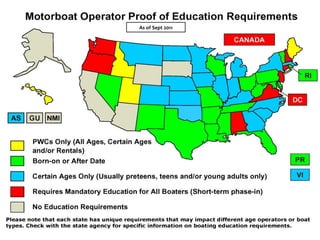
As of Sept 2011
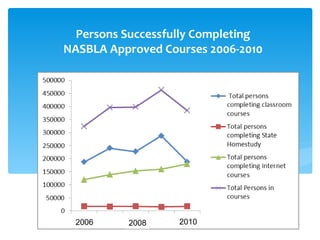
Persons Successfully Completing NASBLA Approved Courses 2006-2010 2006 2010 2008
Heighten level of   national agreement and consistency in boating education program content and delivery for the nation’s boaters . To advance Boating Safety Education…
Gauge efficacy of Standards based on risk assessments, accident and participation data analyses, other research studies and scientific resources  Education Standards Panel (Authorized in 2010) Primary  Objectives
Implement a process that heightens recognition of voluntary,  consensus-based standards   (i.e. such as a process that conforms to  American National Standards Institute (ANSI)  Essential Requirements).  Education Standards Panel Primary Objectives
Openness Lack of dominance Balance Coordination and harmonization Notification of standards development Standards Development Process ANSI’s Ten Essential Requirements
Consideration of views & objections Consensus vote Appeals (procedural) Written procedures Compliance  Standards Development Process ANSI’s Ten Essential Requirements
National Boating Education Standards Panel Rules:  define Panel’s objectives, authority, organization, interest categories, and all procedures governing standards development and procedural appeals. Education Standards Panel
Panel serves as ‘ consensus body ’ Panel members appointed by Board for  3-year terms , with chance for reappointment. Term limits.  Maximum  15 members , including chairperson.  Application process  open to all persons directly & materially affected by standards Education Standards Panel  – Key features
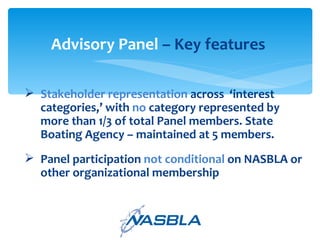
Stakeholder representation  across  ‘interest categories,’ with  no  category represented by more than 1/3 of total Panel members. State Boating Agency – maintained at 5 members. Panel participation  not conditional  on NASBLA or other organizational membership Advisory Panel  – Key features
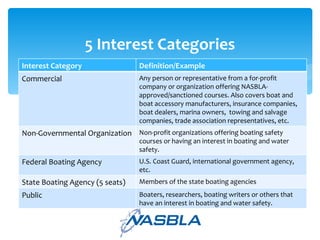
5 Interest Categories Interest Category Definition/Example Commercial Any person or representative from a for-profit company or organization offering NASBLA-approved/sanctioned courses. Also covers boat and boat accessory manufacturers, insurance companies, boat dealers, marina owners,  towing and salvage companies, trade association representatives, etc. Non-Governmental Organization Non-profit organizations offering boating safety courses or having an interest in boating and water safety. Federal Boating Agency U.S. Coast Guard, international government agency, etc. State Boating Agency (5 seats) Members of the state boating agencies  Public Boaters, researchers, boating writers or others that have an interest in boating and water safety.
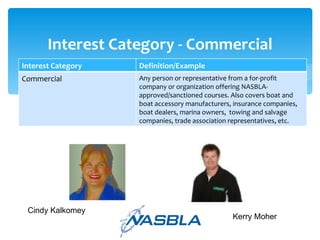
Interest Category - Commercial Cindy Kalkomey Kerry Moher Interest Category Definition/Example Commercial Any person or representative from a for-profit company or organization offering NASBLA-approved/sanctioned courses. Also covers boat and boat accessory manufacturers, insurance companies, boat dealers, marina owners,  towing and salvage companies, trade association representatives, etc.
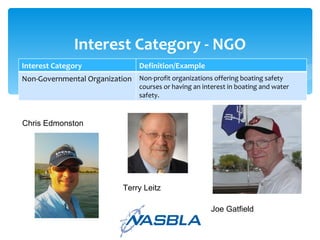
Interest Category - NGO Chris Edmonston Terry Leitz Joe Gatfield Interest Category Definition/Example Non-Governmental Organization Non-profit organizations offering boating safety courses or having an interest in boating and water safety.
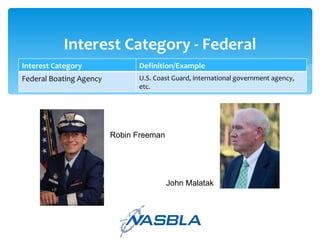
Interest Category - Federal Robin Freeman John Malatak Interest Category Definition/Example Federal Boating Agency U.S. Coast Guard, international government agency, etc.
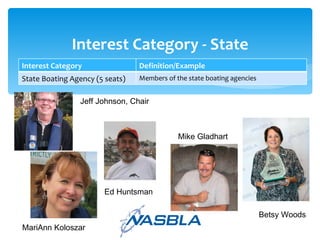
Interest Category - State Jeff Johnson, Chair MariAnn Koloszar Ed Huntsman Mike Gladhart Betsy Woods Interest Category Definition/Example State Boating Agency (5 seats) Members of the state boating agencies
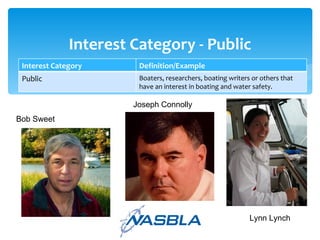
Interest Category - Public Bob Sweet Joseph Connolly Lynn Lynch Interest Category Definition/Example Public Boaters, researchers, boating writers or others that have an interest in boating and water safety.
Part V. General (1) Members shall  “ function independently as individuals  and not as agents or representatives of organizations with which they are or may be associated or employed when engaged in the work of the Panel.” Conflict of Interest & Ethical Conduct
Panel continues to organize its work. Determining  ‘Scope of Standards.’ Determining  ‘decision criteria’. Preparing for  ‘call for proposed revisions’ to the current (Jan 2012) Standards. Standards Development  – First Cycle
5-year cycle  for Standards review Drafts of proposed Standards must  be published for review , with publicized ‘ call for comments ’ Panel must  dispose of each comment  received  and  communicate disposition  to each commenter Standards Development  – General Procedures
Upon Panel approval, proposed Standards move to ‘ consensus ballot ’ stage, with  recorded votes  and  efforts to resolve all negative comments Then on to ‘ public review draft ’ stage, with  publicized comment period  and  efforts to resolve comments received Standards Development  – Procedures
Instructions for submission , availability of the document containing the most currently approved standards will be  announced in suitable media outlets. Submissions encouraged  from panel members, NASBLA members, non-members alike. Standards Development  – First Cycle
We anticipate the process will  simplify national boating education standards, emphasizing those based on risk analysis and accident data. Planned/formatted to achieve ANSI certification in the future. Moving Forward……
Questions?

National Boating Education Standards Panel

  • 1.
    Education Standards PanelUpdate 2012 BLA Workshop Jeff Johnson, ESP Chair Pamela Dillon, Education Director February 29, 2012
  • 2.
    National Boating EducationStandards The standards were developed in the mid-90s as a list of minimum content items that must be included in a boating safety course. The standards serve as a guide for state, non-profit and commercial providers to follow. NASBLA- reviews and approves courses which meet the Standards.
  • 3.
  • 4.
    Persons Successfully CompletingNASBLA Approved Courses 2006-2010 2006 2010 2008
  • 5.
    Heighten level of national agreement and consistency in boating education program content and delivery for the nation’s boaters . To advance Boating Safety Education…
  • 6.
    Gauge efficacy ofStandards based on risk assessments, accident and participation data analyses, other research studies and scientific resources Education Standards Panel (Authorized in 2010) Primary Objectives
  • 7.
    Implement a processthat heightens recognition of voluntary, consensus-based standards (i.e. such as a process that conforms to American National Standards Institute (ANSI) Essential Requirements). Education Standards Panel Primary Objectives
  • 8.
    Openness Lack ofdominance Balance Coordination and harmonization Notification of standards development Standards Development Process ANSI’s Ten Essential Requirements
  • 9.
    Consideration of views& objections Consensus vote Appeals (procedural) Written procedures Compliance Standards Development Process ANSI’s Ten Essential Requirements
  • 10.
    National Boating EducationStandards Panel Rules: define Panel’s objectives, authority, organization, interest categories, and all procedures governing standards development and procedural appeals. Education Standards Panel
  • 11.
    Panel serves as‘ consensus body ’ Panel members appointed by Board for 3-year terms , with chance for reappointment. Term limits. Maximum 15 members , including chairperson. Application process open to all persons directly & materially affected by standards Education Standards Panel – Key features
  • 12.
    Stakeholder representation across ‘interest categories,’ with no category represented by more than 1/3 of total Panel members. State Boating Agency – maintained at 5 members. Panel participation not conditional on NASBLA or other organizational membership Advisory Panel – Key features
  • 13.
    5 Interest CategoriesInterest Category Definition/Example Commercial Any person or representative from a for-profit company or organization offering NASBLA-approved/sanctioned courses. Also covers boat and boat accessory manufacturers, insurance companies, boat dealers, marina owners, towing and salvage companies, trade association representatives, etc. Non-Governmental Organization Non-profit organizations offering boating safety courses or having an interest in boating and water safety. Federal Boating Agency U.S. Coast Guard, international government agency, etc. State Boating Agency (5 seats) Members of the state boating agencies Public Boaters, researchers, boating writers or others that have an interest in boating and water safety.
  • 14.
    Interest Category -Commercial Cindy Kalkomey Kerry Moher Interest Category Definition/Example Commercial Any person or representative from a for-profit company or organization offering NASBLA-approved/sanctioned courses. Also covers boat and boat accessory manufacturers, insurance companies, boat dealers, marina owners, towing and salvage companies, trade association representatives, etc.
  • 15.
    Interest Category -NGO Chris Edmonston Terry Leitz Joe Gatfield Interest Category Definition/Example Non-Governmental Organization Non-profit organizations offering boating safety courses or having an interest in boating and water safety.
  • 16.
    Interest Category -Federal Robin Freeman John Malatak Interest Category Definition/Example Federal Boating Agency U.S. Coast Guard, international government agency, etc.
  • 17.
    Interest Category -State Jeff Johnson, Chair MariAnn Koloszar Ed Huntsman Mike Gladhart Betsy Woods Interest Category Definition/Example State Boating Agency (5 seats) Members of the state boating agencies
  • 18.
    Interest Category -Public Bob Sweet Joseph Connolly Lynn Lynch Interest Category Definition/Example Public Boaters, researchers, boating writers or others that have an interest in boating and water safety.
  • 19.
    Part V. General(1) Members shall “ function independently as individuals and not as agents or representatives of organizations with which they are or may be associated or employed when engaged in the work of the Panel.” Conflict of Interest & Ethical Conduct
  • 20.
    Panel continues toorganize its work. Determining ‘Scope of Standards.’ Determining ‘decision criteria’. Preparing for ‘call for proposed revisions’ to the current (Jan 2012) Standards. Standards Development – First Cycle
  • 21.
    5-year cycle for Standards review Drafts of proposed Standards must be published for review , with publicized ‘ call for comments ’ Panel must dispose of each comment received and communicate disposition to each commenter Standards Development – General Procedures
  • 22.
    Upon Panel approval,proposed Standards move to ‘ consensus ballot ’ stage, with recorded votes and efforts to resolve all negative comments Then on to ‘ public review draft ’ stage, with publicized comment period and efforts to resolve comments received Standards Development – Procedures
  • 23.
    Instructions for submission, availability of the document containing the most currently approved standards will be announced in suitable media outlets. Submissions encouraged from panel members, NASBLA members, non-members alike. Standards Development – First Cycle
  • 24.
    We anticipate theprocess will simplify national boating education standards, emphasizing those based on risk analysis and accident data. Planned/formatted to achieve ANSI certification in the future. Moving Forward……
  • 25.