




Evaluation of infant and child manikins
for in-water testing
Chris P. James, principal engineering manager, UL
Alex Schraiber, research engineer, UL
UL AND THE UL LOGO ARE TRADEMARKS OF UL LLC © 2022. ALL RIGHTS RESERVED. THIS DOCUMENT MAY NOT BE COPIED
WITHOUT WRITTEN PERMISSION FROM UL AND ONLY IN ITS ENTIRETY. THE DOCUMENT IS FOR GENERAL INFORMATION
PURPOSES ONLY AND IS NOT INTENDED TO CONVEY LEGAL OR OTHER PROFESSIONAL ADVICE. THE INFORMATION PROVIDED IN
THIS DOCUMENT IS CORRECT TO THE BEST OF OUR KNOWLEDGE, INFORMATION AND BELIEF AT THE DATE OF ITS PUBLICATION.
Agenda
1. Background and technical
approach
2. Test data and results
3. Static balance
measurements
4. Conclusions
2
Background and Technical Approach
Background and technical approach
In-water testing with infant and child subjects
• Requirements
o Static balance, self-righting, stability,
water entry, retroreflective visibility
• Challenges for young participants?
o Not able to follow instructions fully
o Difficult to relax or be passive
o Test outcome is a combination of
subject and sample performance
o Cooperation for complete turn
test dataset, which meant three good
turns with the candidate device and
three good turns with reference test
devices (RTD) is not guaranteed
4
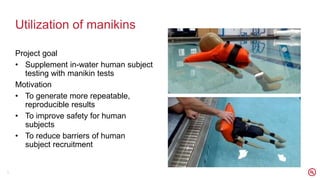
Utilization of manikins
Project goal
• Supplement in-water human subject
testing with manikin tests
Motivation
• To generate more repeatable,
reproducible results
• To improve safety for human
subjects
• To reduce barriers of human
subject recruitment
5
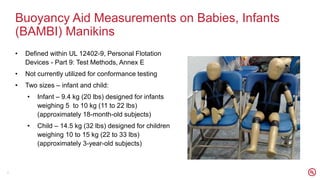
Buoyancy Aid Measurements on Babies, Infants
(BAMBI) Manikins
• Defined within UL 12402-9, Personal Flotation
Devices - Part 9: Test Methods, Annex E
• Not currently utilized for conformance testing
• Two sizes – infant and child:
• Infant – 9.4 kg (20 lbs) designed for infants
weighing 5 to 10 kg (11 to 22 lbs)
(approximately 18-month-old subjects)
• Child – 14.5 kg (32 lbs) designed for children
weighing 10 to 15 kg (22 to 33 lbs)
(approximately 3-year-old subjects)
6
Research plan
• Phase 1 – literature and standards
review (complete)
• Phase 2 – human subject and
manikin comparison (complete)
• 15 designs of personal flotation
devices (PFD) (compliant,
borderline)
• Comparisons of manikin trials to
historical human subject data
• Phase 3 – Standards Technical
Panel (STP) consideration
7
Test Data and Results
Test data and results
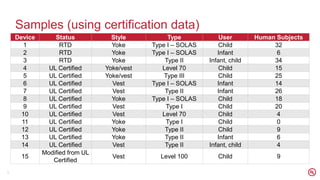
Samples (using certification data)
9
Device Status Style Type User Human Subjects
1 RTD Yoke Type I – SOLAS Child 32
2 RTD Yoke Type I – SOLAS Infant 6
3 RTD Yoke Type II Infant, child 34
4 UL Certified Yoke/vest Level 70 Child 15
5 UL Certified Yoke/vest Type III Child 25
6 UL Certified Vest Type I – SOLAS Infant 14
7 UL Certified Vest Type II Infant 26
8 UL Certified Yoke Type I – SOLAS Child 18
9 UL Certified Vest Type I Child 20
10 UL Certified Vest Level 70 Child 4
11 UL Certified Yoke Type I Child 0
12 UL Certified Yoke Type II Child 9
13 UL Certified Yoke Type II Infant 6
14 UL Certified Vest Type II Infant, child 4
15
Modified from UL
Certified
Vest Level 100 Child 9
Comparison metrics
1. Torso angle
2. Faceplane angle
3. Freeboard
4. List angle
5. Turning time
10 Image copied from UL 12402-9, Personal Flotation Devices - Part 9: Test
Methods
Static Balance Measurements
Static balance measurements
Device 1 – SOLAS RTD, child manikin
• Static balance for child manikin outfitted with a Safety of Life at
Sea (SOLAS) RTD
• Natural balance, shoulder joint slightly stiff
12
Device 1 – SOLAS RTD child data
• Five sets of child manikin data including
measurements before/after turning test
• Manikin data falls within the bounds of
human subject data as a function of
weight
• Manikin data is repeatable
• Faceplane angle shows wide scatter for
human subjects
13
0
20
40
60
80
100
120
140
0 20 40 60 80 100
Freeboard
(mm)
Subject weight (lbs)
Human Subjects Manikin Linear (Human Subjects)
-10
0
10
20
30
40
50
0 20 40 60 80 100
Faceplane
angle
(°)
Subject weight (lbs)
Human Subjects Manikin Linear (Human Subjects)
0
20
40
60
80
100
0 20 40 60 80 100
Torso
angle
(°)
Subject weight (lbs)
Human Subjects Manikin Linear (Human Subjects)
Device 3 – USCG CKS2 RTD, infant manikin
• Static balance for infant manikin outfitted with CKS2 RTD
• Natural balance, shoulder joint slightly stiff
14
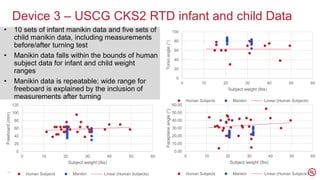
Device 3 – USCG CKS2 RTD infant and child Data
• 10 sets of infant manikin data and five sets of
child manikin data, including measurements
before/after turning test
• Manikin data falls within the bounds of human
subject data for infant and child weight
ranges
• Manikin data is repeatable; wide range for
freeboard is explained by the inclusion of
measurements after turning
15
0.00
10.00
20.00
30.00
40.00
50.00
60.00
0 10 20 30 40 50 60
Faceplane
angle
(°)
Subject weight (lbs)
Human Subjects Manikin Linear (Human Subjects)
0
20
40
60
80
100
120
0 10 20 30 40 50 60
Freeboard
(mm)
Subject weight (lbs)
Human Subjects Manikin Linear (Human Subjects)
0
20
40
60
80
100
0 10 20 30 40 50 60
Torso
angle
(°)
Subject weight (lbs)
Human Subjects Manikin Linear (Human Subjects)
Turning Time
Turning time
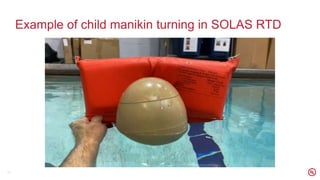
Example of child manikin turning in SOLAS RTD
17
Turn time vs. weight for RTDs
• Turn time typically falls within bounds of
human subject data
• Manikin data is repeatable (Devices 1 and
Device 3)
• Upward trend between turning time and
subject weight
• Infant SOLAS RTD has limited human
subject data for comparison
18
0
1
2
3
4
5
0 20 40 60 80 100
Turning
time
(s)
Subject weight (lbs)
Device 1 – Child SOLAS RTD
Human Subjects Manikin Linear (Human Subjects)
0.0
0.2
0.4
0.6
0.8
1.0
1.2
0 5 10 15 20 25 30 35 40
Turning
time
(s)
Subject weight (lbs)
Device 2 – Infant SOLAS RTD
Human Subjects Manikin Linear (Human Subjects)
0.0
0.5
1.0
1.5
2.0
2.5
3.0
3.5
0 10 20 30 40 50 60
Turning
time
(s) Subject weight (lbs)
Device 3 – Infant and Child CKS Type II RTD
Human Subjects Manikin Linear (Human Subjects)
Turning time for vest style devices
• Five vest-style devices evaluated for turn time
• Manikins did not turn for two devices
o Infant manikin on Device 6
o Infant and child manikins on Device 15
• When manikin turns device, it turns a similar
time to human subjects
19
0
0.5
1
1.5
2
2.5
0 5 10 15 20 25 30 35 40
Turning
time
(s)
Subject weight (lbs)
Device 6 – Infant, Type I – NO TURN
Human Subjects Manikin
0
1
2
3
4
0 10 20 30 40 50
Turning
time
(s)
Subject weight (lbs)
Device 15 – Level 100, Child – NO TURN
Human Subjects Manikin
0
0.5
1
1.5
2
2.5
3
3.5
0 5 10 15 20 25 30 35
Turning
time
(s)
Subject weight (lbs)
Device 14 – Type II, Infant and Child
Human Subjects Manikin
Manikins improve turn time repeatability
20
Subject Device
Standard Deviation -
Turn time for manikin
Standard Deviation –
Turn time for human
subjects
Infant
2 – infant 0.05 0.31
3 – infant 0.09 0.53
7 – infant 0.04 0.46
13 – infant 0.16 0.23
14 – infant 0.14 1.09
Child
1 – child 0.12 0.94
3 – child 0.14 0.31
8 – child 0.02 0.79
9 – child 0.08 1.46
14 – child 0.19 1.09
Conclusions and Next Steps
Conclusions
Conclusions
• Based on preliminary data and current design:
o BAMBI manikins provide repeatable static balance measurements.
o BAMBI manikins may be more conservative than human subjects for
turning behavior.
• Some devices that turn human subjects will not turn BAMBI manikins.
o BAMBI manikins could provide a valuable supplement to human subjects
but not a complete replacement.
22
Chris P. James
Christopher.James@ul.com
Alex Schraiber
Alex.Klieger@ul.com
Questions
23
Thank you
UL and the UL logo are trademarks of UL LLC © 2022.

UL R&D Manikin Project Update

  • 1.
    Evaluation of infantand child manikins for in-water testing Chris P. James, principal engineering manager, UL Alex Schraiber, research engineer, UL UL AND THE UL LOGO ARE TRADEMARKS OF UL LLC © 2022. ALL RIGHTS RESERVED. THIS DOCUMENT MAY NOT BE COPIED WITHOUT WRITTEN PERMISSION FROM UL AND ONLY IN ITS ENTIRETY. THE DOCUMENT IS FOR GENERAL INFORMATION PURPOSES ONLY AND IS NOT INTENDED TO CONVEY LEGAL OR OTHER PROFESSIONAL ADVICE. THE INFORMATION PROVIDED IN THIS DOCUMENT IS CORRECT TO THE BEST OF OUR KNOWLEDGE, INFORMATION AND BELIEF AT THE DATE OF ITS PUBLICATION.
  • 2.
    Agenda 1. Background andtechnical approach 2. Test data and results 3. Static balance measurements 4. Conclusions 2
  • 3.
    Background and TechnicalApproach Background and technical approach
  • 4.
    In-water testing withinfant and child subjects • Requirements o Static balance, self-righting, stability, water entry, retroreflective visibility • Challenges for young participants? o Not able to follow instructions fully o Difficult to relax or be passive o Test outcome is a combination of subject and sample performance o Cooperation for complete turn test dataset, which meant three good turns with the candidate device and three good turns with reference test devices (RTD) is not guaranteed 4
  • 5.
    Utilization of manikins Projectgoal • Supplement in-water human subject testing with manikin tests Motivation • To generate more repeatable, reproducible results • To improve safety for human subjects • To reduce barriers of human subject recruitment 5
  • 6.
    Buoyancy Aid Measurementson Babies, Infants (BAMBI) Manikins • Defined within UL 12402-9, Personal Flotation Devices - Part 9: Test Methods, Annex E • Not currently utilized for conformance testing • Two sizes – infant and child: • Infant – 9.4 kg (20 lbs) designed for infants weighing 5 to 10 kg (11 to 22 lbs) (approximately 18-month-old subjects) • Child – 14.5 kg (32 lbs) designed for children weighing 10 to 15 kg (22 to 33 lbs) (approximately 3-year-old subjects) 6
  • 7.
    Research plan • Phase1 – literature and standards review (complete) • Phase 2 – human subject and manikin comparison (complete) • 15 designs of personal flotation devices (PFD) (compliant, borderline) • Comparisons of manikin trials to historical human subject data • Phase 3 – Standards Technical Panel (STP) consideration 7
  • 8.
    Test Data andResults Test data and results
  • 9.
    Samples (using certificationdata) 9 Device Status Style Type User Human Subjects 1 RTD Yoke Type I – SOLAS Child 32 2 RTD Yoke Type I – SOLAS Infant 6 3 RTD Yoke Type II Infant, child 34 4 UL Certified Yoke/vest Level 70 Child 15 5 UL Certified Yoke/vest Type III Child 25 6 UL Certified Vest Type I – SOLAS Infant 14 7 UL Certified Vest Type II Infant 26 8 UL Certified Yoke Type I – SOLAS Child 18 9 UL Certified Vest Type I Child 20 10 UL Certified Vest Level 70 Child 4 11 UL Certified Yoke Type I Child 0 12 UL Certified Yoke Type II Child 9 13 UL Certified Yoke Type II Infant 6 14 UL Certified Vest Type II Infant, child 4 15 Modified from UL Certified Vest Level 100 Child 9
  • 10.
    Comparison metrics 1. Torsoangle 2. Faceplane angle 3. Freeboard 4. List angle 5. Turning time 10 Image copied from UL 12402-9, Personal Flotation Devices - Part 9: Test Methods
  • 11.
  • 12.
    Device 1 –SOLAS RTD, child manikin • Static balance for child manikin outfitted with a Safety of Life at Sea (SOLAS) RTD • Natural balance, shoulder joint slightly stiff 12
  • 13.
    Device 1 –SOLAS RTD child data • Five sets of child manikin data including measurements before/after turning test • Manikin data falls within the bounds of human subject data as a function of weight • Manikin data is repeatable • Faceplane angle shows wide scatter for human subjects 13 0 20 40 60 80 100 120 140 0 20 40 60 80 100 Freeboard (mm) Subject weight (lbs) Human Subjects Manikin Linear (Human Subjects) -10 0 10 20 30 40 50 0 20 40 60 80 100 Faceplane angle (°) Subject weight (lbs) Human Subjects Manikin Linear (Human Subjects) 0 20 40 60 80 100 0 20 40 60 80 100 Torso angle (°) Subject weight (lbs) Human Subjects Manikin Linear (Human Subjects)
  • 14.
    Device 3 –USCG CKS2 RTD, infant manikin • Static balance for infant manikin outfitted with CKS2 RTD • Natural balance, shoulder joint slightly stiff 14
  • 15.
    Device 3 –USCG CKS2 RTD infant and child Data • 10 sets of infant manikin data and five sets of child manikin data, including measurements before/after turning test • Manikin data falls within the bounds of human subject data for infant and child weight ranges • Manikin data is repeatable; wide range for freeboard is explained by the inclusion of measurements after turning 15 0.00 10.00 20.00 30.00 40.00 50.00 60.00 0 10 20 30 40 50 60 Faceplane angle (°) Subject weight (lbs) Human Subjects Manikin Linear (Human Subjects) 0 20 40 60 80 100 120 0 10 20 30 40 50 60 Freeboard (mm) Subject weight (lbs) Human Subjects Manikin Linear (Human Subjects) 0 20 40 60 80 100 0 10 20 30 40 50 60 Torso angle (°) Subject weight (lbs) Human Subjects Manikin Linear (Human Subjects)
  • 16.
  • 17.
    Example of childmanikin turning in SOLAS RTD 17
  • 18.
    Turn time vs.weight for RTDs • Turn time typically falls within bounds of human subject data • Manikin data is repeatable (Devices 1 and Device 3) • Upward trend between turning time and subject weight • Infant SOLAS RTD has limited human subject data for comparison 18 0 1 2 3 4 5 0 20 40 60 80 100 Turning time (s) Subject weight (lbs) Device 1 – Child SOLAS RTD Human Subjects Manikin Linear (Human Subjects) 0.0 0.2 0.4 0.6 0.8 1.0 1.2 0 5 10 15 20 25 30 35 40 Turning time (s) Subject weight (lbs) Device 2 – Infant SOLAS RTD Human Subjects Manikin Linear (Human Subjects) 0.0 0.5 1.0 1.5 2.0 2.5 3.0 3.5 0 10 20 30 40 50 60 Turning time (s) Subject weight (lbs) Device 3 – Infant and Child CKS Type II RTD Human Subjects Manikin Linear (Human Subjects)
  • 19.
    Turning time forvest style devices • Five vest-style devices evaluated for turn time • Manikins did not turn for two devices o Infant manikin on Device 6 o Infant and child manikins on Device 15 • When manikin turns device, it turns a similar time to human subjects 19 0 0.5 1 1.5 2 2.5 0 5 10 15 20 25 30 35 40 Turning time (s) Subject weight (lbs) Device 6 – Infant, Type I – NO TURN Human Subjects Manikin 0 1 2 3 4 0 10 20 30 40 50 Turning time (s) Subject weight (lbs) Device 15 – Level 100, Child – NO TURN Human Subjects Manikin 0 0.5 1 1.5 2 2.5 3 3.5 0 5 10 15 20 25 30 35 Turning time (s) Subject weight (lbs) Device 14 – Type II, Infant and Child Human Subjects Manikin
  • 20.
    Manikins improve turntime repeatability 20 Subject Device Standard Deviation - Turn time for manikin Standard Deviation – Turn time for human subjects Infant 2 – infant 0.05 0.31 3 – infant 0.09 0.53 7 – infant 0.04 0.46 13 – infant 0.16 0.23 14 – infant 0.14 1.09 Child 1 – child 0.12 0.94 3 – child 0.14 0.31 8 – child 0.02 0.79 9 – child 0.08 1.46 14 – child 0.19 1.09
  • 21.
    Conclusions and NextSteps Conclusions
  • 22.
    Conclusions • Based onpreliminary data and current design: o BAMBI manikins provide repeatable static balance measurements. o BAMBI manikins may be more conservative than human subjects for turning behavior. • Some devices that turn human subjects will not turn BAMBI manikins. o BAMBI manikins could provide a valuable supplement to human subjects but not a complete replacement. 22
  • 23.
    Chris P. James Christopher.James@ul.com AlexSchraiber Alex.Klieger@ul.com Questions 23
  • 24.
    Thank you UL andthe UL logo are trademarks of UL LLC © 2022.