Francis Gilbert
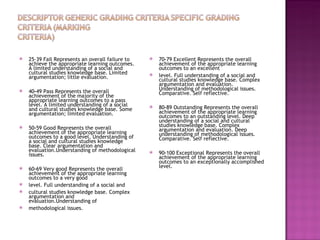
   25–39 Fail Represents an overall failure to      70–79 Excellent Represents the overall
    achieve the appropriate learning outcomes.        achievement of the appropriate learning
    A limited understanding of a social and           outcomes to an excellent
    cultural studies knowledge base. Limited
    argumentation; little evaluation.
                                                     level. Full understanding of a social and
                                                      cultural studies knowledge base. Complex
                                                      argumentation and evaluation.
   40–49 Pass Represents the overall                 Understanding of methodological issues.
                                                      Comparative. Self reflective.
    achievement of the majority of the
    appropriate learning outcomes to a pass
    level. A limited understanding of a social
    and cultural studies knowledge base. Some
                                                     80–89 Outstanding Represents the overall
    argumentation; limited evaluation.                achievement of the appropriate learning
                                                      outcomes to an outstanding level. Deep
                                                      understanding of a social and cultural
   50–59 Good Represents the overall                 studies knowledge base. Complex
                                                      argumentation and evaluation. Deep
    achievement of the appropriate learning           understanding of methodological issues.
    outcomes to a good level. Understanding of        Comparative. Self reflective.
    a social and cultural studies knowledge
    base. Clear argumentation and
    evaluation.Understanding of methodological
    issues.                                          90–100 Exceptional Represents the overall
                                                      achievement of the appropriate learning
                                                      outcomes to an exceptionally accomplished
                                                      level.
   60–69 Very good Represents the overall
    achievement of the appropriate learning
    outcomes to a very good
   level. Full understanding of a social and
   cultural studies knowledge base. Complex
    argumentation and
    evaluation.Understanding of
   methodological issues.
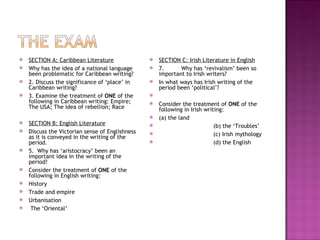
   SECTION A: Caribbean Literature                 SECTION C: Irish Literature in English
   Why has the idea of a national language         7.      Why has ‘revivalism’ been so
    been problematic for Caribbean writing?          important to Irish writers?
   2. Discuss the significance of ‘place’ in       In what ways has Irish writing of the
    Caribbean writing?                               period been ‘political’?
   3. Examine the treatment of ONE of the       
    following in Caribbean writing: Empire;         Consider the treatment of ONE of the
    The USA; The idea of rebellion; Race             following in Irish writing:
                                                    (a) the land
   SECTION B: English Literature                                          (b) the ‘Troubles’
   Discuss the Victorian sense of Englishness                             (c) Irish mythology
    as it is conveyed in the writing of the
    period.                                                                (d) the English
   5. Why has ‘aristocracy’ been an
    important idea in the writing of the
    period?
   Consider the treatment of ONE of the
    following in English writing:
   History
   Trade and empire
   Urbanisation
    The ‘Oriental’
Francis Gilbert
   Michael Smith, usually referred to as Mikey Smith (14 September 1954 - 17 August
    1983), was a Jamaican dub poet.[1] Along with Linton Kwesi Johnson, and 
    Mutabaruka, he was one of the most well-known dub poets. In 1978, Michael Smith
    represented Jamaica at the 11th World Festival of Youth and Students in Cuba. His
    album Mi Cyaan Believe It includes his best known poem of the same name. He had
    left-anarchist leanings and Rastafarian sympathies. Smith was allegedly murdered
    by political opponents associated with the right-wing Jamaica Labour Party after
    heckling the Jamaican Minister of Culture at a political rally on August 17, 1983.
   Smith was educated at Kingston College and the St George's College Extension
    School. He also studied at the Jamaican School of Drama with Jean 'Binta' Breeze
     and Oku Onuora. Linton Kwesi Johnson released some of Smith’s work on his LKJ
    label. Smith appeared on the BBC television series Ebony and the BBC also broadcast
    a documentary based on his association with Johnson. "Mi Cyaan Believe It" is most
    remembered for Smith’s heartfelt phrase "Laaawwwd - mi cyaan believe it - mi seh -
    mi cyaan believe it". In 1982, Smith released his debut album and performed
    extensively in Europe supporting such acts as Gregory Isaacs. Smith recorded a
    session for John Peel which was broadcast by the BBC on 4 May 1982. [2] He
    continued to work as a social worker representing prisoners in Gun Court. His
    outspoken commentary on the “isms and schisms of ‘politricks”’ in Jamaica led to
    his life being cut short. Michael Smith was stoned to death following a clash at a
    political rally, which sadly occurred on Marcus Garvey's birthday.
   Linton Kwesi Johnson, during a presentation on Smith’s life and work at the second
    Caribbean Conference on Culture at the University of the West Indies Mona Campus,
    had the following to say about him: “The late Jamaican poet, Michael Smith, was to
    my mind one of the most interesting and original poetic voices to emerge from the
    English-speaking Caribbean during the last quarter of the 20th century". [3]
   Linton Kwesi Johnson, who produced Smith's first and only album in London, also
    wrote the following in an article for the Jamaica Observer: "In 1978, Michael Smith
    represented Jamaica at the 11th World Festival of Youth and Students in Cuba. That
    year, saw the release of his first recording, a single titled, "Word", followed by
    perhaps his most famous piece "Mi Cyaan Believe It" and "Roots".
   In 1981, he performed in Barbados during CARIFESTA and was filmed by BBC
    Television performing "Mi Cyaan Believe It" for the documentary From Brixton To
    Barbados.
   In 1982, Smith took London by storm with performances at the Campden Centre for
    "International Book Fair of Radical Blacks and Third World books". And also at
    Lambeth Town Hall in Brixton for "Creation for Liberation".
   While in Britain, together with Oku Onoura, Michael Smith also did a successful
    poetry tour and recorded the Mi Cyaan Believe It album for Island Records.
   Linton Kwesi Johnson recalled how the circumstances of Smith's death was shrouded
    in controversy…
   As far as I understand the facts, Mikey had attended a political meeting in Stony Hill
    where the ruling JLP Minister of Education was speaking and [he] had heckled her.
    The following day, he was confronted by three [persons believed to be] party
    activists, an argument ensued, stones were thrown and Mikey died from a blow to
    his head."
 http://www.youtube.com/watch?v=-RFv7WqpcQQ&feat
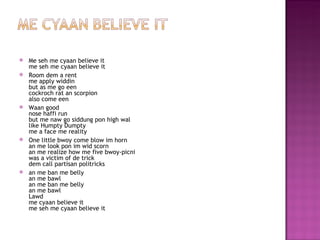
   Me seh me cyaan believe it
    me seh me cyaan believe it
   Room dem a rent
    me apply widdin
    but as me go een
    cockroch rat an scorpion
    also come een
   Waan good
    nose haffi run
    but me naw go siddung pon high wal
    like Humpty Dumpty
    me a face me reality
   One little bwoy come blow im horn
    an me look pon im wid scorn
    an me realize how me five bwoy-picni
    was a victim of de trick
    dem call partisan politricks
   an me ban me belly
    an me bawl
    an me ban me belly
    an me bawl
    Lawd
    me cyaan believe it
    me seh me cyaan believe it
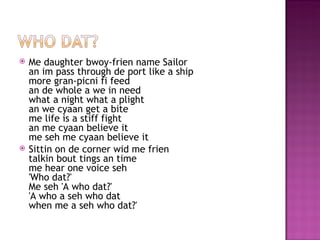
   Me daughter bwoy-frien name Sailor
    an im pass through de port like a ship
    more gran-picni fi feed
    an de whole a we in need
    what a night what a plight
    an we cyaan get a bite
    me life is a stiff fight
    an me cyaan believe it
    me seh me cyaan believe it
   Sittin on de corner wid me frien
    talkin bout tings an time
    me hear one voice seh
    'Who dat?'
    Me seh 'A who dat?'
    'A who a seh who dat
    when me a seh who dat?'
   When yuh teck a stock
    dem lick we dung flat
    teet start fly
    an big man start cry
    an seh me cyaan believe it
    an seh me cyaan believe it
   De odder day
    me a pass one yard pon de hill
    When me teck a stock me hear
    'Hey, bwoy!'
    'Yes, mam?'
    'Hey, bwoy!'
    'Yes, mam!'
    'Yuh clean up de dawg shit?'
    'Yes, mam.'
   An me cyaan believe it
    an seh me cyaan believe it
   Doris a modder of four
    get a wuk as a domestic
    Boss man move een
    an bap si kaisico she pregnant again
    bap si caisico she pregnant again
    an me cyaan believe it
    me seh me cyaan believe it
   Deh a yard de odder night
    when me hear 'Fire!  Fire!'
    'Fire, to plate claat!'
    Who dead?  You dead!
    Who dead?  Me dead!
    Who dead?  Harry dead!
    Who dead?  Eleven dead!
    Woeeeeeeee
    Orange Street fire
    deh pon me head
    an me cyaan believe it
    me seh me cyaan believe it
   Lawd
    me see some blackbud
    livin inna one buildin
    but no rent no pay
    so dem cyaan stay
    Lawd
    de oppress an de dispossess
    cyaan get no res
   What nex?
   Teck a trip from Kingston
    to Jamaica
    Teck twelve from a dozen
    an me see me mumma in heaven
    Madhouse!  Madhouse!
   Me seh me cyaan believe it
    me seh me cyaan believe it
   Yuh believe it?
    How yuh fi believe it
    when yuh laugh
    an yuh blind yuh eye to it?
   But me know yuh believe it
    Lawwwwwwwwd
    me know yuh believe it
   from It A Come, 1986  (13-14)
 What  is effective about this poem?
 Why do you think it’s had a big impact?
 What does it tell us about post-colonial
  identity?
 3][4] He
         worked for the 
  Commonwealth Institute and the BBC in
  London. His awards include the 
  Paul Hamlyn Award for Poetry in 1997 and
  the Cholmondeley Award in 2004. Agard was
  Poet-in-Residence at the 
  National Maritime Museum in 2008. His poem 
  Half Caste has been featured in the AQA
  English GCSE anthology since 2002, meaning
  that many students (aged 14 – 16) have
  studied his work for their GCSE English
  qualification. Agard now lives in Lewes, in 
  East Sussex.
 http://www.youtube.com/watch?v=Ywy-Tthdg7w&featu


 What    do you think of his performance?

 Agard on poetry archive:
 http://www.poetryarchive.org/poetryarchive/singlePoe
 Me  not no Oxford don
 me a simple immigrant
 from Clapham Common
 I didn’t graduate
 I immigrate
 
 But listen Mr Oxford don
 I’m a man on de run
 and a man on de run
 is a dangerous one
  
 I ent have no gun
 I ent have no knife
 but mugging de Queen’s English
 is the story of my life
 
 I dont need no axe
 to split/ up yu syntax
 I dont need no hammer
 to mash/ up yu grammar
 
 I warning you Mr Oxford don
 I’m a wanted man
 and a wanted man
 is a dangerous one
 
 Dem accuse me of assault
 on de Oxford dictionary/
 imagine a concise peaceful man like me/
 dem want me serve time
 for inciting rhyme to riot
 but I rekking it quiet
 down here in Clapham Common
    
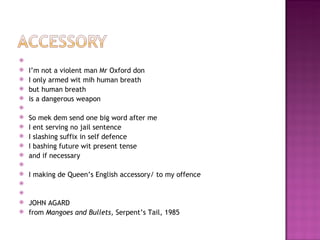
   I’m not a violent man Mr Oxford don
   I only armed wit mih human breath
   but human breath
   is a dangerous weapon
    
   So mek dem send one big word after me
   I ent serving no jail sentence
   I slashing suffix in self defence
   I bashing future wit present tense
   and if necessary
    
   I making de Queen’s English accessory/ to my offence
    
    
   JOHN AGARD
   from Mangoes and Bullets, Serpent’s Tail, 1985
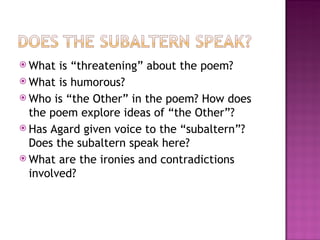
 What  is “threatening” about the poem?
 What is humorous?
 Who is “the Other” in the poem? How does
  the poem explore ideas of “the Other”?
 Has Agard given voice to the “subaltern”?
  Does the subaltern speak here?
 What are the ironies and contradictions
  involved?
 Linton Kwesi Johnson (aka LKJ) (born 24
 August 1952, Chapelton, Jamaica) is a UK-
 based dub poet. He became the second living
 poet, and the only black poet, to be
 published in the Penguin Classics series.[1] His
 poetry involves the recitation of his own
 verse in Jamaican Patois over dub-reggae,
 usually written in collaboration with
 renowned British reggae producer/artist 
 Dennis Bovell. His middle name 'Kwesi' is
 Ghanaian.
 Johnson studied for a degree in sociology at 
  Goldsmiths College in New Cross, London
  (graduating in 1973),[2] which currently holds his
  personal papers in its archives; in 2004 he
  became an Honorary Visiting Professor of 
  Middlesex University in London. In 2005 he was
  awarded a silver Musgrave medal from the
  Institute of Jamaica for distinguished eminence
  in the field of poetry.[3]
 While still at school he joined the British 
  Black Panther Movement,[3] helped to organise a
  poetry workshop within the movement, and
  developed his work with Rasta Love, a group of
  poets and drummers.
 http://www.poetryarchive.org/poetryarchive/singlePoe


 Di Great Insohreckshan:
 http://www.poetryarchive.org/poetryarchive/singlePoe
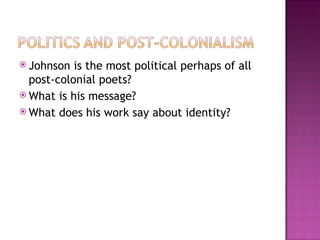
 Johnson  is the most political perhaps of all
  post-colonial poets?
 What is his message?
 What does his work say about identity?
 What  do these poets share in their:
 Attitudes
 Use of poetic form
 Identities?
 Lamming: the myth of English supremacy,
 predicated upon certain cultural assumptions that
 have subjugated colonial subjects…

 Spivak – the impossibility of the subaltern
 “speaking”, making their views known from a
 position of equality; always the “Other”, the
 invisible one…

 Said– the discourses of colonialism have filtered
 into every sphere: science, anthropology, art
 The  myth of supremacy: of a hierarchy of knowledge;
  a right way to do things;
 Codification
 Literary canon; great works of art
 The supremacy of Western approaches to subjects,
  eg scientific, materialistic, religious
 The colonial subject is largely “silenced”, invisible,
  the “Other”,
 The colonial subject is often turned into the
  “exotic”; eg Caribbean tourism
 Or demonised, eg terrorists
 Or pitied, eg charity, Live Aid etc…
 Theeffects of colonialism is far deeper than the
 seizure of land, of political power; colonialism has
 infected the very fabric of people’s identities, both
 the colonialiser and the colonialised.
 Highly problematic studying it;
 Lamming; the solution is to write fiction that
  liberates the subject
 Spivak; there can be no solution, the subaltern can
  never speak; we can only suggest solutions
 Said; we have to use the language of the colonial
  oppressors in order to explore its effects; the
  paradox of this…
 Predominantly   about social class rather than
  ethnicity
 Avoid “essentialism”; there is no innate human
  nature
 Social identity is “constructed” by culture, language,
  upbringing
 Lamming;   the supremacy of fiction as a mode of
  discourse
 Said; there is no “overt” nefarious plot to subjugate;
  using Foucault
 Spivak; a feminist approach
 Make  comparisons and contrasts between
  texts; show off your wider reading…
 TASK: How could you do this?
 Spivak: “Some of the most radical criticism
  coming out of the West today is the result of
  an interested desire to conserve the subject
  of the West, or the West as Subject.”
 The concept of the individual is problematic
  Spivak; we do not have “essential selves”;
  we do not speak; discourses speak through
  us…
   A subject-effect can be briefly plotted as follows:
    that which seems to operate as a subject may be part
    of an immense discontinuous network … of strands
    that may be termed politics, ideology, economics,
    history, sexuality, language, and so on. … Different
    knottings and configurations of these strands,
    determined by heterogeneous determinations which
    are themselves dependent upon myriad
    circumstances, produce the effect of an operating
    subject. Yet the continuist and homogenist
    deliberative consciousness symptomatically requires a
    continuous and homogeneous cause for this effect
    and thus posits a sovereign and determining subject.
   (Gayatri Chakravorty Spivak, “In Other Worlds”)
 The theory of pluralized ‘subject-effects’
 gives an illusion of undermining subjective
 sovereignty while often providing a covered
 this subject of knowledge. Although the
 history of Europe as Subject is narrativized
 by the law, political economy, and the
 ideology of the West, this concealed Subject
 pretends it has ‘no geo-political
 determinations’. The much publicized
 critique of the sovereign subject thus
 inaugurates a Subject…”
 Accordingto Foucault and Deleuze…the
 oppressed, if given the chance…can speak
 and know their conditions…
 Madness and Civilization
 Main article: Madness and Civilization
 The English edition of Madness and Civilization is
  an abridged version of Folie et déraison: Histoire
  de la folie à l'âge classique, originally published
  in 1961. A full English translation titled The
  History of Madness has since been published by 
  Routledge in 2006.[27] "Folie et deraison"
  originated as Foucault's doctoral dissertation;[28]
   this was Foucault's first major book, mostly
  written while he was the Director of the Maison
  de France in Sweden. It examines ideas,
  practices, institutions, art and literature relating
  to madness in Western history.[29]
   Foucault begins his history in the Middle Ages,
    noting the social and physical exclusion of lepers
    .[29] He argues that with the gradual
    disappearance of leprosy, madness came to
    occupy this excluded position. The ship of fools
     in the 15th century is a literary version of one
    such exclusionary practice, namely that of
    sending mad people away in ships. In 17th
    century Europe, in a movement Foucault
    famously calls the "Great Confinement,"
    "unreasonable" members of the population were
    institutionalised.[30] In the 18th century, madness
    came to be seen as the reverse of Reason, and,
    finally, in the 19th century as mental illness.
   Foucault also argues that madness was silenced by
    Reason, losing its power to signify the limits of social
    order and to point to the truth. He examines the rise
    of scientific and "humanitarian" treatments of the
    insane, notably at the hands of Philippe Pinel and 
    Samuel Tuke who he suggests started the
    conceptualization of madness as 'mental illness'. He
    claims that these new treatments were in fact no less
    controlling than previous methods. Pinel's treatment
    of the mad amounted to an extended 
    aversion therapy, including such treatments as
    freezing showers and use of a straitjacket. In
    Foucault's view, this treatment amounted to
    repeated brutality until the pattern of judgment and
    punishment was internalized by the patient.
 Elite: 1. Dominant foreign groups
 Elite: 2. Dominant indigenous groups on all-
  India level.
 3. Dominant indigenous groups at the
  regional and local levels
 4. The terms ‘people’ and ‘subaltern’ classes
  (are) used synonymous throughout. The
  social groups and elements included in this
  category represent the demographic
  difference between the total Indian
  population and all those whome we have
  described as ‘elite’.
 “Forthe ‘true’ subaltern group, whose
 identity is its difference, there is no
 unrepresentable subaltern subject that can
 know and speak itself; the intellectual’s
 solution is no to abstain from representation.
 The problem is that the subject’s itinerary
 has not been traced so as to offern an object
 of seduction to the representing intellectual.
 How can we trouch the consciousness of the
 people, even as we investigate their politics?
 With what voice-consciousness can the
 subaltern speak?
 When  we come to the concomitant question
 of the consciousness of the subaltern, the
 notion of what the work cannot say becomes
 important. In the semioses of the social text,
 elaborations of insurgency stand in the place
 of ‘the utterance’.
   2. Discuss the significance of ‘place’ in Caribbean writing?
 Outstanding   Represents the overall
    achievement of the appropriate learning
    outcomes to an outstanding level. Deep
    understanding of a social and cultural
    studies knowledge base. Complex
    argumentation and evaluation. Deep
    understanding of methodological issues.
    Comparative. Self reflective.

Brainstorm; Order; Link
TASK: Have a go at a plan…
 Small Island            Dragon Can’t Dance
 Realist narrative       Experiments with
 Character-based;         form and language
  examines the            Character-based
  journeys of the         Rebellion and national
  characters               identity are key
 England/Caribbean        themes
 Feminist?               A number of climatic
 Relying on               moments
  “coincidence”           Patriarchal in tone?
 Builds to moments of
  climax
 Race and ‘place’ are
  the main themes
 SECTION   B: English Literature
 Discuss the Victorian sense of Englishness as
  it is conveyed in the writing of the period.
 Why has ‘aristocracy’ been an important idea
  in the writing of the period?
 Consider the treatment of ONE of the
  following in English writing:
 History
 Trade and empire
 Urbanisation
 The ‘Oriental’
 Fairytale quality:
 Unlikely co-incidences
 Queenie  Bligh – what does she represent?
 Changing England?
 Her escape from her confining parents
 Her restrictive relationship with Bernard
 Her liberating sexual experience with a black man,
  Michael Roberts

 Does this play up to stereotypes? Eg uptight, asexual
 Englishman, sexually magnetic, wayward Jamaican
 male.
 Mrs Ryder and Michael
 Page 46, “But every sound made them hug up closer.
  Every gesture drew them together. Until the shadow
  of their heads took the shape of a heart on the
  wall…”
 Leads to the death of Mr Ryder
 The disgrace of Michael
 Illegitimate: indeterminate background
 Ambitious: wants to become a good teacher
 Constructs a new identity for herself based on
  colonial texts
 False vision of England
 Pretentious
 Devious: uses her knowledge of her friend, Celia, to
  stop her marrying Gilbert…
 Puritanical?
 Learns and develops as a character
   Hortense, page 86
 “If a body in its beauty is the work of God, then this
  hideous predicament between his legs was without
  doubt the work of the devil.”
 Gilbert: “There, that is a promise from a gentleman. I
  will sleep on the floor. And tomorrow I will rise early,
  go to the ship and sail to the Mother Country for us
  both. Because, oh, boy, Miss Mucky Foot,’ he shook
  his head slowly back and forth, ‘England will need to
  be prepared for your arrival.’
 Page  118, “An English soldier, a Tommy called Tommy
  Atkins. Skin as pale as sopa, hair slicked with oil and
  shinier than his boots. See him sitting in a pub sipping
  a glass of warming rum and rolling a cigarette from a
  tin. Ask him, ‘Tommy, tell me nah, where is
  Jamaica?’
 And hear him reply, ‘Well, dunno. Africa, ain’t it?’
 Page  131
 ‘You’re British, you say?’
 ‘British. Yes,’ I answered.
 ‘But not English?’
 ‘No. I am from Jamaica but England is my Mother
  Country.’…
 ‘No Britain is Jamaica’s Mother Country. But we are
  all part of the Empire.’
… ‘The British own the island of Jamaica…”
 Page 155, “Rows of black Gis at the back. Rows of
  white Gis at the front.”
 Page 158, “Defence skulls cracked like nutshells as
  panicked black men had nowhere to go but stagger
  towards the furious boots, fists and elbows of the
  white GIs.”
 Page 247, “I felt his leg gently touch his foot. ‘We
 have a bird in Jamaica,’ he said, softly as a bedtime
 story. “A humming-bird – our national bird… A
 humming bird in London. I watched that bird like I see
 an old friend. It looked dowdier in this grey British
 light – no sun to sparkle it up…” And as his hand
 fluttered downward, his fingers delicately caressed
 my hair.”
 Page  431, “Bernard. One day he’ll do something
 naughty and you’ll look at him and think ‘The little
 black bastard, because you’ll be angry. And he’ll see
 it in your eyes. You’ll be angry with him not only for
 that. But because the neighbours never invited you
 around. Because they whispered about you as you
 went by. Because they never though you were as good
 as them. Because they though you and your family
 were odd. And all because you had a coloured child.”
 Page  432, Queenie “I just want him to be with people
 who’ll understand. Can’t you see? His own kind. But
 I’ll do it any way you want to. Any way. But you have
 to say you’ll take him,”
 What  is Levy saying about British and Jamaican
  identity in this novel?
 What characters are most profoundly affected by the
  issue of race?
 What is this novel saying about social class and race?
 What does this novel tell us about the effects of
  Empire and colonialism?
 What makes this a “post-colonial” novel?
 The first phase of the novel develops around
  characters stylised as –
 Queen
 Princess
 Priest
 Warrior
 How does this first phase work?
 The first chapter follows a conversation
 between Miss Olive and Miss Caroline and
 their criticisms of Miss Cleothlida, a proud
 mulatto widow who owns a parlor store but
 runs it as “if she were doing a favour to the
 Hill, rather than carrying on a business from
 which she intend[s] to profit”
 Aldrickis very concerned that Sylvia, 17,
 sexy and dangerous, has the ability to
 “capture him in passion but to enslave him in
 caring, to bring into his world those ideas of
 love and home and children that he [has]
 spent his whole life avoiding”
 Aldrick is in his small room working on his
  dragon costume, which he recreates every
  year for Carnival. While at work, thoughts of
  Sylvia keep coming to his head, when all of a
  sudden she appears at his doorstep.
 TEMPTATION…
 Fisheye becomes the center of the Calvary
 Hill steelband, and as their leader, he
 attempts to unite several bands so that
 instead of fighting one another, they can
 unite and “fight the people who are keeping
 down black people…the government”
 Paraig – the Indian outcast
 In an effort to become noticed by others on
  the Hill, Pariag buys a bicycle a week before
  Carnival, a very exciting time for people on
  the Hill. Pariag’s new acquisition gets him
  the name “Crazy Indian” and makes people
  in the neighborhood nervous about his
  ambitions.
 “No,this ain’t no joke. This is warriors going
 to battle. This is the guts of the people, their
 blood” (123). Aldrick becomes the dragon of
 Port of Spain for two full days. He feels joy
 when he sees terror in people’s faces after
 gazing at him: “he liked it when they saw
 him coming and gathering up their children
 and ran”
 Aldrickwakse and sees the “pathetic and
 ridiculous looking shacks planted in this
 brown dirt and stone, this was his home”.
 Paraig’suncle criticising his decision to live
 in the city. “Is so you want to live, among
 Creole people, like cat and dog, and forget
 your family. You have family boy. Next thing
 you know, you leave your wife – who you
 didn’t bring to see me"
 MissCleothilda becomes giving and
 inquisitive around the yard and shows off the
 belief that “all o’ we is one” when Dolly
 becomes pregnant and she leads her baby
 shower
 Aldrick,Fisheye and a few other young
 men have begun assembling at the corner
 more and more, not in the same
 company, but occupying the same space.
 They are men that no longer partake in
 carnival, especially since Johnson and
 Fullers began sponsoring their steelband.
 For them, the true renegade spirit of
 masking as timeless warriors of
 generations past has become overrun by
 modern forces like business and tourism.
 They go to Woodford Square, the political
 centre of Port of Spain, where speeches and
 rallies are always held. Over the megaphone
 they proclaimed “This is the People’s
 Liberation Army” 40. At one point Aldrick
 takes the microphone and says: “make no
 peace with slavery…make no peace with
 shanty towns, dog shit, piss. We have to rise
 up as people. People”.
 Argumentation:   explore different
  viewpoints; argument and counter-
  argument
 TASK: Write TWO or THREE arguments and
  counter-arguments about Small
  Island/Dragon Can’t Dance…
 Evaluation; make informed judgements,
  based on evidence, about the
  effectiveness of the books
 TASK: evaluate the effectiveness of
  chosen text…
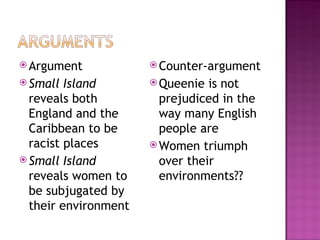
 Argument             Counter-argument
 Small  Island        Queenie  is not
  reveals both          prejudiced in the
  England and the       way many English
  Caribbean to be       people are
  racist places        Women triumph
 Small Island          over their
  reveals women to      environments??
  be subjugated by
  their environment
 Applying   theories…
 Reflect
        upon what you have learned, develop
 a personal response…
 Please
       give some feedback on this session
 and anything else you want to say…

Nation states revision

  • 1.
  • 2.
    25–39 Fail Represents an overall failure to  70–79 Excellent Represents the overall achieve the appropriate learning outcomes. achievement of the appropriate learning A limited understanding of a social and outcomes to an excellent cultural studies knowledge base. Limited argumentation; little evaluation.  level. Full understanding of a social and cultural studies knowledge base. Complex argumentation and evaluation.  40–49 Pass Represents the overall Understanding of methodological issues. Comparative. Self reflective. achievement of the majority of the appropriate learning outcomes to a pass level. A limited understanding of a social and cultural studies knowledge base. Some  80–89 Outstanding Represents the overall argumentation; limited evaluation. achievement of the appropriate learning outcomes to an outstanding level. Deep understanding of a social and cultural  50–59 Good Represents the overall studies knowledge base. Complex argumentation and evaluation. Deep achievement of the appropriate learning understanding of methodological issues. outcomes to a good level. Understanding of Comparative. Self reflective. a social and cultural studies knowledge base. Clear argumentation and evaluation.Understanding of methodological issues.  90–100 Exceptional Represents the overall achievement of the appropriate learning outcomes to an exceptionally accomplished level.  60–69 Very good Represents the overall achievement of the appropriate learning outcomes to a very good  level. Full understanding of a social and  cultural studies knowledge base. Complex argumentation and evaluation.Understanding of  methodological issues.
  • 3.
    SECTION A: Caribbean Literature  SECTION C: Irish Literature in English  Why has the idea of a national language  7. Why has ‘revivalism’ been so been problematic for Caribbean writing? important to Irish writers?  2. Discuss the significance of ‘place’ in  In what ways has Irish writing of the Caribbean writing? period been ‘political’?  3. Examine the treatment of ONE of the  following in Caribbean writing: Empire;  Consider the treatment of ONE of the The USA; The idea of rebellion; Race following in Irish writing:  (a) the land  SECTION B: English Literature  (b) the ‘Troubles’  Discuss the Victorian sense of Englishness  (c) Irish mythology as it is conveyed in the writing of the period.  (d) the English  5. Why has ‘aristocracy’ been an important idea in the writing of the period?  Consider the treatment of ONE of the following in English writing:  History  Trade and empire  Urbanisation  The ‘Oriental’
  • 4.
  • 5.
    Michael Smith, usually referred to as Mikey Smith (14 September 1954 - 17 August 1983), was a Jamaican dub poet.[1] Along with Linton Kwesi Johnson, and  Mutabaruka, he was one of the most well-known dub poets. In 1978, Michael Smith represented Jamaica at the 11th World Festival of Youth and Students in Cuba. His album Mi Cyaan Believe It includes his best known poem of the same name. He had left-anarchist leanings and Rastafarian sympathies. Smith was allegedly murdered by political opponents associated with the right-wing Jamaica Labour Party after heckling the Jamaican Minister of Culture at a political rally on August 17, 1983.  Smith was educated at Kingston College and the St George's College Extension School. He also studied at the Jamaican School of Drama with Jean 'Binta' Breeze  and Oku Onuora. Linton Kwesi Johnson released some of Smith’s work on his LKJ label. Smith appeared on the BBC television series Ebony and the BBC also broadcast a documentary based on his association with Johnson. "Mi Cyaan Believe It" is most remembered for Smith’s heartfelt phrase "Laaawwwd - mi cyaan believe it - mi seh - mi cyaan believe it". In 1982, Smith released his debut album and performed extensively in Europe supporting such acts as Gregory Isaacs. Smith recorded a session for John Peel which was broadcast by the BBC on 4 May 1982. [2] He continued to work as a social worker representing prisoners in Gun Court. His outspoken commentary on the “isms and schisms of ‘politricks”’ in Jamaica led to his life being cut short. Michael Smith was stoned to death following a clash at a political rally, which sadly occurred on Marcus Garvey's birthday.
  • 6.
    Linton Kwesi Johnson, during a presentation on Smith’s life and work at the second Caribbean Conference on Culture at the University of the West Indies Mona Campus, had the following to say about him: “The late Jamaican poet, Michael Smith, was to my mind one of the most interesting and original poetic voices to emerge from the English-speaking Caribbean during the last quarter of the 20th century". [3]  Linton Kwesi Johnson, who produced Smith's first and only album in London, also wrote the following in an article for the Jamaica Observer: "In 1978, Michael Smith represented Jamaica at the 11th World Festival of Youth and Students in Cuba. That year, saw the release of his first recording, a single titled, "Word", followed by perhaps his most famous piece "Mi Cyaan Believe It" and "Roots".  In 1981, he performed in Barbados during CARIFESTA and was filmed by BBC Television performing "Mi Cyaan Believe It" for the documentary From Brixton To Barbados.  In 1982, Smith took London by storm with performances at the Campden Centre for "International Book Fair of Radical Blacks and Third World books". And also at Lambeth Town Hall in Brixton for "Creation for Liberation".  While in Britain, together with Oku Onoura, Michael Smith also did a successful poetry tour and recorded the Mi Cyaan Believe It album for Island Records.  Linton Kwesi Johnson recalled how the circumstances of Smith's death was shrouded in controversy…  As far as I understand the facts, Mikey had attended a political meeting in Stony Hill where the ruling JLP Minister of Education was speaking and [he] had heckled her. The following day, he was confronted by three [persons believed to be] party activists, an argument ensued, stones were thrown and Mikey died from a blow to his head."
  • 7.
  • 8.
    Me seh me cyaan believe it me seh me cyaan believe it  Room dem a rent me apply widdin but as me go een cockroch rat an scorpion also come een  Waan good nose haffi run but me naw go siddung pon high wal like Humpty Dumpty me a face me reality  One little bwoy come blow im horn an me look pon im wid scorn an me realize how me five bwoy-picni was a victim of de trick dem call partisan politricks  an me ban me belly an me bawl an me ban me belly an me bawl Lawd me cyaan believe it me seh me cyaan believe it
  • 9.
    Me daughter bwoy-frien name Sailor an im pass through de port like a ship more gran-picni fi feed an de whole a we in need what a night what a plight an we cyaan get a bite me life is a stiff fight an me cyaan believe it me seh me cyaan believe it  Sittin on de corner wid me frien talkin bout tings an time me hear one voice seh 'Who dat?' Me seh 'A who dat?' 'A who a seh who dat when me a seh who dat?'
  • 10.
    When yuh teck a stock dem lick we dung flat teet start fly an big man start cry an seh me cyaan believe it an seh me cyaan believe it  De odder day me a pass one yard pon de hill When me teck a stock me hear 'Hey, bwoy!' 'Yes, mam?' 'Hey, bwoy!' 'Yes, mam!' 'Yuh clean up de dawg shit?' 'Yes, mam.'  An me cyaan believe it an seh me cyaan believe it  Doris a modder of four get a wuk as a domestic Boss man move een an bap si kaisico she pregnant again bap si caisico she pregnant again an me cyaan believe it me seh me cyaan believe it
  • 11.
    Deh a yard de odder night when me hear 'Fire!  Fire!' 'Fire, to plate claat!' Who dead?  You dead! Who dead?  Me dead! Who dead?  Harry dead! Who dead?  Eleven dead! Woeeeeeeee Orange Street fire deh pon me head an me cyaan believe it me seh me cyaan believe it  Lawd me see some blackbud livin inna one buildin but no rent no pay so dem cyaan stay Lawd de oppress an de dispossess cyaan get no res
  • 12.
    What nex?  Teck a trip from Kingston to Jamaica Teck twelve from a dozen an me see me mumma in heaven Madhouse!  Madhouse!  Me seh me cyaan believe it me seh me cyaan believe it  Yuh believe it? How yuh fi believe it when yuh laugh an yuh blind yuh eye to it?  But me know yuh believe it Lawwwwwwwwd me know yuh believe it  from It A Come, 1986  (13-14)
  • 13.
     What is effective about this poem?  Why do you think it’s had a big impact?  What does it tell us about post-colonial identity?
  • 14.
     3][4] He worked for the  Commonwealth Institute and the BBC in London. His awards include the  Paul Hamlyn Award for Poetry in 1997 and the Cholmondeley Award in 2004. Agard was Poet-in-Residence at the  National Maritime Museum in 2008. His poem  Half Caste has been featured in the AQA English GCSE anthology since 2002, meaning that many students (aged 14 – 16) have studied his work for their GCSE English qualification. Agard now lives in Lewes, in  East Sussex.
  • 15.
     http://www.youtube.com/watch?v=Ywy-Tthdg7w&featu  What do you think of his performance?  Agard on poetry archive:  http://www.poetryarchive.org/poetryarchive/singlePoe
  • 16.
     Me not no Oxford don  me a simple immigrant  from Clapham Common  I didn’t graduate  I immigrate    But listen Mr Oxford don  I’m a man on de run  and a man on de run  is a dangerous one
  • 17.
        Ient have no gun  I ent have no knife  but mugging de Queen’s English  is the story of my life    I dont need no axe  to split/ up yu syntax  I dont need no hammer  to mash/ up yu grammar  
  • 18.
     I warningyou Mr Oxford don  I’m a wanted man  and a wanted man  is a dangerous one    Dem accuse me of assault  on de Oxford dictionary/  imagine a concise peaceful man like me/  dem want me serve time  for inciting rhyme to riot  but I rekking it quiet  down here in Clapham Common
  • 19.
       I’m not a violent man Mr Oxford don  I only armed wit mih human breath  but human breath  is a dangerous weapon     So mek dem send one big word after me  I ent serving no jail sentence  I slashing suffix in self defence  I bashing future wit present tense  and if necessary     I making de Queen’s English accessory/ to my offence        JOHN AGARD  from Mangoes and Bullets, Serpent’s Tail, 1985
  • 20.
     What is “threatening” about the poem?  What is humorous?  Who is “the Other” in the poem? How does the poem explore ideas of “the Other”?  Has Agard given voice to the “subaltern”? Does the subaltern speak here?  What are the ironies and contradictions involved?
  • 21.
     Linton KwesiJohnson (aka LKJ) (born 24 August 1952, Chapelton, Jamaica) is a UK- based dub poet. He became the second living poet, and the only black poet, to be published in the Penguin Classics series.[1] His poetry involves the recitation of his own verse in Jamaican Patois over dub-reggae, usually written in collaboration with renowned British reggae producer/artist  Dennis Bovell. His middle name 'Kwesi' is Ghanaian.
  • 22.
     Johnson studiedfor a degree in sociology at  Goldsmiths College in New Cross, London (graduating in 1973),[2] which currently holds his personal papers in its archives; in 2004 he became an Honorary Visiting Professor of  Middlesex University in London. In 2005 he was awarded a silver Musgrave medal from the Institute of Jamaica for distinguished eminence in the field of poetry.[3]  While still at school he joined the British  Black Panther Movement,[3] helped to organise a poetry workshop within the movement, and developed his work with Rasta Love, a group of poets and drummers.
  • 23.
     http://www.poetryarchive.org/poetryarchive/singlePoe  DiGreat Insohreckshan:  http://www.poetryarchive.org/poetryarchive/singlePoe
  • 24.
     Johnson is the most political perhaps of all post-colonial poets?  What is his message?  What does his work say about identity?
  • 25.
     What do these poets share in their:  Attitudes  Use of poetic form  Identities?
  • 26.
     Lamming: themyth of English supremacy, predicated upon certain cultural assumptions that have subjugated colonial subjects…  Spivak – the impossibility of the subaltern “speaking”, making their views known from a position of equality; always the “Other”, the invisible one…  Said– the discourses of colonialism have filtered into every sphere: science, anthropology, art
  • 27.
     The myth of supremacy: of a hierarchy of knowledge; a right way to do things;  Codification  Literary canon; great works of art  The supremacy of Western approaches to subjects, eg scientific, materialistic, religious
  • 28.
     The colonialsubject is largely “silenced”, invisible, the “Other”,  The colonial subject is often turned into the “exotic”; eg Caribbean tourism  Or demonised, eg terrorists  Or pitied, eg charity, Live Aid etc…
  • 29.
     Theeffects ofcolonialism is far deeper than the seizure of land, of political power; colonialism has infected the very fabric of people’s identities, both the colonialiser and the colonialised.
  • 30.
     Highly problematicstudying it;  Lamming; the solution is to write fiction that liberates the subject  Spivak; there can be no solution, the subaltern can never speak; we can only suggest solutions  Said; we have to use the language of the colonial oppressors in order to explore its effects; the paradox of this…
  • 31.
     Predominantly about social class rather than ethnicity  Avoid “essentialism”; there is no innate human nature  Social identity is “constructed” by culture, language, upbringing
  • 32.
     Lamming; the supremacy of fiction as a mode of discourse  Said; there is no “overt” nefarious plot to subjugate; using Foucault  Spivak; a feminist approach
  • 33.
     Make comparisons and contrasts between texts; show off your wider reading…  TASK: How could you do this?
  • 34.
     Spivak: “Someof the most radical criticism coming out of the West today is the result of an interested desire to conserve the subject of the West, or the West as Subject.”  The concept of the individual is problematic Spivak; we do not have “essential selves”; we do not speak; discourses speak through us…
  • 35.
    A subject-effect can be briefly plotted as follows: that which seems to operate as a subject may be part of an immense discontinuous network … of strands that may be termed politics, ideology, economics, history, sexuality, language, and so on. … Different knottings and configurations of these strands, determined by heterogeneous determinations which are themselves dependent upon myriad circumstances, produce the effect of an operating subject. Yet the continuist and homogenist deliberative consciousness symptomatically requires a continuous and homogeneous cause for this effect and thus posits a sovereign and determining subject.  (Gayatri Chakravorty Spivak, “In Other Worlds”)
  • 36.
     The theoryof pluralized ‘subject-effects’ gives an illusion of undermining subjective sovereignty while often providing a covered this subject of knowledge. Although the history of Europe as Subject is narrativized by the law, political economy, and the ideology of the West, this concealed Subject pretends it has ‘no geo-political determinations’. The much publicized critique of the sovereign subject thus inaugurates a Subject…”
  • 37.
     Accordingto Foucaultand Deleuze…the oppressed, if given the chance…can speak and know their conditions…
  • 38.
     Madness andCivilization  Main article: Madness and Civilization  The English edition of Madness and Civilization is an abridged version of Folie et déraison: Histoire de la folie à l'âge classique, originally published in 1961. A full English translation titled The History of Madness has since been published by  Routledge in 2006.[27] "Folie et deraison" originated as Foucault's doctoral dissertation;[28]  this was Foucault's first major book, mostly written while he was the Director of the Maison de France in Sweden. It examines ideas, practices, institutions, art and literature relating to madness in Western history.[29]
  • 39.
    Foucault begins his history in the Middle Ages, noting the social and physical exclusion of lepers .[29] He argues that with the gradual disappearance of leprosy, madness came to occupy this excluded position. The ship of fools  in the 15th century is a literary version of one such exclusionary practice, namely that of sending mad people away in ships. In 17th century Europe, in a movement Foucault famously calls the "Great Confinement," "unreasonable" members of the population were institutionalised.[30] In the 18th century, madness came to be seen as the reverse of Reason, and, finally, in the 19th century as mental illness.
  • 40.
    Foucault also argues that madness was silenced by Reason, losing its power to signify the limits of social order and to point to the truth. He examines the rise of scientific and "humanitarian" treatments of the insane, notably at the hands of Philippe Pinel and  Samuel Tuke who he suggests started the conceptualization of madness as 'mental illness'. He claims that these new treatments were in fact no less controlling than previous methods. Pinel's treatment of the mad amounted to an extended  aversion therapy, including such treatments as freezing showers and use of a straitjacket. In Foucault's view, this treatment amounted to repeated brutality until the pattern of judgment and punishment was internalized by the patient.
  • 41.
     Elite: 1.Dominant foreign groups  Elite: 2. Dominant indigenous groups on all- India level.  3. Dominant indigenous groups at the regional and local levels  4. The terms ‘people’ and ‘subaltern’ classes (are) used synonymous throughout. The social groups and elements included in this category represent the demographic difference between the total Indian population and all those whome we have described as ‘elite’.
  • 42.
     “Forthe ‘true’subaltern group, whose identity is its difference, there is no unrepresentable subaltern subject that can know and speak itself; the intellectual’s solution is no to abstain from representation. The problem is that the subject’s itinerary has not been traced so as to offern an object of seduction to the representing intellectual.
  • 43.
     How canwe trouch the consciousness of the people, even as we investigate their politics? With what voice-consciousness can the subaltern speak?
  • 44.
     When we come to the concomitant question of the consciousness of the subaltern, the notion of what the work cannot say becomes important. In the semioses of the social text, elaborations of insurgency stand in the place of ‘the utterance’.
  • 45.
    2. Discuss the significance of ‘place’ in Caribbean writing?  Outstanding Represents the overall achievement of the appropriate learning outcomes to an outstanding level. Deep understanding of a social and cultural studies knowledge base. Complex argumentation and evaluation. Deep understanding of methodological issues. Comparative. Self reflective. Brainstorm; Order; Link TASK: Have a go at a plan…
  • 46.
     Small Island  Dragon Can’t Dance  Realist narrative  Experiments with  Character-based; form and language examines the  Character-based journeys of the  Rebellion and national characters identity are key  England/Caribbean themes  Feminist?  A number of climatic  Relying on moments “coincidence”  Patriarchal in tone?  Builds to moments of climax  Race and ‘place’ are the main themes
  • 47.
     SECTION B: English Literature  Discuss the Victorian sense of Englishness as it is conveyed in the writing of the period.  Why has ‘aristocracy’ been an important idea in the writing of the period?  Consider the treatment of ONE of the following in English writing:  History  Trade and empire  Urbanisation  The ‘Oriental’
  • 48.
     Fairytale quality: Unlikely co-incidences
  • 49.
     Queenie Bligh – what does she represent?  Changing England?  Her escape from her confining parents  Her restrictive relationship with Bernard  Her liberating sexual experience with a black man, Michael Roberts  Does this play up to stereotypes? Eg uptight, asexual Englishman, sexually magnetic, wayward Jamaican male.
  • 50.
     Mrs Ryderand Michael  Page 46, “But every sound made them hug up closer. Every gesture drew them together. Until the shadow of their heads took the shape of a heart on the wall…”  Leads to the death of Mr Ryder  The disgrace of Michael
  • 51.
     Illegitimate: indeterminatebackground  Ambitious: wants to become a good teacher  Constructs a new identity for herself based on colonial texts  False vision of England  Pretentious  Devious: uses her knowledge of her friend, Celia, to stop her marrying Gilbert…  Puritanical?  Learns and develops as a character
  • 52.
    Hortense, page 86  “If a body in its beauty is the work of God, then this hideous predicament between his legs was without doubt the work of the devil.”  Gilbert: “There, that is a promise from a gentleman. I will sleep on the floor. And tomorrow I will rise early, go to the ship and sail to the Mother Country for us both. Because, oh, boy, Miss Mucky Foot,’ he shook his head slowly back and forth, ‘England will need to be prepared for your arrival.’
  • 53.
     Page 118, “An English soldier, a Tommy called Tommy Atkins. Skin as pale as sopa, hair slicked with oil and shinier than his boots. See him sitting in a pub sipping a glass of warming rum and rolling a cigarette from a tin. Ask him, ‘Tommy, tell me nah, where is Jamaica?’  And hear him reply, ‘Well, dunno. Africa, ain’t it?’
  • 54.
     Page 131  ‘You’re British, you say?’  ‘British. Yes,’ I answered.  ‘But not English?’  ‘No. I am from Jamaica but England is my Mother Country.’…  ‘No Britain is Jamaica’s Mother Country. But we are all part of the Empire.’ … ‘The British own the island of Jamaica…”
  • 55.
     Page 155,“Rows of black Gis at the back. Rows of white Gis at the front.”  Page 158, “Defence skulls cracked like nutshells as panicked black men had nowhere to go but stagger towards the furious boots, fists and elbows of the white GIs.”
  • 56.
     Page 247,“I felt his leg gently touch his foot. ‘We have a bird in Jamaica,’ he said, softly as a bedtime story. “A humming-bird – our national bird… A humming bird in London. I watched that bird like I see an old friend. It looked dowdier in this grey British light – no sun to sparkle it up…” And as his hand fluttered downward, his fingers delicately caressed my hair.”
  • 57.
     Page 431, “Bernard. One day he’ll do something naughty and you’ll look at him and think ‘The little black bastard, because you’ll be angry. And he’ll see it in your eyes. You’ll be angry with him not only for that. But because the neighbours never invited you around. Because they whispered about you as you went by. Because they never though you were as good as them. Because they though you and your family were odd. And all because you had a coloured child.”  Page 432, Queenie “I just want him to be with people who’ll understand. Can’t you see? His own kind. But I’ll do it any way you want to. Any way. But you have to say you’ll take him,”
  • 58.
     What is Levy saying about British and Jamaican identity in this novel?  What characters are most profoundly affected by the issue of race?  What is this novel saying about social class and race?  What does this novel tell us about the effects of Empire and colonialism?  What makes this a “post-colonial” novel?
  • 59.
     The firstphase of the novel develops around characters stylised as –  Queen  Princess  Priest  Warrior  How does this first phase work?
  • 60.
     The firstchapter follows a conversation between Miss Olive and Miss Caroline and their criticisms of Miss Cleothlida, a proud mulatto widow who owns a parlor store but runs it as “if she were doing a favour to the Hill, rather than carrying on a business from which she intend[s] to profit”
  • 61.
     Aldrickis veryconcerned that Sylvia, 17, sexy and dangerous, has the ability to “capture him in passion but to enslave him in caring, to bring into his world those ideas of love and home and children that he [has] spent his whole life avoiding”
  • 62.
     Aldrick isin his small room working on his dragon costume, which he recreates every year for Carnival. While at work, thoughts of Sylvia keep coming to his head, when all of a sudden she appears at his doorstep.  TEMPTATION…
  • 63.
     Fisheye becomesthe center of the Calvary Hill steelband, and as their leader, he attempts to unite several bands so that instead of fighting one another, they can unite and “fight the people who are keeping down black people…the government”
  • 64.
     Paraig –the Indian outcast  In an effort to become noticed by others on the Hill, Pariag buys a bicycle a week before Carnival, a very exciting time for people on the Hill. Pariag’s new acquisition gets him the name “Crazy Indian” and makes people in the neighborhood nervous about his ambitions.
  • 65.
     “No,this ain’tno joke. This is warriors going to battle. This is the guts of the people, their blood” (123). Aldrick becomes the dragon of Port of Spain for two full days. He feels joy when he sees terror in people’s faces after gazing at him: “he liked it when they saw him coming and gathering up their children and ran”
  • 66.
     Aldrickwakse andsees the “pathetic and ridiculous looking shacks planted in this brown dirt and stone, this was his home”.
  • 67.
     Paraig’suncle criticisinghis decision to live in the city. “Is so you want to live, among Creole people, like cat and dog, and forget your family. You have family boy. Next thing you know, you leave your wife – who you didn’t bring to see me"
  • 68.
     MissCleothilda becomesgiving and inquisitive around the yard and shows off the belief that “all o’ we is one” when Dolly becomes pregnant and she leads her baby shower
  • 69.
     Aldrick,Fisheye anda few other young men have begun assembling at the corner more and more, not in the same company, but occupying the same space. They are men that no longer partake in carnival, especially since Johnson and Fullers began sponsoring their steelband. For them, the true renegade spirit of masking as timeless warriors of generations past has become overrun by modern forces like business and tourism.
  • 70.
     They goto Woodford Square, the political centre of Port of Spain, where speeches and rallies are always held. Over the megaphone they proclaimed “This is the People’s Liberation Army” 40. At one point Aldrick takes the microphone and says: “make no peace with slavery…make no peace with shanty towns, dog shit, piss. We have to rise up as people. People”.
  • 71.
     Argumentation: explore different viewpoints; argument and counter- argument  TASK: Write TWO or THREE arguments and counter-arguments about Small Island/Dragon Can’t Dance…  Evaluation; make informed judgements, based on evidence, about the effectiveness of the books  TASK: evaluate the effectiveness of chosen text…
  • 72.
     Argument  Counter-argument  Small Island  Queenie is not reveals both prejudiced in the England and the way many English Caribbean to be people are racist places  Women triumph  Small Island over their reveals women to environments?? be subjugated by their environment
  • 73.
     Applying theories…
  • 74.
     Reflect upon what you have learned, develop a personal response…
  • 75.
     Please give some feedback on this session and anything else you want to say…