NOMBRE: GALO RENDÒN S.
MATERIA: LISTENING AND SPEAKING I
CENTRO UNIVERSITARIO: MACHALA
FECHA: 10 de Noviembre 2010

                                            UNIT 1

Listen for main ideas, page 6

    CD1(4) Listen to the conversation between Nina and Rick. Read sentences.
      Write T true or F false

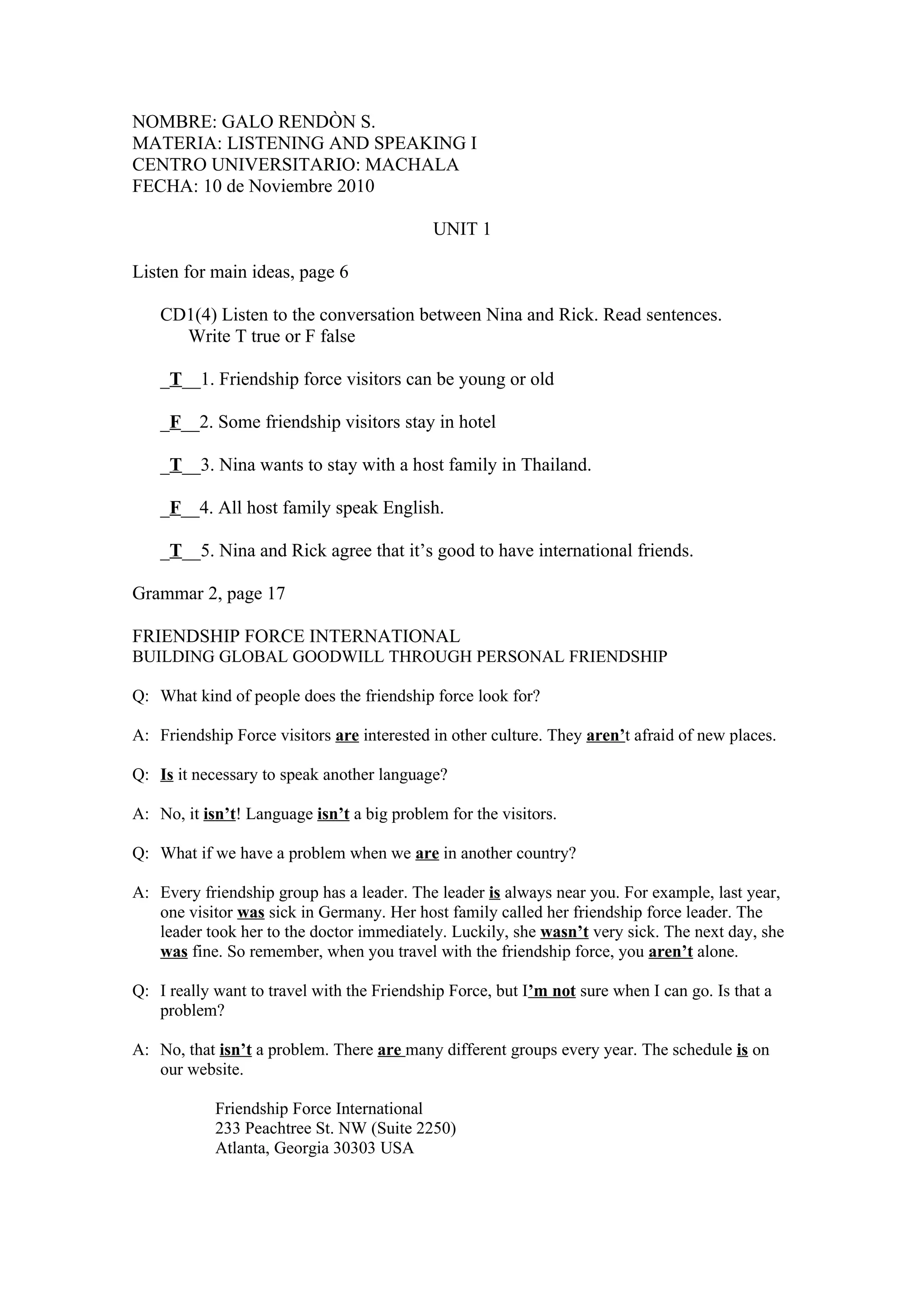
    _T__1. Friendship force visitors can be young or old

    _F__2. Some friendship visitors stay in hotel

    _T__3. Nina wants to stay with a host family in Thailand.

    _F__4. All host family speak English.

    _T__5. Nina and Rick agree that it’s good to have international friends.

Grammar 2, page 17

FRIENDSHIP FORCE INTERNATIONAL
BUILDING GLOBAL GOODWILL THROUGH PERSONAL FRIENDSHIP

Q: What kind of people does the friendship force look for?

A: Friendship Force visitors are interested in other culture. They aren’t afraid of new places.

Q: Is it necessary to speak another language?

A: No, it isn’t! Language isn’t a big problem for the visitors.

Q: What if we have a problem when we are in another country?

A: Every friendship group has a leader. The leader is always near you. For example, last year,
   one visitor was sick in Germany. Her host family called her friendship force leader. The
   leader took her to the doctor immediately. Luckily, she wasn’t very sick. The next day, she
   was fine. So remember, when you travel with the friendship force, you aren’t alone.

Q: I really want to travel with the Friendship Force, but I’m not sure when I can go. Is that a
   problem?

A: No, that isn’t a problem. There are many different groups every year. The schedule is on
   our website.

            Friendship Force International
            233 Peachtree St. NW (Suite 2250)
            Atlanta, Georgia 30303 USA
UNIT 2

Listening two, pages 29-30
LISTENING TWO: The Quilts of Gee’s bend

Gee’s Bend is the name of the small town in Alabama. The women of Gee’s Bend are famous
for their quilts. They use old materials to make beautiful quilts.

Listen to the radio broadcast about the women in a town called Gee’s Bend.
Then complete the outline with the information you hear. Circle the correct answer.

.
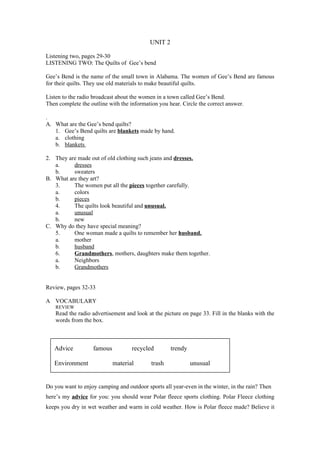
A. What are the Gee’s bend quilts?
   1. Gee’s Bend quilts are blankets made by hand.
   a. clothing
   b. blankets

2. They are made out of old clothing such jeans and dresses.
   a.     dresses
   b.     sweaters
B. What are they art?
   3.     The women put all the pieces together carefully.
   a.     colors
   b.     pieces
   4.     The quilts look beautiful and unusual.
   a.     unusual
   b.     new
C. Why do they have special meaning?
   5.     One woman made a quilts to remember her husband.
   a.     mother
   b.     husband
   6.     Grandmothers, mothers, daughters make them together.
   a.     Neighbors
   b.     Grandmothers


Review, pages 32-33

A VOCABULARY
    REVIEW
    Read the radio advertisement and look at the picture on page 33. Fill in the blanks with the
    words from the box.


   Advice          famous           recycled        trendy

   Environment              material        trash            unusual


Do you want to enjoy camping and outdoor sports all year-even in the winter, in the rain? Then
here’s my advice for you: you should wear Polar fleece sports clothing. Polar Fleece clothing
keeps you dry in wet weather and warm in cold weather. How is Polar fleece made? Believe it
or not, Polar Fleece clothing is made out of recycled plastic bottles! Recycled bottles go to a big
factory. Machines at the factory clean the bottles, cut them into small pieces, and heat them. The
bottles melt and become a liquid, like water. Then, another machine changes the liquid into a
material that looks like wool. This wool is called Polar Fleece! This unusual material is
comfortable and very warm. You can buy Polar Fleece winter clothes in many styles, so you
will always look trendy! Polar Fleece also reduces trash because it is made out of recycled
plastic bottles. So it helps the environment. Today, the name Polar Fleece is famous all over
the world.

Pronunciation 3b, page 38

b. Work with a partner and check the stressed syllables in part a. then look at boldfaced words
   and answer the questions bellow.

    1. Which words are nouns? Write them on the line.
        Clothing, music, question, pocket, garage, sister, student, parents, advice, fashion.

    2. Which words are verbs? Write them on the line.
       Listen, answer, agree, decide, believe, design, invite, visit, study.

    3. Circle the best answer for the rules below.
           a. (Most / A few) two-syllables nouns are stressed on the first syllable.
           b. (Most / about half of ) two-syllable verbs are stressed on the second syllable.


                                       ESSAY PART
                                             UNIT 3

Background and vocabulary 3, page 48
Pronunciation 2, page 59

Write each word or phrase from the box next to its definition.


     Great           melody                               played               rhymed
     In the 70s      musical instruments                  poor                 rhythm
     Just            neighborhoods                        popular              slang

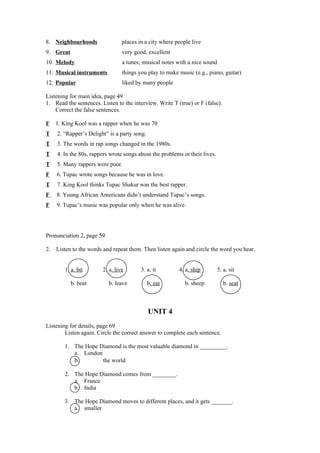
1. In the 70s                   from 1970 to 1979
2. Rhythm                       the beat; the tempo; regular sounds in music
3. Slang                        informal language (i.e., among friends)
4. Just                         a short time ago
5. Played                       made music (with an instrument, CD, radio, etc)
6. Rhymed                       had the same ending sound (e. g., walk/talk)
7. Poor                         with very little money
8. Neighbourhoods                places in a city where people live
9. Great                         very good, excellent
10. Melody                       a tunes; musical notes with a nice sound
11. Musical instruments          things you play to make music (e.g., piano, guitar)
12. Popular                      liked by many people

Listening for main idea, page 49
1. Read the sentences. Listen to the interview. Write T (true) or F (false).
    Correct the false sentences.

F    1. King Kool was a rapper when he was 70
T    2. “Rapper’s Delight” is a party song.
T    3. The words in rap songs changed in the 1980s.
T    4. In the 80s, rappers wrote songs about the problems in their lives.
T    5. Many rappers were poor.
F    6. Tupac wrote songs because he was in love.
T    7. King Kool thinks Tupac Shakur was the best rapper.
F    8. Young African Americans didn’t understand Tupac’s songs.
F    9. Tupac’s music was popular only when he was alive.


Pronunciation 2, page 59

2.   Listen to the words and repeat them. Then listen again and circle the word you hear.


        1. a. bit       2. a. live       3. a. it        4. a. ship          5. a. sit

           b. beat         b. leave           b. eat        b. sheep            b. seat


                                              UNIT 4
Listening for details, page 69
        Listen again. Circle the correct answer to complete each sentence.

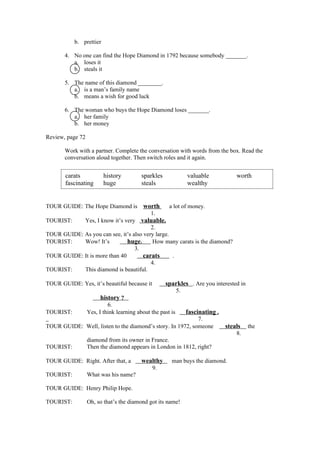
        1. The Hope Diamond is the most valuable diamond in _________.
           a. London
           b.        the world

        2. The Hope Diamond comes from ________.
           a. France
           b. India

        3. The Hope Diamond moves to different places, and it gets _______.
           a. smaller
b. prettier

       4. No one can find the Hope Diamond in 1792 because somebody _______.
          a. loses it
          b. steals it

       5. The name of this diamond ________.
          a. is a man’s family name
          b. means a wish for good luck

       6. The woman who buys the Hope Diamond loses _______.
          a. her family
          b. her money

Review, page 72

       Work with a partner. Complete the conversation with words from the box. Read the
       conversation aloud together. Then switch roles and it again.


       carats            history          sparkles               valuable            worth
       fascinating       huge             steals                 wealthy


TOUR GUIDE: The Hope Diamond is           worth       a lot of money.
                                              1.
TOURIST:       Yes, I know it’s very     valuable.
                                         2.
TOUR GUIDE: As you can see, it’s also very large.
TOURIST:    Wow! It’s          huge.      How many carats is the diamond?
                                  3.
TOUR GUIDE: It is more than 40        carats      .
                                         4.
TOURIST:    This diamond is beautiful.

TOUR GUIDE: Yes, it’s beautiful because it           sparkles . Are you interested in
                                                            5.
                       history ?
                           6.
TOURIST:          Yes, I think learning about the past is        fascinating .
                                                            7.
TOUR GUIDE: Well, listen to the diamond’s story. In 1972, someone                steals   the
                                                                                     8.
                  diamond from its owner in France.
TOURIST:          Then the diamond appears in London in 1812, right?

TOUR GUIDE: Right. After that, a          wealthy      man buys the diamond.
                                              9.
TOURIST:          What was his name?

TOUR GUIDE: Henry Philip Hope.

TOURIST:          Oh, so that’s the diamond got its name!
UNIT 5

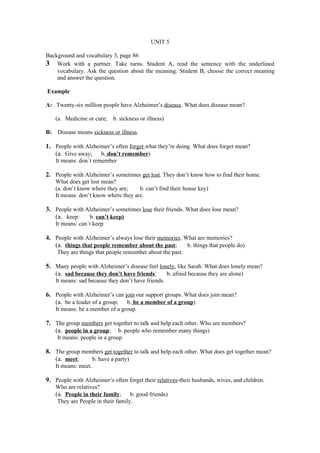
Background and vocabulary 3, page 86
3 Work with a partner. Take turns. Student A, read the sentence with the underlined
    vocabulary. Ask the question about the meaning. Student B, choose the correct meaning
    and answer the question.

Example

A: Twenty-six million people have Alzheimer’s disease. What does disease mean?

     (a. Medicine or cure;   b. sickness or illness)

B:   Disease means sickness or illness.

1. People with Alzheimer’s often forget what they’re doing. What does forget mean?
   (a. Give away; b. don’t remember)
     It means: don´t remember

2. People with Alzheimer’s sometimes get lost. They don’t know how to find their home.
     What does get lost mean?
     (a. don’t know where they are;    b. can’t find their house key)
     It means: don’t know where they are.

3. People with Alzheimer’s sometimes lose their friends. What does lose mean?
   (a. keep:    b. can’t keep)
     It means: can´t keep

4. People with Alzheimer’s always lose their memories. What are memories?
   (a. things that people remember about the past;      b. things that people do)
     They are things that people remember about the past.

5. Many people with Alzheimer’s disease feel lonely, like Sarah. What does lonely mean?
   (a. sad because they don’t have friends;     b. afraid because they are alone)
     It means: sad because they don’t have friends.

6. People with Alzheimer’s can join our support groups. What does join mean?
   (a. be a leader of a group; b. be a member of a group)
     It means: be a member of a group.

7. The group members get together to talk and help each other. Who are members?
   (a. people in a group; b. people who remember many things)
     It means: people in a group

8. The group members get together to talk and help each other. What does get together mean?
   (a. meet;    b. have a party)
     It means: meet.

9. People with Alzheimer’s often forget their relatives-their husbands, wives, and children.
     Who are relatives?
     (a. People in their family; b. good friends)
      They are People in their family.
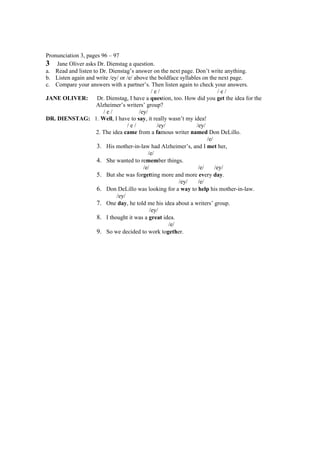
Pronunciation 3, pages 96 – 97
3 Jane Oliver asks Dr. Dienstag a question.
a. Read and listen to Dr. Dienstag’s answer on the next page. Don’t write anything.
b. Listen again and write /ey/ or /e/ above the boldface syllables on the next page.
c. Compare your answers with a partner’s. Then listen again to check your answers.
                                               /e/                         /e/
JANE OLIVER:         Dr. Dienstag, I have a question, too. How did you get the idea for the
                    Alzheimer’s writers’ group?
                        /e/             /ey/
DR. DIENSTAG: 1. Well, I have to say, it really wasn’t my idea!
                                  /e/            /ey/           /ey/
                    2. The idea came from a famous writer named Don DeLillo.
                                                                     /e/
                     3. His mother-in-law had Alzheimer’s, and I met her,
                                             /e/
                     4. She wanted to remember things.
                                          /e/                    /e/     /ey/
                     5. But she was forgetting more and more every day.
                                                          /ey/   /e/
                     6. Don DeLillo was looking for a way to help his mother-in-law.
                             /ey/
                     7. One day, he told me his idea about a writers’ group.
                                              /ey/
                     8. I thought it was a great idea.
                                                      /e/
                     9. So we decided to work together.

Galo rendón listiningandspeakingi_ii_bim

  • 1.
    NOMBRE: GALO RENDÒNS. MATERIA: LISTENING AND SPEAKING I CENTRO UNIVERSITARIO: MACHALA FECHA: 10 de Noviembre 2010 UNIT 1 Listen for main ideas, page 6 CD1(4) Listen to the conversation between Nina and Rick. Read sentences. Write T true or F false _T__1. Friendship force visitors can be young or old _F__2. Some friendship visitors stay in hotel _T__3. Nina wants to stay with a host family in Thailand. _F__4. All host family speak English. _T__5. Nina and Rick agree that it’s good to have international friends. Grammar 2, page 17 FRIENDSHIP FORCE INTERNATIONAL BUILDING GLOBAL GOODWILL THROUGH PERSONAL FRIENDSHIP Q: What kind of people does the friendship force look for? A: Friendship Force visitors are interested in other culture. They aren’t afraid of new places. Q: Is it necessary to speak another language? A: No, it isn’t! Language isn’t a big problem for the visitors. Q: What if we have a problem when we are in another country? A: Every friendship group has a leader. The leader is always near you. For example, last year, one visitor was sick in Germany. Her host family called her friendship force leader. The leader took her to the doctor immediately. Luckily, she wasn’t very sick. The next day, she was fine. So remember, when you travel with the friendship force, you aren’t alone. Q: I really want to travel with the Friendship Force, but I’m not sure when I can go. Is that a problem? A: No, that isn’t a problem. There are many different groups every year. The schedule is on our website. Friendship Force International 233 Peachtree St. NW (Suite 2250) Atlanta, Georgia 30303 USA
  • 2.
    UNIT 2 Listening two,pages 29-30 LISTENING TWO: The Quilts of Gee’s bend Gee’s Bend is the name of the small town in Alabama. The women of Gee’s Bend are famous for their quilts. They use old materials to make beautiful quilts. Listen to the radio broadcast about the women in a town called Gee’s Bend. Then complete the outline with the information you hear. Circle the correct answer. . A. What are the Gee’s bend quilts? 1. Gee’s Bend quilts are blankets made by hand. a. clothing b. blankets 2. They are made out of old clothing such jeans and dresses. a. dresses b. sweaters B. What are they art? 3. The women put all the pieces together carefully. a. colors b. pieces 4. The quilts look beautiful and unusual. a. unusual b. new C. Why do they have special meaning? 5. One woman made a quilts to remember her husband. a. mother b. husband 6. Grandmothers, mothers, daughters make them together. a. Neighbors b. Grandmothers Review, pages 32-33 A VOCABULARY REVIEW Read the radio advertisement and look at the picture on page 33. Fill in the blanks with the words from the box. Advice famous recycled trendy Environment material trash unusual Do you want to enjoy camping and outdoor sports all year-even in the winter, in the rain? Then here’s my advice for you: you should wear Polar fleece sports clothing. Polar Fleece clothing keeps you dry in wet weather and warm in cold weather. How is Polar fleece made? Believe it
  • 3.
    or not, PolarFleece clothing is made out of recycled plastic bottles! Recycled bottles go to a big factory. Machines at the factory clean the bottles, cut them into small pieces, and heat them. The bottles melt and become a liquid, like water. Then, another machine changes the liquid into a material that looks like wool. This wool is called Polar Fleece! This unusual material is comfortable and very warm. You can buy Polar Fleece winter clothes in many styles, so you will always look trendy! Polar Fleece also reduces trash because it is made out of recycled plastic bottles. So it helps the environment. Today, the name Polar Fleece is famous all over the world. Pronunciation 3b, page 38 b. Work with a partner and check the stressed syllables in part a. then look at boldfaced words and answer the questions bellow. 1. Which words are nouns? Write them on the line. Clothing, music, question, pocket, garage, sister, student, parents, advice, fashion. 2. Which words are verbs? Write them on the line. Listen, answer, agree, decide, believe, design, invite, visit, study. 3. Circle the best answer for the rules below. a. (Most / A few) two-syllables nouns are stressed on the first syllable. b. (Most / about half of ) two-syllable verbs are stressed on the second syllable. ESSAY PART UNIT 3 Background and vocabulary 3, page 48 Pronunciation 2, page 59 Write each word or phrase from the box next to its definition. Great melody played rhymed In the 70s musical instruments poor rhythm Just neighborhoods popular slang 1. In the 70s from 1970 to 1979 2. Rhythm the beat; the tempo; regular sounds in music 3. Slang informal language (i.e., among friends) 4. Just a short time ago 5. Played made music (with an instrument, CD, radio, etc) 6. Rhymed had the same ending sound (e. g., walk/talk) 7. Poor with very little money
  • 4.
    8. Neighbourhoods places in a city where people live 9. Great very good, excellent 10. Melody a tunes; musical notes with a nice sound 11. Musical instruments things you play to make music (e.g., piano, guitar) 12. Popular liked by many people Listening for main idea, page 49 1. Read the sentences. Listen to the interview. Write T (true) or F (false). Correct the false sentences. F 1. King Kool was a rapper when he was 70 T 2. “Rapper’s Delight” is a party song. T 3. The words in rap songs changed in the 1980s. T 4. In the 80s, rappers wrote songs about the problems in their lives. T 5. Many rappers were poor. F 6. Tupac wrote songs because he was in love. T 7. King Kool thinks Tupac Shakur was the best rapper. F 8. Young African Americans didn’t understand Tupac’s songs. F 9. Tupac’s music was popular only when he was alive. Pronunciation 2, page 59 2. Listen to the words and repeat them. Then listen again and circle the word you hear. 1. a. bit 2. a. live 3. a. it 4. a. ship 5. a. sit b. beat b. leave b. eat b. sheep b. seat UNIT 4 Listening for details, page 69 Listen again. Circle the correct answer to complete each sentence. 1. The Hope Diamond is the most valuable diamond in _________. a. London b. the world 2. The Hope Diamond comes from ________. a. France b. India 3. The Hope Diamond moves to different places, and it gets _______. a. smaller
  • 5.
    b. prettier 4. No one can find the Hope Diamond in 1792 because somebody _______. a. loses it b. steals it 5. The name of this diamond ________. a. is a man’s family name b. means a wish for good luck 6. The woman who buys the Hope Diamond loses _______. a. her family b. her money Review, page 72 Work with a partner. Complete the conversation with words from the box. Read the conversation aloud together. Then switch roles and it again. carats history sparkles valuable worth fascinating huge steals wealthy TOUR GUIDE: The Hope Diamond is worth a lot of money. 1. TOURIST: Yes, I know it’s very valuable. 2. TOUR GUIDE: As you can see, it’s also very large. TOURIST: Wow! It’s huge. How many carats is the diamond? 3. TOUR GUIDE: It is more than 40 carats . 4. TOURIST: This diamond is beautiful. TOUR GUIDE: Yes, it’s beautiful because it sparkles . Are you interested in 5. history ? 6. TOURIST: Yes, I think learning about the past is fascinating . 7. TOUR GUIDE: Well, listen to the diamond’s story. In 1972, someone steals the 8. diamond from its owner in France. TOURIST: Then the diamond appears in London in 1812, right? TOUR GUIDE: Right. After that, a wealthy man buys the diamond. 9. TOURIST: What was his name? TOUR GUIDE: Henry Philip Hope. TOURIST: Oh, so that’s the diamond got its name!
  • 6.
    UNIT 5 Background andvocabulary 3, page 86 3 Work with a partner. Take turns. Student A, read the sentence with the underlined vocabulary. Ask the question about the meaning. Student B, choose the correct meaning and answer the question. Example A: Twenty-six million people have Alzheimer’s disease. What does disease mean? (a. Medicine or cure; b. sickness or illness) B: Disease means sickness or illness. 1. People with Alzheimer’s often forget what they’re doing. What does forget mean? (a. Give away; b. don’t remember) It means: don´t remember 2. People with Alzheimer’s sometimes get lost. They don’t know how to find their home. What does get lost mean? (a. don’t know where they are; b. can’t find their house key) It means: don’t know where they are. 3. People with Alzheimer’s sometimes lose their friends. What does lose mean? (a. keep: b. can’t keep) It means: can´t keep 4. People with Alzheimer’s always lose their memories. What are memories? (a. things that people remember about the past; b. things that people do) They are things that people remember about the past. 5. Many people with Alzheimer’s disease feel lonely, like Sarah. What does lonely mean? (a. sad because they don’t have friends; b. afraid because they are alone) It means: sad because they don’t have friends. 6. People with Alzheimer’s can join our support groups. What does join mean? (a. be a leader of a group; b. be a member of a group) It means: be a member of a group. 7. The group members get together to talk and help each other. Who are members? (a. people in a group; b. people who remember many things) It means: people in a group 8. The group members get together to talk and help each other. What does get together mean? (a. meet; b. have a party) It means: meet. 9. People with Alzheimer’s often forget their relatives-their husbands, wives, and children. Who are relatives? (a. People in their family; b. good friends) They are People in their family.
  • 7.
    Pronunciation 3, pages96 – 97 3 Jane Oliver asks Dr. Dienstag a question. a. Read and listen to Dr. Dienstag’s answer on the next page. Don’t write anything. b. Listen again and write /ey/ or /e/ above the boldface syllables on the next page. c. Compare your answers with a partner’s. Then listen again to check your answers. /e/ /e/ JANE OLIVER: Dr. Dienstag, I have a question, too. How did you get the idea for the Alzheimer’s writers’ group? /e/ /ey/ DR. DIENSTAG: 1. Well, I have to say, it really wasn’t my idea! /e/ /ey/ /ey/ 2. The idea came from a famous writer named Don DeLillo. /e/ 3. His mother-in-law had Alzheimer’s, and I met her, /e/ 4. She wanted to remember things. /e/ /e/ /ey/ 5. But she was forgetting more and more every day. /ey/ /e/ 6. Don DeLillo was looking for a way to help his mother-in-law. /ey/ 7. One day, he told me his idea about a writers’ group. /ey/ 8. I thought it was a great idea. /e/ 9. So we decided to work together.