NASAC 2013,Tianjin, 9 November 2013
Probability and Uncertainty
in Software Engineering
David S. Rosenblum!
Dean, School of Computing!
National University of Singapore
NASAC 2013,Tianjin, 9 November 2013
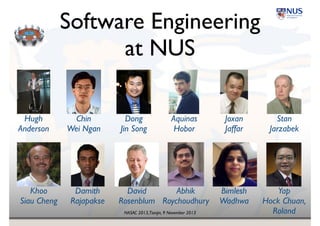
Software Engineering

at NUS
Hugh

Anderson
Chin

Wei Ngan
Dong

Jin Song
Aquinas

Hobor
Joxan!
Jaffar
Stan

Jarzabek
Khoo

Siau Cheng
Damith

Rajapakse
David!
Rosenblum
Abhik

Roychoudhury
Bimlesh

Wadhwa
Yap

Hock Chuan,

Roland
NASAC 2013,Tianjin, 9 November 2013
Certainty in

Software Engineering
Engineering of software is centered around
simplistic,“yes/no” characterizations of artifacts
NASAC 2013,Tianjin, 9 November 2013
Certainty in

Software Engineering
Engineering of software is centered around
simplistic,“yes/no” characterizations of artifacts
Program is correct/incorrect
Program execution finished/crashed
Compilation completed/aborted
Test suite succeeded/failed
Specification is satisfied/violated
NASAC 2013,Tianjin, 9 November 2013
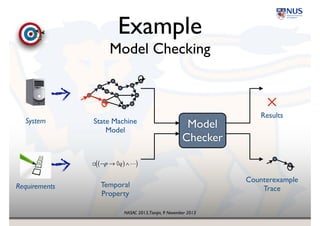
Example!
Model Checking
! ¬p → ◊q( )∧"( )
Model
Checker
✓
✕
State Machine!
Model
Temporal

Property
Results
Counterexample!
Trace
System
Requirements
NASAC 2013,Tianjin, 9 November 2013
Example!
Model Checking
! ¬p → ◊q( )∧"( )
Model
Checker
✕
State Machine!
Model
Temporal

Property
Results
Counterexample!
Trace
System
Requirements
NASAC 2013,Tianjin, 9 November 2013
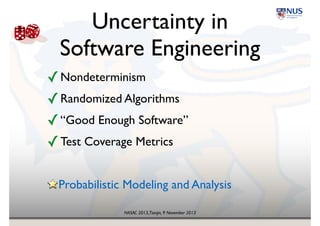
Uncertainty in

Software Engineering
✓Nondeterminism
✓Randomized Algorithms
✓“Good Enough Software”
✓Test Coverage Metrics
NASAC 2013,Tianjin, 9 November 2013
Uncertainty in

Software Engineering
✓Nondeterminism
✓Randomized Algorithms
✓“Good Enough Software”
✓Test Coverage Metrics
Probabilistic Modeling and Analysis
NASAC 2013,Tianjin, 9 November 2013
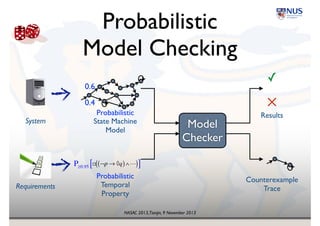
Probabilistic

Model Checking
! ¬p → ◊q( )∧"( )
Model
Checker
✓
✕
State Machine!
Model
Temporal

Property
Results
Counterexample!
Trace
System
Requirements
P≥0.95 [ ]
0.4
0.6
Probabilistic
Probabilistic
NASAC 2013,Tianjin, 9 November 2013
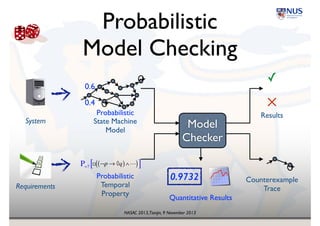
Probabilistic

Model Checking
! ¬p → ◊q( )∧"( )
Model
Checker
✓
✕
State Machine!
Model
Temporal

Property
Results
Counterexample!
Trace
System
Requirements
P=? [ ]
0.4
0.6
Quantitative Results
0.9732Probabilistic
Probabilistic
NASAC 2013,Tianjin, 9 November 2013
Example

Die Tossing Simulated by Coin Flipping
Knuth-Yao algorithm,

from the PRISM group

(Kwiatkowska et al.)
0
3
2
1
6
4
5
0.5
0.5
0.5
0.5
0.5
0.5
0.5
0.5
0.5
0.5
0.5
0.5
0.5
0.5
NASAC 2013,Tianjin, 9 November 2013
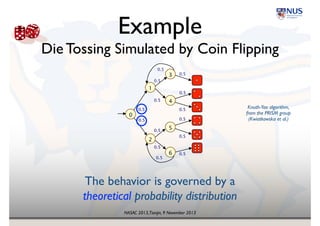
Example

Die Tossing Simulated by Coin Flipping
Knuth-Yao algorithm,

from the PRISM group

(Kwiatkowska et al.)
The behavior is governed by a!
theoretical probability distribution
0
3
2
1
6
4
5
0.5
0.5
0.5
0.5
0.5
0.5
0.5
0.5
0.5
0.5
0.5
0.5
0.5
0.5
NASAC 2013,Tianjin, 9 November 2013
Probabilistic

Model Checking
! ¬p → ◊q( )∧"( )
Model
Checker
✓
State Machine!
Model
Temporal

Property
Results
Counterexample!
Trace
System
Requirements
P≥0.95 [ ]
0.4
0.6
Quantitative Results
0.9732Probabilistic
Probabilistic
NASAC 2013,Tianjin, 9 November 2013
Probabilistic

Model Checking
! ¬p → ◊q( )∧"( )
Model
Checker
✕
State Machine!
Model
Temporal

Property
Results
Counterexample!
Trace
System
Requirements
P≥0.95 [ ]
Quantitative Results
Probabilistic
Probabilistic
0.41
0.59
0.6211
NASAC 2013,Tianjin, 9 November 2013
Example!
Zeroconf Protocol
s1s0 s2 s3
q
1
1
{ok} {error}
{start} s4
s5
s6
s7
s8
1
1-q
1-p
1-p
1-p
1-p
p p p
p
1
from the PRISM group

(Kwiatkowska et al.)
NASAC 2013,Tianjin, 9 November 2013
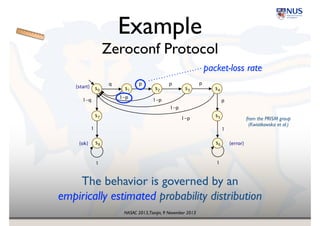
Example!
Zeroconf Protocol
s1s0 s2 s3
q
1
1
{ok} {error}
{start} s4
s5
s6
s7
s8
1
1-q
1-p
1-p
1-p
1-p
p p p
p
1
The behavior is governed by an!
empirically estimated probability distribution
from the PRISM group

(Kwiatkowska et al.)
packet-loss rate
NASAC 2013,Tianjin, 9 November 2013
Perturbed Probabilistic Systems!
(Current Research)
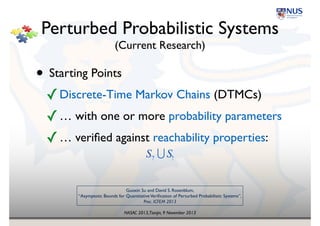
• Starting Points!
✓Discrete-Time Markov Chains (DTMCs)!
✓… with one or more probability parameters!
✓… verified against reachability properties:
S? ∪ S!
Guoxin Su and David S. Rosenblum,

“Asymptotic Bounds for QuantitativeVerification of Perturbed Probabilistic Systems”,

Proc. ICFEM 2013
NASAC 2013,Tianjin, 9 November 2013
Parametric

Markov Chains
• A distribution parameter in a DTMC is represented as a
vector x of parameters xi!
• The norm of total variance represents the amount of
perturbation:!
!
• The parameter is allowed a “sufficiently small”
perturbation with respect to ideal reference values r:!
!
• Can generalize to multiple parameters
v = vi∑
x − r ≤ Δ
NASAC 2013,Tianjin, 9 November 2013
Perturbation Bounds
• Perturbation Function!
!
where A is the transition probability sub-matrix for S?
and b is the vector of one-step probabilities from S? to S!
!
• Condition Numbers!
!
ρ x( )= ι? i A x
i
i b x( )− Ai
i b( )( )i=0
∞
∑
κ = lim
δ→0
sup
ρ(x − r)
δ
: x − r ≤ δ,δ > 0
⎧
⎨
⎩
⎫
⎬
⎭
NASAC 2013,Tianjin, 9 November 2013
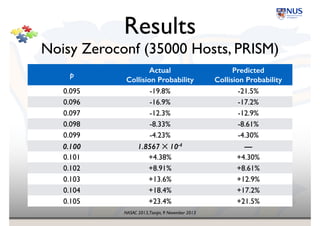
Results!
Noisy Zeroconf (35000 Hosts, PRISM)
p
Actual
Collision Probability
Predicted
Collision Probability
0.095 -19.8% -21.5%
0.096 -16.9% -17.2%
0.097 -12.3% -12.9%
0.098 -8.33% -8.61%
0.099 -4.23% -4.30%
0.100 1.8567 —
0.101 +4.38% +4.30%
0.102 +8.91% +8.61%
0.103 +13.6% +12.9%
0.104 +18.4% +17.2%
0.105 +23.4% +21.5%
NASAC 2013,Tianjin, 9 November 2013
Additional Aspects
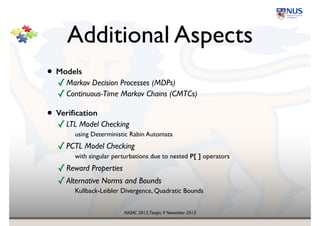
• Models
✓Markov Decision Processes (MDPs)!
✓Continuous-Time Markov Chains (CMTCs)
• Verification
✓LTL Model Checking!
using Deterministic Rabin Automata!
✓PCTL Model Checking!
with singular perturbations due to nested P[ ] operators!
✓Reward Properties!
✓Alternative Norms and Bounds!
Kullback-Leibler Divergence, Quadratic Bounds
NASAC 2013,Tianjin, 9 November 2013
Other Forms of
Uncertainty
“There are known knowns; there are things we know
we know. We also know there are known unknowns;
that is to say, we know there are some things we do
not know. But there are also unknown unknowns –
the ones we don’t know we don’t know.”!
!
— Donald Rumsfeld
NASAC 2013,Tianjin, 9 November 2013
Uncertainty in Testing!
(New Research)
1982: Weyuker: Non-Testable Programs!
- Impossible/too costly to efficiently check results!
- Example: mathematical software!
2010: Garlan: Intrinsic Uncertainty!
- Systems embody intrinsic uncertainty/imprecision!
- Cannot easily distinguish bugs from “features”!
- Example: ubiquitous computing
NASAC 2013,Tianjin, 9 November 2013
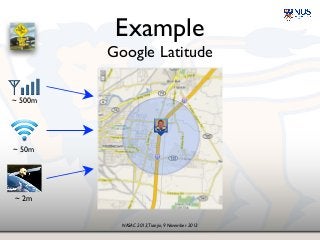
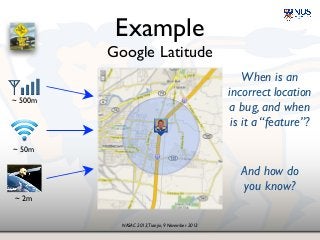
Example!
Google Latitude
~ 500m
~ 50m
~ 2m
NASAC 2013,Tianjin, 9 November 2013
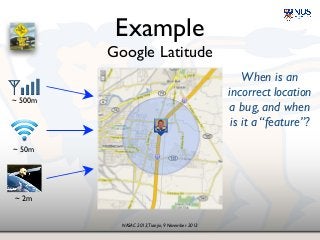
Example!
Google Latitude
When is an

incorrect location!
a bug, and when

is it a “feature”?
~ 500m
~ 50m
~ 2m
NASAC 2013,Tianjin, 9 November 2013
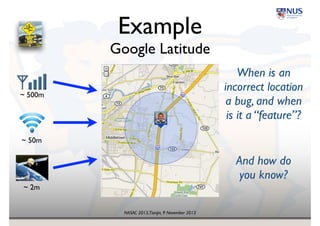
Example!
Google Latitude
When is an

incorrect location!
a bug, and when

is it a “feature”?
And how do!
you know?
~ 500m
~ 50m
~ 2m
NASAC 2013,Tianjin, 9 November 2013
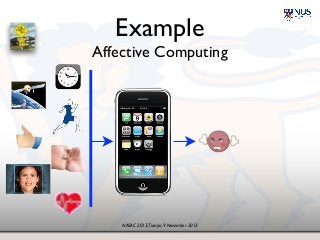
Example!
Affective Computing
NASAC 2013,Tianjin, 9 November 2013
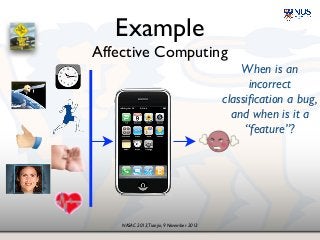
Example!
Affective Computing
When is an!
incorrect!
classification a bug,!
and when is it a!
“feature”?
NASAC 2013,Tianjin, 9 November 2013
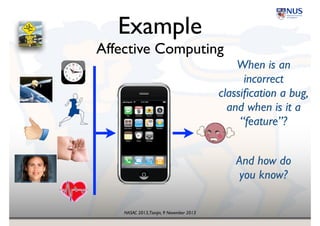
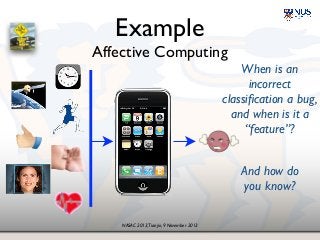
Example!
Affective Computing
When is an!
incorrect!
classification a bug,!
and when is it a!
“feature”?
And how do!
you know?
NASAC 2013,Tianjin, 9 November 2013
Sources of

Uncertainty
✓Output: results, characteristics of results!
✓Sensors: redundancy, reliability, resolution!
✓Context: sensing, inferring, fusing!
✓Machine learning: imprecision, user training
NASAC 2013,Tianjin, 9 November 2013
Sources of

Uncertainty
✓Output: results, characteristics of results!
✓Sensors: redundancy, reliability, resolution!
✓Context: sensing, inferring, fusing!
✓Machine learning: imprecision, user training
These create significant challenges for

software engineering research and practice!
NASAC 2013,Tianjin, 9 November 2013
Conclusion
✓Software engineering (certainly) suffers
from excessive certainty!
✓A probabilistic mindset offers greater insight!
✓But significant challenges remain for
probabilistic verification!
✓And other forms of uncertainty are equally
challenging to address
NASAC 2013,Tianjin, 9 November 2013
Probability and Uncertainty
in Software Engineering
David S. Rosenblum!
Dean, School of Computing!
National University of Singapore
ThankYou!

Probability and Uncertainty in Software Engineering (keynote talk at NASAC 2013)

  • 1.
    NASAC 2013,Tianjin, 9November 2013 Probability and Uncertainty in Software Engineering David S. Rosenblum! Dean, School of Computing! National University of Singapore
  • 2.
    NASAC 2013,Tianjin, 9November 2013 Software Engineering
 at NUS Hugh
 Anderson Chin
 Wei Ngan Dong
 Jin Song Aquinas
 Hobor Joxan! Jaffar Stan
 Jarzabek Khoo
 Siau Cheng Damith
 Rajapakse David! Rosenblum Abhik
 Roychoudhury Bimlesh
 Wadhwa Yap
 Hock Chuan,
 Roland
  • 3.
    NASAC 2013,Tianjin, 9November 2013 Certainty in
 Software Engineering Engineering of software is centered around simplistic,“yes/no” characterizations of artifacts
  • 4.
    NASAC 2013,Tianjin, 9November 2013 Certainty in
 Software Engineering Engineering of software is centered around simplistic,“yes/no” characterizations of artifacts Program is correct/incorrect Program execution finished/crashed Compilation completed/aborted Test suite succeeded/failed Specification is satisfied/violated
  • 5.
    NASAC 2013,Tianjin, 9November 2013 Example! Model Checking ! ¬p → ◊q( )∧"( ) Model Checker ✓ ✕ State Machine! Model Temporal
 Property Results Counterexample! Trace System Requirements
  • 6.
    NASAC 2013,Tianjin, 9November 2013 Example! Model Checking ! ¬p → ◊q( )∧"( ) Model Checker ✕ State Machine! Model Temporal
 Property Results Counterexample! Trace System Requirements
  • 7.
    NASAC 2013,Tianjin, 9November 2013 Uncertainty in
 Software Engineering ✓Nondeterminism ✓Randomized Algorithms ✓“Good Enough Software” ✓Test Coverage Metrics
  • 8.
    NASAC 2013,Tianjin, 9November 2013 Uncertainty in
 Software Engineering ✓Nondeterminism ✓Randomized Algorithms ✓“Good Enough Software” ✓Test Coverage Metrics Probabilistic Modeling and Analysis
  • 9.
    NASAC 2013,Tianjin, 9November 2013 Probabilistic
 Model Checking ! ¬p → ◊q( )∧"( ) Model Checker ✓ ✕ State Machine! Model Temporal
 Property Results Counterexample! Trace System Requirements P≥0.95 [ ] 0.4 0.6 Probabilistic Probabilistic
  • 10.
    NASAC 2013,Tianjin, 9November 2013 Probabilistic
 Model Checking ! ¬p → ◊q( )∧"( ) Model Checker ✓ ✕ State Machine! Model Temporal
 Property Results Counterexample! Trace System Requirements P=? [ ] 0.4 0.6 Quantitative Results 0.9732Probabilistic Probabilistic
  • 11.
    NASAC 2013,Tianjin, 9November 2013 Example
 Die Tossing Simulated by Coin Flipping Knuth-Yao algorithm,
 from the PRISM group
 (Kwiatkowska et al.) 0 3 2 1 6 4 5 0.5 0.5 0.5 0.5 0.5 0.5 0.5 0.5 0.5 0.5 0.5 0.5 0.5 0.5
  • 12.
    NASAC 2013,Tianjin, 9November 2013 Example
 Die Tossing Simulated by Coin Flipping Knuth-Yao algorithm,
 from the PRISM group
 (Kwiatkowska et al.) The behavior is governed by a! theoretical probability distribution 0 3 2 1 6 4 5 0.5 0.5 0.5 0.5 0.5 0.5 0.5 0.5 0.5 0.5 0.5 0.5 0.5 0.5
  • 13.
    NASAC 2013,Tianjin, 9November 2013 Probabilistic
 Model Checking ! ¬p → ◊q( )∧"( ) Model Checker ✓ State Machine! Model Temporal
 Property Results Counterexample! Trace System Requirements P≥0.95 [ ] 0.4 0.6 Quantitative Results 0.9732Probabilistic Probabilistic
  • 14.
    NASAC 2013,Tianjin, 9November 2013 Probabilistic
 Model Checking ! ¬p → ◊q( )∧"( ) Model Checker ✕ State Machine! Model Temporal
 Property Results Counterexample! Trace System Requirements P≥0.95 [ ] Quantitative Results Probabilistic Probabilistic 0.41 0.59 0.6211
  • 15.
    NASAC 2013,Tianjin, 9November 2013 Example! Zeroconf Protocol s1s0 s2 s3 q 1 1 {ok} {error} {start} s4 s5 s6 s7 s8 1 1-q 1-p 1-p 1-p 1-p p p p p 1 from the PRISM group
 (Kwiatkowska et al.)
  • 16.
    NASAC 2013,Tianjin, 9November 2013 Example! Zeroconf Protocol s1s0 s2 s3 q 1 1 {ok} {error} {start} s4 s5 s6 s7 s8 1 1-q 1-p 1-p 1-p 1-p p p p p 1 The behavior is governed by an! empirically estimated probability distribution from the PRISM group
 (Kwiatkowska et al.) packet-loss rate
  • 17.
    NASAC 2013,Tianjin, 9November 2013 Perturbed Probabilistic Systems! (Current Research) • Starting Points! ✓Discrete-Time Markov Chains (DTMCs)! ✓… with one or more probability parameters! ✓… verified against reachability properties: S? ∪ S! Guoxin Su and David S. Rosenblum,
 “Asymptotic Bounds for QuantitativeVerification of Perturbed Probabilistic Systems”,
 Proc. ICFEM 2013
  • 18.
    NASAC 2013,Tianjin, 9November 2013 Parametric
 Markov Chains • A distribution parameter in a DTMC is represented as a vector x of parameters xi! • The norm of total variance represents the amount of perturbation:! ! • The parameter is allowed a “sufficiently small” perturbation with respect to ideal reference values r:! ! • Can generalize to multiple parameters v = vi∑ x − r ≤ Δ
  • 19.
    NASAC 2013,Tianjin, 9November 2013 Perturbation Bounds • Perturbation Function! ! where A is the transition probability sub-matrix for S? and b is the vector of one-step probabilities from S? to S! ! • Condition Numbers! ! ρ x( )= ι? i A x i i b x( )− Ai i b( )( )i=0 ∞ ∑ κ = lim δ→0 sup ρ(x − r) δ : x − r ≤ δ,δ > 0 ⎧ ⎨ ⎩ ⎫ ⎬ ⎭
  • 20.
    NASAC 2013,Tianjin, 9November 2013 Results! Noisy Zeroconf (35000 Hosts, PRISM) p Actual Collision Probability Predicted Collision Probability 0.095 -19.8% -21.5% 0.096 -16.9% -17.2% 0.097 -12.3% -12.9% 0.098 -8.33% -8.61% 0.099 -4.23% -4.30% 0.100 1.8567 — 0.101 +4.38% +4.30% 0.102 +8.91% +8.61% 0.103 +13.6% +12.9% 0.104 +18.4% +17.2% 0.105 +23.4% +21.5%
  • 21.
    NASAC 2013,Tianjin, 9November 2013 Additional Aspects • Models ✓Markov Decision Processes (MDPs)! ✓Continuous-Time Markov Chains (CMTCs) • Verification ✓LTL Model Checking! using Deterministic Rabin Automata! ✓PCTL Model Checking! with singular perturbations due to nested P[ ] operators! ✓Reward Properties! ✓Alternative Norms and Bounds! Kullback-Leibler Divergence, Quadratic Bounds
  • 22.
    NASAC 2013,Tianjin, 9November 2013 Other Forms of Uncertainty “There are known knowns; there are things we know we know. We also know there are known unknowns; that is to say, we know there are some things we do not know. But there are also unknown unknowns – the ones we don’t know we don’t know.”! ! — Donald Rumsfeld
  • 23.
    NASAC 2013,Tianjin, 9November 2013 Uncertainty in Testing! (New Research) 1982: Weyuker: Non-Testable Programs! - Impossible/too costly to efficiently check results! - Example: mathematical software! 2010: Garlan: Intrinsic Uncertainty! - Systems embody intrinsic uncertainty/imprecision! - Cannot easily distinguish bugs from “features”! - Example: ubiquitous computing
  • 24.
    NASAC 2013,Tianjin, 9November 2013 Example! Google Latitude ~ 500m ~ 50m ~ 2m
  • 25.
    NASAC 2013,Tianjin, 9November 2013 Example! Google Latitude When is an
 incorrect location! a bug, and when
 is it a “feature”? ~ 500m ~ 50m ~ 2m
  • 26.
    NASAC 2013,Tianjin, 9November 2013 Example! Google Latitude When is an
 incorrect location! a bug, and when
 is it a “feature”? And how do! you know? ~ 500m ~ 50m ~ 2m
  • 27.
    NASAC 2013,Tianjin, 9November 2013 Example! Affective Computing
  • 28.
    NASAC 2013,Tianjin, 9November 2013 Example! Affective Computing When is an! incorrect! classification a bug,! and when is it a! “feature”?
  • 29.
    NASAC 2013,Tianjin, 9November 2013 Example! Affective Computing When is an! incorrect! classification a bug,! and when is it a! “feature”? And how do! you know?
  • 30.
    NASAC 2013,Tianjin, 9November 2013 Sources of
 Uncertainty ✓Output: results, characteristics of results! ✓Sensors: redundancy, reliability, resolution! ✓Context: sensing, inferring, fusing! ✓Machine learning: imprecision, user training
  • 31.
    NASAC 2013,Tianjin, 9November 2013 Sources of
 Uncertainty ✓Output: results, characteristics of results! ✓Sensors: redundancy, reliability, resolution! ✓Context: sensing, inferring, fusing! ✓Machine learning: imprecision, user training These create significant challenges for
 software engineering research and practice!
  • 32.
    NASAC 2013,Tianjin, 9November 2013 Conclusion ✓Software engineering (certainly) suffers from excessive certainty! ✓A probabilistic mindset offers greater insight! ✓But significant challenges remain for probabilistic verification! ✓And other forms of uncertainty are equally challenging to address
  • 33.
    NASAC 2013,Tianjin, 9November 2013 Probability and Uncertainty in Software Engineering David S. Rosenblum! Dean, School of Computing! National University of Singapore ThankYou!