As you walk in:
– Please sign in
– Please fill out a name tag
– Answer question on chart paper
– Agenda + links found at:
goo.gl/4Qkzkn
STAR Net and NASA at Your
Library in 2019
10/31/2018
Presenters: Brooks Mitchell (STAR Net) and Christine Shupla (LPI)
Who Are You?!
Name
Library
Role
Today’s Agenda
1. Introduction and Ice Breaker
2. The Solar System
3. Beyond the Solar System
4. Working Lunch (12:00 pm)
5. Human Exploration
6. Discussion and Feedback
Join STAR Net!
www.starnetlibraries.org
Professional development
resources, including webinars,
newsletters, blogs, forums, videos,
and much more!
For example:
DIY Sun Cookies
Like an activity and think other library staff should know how great it is? Didn’t like
an activity or have modifications to make it better? Make sure to leave a review!
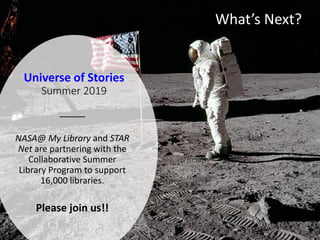
Universe of Stories
Summer 2019
NASA@ My Library and STAR
Net are partnering with the
Collaborative Summer
Library Program to support
16,000 libraries.
Please join us!!
What’s Next?
How Big, How Far, How Hot?
How can you sort these images?
Use the images on your tables to discuss in groups
how you can arrange items in the Universe.
• Start by arranging the cards in whatever way makes sense to your group
• Next, place them in order of distance away and size
How Big, How Far, How Hot?
Answers
How Big?
Lions, International Space Station, Moon, Mars,
Earth, Jupiter, Sun, Solar System, Andromeda
Galaxy
How Big, How Far, How Hot?
Answers
How Far?
Eagle, Jet, Aurora, Hubble Space Telescope,
Moon, Sun, Saturn, Orion Nebula, Andromeda
Galaxy
How Big, How Far, How Hot?
Answers
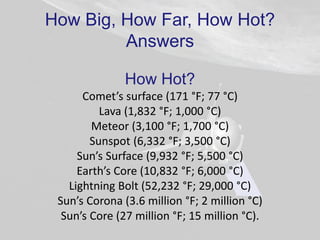
How Hot?
Comet’s surface (171 °F; 77 °C)
Lava (1,832 °F; 1,000 °C)
Meteor (3,100 °F; 1,700 °C)
Sunspot (6,332 °F; 3,500 °C)
Sun’s Surface (9,932 °F; 5,500 °C)
Earth’s Core (10,832 °F; 6,000 °C)
Lightning Bolt (52,232 °F; 29,000 °C)
Sun’s Corona (3.6 million °F; 2 million °C)
Sun’s Core (27 million °F; 15 million °C).
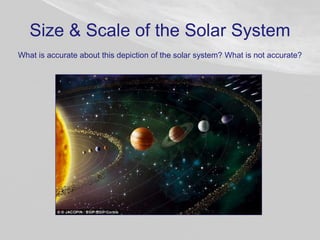
Size & Scale of the Solar System
What is accurate about this depiction of the solar system? What is not accurate?
What is a Solar System?
…a galaxy?
…a universe??
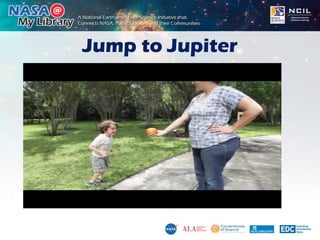
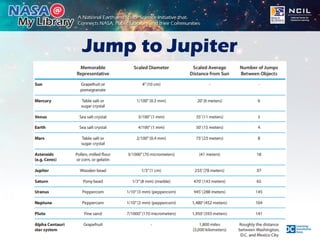
Jump to Jupiter
Jump to Jupiter
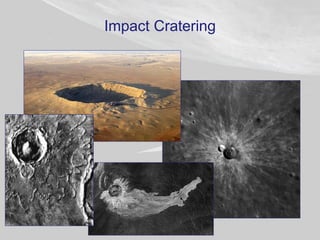
Impact Cratering
Crater Creations
www.clearinghouse.starnetlibraries.org
Apollo Program Accomplishments
• 6 human landings
• 14 EVAs, total 80.1 hours
• Longest traverse 18 km
• 382 kg samples
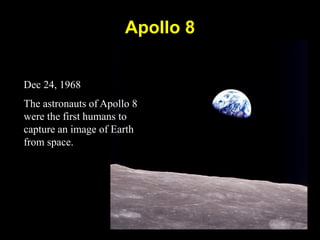
Apollo 8
Dec 24, 1968
The astronauts of Apollo 8
were the first humans to
capture an image of Earth
from space.
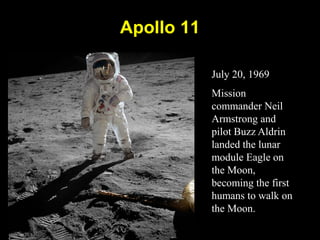
Apollo 11
July 20, 1969
Mission
commander Neil
Armstrong and
pilot Buzz Aldrin
landed the lunar
module Eagle on
the Moon,
becoming the first
humans to walk on
the Moon.
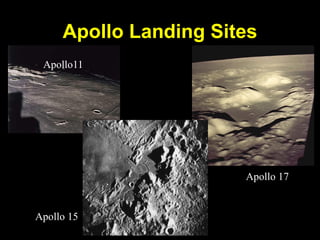
Apollo Landing Sites
Apollo11
Apollo 15
Apollo 17
Sample Collection
Sample Curation
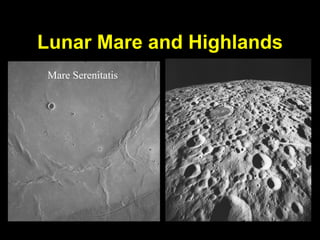
Lunar Mare and Highlands
Mare Serenitatis
Impact Basin Formation
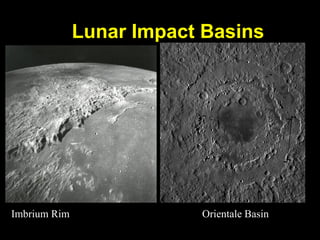
Lunar Impact Basins
Imbrium Rim Orientale Basin
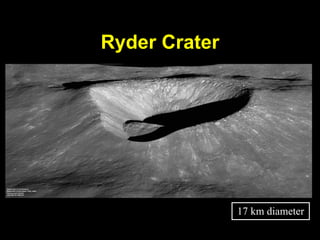
Ryder Crater
17 km diameter
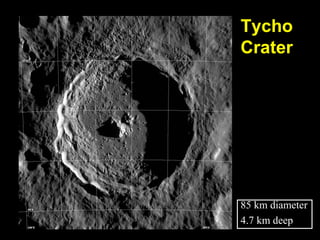
Tycho
Crater
85 km diameter
4.7 km deep
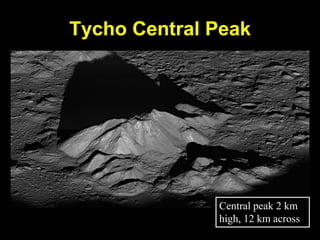
Tycho Central Peak
Central peak 2 km
high, 12 km across
Example Apollo Program
- Contact a local astronomy club to host a
night sky viewing!
- OR, invite patrons to explore Lunar Trek on
library computers -
https://moontrek.jpl.nasa.gov/
- Watch the “International Observe the Moon
Night” webinar for programming ideas
- Show an inspiring video
- Facilitate an activity (or two!) from the
Clearinghouse “Moon” Collection!
Astronomy Basics
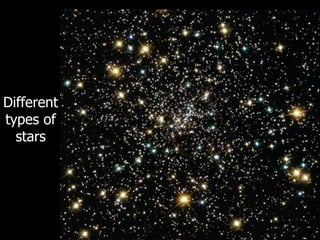
Different
types of
stars
Types of Stars
❖ Big
❖ Small
❖ Red
❖ Blue
❖ Yellow
❖ In groups
❖ Alone
❖More later
Young
stars
form in
nebulae
Regular/ Small Star
Red Giant
White Dwarf
Small, but very hot
Massive
Stars
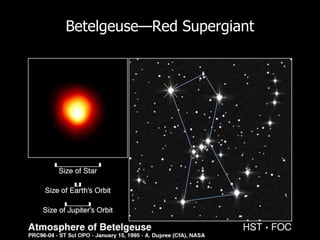
Betelgeuse—Red Supergiant
Supernova—Massive Star Explodes
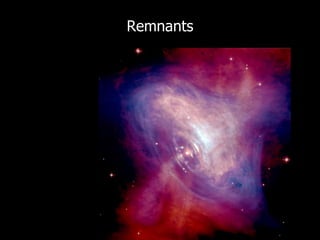
Remnants
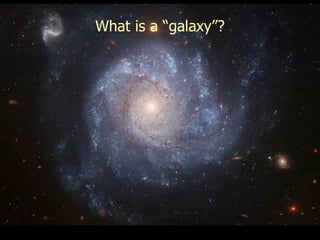
What is a “galaxy”?
The Milky Way
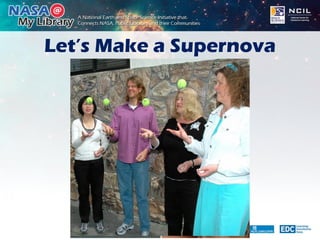
Let’s Make a Supernova
Big Dipper Star Clock
- Cut out and place “The Time Is” on top of the
month/time disk
- Go outside and face north, holding the Star
Clock so the current month is at the top of the
outer circle.
- Turn the black disk until the small picture of
the Big Dipper matches the real Big Dipper's
position The current time will appear in the
cutout.
- Note: If daylight-saving (summer) time is in
effect, you'll need to add one hour to the
LPI Explore Series
https://www.lpi.usra.edu/education/explore/
LPI Traveling Exhibits
https://www.lpi.usra.edu/exploration/education/exhibits/
Meteorites: Messengers of
Mayhem
Protecting our Home
Treasure Hunt in Earth's Attic
Earth’s Daughter
A Storm of Asteroids
Impacts: Delivering Death and
Fostering Life
Our Molten Moon: The Story of the
First Moon Rocks
Moon Views: Rabbits in the Rocks
The Moon: Cosmic Decoder Ring
FREE STAR Net Resources
(take a picture of this slide!!)
175+ Activities Specifically for #STEMINLIB
http://clearinghouse.starnetlibraries.org/
Upcoming and Archived Professional Development
Webinars
https://www.starnetlibraries.org/resources/webinars/
Monthly Newsletter
https://www.starnetlibraries.org/resources/newsletters/
Upcoming STEM Events
https://www.starnetlibraries.org/upcoming-events/
STAR Net Blog (for library staff and written
by library staff!)
https://www.starnetlibraries.org/blog/
Partnership Resources
https://www.starnetlibraries.org/stem-in-
libraries/collaboration/partnership-
opportunities/
Community Dialogue Resources
http://www.starnetlibraries.org/resources/
community-dialogues/
Subscribe to Our YouTube
Channel!
https://www.youtube.com/channel/UCAlTEzl-kWDOrWf6-GBvpYQ
(…isn’t that a long URL? We need YOUR help to make it easier to
remember!)
- How-to Videos
- Webinar Recordings
- NASA Mission Videos
- Kid-friendly Video Clips of REAL Engineers and
Scientists in action
Solar System Ambassadors
www.solarsystem.nasa.gov/ssa/home.cfm
June 6, 2018 Solar System Ambassadors 54
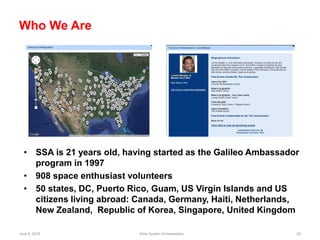
Who We Are
• SSA is 21 years old, having started as the Galileo Ambassador
program in 1997
• 908 space enthusiast volunteers
• 50 states, DC, Puerto Rico, Guam, US Virgin Islands and US
citizens living abroad: Canada, Germany, Haiti, Netherlands,
New Zealand, Republic of Korea, Singapore, United Kingdom
June 6, 2018 Solar System Ambassadors 55
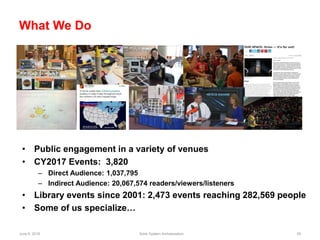
What We Do
• Public engagement in a variety of venues
• CY2017 Events: 3,820
– Direct Audience: 1,037,795
– Indirect Audience: 20,067,574 readers/viewers/listeners
• Library events since 2001: 2,473 events reaching 282,569 people
• Some of us specialize…
June 6, 2018 Solar System Ambassadors 56
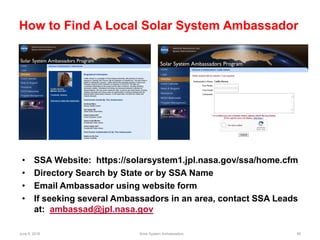
How to Find A Local Solar System Ambassador
• SSA Website: https://solarsystem1.jpl.nasa.gov/ssa/home.cfm
• Directory Search by State or by SSA Name
• Email Ambassador using website form
• If seeking several Ambassadors in an area, contact SSA Leads
at: ambassad@jpl.nasa.gov
June 6, 2018 Solar System Ambassadors 57
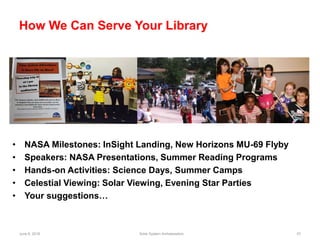
How We Can Serve Your Library
• NASA Milestones: InSight Landing, New Horizons MU-69 Flyby
• Speakers: NASA Presentations, Summer Reading Programs
• Hands-on Activities: Science Days, Summer Camps
• Celestial Viewing: Solar Viewing, Evening Star Parties
• Your suggestions…
Resources and
Potential Partnerships with
Astronomy Clubs
Vivian White
nightskyinfo@astrosociety.org
Astronomical Society of the Pacific
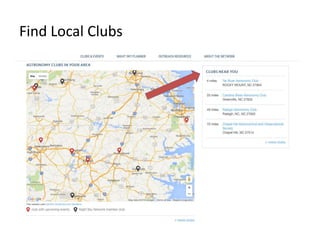
More than 450 clubs in the network
nightskynetwork.org
Find Local Clubs
Astronomy Demos and Activities
Featured
Activities
Night Sky
Planner
And Other
Resources
Lunch Discussion
- What resources do you need?
- What resources do you have?
- What challenges do you anticipate?
Engineering
Design
Process
…in
SPACE!
Build a shock-absorbing system that will protect two
"astronauts" when they land.
Follow the engineering design process to design and
build a shock-absorbing system out of paper, straws,
and mini-marshmallows; attach the shock absorber to
a cardboard platform; and improve the design based
on testing results.
Touchdown!
Materials (per
lander)
• 1 piece of stiff
paper or cardboard
• 1 small paper or
plastic cup
• 3 index cards
• 2 regular
marshmallows
• 10 miniature
marshmallows
• 3 rubber bands
• 8 plastic straws
• scissors
• tape
• After creating a UV kid from chenille
sticks and UV beads, design and test
clothing or other protection from the
Sun’s ultraviolet light.
• Use to connect concepts:
• Conducting science—creating a hypothesis
and testing it
• Just like we need to keep ourselves safe
from sunburn, astronauts need to protect
themselves from radiation in space
• Our Earth’s atmosphere helps to shield us
from some radiation
• Other ideas and connections?
UV Kid
Children work in pairs to measure each other's ankles with
lengths of string before and after lying on their backs with
their feet in the air for 1 minute.
Measure Up
Experiment and discuss:
• If astronauts don’t have gravity pulling fluids down to their feet, how
will that change their bodies during space flight?
• How can you modify this experiment?
• What health effects might we expect from the changes in fluids in
space?
Implementation Discussion
Collaboration/Reflection
• How can you use any of the activities/ presentation
content from today in your programs/activities?
• What barriers may present themselves? How can you
modify activities to suit your needs?
• Do you have suggestions for your colleagues?
• Are there ways you can partner with others?
Lunch Discussion
- What resources do you need?
- What resources do you have?
- What challenges do you anticipate?
How Can We Help YOU?
- Have you planned any programs
already? Please share!
How Can We Help YOU?
- What resources would be valuable
from NASA?
- Multimedia resources?
- Activity guides?
How Can We Help YOU?
- What are some webinar
themes/topics that you would like
to see in the future?

NASA STEM Workshop - New Mexico

  • 1.
    As you walkin: – Please sign in – Please fill out a name tag – Answer question on chart paper – Agenda + links found at: goo.gl/4Qkzkn
  • 2.
    STAR Net andNASA at Your Library in 2019 10/31/2018 Presenters: Brooks Mitchell (STAR Net) and Christine Shupla (LPI)
  • 3.
  • 4.
    Today’s Agenda 1. Introductionand Ice Breaker 2. The Solar System 3. Beyond the Solar System 4. Working Lunch (12:00 pm) 5. Human Exploration 6. Discussion and Feedback
  • 6.
    Join STAR Net! www.starnetlibraries.org Professionaldevelopment resources, including webinars, newsletters, blogs, forums, videos, and much more!
  • 7.
    For example: DIY SunCookies Like an activity and think other library staff should know how great it is? Didn’t like an activity or have modifications to make it better? Make sure to leave a review!
  • 8.
    Universe of Stories Summer2019 NASA@ My Library and STAR Net are partnering with the Collaborative Summer Library Program to support 16,000 libraries. Please join us!! What’s Next?
  • 9.
    How Big, HowFar, How Hot? How can you sort these images? Use the images on your tables to discuss in groups how you can arrange items in the Universe. • Start by arranging the cards in whatever way makes sense to your group • Next, place them in order of distance away and size
  • 10.
    How Big, HowFar, How Hot? Answers How Big? Lions, International Space Station, Moon, Mars, Earth, Jupiter, Sun, Solar System, Andromeda Galaxy
  • 11.
    How Big, HowFar, How Hot? Answers How Far? Eagle, Jet, Aurora, Hubble Space Telescope, Moon, Sun, Saturn, Orion Nebula, Andromeda Galaxy
  • 12.
    How Big, HowFar, How Hot? Answers How Hot? Comet’s surface (171 °F; 77 °C) Lava (1,832 °F; 1,000 °C) Meteor (3,100 °F; 1,700 °C) Sunspot (6,332 °F; 3,500 °C) Sun’s Surface (9,932 °F; 5,500 °C) Earth’s Core (10,832 °F; 6,000 °C) Lightning Bolt (52,232 °F; 29,000 °C) Sun’s Corona (3.6 million °F; 2 million °C) Sun’s Core (27 million °F; 15 million °C).
  • 13.
    Size & Scaleof the Solar System What is accurate about this depiction of the solar system? What is not accurate?
  • 14.
    What is aSolar System? …a galaxy? …a universe??
  • 15.
  • 16.
  • 17.
  • 18.
  • 19.
    Apollo Program Accomplishments •6 human landings • 14 EVAs, total 80.1 hours • Longest traverse 18 km • 382 kg samples
  • 20.
    Apollo 8 Dec 24,1968 The astronauts of Apollo 8 were the first humans to capture an image of Earth from space.
  • 21.
    Apollo 11 July 20,1969 Mission commander Neil Armstrong and pilot Buzz Aldrin landed the lunar module Eagle on the Moon, becoming the first humans to walk on the Moon.
  • 22.
  • 24.
  • 25.
  • 26.
    Lunar Mare andHighlands Mare Serenitatis
  • 27.
  • 28.
    Lunar Impact Basins ImbriumRim Orientale Basin
  • 29.
  • 30.
  • 31.
    Tycho Central Peak Centralpeak 2 km high, 12 km across
  • 32.
    Example Apollo Program -Contact a local astronomy club to host a night sky viewing! - OR, invite patrons to explore Lunar Trek on library computers - https://moontrek.jpl.nasa.gov/ - Watch the “International Observe the Moon Night” webinar for programming ideas - Show an inspiring video - Facilitate an activity (or two!) from the Clearinghouse “Moon” Collection!
  • 33.
  • 34.
  • 35.
    Types of Stars ❖Big ❖ Small ❖ Red ❖ Blue ❖ Yellow ❖ In groups ❖ Alone ❖More later
  • 36.
  • 37.
  • 38.
  • 39.
  • 40.
  • 41.
  • 42.
  • 43.
  • 44.
    What is a“galaxy”?
  • 45.
  • 47.
    Let’s Make aSupernova
  • 48.
    Big Dipper StarClock - Cut out and place “The Time Is” on top of the month/time disk - Go outside and face north, holding the Star Clock so the current month is at the top of the outer circle. - Turn the black disk until the small picture of the Big Dipper matches the real Big Dipper's position The current time will appear in the cutout. - Note: If daylight-saving (summer) time is in effect, you'll need to add one hour to the
  • 49.
  • 50.
    LPI Traveling Exhibits https://www.lpi.usra.edu/exploration/education/exhibits/ Meteorites:Messengers of Mayhem Protecting our Home Treasure Hunt in Earth's Attic Earth’s Daughter A Storm of Asteroids Impacts: Delivering Death and Fostering Life Our Molten Moon: The Story of the First Moon Rocks Moon Views: Rabbits in the Rocks The Moon: Cosmic Decoder Ring
  • 51.
    FREE STAR NetResources (take a picture of this slide!!) 175+ Activities Specifically for #STEMINLIB http://clearinghouse.starnetlibraries.org/ Upcoming and Archived Professional Development Webinars https://www.starnetlibraries.org/resources/webinars/ Monthly Newsletter https://www.starnetlibraries.org/resources/newsletters/ Upcoming STEM Events https://www.starnetlibraries.org/upcoming-events/ STAR Net Blog (for library staff and written by library staff!) https://www.starnetlibraries.org/blog/ Partnership Resources https://www.starnetlibraries.org/stem-in- libraries/collaboration/partnership- opportunities/ Community Dialogue Resources http://www.starnetlibraries.org/resources/ community-dialogues/
  • 52.
    Subscribe to OurYouTube Channel! https://www.youtube.com/channel/UCAlTEzl-kWDOrWf6-GBvpYQ (…isn’t that a long URL? We need YOUR help to make it easier to remember!) - How-to Videos - Webinar Recordings - NASA Mission Videos - Kid-friendly Video Clips of REAL Engineers and Scientists in action
  • 53.
  • 54.
    June 6, 2018Solar System Ambassadors 54 Who We Are • SSA is 21 years old, having started as the Galileo Ambassador program in 1997 • 908 space enthusiast volunteers • 50 states, DC, Puerto Rico, Guam, US Virgin Islands and US citizens living abroad: Canada, Germany, Haiti, Netherlands, New Zealand, Republic of Korea, Singapore, United Kingdom
  • 55.
    June 6, 2018Solar System Ambassadors 55 What We Do • Public engagement in a variety of venues • CY2017 Events: 3,820 – Direct Audience: 1,037,795 – Indirect Audience: 20,067,574 readers/viewers/listeners • Library events since 2001: 2,473 events reaching 282,569 people • Some of us specialize…
  • 56.
    June 6, 2018Solar System Ambassadors 56 How to Find A Local Solar System Ambassador • SSA Website: https://solarsystem1.jpl.nasa.gov/ssa/home.cfm • Directory Search by State or by SSA Name • Email Ambassador using website form • If seeking several Ambassadors in an area, contact SSA Leads at: ambassad@jpl.nasa.gov
  • 57.
    June 6, 2018Solar System Ambassadors 57 How We Can Serve Your Library • NASA Milestones: InSight Landing, New Horizons MU-69 Flyby • Speakers: NASA Presentations, Summer Reading Programs • Hands-on Activities: Science Days, Summer Camps • Celestial Viewing: Solar Viewing, Evening Star Parties • Your suggestions…
  • 58.
    Resources and Potential Partnershipswith Astronomy Clubs Vivian White nightskyinfo@astrosociety.org Astronomical Society of the Pacific
  • 59.
    More than 450clubs in the network
  • 60.
  • 61.
  • 63.
  • 64.
  • 65.
    Lunch Discussion - Whatresources do you need? - What resources do you have? - What challenges do you anticipate?
  • 67.
  • 68.
    Build a shock-absorbingsystem that will protect two "astronauts" when they land. Follow the engineering design process to design and build a shock-absorbing system out of paper, straws, and mini-marshmallows; attach the shock absorber to a cardboard platform; and improve the design based on testing results. Touchdown!
  • 69.
    Materials (per lander) • 1piece of stiff paper or cardboard • 1 small paper or plastic cup • 3 index cards • 2 regular marshmallows • 10 miniature marshmallows • 3 rubber bands • 8 plastic straws • scissors • tape
  • 70.
    • After creatinga UV kid from chenille sticks and UV beads, design and test clothing or other protection from the Sun’s ultraviolet light. • Use to connect concepts: • Conducting science—creating a hypothesis and testing it • Just like we need to keep ourselves safe from sunburn, astronauts need to protect themselves from radiation in space • Our Earth’s atmosphere helps to shield us from some radiation • Other ideas and connections? UV Kid
  • 71.
    Children work inpairs to measure each other's ankles with lengths of string before and after lying on their backs with their feet in the air for 1 minute. Measure Up Experiment and discuss: • If astronauts don’t have gravity pulling fluids down to their feet, how will that change their bodies during space flight? • How can you modify this experiment? • What health effects might we expect from the changes in fluids in space?
  • 72.
    Implementation Discussion Collaboration/Reflection • Howcan you use any of the activities/ presentation content from today in your programs/activities? • What barriers may present themselves? How can you modify activities to suit your needs? • Do you have suggestions for your colleagues? • Are there ways you can partner with others?
  • 73.
    Lunch Discussion - Whatresources do you need? - What resources do you have? - What challenges do you anticipate?
  • 74.
    How Can WeHelp YOU? - Have you planned any programs already? Please share!
  • 75.
    How Can WeHelp YOU? - What resources would be valuable from NASA? - Multimedia resources? - Activity guides?
  • 76.
    How Can WeHelp YOU? - What are some webinar themes/topics that you would like to see in the future?