Exploring Lunar Phases: How Your Library
Can Support Science Learning
Presenters: Keliann LaConte, Christine Shupla, and Claire Ratcliffe
The webinar will begin at 4:00 p.m. (CT) and will be recorded.
While you’re waiting:
1) Find the toolbar – it will either be on the bottom or top of your Zoom window
2) Introduce yourself in the chat box (please select “Share with All” not “Share with
Panelists”)
3) Click audio “Join by Computer” – you won’t have microphone access
Tip for viewing: You can resize and move the location of the video and slide screens by
clicking and dragging them
Facilitator Introduction
• Keliann LaConte (Space Science Institute)
• Christine Shupla (Lunar and Planetary Institute)
• Claire Ratcliffe (Space Science Institute)
Today’s Agenda
STAR Net Overview
Poll Questions
Teacher Experiences
Hands-on Activity: Scale Model of Earth-Moon System
Hands-on Activity: Looney Lunar Phases
Hands-on Activity: Golf Ball Phases
Discussion
Universe of Stories
Like an activity and think other library staff should
know how great it is? Didn’t like an activity or have
modifications to make it better? Make sure to
leave a review!
Poll Question
How long does it take the Moon to orbit the
Earth?
a. Once a day
b. Once a week
c. Once a month
d. Once a year
e. It depends on the season
Poll Question
What do most children think causes the different
phases of the Moon?
a. The phases change according to the seasons
b. Clouds
c. Earth’s shadow
d. Earth’s rotation
e. The Moon grows a little bit bigger each day
until it is full, then it gets smaller again
So what’s actually going on?
Parts of the Moon reflect light depending
on the position of the Earth in relation to
the Sun and Moon.
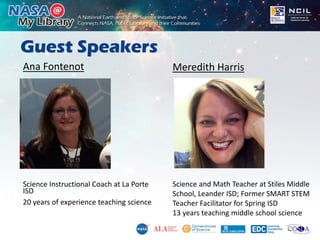
Guest Speakers
Ana Fontenot
Science Instructional Coach at La Porte
ISD
20 years of experience teaching science
Meredith Harris
Science and Math Teacher at Stiles Middle
School, Leander ISD; Former SMART STEM
Teacher Facilitator for Spring ISD
13 years teaching middle school science
Teacher Experiences
“Students learn differently, so the more ways
the phases can be shown the more chance of
them learning and forming a deeper
knowledge base of the moon phases”
How can Lunar Phases programs in libraries help
students and teachers?
Teacher Experiences
“It can be an entry point for students to
learn and understand the phases…
How can Lunar Phases programs in libraries help
students and teachers?
Teacher Experiences
“(There are) time limits in class…this will
build on what we try to do”
How can Lunar Phases programs in libraries help
students and teachers?
Hands-On Activity: How Far is
the Moon?
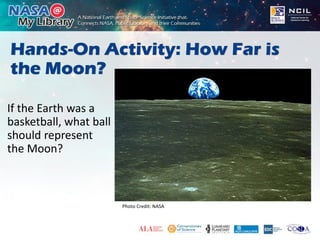
If the Earth was a
basketball, what ball
should represent
the Moon?
Photo Credit: NASA
Hands-On Activity: How Far is
the Moon?
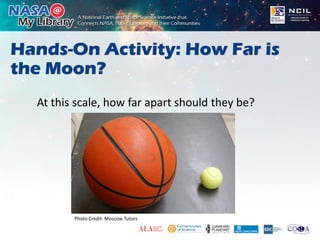
At this scale, how far apart should they be?
Photo Credit: Moscow Tutors
Hands-On Activity: How Far is
the Moon?
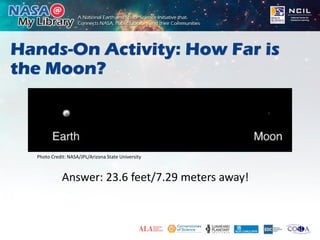
Answer: 23.6 feet/7.29 meters away!
Photo Credit: NASA/JPL/Arizona State University
Hands-On Activity: Loony
Lunar Phases
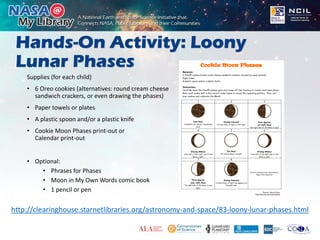
Supplies (for each child)
• 6 Oreo cookies (alternatives: round cream cheese
sandwich crackers, or even drawing the phases)
• Paper towels or plates
• A plastic spoon and/or a plastic knife
• Cookie Moon Phases print-out or
Calendar print-out
• Optional:
• Phrases for Phases
• Moon in My Own Words comic book
• 1 pencil or pen
http://clearinghouse.starnetlibraries.org/astronomy-and-space/83-loony-lunar-phases.html
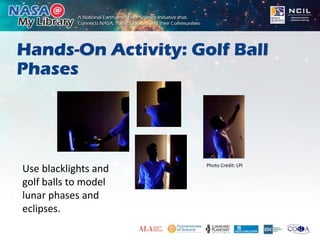
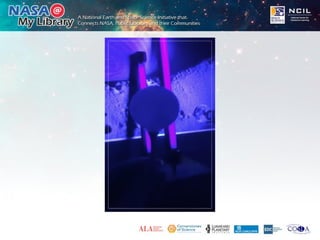
Hands-On Activity: Golf Ball
Phases
Use blacklights and
golf balls to model
lunar phases and
eclipses.
Photo Credit: LPI
Poll Question
In what way will you incorporate Moon phases activities
into your programs?
a. I already do Moon phases activities
b. I am going to start introducing basic concepts
c. I am excited to try Moon phases activities
d. I am going to work with teachers and colleagues to
understand Moon phases better before I facilitate a
program
e. I don’t feel like I am equipped to facilitate Moon
phases programs
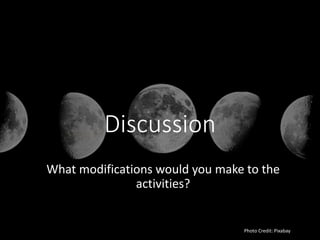
Discussion
What modifications would you make to the
activities?
Photo Credit: Pixabay
Discussion
How can you partner with a teacher for help?
Photo Credit: Pixabay
Partnering with a Teacher
Consider contacting a science teacher in your
area who teaches lunar phases
Invite him/her to
• Answer your questions about Moon phases
• Provide insight into their students'
challenges in understanding
• Assist with your Moon activities this summer
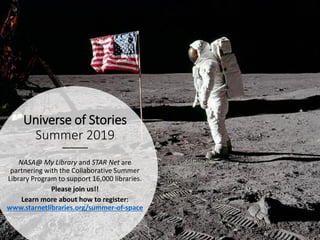
Universe of Stories
Summer 2019
NASA@ My Library and STAR Net are
partnering with the Collaborative Summer
Library Program to support 16,000 libraries.
Please join us!!
Learn more about how to register:
www.starnetlibraries.org/summer-of-space
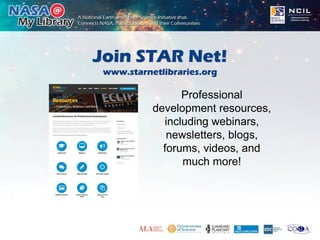
Join STAR Net!
www.starnetlibraries.org
Professional
development resources,
including webinars,
newsletters, blogs,
forums, videos, and
much more!

Exploring Lunar Phases: How Your Library Can Support Science Learning

  • 1.
    Exploring Lunar Phases:How Your Library Can Support Science Learning Presenters: Keliann LaConte, Christine Shupla, and Claire Ratcliffe The webinar will begin at 4:00 p.m. (CT) and will be recorded. While you’re waiting: 1) Find the toolbar – it will either be on the bottom or top of your Zoom window 2) Introduce yourself in the chat box (please select “Share with All” not “Share with Panelists”) 3) Click audio “Join by Computer” – you won’t have microphone access Tip for viewing: You can resize and move the location of the video and slide screens by clicking and dragging them
  • 2.
    Facilitator Introduction • KeliannLaConte (Space Science Institute) • Christine Shupla (Lunar and Planetary Institute) • Claire Ratcliffe (Space Science Institute)
  • 3.
    Today’s Agenda STAR NetOverview Poll Questions Teacher Experiences Hands-on Activity: Scale Model of Earth-Moon System Hands-on Activity: Looney Lunar Phases Hands-on Activity: Golf Ball Phases Discussion Universe of Stories
  • 4.
    Like an activityand think other library staff should know how great it is? Didn’t like an activity or have modifications to make it better? Make sure to leave a review!
  • 5.
    Poll Question How longdoes it take the Moon to orbit the Earth? a. Once a day b. Once a week c. Once a month d. Once a year e. It depends on the season
  • 6.
    Poll Question What domost children think causes the different phases of the Moon? a. The phases change according to the seasons b. Clouds c. Earth’s shadow d. Earth’s rotation e. The Moon grows a little bit bigger each day until it is full, then it gets smaller again
  • 7.
    So what’s actuallygoing on? Parts of the Moon reflect light depending on the position of the Earth in relation to the Sun and Moon.
  • 8.
    Guest Speakers Ana Fontenot ScienceInstructional Coach at La Porte ISD 20 years of experience teaching science Meredith Harris Science and Math Teacher at Stiles Middle School, Leander ISD; Former SMART STEM Teacher Facilitator for Spring ISD 13 years teaching middle school science
  • 9.
    Teacher Experiences “Students learndifferently, so the more ways the phases can be shown the more chance of them learning and forming a deeper knowledge base of the moon phases” How can Lunar Phases programs in libraries help students and teachers?
  • 10.
    Teacher Experiences “It canbe an entry point for students to learn and understand the phases… How can Lunar Phases programs in libraries help students and teachers?
  • 11.
    Teacher Experiences “(There are)time limits in class…this will build on what we try to do” How can Lunar Phases programs in libraries help students and teachers?
  • 12.
    Hands-On Activity: HowFar is the Moon? If the Earth was a basketball, what ball should represent the Moon? Photo Credit: NASA
  • 13.
    Hands-On Activity: HowFar is the Moon? At this scale, how far apart should they be? Photo Credit: Moscow Tutors
  • 14.
    Hands-On Activity: HowFar is the Moon? Answer: 23.6 feet/7.29 meters away! Photo Credit: NASA/JPL/Arizona State University
  • 15.
    Hands-On Activity: Loony LunarPhases Supplies (for each child) • 6 Oreo cookies (alternatives: round cream cheese sandwich crackers, or even drawing the phases) • Paper towels or plates • A plastic spoon and/or a plastic knife • Cookie Moon Phases print-out or Calendar print-out • Optional: • Phrases for Phases • Moon in My Own Words comic book • 1 pencil or pen http://clearinghouse.starnetlibraries.org/astronomy-and-space/83-loony-lunar-phases.html
  • 16.
    Hands-On Activity: GolfBall Phases Use blacklights and golf balls to model lunar phases and eclipses. Photo Credit: LPI
  • 18.
    Poll Question In whatway will you incorporate Moon phases activities into your programs? a. I already do Moon phases activities b. I am going to start introducing basic concepts c. I am excited to try Moon phases activities d. I am going to work with teachers and colleagues to understand Moon phases better before I facilitate a program e. I don’t feel like I am equipped to facilitate Moon phases programs
  • 19.
    Discussion What modifications wouldyou make to the activities? Photo Credit: Pixabay
  • 20.
    Discussion How can youpartner with a teacher for help? Photo Credit: Pixabay
  • 21.
    Partnering with aTeacher Consider contacting a science teacher in your area who teaches lunar phases Invite him/her to • Answer your questions about Moon phases • Provide insight into their students' challenges in understanding • Assist with your Moon activities this summer
  • 22.
    Universe of Stories Summer2019 NASA@ My Library and STAR Net are partnering with the Collaborative Summer Library Program to support 16,000 libraries. Please join us!! Learn more about how to register: www.starnetlibraries.org/summer-of-space
  • 23.
    Join STAR Net! www.starnetlibraries.org Professional developmentresources, including webinars, newsletters, blogs, forums, videos, and much more!