NANOTECHNOLOGY
Submitted to : Dr ANIL CHAUHAN
HEAD OF DEPARTMENT
Submitted by : SONAM CHUZIN
Msc. Food technology 1st year
Introduction
2
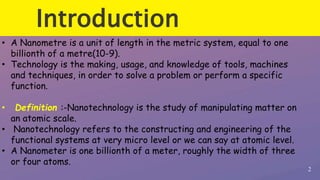
• A Nanometre is a unit of length in the metric system, equal to one
billionth of a metre(10-9).
• Technology is the making, usage, and knowledge of tools, machines
and techniques, in order to solve a problem or perform a specific
function.
• Definition :-Nanotechnology is the study of manipulating matter on
an atomic scale.
• Nanotechnology refers to the constructing and engineering of the
functional systems at very micro level or we can say at atomic level.
• A Nanometer is one billionth of a meter, roughly the width of three
or four atoms.
HISTORY
3
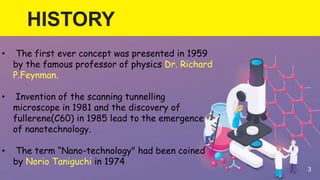
• The first ever concept was presented in 1959
by the famous professor of physics Dr. Richard
P.Feynman.
• Invention of the scanning tunnelling
microscope in 1981 and the discovery of
fullerene(C60) in 1985 lead to the emergence
of nanotechnology.
• The term “Nano-technology" had been coined
by Norio Taniguchi in 1974
BIG WHEEL OF NANOTECHNOLO
4
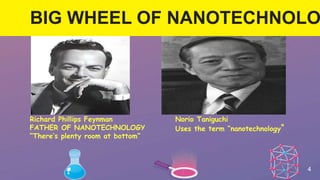
Richard Phillips Feynman
FATHER OF NANOTECHNOLOGY
“There’s plenty room at bottom”
Norio Taniguchi
Uses the term “nanotechnology”
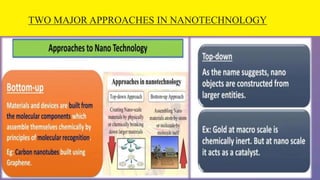
TWO MAJOR APPROACHES IN NANOTECHNOLOGY
5
KEY TERMS
6
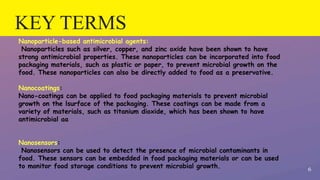
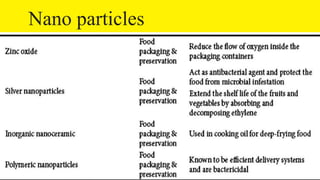
Nanoparticle-based antimicrobial agents:
Nanoparticles such as silver, copper, and zinc oxide have been shown to have
strong antimicrobial properties. These nanoparticles can be incorporated into food
packaging materials, such as plastic or paper, to prevent microbial growth on the
food. These nanoparticles can also be directly added to food as a preservative.
Nanocoatings:
Nano-coatings can be applied to food packaging materials to prevent microbial
growth on the lsurface of the packaging. These coatings can be made from a
variety of materials, such as titanium dioxide, which has been shown to have
antimicrobial aa
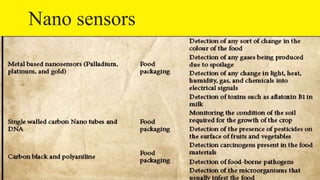
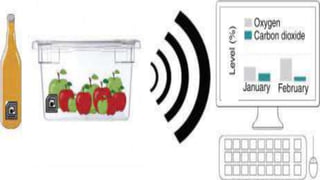
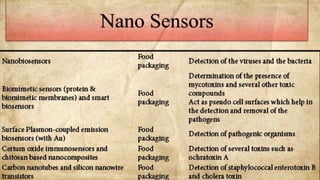
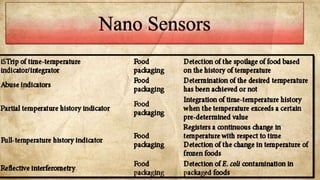
Nanosensors:
Nanosensors can be used to detect the presence of microbial contaminants in
food. These sensors can be embedded in food packaging materials or can be used
to monitor food storage conditions to prevent microbial growth.
7
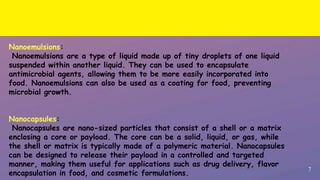
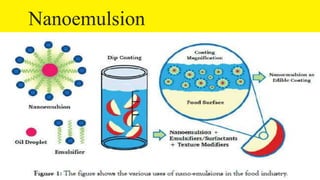
Nanoemulsions:
Nanoemulsions are a type of liquid made up of tiny droplets of one liquid
suspended within another liquid. They can be used to encapsulate
antimicrobial agents, allowing them to be more easily incorporated into
food. Nanoemulsions can also be used as a coating for food, preventing
microbial growth.
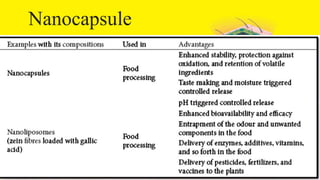
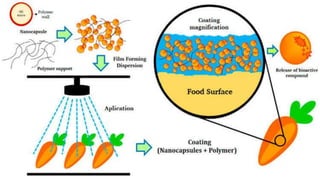
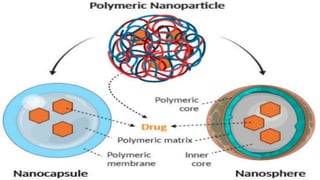
Nanocapsules:
Nanocapsules are nano-sized particles that consist of a shell or a matrix
enclosing a core or payload. The core can be a solid, liquid, or gas, while
the shell or matrix is typically made of a polymeric material. Nanocapsules
can be designed to release their payload in a controlled and targeted
manner, making them useful for applications such as drug delivery, flavor
encapsulation in food, and cosmetic formulations.
8
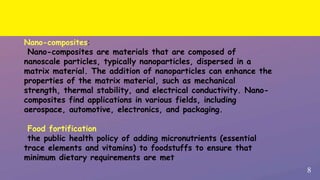
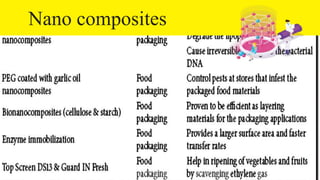
Nano-composites:
Nano-composites are materials that are composed of
nanoscale particles, typically nanoparticles, dispersed in a
matrix material. The addition of nanoparticles can enhance the
properties of the matrix material, such as mechanical
strength, thermal stability, and electrical conductivity. Nano-
composites find applications in various fields, including
aerospace, automotive, electronics, and packaging.
Food fortification
the public health policy of adding micronutrients (essential
trace elements and vitamins) to foodstuffs to ensure that
minimum dietary requirements are met
9
FOOD PROCESSING
10
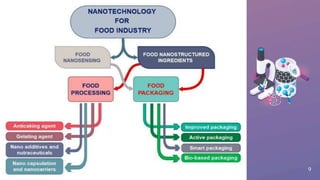
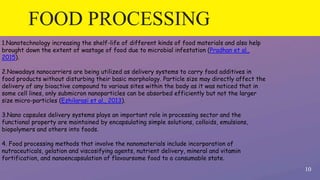
1.Nanotechnology increasing the shelf-life of different kinds of food materials and also help
brought down the extent of wastage of food due to microbial infestation (Pradhan et al.,
2015).
2.Nowadays nanocarriers are being utilized as delivery systems to carry food additives in
food products without disturbing their basic morphology. Particle size may directly affect the
delivery of any bioactive compound to various sites within the body as it was noticed that in
some cell lines, only submicron nanoparticles can be absorbed efficiently but not the larger
size micro-particles (Ezhilarasi et al., 2013).
3.Nano capsules delivery systems plays an important role in processing sector and the
functional property are maintained by encapsulating simple solutions, colloids, emulsions,
biopolymers and others into foods.
4. Food processing methods that involve the nanomaterials include incorporation of
nutraceuticals, gelation and viscosifying agents, nutrient delivery, mineral and vitamin
fortification, and nanoencapsulation of flavoursome food to a consumable state.
Nanocapsule
11
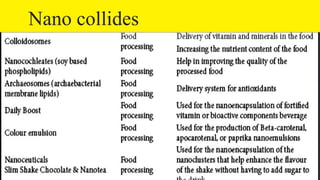
• In Figure , diagrammatic examples
of several nonmaterial used in food
processing are summarized. Processing
of food is mainly carried out in order
to keep the food intact and also to
increase its shelf life.
12
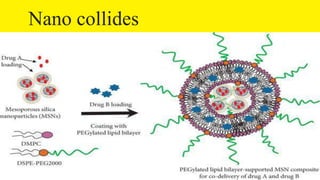
Nano collides
13
Nano collides
14
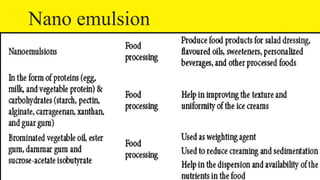
Nano emulsion
15
Nanoemulsion
16
Food Packaging
17
• Food packaging for food requires protection, tampering
resistance, and special physical, chemical, or biological needs.
• It also shows the product that is labelled to show any nutrition
information on the food being consumed.
• Nano-based “smart” and “active” food packaging's confer several
advantages over conventional packaging methods from providing better
packaging material with improved mechanical strength, barrier properties,
antimicrobial films to nanosensing for pathogen detection and alerting
consumers to the safety status of food (Mihindukulasuriya and Lim, 2014).
• Nanotechnology in packaging is categorized based on the purpose
of the application.
18
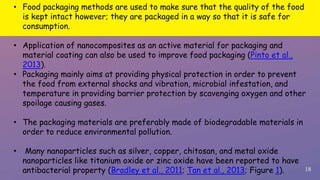
• Food packaging methods are used to make sure that the quality of the food
is kept intact however; they are packaged in a way so that it is safe for
consumption.
• Application of nanocomposites as an active material for packaging and
material coating can also be used to improve food packaging (Pinto et al.,
2013).
• Packaging mainly aims at providing physical protection in order to prevent
the food from external shocks and vibration, microbial infestation, and
temperature in providing barrier protection by scavenging oxygen and other
spoilage causing gases.
• The packaging materials are preferably made of biodegradable materials in
order to reduce environmental pollution.
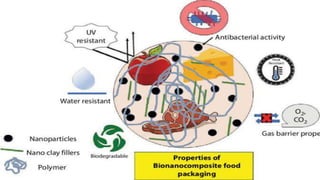
• Many nanoparticles such as silver, copper, chitosan, and metal oxide
nanoparticles like titanium oxide or zinc oxide have been reported to have
antibacterial property (Bradley et al., 2011; Tan et al., 2013; Figure 1).
Nano sensors
19
20
21
22
Nano composites
23
24
Nano particles
25
26
Reference
27
Pradhan, N., Singh, S., Ojha, N., Srivastava, A., Barla, A., Rai, V., et al. (2015). Facets of
nanotechnology as seen in food processing, packaging, and preservation industry. BioMed Res.
Int. 2015:365672. doi: 10.1155/2015/365672
Ezhilarasi, P. N., Karthik, P., Chhanwal, N., and Anandharamakrishnan, C. (2013).
Nanoencapsulation techniques for food bioactive components: a review. Food Bioprocess
Technol. 6, 628–647. doi: 10.1007/s11947-012-0944-0
Pinto, R. J. B., Daina, S., Sadocco, P., Neto, C. P., and Trindade, T. (2013). Antibacterial activity
of nanocomposites of copper and cellulose. BioMed Res. Int. 6:280512. doi:
10.1155/2013/280512
Mihindukulasuriya, S. D. F., and Lim, L. T. (2014). Nanotechnology development in food packaging:
a review. Trends Food Sci. Technol. 40, 149–167. doi: 10.1016/j.tifs.2014.09.009
Bradley, E. L., Castle, L., and Chaudhry, Q. (2011). Applications of nanomaterials in food
packaging with a consideration of opportunities for developing countries. Trends Food Sci.
28
THANK
YOU

Nanotechnology - FOOD PROCESSING final copy.pptx

  • 1.
    NANOTECHNOLOGY Submitted to :Dr ANIL CHAUHAN HEAD OF DEPARTMENT Submitted by : SONAM CHUZIN Msc. Food technology 1st year
  • 2.
    Introduction 2 • A Nanometreis a unit of length in the metric system, equal to one billionth of a metre(10-9). • Technology is the making, usage, and knowledge of tools, machines and techniques, in order to solve a problem or perform a specific function. • Definition :-Nanotechnology is the study of manipulating matter on an atomic scale. • Nanotechnology refers to the constructing and engineering of the functional systems at very micro level or we can say at atomic level. • A Nanometer is one billionth of a meter, roughly the width of three or four atoms.
  • 3.
    HISTORY 3 • The firstever concept was presented in 1959 by the famous professor of physics Dr. Richard P.Feynman. • Invention of the scanning tunnelling microscope in 1981 and the discovery of fullerene(C60) in 1985 lead to the emergence of nanotechnology. • The term “Nano-technology" had been coined by Norio Taniguchi in 1974
  • 4.
    BIG WHEEL OFNANOTECHNOLO 4 Richard Phillips Feynman FATHER OF NANOTECHNOLOGY “There’s plenty room at bottom” Norio Taniguchi Uses the term “nanotechnology”
  • 5.
    TWO MAJOR APPROACHESIN NANOTECHNOLOGY 5
  • 6.
    KEY TERMS 6 Nanoparticle-based antimicrobialagents: Nanoparticles such as silver, copper, and zinc oxide have been shown to have strong antimicrobial properties. These nanoparticles can be incorporated into food packaging materials, such as plastic or paper, to prevent microbial growth on the food. These nanoparticles can also be directly added to food as a preservative. Nanocoatings: Nano-coatings can be applied to food packaging materials to prevent microbial growth on the lsurface of the packaging. These coatings can be made from a variety of materials, such as titanium dioxide, which has been shown to have antimicrobial aa Nanosensors: Nanosensors can be used to detect the presence of microbial contaminants in food. These sensors can be embedded in food packaging materials or can be used to monitor food storage conditions to prevent microbial growth.
  • 7.
    7 Nanoemulsions: Nanoemulsions are atype of liquid made up of tiny droplets of one liquid suspended within another liquid. They can be used to encapsulate antimicrobial agents, allowing them to be more easily incorporated into food. Nanoemulsions can also be used as a coating for food, preventing microbial growth. Nanocapsules: Nanocapsules are nano-sized particles that consist of a shell or a matrix enclosing a core or payload. The core can be a solid, liquid, or gas, while the shell or matrix is typically made of a polymeric material. Nanocapsules can be designed to release their payload in a controlled and targeted manner, making them useful for applications such as drug delivery, flavor encapsulation in food, and cosmetic formulations.
  • 8.
    8 Nano-composites: Nano-composites are materialsthat are composed of nanoscale particles, typically nanoparticles, dispersed in a matrix material. The addition of nanoparticles can enhance the properties of the matrix material, such as mechanical strength, thermal stability, and electrical conductivity. Nano- composites find applications in various fields, including aerospace, automotive, electronics, and packaging. Food fortification the public health policy of adding micronutrients (essential trace elements and vitamins) to foodstuffs to ensure that minimum dietary requirements are met
  • 9.
  • 10.
    FOOD PROCESSING 10 1.Nanotechnology increasingthe shelf-life of different kinds of food materials and also help brought down the extent of wastage of food due to microbial infestation (Pradhan et al., 2015). 2.Nowadays nanocarriers are being utilized as delivery systems to carry food additives in food products without disturbing their basic morphology. Particle size may directly affect the delivery of any bioactive compound to various sites within the body as it was noticed that in some cell lines, only submicron nanoparticles can be absorbed efficiently but not the larger size micro-particles (Ezhilarasi et al., 2013). 3.Nano capsules delivery systems plays an important role in processing sector and the functional property are maintained by encapsulating simple solutions, colloids, emulsions, biopolymers and others into foods. 4. Food processing methods that involve the nanomaterials include incorporation of nutraceuticals, gelation and viscosifying agents, nutrient delivery, mineral and vitamin fortification, and nanoencapsulation of flavoursome food to a consumable state.
  • 11.
  • 12.
    • In Figure, diagrammatic examples of several nonmaterial used in food processing are summarized. Processing of food is mainly carried out in order to keep the food intact and also to increase its shelf life. 12
  • 13.
  • 14.
  • 15.
  • 16.
  • 17.
    Food Packaging 17 • Foodpackaging for food requires protection, tampering resistance, and special physical, chemical, or biological needs. • It also shows the product that is labelled to show any nutrition information on the food being consumed. • Nano-based “smart” and “active” food packaging's confer several advantages over conventional packaging methods from providing better packaging material with improved mechanical strength, barrier properties, antimicrobial films to nanosensing for pathogen detection and alerting consumers to the safety status of food (Mihindukulasuriya and Lim, 2014). • Nanotechnology in packaging is categorized based on the purpose of the application.
  • 18.
    18 • Food packagingmethods are used to make sure that the quality of the food is kept intact however; they are packaged in a way so that it is safe for consumption. • Application of nanocomposites as an active material for packaging and material coating can also be used to improve food packaging (Pinto et al., 2013). • Packaging mainly aims at providing physical protection in order to prevent the food from external shocks and vibration, microbial infestation, and temperature in providing barrier protection by scavenging oxygen and other spoilage causing gases. • The packaging materials are preferably made of biodegradable materials in order to reduce environmental pollution. • Many nanoparticles such as silver, copper, chitosan, and metal oxide nanoparticles like titanium oxide or zinc oxide have been reported to have antibacterial property (Bradley et al., 2011; Tan et al., 2013; Figure 1).
  • 19.
  • 20.
  • 21.
  • 22.
  • 23.
  • 24.
  • 25.
  • 26.
  • 27.
    Reference 27 Pradhan, N., Singh,S., Ojha, N., Srivastava, A., Barla, A., Rai, V., et al. (2015). Facets of nanotechnology as seen in food processing, packaging, and preservation industry. BioMed Res. Int. 2015:365672. doi: 10.1155/2015/365672 Ezhilarasi, P. N., Karthik, P., Chhanwal, N., and Anandharamakrishnan, C. (2013). Nanoencapsulation techniques for food bioactive components: a review. Food Bioprocess Technol. 6, 628–647. doi: 10.1007/s11947-012-0944-0 Pinto, R. J. B., Daina, S., Sadocco, P., Neto, C. P., and Trindade, T. (2013). Antibacterial activity of nanocomposites of copper and cellulose. BioMed Res. Int. 6:280512. doi: 10.1155/2013/280512 Mihindukulasuriya, S. D. F., and Lim, L. T. (2014). Nanotechnology development in food packaging: a review. Trends Food Sci. Technol. 40, 149–167. doi: 10.1016/j.tifs.2014.09.009 Bradley, E. L., Castle, L., and Chaudhry, Q. (2011). Applications of nanomaterials in food packaging with a consideration of opportunities for developing countries. Trends Food Sci.
  • 28.