
Nanotechnology
for
Green Building
Green Technology Forum 2007
Nanotechnology for Green
Building
© 2007 Dr. George Elvin
Green Technology Forum
Table of Contents
Executive Summary
Part 1: Nanotechnology and Green Building
1. Introduction
1.1 Green Building
1.2 Nanotechnology
1.3 Convergence
Part 2: Materials
2. Insulation
2.1 Aerogel
2.2 Thin-film insulation
2.3 Insulating coatings
2.4 Emerging insulation technologies
2.5 Future market for nano-insulation
3. Coatings
3.1 Self-cleaning coatings
3.2 Anti-stain coatings
3.3 Depolluting surfaces
3.4 Scratch-resistant coatings
3.5 Anti-fogging and anti-icing coatings
3.6 Antimicrobial coatings
3.7 UV protection
3.8 Anti-corrosion coatings
3.9 Moisture resistance
4. Adhesives
5. Lighting
5.1 Light-emitting diodes (LEDs)
5.2 Organic light-emitting diodes (OLEDs)
5.3 Quantum dot lighting
5.4 Future market for lighting
6. Solar energy
6.1 Silicon solar enhancement
6.2 Thin-film solar nanotechnologies
6.3 Emerging solar nanotechnologies
7. Energy storage
8. Air purification
9. Water purification
10. Structural materials
10.1 Concrete
10.2 Steel
10.3 Wood
10.4 New structural materials
11. Non-structural materials
11.1 Glass
11.2 Plastics and polymers
11.3 Drywall
11.4 Roofing
Part 3: Conclusions
12. Additional benefits
12.1 Nanosensors and smart environments
12.2 Multifunctional properties
12.3 Reduced processing energy
12.4 Adaptability to existing buildings
13. Market forces
13.1 Forces accelerating adoption
13.2 Obstacles to adoption
14. Future trends and needs
14.1 Independent testing
14.2 Life cycle analysis
14.3 Societal concerns
14.4 Environmental and human health concerns
14.5 Regulation
References and links
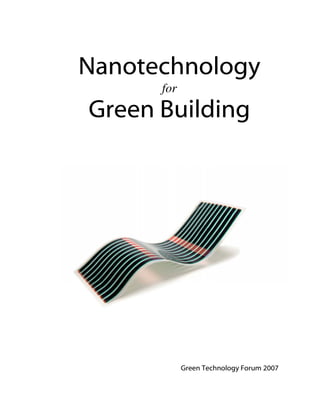
cover: flexible solar panel from konarka
acknowledgements: an initial study of energy-efficient nanomaterials was made possible by a
fellowship at the center for energy research, education and service
Nanotechnology for Green Building © 2007 Dr. George Elvin
1
Executive summary
This report offers a comprehensive research review of current and near future
applications of nanotechnology for green building. Its results suggest that the potential
for energy conservation and reduced waste, toxicity, non-renewable resource
consumption, and carbon emissions through the architectural applications of
nanotechnology is significant. These environmental performance improvements will
be led by current improvements in insulation, coatings, air and water purification,
followed by forthcoming advances in solar and lighting technology, and more distant
(>10 years) potential in structural components and adhesives. U.S. demand for nano-
enhanced building materials totaled less than $20 million in 2006, but the market is
expected to reach almost $400 million by 2016. Green building, meanwhile, accounts
for $12 billion of the $142 billion U.S. construction market.1
The convergence of
green building and nanotechnology will result in economic opportunities for both
industries and, most importantly, significant improvements in human and
environmental health.
Based on our research, we divide the timeline for nano-enhanced building materials
into three phases. First, current architectural market applications of nanotechnology
are led by nanocoatings for insulating, self-cleaning, UV protection, corrosion
resistance, and waterproofing. Many of these coatings incorporate titanium dioxide
nanoparticles to make surfaces not only self-cleaning but also depolluting, able to
remove pollutants from the surrounding atmosphere. Insulating nanocoatings promise
significant energy savings, particularly for existing buildings which can be difficult to
insulate with conventional materials. Already gaining market share rapidly in
industrial applications, insulating nanocoatings will soon have a major impact in
architecture.
Coming soon are nanotechnologies for solar energy, lighting, and water and air
filtration. Nano-enhanced solar cell technologies such as organic thin-film and roll-to-
roll processing are also well under development and will gain an increasing share of
the solar cell market in coming years. Not far behind is nano-enhanced lighting such
as organic light-emitting diodes (OLEDs) and quantum dot lighting. Market
applications of these technologies have already begun with small consumer devices
like cellphone screens, are beginning to enter the architectural lighting market, and
will gain an increasing percentage of that market in the future due to their energy-
saving capabilities. Nanotechnologies for water and air filtration, already widely
available as consumer products, will gain an increasing percentage of the market for
built-in filtration systems.
In the future, advances in fire protection through nanotechnology suggest great
opportunity as extensive research in this area moves from the universities and research
centers into commercial production. Extensive research underway on nano-
enhancement of structural materials including steel, concrete and wood suggests that
Nanotechnology for Green Building © 2007 Dr. George Elvin
2
dramatic improvements are possible in this area, although their marketplace
applications are, in most cases, many years off.
Public and building industry reaction to nanotechnology has been largely positive so
far. Nanomaterials have already been used in hundreds of buildings, including high-
end projects like the Jubilee Church in Rome by Richard Meier and Partners and New
York’s Bond Street Apartment Building by Herzog & de Meuron. We have even
incorporated several nanocoatings into our office construction at Green Technology
Forum with positive results.
However, a number of factors stand in the way of widespread adoption. Current
obstacles to the adoption of nanotechnology for green building include the high cost of
many nanotech products and processes, risk aversion and the traditional hesitancy of
the building industry to embrace new technologies, as well as uncertainty about the
health and environmental effects of nanoparticles and public acceptance of
nanotechnology. Lack of independent testing and the current reliance on manufacturer
claims in determining the architectural and environmental performance of most nano-
products could also hinder adoption.
But as this report reveals, many nano-enhanced products are available today which
offer substantial architectural and environmental performance improvements over
conventional products. Many coatings, for example, can protect building surfaces and
reduce the need for harsh chemical cleansers while producing no volatile organic
compounds (VOCs) and even removing pollutants from their surroundings. If
consumers embrace nanotechnology as a green technology, if building owners,
architects, contractors and engineers accept uncertainty and risk and embrace
innovation, and if the high cost of nano-products continues to fall, the tremendous
promise of nanotechnology for green building will be realized.
As prices for nano-enhanced building products continue to fall, as buyers weigh their
life cycle and environmental cost advantages, and building industry leaders become
more familiar with nanotechnology, its widespread adoption seems inevitable.
Nanotechnology for green building will reduce waste and toxicity, as well as energy
and raw material consumption in the building industry, resulting in cleaner, healthier
buildings. In addition to the human health and environmental benefits nanotechnology
for green building is poised to make, economic benefits for both the building industry
and nanomaterials industry appear considerable. The demand for green building is at a
an all-time high, and building owners, architects, contractors and engineers adopting
nanotechnology for green building are likely to emerge as leaders and be rewarded
accordingly for their services. For nanotechnology companies, green building
represents one of the largest markets possible for new products and processes.
The Green Technology Forum report on nanotechnology for green building identifies
130 startups and established companies offering or developing nanomaterials for green
building, 54 projects underway at universities and research centers, 43 recent patents
available for licensing, and over 250 citations and links to these resources.
Nanotechnology for Green Building © 2007 Dr. George Elvin
3
Part 1. Nanotechnology and Green Building
1. Introduction
The design, construction and operation of buildings is a $1 trillion per year market as
yet largely untouched by nanotechnology. Demand for nanomaterials in the U.S.
construction industry in 2006 totaled less than $20 million.2
However, as this report
shows, the migration of the entire building industry toward more sustainable “green”
practices is a multi-billion dollar opportunity for the makers and suppliers of
nanotech-based materials and products. For architects, engineers, developers,
contractors and building owners, new nanomaterials and nano-products offer
extraordinary environmental benefits to help meet the rapidly growing demand for
greener, more sustainable buildings.
Nanotechnology, the manipulation of matter at the molecular scale, is bringing new
materials and new possibilities to industries as diverse as electronics, medicine, energy
and aeronautics. Our ability to design new materials from the bottom up is impacting
the building industry as well. New materials and products based on nanotechnology
can be found in building insulation, coatings, and solar technologies. Work now
underway in nanotech labs will soon result in new products for lighting, structures,
and energy.
In the building industry, nanotechnology has already brought to market self-cleaning
windows, smog-eating concrete, and many other advances. But these advances and
currently available products are minor compared to those incubating in the world’s
nanotech labs today. There, work is underway on illuminating walls that change color
with the flip of a switch, nanocomposites as thin as glass yet capable of supporting
entire buildings, and photosynthetic surfaces making any building façade a source of
free energy. By 2016, the market for nanomaterials in U.S. construction is expected to
reach almost $400 million, twenty times its current volume.3
1.1 Green building
The advent of the nano era in building could not have come at a better time, as the
building industry moves aggressively toward sustainability. Green building is one of
the most urgent environmental issues of our time. The energy services required by
residential, commercial, and industrial buildings are responsible for approximately 43
percent of U.S. carbon dioxide emissions. Worldwide, buildings consume between 30
and 40 percent of the world’s electricity.4
Waste from building construction accounts
for 40 percent of all landfill material in the U.S., and sick building syndrome costs an
Nanotechnology for Green Building © 2007 Dr. George Elvin
4
estimated $60 billion in healthcare costs annually. Deforestation, soil erosion,
environmental pollution, acidification, ozone depletion, fossil fuel depletion, global
climate change, and human health risks are all attributable in some measure to
building construction and operation. Clearly, buildings play a leading role in our
current environmental predicament.
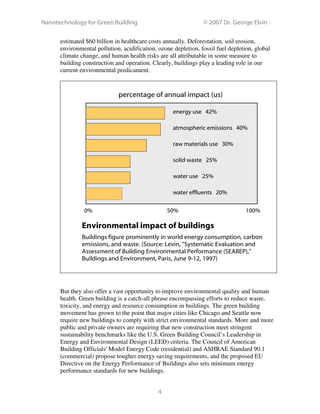
Environmental impact of buildings
Buildings figure prominently in world energy consumption, carbon
emissions, and waste. (Source: Levin, “Systematic Evaluation and
Assessment of Building Environmental Performance (SEABEP),”
Buildings and Environment, Paris, June 9-12, 1997)
But they also offer a vast opportunity to improve environmental quality and human
health. Green building is a catch-all phrase encompassing efforts to reduce waste,
toxicity, and energy and resource consumption in buildings. The green building
movement has grown to the point that major cities like Chicago and Seattle now
require new buildings to comply with strict environmental standards. More and more
public and private owners are requiring that new construction meet stringent
sustainability benchmarks like the U.S. Green Building Council’s Leadership in
Energy and Environmental Design (LEED) criteria. The Council of American
Building Officials' Model Energy Code (residential) and ASHRAE Standard 90.1
(commercial) propose tougher energy saving requirements, and the proposed EU
Directive on the Energy Performance of Buildings also sets minimum energy
performance standards for new buildings.
atmospheric emissions 40%
energy use 42%
raw materials use 30%
solid waste 25%
water use 25%
water effluents 20%
100%50%0%
percentage of annual impact (us)
Nanotechnology for Green Building © 2007 Dr. George Elvin
5
In 2007, the green building sector of the $142 billion U.S. construction market is
expected to exceed $12 billion.5
And as owners, architects and builders worldwide
become increasingly committed to green building, a true paradigm shift is emerging,
from buildings as one of the primary causes of environmental damage and global
climate change to the industry with the greatest potential to reduce carbon emissions,
waste, and energy consumption.
Analyses of global climate change and global-scale plans to alleviate it affirm the
importance of building as our primary opportunity to heal the planet. “Tackling
Climate Change in the U.S.,” by the American Solar Energy Society, for example,
suggests that 40 percent of the energy savings required to achieve necessary carbon
reductions could come from the building sector, with transportation and industry
providing about 30 percent each.6
Better building envelope design, daylighting, more
efficient artificial lighting, and better efficiency standards for building components
and appliances are all opportunities to make the building industry the leader in fighting
global climate change and advancing sustainable development and energy
conservation.
Green building practitioners seek to implement sustainable development,
“development that meets the needs of the present without compromising the ability of
future generations to meet their own needs,” in the design, construction and operation
of buildings.7
They strive to minimize the use of non-renewable resources like coal,
petroleum, natural gas and minerals, and minimize waste and pollutants. Energy
conservation is critical to green building because it both conserves resources and
reduces waste and pollutants.
But a number of obstacles stand between green builders and these goals. Education
and economics are certainly factors, and efforts are well underway to inform clients
that initial design and construction costs for green buildings are typically less than 5
percent more than the waste- and energy-intensive buildings of the past, and that life
cycle costs for green buildings are actually lower. Policies, regulations and standards
also play a role, and these are changing quickly in some areas to allow for greener
alternatives like recycled materials and graywater systems.
But for the building industry to achieve its potential as the leader in sustainable
development, new materials are urgently needed. A trip to the lumber yard just a few
years ago to buy materials for a new deck, for example, would turn up the unpleasant
options of arsenic-laden pressure-treated lumber, non-renewable old-growth redwood,
or environmentally toxic vinyl decking. An effort to conserve energy by installing attic
insulation would meet with the alternatives of fiberglass, polystyrene, or cellulose
laced with fire-retardant chemicals, all considered dangerous. Current windows are
extremely poor insulators, leading to increased energy consumption. And alternatives
to polyvinyl chloride (PVC) pipe for plumbing are healthier than this known
carcinogen but scarce and costly. Now, however, a new frontier is opening in building
materials as nanotechnology introduces new products and new possibilities.
Nanotechnology for Green Building © 2007 Dr. George Elvin
6
1.2 Nanotechnology
Nanotechnology, the understanding and control of matter at dimensions of roughly
one to one hundred billionths of a meter, is bringing dramatic changes to the materials
and processes of science and industry worldwide. $13 billion worth of products
incorporating nanotechnology were sold last year, with sales expected to top $1 trillion
by 2015.8
In 2004, over $8 billion was spent in the U.S. alone on nanotech research
and development.
Dimensions at the nanoscale
The diameter of a nanoparticle is to the diameter of a soccer ball as the
soccer ball’s diameter is to the Earth’s. (Source: Green Technology
Forum)
By working at the molecular level, nanotechnology opens up new possibilities in
material design. In the nanoscale world where quantum physics rules, objects can
change color, shape, and phase much more easily than at the macroscale. Fundamental
properties like strength, surface-to-mass ratio, conductivity, and elasticity can be
designed in to create dramatically different materials.
Nanoparticles have unique mechanical, electrical, optical and reactive properties
distinct from larger particles. Their study (nanoscience) and manipulation
(nanotechnology) also open up the convergence of synthetic and biological materials
Nanotechnology for Green Building © 2007 Dr. George Elvin
7
as we explore biological systems which are configured to the nanoscale. Crossing the
traditional boundaries between living and non-living systems allows for the design of
new materials with the advantages of both, and it raises ethical concerns. Advances in
biomaterials and biocomposites converge with advances in nanotechnology, and an
increase in their application to construction seems certain to emerge in the future.
Carbon nanotubes
Carbon nanotubes can be up to 250 times stronger than steel and 10
times lighter, as well as electrically and thermally conductive. (Source:
Nanomix)
But with new materials and technologies come new concerns. Uncertainty surrounding
the interaction of nanoscale particles with the environment and the human body has
led to caution and concern about toxicology, worker health and safety, and regulation.
Regulations specific to nanomaterials and products have been slow to emerge, partly
due to the inherent difficulty in regulating materials based on particle size, as well as
lack of public outcry in favor of stiffer regulation and the success so far of self-
regulation by industry and the avoidance of any nano-disasters.
Nanotechnology for Green Building © 2007 Dr. George Elvin
8
1.3 Convergence
“It is not as though nanotechnology will be an option; it is going to be essential for
coming up with sustainable technologies.” advises Paul Anastas, director of the
American Chemical Society Green Chemistry Institute. 9
The nanotech community
appears ready to meet Anatsas’ challenge, and the market for nano-based products and
processes for sustainability is expected to grow from $12 billion in 2006 to $37 billion
by 2015.10
New materials and processes brought about by nanotechnology, for
example, offer tremendous potential for fighting global climate change. According to
the report, “Nanotechnologies for Sustainable Energy,” by Research and Markets,
“Current applications of nanotechnologies will result in a global annual saving of
8,000 tons of carbon dioxide in 2007, rising to over 1 million tons by 2014.”11
Globally, nanotechnologies are expected to reduce carbon emissions in three main
areas: 1) transportation, 2) improved insulation in residential and commercial
buildings, and 3) generation of renewable photovoltaic energy.12
It is worth noting that
the last two of these three areas are centered in the building industry, suggesting that
building could in fact lead the green nano revolution.
Many nano-enhanced products and processes now on the market can help create more
sustainable, energy-conserving buildings, providing materials that reduce waste and
toxic outputs as well as dependence on non-renewable resources. Other products still
in development offer even more promise for dramatically improving the
environmental and energy performance of buildings. Nano-enabled advances for
energy conservation in architecture include new materials like carbon nanotubes and
insulating nanocoatings, as well as new processes including photocatalysis.
Nanomaterials can improve the strength, durability, and versatility of structural and
non-structural materials, reduce material toxicity, and improve building insulation.
Nanotechnology markets 2007
Building construction is not yet a significant market for nanotechnology.
(Source: Cientifica, “Nanotechnologies and energy whitepaper,” 2007)
chemical 53%
semiconductor 34%
electronics 7%
aero/defense 3%
pharma/health 2%
automotive 1%
food <1%
Nanotechnology for Green Building © 2007 Dr. George Elvin
9
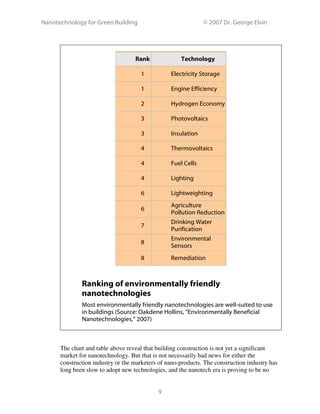
Rank Technology
1 Electricity Storage
1 Engine Efficiency
2 Hydrogen Economy
3 Photovoltaics
3 Insulation
4 Thermovoltaics
4 Fuel Cells
4 Lighting
6 Lightweighting
6
Agriculture
Pollution Reduction
7
Drinking Water
Purification
8
Environmental
Sensors
8 Remediation
Ranking of environmentally friendly
nanotechnologies
Most environmentally friendly nanotechnologies are well-suited to use
in buildings (Source: Oakdene Hollins, “Environmentally Beneficial
Nanotechnologies,” 2007)
The chart and table above reveal that building construction is not yet a significant
market for nanotechnology. But that is not necessarily bad news for either the
construction industry or the marketers of nano-products. The construction industry has
long been slow to adopt new technologies, and the nanotech era is proving to be no
Nanotechnology for Green Building © 2007 Dr. George Elvin
10
exception. The demands of public and private building owners for greener materials,
demands increasingly being enforced as regulations in many instances, will soon force
architects and engineers to specify greener materials in buildings. This demand,
combined with the environmentally friendly character of most nano-products for
architecture, will create a synergy that we expect will result in a boom in demand for
nanotechnology for green building.
Nanotechnology for Green Building © 2007 Dr. George Elvin
11
Part 2. Materials
2. Insulation
The market for green building materials and technologies will of course be determined
more by market pull--the needs of architects, owners and contractors--than by the
technological push of new nanomaterials discovered and developed in the laboratory.
But the convergence of green building demands and green nanotechnology capabilities
over the next 5-10 years appears very strong. It suggests eight categories of
nanotechnology for green building that are the focus of this report.
Insulation
Coatings
Adhesives
Solar energy
Lighting
Air and water filtration
Structural materials
Non-structural materials
The demand from both public and private enterprise for more energy efficient
buildings will lead to significant growth in the insulation sector in the next few years.
Valued at $7.2 billion value in 2005, it is expected to reach $9.5 billion by 2010.13
Current building insulation is estimated to save about 12 quadrillion Btu annually or
42 percent of the energy that would be consumed without it.14
Building insulation
reduces the amount of energy required to maintain a comfortable environment.
Reduced energy consumption, in turn, means reduced carbon emissions from energy
production. Insulation is, in fact, the most cost-effective means of reducing carbon
emissions available today.
Improving on current building insulation could save even more energy and carbon
emissions. EU households, for instance, are responsible for one quarter of EU carbon
emissions, roughly 70 percent of which comes from meeting space heating needs.
Space heating savings through better insulation in Germany, The Netherlands, Italy,
UK, Spain and Ireland, would reduce EU carbon emissions by 100 million metric tons
per year.15
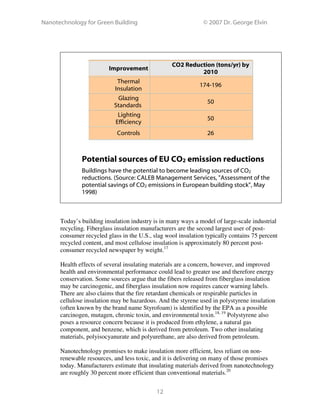
As the table below indicates, improved thermal insulation could meet over
25 percent of EU carbon reduction goals by 2010. In the U.S., improved insulation
could save 2.2 quadrillion Btu of energy (3 percent of total energy use) and reduce
carbon emissions by 294 billion pounds annually.16
Nanotechnology for Green Building © 2007 Dr. George Elvin
12
Improvement
CO2 Reduction (tons/yr) by
2010
Thermal
Insulation
174-196
Glazing
Standards
50
Lighting
Efficiency
50
Controls 26
Potential sources of EU CO2 emission reductions
Buildings have the potential to become leading sources of CO2
reductions. (Source: CALEB Management Services, "Assessment of the
potential savings of CO2 emissions in European building stock", May
1998)
Today’s building insulation industry is in many ways a model of large-scale industrial
recycling. Fiberglass insulation manufacturers are the second largest user of post-
consumer recycled glass in the U.S., slag wool insulation typically contains 75 percent
recycled content, and most cellulose insulation is approximately 80 percent post-
consumer recycled newspaper by weight.17
Health effects of several insulating materials are a concern, however, and improved
health and environmental performance could lead to greater use and therefore energy
conservation. Some sources argue that the fibers released from fiberglass insulation
may be carcinogenic, and fiberglass insulation now requires cancer warning labels.
There are also claims that the fire retardant chemicals or respirable particles in
cellulose insulation may be hazardous. And the styrene used in polystyrene insulation
(often known by the brand name Styrofoam) is identified by the EPA as a possible
carcinogen, mutagen, chronic toxin, and environmental toxin.18, 19
Polystyrene also
poses a resource concern because it is produced from ethylene, a natural gas
component, and benzene, which is derived from petroleum. Two other insulating
materials, polyisocyanurate and polyurethane, are also derived from petroleum.
Nanotechnology promises to make insulation more efficient, less reliant on non-
renewable resources, and less toxic, and it is delivering on many of those promises
today. Manufacturers estimate that insulating materials derived from nanotechnology
are roughly 30 percent more efficient than conventional materials.20
Nanotechnology for Green Building © 2007 Dr. George Elvin
13
Nanoscale materials hold great promise as insulators because of their extremely high
surface-to-volume ratio. This gives them the ability to trap still air within a material
layer of minimal thickness (conventional insulating materials like fiberglass and
polystyrene get their high insulating value less from the conductive properties of the
materials themselves than from their ability to trap still air.) Insulating nanomaterials
may be sandwiched between rigid panels, applied as thin films, or painted on as
coatings.
Making nanofibers from cotton waste
While cellulose insulation is made from 80 percent post-consumer
recycled newspaper, the equivalent of 25 million 480-pound cotton
bales are discarded as scrap every year in the garment industry.
"Producing a high-performance material from reclaimed cellulose
material will increase motivation to recycle these materials at all
phases of textile production and remove them from the waste
stream," said Margaret Frey, an assistant professor of textiles and
apparel at Cornell.
Frey and her collaborators are using electrospinning techniques to
produce usable nanofibers from waste cellulose. These nanofibers
could form the basis of new insulating materials from cellulose
which, as the basic building block of all plant life, represents the
most abundant renewable resource on the planet.21
2.1 Aerogel
Aerogel is an ultra-low density solid, a gel in which the liquid component has been
replaced with gas. Nicknamed “frozen smoke”, aerogel has a content of just 5 percent
solid and 95 percent air, and is said to be the lightest weight solid in the world. Despite
its lightness, however, aerogel can support over 2,000 times its own weight.
Because nanoporous aerogels can be sensitive to moisture, they are often marketed
sandwiched between wall panels that repel moisture. Aerogel panels are available with
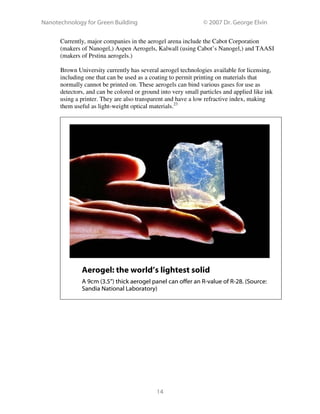
up to 75 percent translucency, and their high air content means that a 9cm (3.5”) thick
aerogel panel can offer an R-value of R-28, a value previously unheard of in a
translucent panel.22
Architectural applications of aerogel include windows, skylights,
and translucent wall panels.
Nanotechnology for Green Building © 2007 Dr. George Elvin
14
Currently, major companies in the aerogel arena include the Cabot Corporation
(makers of Nanogel,) Aspen Aerogels, Kalwall (using Cabot’s Nanogel,) and TAASI
(makers of Prstina aerogels.)
Brown University currently has several aerogel technologies available for licensing,
including one that can be used as a coating to permit printing on materials that
normally cannot be printed on. These aerogels can bind various gases for use as
detectors, and can be colored or ground into very small particles and applied like ink
using a printer. They are also transparent and have a low refractive index, making
them useful as light-weight optical materials.23
Aerogel: the world’s lightest solid
A 9cm (3.5”) thick aerogel panel can offer an R-value of R-28. (Source:
Sandia National Laboratory)
Nanotechnology for Green Building © 2007 Dr. George Elvin
15
Aerogels offer superior insulation
Aerogels offer 2-3 times the insulating value of other common insulating
materials. (Source: Aspen Aerogels)
Nanogel panels provide translucency and
insulation
High-insulating Nanogel panels are available with up to 75 percent
translucency. (Source: Kalwall)
aspen aerogels spaceloft
polyisocyanurate foam
polystyrene foam
mineral wool
fiberglass batts
r-value per inch
0 4 8 12 16 20 24
Nanotechnology for Green Building © 2007 Dr. George Elvin
16
2.2 Thin-film insulation
Insulating nanocoatings can also be applied as thin films to glass and fabrics. Masa
Shade Curtains, for example, are fiber sheets coated with a nanoscale stainless steel
film. Thanks to stainless steel's ability to absorb infrared rays, these curtains are able
to block out sunlight, lower room temperatures in summer by 2-3º C more than
conventional products, and reduce electrical expenses for air conditioning, according
to manufacturer claims.24
Heat absorbing films can be applied to windows as well. Windows manufactured by
Vanceva incorporate a nanofilm “interlayer” which, according to the company, offers
cost effective control of heat and energy loads in building and solar performance
superior to that of previously available laminating systems. By selectively reducing
the transmittance of solar energy relative to visible light, they say, these solar
performance interlayers result in savings in the capital cost of energy control
equipment as well as operating costs of climate control equipment. Benefits include
the ability to block solar heat and up to 99 percent of UV rays while allowing visible
light to pass through.25
Stainless steel nanofilm improves UV light
blockage
Masa Shade Curtains reduce room temperatures and air conditioning by
improving blockage of ultraviolet (UV) rays. (Source: Suzutora
Corporation)
3M has developed a range of nanotech-based window films that reduce heat and
ultraviolet light penetration. Their films reject up to 97 percent of the sun's infrared
light and up to 99.9 percent of UV rays. Unlike many reflective films, theirs are metal-
free and therefore less susceptible to corrosion in coastal environments and less likely
to interfere with mobile phone reception. These films also have less interior
reflectivity than the glass they cover. 26
masa shade curtain 84%
untreated curtain 58%
uv blockage
0% 100%
Nanotechnology for Green Building © 2007 Dr. George Elvin
17
Exterior reflectivity can also be controlled by nanofilms. Technology from Rensselaer
Polytechnic Institute and Crystal IS, Inc. has led to highly anti-reflective coatings
utilizing silicon dioxide and titanium dioxide nanorods for a variety of surfaces. Their
coating has a refelctivity index of just 1.05, the lowest ever reported.27
Infrared (IR) rays can also be blocked using transparent IR-absorbing coatings for
heat-absorbing films for windows. VP AdNano ITO IR5, used in transparent film
coatings, improves solar absorption properties while maintaining optical transparency,
according to its manufacturer, Degussa. The use of AdNano ITO on windows, they
claim, improves heat management, greatly reducing the energy consumption of air
conditioners, thereby lowering greenhouse gas emissions. Production of AdNano ITO,
they add, does not pollute the environment with heavy metals, and consumes very
little energy because drying and calcination take place at moderate temperatures.28
2.3 Insulating coatings
Insulation can also be painted or sprayed on in the form of a coating. This is a
tremendous advantage nanocoatings offer over more conventional bulk insulators like
fiberglass, cellulose, and polystyrene boards, which often require the removal of
building envelope components for installation.
Because they trap air at the molecular level, insulating nanocoatings even a few
thousands of an inch thick can have a dramatic effect. Nanoseal is one company
already making insulating paints for buildings. Their insulating coating is also being
used on beer tanks by Corona in Mexico, resulting in a temperature differential of 36
degrees Fahrenheit after application of a coating just seven one thousands of an inch
thick.29
Industrial Nanotechnology, the makers of Nansulate HomeProtect Interior paint,
advertise that the average surface temperature difference when applied correctly is
approximately 30 degrees Fahrenheit for three coats. For Nansulate HomeProtect
ClearCoat, they claim an average surface temperature difference of approximately 60
degrees Fahrenheit. Nansulate PT is being applied to aluminum ceiling panels in the
new Suvanabhumi International Airport in Bangkok, the world’s largest airport.30
HPC HiPerCoat and HiPerCaot Extreme are currently used as thermal barrier coatings
by NASA and NASCAR. Their ceramic-aluminum coating process, they report,
reduces radiant heat and ambient underhood temperature in autos by more than 40
percent. It also offers a corrosion-resistant alternative to environmentally harmful
chrome-plating.31
Industrial Nanotech is even developing thermal insulation that will generate
electricity. The thin sheets of insulation use the temperature differential that insulation
creates as a source for generating electricity. “The fact that there is almost always, day
or night and anywhere in the world, a difference between the temperature inside a
building and outside a building gives us an almost constant source of energy
Nanotechnology for Green Building © 2007 Dr. George Elvin
18
generation to tap into,” said CEO Stuart Burchill. The company is now designing the
first prototype material and filing patents.32
NanoPore Thermal Insulation uses silica, titania and carbon in a 3D, highly branched
network of particles 2-20 nanometers in diameter to create a unique pore structure.
According to its maker, NanoPore Thermal Insulation can provide thermal
performance unequalled by conventional insulation materials. In the form of a vacuum
insulation panel, It can have thermal resistance values as high as R-40/inch--7 to 8
times greater than conventional foam insulation materials.
NanoPore’s makers claim that its conductivity can actually be lower than air at the
same pressure. Its superior insulation characteristics, they say, are due to the unique
shape and small size of its large number of pores. Solid phase conduction is low due to
the materials low density and high surface area, and NanoPore’s proprietary blend of
infra-red opacifiers greatly reduces radiant heat transfer.33
Nanoparticles with extreme insulating value can also be incorporated into
conventional paints, as in the case of INSULADD paints. As its manufacturer
describes it, the complex blend of microscopic hollow ceramic spheres that makes up
INSULADD have a vacuum inside like mini-thermos bottles. The ceramic materials
have unique energy savings properties that reflect heat while dissipating it. The hollow
ceramic microspheres in INSULADD create a thermal barrier by refracting, reflecting,
and dissipating heat.34
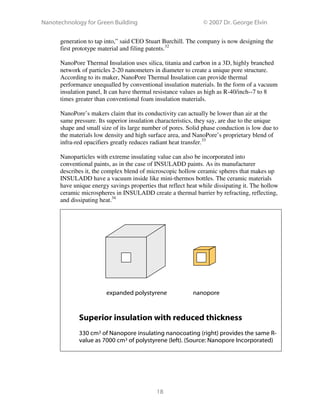
Superior insulation with reduced thickness
330 cm3 of Nanopore insulating nanocoating (right) provides the same R-
value as 7000 cm3 of polystyrene (left). (Source: Nanopore Incorporated)
expanded polystyrene nanopore
Nanotechnology for Green Building © 2007 Dr. George Elvin
19
Inside an insulating nanocoating
Nansulate Shield is an insulation material designed specifically for
the construction industry. It is an ultra-thin insulation that,
according to its manufacturer, has an R-Value many times higher
than the current best building insulation available. It is a
nanocomposite insulation composed of 70 percent “Hydro-NM-
Oxide” and 30 percent acrylic resin and performance additive. A
liquid applied coating, the material dries to a thin layer and
provides insulation as well as corrosion and rust protection. The
manufacturers describe their product’s performance this way:
“Thermal conduction through the solid portion is hindered by the
tiny size of the connections between the particles making up the
conduction path, and the solids that are present consist of very
small particles linked in a three-dimensional network (with many
"dead-ends"). Therefore, thermal transfer through the solid portion
occurs through a very complicated maze and is not very effective.
Air and gas in the material can inherently also transport thermal
energy, but the gas molecules within the matrix experience what is
known as the Knudsen effect and the exchange of energy is
virtually eliminated. Conduction is limited because the "tunnels"
are only the size of the mean-free path for molecular collisions,
smaller than a wave of light, and molecules collide with the solid
network as frequently as they collide with each other. The unique
structure... nanometer-sized cells, pores, and particles, means poor
thermal conduction. Radiative conduction is low due to small mass
fractions and large surface areas.”35
Hydro-NM-Oxide ----------- 10 to 13
Polyurethane Foam -------- 6.64
Fiberglass (batts) ----------- 3.2
Cellulose ---------------------- 3.2 to 3.7
R-value comparison of insulation
Similar to aerogel, insulating nanocoatings like
the active ingredient in Nansulate Shield provide
2-3 times the R-value of ordinary insulators
(Source: Industrial Nanotech)
Nanotechnology for Green Building © 2007 Dr. George Elvin
20
2.4 Emerging insulation technologies
Work is underway at many universities and research centers to develop new insulating
materials based on nanotechnology. University of California scientists working at Los
Alamos National Laboratory, for instance, have developed a process for modifying
silica aerogels to create a silicon multilayer that enhances the current physical
properties of aerogels. With the addition of a silicon monolayer, they say, an aerogel's
strength can be increased four-fold. This could expand the range of applications for
aerogels, which must currently be protected by surrounding panels.36
At EMPA Research Institute in Switzerland, work is underway to create vacuum
insulated products using plastic films such as PET, polyethylene and polyurethane
treated with an ultra-thin coating of aluminum. Only about 30 nanometers thick, the
aluminum layer significantly reduces the gas permeability of the film while at the
same time barely raising its thermal conductivity. The resulting cladding layer is thin,
homogeneous and gas-tight. The higher cost (still about double that of conventional
materials) is offset by the space-saving potential the new materials offer.37
Many products of current research on nano-insulation are available for licensing. For
example, eight licensable patents for aerospace insulation materials are available
through the Engineering Technology Transfer Center at the USC Viterbi School of
Engineering, including “Composite Flexible Blanket Insulation,” “Durable Advanced
Flexible Reusable Surface Insulation,” and “Flexible Ceramic-Metal Insulation
Composite.” 38
Also available for licensing are NASA’s Ames Research Center’s novel
nanoengineered heat sink materials enabling multi-zone, reconfigurable thermal
control systems in spacesuits, habitats, and mobile systems. This platform technology
can be adapted to a wide range of form factors thanks to a flexible metallic substrate.
2.5 Future market for nano-insulation
If the field performance of nano-insulation products lives up to manufacturer claims,
these products could foster dramatic improvements in energy savings and carbon
reduction. However, independent testing of insulating nanomaterials and products in
use will be necessary to verify manufacturer claims and convince potential buyers of
their effectiveness. Some manufacturers are already making the results of such testing
public, with encouraging results.
One of the greatest potential energy-saving characteristics of nanocoatings and thin
films is their applicability to existing surfaces for improved insulation. They can be
applied directly to the surfaces of existing buildings, whereas the post-construction
addition of conventional insulating materials like cellulose fiber, fiberglass batts, and
rigid polystyrene boards typically require expensive and invasive access to wall
cavities and remodeling. Nanocoatings could also make it much easier to insulate
solid-walled buildings, which make up approximately one third of the UK’s housing
Nanotechnology for Green Building © 2007 Dr. George Elvin
21
stock. And unlike cellulose fiber, fiberglass batts, and rigid polystyrene boards,
nanocoatings can be made transparent. Their application to existing structures could
lead to tremendous energy savings, and they do not appear to raise the environmental
and health concerns attributed to fiberglass and polystyrene.
3. Coatings
Insulating nanoparticles can be applied to substrates using chemical vapor deposition,
dip, meniscus, spray, and plasma coating to create a layer bound to the base material.
Other types of nanoparticle coatings can also be applied by these methods to achieve a
wide variety of other performance characteristics, including:
Self-cleaning
Depolluting
Scratch-resistant
Anti-icing and anti-fogging
Antimicrobial
UV protection
Corrosion-resistant
Waterproofing
Thanks to the versatility of many nanoparticles, surfaces treated with them often
exhibit more than one of these properties. On this versatility and the environmental
improvements possible through the use of nanocoatings, the European Parliament's
Scientific Technology Options Assessment concluded:
"At present, nanotechnologies and nanotechnological concepts deliver a variety of
mostly incremental improvements of existing bulk materials, coatings or products.
These improvements point in several directions and often are aimed at improving
several properties at the same time. With respect to substitution this means that
nanotechnological approaches often cannot lead to direct substitution of a hazardous
substance, but may lead in general to a more environmentally friendly product or
process."39
3.1 Self-cleaning coatings
Self-cleaning surfaces have become a reality thanks to photocatalytic coatings
containing titanium dioxide (TiO2) nanoparticles. These nanoparticles initiate
photocatalysis, a process by which dirt is broken down by exposure to the sun’s
ultraviolet rays and washed away by rain. Volatile organic compounds are oxidized
into carbon dioxide and water. Today’s self-cleaning surfaces are made by applying a
thin nanocoating film, painting a nanocoating on, or integrating nanoparticles into the
surface layer of a substrate material.
Nanotechnology for Green Building © 2007 Dr. George Elvin
22
Self-cleaning facade systems utilizing the latter technology can be found in the Jubilee
Church in Rome by Richard Meier and Partners, the Marunouchi Building in
downtown Tokyo, the General Hospital in Carmarthen, UK, and Herzog & de
Meuron’s Bond Street Apartment Building in New York. Self-cleaning windows are
now available from most major window manufacturers including Pilkington, PPG,
Saint-Gobain, and Andersen. While the Marunouchi Building and General Hospital
have self-cleaning windows, in the Jubilee Church titanium dioxide nanoparticles are
actually integrated into the precast concrete facade panels. The panel system’s
manufacturer, Italcementi Group, has even tested TiO2 on road surfaces and found it
reduced nitrogen oxide levels by up to 60 percent. At present, their self-cleaning
facade system costs 30 to 40 percent more than regular concrete, but they believe that
self-cleaning materials will save money in the long run.40
The fiber cement company, Nichiha, employs nanotechnology in three precast panel
lines for exterior cladding; Canyon Brick, Field Stone and Quarry Stone. Working
together with paint manufacturers, Nichiha created a self-cleaning finish on its fiber
cement panels that allows a microscopic layer of water to protect the finish from dirt
or soot. A simple rain, they say, will wash away stains leaving the exterior looking
new.41
Ai-Nano is, according to its manufacturer, a non-toxic, environmentally friendly,
hygienic photocatalytic coating. It creates a semi-permanent invisible coating on most
surfaces to provide anti-bacteria, anti-mold, anti-fungus, UV protection, deodorizing,
air purification, self-cleaning and self sanitizing functionality.42
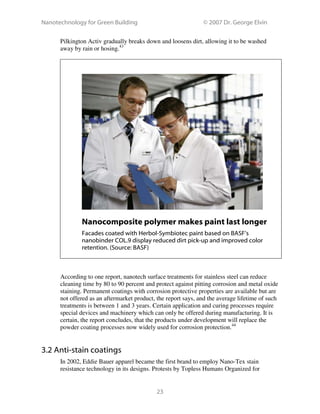
Self-cleaning nanocoatings can also be applied as paint, and a variety of commercially
available paints take advantage of TiO2’s properties. Herbol by Akzo Nobel, based on
BASF’s nanobinder COL.9, displays much lower dirt pick-up and excellent color
retention, according to its manufacturer. They say that during the production of COL.9
binders, inorganic nanoparticles are incorporated homogeneously into organic polymer
particles of water-based dispersions. These then form a three-dimensional network in
the facade coating which ensures an extremely hard and hydrophilic surface(causing
water to sheet) and a good balance between moisture protection and water vapor
transmission. With Herbol-Symbiotec, falling water droplets wet the substrate evenly,
meaning the facade dries faster and picks up less dirt. Similar paints containing TiO2
are manufactured by Behr, Valspar, and a number of others.
Nanotec offers a range of nanocoatings with varying functionalities. Their
Nanoprotect product creates a self-cleaning effect on glass and ceramic surfaces. They
report that nanoparticles in Nanoprotect adhere directly to the material molecule and
allow the surface to deflect dirt and water.
Self-cleaning windows were one of the first architectural applications of
nanotechnology. The special hydrophilic coating on Pilkington Activ self-cleaning
glass, for example, causes water to sheet off the surface, leaving a clean exterior with
minimal spotting or streaking. Using daylight UV energy, the photocatalytic surface of
Nanotechnology for Green Building © 2007 Dr. George Elvin
23
Pilkington Activ gradually breaks down and loosens dirt, allowing it to be washed
away by rain or hosing.43
Nanocomposite polymer makes paint last longer
Facades coated with Herbol-Symbiotec paint based on BASF’s
nanobinder COL.9 display reduced dirt pick-up and improved color
retention. (Source: BASF)
According to one report, nanotech surface treatments for stainless steel can reduce
cleaning time by 80 to 90 percent and protect against pitting corrosion and metal oxide
staining. Permanent coatings with corrosion protective properties are available but are
not offered as an aftermarket product, the report says, and the average lifetime of such
treatments is between 1 and 3 years. Certain application and curing processes require
special devices and machinery which can only be offered during manufacturing. It is
certain, the report concludes, that the products under development will replace the
powder coating processes now widely used for corrosion protection.44
3.2 Anti-stain coatings
In 2002, Eddie Bauer apparel became the first brand to employ Nano-Tex stain
resistance technology in its designs. Protests by Topless Humans Organized for
Nanotechnology for Green Building © 2007 Dr. George Elvin
24
Natural Genetics (THONG) at the Eddie Bauer flagship store in Chicago soon
followed, but today the clothier continues to expand its nano-enhaced line, and Nano-
Tex has expanded to bring stain resistance to fabrics and other interior finishes. HON
Company, KnollTextiles, Mayer Fabrics, Arc-Com, Architex, Carnegie, Designtex,
and Kravet all employ Nano-tex in their textiles. Unlike conventional methods that
coat the fabric, claims Nano-Tex, they use a process that bonds to each fiber, making
textiles last longer, retain their natural hand, and breathe normally. This means that
solid colors, lighter fabrics and delicate weaves can be used in places where spills and
stains are likely.
Nanoprotex by Nanotec is a water-based impregnator with very high penetration depth
for textile. The product is repellent to water, and the adherence of foreign matter to the
surface is decreased. The nanoparticles adhere directly to the substrate molecules,
deflecting any foreign matter.45
P2i produces Ion Mask enhancement for many applications, including aircraft cabin
trim, seats, carpets and uniforms. Originally developed as a military technology to
protect soldiers from chemical attack, Ion Mask applies a protective layer, just
nanometers thick, over the surface of a material by means of an ionized gas or plasma.
Without changing the look, feel or breathability of the fabric, the treated material
becomes hydrophobic (water-resistant), making coffee and red wine spills roll off the
surface like beads of mercury.46
Anti-stain technology is also available from CG2
. They incorporate ceramic
nanoparticles that bond with the underlying material to create strong chemical forces
which they say are around one million times more powerful than the purely physical
interaction that is present in coatings made using standard mixing or deposition
techniques. The particles can be designed for different capabilities such as anti-
adherence, scratch resistance, reduced friction, and corrosion resistance. The addition
of only 3 percent silica nanoparticles, they report, can increase abrasion resistance by
approximately 400 percent, while using 10 percent silica resulted in an increase of
approximately 945 percent.47
G3i has introduced GreenShield, a soil- and stain-repellent textile finish produced
using the principles of green nanotechnology. According to the company, the
manufacturing process eliminates waste and uses ambient temperature and pressure as
well as water-based solvents, minimizing the use of environmentally detrimental
chemistries and reducing the amount of product needed to deliver desired properties.
The company reports the new finish reduces the use of liquid- and stain-repelling
fluorochemicals by a factor of 10 by using what it calls the principle of micro- and
nano-roughness, which creates a pocket of air between the liquid or stain and the
fabric, thereby preventing penetration into the fabric. GreenShield, they say, also
safely provides antimicrobial properties and antistatic properties.48
LuxShield coating for Luxrae Decking protects by controlling moisture, heat and
water content, UV radiation, and stains. LuxShield coating, says it manufacturer, will
Nanotechnology for Green Building © 2007 Dr. George Elvin
25
not diminish when exposed to the harsh elements. “LuxShield coating is not a sealer,”
they say. Instead, its nanoparticles adhere directly to the substrate’s molecules and
assemble into an invisible, ultra-thin nanoscopic mesh that provides an extremely long
lasting hydrophobic surface. The hydrophobic effect creates an easy to clean protected
surface with self-cleaning properties. All foreign particles are washed off by rain or
when rinsed with water. LuxShield coating is non-toxic, environmentally-friendly, and
UV-stable. It is, they say, resistant to friction and cannot be removed by water, normal
cleaning agents, or high pressure equipment.49
Zirconia nanoparticles are graffiti’s demise
Graffiti is an expensive social phenomenon, costing about $1.50 to
$2.50 per square foot to clean. Last year alone the London tube
spent over $15 million and the City of Los Angeles $150 million for
graffiti cleanup. Those costs could go way down, along with the
harmful effects of solvents used in the cleanup, thanks to new
nanocoatings developed by Professor Victor Castaño, Senior
Research Consultant at CG2.
Dr. Castaño and his associates developed a novel approach using
nanotechnology to chemically attach zirconia, a hard ceramic, to a
typical polymer (PolyMethylMethAcrylate). In their process,
ceramic nanoparticles are chemically “grown” on top of the
polymeric surface, creating a “ceramic” surface to the exterior, with
a much higher wear resistance. A coating of just 130 nm, which is
99.9 percent transparent, passed through an ASTM 500 series wear
test, demonstrated an improvement of over 55 percent compared
to uncoated surfaces.50
Nanoprotect AntiG is a water-based anti-graffiti nano-treatment suitable for concrete,
brickwork, sandstone, travertine, granite, natural cast stones, and mineral plaster. The
treatment consists of a permanent impregnating undercoat and a semi-permanent
topcoat. Graffiti, says the manufacturer, can be easily removed by low-pressure hot
water, without the need for harsh detergents and chemicals.51
3.3 Depolluting surfaces
Self-cleaning surfaces enabled by nanotechnology offer energy savings by reducing
the energy consumed in cleaning building facades. They also reduce the runoff of
environmentally hazardous cleansers. As surfaces self-clean, they are “depolluting”,
removing organic and inorganic air pollutants like nitrogen oxide from the air and
breaking them down into relatively benign elements.
Nanotechnology for Green Building © 2007 Dr. George Elvin
26
Depolluting nanocoatings show considerable promise in cleansing indoor air and
reducing instances of sick building syndrome (SBS). The World Health Organization
estimates that up to 30 percent of new or renovated energy-efficient buildings may
suffer from SBS.52
The EPA estimates that SBS costs the U.S. economy $60 billion
per year in medical expenses, absenteeism, lost revenue, reduced productivity and
property damage.53
Self-cleaning nanocoatings shed dirt through
photocatalysis
Nanocoatings containing titanium dioxide (left) can be self-cleaning as
compared to untreated surfaces (right). (Source: AVM Industries, Inc.)
MCH Nano Solutions, for example, recently introduced Gens Nano, which the
company describes as a new easy to apply, green, environmentally friendly,
transparent coating for exterior applications. Gens Nano uses titanium dioxide
nanoparticles to keep the building exterior clean and at the same time purify the air
near and on the surface by breaking down nitrous oxides, formaldehyde, benzene, and
VOCs.54
Nanotechnology for Green Building © 2007 Dr. George Elvin
27
A current drawback to self-cleaning photocatalytic coatings utilizing titanium dioxide,
however, is that they require sunlight for activation, reducing their effectiveness
indoors. As an alternative for indoor applications, coatings using layered double metal
hydroxides (LDH), air-cleaning nanocrystals, can be applied to indoor surfaces to
improve the indoor climate and reduce ventilation requirements, thereby improving
the building’s energy efficiency.55
To help overcome the current outdoor-only
limitation of titanium oxide, researchers at the Institute for Nanoscale Technology in
Sydney, Australia, are developing a variation that is activated by a standard
lightbulb.56
Outdoors, photocatalytic coatings like the ones used in the Jubilee Church in Rome
suggest the possibility of smog-eating roads and bridges for reducing outdoor air
pollution. The Swedish construction giant Skanska is now involved in a $1.7 million
Swedish-Finnish project to develop catalytic cement and concrete products coated
with depolluting titanium dioxide.57
3.4 Scratch-resistant coatings
Buildings are subjected to a great deal of wear and tear. Surface scratches can reduce
the lifespan of many materials and add to the cost and energy required for
maintenance and replacement. The susceptibility of many metals, wood, plastics,
polymers and glazings to scratching can limit their potential applications in many
areas. Nanocoatings can significantly reduce wear and surface scratches.
Scratch-resistant nanocoatings are already common in the automotive industry. The
2007 Mercedes-Benz SL series, for example, sports a protective coating of
nanoparticles that provides a three-fold improvement in the scratch resistance of the
paintwork. DuPont is also working on nanoparticle paint for autos. The paint, licensed
from Ecology Coatings, is cured using UV light at room temperature, rather than in
the 204º C (400 º F) ovens required for conventional auto paint.
"After the UV hits it, it becomes a thin sheet of plastic," explained Ecology Coatings
co-founder and chief chemist Sally Ramsey in a recent interview. "Abrasion-resistance
and scratch-resistance is very much enhanced."
"We are in the early stages of a profound industry change," added Bob Matheson,
technical manager for strategic technology production at DuPont. He estimates the
technology will reduce the amount of energy used in the coating-application process
by 25 percent and reduce materials costs by 75 percent. 58
Ecology Coatings makes coatings for metals, polycarbonates, and composites, and has
also devised a method for waterproofing paper with nanoparticles. In 2005, the
company granted a license to Red Spot Paint & Varnish to manufacture and sell its
product in North America.59
Nanotechnology for Green Building © 2007 Dr. George Elvin
28
Diamon-Fusion International (DFI) offers a patented scratch-resistant nanocoating
tested and approved by a U.S. Army prime contractor, PAS Armored, Inc., for glass
and other silica-based surfaces in military vehicles. The coating, they say, will
improve vehicle safety under a wide range of adverse weather conditions. DFI’s
nanocoating also integrates an antimicrobial property by inhibiting the growth of mold
and bacteria on the treated surface. Like many of the nanocaotings described here, the
DFI coating is multi-functional, incorporating water and oil repellency, impact and
scratch resistance, protection against graffiti, dirt and stains, finger print protection,
UV stability, additional electrical insulation, protection against calcium and sodium
deposits, and increased brilliance and lubricity. DFI’s hydrophobic nanotechnology
can also be found in Moen’s Vivid Collection, a new line of luxury faucets and
accessories for kitchens and baths, where it will help guard against watermarks and
deposits. 60
Triton Systems manufactures NanoTuf coating, a clear protective coating for
polycarbonate surfaces. NanoTuf coatings are created from a solution of nanometer-
sized particles suspended in an epoxy-containing matrix. They are specifically
designed to coat and protect polycarbonate surfaces such as eyewear, making them up
to four times stronger than existing polycarbonate coatings.61
Move over diamond: carbon nanorods are world’s
hardest substance
Diamond is no longer the world’s hardest material. Researchers at
the University of Bayreuth in Germany have created an even harder
material they call aggregated carbon nanorods. They made the new
material by compressing super-strong carbon molecules called
buckyballs to 200 times normal atmospheric pressure while
simultaneously heating them to 2226° C (4719° F). The new material
is so tough it even scratches normal diamonds.62
3.5 Anti-fogging and anti-icing coatings
Titanium dioxide becomes hydrophilic (attractive to water) when exposed to UV light,
making it useful for anti-fogging coatings on windows and mirrors. G-40 Nano 2000
by AVM Industries is an example of a product using this technology. Polymer
coatings made of silica nanoparticles can also create surfaces that never fog, without
the need for UV light. This coating also reduces reflectivity in glazed surfaces.
The fogging of glazed surfaces is due to condensation. Condensation occurs when
warm, humid air contacts a cold surface; the moisture in the air condenses and forms a
layer on the colder surface. Condensation can be prevented by heating the cold
surface. A team of researchers at the Fraunhofer Technology Development Group
Nanotechnology for Green Building © 2007 Dr. George Elvin
29
TEG in Stuttgart, Germany have developed a nanotechnology that warms the surface
with a transparent coat of carbon nanotubes. When electrically charged, the coating
acts as a continuous heater uniformly covering the cold surface without wires of other
visible heating elements.63
Nanocoatings can also help reduce the buildup of ice. CG2
makes an anti-icing coating
that could offer improved environmental performance compared to heating, salts or
chemicals often used to remove ice. According to the company, their product is an
economical anti-ice coating that in independent tests demonstrated a reduction in ice
adhesion by a factor of approximately four in comparison to bare aluminum. Potential
uses include any application where even a relatively small reduction in ice adhesion is
valuable and where a large surface area has to be coated.64
3.6 Antimicrobial coatings
Many of the multifunctional coatings already mentioned incorporate antimicrobial
properties. Others are marketed specifically for their antimicrobial properties.
Antimicrobial products are marketed in sprays, liquids, concentrated powders, and
gases. The U.S. Environmental Protection Agency says that approximately $1 billion
each year is spent on antimicrobial products. Conventional antimicrobial products can
contain any of about 275 different active ingredients, including biocides, which may
release into the environment. Some biocidal ingredients in antimicrobial products pose
both environmental hazards and indoor air quality concerns.
Antimicrobial nanocoatings reportedly offer the benefits of conventional antimicrobial
products without these environmental and health concerns. Bioni, for example, offers
nanocoatings with a combination of antimicrobial and heat deflective properties. Their
low thermal conductivity and the ability to reflect up to 90 percent of the sun’s rays
reduce heat absorption in coated walls, thereby reducing air conditioning and energy
consumption.65
Researchers at the Fraunhofer Institute for Manufacturing Engineering and Applied
Materials Research IFAM in Bremen and at Bioni CS have developed a process for
binding antibacterial silver nanoparticles permanently to paint. According to Bioni, the
coating is certified as emission-free, and can destroy antibiotic-resistant bacteria. They
report that their coating has been used in more than 20 hospital projects in Europe and
the Gulf region, including the 40,000 square meter Discovery Gardens project in
Dubai. As with nanocoatings from other manufacturers, Bioni can “cross-link” a
variety of nanoparticles to add additional functionality such as UV protection and
improved wear resistance to their antimicrobial coating. Mirage Hardwood Floors of
Canada currently uses these cross-linked nanocoatings.
Nanotechnology for Green Building © 2007 Dr. George Elvin
30
End of the line for subway-riding germs
"Public transportation is a very common way, we know, of how
diseases ... spread," said Ben Mascall, spokesman with MTR Corp.,
which operates the railway in Hong Kong and has bid for two new
rail franchises in the U.K.
In response, his company has coated its cars' interiors with titanium
and silver dioxide nanocoatings that kill most of the airborne
bacteria and viruses that come into contact with them. The London
tube will soon do the same.
Many surfaces that people touch every day in a subway carry
thousands of bacteria and germs. With news of powerful flu strains
like avian flu and hand-transmissible diseases like colds, public
transportation operators like these pioneers are considering using
new nano-enhanced disinfectants in their subways. Hong Kong is
among the first cities to apply silver-titianium dioxide nanocoating
to subway car interiors. Preliminary tests show the disinfectant
reduced the presence of bacteria by 60 percent.66
BioQuest Technologies is marketing its BioShield 75, a nanotech- and water-based
antimicrobial with no poisons, as a preventative product for use in homes and
businesses in hurricane paths. Proactive application, they suggest, will reduce bacteria
and provide an effective solution to microbial problems that continue to exist in homes
and businesses after hurricane damage.67
Antimicrobial nanocoatings can also be incorporated into ceramic surfaces. The
German plumbing-fixture manufacturer, Duravit, for example, has teamed with
Nanogate Technologies to develop a product called Wondergliss. Wondergliss
coating is fired over traditional ceramic glazing to create a surface so smooth that
dirt, germs, and fungus cannot stick to it. In addition, water beads up and runs off the
hydrophobic surface without lime and soaps being able to build up.68
Many paints contain nanoparticles (commonly titanium dioxide) to prevent mildew,
including Zinsser’s Perma-White Interior Paint, Behr Premium Plus Kitchen & Bath
Paint, and Lowe’s Valspar.
Nanotechnology for Green Building © 2007 Dr. George Elvin
31
Plumbing aint what it used to be
Microban International offers Microban, which they call the first
antimicrobial polymeric, a plastic resistant to germs, molds, yeast,
and mildew. Microban is used in more than 450 products ranging
from cleaning supplies, paints and caulking to medical products,
plumbing fixtures, and other kitchen and bath products. Their
product, they say, does not wash or wear off of its material substrate.
As one reviewer of the technology put it:
“It is easy to imagine this technology producing piping so smooth
that it would have little or no friction loss, which would lead to
smaller piping able to carry many more gallons of water at the same
working pressure as today’s piping. Or drain pipe so smooth and
slippery that it cannot plug up. Or pipes that never wear out.
Someday, entire plumbing systems may follow nature’s design of a
living system. Imagine a water piping system that could change its
dimensions based on the flow demand and available pressure like
our own circulatory systems. Septic tanks could generate electricity
as they digest waste. Plumbers in the future will no doubt look back
and wonder how we got by with such primitive materials and tools.
Truly, plumbing aint what it used to be and it never will be again.”69
Nansulate LDX from Industrial Nanotech is designed to encapsulate lead-painted
surfaces, making them inaccessible by providing an overcoat barrier. At the same
time, it provides mold resistance, thermal insulation, and protection against corrosion.
Three out of four homes built prior to 1978 contain lead-based paint, and according to
the EPA, residential lead abatement has cost $570 billion and commercial $500
billion. In the past fifteen years, encapsulation as an abatement technique has become
a cost-effective alternative solution, typically costing 50 to 80 percent less than lead
paint removal and replacement.70
Researchers at Yale University have found that carbon nanotubes can kill E. coli
bacteria. In their experiments, roughly 80 percent of these bacteria were killed after
one hour of exposure. The researchers said nanotubes could be incorporated during the
manufacturing process or applied to existing surfaces to keep them microbe-free. The
researchers also recognized that since nanotubes can kill bacteria, they could have a
major impact on ecosystems. "Microbial function is critical in ecosystem sustainability
and we rely on microbes to detoxify wastes in environmental systems," said Joseph
Hughes of Georgia Tech. "If they are impaired by nanotubes, or other materials,” he
concluded, “it is the cause for significant concern."71
The EPA now regulates nano-
products sold as germ-killing, believing they may pose unanticipated environmental
risks.
Nanotechnology for Green Building © 2007 Dr. George Elvin
32
3.7 UV protection
Ultraviolet (UV) light can break down many building materials. Wood, for example, is
a desirable, renewable building material; it can be recycled and regenerated, and as a
structural material, it can reduce heating and cooling loads because it is 400 times less
conductive than steel, and up to 20 times less than concrete. It is also the only building
material that takes in carbon dioxide and releases oxygen as it grows, working to
counter the effects of carbon emissions. And it contributes far fewer of these
emissions than its non-renewable counterparts, steel and concrete. But wood must be
protected from environmental forces including water, pests, mold and UV radiation.
When the use of wood-preserving chromium copper arsenate was discontinued for
residential uses (in “pressure-treated” lumber) in 2003 due to environmental concerns,
the wood industry began searching for cost-effective, long-lasting, antimicrobial
products that would allow wood to perform well in outdoor applications. Today,
nanocoatings are proving to fill that gap.
Nanoscale UV absorbers added to protective coatings can help keep substrates from
being degraded by UV radiation. The result is wood that lasts longer with less graying
than unprotected wood. And the small size of the particles makes it possible to offer
high protection without affecting the transparency of the coating. Nanovations Teak
Guard Marine is one example of UV protection for wood. Nanovations provides
sustainable wood protection solutions for Teak and other hardwoods.72
Many other materials can be protected by nanoparticles as well. SportCoatings makes
a colorless, odorless Sports Antimicrobial System (SAS) based on AEGIS Microbe
Shield, recently tested on synthetic turf fields, sports medicine training rooms, locker
rooms, whirlpools, and wrestling rooms at Virginia Tech. “You could tell it worked
quickly,” said Denie Marie, Facilities Manager of Virginia Tech’s Rector Field House.
“Within 24 hours of the application it erased the typical locker room scent. It brought
a noticeable freshness to our facilities.” SAS provides an invisible layer of
antimicrobial protection they say will not leach any chemicals or heavy metals into the
environment and will not rub off onto a player’s skin.73
Suncoat makes multifunctional adhesive films and “nano-adhesive transparent
varnish” for UV protection of awnings and window glass. They say their product
allows protected surfaces to maintain color quality over a longer period of time, shed
dirt, resist scratches, and self-clean.74
Centrosolar Glas makes Solarglas Clear and
Solarglas PRISM glasses that can be supplied with nano-coated anti-reflective
properties.75
Advanced Nanotechnology Limited's NanoZ product is a zinc oxide nanopowder
coating that the company claims provides superior UV protection and anti-fungal
properties to wood and plastic surfaces. At the nanoscale, zinc-oxide particles are
invisible, enabling the creation of transparent varnishes with the same enhanced
Nanotechnology for Green Building © 2007 Dr. George Elvin
33
functionality of colored coatings. NanoZ is used, among other things, to provide UV
protection in Bondall Paints.76
Tekon makes chemical-free treatments for keeping kitchens, baths, stone, glass, and
countertops clean. Their sealing products protect surfaces from viruses, germs,
bacteria, mold, and other harmful toxins. Tekon’s Bath, Stone, Countertop, and
Stainless Steel Kits clean, protect and maintain surfaces in kitchens and bathrooms.77
Seal America sells a variety of nano-based sealants for wood, stone, tile, fabric,
masonry, metal and concrete which they say are non-toxic and have no negative
effects on human health or the environment.78
Finally, AVM Industries offers nine
multifunctional nanocoatings for metal, wood, concrete and glass.79
Research currently underway in universities will add even more functionality to the
range of UV-protectant products already available. Researchers at the School of Forest
Resources and Environmental Science at Michigan Technological University, for
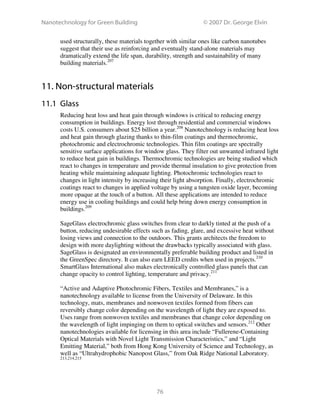
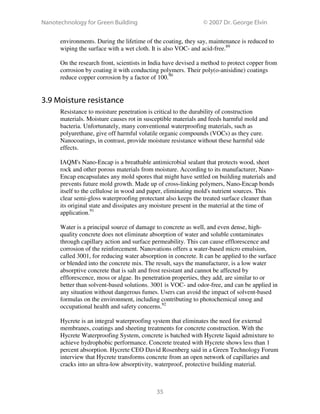
example, have discovered a way to embed organic insecticides and fungicides in
plastic beads only about 100 nanometers across. Suspended in water, the beads are
small enough to travel through wood when it is placed under pressure. Their
technology has been licensed to the New Jersey-based company Phibro-Tech.80
Recent
patents for protective nanocoatings include “Interior protectant/cleaner composition,”
by Hida Hasinovic and Tara Weinmann.81
3.8 Anti-corrosion coatings
The cost of corrosion in the U.S. is estimated at $276 billion per year. In the Federal
Republic of Germany, 4 percent of the gross national product is lost every year as a
result of corrosion damage. Corrosion takes a toll not only on steel structures, but on
concrete ones, which require steel reinforcing. In fact, 15 percent of all concrete
bridges are structurally deficient because of corroded steel reinforcement.82
For protecting metal surfaces from corrosion, chrome plating is becoming an
increasing concern because of the negative health and environmental effects of
chromium.83
But corrosion can be reduced by coating materials with chemically
resistant nanofilms of oxides. CG2
is one of several manufacturers marketing
corrosion-resistant nanocoatings. Their technology consists of homogeneous thin films
using alkoxides with chemically attached ceramic nanoparticles.84
Another system, Corrpassiv Primer epoxy by Ormecon, displayed “the best filiform
corrosion results in the history of the institute,” in a study by the FPL Research
Institute for Pigments and Paints in Stuttgart. Corrosion protection with Ormecon also
offers environmental benefits by incorporating organic metals that are free from heavy
metals. This makes it possible to replace not only lead compounds, chromate
treatments and chromate, but also the zinc-rich coatings that will in the future be
classified as containing heavy metals.85
Nanotechnology for Green Building © 2007 Dr. George Elvin
34
Bonderite NT is said to be suitable for surface pretreatment for all conventional
powder and wet paint coatings. It can be applied by dipping or spraying and creates a
cohesive, inorganic, high-density layer incorporating nanoparticles. Measurements
have shown that the nanoceramic coating delivers markedly better corrosion
protection and paint adhesion than iron phosphating. Bonderite NT coatings do not
require bath heating, and can be applied at room temperature, thus saving energy.
They also offer significant environmental benefits. In addition to its low energy needs,
Bonderite NT is distinguished by its lack of organic ingredients. Neither phosphates
nor toxic heavy metals have to be disposed of, which means that far less sludge is
generated in production. Outlay on wastewater treatment, waste disposal and plant
cleaning and maintenance is significantly reduced.86
Ormecon has also released Organic Metal Nanofinish, a solderable surface finish for
printed circuit boards, a technology that could be applied to architectural metals in the
future. This new process consumes less than 10 percent of the energy compared to
other metallic finishes, and promises to save more than 90 percent of raw materials.87
Integran makes nanoPLATE Coatings, nanostructured metal coatings with properties
that meet or exceed those of hard chrome, including wear resistance, corrosion
resistance, coefficient of friction, and also allow for the complete elimination of
chromium.88
Nanocoatings offer superior corrosion resistance
NanoPlate coatings (yellow) provide significantly greater corrosion
resistance than HVOF (green) and hard chrome (blue) finishes, at half
the thickness. (Source: Integran)
NH 2015, available from Nanovations, is an oil-free, nanotechnology-enhanced
surface treatment. Its makers report that it easily removes all staining and soiling and
leaves behind a clean surface that is water and dirt repellent. It protects stainless steel
against contamination for up to two years, even if fully exposed to weathering or harsh
0 500 1000 1500 2000
exposure time (hrs)
astm
b537
ranking
10
0
Nanotechnology for Green Building © 2007 Dr. George Elvin
35
environments. During the lifetime of the coating, they say, maintenance is reduced to
wiping the surface with a wet cloth. It is also VOC- and acid-free.89
On the research front, scientists in India have devised a method to protect copper from
corrosion by coating it with conducting polymers. Their poly(o-anisidine) coatings
reduce copper corrosion by a factor of 100.90
3.9 Moisture resistance
Resistance to moisture penetration is critical to the durability of construction
materials. Moisture causes rot in susceptible materials and feeds harmful mold and
bacteria. Unfortunately, many conventional waterproofing materials, such as
polyurethane, give off harmful volatile organic compounds (VOCs) as they cure.
Nanocoatings, in contrast, provide moisture resistance without these harmful side
effects.
IAQM's Nano-Encap is a breathable antimicrobial sealant that protects wood, sheet
rock and other porous materials from moisture. According to its manufacturer, Nano-
Encap encapsulates any mold spores that might have settled on building materials and
prevents future mold growth. Made up of cross-linking polymers, Nano-Encap bonds
itself to the cellulose in wood and paper, eliminating mold's nutrient sources. This
clear semi-gloss waterproofing protectant also keeps the treated surface cleaner than
its original state and dissipates any moisture present in the material at the time of
application.91
Water is a principal source of damage to concrete as well, and even dense, high-
quality concrete does not eliminate absorption of water and soluble contaminates
through capillary action and surface permeability. This can cause efflorescence and
corrosion of the reinforcement. Nanovations offers a water-based micro emulsion,
called 3001, for reducing water absorption in concrete. It can be applied to the surface
or blended into the concrete mix. The result, says the manufacturer, is a low water
absorptive concrete that is salt and frost resistant and cannot be affected by
efflorescence, moss or algae. Its penetration properties, they add, are similar to or
better than solvent-based solutions. 3001 is VOC- and odor-free, and can be applied in
any situation without dangerous fumes. Users can avoid the impact of solvent-based
formulas on the environment, including contributing to photochemical smog and
occupational health and safety concerns.92
Hycrete is an integral waterproofing system that eliminates the need for external
membranes, coatings and sheeting treatments for concrete construction. With the
Hycrete Waterproofing System, concrete is batched with Hycrete liquid admixture to
achieve hydrophobic performance. Concrete treated with Hycrete shows less than 1
percent absorption. Hycrete CEO David Rosenberg said in a Green Technology Forum
interview that Hycrete transforms concrete from an open network of capillaries and
cracks into an ultra-low absorptivity, waterproof, protective building material.
Nanotechnology for Green Building © 2007 Dr. George Elvin
36
Hycrete also coats reinforcing steel surface with a monomolecular film while
providing waterproofing properties to the concrete. It reacts with metals in the water,
concrete, and reinforcement to form a precipitate that fills the capillaries of the
concrete, repelling water and shutting down capillary absorption. The product is so
environmentally safe it is the first material certified by Cradle-to-Cradle, a new
program that evaluates and certifies the quality of products by measuring their positive
effects on the environment, human health, and social equity.
Reduced moisture absorption in concrete
Hycrete, a Cradle-to-Cradle certified green nanomaterial for integral
waterproofing, greatly reduces moisture absorption in concrete. (Source:
Hycrete)
Nanoprotect CS is a water-based solution with a very high penetration depth for
concrete materials. The hydrophobic treatment, says its maker, is long lasting and can
only be removed by damaging the surface.93
Another exterior coating, Lotusan,
possesses a highly water-repellent surface similar to that of the lotus leaf. Its
microstructure has been modeled on the lotus plant to minimize the contact area for
water and dirt.94
Self-cleaning awning fabrics from Markilux are made of Swela Sunsilk Nano Clean,
which its manufacturer says is extremely dirt, grease, oil and water repellent. The
highly dirt repellent finish of the fabric, they add, offers UV protection and ensures
long lasting radiant colors.95
Because of their vast market applications, water-repellent nanocoatings are a popular
subject of university research as well, and many of these projects are available for
license. Ohio State University engineers, for example, are designing super-slick,
water-repellent surfaces that mimic the texture of lotus leaves for application in self-
cleaning glass.96
Hong Kong University of Science and Technology has available,
“Novel TiO2 Material and the Coating Methods Thereof.”97
Other licensable patents
for waterproofing nanomaterials are available through the Engineering Technology
control
hycrete
percent absorption
0 1 2
Nanotechnology for Green Building © 2007 Dr. George Elvin
37
Transfer Center at the University of Southern California’s Viterbi School of
Engineering.98
“Interior Protectant/Cleaner Composition” is an example of a recent patent in this area,
combining natural camauba wax nanoparticles and zinc oxide nanoparticles with a
quaternary siloxane compound. Its protectant composition cleans, protects, preserves
and enhances the appearances of leather or vinyl surfaces used for covering items in
the home or in vehicles. It dries quickly and leaves no oily residue behind.99
4. Adhesives
While not the most glamorous technology, adhesives have revolutionized the
construction industry. Construction adhesives were, in fact, voted the most significant
technological advance of the last half of the 20th
century in one survey of industry
professionals. But many contain environmentally harmful substances like
formaldehyde. Just as we saw with moisture-resistant coatings, however,
nanotechnology promises a more environmentally friendly alternative. But consumers
eager to adopt these eco-friendly super-adhesives will have to wait for their
commercialization in construction. The Nano Adhesive Co. of Taiwan, for example,
makes nanoadhesives, but only for the cosmetics and medical industries.100
Much of the inspiration for nano-enabled adhesives comes from nature. Adopting
nature’s tricks is sometimes referred to as biomimicry. Examples of how
nanoscientists mimic nature can be found in the water-repellent properties of
nanocoatings, which take their lessons from the hydrophobic lotus leaf, and in a new
generation of nano-adhesives now under investigation, which are based on the
remarkable feet of the gecko, which enable it to climb walls and even ceilings.
Several years ago researchers created nanotube surfaces that matched the gecko’s
tenacious toes for stickiness, but how to unstick, and thereby create a useful product,
has eluded scientists—until now. Researchers at Rensselaer Polytechnic Institute and
the University of Akron have created synthetic gecko nanotube tape with four times
the gecko’s sticking power that can stick and unstick repeatedly. The material could
have applications in feet for wall-climbing robots, reversible adhesives for electronic
devices, and even aerospace, where most adhesives don’t work because of the
vacuum.101
The Center for Information Technology Research in the Interest of Society
has also devised gecko-inspired adhesive nanostructures that will increase the
capability of small robots to scamper up rocks, walls, and smooth surfaces.102
Researchers at Rensselaer Polytechnic Institute have devised a new adhesive for
bonding materials that don’t normally stick to each other. Their adhesive, based on
self-assembling nanoscale chains, could impact everything from next-generation
computer chip manufacturing to energy production. “The molecular glue is
inexpensive--100 grams cost about $35--and already commercially available,” said
project leader Ganapathiraman Ramanath.103
Nanotechnology for Green Building © 2007 Dr. George Elvin
38
Self-assembling nanoscale chains form nano-super-
glue
Researchers at Rensselaer Polytechnic Institute have developed a new
method using self-assembling nanomaterials to bond materials that
don’t normally stick together. (Source: Rensselaer/G. Ramanath)
Researchers at the University of California, Berkeley, meanwhile, have developed
biomimetically inspired nanostructures that can stick to wet, dry, rough or smooth
surfaces, and can be peeled off and reused. These materials are also self-cleaning,
leave no residue, and are bio-compatible. Their technology is available for
licensing.104
Nanotechnology for Green Building © 2007 Dr. George Elvin
39
Biomimicry: learning from the lotus leaf
Through nanoscience and molecular biology we are learning more
about how natural systems, organisms, and materials behave, and
nanotechnology and biotechnology give us the tools not only to
intervene in those systems, but to create new ones based on their
capabilities.
The lotus leaf is a good example. By studying its molecular makeup,
scientists have unlocked its hydrophobic (water-repellent)
properties and incorporated them into a new breed of materials
capable of shedding water completely. The NanoNuno umbrella, for
instance, dries itself completely after a downpour with just one
shake. Developers are applying the hydrophobic properties of the
lotus leaf in a wide range of products and materials from self-
cleaning windows to car wax.
Nature offers endless lessons that could be applied to future
products, processes and materials. By examining the nanoscale
structure of gecko feet, for instance, scientists have created gloves
so adhesive a person wearing them can hang from the ceiling. All of
these lessons will enable us to learn from nature to create systems,
materials and devices that are less wasteful and more efficient than
those available today. Nature does not waste, and through
biomimicry we will learn to model our own systems with the
efficiency, beauty and economy of natural systems.
Scientists are even developing materials that adhere without the use of adhesives.
Scientists at the Max Planck Institute for Metals Research in Stuttgart, Germany, have
developed materials whose surface structure allows them to stick to smooth walls
without any adhesives. The extremely strong adhesive force of these materials is the
result of very small, specially shaped hairs based on the soles of beetles' feet. Their
artificial adhesive system lasts for hundreds of applications, does not leave any visible
marks, and can be thoroughly cleaned with soap and water. Potential applications
include protective foil for delicate glasses and reusable adhesive fixtures. The new
material will soon be used in the manufacture of glass components.105
Nanotechnology for Green Building © 2007 Dr. George Elvin
40
Adhesion without adhesives
Scientists have developed materials whose surface structure allows them
to stick to smooth walls without any adhesives. (Source: Max Planck
Institute for Metals Research)
5. Lighting
Lighting and appliances consume approximately one third of the energy used in
building operation. Not only do lighting fixtures consume electricity, but most produce
heat that can add to building cooling costs. Incandescent lights, for example, waste as
much as 95 percent of their energy as heat. Fluorescent lights use less energy and
produces less heat, but contain trace amounts of mercury.
Because of the heat generated by lighting, most office buildings run air conditioning
when the outside air temperature is above 12°C (55°F). In fact, the cores of most
buildings over 20,000 square feet require cooling even during the winter heating
season.106
Because of this effect, every three watts of lighting energy conserved saves
about one additional watt of air cooling energy.107
The energy-saving potential in more
efficient lighting is therefore tremendous.
Nanotechnology for Green Building © 2007 Dr. George Elvin
41
heating/cooling 44%
lighting + other
appliances 33%
water heating 14%
refrigerator 9%
Residential energy consumption
Lighting and other appliances (purple) consume one third of all energy
in buildings (Source: US Department of Energy)
5.1 Light-emitting diodes (LEDs)
One of the most promising technologies for energy conservation in lighting is light-
emitting diodes (LEDs). In a global lighting market of $21 billion, the current market
for high brightness LEDs exceeds $4 billion. Current uses of LEDs include civil works
like traffic lights and signs, as well as some building applications like the facade of the
Galleria Shopping Mall in Seoul by UN studio.
Some LEDs are projected to have a service life of about 100,000 hours and offer the
lowest long term cost of operation available. Potential energy savings from LEDs are
estimated at 82 to 93 percent over conventional incandescent and fluorescent lighting.
LEDs could save 3.5 quadrillion BTUs of electricity and reduce global carbon
emissions by 300 million tons per year, potentially cutting global lighting energy
demand in half by 2025. The principal obstacle to greater adoption of LEDs, however,
is cost; they currently cost at least 10 times more than fluorescent ceiling lights. 108
Heat dissipation can be a problem with bright long-lasting LEDs, and the nanotech
company, Celsia, is working with leading LED companies to develop LED cooling
solutions. These include laminating their NanoSpreader technology with PCB film, so
that LED circuitry can be attached to form an integrated cooler.109
Nanotechnology for Green Building © 2007 Dr. George Elvin
42
Light-emitting diodes: always low prices!
Wal–Mart expects to save $2.6 million in energy costs and reduce
carbon emissions by 35 million pounds per year by using light-
emitting diode (LED) refrigerated display lighting by GE. The retailer
is outfitting refrigerated display cases in over 500 U.S. stores with the
technology, and expects to net up to 66 percent energy savings,
compared with fluorescent technology. Occupancy sensors and LED
dimming capabilities will reduce the time the LED refrigerated
display cases are at 100 percent light levels from 24 to
approximately 15 hours per day.110
LED lighting uses one-third the energy
Wal–Mart expects to save $2.6 million in energy costs
and reduce carbon emissions by 35 million pounds per
year with LED refrigerated display lighting. (Source: GE)
Nanotechnology for Green Building © 2007 Dr. George Elvin
43
BridgeLux InGaN (indium gallium nitride) power-LED chips replace traditional bulb
technologies with solid state products that provide a powerful and energy-efficient
source of blue, green, or white light. BridgeLux chips are currently found in mobile
appliances, signage, automotive, and various general lighting applications.111
Let there be light, but hold the heat
PlexiLight, a startup out of Wake Forest University, plans to
develop a new lighting source that is lightweight, ultra-thin, and
energy efficient because it uses nanotechnology to produce visible
light directly rather than as a byproduct of heating a filament or
gas. Its unique properties suggest a wide range of residential and
commercial applications.
Light without heat
“It looks like a sheet of plexiglass that lights up,”
professor David Carroll says of PlexiLight, a new
lighting source that may lead to heat-free lighting.
(Source: Wake Forest University)
Many other companies occupy the LED field, and opportunities for licensing abound.
Two available nanotech-specific LED technologies are “Nanowires-Based Large-Area
Light Emitters and Collectors,” from Harvard University, and “Luminescent Gold (III)
Compounds, Their Preparation and Light-Emitting Devices,” from the Hong Kong
University of Science and Technology.112,113
Recent patents in nano-enhanced LED
Nanotechnology for Green Building © 2007 Dr. George Elvin
44
lighting include “Method for fabricating substrate with nano structures, light emitting
device and manufacturing method thereof,” by Jong Wook Kim and Hyun Kyong
Cho.114
PlexiLight has received startup funding from Wake Forest University and
Connecticut-based NanoHoldings, which specializes in building early-stage
nanotechnology companies around exclusive licenses from leading research
universities. PlexiLight could target development of a substitute for the fluorescent
ceiling light fixtures used in nearly all commercial buildings. The new technology may
lead to higher-efficiency panels that would have no bulbs or ballasts to wear out and
would not give off heat that requires additional energy to cool buildings.115
LEDs lead in lighting efficiency
LEDs provide extremely efficient lighting—more than ten times that of
today’s incandescent bulbs. (Source: Dowd, “Low Cost Hybrid Substrates
for Solid State Lighting Applications,” Cleantech 2007, May 24, 2007,
Santa Clara, CA)
5.2 Organic light-emitting diodes (OLEDs)
Among the most promising nanotechnologies for energy conservation in lighting are
organic light-emitting diodes (OLEDs). When electricity is run through the strata of
organic materials that make up an OLED, atoms within them become excited and emit
white led 150
hp sodium 132
metal halide 90
fluorescent 90
halogen 20
efficacy (lm/w)
0 50 100 150 200
incandescent 13
Nanotechnology for Green Building © 2007 Dr. George Elvin
45
photons. OLEDs are highly efficient, long-lived natural light sources that can be
integrated into extremely thin, flexible panels. Their introduction in the marketplace
has so far been limited to small electronic components like cellphone displays, but
their applications continue to grow in scale. OLEDs offer unique features like extreme
flexibility, transparency when turned off, and tunability to produce variable colored
light.
OLED structure
Organic light-emitting diodes (OLEDs) are highly efficient, long-lived
natural light sources that can be integrated into extremely thin, flexible
panels. (Source: HowStuffWorks.com)
OLEDs could be used to create windows and skylights that mimic the look and feel of
natural light after dark and could be applied to any surface, flat or curved, to make it a
source of light. With this technology, walls, floors, ceilings, curtains, cabinets and
tables could become light sources. Carbon nanotube-organic composites could even
lead to structural panels capable of integrating lighting. This multifunctional ability of
surfaces integrating OLEDs could lead to energy savings not only because OLEDs are
more efficient than today’s lighting technologies, but by more efficiently integrating
lighting into other building components. Scientists in Germany, for example, recently
developed OLEDs that are transparent. Transparent OLEDs could be embedded into
laminated glass, enabling windows to switch between transparent glazing and
informational display panels, or act as both simultaneously.
Universal Display Corporation is an OLED technology developer providing OLED
manufacturers and product developers with phosphorescent, flexible, transparent and
Nanotechnology for Green Building © 2007 Dr. George Elvin
46
top emission OLEDs. Their flexible organic light-emitting diode (FOLED)
technologies apply to thin, lightweight displays that use little power and provide easy-
to-read, vibrant color, transparency, and flexibility.116
FOLEDs make lighting flexible and efficient
Flexible light-emitting diodes (FOLEDs) could free lighting and displays
to bend with architectural surfaces. (Source: Universal Display
Corporation)
5.3 Quantum dot lighting
Quantum dots are nanoscale semiconductor particles that can be tuned to brightly
fluoresce at virtually any wavelength in the visible and infrared portions of the
spectrum. They can be used to convert the wavelength, and therefore the color, of light
emitted by LEDs.
Evident Technologies has developed technologies for dispersing quantum dots into a
number of polymeric materials including standard LED thermal curing encapsulant
materials (silicones and epoxies), injection moldable polymers, printable matrix
materials, and semiconductor conjugated polymers. Their quantum dot composites can
Nanotechnology for Green Building © 2007 Dr. George Elvin
47
be applied to LEDs, molded into fluorescent components and light guides, or printed
onto any substrate.117
Quantum dot LEDs
Quantum dot composites can be applied to LEDs, molded into
fluorescent components and light guides, or printed onto any substrate.
(Source: Evident Technologies)
Displays from E Ink and LG Phillips are less than 300 microns thick, as thin and
flexible as construction paper. Their prototype 10" screen achieves SVGA (600x800)
resolution at 100 pixels per inch and has a 10:1 contrast ratio with four levels of
grayscale. E Ink Imaging Film is a novel display material that looks like printed ink on
paper and has been designed for use in paper-like electronic displays. Like paper, the
material can be flexed and rolled. As an additional benefit, the E Ink Imaging Film
uses 100 times less energy than a liquid crystal display because it can hold an image
without power and without a backlight. They are 80 percent thinner and lighter than
glass displays, and they do not break like glass displays.118
Nanotechnology for Green Building © 2007 Dr. George Elvin
48
"This will completely change the way we use
lighting"
Carbon nanotube-organic composites may significantly reduce
energy running costs, thus reducing carbon dioxide emissions at
power generating stations. The Advanced Technology Institute (ATI)
at the University of Surrey, for example, was recently awarded a
£200,000 grant by the Carbon Trust to produce prototype solid state
lighting devices using nano-composite materials. Their Ultra Low
Energy High Brightness (ULEHB) technology may offer a cost-
efficient and clean replacement for mercury based fluorescent lamps
and many other low efficiency, heat producing light sources.
Carbon nanotube lighting
The Advanced Technology Institute is producing
prototype solid state lighting devices like this Ultra Low
Energy High Brightness (ULEHB) device using nano-
composite materials. (Source: Advanced Technology
Institute, University of Surrey)
Nanotechnology for Green Building © 2007 Dr. George Elvin
49
New quantum dot technologies available for licensing from several universities and
research centers include “Process to Grow a Highly-Ordered Quantum DOT Array,
and a Quantum Dot Array Grown in Accordance with the Process,” from Brown
University, “Biomolecular Synthesis of Quantum Dot Composites,” University of
Massachusetts, Lowell, “Self-Organized Formation of Quantum Dots of a Material
On a Substrate,” Oak Ridge National Laboratory, and “Fabrication of Quantum Dots
Embedded in Three-Dimensional Photonic Crystal Lattice,” from the University of
Delaware.119,120,121,122
The Advanced Technology Institute is experimenting with Ultra Low Energy High
Brightness (ULEHB) devices made of nano-composite materials. Potential uses such
as variable mood lighting over a whole wall or ceiling opens up a range of exciting
applications. ULEHBs are also expected to have wide uses in signage, displays, street
lighting, commercial lighting, public buildings, offices and image projectors. The
patented technology can also be used for low cost solar cell production and has the
versatility to be tuned to produce colored light.123"
This will completely change the way we use lighting," predicted project leader
Professor Ravi Silva. “ULEHB lighting will produce the same quality light as the best
100 watt light bulb, but using only a fraction of the energy and last many times
longer."
5.4 Future market for lighting
As costs decline, experts anticipate that LEDs will take an increasing share of the task
lighting market (for reading and other activities requiring bright, focused light) while
OLEDs will be increasingly popular for ambient lighting (low-light conditions like
hotel lobbies and high-end restaurants.) As the transition from conventional lighting to
solid-state LEDs and OLEDs evolves, solid-state lamps will be made to fit existing
incandescent and fluorescent fixtures. These advanced light fixtures will offer users
the ability to change room color with the turn of a conventional dimmer switch, as is
already possible with LED lighting in some high-end hotels and night clubs. Mass
commercialization of LEDs and OLEDs, however, will depend on improvements in
their efficiency. Most current LEDs and OLEDs provide efficiency of roughly 30-160
lumens, whereas 1000 lumens will be required for their widespread adoption.124
6. Solar energy
The sun offers a free, renewable source of energy capable of meeting all our energy
needs . . . if an efficient, economical means of converting solar to electrical energy can
be found. Current silicon-based solar cell technologies, however, have only achieved
modest conversion efficiencies at relatively high costs. But conversion technologies
are improving, and the market for solar energy is expected to grow from $15.6 billion
in 2006 to $69.3 billion by 2016. And while solar represents less than .5 percent of
today’s total energy market, it is growing rapidly at 30 percent annually.
Nanotechnology for Green Building © 2007 Dr. George Elvin
50
Some experts believe that the pace of solar development will be slowed due to the
rising cost of its primary raw material, silicon. Today, at least 90 percent of
photovoltaic sales are made from silicon-based solar cells, and at least half of their
cost is in the initial silicon wafer. Most of the silicon used by the solar industry comes
from reject silicon wafers found unsuitable for use by computer chip manufacturers,
and high-grade processed silicon is in such high demand among chip makers and solar
panel manufacturers that competition for silicon from the computer chip industry has
driven the price of silicon up dramatically.
Due to increased demand, the price of silicon has skyrocketed from about $25 per
kilogram in 2004 to roughly $200 per kilogram in 2006. The result has been a
significant shortage of solar-quality silicon. The high price and short supply of silicon
is expected to pose a serious obstacle to solar power growth, leading some analysts to
suggest that solar growth may decline to 20 percent in coming years.125
Breaking silicon’s hold on solar
Nanotechnology will eventually outshine silicon technology in
solar cell manufacturing, said Bo Varga, Managing Director of
Silicon Valley Nano Ventures, in an interview with Green
Technology Forum.
“I don’t think the current paradigm of using silicon and
semiconductor processes [for solar cells] is viable for a very simple
economic reason,” said Varga. “When I’m making a memory or a
computer chip, I’m fundamentally taking a raw material and
marking it up by one hundred times, or even one thousand times
for a quad processor, so the cost of the pure silicon versus what
Intel or AMD sells a CPU for is a thousand percent markup.
In silicon solar cells today, forty percent of the cost is materials, and
the best studies I’ve seen say that in five years that will be reduced
to thirty percent. When you’re looking at thin-film solar using
nanotechnology, the cost of goods might be one percent or one-
half of one percent.
So I think that by creating nanostructures which are the most
efficient at harvesting the light at different wavelengths, reducing
the amount of materials we use from two hundred microns thick in
the case of silicon to ultimately just a few nanometers with
nanomaterials, and converting from the batch process used today
to roll-to-roll, solar will be able to compete with coal, natural gas,
and other current energy sources.”126
Nanotechnology for Green Building © 2007 Dr. George Elvin
51
6.1 Silicon solar enhancement
Nanotechnology is not only an alternative to silicon-based solar. It is also contributing
significantly to today’s silicon-based solar market. Innovalight, for example, has
developed a technology they say has the potential to greatly reduce the cost of silicon-
based solar cells. They have developed a silicon nanocrystalline ink that could make
flexible solar panels as much as ten times cheaper than current solutions. Their silicon
process lends itself to low cost, high throughput manufacturing.127
Meanwhile, Solaicx has designed and built a proprietary single crystal silicon wafer
production system for the silicon-based photovoltaic manufacturing industry. Their
system, they report, allows the manufacture of low cost, high quality single crystal
silicon ingots at high volume for conversion into solar wafers. Solaicx expects their
process to be up to 5 times more productive than traditional methods. They also
anticipate that silicon utilization will be greatly improved because they will be able to
slice thinner silicon wafers of between 300 to 150 microns, allowing excess silicon to
be recycled back into the manufacturing process.128
Transparent and semitransparent solar panels
Building Integrated Photovoltaics (BIPV) awnings can provide shade
from the sun’s heat, saving energy while also producing electricity.
(Source: Spire Solar)
Nanotechnology for Green Building © 2007 Dr. George Elvin
52
Spire Solar produces nanostructured materials, fabricating solar cells with greater
efficiency than conventional devices while providing color options for improved
aesthetics when integrated into building designs. Their Building Integrated
Photovoltaics (BIPV) solutions include curtain wall systems in which panels can be
mounted vertically on an exterior wall. These transparent and semitransparent panels
can also be mounted on a roof, acting as a power-generating skylight. This allows the
panel to be visible from indoors, providing partial shade. Their BIPV awnings can
provide shade from the sun’s heat, saving energy while also producing electricity.
These can be mounted over windows, integrated into louvers and shutters, and built
into carports and patios. Their rooftop installation helps power the Chicago Center for
Green Technology, a LEED platinum certified building. 129
Octillion is developing what they call a first-of-its-kind transparent glass window
capable of generating electricity using silicon nanoparticles. While conventional
photovoltaic solar cells lose about 50 percent of incident energy as heat, silicon
nanocrystals can produce more than one electron from a single photon of sunlight,
providing a way to convert some of the energy lost as heat into additional
electricity.130
6.2 Thin-film solar nanotechnologies
While nanotechnology is leading to advances in silicon-based photovoltaics, it appears
likely to supplant silicon wafer technology as the primary technology behind solar
cells with new nanocrystalline materials, thin-film materials, and conducting
polymeric films. Revolutionary thin-film and organic solar cells are now entering the
market and are expected to be significantly less expensive than current silicon-based
solar cells by 2010.131
Organic thin-film, or plastic solar cells, use low-cost materials primarily based on
nanoparticles and polymers. They are formed on inexpensive polymer substrates
which can take advantage of the relatively inexpensive “roll-to-roll” production
methods used in newspaper presses.
The other dramatic advantage of organic thin films is their flexibility, which will
enable their integration into far more building applications than conventional flat glass
panels. This will open new architectural possibilities and overcome the aesthetic
concerns some architects hold against rigid flat panels, which can hardly be integrated
into building facades. Thanks to their flexibility and thinness, thin films could be
integrated into windows, roofs, and facades, potentially making almost the entire
building envelope a solar collector.
Cost savings could also be dramatic, with the price of plastic solar cells projected at as
little as one fiftieth the cost of silicon based solar cells.132
Predictions for thin-film
efficiency go as high as 30 percent, and they also appear to pose fewer environmental
concerns than silicon. Thin-film development will continue to be spurred by the large
amount of funding going into both nanotechnologies and renewable energy. Obstacles
Nanotechnology for Green Building © 2007 Dr. George Elvin
53
to its adoption currently include cost, limited efficiency, energy storage and
conversion.133
Thin-film solar nanotechnology is entering the marketplace already. Nanosolar
employs semiconductor quantum dots and other nanoparticles in their SolarPly BIPV
panels to create large-area, solar-electric “carpet” for integration with commercial
roofing membranes. SolarPly can be utilized in a variety of building products because
the cells are both non-fragile and bendable. Nanosolar will soon open the world's
largest solar cell factory in California’s Silicon Valley. The plant will triple U.S. solar
cell production and produce enough cells to power 325,000 homes.134
Konarka makes light-activated “power plastic” that can be coated or printed onto a
surface. Their photovoltaic fibers and durable plastics bring power-generating
capabilities to structures including tents, awnings, roofs, windows and window
coverings.135
Flexible solar panels
Flexible, lightweight “power plastic” from Konarka brings power-
generating capabilities to awnings, roofs, and windows. (Source: Konarka
Technologies, Inc.)
A technology pioneered by startup Solexant captures infrared (IR) radiation (forty-five
percent of total solar radiation,) which is typically not captured by traditional silicon-
based solar cells. The company uses IR photon absorbing nanostructures and
broadband thin-film solar cells that can be combined with traditional solar cells to
create hybrid cells. The technology could be used to create window films that generate
energy and reduce heat gain.136
Nanotechnology for Green Building © 2007 Dr. George Elvin
54
Solar startup Stion says its thin-film solar cell technology will have a lower
installation cost than its competitors and will be 25 to 30 percent efficient, much
higher than the efficiency of silicon solar cell technologies produced by existing
public companies. Stion plans to begin production in 2010.137
Solar cells can also be embedded in glass windows. The Carvist Corporation is one of
the first to do this, turning glass facades and roofs of buildings into solar-energy
receivers able to generate most, or perhaps all, of a building's power needs.138
Nanoexa is another company moving into production of large-format thin-film solar
cells, their Director of Business Development, Michael Sinkula, said in an interview
with Green Technology Forum. Nanoexa plans to combine its computational modeling
capabilities and design expertise to tailor materials to become much more efficient,
enabling low-cost manufacturing of solar cells.139
Dramatic improvements are also looming as carbon nanotube technology for solar
energy develops. "Efficiencies reaching 4.4 percent have already been achieved and
hopefully 10-15 percent efficiencies are feasible in the near-future upon further
optimization," says Emmanuel Kymakis, author of "The Impact of Carbon Nanotubes
on Solar Energy Conversion."140
"Once this obstacle is tackled,” says Kymakis, “the lifetime issue, which is directly
related to the cell temperatures, can be explored. A working environment combining
the strengths of scientists and business leaders may soon result in rapid
commercialization of this technology."
6.3 Emerging solar nanotechnologies
Quantum dot technology could also play a role in solar’s future. In silicon, one photon
of light frees one electron from its atomic orbit. But researchers at the National
Renewable Energy Laboratory have now demonstrated that quantum dots of lead
selenide can produce up to seven electrons per photon when exposed to high-energy
ultraviolet light. These dots would be far less costly to incorporate into solar cells than
the large crystalline sheets of silicon used today. A photovoltaic device based on
quantum dots could have an efficiency of 42 percent, far better than silicon's typical
efficiency of 12 percent.141
Other nanotech advances include spray-on polymer-based solar collecting paint in
development at Wake Forest University. "You just paint it on," said Professor David
Carroll of the new nano-phase material with an efficiency of six percent, double that
of similar cells, but still well shy of silicon cells' 12 percent efficiency. "I strongly
believe we can get there [12 per cent] within the next year," said Carroll.142
Wake Forest University has also launched FiberCell, a startup company with plans to
develop the next generation of solar cells based on a novel architecture that utilizes
nanotechnology and optical fibers to dramatically boost efficiency. The technology
Nanotechnology for Green Building © 2007 Dr. George Elvin
55
FiberCell is using stems from research Wake Forest scientists conducted in
conjunction with New Mexico State University. Using the new fiber optic structure,
They expect to raise the efficiency rate soon to a level that will make plastic solar cells
competitive with existing silicon and proposed non-silicon systems. While solar
collectors with the new technology might look similar to existing panels, they could be
installed in new ways because their efficiency is not as dependent on the angle of the
sun.143
Making solar smaller and stronger
Dr. Jiwen Liu of the Wake Forest University Center for Nanotechnology
and Molecular Materials tests a new solar cell. (Source: Wake Forest
University)
Researchers at New Jersey Institute of Technology have also developed an
inexpensive solar cell that can be painted or printed on flexible plastic sheets. The
solar cell combines carbon nanotubes with carbon fullerenes (or Buckyballs), which
are significantly better conductors than copper. The Buckyballs trap electrons, and the
nanotubes make the electrons or current flow.
“The process is simple,” said lead researcher professor Somenath Mitra. “Someday
homeowners will even be able to print sheets of these solar cells with inexpensive
home-based inkjet printers. Consumers can then slap the finished product on a wall,
roof or billboard to create their own power stations.” 144
Nanotechnology for Green Building © 2007 Dr. George Elvin
56
Among the many technologies in this area available for licensing are NASA’s “Novel
Solar Cell Nanotechnology for Improved Efficiency and Radiation Hardness,” Oak
Ridge National Laboratory’s “Textured Substrate for Thin-Film Photovoltaic Cells
and Method for Preparation” and “High Capacity, Thin-Film, Solid-State
Rechargeable Battery for Portable Power Applications,” and “Approaches for
Inexpensive, Sheet-to-Sheet Manufacturing of Dye Sensitized Nanoparticle Based
Solar Modules” from the University of Massachusetts, Lowell.145,146147,148
The Lawrence Berkeley National Laboratory currently has seven nanotech-based solar
technologies available for licensing, including “Novel Concentrating Nanoscale Solar
Cells” and “High Efficiency Fullerene/Polymer Solar Cells.”149
In addition, the
National Renewable Energy Laboratory has two patents in nano-solar technologies
available for licensing.150
7. Energy storage
Improved energy storage can reduce our dependence on fossil fuels, lowering carbon
dioxide emissions from energy production. Currently, energy for homes and offices is
not stored onsite. Instead, it is delivered on an as-needed basis from power lines.
However, the separation of energy source from its point of use, as when the energy in
subterranean coal deposits must be converted and transported to coal-burning power
plants, then transmitted along power lines to homes and offices, wastes most of the
energy latent in the original fuel source. This inefficiency can be overcome by
producing energy at the point of use, as in the case of building integrated
photovoltaics. However, as the table below shows, a significant contribution from
nanotechnology to energy storage is still many years off. Other projections similarly
suggest that nanotechnology for energy savings will play a much greater role in future
markets than nanotech for energy storage.151
Nanotechnology’s possible contributions to the future of energy storage include
improved efficiency for conventional rechargeable batteries, new supercapacitors,
advances in thermovoltaics for turning waste heat into electricity, improved materials
for storing hydrogen, and more efficient efficient hydrocarbon based fuel cells.152
Altairnano is one of the most established companies using nanotechnology to develop
new batteries, including their NanoSafe product, to be used in the new line of Phoenix
motorcars.153
AlwaysReady, a wholly owned subsidiary of mPhase Technologies, is
bringing to market its Smart Nanobattery.154
Nanotechnology for Green Building © 2007 Dr. George Elvin
57
Application Impact
Infrastructural
Change
Benefit
(Mte
CO2/yr)
Implementation
Timeline (yrs)
Fuel
efficiency
Critical Low
<3 <5
Insulation Moderate Low <3 3-8
Photovoltaics High Moderate +6 >5
Electricity
Storage
High High
10-
42
10-40
Hydrogen
Economy
Critical Very High
29-
12
0
20-40
Environmentally beneficial technologies and
infrastructural change
Environmentally beneficial energy storage through nanotechnology will
require significant infrastructural changes and take many years to
implemment. (Source: Oakdene Hollins, Environmentally Beneficial
Nanotechnologies, 2007)
Nanotechnology for the energy market 2014
Energy storage is estimated to play a small role in future nanotech for
energy markets (Source: Cientifica, “Nanotechnologies and energy
whitepaper,” 2007)
energy saving 77%
energy production 15%
energy storage 8%
Nanotechnology for Green Building © 2007 Dr. George Elvin
58
Flexible display screens have considerable potential in the architectural market, but
flexible devices won’t work unless scientists can come up with batteries that bend,
fold and twist. One response to that challenge is a new battery made out of paper
impregnated with carbon nanotubes. Researchers at Rensselaer Polytechnic Institute
used a piece of paper containing carbon nanotubes as a cathode and evaporated a layer
of lithium onto the other side to serve as an anode. They then sandwiched it between
sheets of aluminium foil, which served as current collectors. The team says the next
step will be to develop different formulations of cellulose and electrolyte that will
increase their paper battery’s storage capacity.155
Many universities and research centers have nanotechnologies for energy storage
available for licensing, including hydrogen storage technologies from the University
of Montana and Lawrence Berkeley National Laboratory. “Lithium-Ion Battery
Incorporating Carbon Nanostructures Materials” is available from Hong Kong
University of Science and Technology.156,157,158
Small yet powerful batteries
The Smart Nanobattery has survived forces up to 50,000 Gs. (Source:
AlwaysReady)
Nanotechnology for Green Building © 2007 Dr. George Elvin
59
8. Air purification
Americans spend up to 90 percent of their time indoors, and in 90 percent of U.S.
offices the number one complaint is lack of outdoor air. The EPA estimates that poor
indoor air quality results in $60 billion per year in medical expenses. But indoor air
quality can be improved by using materials that emit few or no toxins and volatile
organic compounds (VOCs), resist moisture thereby inhibiting the growth of
biological like mold, and adding systems, equipment and products that identify indoor
air pollutants or enhance air quality.159
Nanotechnology is contributing to indoor air quality on all of these fronts. Samsung
Electronics, for example, has launched its new Nano e-HEPA (for electric High
Efficiency Particulate Arrest) filtration system. The system sifts the air to filter
particles, eliminate undesirable odors, and kill airborne health threats. It uses a metal
dust filter that has been coated with 8-nanometer silver particles. The Kitasato
research center of environmental sciences in Japan found the nanofilter killed 99.7
percent of influenza viruses. Up to 98 percent of odors were eliminated, and another
nanofilter eliminated all noxious VOC fumes from paint, varnishes and adhesives.160
Ultra-Web nanofiber media from Donaldson Filtration Systems uses a layer of
nanofibers that encourage dust particles to rapidly accumulate on the filter surface
building a thin, permeable dust-stopping filter cake. Ultra-Web, says its maker, cleans
the air better by filtering even submicron contaminants. It efficiently filters 0.3 micron
and larger particles by capturing them on the surface of the media, solving premature
filter plugging and making contaminants easier to pulse off compared to depth-loading
80/20 blend or cellulose commodity media. Independent lab tests concluded that 80/20
and cellulose media have lower MERV efficiency ratings and are not suitable for
capturing submicron particulate.161
ConsERV brand energy recovery ventilator products are said by their manufacturer,
Dais Analytic Corporation, to improve heating, ventilating and air conditioning
systems in buildings. They are promoted as reducing the energy required to heat, cool
and dehumidify, working best when outdoor weather is extreme and energy demand is
highest, and bringing in the freshness of outdoors while controlling uncomfortable
humidity and moisture that can lead to mold. Unlike other energy recovery products,
ConsERV uses patented polymer membranes in a highly efficient and reliable solid
state enthalpy exchange core that has no moving parts.162
Another product, the NanoBreeze room air purifier, utilizes a patented fluorescent
light tube coated with phosphor to produce UVA radiation and blue light. The outside
of the tube features a fiberglass mesh where each strand is coated with a thin layer of
40-nanometer semiconductor crystals. The air circulating over the light tube is cleaned
by photocatalytic oxidation.163
Nanotechnology for Green Building © 2007 Dr. George Elvin
60
9. Water purification
Water is the source of all life on Earth, and yet 1.3 billion people do not have access to
safe drinking water. Furthermore, water is implicated in 80 percent of all sickness and
disease according to the World Health Organization. And less than 1 percent of the
world’s drinking water is actually fit for drinking. If the world’s water were
compressed into a single gallon, only 4 ounces would be fresh. Of that, only two drops
would be easily accessible, and only one would be suitable for human use. In part
because of this scarcity, the current global water market for water purification is
estimated at $287 billion, and is expected to rise to $413 billion by 2010.
Water must be purified in order to remove harmful materials and make it suitable for
human uses. Contaminants can include metals like cadmium, copper, lead, mercury,
nickel, zinc, chromium and aluminium; nutrients including phosphate, ammonium,
nitrate, nitrite, phosphorus and nitrogen; and biological elements such as bacteria,
viruses, parasites and biological agents from weapons. UV light is an effective
purifier, but is energy intensive, and application in large-scale systems is sometimes
considered cost prohibitive. Chlorine, also commonly used in water purification, is
undesirable because it is one of the world’s most energy-intensive industrial processes,
consuming about 1 percent of the world’s total electricity output in its production.164
saltwater 97%
available freshwater 2%
unavailable freshwater 1%
Running dry: global water supply
Less than 1% of the world’s water is readily available freshwater. (Source:
Investopedia.com)
Nanotechnology is opening new doors to water decontamination, purification and
desalinization, and providing improved detection of water-borne harmful substances.
“We envision that nanomaterials will become critical components of industrial and
public water purification systems,” said Dr. Mamadou Diallo, Director of Molecular
Nanotechnology for Green Building © 2007 Dr. George Elvin
61
Environmental Technology at the California Institute of Technology, recipient of an
EPA grant for nanotechnology research.165
For example, iron nanoparticles have a high surface area and reactivity, and can be
used to detoxify carcinogenic chlorinated hydrocarbons in groundwater. They can also
render heavy metals like lead and mercury insoluble, reducing their contamination.
Dendrimers, with their sponge-like molecular structure, can clean up heavy metals by
trapping metal ions in their pores. Nanoscale filters have a charged membrane,
enabling them to treat both metallic and organic contaminant ions via both Steric
filtration based on the size of openings and Donnan filtration based on electrical
charge. They can also be self-cleaning.166
Gold nanoparticles coated with palladium have proven to be 2,200 times better than
palladium alone for removing trichloroethylene from groundwater. In addition,
photocatalytic nanomaterials enable ultraviolet light to destroy pesticides, industrial
solvents and germs. Titanium dioxide, for example, can be used to decontaminate
bacteria-ridden water. When exposed to light, it breaks down bacterial cell
membranes, killing bacteria like E. coli.167
Purification and filtration of water can also
be achieved through nanoscale membranes or using nanoscale polymer "brushes"
coated with molecules that can capture and remove poisonous metals, proteins and
germs.
Water without the mercury menace
Mercury is one of the most harmful contaminants present in water.
The Centers for Disease Control and Prevention estimate that one in
eight women have mercury concentrations in their bodies that
exceed safety limits. Self-Assembled Monolayers on Mesoporous
Supports (SAMMS), which removes mercury and other toxic
substances from industrial waste streams, was created by Pacific
Northwest National Laboratory (PNNL) and licensed to Steward
Environmental Solutions through Battelle.
SAMMS can be tailored to selectively remove metal contaminants
without creating hazardous waste or by-products. Steward intends
to initially market SAMMS for treating stack emissions from coal fired
power plants, process industry, and municipal facilities. In tests at
PNNL, SAMMS removed 99.9 percent of mercury in simulated waste
water. It can also be easily adapted to recover many other toxic
substances, including toxic metals such as lead, chromium and
arsenic, as well as radionuclides.168
Nanotechnology for Green Building © 2007 Dr. George Elvin
62
A new sterilizer, the RVK-NI, mixes ozone nano-bubbles with oxygen micro-bubbles
to produce, according to manufacturer Royal Electric, almost completely bacteria-free
water for food processing. Ozone gas is a naturally occurring type of oxygen that is
formed as sunlight passes through the atmosphere. It can be generated artificially by
passing high voltage electricity through oxygenated air. Because ozone is an unstable,
highly reactive form of oxygen, it is 51 times more powerful than chlorine, the
oxidizer used by most food processors. With it, manufacturers can forego the use of
environmentally harmful chlorine or other chemicals used in conventional water
disinfection processes. The ozone process is also said to kill bacteria and other
microbes 3,000 times faster than chlorine.
Japan's Research Institute for Environmental Management Technology, which worked
with Royal to develop the m process behind the RVK-NI, reported that it uses very
little energy. And they concluded, "When this technology is applied to wastewater
treatment of the organic effluents discharged from a food processing plant, virtually all
organic components can be decomposed efficiently into water and CO2."169
Seldon Laboratories employs nanotechnology they say reliably removes
microorganisms from fluids without the use of heat, ultra-violet radiation, chemicals,
contact time, or significant pressure. "We've invented and produced a new purification
media … that is porous so you can pour water through it and when you do pour water
through it we clean the water, we remove the virus and bacteria, and we remove other
harmful chemicals and other contaminants," CEO Alan Cummings said. The company
has delivered prototype portable water purification systems to the Air Force for
testing.170
Nanocheck from Altairnano is a lanthanum-based compound that binds with
phosphate anions to starve algae by removing its primary food source. Nanocheck’s
high surface area enables quicker response and higher capacity than other chemicals,
says Altairnano. It can be used in a variety of water treatment applications, from
recreational pools to industrial water management.171
Desalinization is another critical area of water purification. Dais Analytic Corporation,
for example, is currently preparing its Nanoclear desalinization process for
commercialization.172
Many other companies have entered the nanotech-for-water-purification field,
including Trisep, Argonide, KX Industries, Nanomagnetics, Generale Des Eaux,
Ondeo, Ambri, Nanochem, Emembrane, Taasi, Rossmark, Inframat, Fluxxion,
NanoSight, Applied Nanotech, AqWise, Crystal Clear Technologies, Aqua Pure,
NanoH2O, Vortex Corporation, Stonybrook Water Purification, Novazone, JMAR
Technologies, Pionetics, Bio-Pure Technology and RainDance Water Systems.
Research on water purification is also proliferating, with experiments underway at
Rice University's Center for Biological and Environmental Nanotechnology, NanoVic,
Monash University, Swinburne University, the University of Aberdeen, the Center of
Nanotechnology for Green Building © 2007 Dr. George Elvin
63
Advanced Materials for the Purification of Water with Systems, Molecular
Environmental Technology at the California Institute of Technology, and the
Department of Energy’s Pacific Northwest National Laboratory.
Researchers at Queensland University of Technology, for example, have developed a
novel form of titanium and a process for fabrication of an environmentally-friendly
product that purifies water. They say their innovative photocatalyst has twice the
efficiency of current state of the art materials and is an ideal platform technology to
complement existing product portfolios. Together with bluebox, the university’s
technology transfer company, they are currently seeking partnerships to develop their
technology further.173
Other water purification nanotechnologies available for
licensing include “Biofunctional Magnetic Nanoparticles for Pathogen Detection,”
from Hong Kong University of Science and Technology.174
Lead- and arsenic-free water for the developing
world
Keith Blakely, CEO of NanoDynamics, explained his company’s Cell-
Pore technology for water filtration and bioremediation in an
interview with Green Technology Forum.
“One of the things that has us very excited is that testing against a
number of contaminants in soil, air and water appears to indicate
that the Cell-Pore technology, which has very, very high surface area
but at the same time produces very little back pressure, is capable of
reacting with a large range of fairly common and problematic
impurities in soil, water and gas streams and removes them very
effectively with very little cost.”
“One of the approaches that we’re taking right now involves
depositing active materials that will react with, for example, lead and
arsenic in water supplies, complex with those impurities as the water
flows by, and completely eliminate them from the water stream. So
you can imagine that in a number of places where these particular
contaminants are problematic, having a very simple cartridge or
filter that one could pass these contaminated water streams through
and wind up with pure and potable water could be very
advantageous, particularly in developing parts of the world where
clean water is at a premium.”175
Nanotechnology for Green Building © 2007 Dr. George Elvin
64
Water purification at twice the efficiency
Researchers at Queensland University of Technology use titanium
nanoparticles to create an environmentally-friendly water purification
system with twice the efficiency of current materials. (Source:
Queensland University of Technology)
Nanotechnology for Green Building © 2007 Dr. George Elvin
65
10. Structural materials
Material strength is critical in a building, defining its structure, longevity, and
resistance to gravity, wind, earthquake and other loads that act to tear it down.
Strength is equally important in non-structural components like windows and doors for
security and durability. A load-bearing structural material’s strength/weight ratio is
particularly important because stronger, lighter materials can carry greater loads per
unit of material. A higher strength/weight ratio means fewer materials, which in turn
means fewer resources and energy consumed in production.
Nanotechnology promises significant improvements in structural materials in two
ways. First, nano-reinforcement of existing materials like concrete and steel will lead
to nanocomposites, materials produced by adding nanoparticles to a bulk material in
order to improve the bulk material’s properties. Eventually, when cost and technical
know-how permit, we will see structures made from altogether new materials like
carbon nanotubes.
New structural possibilities with carbon nanotubes
Architecture students at Ball State University experiment with the
potential of nano-enhanced structural materials. (Source: Andy
Naunheimer/George Elvin, nanoSTUDIO.com)
Nanotechnology for Green Building © 2007 Dr. George Elvin
66
Nanotech yacht is stronger, lighter
One of the largest nanocomposite structures built to date is the
350SR racing yacht from Synergy Yachts. Zyvex, the company
producing the nanocomposite, is often referred to as the first
nanotechnology company. They developed nanocomposite
materials for NASA by dispersing carbon nanotubes into an epoxy
matrix to provide stiffer and tougher composite structures.
With a tensile strength 5-10 times higher than carbon fibers, carbon
nanotubes reinforce the epoxy and make the entire structure
significantly stronger. The yacht’s hull is constructed with high-
modulus carbon fiber that is impregnated with NanoSolve enhanced
epoxy resin, increasing its strength without added weight or work in
the construction process. Even the paint on the yacht is enhanced
through nanotechnology; Zyvex claims it prevents any marine
growth under the waterline of the yacht without the need for
toxins.176,177
10.1 Concrete
Concrete is the world’s most widely used manufactured material; about one ton of
concrete is produced each year for every human being in the world (some 6 billion
tons per year.) Global annual trade in concrete is estimated at $13-14 trillion. Energy
consumption, carbon emissions and waste are all major environmental concerns
connected with concrete production and use. Portland cement, the dry powder “glue”
that holds aggregate, water and lime together to make concrete, accounts for about 12
percent of its volume, but 92 percent of its energy demand. For every ton of cement
produced, 1.3 tons of C02 is released into the atmosphere. Worldwide, cement
production generates over 1.6 billion tons of carbon, more than 8 percent of total
carbon emissions. Waste is also considerable, as concrete accounts for more than two-
thirds of construction and demolition waste with only 5 percent currently recycled.178
Nanotechnology is leading to new cements, concretes, admixtures (concrete
performance-enhancing additives,) low energy cements, nanocomposites, and
improved particle packing. The addition of nanoparticles, for example, can improve
concrete’s durability through physical and chemical interactions such as pore filling.
In part because the bulk synthesis of nanoparticles such as carbon nanotubes is still too
expensive for widespread use and concrete is such a high-volume material, few
commercial products incorporate them. One that does is NanoCrete by EMACO, a
concrete repair mortar with improved bond strength, tensile strength, density and
Nanotechnology for Green Building © 2007 Dr. George Elvin
67
impermeability, as well as reduced shrinkage and cracking, according to its
manufacturer.179
Conventional concrete must be reinforced with steel to resist tension loads, and
placing steel “rebar” in forms prior to the introduction of wet concrete is a time-
consuming and expensive process. Nanofiber reinforcement, including the
introduction of carbon nanotubes, has been shown to improve the strength of concrete
significantly. Even simply grinding Portland cement into nanoscale particles has been
shown to increase compressive strength four-fold.180
“We mix cement with aggregate to create concrete, which we often reinforce with
steel rebar,” said Vanderbilt University professor Florence Sanchez. “The rebar
corrodes over time, leading to significant problems in our transportation and building
infrastructure.” Sanchez was recently awarded a CAREER Award from the National
Science Foundation to strengthen concrete by adding randomly oriented fibers ranging
from nanometers to micrometers in length and made of carbon, steel or polymers.
According to Sanchez, carbon nanofibers could one day be added to concrete bridges,
heating them during winter or allowing them to self-monitor for cracks because of the
fibers’ ability to conduct electricity.181
Nanobinders double concrete’s compressive
strength
The compressive strength of concrete with (top) and without (bottom)
nanobinders after curing 28 days. (Source: Sobolev K. and Ferrada-
Gutiérrez M., “How Nanotechnology Can Change the Concrete World:
Part 2,” American Ceramic society Bulletin, No. 11, 2005)
Carbon nanotubes also have the potential to effectively hinder crack propagation in
cement composites. Reinforcing concrete with nanofibers will produce tougher
concretes by interrupting crack formation as soon as it is initiated. Development of
low energy cements will also contribute to increased use of supplementary cementing
w/ nanobinders 91.7
w/o nanobinders 45.2
compressive strength (mpa)
0 50 100
Nanotechnology for Green Building © 2007 Dr. George Elvin
68
materials like fly ash and slag while making concrete production more
environmentally sustainable.182
“Development of nano-binders can lead to more than 50 percent reduction of the
cement consumption,” report Konstantin Sobolev and Miguel Ferrada-Gutiérrez,
“capable to offset the demands for future development and, at the same time, combat
global warming,” The results of their experiments studying the mechanical properties
of cement-based materials with nano-SiO2, TiO2 and Fe2O2 demonstrated an increase
in compressive and flexural strength of mortars containing nanoparticles.183
Adding nano-SiO2, or nano-silica, to concrete promises many benefits. It can, for
example, improve concrete’s mechanical properties by creating denser particle
packing of the micro and nanostructure. Nano-silica can also improve durability by
reducing calcium leaching in water and blocking water penetration. It can even allow
for more fly ash to be added to the concrete without sacrificing strength and curing
speed, which can improve concrete durability and strength while reducing the overall
volume of cement required.
TiO2 nanoparticles can also improve the environmental performance of concrete. It
can, for example, be added to cement to enhance sterilization since it breaks down
organic pollutants, volatile organic compounds, and bacterial membranes through
powerful catalytic reactions. It can even reduce airborne pollutants when applied to
outdoor surfaces. Additionally, it is hydrophilic, giving self-cleaning properties to
surfaces to which it is applied.
Carbon nanotubes are also likely to play an important role in the future of concrete.
Adding small amounts of carbon nanotubes can improve compressive and flexural
strength compared to unreinforced concrete. The high defect concentration on the
surface of the oxidized multiwalled carbon nanotubes could also create better linkage
between nanostructures and binders, thereby improving the mechanical properties of
the composite.
Obstacles to the integration of carbon nanotubes into concrete include their propensity
for clumping together and the lack of cohesion between them and the surrounding bulk
material. Cost is the other great obstacle to incorporating carbon nanotubes into any
material, as they can cost as much as $200,000 per pound. But considerable industry,
government and academic resources are being devoted to reducing their cost, which
will continue to drop until carbon nanotube composites become cost effective.
Concrete is attacked by carbon dioxide and choride ions, resulting in corrosion and
separation of reinforcing steel. Chinese researchers have created sensors that monitor
reinforced concrete for acidity and chloride ions, the primary causes of deterioration
and failure. These sensors can be embedded directly in the concrete mix to enable
monitoring in place throughout the life of a structure.184
Nanotechnology for Green Building © 2007 Dr. George Elvin
69
Nanosensors can also be integrated directly into concrete to collect performance data
on concrete density and viscosity, curing and shrinkage, temperature, moisture,
chlorine concentration, pH, carbon dioxide, stresses, reinforcement, corrosion and
vibration. They could even monitor external conditions such as seismic activity,
building loads, and, in roadways, traffic volume and road conditions. The latter are
examples of “smart aggregates”, in which micro-electromechanical devices are cast
directly into concrete roadways. Valuable information from these sensors can be
gathered by monitoring vehicles or monitored wirelessly.185
Experimentation is also underway on self-healing concrete. When self-healing
concrete cracks, embedded microcapsules rupture and release a healing agent into the
damaged region through capillary action. The released healing agent contacts an
embedded catalyst, polymerizing to bond the crack face closed. In fracture tests, self-
healed composites recovered as much as 75 percent of their original strength. They
could increase the life of structural components by as much as two or three times.186
Self-healing concrete
When cracks form in this self-healing concrete, they rupture
microcapsules, releasing a healing agent which then contacts a catalyst,
triggering polymerization that bonds the crack closed. (Source: Scott
White, University of Illinois at Urbana-Champaign)
Nanotechnology for Green Building © 2007 Dr. George Elvin
70
Nanotechnologies available for licensing include “Concrete Durability Enhancing
Admixture,” and “Prestressing of FRP Sheet Technique for Repair and Strengthening
of Concrete Members,” both from Hong Kong University of Science and
Technology.187,188
“Fiber reinforced concrete/cement products and method of preparation,” is an example
of a recent patent in this area, focusing on “concrete and/or cement products and mixes
with reinforcing carbon graphite fibers having a length of about 2½ inches to about 3½
inches, and/or nano and/or micron sized carbon fibers, and a method of reinforcing
concrete.”189
10.2 Steel
Steel is a major component in reinforced concrete construction as well as a primary
construction material in its own right. Light gauge steel framing for residential-scale
buildings is the fastest growing use of steel. The U.S. consumes about 130 million
tons of steel per year, and more than half of annual spending for steel is on residential
framing.
We have seen how nanotechnology is improving corrosion resistance in steel, but it is
not yet impacting the structural steel market. However, several forms of steel using
nanoscale processes are available today. A brand of steel reinforcing bar for concrete
construction, for example, is now marketed as MMFX steel. MMFX steel is,
according to its manufacturer, five times more corrosion-resistant and up to three
times stronger than conventional steel. MMFX steel products are used in structures
across North America including bridges, highways, parking structures, and residential
and commercial buildings. The added strength of MMFX steel results in a decrease in
the amount of conventional steel necessary to accomplish the same task.190
Steel produced using MMFX’s technology has a unique nanoscale structure--a
laminated lath structure resembling plywood--that limits the formation of
microgalvanic cells, the primary corrosion initiator that drives the corrosion reaction.
MMFX’s “plywood” effect reportedly makes the steel very strong and increases
corrosion resistance, ductility and toughness.
Another steel product employing nanotechnology, though not yet available in
structural dimensions, is Sandvik Nanoflex, which offers a high modulus of elasticity
combined with extreme strength resulting in thinner and lighter components than those
made from aluminium and titanium. Sandvik Nanoflex was first used in medical
equipment like surgical needles and dental tools. It has since been used in larger-scale
applications like ice axes. The strength and surface properties of Sandvik Nanoflex are
also creating opportunities for the automotive industry, replacing hard-chromed low
alloy steels. Thus, the environmentally unfriendly hard-chromizing process can be
eliminated.191
Nanotechnology for Green Building © 2007 Dr. George Elvin
71
Sustaining twice the stress with nano-steel
Nano-laminated MMFX steel (yellow) can sustain twice the stress of
ASTM A615 Grade 60 steel (blue) (Source: MMFX Technologies Corp.)
Nanotubes give ancient sword its cutting edge
Nanotechnology is nothing new for steel. Researchers recently
discovered that Damascus swords, made in the eighth century and
known for their unusual hardness and sharpness, incorporated
naturally occurring nanoparticles including iron carbide nanowires
and carbon nanotubes into their structure.
“These nanotube-nanowire bundles may give the swords their
special properties,” said Peter Paufler, a crystallographer. “The
carbon nanotubes in the sword are the first nanotubes ever found in
steel.”192
ChemNova Technologies, a spin-off from Northern Illinois University started by
Professor Chiu-Tsu Lin, is working to market a chrome-free single-step in-situ
phosphatizing/silicating (ISPC) for coating metal. Their patented coating process uses
a chemical bond to enhance paint adhesion to metal surfaces and inhibit substrate
corrosion. The ISPC process eliminates the need for potentially toxic chromating baths
and other high-waste procedures found in traditional coating methods.193
PComP nanocomposite coatings from Powdermet are marketed as a low cost,
environmentally friendly substitute for hard chrome plating. MComP metallic
nanocomposites, including nanocomposite aluminum, titanium and magnesium
0 .1 .2
strain (in/in)
stress
(ksi)
200
0
100
Nanotechnology for Green Building © 2007 Dr. George Elvin
72
products, are said to offer revolutionary advances in strength-weight compared to
traditional wrought and cast materials.194
A research team at the University of Liverpool has also devised a new manufacturing
process for fabricating metals by weaving them into ultra-fine lattice structures
weighing just half as much as conventional steel or titanium. The team plans to begin
commercial production this year.195
Nanotechnology is also impacting the welding process. Welds and the Heat Affected
Zone (HAZ) adjacent to them can be brittle, failing without warning when subjected to
sudden dynamic loading. The addition of magnesium and calcium nanoparticles,
however, can reduce the size of HAZ grains to about 1/5th their standard size, greatly
increasing weld toughness. This is a sustainability as well as a safety issue, as an
increase in toughness at welded joints would result in a smaller resource requirement
because less material is required in order to keep stresses within allowable limits.
Other research has shown that vanadium and molybdenum nanoparticles can improve
the delayed fracture problems associated with high strength bolts.196
10.3 Wood
While concrete is the most consumed construction material by weight, on a volume
basis, wood is the most-used construction material in the United States. Over 1.7
million housing units were constructed of wood in the U.S. in 2004 alone. Wood-
frame construction is relatively inexpensive, easy to build with, and flexible in its
structural and stylistic applications. Today, half of the wood products used in housing
are engineered wood such as “gluelams” and I-joists. Wood is attractive from an
environmental standpoint because it is renewable and can be readily recycled and
reused.
Nanotechnology promises to improve the structural performance and serviceability of
wood by giving scientists control over fiber-to-fiber bonding at a microscopic level
and nanofibrillar bonding at the nanoscale. It could also reduce or eliminate the
formation of the random defects that limit the performance of wood today.197
Experts
foresee nanotechnology as “a cornerstone for advancing the biomass-based renewable,
sustainable economy.” Nanocatalysts that induce chemical reactions and make wood
even more multifunctional than it is today, nanosensors to identify mold, decay, and
termites, quantum dot fiber tagging, natural nanoparticle pesticides and repellents,
self-cleaning wood surfaces, and photocatalytic degradation of pollutants are all
envisioned by today’s wood engineers. 198
One of the great problems facing wood construction is rot. Pressure-treating wood can
delay the problem, but the metallic salts employed can pose a health and
environmental hazard. Safer organic insecticides and fungicides, however, are often
insoluble, making it difficult for them to permeate the lumber. Scientists at Michigan
Technological University’s School of Forest Resources and Environmental Science
have discovered a way to embed organic compounds in nanoscale plastic beads. The
Nanotechnology for Green Building © 2007 Dr. George Elvin
73
beads can permeate wood fibers because of their tiny size. This technology, which
allows the industry to use more environmentally friendly biocides, has been licensed
to the New Jersey-based company Phibro-Tech.199
Enertia Building Systems turn structural wood members in houses into thermal
batteries. Zeolitic seed crystals are injected into the wood, altering the molecular
structure at the nanoscale, so it becomes a solar energy storing device. Enertia has
been named among the top 25 Inventions of 2007 in the Modern Marvels Invent Now
Challenge.200
Nanotechnology and wood: “previously
undreamed of growth opportunities”
“Employing nanotechnology with wood and wood-based materials
could result in previously undreamed of growth opportunities for
bio-based products,” says Jerrold E. Winandy, PhD, leader of the U.S.
Department of Agriculture’s Engineered Composites Science
Project. “Nanotechnology will result in a unique next generation of
bio-products that have hyper-performance and superior
serviceability. These products will have strength properties now only
seen with carbon-based composite materials. These new hyper-
performance bioproducts will be capable of longer service lives in
severe moisture environments.”
“Enhancements to existing uses will include development of resin-
free biocomposites or wood-plastic composites having enhanced
strength and serviceability because of nano-enhanced and nano-
manipulated fiber-to-fiber and fiber-to-plastic bonding.
Nanotechnology represents a major opportunity for wood and
wood-based materials to improve their performance and
functionality, develop new generations of products, and open new
market segments in the coming decades.”201
Wood/plastic composites are another intriguing possibility raised by nanotechnology.
Rakesh Gupta, PhD, a professor of chemical engineering at West Virginia University,
is using carbon nanofibers and nanoclays to improve stiffness and other mechanical
properties in wood/plastic composites. His goal is to produce a less-toxic alternative to
traditional treated lumber as a construction material.202
A related technology,
“Bamboo Fiber Reinforced Polypropylene Composites,” is available for licensing
from the Hong Kong University of Science and Technology.203
Nanotechnology for Green Building © 2007 Dr. George Elvin
74
10.4 New structural materials
While the introduction of nanomaterials into building structural components has begun
with the reinforcement of conventional materials like wood, concrete and steel,
breakthrough materials made primarily from nanomaterials are changing smaller-scale
products like sporting equipment and will eventually scale up to impact the building
industry. Nanotubes, nanofibers and nanosheets of carbon and similar materials may
eventually form the structural skeletons of new buildings.
Building with Buckypaper
Carbon nanotube sheets, “Buckypaper”, could help shape the structural
materials of the future. (Source: Brookhaven National Laboratory)
A carbon nanotube is a one-atom thick sheet of graphite rolled into a seamless
cylinder with a diameter of approximately one nanometer. Multi-walled carbon
nanotubes have been tested to have a tensile strength of 63 GPa as compared to high-
carbon steel with a tensile strength of approximately 1.2 GPa.204
While this strength
may not be maintained when nanotubes are combined to form macroscale structural
components, it nonetheless suggests that exponential improvements in strength may be
possible.
Researchers at the University of Texas at Dallas together with an Australian colleague
have produced transparent carbon nanotube sheets that are stronger than the same-
Nanotechnology for Green Building © 2007 Dr. George Elvin
75
weight steel sheets. These can be made so thin that a square kilometer nanotube sheet
would weigh only 30 kilograms.205
The prospect of transparent sheet materials
stronger than steel not only holds tremendous energy-saving potential, it promises to
dramatically transform conventional assumptions about the relationship between
building structure and skin. Could, for example, a super-thin nanotube sheet serve as
both skin and structure, eliminating the need for conventional structural systems
altogether?
Buckypaper: “10 times lighter than steel but 250
times stronger”
The Florida Advanced Center for Composite Technologies (FAC2T) is
one of many groups exploring the potential of so-called
buckypaper, a material formed by combining carbon nanotubes into
larger sheets. Buckypaper owes its name to Buckminsterfullerene, or
Carbon 60—a type of carbon molecule whose powerful atomic
bonds are said to make it twice as hard as diamond.
"At FAC2T, our objective is to push the envelope to find out just how
strong a composite material we can make using buckypaper," said
FAC2T director Ben Wang. "In addition, we're focused on developing
processes that will allow it to be mass-produced cheaply."
The Army Research Lab recently awarded FAC2T a $2.5 million grant,
while the Air Force Office of Scientific Research awarded them $1.2
million to develop new, high-performance composite materials they
say are 10 times lighter than steel but 250 times stronger and highly
conductive of heat and electricity.206
The prospect of transparent sheet materials stronger than steel that are highly
conductive of heat and electricity vividly illustrates one of the key energy-saving
attributes of emerging nanomaterials--their versatility. For example, the nanotubes in
buckypaper can be used as electrodes for bright organic light-emitting diodes
(OLEDs). They can be lighter, more energy-efficient, and allow for a more uniform
level of brightness than current cathode ray tube (CRT) and liquid crystal display
(LCD) technology. They could be used to illuminate surfaces in buildings which also
serve to support the structure.
Nanomaterials and nanoreinforcement of existing materials could greatly extend the
durability and lifespan of building materials, resulting in reduced maintenance and
replacement costs as well as energy conservation. Researchers at the University of
Bayreuth, for instance, recently developed aggregated diamond nanorods which have
replaced natural diamonds as the world’s hardest substance. While they may never be
Nanotechnology for Green Building © 2007 Dr. George Elvin
76
used structurally, these materials together with similar ones like carbon nanotubes
suggest that their use as reinforcing and eventually stand-alone materials may
dramatically extend the life span, durability, strength and sustainability of many
building materials.207
11. Non-structural materials
11.1 Glass
Reducing heat loss and heat gain through windows is critical to reducing energy
consumption in buildings. Energy lost through residential and commercial windows
costs U.S. consumers about $25 billion a year.208
Nanotechnology is reducing heat loss
and heat gain through glazing thanks to thin-film coatings and thermochromic,
photochromic and electrochromic technologies. Thin film coatings are spectrally
sensitive surface applications for window glass. They filter out unwanted infrared light
to reduce heat gain in buildings. Thermochromic technologies are being studied which
react to changes in temperature and provide thermal insulation to give protection from
heating while maintaining adequate lighting. Photochromic technologies react to
changes in light intensity by increasing their light absorption. Finally, electrochromic
coatings react to changes in applied voltage by using a tungsten oxide layer, becoming
more opaque at the touch of a button. All these applications are intended to reduce
energy use in cooling buildings and could help bring down energy consumption in
buildings.209
SageGlass electrochromic glass switches from clear to darkly tinted at the push of a
button, reducing undesirable effects such as fading, glare, and excessive heat without
losing views and connection to the outdoors. This grants architects the freedom to
design with more daylighting without the drawbacks typically associated with glass.
SageGlass is designated an environmentally preferable building product and listed in
the GreenSpec directory. It can also earn LEED credits when used in projects.210
SmartGlass International also makes electronically controlled glass panels that can
change opacity to control lighting, temperature and privacy.211
“Active and Adaptive Photochromic Fibers, Textiles and Membranes,” is a
nanotechnology available to license from the University of Delaware. In this
technology, mats, membranes and nonwoven textiles formed from fibers can
reversibly change color depending on the wavelength of light they are exposed to.
Uses range from nonwoven textiles and membranes that change color depending on
the wavelength of light impinging on them to optical switches and sensors.212
Other
nanotechnologies available for licensing in this area include “Fullerene-Containing
Optical Materials with Novel Light Transmission Characteristics,” and “Light
Emitting Material,” both from Hong Kong University of Science and Technology, as
well as “Ultrahydrophobic Nanopost Glass,” from Oak Ridge National Laboratory.
213,214,215
Nanotechnology for Green Building © 2007 Dr. George Elvin
77
From transparent to tinted with the flip of a switch
SageGlass switches from clear to darkly tinted with the push of a button,
reducing fading, glare, and excessive heat without losing views and
connection to the outdoors. (Source: SageGlass)
Nanotechnology for Green Building © 2007 Dr. George Elvin
78
11.2 Plastics and polymers
Vinyl (polyvinyl chloride or PVC), which is used in a wide range of building
materials, has come under fire recently as detrimental to human health. Phthalates,
used to make PVC flexible, have been cited as bronchial irritants and potential asthma
triggers. In addition, PVC production is the world’s largest consumer of chlorine gas,
using about 16 million tons of chlorine per year worldwide.216
New alternatives to many conventional plastics will in time result from nanocomposite
research. For example, glass microspheres, or microballoons, created using a spray
pyrolysis process, can be cast in a polymer matrix to create syntactic foam with
extremely high compressive strength and low density. Naturally occurring nanoscale
aggregates can also be used in making nanocomposites. The crystalline structure of
these ceramic materials allows them to be easily separated into flakes or fibers.
Nanoclays making GM vehicles lighter, more
efficient
A nanocomposite of fine-grained nanoclays suspended in a plastic
resin is used by General Motors for auto parts. The huge surface
areas of these nanoclays relative to other additives like talc result in
exceptional improvements in the properties of the plastics. A
composite with as little as 2.5 percent inorganic nanoclay is as stiff as
and much lighter than parts with 10 times the amount of
conventional talc filler. Nanocomposite parts are stiffer, lighter and
less brittle in cold temperatures. They are also more easily recycled.
"The potential market opportunities for our nanoclays involve parts
that help GM meet its goal of lighter weight vehicles,” said Vern
Sumner, President of Southern Clay, GM’s partner in the project.217
“Most properties of polymers are based on nanostructures,” says Franz Brandstetter, a
polymer researcher at BASF. “We are creating new polymerization methods to create
micro- and nano-structures.” BASF predicts that sheets made using this method will
have half the thermal conductivity of its Basotect foam. In BASF’s nanostructuring
process, chemical molecules self-align, allowing engineers to design molecules with
more specific properties. “Now,” Brandstetter says, “instead of asking ‘What will this
material do?’ we can ask ‘What properties do we want?’”218
Fiberline Composites says its nano-reinforced polyester provides excellent thermal
and electrical insulation while remaining strong and lightweight. The material is
corrosion resistant, has a high fatigue limit, good impact strength, and fine surface
Nanotechnology for Green Building © 2007 Dr. George Elvin
79
finish. It can also be used as a load-bearing structural material. It has been used in
bridges, doors, windows, facades, and structural systems.219
Framing with nano-reinforced polyester
Fiberline Composites makes a polyester reinforced with glass nanofibers
that provides thermal and electrical insulation while remaining strong
and lightweight. (Source: Fiberline Composites)
Nanotechnology for Green Building © 2007 Dr. George Elvin
80
Scientists at the GE Global Research Center Nano Lab have created a polymer that
repels water-based fluids. The team modified GE’s Lexan plastic, a commonly
available, inexpensive plastic, to create a superhydrophobic surface.220
ECORE wall coverings are low-VOC, PVC-free, and recyclable. Their manufacturer
even includes a post-use reclamation program. They are said to be exceptionally
resistant to stains and tears while boasting a Class A fire rating. They are low-
maintenance and can be installed without special tooling or training.221
ECORE is based on Evolon microfilament technology. Evolon makes a wide range of
products, including sound absorption materials and window treatments. By using
water jets to split microfibers into even smaller strands, they create microfibers that
are soft, light, strong, washable, absorbent, quick-drying and breathable. They are also
chemical-, binder-, and solvent-free, earning them the Oeko-Tex mark (standard 100,
product class 1). ECORE acoustic drapes can reduce sound levels by 6-10 decibels
while also providing UV protection and other attributes.222
Multifunctional microfibers
ECORE wall coverings are low-VOC, PVC-free, and completely recyclable,
as well as stain- and tear-resistant while providing a Class A fire rating.
(Source: Freudenberg Evolon)
Nanotechnology for Green Building © 2007 Dr. George Elvin
81
The aliphatic polyesters that make biodegradable plastics decompose are seldom used
in engineering plastics because of their poor thermal and mechanical properties.
Researchers from Osaka University in Japan, however, have synthesized a
biodegradable polyester with superior mechanical strength using chemicals found in
plants. Its molecules are found naturally as precursors to lignin and can be broken
down by microbes. And it is so strong that the researchers foresee its use in
environmentally friendly plastics for the automobile, aircraft, and electronics.223
The plastics common in buildings are typically so flammable they require the addition
of flame-retardant chemicals, many of which come with health and environmental
concerns. The state of Washington has even banned one class of flame-retardants from
use in household items. But now scientists from the University of Massachusetts
Amherst have created a synthetic polymer that requires no flame-retardants because it
simply will not burn. Their polymer uses bishydroxydeoxybenzoin as a building
block, which releases water vapor when it burns instead of hazardous gasses. The
synthetic polymer is clear, flexible, durable and much cheaper to make than high-
temperature, heat-resistant plastics in current use, which tend to be brittle and dark in
color.224
A team of University of Virginia researchers are using carbon nanotubes to unite the
virtues of plastics and metals in a new ultra-lightweight, conductive material. This
new nanocomposite material is a mixture of plastic, carbon nanotubes and a foaming
agent, making it extremely lightweight, corrosion-proof and cheaper to produce than
metal. Their experiments revealed that while the nanotubes make up only 1 percent to
2 percent of the nanocomposite, they increase its electrical conductivity by 10 orders
of magnitude. The addition of carbon nanotubes also increased the material’s thermal
conductivity, improving its capacity to dissipate heat.
“Metal is not only heavy; it corrodes easily,” said team leader Mool C. Gupta. “And
plastic insulators are lightweight, stable and cheaper to produce, but cannot conduct
electricity. So the goal, originally, was to take plastic and make it electrically
conductive.”225
11.3 Drywall
The average new American home contains more than 7 metric tons of gypsum,
making gypsum one of the most prevalent materials in construction today. North
America alone produces 40 billion square feet of gypsum board (drywall) per year.
But drywall raises many environmental issues. Panels must be dried at 260° C (500º
F), making their processing energy consumption a concern. Drywall also consumes
100 million metric tons of calcium sulphate, a non-renewable resource, per year.
Synthetic gypsum avoids this problem, but its processing by flue gas desulfurization
releases mercury.226
Waste is yet another concern, since as much as 17 percent of all
drywall is lost during manufacturing and installation. Finally, drywall can be a
breeding ground for Stachybotrys and other harmful molds.227
Nanotechnology for Green Building © 2007 Dr. George Elvin
82
Nanotechnology shows promise in the manufacture of lighter yet stronger drywall.
ICBM, Innovative Construction and Building Materials, has developed a gypsum-
polymer replacement for gypsum that they say significantly improves strength-to-
weight ratio and mold resistance.228
Laboratory experiments elsewhere on nanosized gypsum show significant
improvement in mechanical properties, including an up to three times higher hardness
of nano-gypsum as compared to conventional micron-sized gypsum.229
Other experimenters have added nanoscale silicon dioxide (SiO2) to drywall. The
results show that nano SiO2 is helpful for the improvement of various properties,
including modulus of rupture (improved by 44.44 percent) and modulus of elasticity
(improved by 108.38 percent.)230
Nano-gypsum could reduce environmental impacts
and improve performance
Calcium sulphate nano-needles entwine in this scanning electron
micrograph of nano-gypsum, while the inset image (lower right) shows a
pressed nano-gypsum pill. (Source: Neil Osterwalder/ ETH Zurich)
Nanotechnology for Green Building © 2007 Dr. George Elvin
83
Nanowire sheets cut, bend and fold like paper
University of Arkansas researchers have created assemblies of nanowire
"paper" that show potential in applications such as flame-retardant fabric,
armor, bacteria filters, and decomposition of pollutants.
This two-dimensional "paper" can be shaped into three-dimensional devices.
It can be folded, bent , cut, or used as a filter, yet is chemically inert, robust,
and can be heated to 700° C (1300° F).
Super-strong nanowire "paper"
Two-dimensional "paper" made from titanium dioxide
nanowires can be folded, bent, cut, and shaped into three-
dimensional materials. (Source: Ryan Tian/University of
Arkansas)
Researchers used a hydrothermal heating process to create long nanowires
out of titanium dioxide and from there created free-standing membranes.
The resulting material is white in color and resembles regular paper. It can
be cast into different three-dimensional shapes like tubes, bowls and cups.
These three-dimensional hollow objects can be manipulated by hand and
trimmed with scissors.231
Nanotechnology for Green Building © 2007 Dr. George Elvin
84
11.4 Roofing
Asphalt shingles make up more than 80 percent of the $30.18 billion U.S. roofing
market. Heating their asphalt binders, however, can pose health hazards and the
release of hazardous air pollutants.232
In addition, many asphalt shingles are reinforced
with fiberglass, which has its own environmental and health hazards.
Although nanotechnology has yet to reach the asphalt shingle market, research is
underway at a number of universities and research centers on its application to asphalt
in general. The University of Arkansas, Fayetteville, for example, is looking to
improve asphalt’s durability, stiffness, and resistance to moisture damage in its
project, “Potential Applications of Nanotechnology for Improved Performance of
Asphalt Pavements.”233
Outside of asphalt, nanotechnology is beginning to make an impact on roofing. Erlus
Lotus, for example, offers what they refer to as the world’s first self-cleaning clay
roof. The tile’s burned-in surface finish destroys dirt particles, grease deposits, soot,
moss and algae with the aid of sunlight.234
In another application, Palo Alto’s Nanosys
has a partnership with Matsushita Electric Works to market solar roofing tiles
embedded with nanorods.235
Cabot Corporation has a supply and marketing agreement with Centerpoint
Translucent Systems for the use of Nanogel translucent aerogel in energy efficient
daylighting roofing systems. The Nanogel daylighting material combines high light
transmission with energy efficiency and sound insulation. It will be incorporated into
polycarbonate panels made specifically for translucent roofing applications. The
combined panel provides more than five times the energy efficiency of glass panels
typically used in residential sloped glazing. Centerpoint's roofing structure is
engineered to allow penetration of natural, filtered daylight into home living areas
without the energy loss and increased heating and cooling costs associated with
traditional glass roof inserts.236
Bioni Roof, says its manufacturer, is a premium roof coating system with outstanding
long term protection and performance characteristics for restoring roof finishes. Bioni
Roof not only reflects up to 90 percent of sunlight, says its manufacturer, but also
prevents the growth of moss and algae by the use of active nanotechnology
components. Reduced energy costs and improved environmental ratings can be
archived, they suggest, without compromising the aesthetics of the roof. Bioni Roof is
a suitable coating for the renovation of numerous roofing materials such as clay tiles,
concrete roofing tiles, artificial slate tiles, or corrugated iron, and is available in
common roofing colors.237
Nanotechnology for Green Building © 2007 Dr. George Elvin
85
12. Additional benefits
The benefits of nanotechnology for green building transcend categories of specific
materials. Their versatility, adaptability to existing buildings, and ability to conserve
processing energy, together with the introduction of nanosensors for smart materials
and smart environments will contribute to improved environmental performance in
buildings.
12.1 Nanosensors and smart environments
While nanotechnology will bring dramatic performance improvements to building
materials, its most dramatic impact may come in the area of nanosensors. Nanosensors
embedded in building materials will gather data on the environment, building users,
and material performance, even interacting with users and other sensors until buildings
become networks of intelligent, interacting components.
Initially, building components will become smarter, gathering data on temperature,
humidity, vibration, stress, decay, and a host of other factors. This information will be
invaluable in monitoring and improving building maintenance and safety. Dramatic
improvements in energy conservation can be expected as well, as, for instance,
environmental control systems recognize patterns of building occupancy and adjust
heating and cooling accordingly. Similarly, windows will self-adjust to reflect or let
pass solar radiation. Eventually, networks of embedded sensors will interact with those
worn or implanted in building users, resulting in “smart environments” that self-adjust
to individual needs and preferences. Everything from room temperature to wall color
could be determined based on invisible, passive correspondence between sensors.
Work on smart environments is already underway. Leeds NanoManufacturing Institute
(NMI), for example, is part of a €9.5 million European Union-funded project to
develop a house with special walls that will contain wireless, battery-less sensors and
radio frequency identity tags to collect data on stresses, vibrations, temperature,
humidity and gas levels.
"If there are any problems, the intelligent sensor network will alert residents
straightaway so they have time to escape," said NMI chief executive Professor Terry
Wilkins.
The self-healing house walls will be built from novel load bearing steel frames and
high-strength gypsum board, and will contain nano polymer particles that will turn
into a liquid when squeezed under pressure, flow into the cracks to harden and form a
solid material.238
Nanotechnology for Green Building © 2007 Dr. George Elvin
86
Smart environments integrate nanosensors and
microsensors
Nanosensors and microsensors could enable “smart environments” that
gather information from their environment and users (Source: Bob
Ching/Queensgate Instruments)
12.2 Multifunctional properties
One of the most important aspects of nanotechnology is that it enables the design of
multifunctional materials with multiple properties. This versatility means that a single
nanomaterial can perform the work of several traditional materials. Titanium dioxide
nanoparticles incorporated into a facade, for instance, can make it both self-cleaning
and depolluting. New nanocompisites could easily be made fireproof, electrically
conductive, and super-strong. The ability to design multifunctional materials from the
bottom up will undoubtedly save energy and costs in tomorrow’s buildings. As
Nanotechnology for Green Building © 2007 Dr. George Elvin
87
nanoscientists have said, we will no longer have to make due with materials that meet
some performance criteria and fall short of others. In the long run, we will design
materials to meet multiple criteria.
Nanoscale design for versatility is already occurring. Carbon nanotubes, as we have
seen, are amazingly versatile—strong, flexible, and electrically and thermally
conductive. Nanocoatings also take advantage of the diverse properties of titanium
dioxide and other nanoparticles to create self-cleaning, depolluting, antimicrobial
surfaces.
Germany’s Nanogate AG is creating multifunctional surfaces for various product lines
manufactured by a leading bathroom fixtures company. Their work includes coating
glass surfaces with an invisible, eco-friendly finish that repels water, limescale and
dirt, protects them from glass corrosion, and is easy to clean.239
Flexible heat-activated displays
This light-emitting display combines flexibility, conductivity, and heat
dissipation to create devices that reduce energy use. (Source: Weijia
Wen/Hong Kong University of Science and Technology)
Professor Weijia Wen at the Hong Kong University of Science and Technology has
developed a paper-like, thermally activated display fabricated from thermochromic
composite and embedded conductive wiring patterns, shaped from a mixture of
metallic nanoparticles in polydimethylsioxane using soft lithography. The
nanomaterials’ combination of light-emitting characteristics, flexibility, conductivity
and heat dissipation combine to create a display that exhibits good image quality and
ease of control, reduces energy consumption, improves image quality control, and has
excellent mechanical bending flexibility.240
Nanotechnology for Green Building © 2007 Dr. George Elvin
88
12.3 Reduced processing energy
Because buildings typically use five times as much energy in their operation as in all
other phases of their life cycle, energy saving strategies focus primarily on reducing
operating energy costs. However, nanotechnology is demonstrating considerable
savings during the manufacturing of building-related products as well. DuPont, for
instance, has licensed nanoparticle paint from Ecology Coatings that will reduce the
energy used in coating application by 25 percent and materials costs by 75 percent.
The savings come because the paint is cured using ultraviolet (UV) light at room
temperature, rather than in the 204ºC (400ºF) ovens required for conventional auto
paint. The same technology could be applied to factory-coated facade panels and
surfaces for the building industry.241
12.4 Adaptability to existing buildings
The market for nanomaterials in insulation for all industries is projected to reach $590
million by 2014.242
We believe that the application of insulating nanocoatings to
existing buildings will be one of the greatest contributions of nanotechnology to the
reduction of carbon emissions worldwide in the 21st
century.
ECOFYS estimates that adding thermal insulation to existing European buildings
could cut current building energy costs and carbon emissions by 42 percent or 350
million metric tons. But while insulation is the single most cost effective strategy for
reducing carbon emissions, existing buildings can be difficult to insulate with
conventional materials like rigid boards and fiberglass bats because wall cavities
where the insulation needs to go are inaccessible without partial demolition. Insulating
nanocoatings could exceed the insulating values of conventional materials through the
much simpler application of an invisible coating to the building envelope. Aerogels
could also play a major role in insulating existing structures. Further study is needed to
determine the exact insulating value of nanocoating products, but considering that half
of the buildings that will be standing at mid-century have already been built, the
prospect of easily improving their energy conservation capabilities is urgent.
The other great carbon emission reducer will likely be thin-film organic solar
technology enabled by nanotechnology. Thin-film solar cells can be produced on
plastic rolls, bringing dramatic price reductions over traditional glass plate technology.
In addition, flexible plastic solar cells are much more adaptable to building facades
than rigid glass plates, making building integrated photovoltaics both more affordable
and adaptable. Nanosolar’s construction of a plant that will triple U.S. solar cell
production shows that now is nano-enabled solar energy’s time to shine.
Energy savings from light-emitting diodes (LEDs) and organic light-emitting diodes
(OLEDs) will also be substantial, given their dramatically superior efficiency as
compared to conventional lighting. Wal–Mart’s projected $2.6 million energy cost
savings and 35 million pound carbon emission reductions by using LED refrigerated
display lighting show that these are also technologies whose time has come.
Nanotechnology for Green Building © 2007 Dr. George Elvin
89
Part 3. Conclusions
13. Market forces
The next five to ten years will see a boom in nanotechnology for green building.
Current nanomaterials and nano-products show demonstrable environmental
improvements including energy savings and reduced reliance on non-renewable
resources, as well as reduced waste, toxicity and carbon emissions. Some can even
absorb and break down airborne pollutants. The benefits of nanotechnology for green
building will accrue first from coatings and insulating materials available today,
followed by advances in solar technology, lighting, air and water purification, and,
eventually, structural materials and fire protection.
13.1 Forces accelerating adoption
While the construction industry is generally slow to adopt new technologies, we
believe five converging forces will accelerate the adoption of nanotechnology for
green building:
Forces accelerating nanotechnology adoption
1. Increasing green building requirements
2. $4 billion per year in nanotechnology research and development
worldwide
3. Proliferation of nanotechnology products and materials
4. Demonstrated environmental benefits of nanotechnology products
and materials
5. Declining costs of nanotechnology products and materials
Increasing demand for more sustainable buildings will necessarily require new, more
environmentally friendly building materials. The green building sector of the $142
billion U.S. construction market is expected to exceed $12 billion in 2007.243
We
expect it to grow rapidly as government agencies adopt increasingly stringent
environmental standards. Widely accepted benchmarks for measuring sustainability
rely heavily on material specifications. Architects able to demonstrate improved
Nanotechnology for Green Building © 2007 Dr. George Elvin
90
environmental performance in the materials they specify will be rewarded with higher
ratings for their buildings and more work for their firms.
The demand for greener buildings will not only be borne out of the desire to do the
right thing for the environment—increasingly, it will be required by law and corporate
policy. Because the ability to meet accepted environmental performance criteria like
LEED (Leadership in Energy and Environmental Design) offers a definable measure
of sustainability, an increasing number of municipalities and corporations are
requiring that new buildings meet them. The cities of Vancouver and Portland now
require new city facilities to meet LEED gold standards; Seattle and San Francisco
require silver, and Atlanta requires LEED certification, providing these cities with
tangible evidence they are meeting their green goals.244
Most importantly, nanotechnology for green building can help us achieve goals for
reducing carbon emissions and the effects of global climate change. Building is a
logical point of focus in those efforts. Buildings consume roughly 40 percent of U.S.
energy, emit 40 percent of carbon, and contribute 40 percent of landfill waste, but
these alarming numbers also suggest that building must become a focal point in the
global fight for a greener, healthier world.
“By some conservative estimates,” says one United Nations report, “the building
sector world-wide could deliver emission reductions of 1.8 billion tonnes of C02. A
more aggressive energy efficiency policy might deliver over two billion tonnes or
close to three times the amount scheduled to be reduced under the Kyoto Protocol."245
These conclusions combined with our own suggest that nanotechnology for green
building will be in great demand to meet not only municipal and corporate
sustainability requirements, but increasing national and international pressures to
reduce carbon emissions as well. We can already see national carbon emission policies
affecting the building industry as in, for example, the Danish Building Regulations
and Parliamentary decision from 2005 requiring reduction in building energy
consumption of 25 percent by 2015.246
These green building requirements will create unprecedented demand for green
materials. In a $1 trillion dollar per year market like building, such a shift in criteria
for material selection opens up enormous opportunities for new materials, new
processes, and new business. And as this study has shown, many current and near-
term nanomaterials and nano-products have demonstrable environmental benefits
enabling them to meet the criteria established by LEED and other benchmarking tools
for sustainability. The convergence of growing demand for green building products
with the explosion in available nanomaterials and nano-products makes building
construction and operation a prime market for nanotechnology. Four billion dollars per
year in nanotechnology research and development worldwide will help ensure a steady
flow of new nanomaterials and nano-products into the market indefinitely.
Nanotechnology for Green Building © 2007 Dr. George Elvin
91
13.2 Obstacles to adoption
Markets are full of uncertainty, especially when new technologies are introduced. The
application of nanotechnology to a market as broad as the building industry poses
many challenges for businesses, professionals, and government agencies. There are
three primary forces that could thwart a boom in nanotechnology for green building:
Forces with potential to slow adoption
1. Prolonged high cost of nanomaterials and nano-products
2. Construction industry resistance to innovation
3. Public rejection of nanotechnology
The immediate adoption of nanotechnology into the building industry is being slowed
by the mismatch between a short term cost-conscious industry and the high cost of
most nano-products relative to conventional building materials. Carbon nanotubes, for
example, can cost $200,000 per pound. Even readily available nano-products like
germ-killing paints are sold as premium products at the high end of the price scale.
However, nanotechnology is still a relatively young enterprise, and prices are certain
to drop just as they do with any new technology over time.
That the industry’s tendency to move cautiously in adopting new technologies could
slow the pace of nanotechnology adoption was confirmed by a recent Danish study on
nanotechnology for the construction industry. The study found the industry knows
very little about nanotechnology and its implications, and that architects fear
nanomaterial and nano-product costs will be too high.
“The overall picture on the demand for, knowledge of, and views on nanotechnology
in the construction sector,” the report states, “is that knowledge and expertise are
currently too fragmented to allow for a substantial uptake, diffusion and development
of nanotechnological solutions in the construction industry. At present, only very
vague ideas of the possible benefits can be identified among key agents of change
such as architects, consulting engineers and facility managers. Furthermore the
demand side will be reluctant about introducing nanotechnological materials until
convincing documentation about functionalities and long-term effects is produced.”247
A larger concern is the uncertainty surrounding public acceptance of nanotechnology.
So far, the public has been largely positive about nanotechnology. However, a single
instance of harm attributable to nanotechnology could be enough to quickly change
public perception. For example, in 2006 a German cleanser called Magic Nano was
recalled after it caused respiratory problems in some users. An investigation later
proved there were in fact no nanoparticles in Magic Nano (the name was basically a
Nanotechnology for Green Building © 2007 Dr. George Elvin
92
marketing gimmick,) but one sufferer complained memorably, “I blame
nanotechnology!”
While a wholesale public rejection of nanotechnology is implausible, an event or
report linking nanotechnology to significant human or environmental health hazards
could brand nanotechnology as environmentally unfriendly. If that occurs, even
nanomaterials and nano-products with proven environmental benefits could be
stricken from the green building palette. Recall that the U.S. Food and Drug
Administration, for instance, initially planned to allow certified organic produce to
contain genetically modified organisms (GMOs) and only changed its position after
public outcry. Nanotechnology, however, enjoys a more positive reputation than
GMOs among the general public, making its branding as environmentally unfriendly
unlikely.
14. Future trends and needs
The fulfillment of nanotechnology’s promise for green building will require effort on
the part of both the nanotech community and the building industry. As it is in so many
aspects of life, communication will be the key. Further research is needed to bridge the
gap between nanotech potential and current construction practice. Research focusing
on the following areas will help overcome construction industry resistance to
innovation and public fears about nanotechnology.
14.1 Independent testing
Consumers need accurate product information in order to make informed buying
decisions. One primary hurdle in assessing the environmental performance of
nanomaterials—their “greenness”—is the current lack of objective performance data.
Independent testing is needed to determine precisely the thermal resistance, embodied
energy, toxicity, waste stream, and other quantifiable environmental performance data
for nanomaterials. This data would help consumers overcome the skepticism that often
accompanies reliance on manufacturer claims. For example, nanomaterials for green
building appear to reduce the buildup of volatile organic compounds (VOC's) and
persistent bioaccumulative toxics (PBTs), resulting in improved indoor air quality.
Data demonstrating favorable comparisons to existing materials (as well as data that
raises environmental concerns) should be collected, analyzed, and disseminated to
facilitate decision making.
14.2 Life cycle analysis
Independently defined environmental performance data should encompass the entire
life cycle of the products tested. A specific insulation product, for example, could
appear to save energy in its application but consume great amounts of energy in its
Nanotechnology for Green Building © 2007 Dr. George Elvin
93
raw material processing and manufacture, distribution, and disposal or reuse. Life
cycle energy and waste analyses should include data on raw material acquisition, raw
material processing and manufacture, product packaging, product distribution, product
installation, use and maintenance, disposal, reuse and recycling.
Life cycle considerations
1. Where did this material come from?
2. Is it renewable?
3. How much energy was used in mining/harvesting?
4. What effect on habitat?
5. How was it processed or fabricated?
6. How much energy was used in manufacture?
7. What were the environmental impacts of manufacture?
8. How did it arrive on-site?
9. How can it minimize construction waste?
Energy life cycle
1. Embodied energy
Energy used in manufacture of building components
2. Gray energy
Energy used in transportation and distribution of materials
3. Induced energy
Energy used to construct building
4. Operating energy
Energy used to run building, equipment and appliances
Nanotechnology for Green Building © 2007 Dr. George Elvin
94
Life cycle energy consumption in buildings
Building operation consumes five times as much energy as all other
phases of building life combined (Source: United Nations Environmental
Programme, “Buildings and Climate Change,” 2007)
14.3 Societal concerns
Buildings will be one of the primary points of contact between people and
nanomaterials. People know they will be in constant contact with materials and
products allowed into their homes and offices. The pervasiveness, uncertainty,
complexity, and rapid development of nanotechnologies for building combine to
create a potentially volatile environment. Some environmental groups, for example,
have warned that nanotechnology could prove to be “the next asbestos,” a reminder of
the grave health consequences wrought by a once-promising building technology.
Because nanotechnology is a new and powerful technology full of uncertainty, care
should be taken to listen to the concerns expressed by consumers, workers and
building users.
Aside from environmental and human health concerns, less direct societal concerns
could also arise. Nanosensors, for example, raise questions of privacy and control.
Who will control the transparency of windows in public places or a child’s room, for
instance? How will data gathered about individual building users be used? The rise of
“smart environments” may even have implications for the design professions as
buildings become more dynamic networks of smart assemblies interacting with their
environment and users.
14.4 Environmental and human health concerns
The uncertainty surrounding the effects of nanoparticles on the environment and the
human body is sure to continue as a concern in the development from experimental
0 30 60
time (years)
demolition/recycling
embodied energy
induced energy
operating energy
gray energy
Nanotechnology for Green Building © 2007 Dr. George Elvin
95
nanoscience to marketplace products. Reports find, for example, that ultrafine particles
behave differently and can be more toxic than equivalent larger-sized particles of a
given material at similar doses per gram of body weight.248, 249
Regulation of nano-
based products based solely on particle size, however, is proving extremely difficult.
Consumers of nanotechnology’s architectural applications will undoubtedly be
concerned about potential environmental and human health hazards, and the fear of
them, whether justified or not, could impede the spread of nanotechnology in the
marketplace.
14.5 Regulation
Like any new technology, nanotechnology raises concerns. By virtue of their size, for
example, nanoparticles are more readily absorbed into the body than larger particles.
In addition, little is known about how they accumulate in the body or the environment.
Silver nanoparticles, for instance, are proven antibacterial agents incorporated into
many nanotech paints and coatings. Samsung even coats some of its appliances with
silver nanoparticles to kill germs.250
But concerns that nanosilver could accumulate in
the environment, killing beneficial bacteria and aquatic organisms, as well as human
health concerns, have led the U.S. Environmental Protection Agency (EPA) to make
products containing silver nanoparticles the subject of the first EPA regulations
applying to nanotechnology. Now, any company looking to sell products advertised as
germ-killing and containing nanosilver or similar nanoparticles will first have to
provide scientific evidence that the product does not pose an environmental risk. But
the EPA has long regulated silver because it is a heavy metal known to cause health
and environmental problems in sufficient quantities.251
Because of the large number of people employed in the construction industry,
workplace regulation of nanotech-based materials and processes could also become a
concern. The harmful side effects of carbon nanotube manufacturing, for example,
have been described in a new study. Researchers found cancer-causing compounds, air
pollutants, toxic hydrocarbons, and other substances of concern. They are now
working with four major U.S. nanotube producers to help develop strategies for more
environmentally friendly production.252
At present, however, the National Institute for
Occupational Safety and Health only offers guidelines for workplace safety for
workers in contact with nanomaterials.253
Since buildings are the primary source of contact between people and materials
through both dermal and respiratory absorption, architects and engineers along with
manufacturers will need to stay attuned to regulations affecting nanotechnology. So
far, however, nanotechnology has a clean record. You’ve been absorbing titanium
dioxide nanoparticles for years through your sunscreen—it’s used in many cosmetics
and other dermal applications to make white particles disappear into the skin.
And while not every environmental group finds current nanotech regulations
sufficient, many do.254
In fact the desire to “get it right” has brought together
Nanotechnology for Green Building © 2007 Dr. George Elvin
96
previously unlikely partners like DuPont and Environmental Defense to iron out
regulatory policies agreeable to all parties.255
While this report details the wide range of nanomaterials and products available today
that can benefit green building, the best is yet to come. With $4 billion per year going
into nanotechnology research and development worldwide, the pipeline is full of
exciting materials and products that will dramatically change the way future buildings
are made. As the findings of this report demonstrate, nanotechnology for green
building is an enormous market with equally enormous potential for environmental
benefit.
References and links:
1
McGraw-Hill Construction Analytics, “McGraw-Hill Construction Green Building SmartMarket Report:
2006,” http://construction.ecnext.com/coms2/summary_0249-87264_ITM_analytics
2
ChannelMinds Network, “Nanotechnology in Construction Forecasts to 2011, 2016 & 2025,” 2004,
http://www.bharatbook.com/detail.asp?id=50045
3
ibid.
4
United Nations Environmental Programme, “Buildings and Climate Change,” 2007,
http://www.unep.org/Documents.Multilingual/Default.asp?DocumentID=502&ArticleID=5545&l=en
5
McGraw-Hill Construction Analytics, “McGraw-Hill Construction Green Building SmartMarket Report:
2006,” http://construction.ecnext.com/coms2/summary_0249-87264_ITM_analytics
6
Kutscher, Charles F., ed., “Tackling Climate Change in the U.S.,” American Solar Energy Society, 2007,
http://www.ases.org/climatechange/
7
Brundtland Commission, “Report of the World Commission on the Environment and Development,” 1987,
http://www.un.org/documents/ga/res/42/ares42-187.htm
8
Roco, Mihail C. and William Sims Bainbridge, eds., “Societal Impacts of Nanoscience and Nanotechnology,”
National Science Foundation, NSET Workshop Report, March 2001, http://www.nsf.gov/cgi-bin/good-
bye?http://itri.loyola.edu/nano/societalimpact/nanosi.pdf
9
Schmidt, Karen F., “Green Nanotechnology,” Woodrow Wilson International Center for Scholars Project on
Emerging Nanotechnologies, 2007, http://www.nanotechproject.org/116/4262007-green-
nanotechnology-its-easier-than-you-think
10
Helmut Kaiser Consultancy, “Sustainable Technologies Worldwide and their Potential 2020,”
http://www.hkc22.com/market.html
11
Research and Markets, "Nanotechnologies for Sustainable Energy: Reducing Carbon Emissions through Clean
Technologies and Renewable Energy Sources (Portable Electronics Sector,)"
http://www.researchandmarkets.com/reports/c58018
12
Cientifica, “Nanotech: Cleantech - Quantifying The Effect of Nanotechnologies on CO2 Emissions,” 2007,
http://www.cientifica.eu/index.php?option=com_content&task=view&id=73&Itemid=118
13
Specialists in Business Information, “Thermal Insulation Market in the U.S.,” 2006,
https://www.sbireports.com/Thermal-Insulation-1209600/
14
Energy Conservation Management, Inc., et.al., “Green and Competitive: The Energy, Environmental, and
Economic Benefits of Fiber Glass and Mineral Wool Insulation Products,” 1996,
http://www.naima.org/pages/resources/library/html/GREEN.HTML
15
European Insulation Manufacturers Association, “Climate Change,” 2006,
http://www.eurima.org/environement/climate_change.html
16
Energy Conservation Management, Inc., et al, “Green and Competitive: The Energy, Environmental, and
Economic Benefits of Fiber Glass and Mineral Wool Insulation Products,” 1996,
http://www.naima.org/pages/resources/library/html/GREEN.HTML
17
North American Insulation Manufacturers Association, “Insulation and the Environment,” 2005,
http://www.naima.org/pages/benefits/environ/environ.html
18
Wilson, Alex, “Insulation Materials: Environmental Comparisons,” Environmental Building News,
January/February 1995, http://www.buildinggreen.com/auth/article.cfm?fileName=040101a.xml
19
Friedman, Daniel, “Indoor Air Quality Investigations: Fiberglass in Indoor Air, HVAC ducts, and Building
Insulation,” 2007, http://www.inspect-ny.com/sickhouse/fiberglass.htm
20
Cientifica, “Nanotech: Cleantech - Quantifying The Effect of Nanotechnologies on CO2 Emissions,” 2007,
http://www.cientifica.eu/index.php?option=com_content&task=view&id=73&Itemid=118
21
“Electrospinning Nanofibres Can Turn Waste Into New Products,” September 2003,
http://www.azonano.com/details.asp?ArticleID=181
22
Cabot Corp., “Daylighting Systems with Nanogel,” http://www.cabot-
corp.com/cws/businesses.nsf/CWSID/cwsBUS200509130810AM2399?OpenDocument&bc=Products+
%26+Markets/Aerogel/Overview&bcn=23/4294967102/1000&entry=product
23
Risen, William et.al., “Aerogel Materials and Detectors, Liquid and Gas Absorbing Objects, and Optical
Devices Comprising Same,” http://research.brown.edu/btp/technologies_detail.php?id=1116009264
24
Suzutora Co., “Blockage of Ultraviolet Rays and Heat Insulation,” 2004,
http://www.suzutora.co.jp/MASA/MASA_ENG/ex03.html
25
Solutia Inc., “Welcome to Vanceva,” 2007, http://www.vanceva.com/design/pages/default.asp
26
3M, “3M Window Film Prestige Series,” http://www.3m.com/us/arch_construct/scpd/prestige/index.html
27
Palmer, D. Jason, “Carpet of nanorods makes for low-index films,” Materials Today, Volume 10, Issue 5, May
2007, p. 15, http://www.sciencedirect.com/science?_ob=ArticleURL&_udi=B6X1J-4NMDD7T-
D&_user=10&_coverDate=05%2F31%2F2007&_rdoc=1&_fmt=&_orig=search&_sort=d&view=c&_a
cct=C000050221&_version=1&_urlVersion=0&_userid=10&md5=ed524d570726a4bbab8ecc4f0760b8
4e
28
Degussa, “AdNano ITO: Nanostructured Indium-Tin Oxide,”
http://www.advancednanomaterials.com/webapps/adnano.nsf/download/9A069C57483742D4C125719
A005003F4/$File/pi%20adnano%20ITO%2008%202006.pdf
29
Elvin, George, “Better beer thanks to nanotech insulation,” May 31, 2006,
http://smallplans.blogspot.com/2006/05/better-beer-thanks-to-nanotech.html
30
Industrial Nanotech Inc., “Ultra Thin High Performance Protective Insulation & Mold Prevention Coating,”
2007, http://www.industrial-nanotech.com/nansulate_home_protect.htm
31
High Performance Coatings, Inc., “HiPerCoat,”
http://www.hpcoatings.com/am/products/products_heat_hipercoat.aspx
32
“Industrial Nanotech Announces Electricity Generating Thermal Insulation Initiative,” press release, August
22, 2007 http://www.nsti.org/press/PRshow.html?id=2219
33
Nanopore Incorporated, “Solutions for porous materials,” 2003, http://www.nanopore.com/
34
The Insuladd Company, “Insuladd Thermal Paints Energy Saving Data,” 2007.
http://www.insuladd.com/home-insulation/index.cfm
35
Industrial Nanotech, “The ‘ABC's’ of Nanotechnology and Insulation,” http://www.industrial-
nanotech.com/howitworks.htm
36
Nano Tsunami, “Laboratory advances the art and science of aerogels,”
http://www.voyle.net/Nano%20Research%20200/research00120.htm
37
Empa, “Five-fold better insulation with vacuum,” 2007, http://www.empa.ch/plugin/template/empa/*/22058/--
-/l=2
38
Engineering Technology Transfer Center, “Technology Catalog,” http://ettc.usc.edu/catalog.html
39
European Parliament Scientific Technology Options Assessment Committee, "The Role of Nanotechnology in
Chemical Substitution, 2007," http://www.nanowerk.com/spotlight/spotid=2212.php
40
Wired.com, “Scrubbing Bubbles Hit the Streets,”
http://www.wired.com/science/planetearth/news/2005/07/68282
41
Nichiha USA, Inc., “Fiber cement building products,” 2007, http://www.nichiha.com/
42
Ai-Nano, “Let the invisible achieve the impossible,” 2006, http://www.ai-nano.com/_products/index.html
43
“Pilkington Activ - Self-cleaning glass,”
http://www.pilkington.com/International+Products/Activ/usa/english/default.htm
44
Nanovations, “Nanotechnology - The Use and Impact in the Building and Construction Industry,”
http://www.nanovations.com.au/Press%20Release/Nano_in_construction.pdf
45
Nanotec, “Products”, 2006, http://www.nanotec.com.au/nanoprotex.htm
46
“Ion Mask set to give aircraft interiors a lift,” P2i, press release, October 23, 2006, http://www.p2i-
labs.co.uk/Newsstory8.html
47
CG2 Nanocoatings Inc., “Anti-stain Technology,” 2007, http://cg2nanocoatings.com/CG2AntiStain.pdf
48
G3i Launches GreenShield Nano Finish, Textile World, August 21, 2007,
http://www.textileworld.com/News.htm?CD=5&ID=13535
49
Luxrae, “Nano-tech Protection: The Coating of the Future,” 2007, http://www.luxrae.com/what-is-nano-
tech.php
50
CG2 Nanocoatings Inc., “Products”, 2007, http://cg2nanocoatings.com/antigraff.shtml
51
Nanotec, “Nanoprotect AntiG,” 2007, http://www.nanotec.com.au/nanoprotect-anti-g.htm
52
U.S. Environmental Protection Agency, “The Inside Story: A Guide to Indoor Air Quality,” Washington: EPA,
September, 1988, http://www.epa.gov/iaq/pubs/insidest.html
53
Axlerad, Robert, "Economic Implications of Indoor Air Quality and Its Regulation and Control," in
NATO/CCMS Pilot Study on Indoor Air Quality: The Implications of Indoor Air Quality for Modern
Society, Report on meeting in Erice, Italy, February 1989, pp. 89-116.
54
“Self-Cleaning Buildings Thanks to Nanotechnology and Green Chemistry,” MCH Nano Solutions, press
release, August 1, 2007, http://www.pr.com/press-release/46970
55
Risø National laboratory, “NanoByg: A survey of nanoinnovation in Danish construction,”
http://www.risoe.dk/rispubl/reports/ris-r-1602.pdf
56
Todras-Whitehill, Ethan, “Nanotech toilets could clean themselves,” Popular Science, June 14, 2006,
http://www.cnn.com/2006/TECH/06/14/nanotech.cleaning/
57
Scrubbing Bubbles Hit the Streets, Wired.com, 07.22.05,
http://www.wired.com/science/planetearth/news/2005/07/68282
58
Gartner, John, “Nano Coatings Paint Green Future,” Wired.com,
http://www.wired.com/science/discoveries/news/2006/02/70117
59
Ecology Coatings, http://www.ecologycoatings.com/
60
Diamon-Fusion USA Southwest, Inc., “Diamon-Fusion nanocoating specified by US Military to improve
safety,” http://www.southwestwindshields.com/100605.html
61
Triton Systems, Inc., “Transitioning materials technology to U.S. military, homeland security and commercial
markets,” http://www.tritonsystems.com/
62
Knight, Will, “Nano-material is harder than diamonds,” NewScientist.com, 30 August 2005, Applied Physics
Letters (vol 87, 08, p 3106)
63
Berger, Michael, “Anti-fogging windshields through nanotechnology,” Nanowerk News, December 15, 2006,
http://www.nanowerk.com/news/newsid=1157.php
64
CG2 Nanocoatings Inc., “Anti-icing coating,” 2007, http://cg2nanocoatings.com/antiice.shtml
65
TCM Asia Bioni Technology, “BIONIC nanotechnology bionic functional coatings,” 2005, http://www.tcm-
asia.com/bioni_e.html
66
Barnier, Benjamin, “London Might Disinfect Its Underground,” ABC News, Oct. 23, 2006,
http://abcnews.go.com/International/print?id=2600360
67
BioQuest Technologies, “Bioshield 75: Biostatic Surface Protectant,”
http://www.bioquestech.com/bioshield75.shtml
68
Duravit, “Wondergliss”, http://www.qkb.com/duravitwondergliss.htm
69
Swisher, Terry, “Plumbing just ain’t what it used to be,” Code Link, January/February 2004, p. 15,
http://72.14.209.104/search?q=cache:rH1zWdQIq4gJ:www.cbs.state.or.us/bcd/pub/codelink/2004/01_0
2.pdf+microban+nanotechnology&hl=en&gl=us&ct=clnk&cd=1&client=firefox-a
70
Industrial Nanotech, Inc., “Industrial Nanotech, Inc. to Enter Global Lead Abatement Market with Launch of
New Product: Nansulate LDX,” press release, April 26, 2006,
http://www.primenewswire.com/newsroom/news.html?d=97988
71
Inman, Mason, “Bug-popping nanotubes promise clean surfaces,” NewScientist.com 22 August 2007,
http://technology.newscientist.com/article/dn12521-bugpopping-nanotubes-promise-clean-surfaces.html
72
Nanovations, “Marine Teak coating,” 2006, http://www.nanovations.com.au/Teak.htm
73
Coatings Specialist Group, “Sports antimicrobial system,” http://www.csggrp.com/sas/index.html
74
SunCoat GmbH, “Technical vinylscare our challenge,” http://www.suncoat.de/
75
CentroSolar Group AG:, “Solar Systems,” http://www.centrosolar.de/englisch/03_products/
76
Invest Australia, “Australian Nanotechnology Consumer Products,” 2005
http://www.investaustralia.com/media/IS_NA_Nano_consumer.pdf
77
Tekon Universal Sciences Inc., “Keep Kitchen and Bath Areas Cleaner, Longer,” press release, April 13, 2006,
http://www.prweb.com/releases/2006/4/prweb371209.htm
78
Seal America, “Seal America brings nanotechnology
to your door!,” http://sealamerica.com/
79
AVM Industries Inc., “Welcome to AVM Industries Inc.,” 2006, http://www.avmindustries.com/
80
“Treating It Right: Using Nanotechnology to Preserve Wood,” Michigan Technological University
Faculty/Staff Newsletter, May 10, 2006,
http://www.admin.mtu.edu/urel/ttoday/previous.php?issue=20060510
81
Hasinovic, Hida and Tara Weinmann, “Interior protectant/cleaner composition,” 2007
http://www.freshpatents.com/Interior-protectant-cleaner-composition-
dt20070719ptan20070163463.php
82
MMFX Technologies Corporation, “A $276 Billion Problem,” 2005,
http://www.mmfxsteel.com/technology2.shtml
83
U.S. Environmental Protection Agency, “Chromium Compounds,” 2007,
http://www.epa.gov/ttnatw01/hlthef/chromium.html
84
CG2 Nanocoatings Inc., “Anti-Corrosion Coatings,” 2007, http://cg2nanocoatings.com/anticorr.shtml
85
Ormecon Chemie GmbH, “Corrosion protection with the world's first Organic Metal: ORMECON,”
http://www2.ormecon.de/Products/PAni/CPAllg.en.html
86
Bonderite NT, “Nano – the big breakthrough in surface treatment,”
http://www.bonderitent.com/eng/index.html
87
“Ormecon's solderable Nanofinish targets PCB manufacture,” Small Times, July 18, 2007,
http://www.smalltimes.com/articles/article_display.cfm?Section=ONART&C=Elect&ARTICLE_ID=2
98237&p=109
88
Integran Technologies Inc., “nanoPLATE - The Hard Chrome Alternative,”
http://www.integran.com/applications/chrome.htm
89
Nanovations, “Metal protection for stainless steel,” 2006, http://www.nanovations.com.au/metal.htm
90
Sudeshna Chaudhari etal, “Anticorrosive properties of electrosynthesized poly(o-anisidine) coatings on copper
from aqueous salicylate medium,” Journal of Physics D: Appied. Physics 40, Issue 2 (21 January 2007),
pp. 520-533, http://www.iop.org/EJ/abstract/-alert=14547/0022-3727/40/2/028
91
IAQM, “Mold prevention combatant against mold and other microbial growths,” 2006,
http://www.iaqm.com/encap.html
92
Nanovations, “New Impregnating and Penetrating, Water based Micro Emulsions for Durable Concrete
Protection,” 2007, http://www.nanovations.com.au/Web%20Data%20sheets/3001%20Brochure.pdf
93
Nanotec, “Hydrophobic Impregnation for Concrete and Stone,” 2007, http://www.nanotec.com.au/nanoprotect-
cs.htm
94
Sto, “Sto Lotusan: the exterior coating with lotus effect,” 2006,
http://www.stocorp.com/allweb.nsf/lotusanpage
95
Markilux, “Selfcleaning awning fabrics made of swela sunsilk SNC,”
http://www.markilux.com/english/awnings/special_equipment/sunsilk_snc.php
96
Bhushan, Bharat, and Michael Nosonovsky, "Hydrophobic surface with geometric roughness pattern,” 2004,
http://www.freshpatents.com/Hydrophobic-surface-with-geometric-roughness-pattern-
dt20060413ptan20060078724.php
97
Yeung, King Lun, and Yao Nan, “Novel TiO2 Material and the Coating Methods Thereof,” 2005,
http://www.ttc.ust.hk/new_selected/doc/patent%20230S.pdf
98
Engineering Technology Transfer Center, “Technology Catalog,” http://ettc.usc.edu/catalog.html
99
Hasinovic, Hida, and Tara Weinmann, “Interior Protectant/Cleaner Composition,” 2007,
http://www.freshpatents.com/Interior-protectant-cleaner-composition-
dt20070719ptan20070163463.php
100
Nano Adhesive Co., Ltd., “Welcome”, 2006, http://www.nano-adhesive.com/
101
Berger, Michael, “Nanotube adhesive sticks better than a gecko's foot,” Nanowerk, June 18, 2007,
http://www.nanowerk.com/news/newsid=2094.php
102
Fearing, Ron, and Robert Full, “Adhesive Toes for Legged Mobile Robots,” Center for Information
Technology Research in the Interest of Society, http://www.citris-
uc.org/research/projects/adhesive_toes_for_legged_mobile_robots
103
“Inexpensive ‘Nanoglue’ Can Bond Nearly Anything Together,” Rensselaer Polytechnic Institute, press
release, May 16, 2007, http://news.rpi.edu/update.do?artcenterkey=2154&setappvar=page%281%29
104
“Nano Structure for Adhesion, Friction and Conduction,” Office of Intellectual Property and Industry
Research Alliances, University of California, Berkeley, 2005,
http://otl.berkeley.edu/inventiondetail.php/1000614
105
Max Plank Society, Beetle Feet Stick to their Promises,” press release, November 3, 2006,
http://www.mf.mpg.de/de/organisation/gs/gs-extern/presse/PMengl_BeetleFeet.pdf
106
EnergyIdeas Clearinghouse, “Energy Conservation Ideas for Building Operators,” Northwest Energy
Efficiency Alliance, 2004,
http://www.betterbricks.com/default.aspx?pid=article&articleid=204&typeid=10&topicname=operation
smaintenance&indextype=
107
Lighting design lab, 2006, http://www.lightingdesignlab.com/
108
United Nations Environmental Programme, “Buildings and Climate Change,” 2007,
http://www.unep.org/Documents.Multilingual/Default.asp?DocumentID=502&ArticleID=5545&l=en
109
Celsia Technologies, “LED Lighting,” 2006, http://www.celsiatech.com/industry_solutions.asp#Displays
110
General Electric Company, “Wal–Mart Uses GE LED Refrigerated Display Lighting to Save Green,” press
release, 2007,
http://www.geconsumerproducts.com/pressroom/press_releases/lighting/gelcore/Walmart_LED_display
.htm
111
Bridgelux, “Delivering brilliance,” 2006, http://www.bridgelux.com/
112
Narayanamurti, Venkatesh, “Nanowires-Based Large-Area Light Emitters and Collectors,” Massachusetts
Technology Transfer Center, http://www.masstechportal.org/IP1821.aspx
113
Kwok, Hoi Sing et.al., “Luminescent Gold (III) Compounds, Their Preparation and Light-Emitting Devices,”
Hong Kong University of Science and Technology and RandD Corporation Ltd., 2005,
http://www.ttc.ust.hk/new_selected/doc/patent%20239S.pdf
114
Kim, Jong Wook, and Hyun Kyong Cho, “Method for fabricating substrate with nano structures, light
emitting device and manufacturing method thereof,” 2007, http://www.freshpatents.com/Method-for-
fabricating-substrate-with-nano-structures-light-emitting-device-and-manufacturing-method-thereof-
dt20070719ptan20070166862.php
115
Wake Forest University, “WFU launches two nanotechnology startup companies,” press release, July 20,
2007, http://www.wfu.edu/news/release/2007.07.20.n.php
116
Universal Display Corporation, “Creating Innovative Display Technology,” 2007,
http://www.universaldisplay.com/
117
Evident Technologies, “LED/ Display Business Unit,” 2007, http://www.evidenttech.com/business-units/led-
displays.php
118
E Ink Corporation, “World’s first tablet-size flexible electronic paper display,” press release, October 19,
2005, http://www.eink.com/press/releases/pr87.html
119
Xu, Jimmy et.al., “Process to Grow a Highly-Ordered Quantum DOT Array, and a Quantum Dot Array
Grown in Accordance with the Process,” Brown University, 2004,
http://research.brown.edu/btp/technologies_detail.php?id=1138723199
120
Lawton, Carl, “Biomolecular Synthesis of Quantum Dot Composites,” Massachusetts Technology Transfer
Center, http://www.masstechportal.org/IP303.aspx
121
Oak Ridge National Laboratory, “Self-Organized Formation of Quantum Dots of a Material On a Substrate,”
Non-licensed Nanotechnologies, http://www.nanovalley.us/library/cms/Image/non-
licensed%20nanotech.pdf
122
Murakowski, Janusz, et.al., “Fabrication of Quantum Dots Embedded in Three-Dimensional Photonic Crystal
Lattice,” University of Delaware, 2006, http://www.ovpr.udel.edu/OVPR/do/index?pageId+20
123
Scenta, “Grant for low-energy lighting,” October 31, 2006,
http://www.scenta.co.uk/viewitem/1242215/grant-for-low-energy-lighting.htm
124
Lebby, Michael, “Greentech Lighting: Seeking Efficiencies Through Solid State Technologies,” August 15,
2007, http://www.oida.org/news/jul07/08_webinar_july07.html
125
Hasan, Russell, “The Solar Silicon Shortage and Its Impact on Solar Power Stocks,” SolarHome.org, 2007,
http://www.solarhome.org/newsthesolarsiliconshortage.html
126
Elvin, George, “GTF Interview: Bo Varga, Managing Director, Silicon Valley Nano Ventures,” April 12,
2007, http://www.greentechforum.net/category/commentary/2007/04/12/gtf-interview-bo-varga-
managing-director-silicon-valley-nano-ventures/
127
Innovalight Inc., 2007, http://www.innovalight.com/
128
Solaicx, “Creating a Revolution,” http://www.solaicx.com/pages/pv.htm
129
Spire Corporation, “Spire Solar,” 2007, http://www.spirecorp.com/spire-solar/index.php
130
“U.S. Government Researchers Validate High Energy Capability of Nanoparticles, Key to Octillion’s
NanoPower Windows,” Octillion Corp., August 21, 2007
http://www.octillioncorp.com/OCTL_20070821.html
131
Cientifica, “Nanotechnologies and Energy Whitepaper,” February 2007,
132
Risø National laboratory, “NanoByg: A survey of nanoinnovation in Danish Construction,”
http://www.risoe.dk/rispubl/reports/ris-r-1602.pdf
133
Cientifica, “Nanotech and Cleantech - Reducing Carbon Emissions Today,” March 2007,
http://www.cientifica.eu/index.php?option=com_content&task=view&id=66&Itemid=110
134
Nanosolar, Inc., “Nanosolar Selects Manufacturing Sites,” press release, Dec. 12, 2006,
http://www.nanosolar.com/pr7.htm
135
Konarka Technologies, Inc., “About Konarka,” 2007, http://www.konarka.com/about/
136
Solexant, “High Efficiency Low Cost Solar Cells,” http://www.solexant.com/
137
Stion Corporation, “About us,” http://www.stion.com/
138
The Carvist Corporation, “Company Overview & Mission Statement,´http://www.carvist.net/
139
Elvin, George, “Interview with Michael Sinkula, Director of Business Development, Nanoexa,” March 6,
2007, http://www.greentechforum.net/category/commentary/2007/03/06/interview-with-michael-
sinkula-director-of-business-development-nanoexa/
140
Kymakis, Emmanuel, “The Impact of Carbon Nanotubes on Solar Energy Conversion,” Nanotechnology Law
and Business, Volume 3, Issue 4,
http://www.nanolabweb.com/index.cfm/action/main.default.viewArticle/articleID/171/CFID/380831/C
FTOKEN/98313612/index.html
141
Talbot, David, “TR10: Nanocharging Solar,” Technology Review, March 12, 2007,
http://www.technologyreview.com/Energy/18285/
142
Elvin, George, “Nanocoatings Transforming Automotive, Solar Cell and Wireless Industries,”
http://www.nanotechbuzz.com/50226711/nanocoatings_transforming_automotive_solar_cell_and_wirel
ess_industries.php
143
Wake Forest University, “WFU launches two nanotechnology startup companies,” press release, July 20,
2007, http://www.wfu.edu/news/release/2007.07.20.n.php
144
New Jersey Institute of Technology, “NJIT Researchers Develop Inexpensive, Easy Process To Produce Solar
Panels,” press release, July 18, 2007, http://www.njit.edu/publicinfo/press_releases/release_1040.php
145
NASA TechFinder, “Novel Solar Cell Nanotechnology for Improved Efficiency and Radiation Hardness,”
http://technology.nasa.gov/Program_Area_Detail.cfm?PKEY=816142&category=Program%20Area
146
Oak Ridge National Laboratory, “Textured Substrate for Thin-Film Photovoltaic Cells and Method for
Preparation,” Non-licensed Nanotechnologies, http://www.nanovalley.us/library/cms/Image/non-
licensed%20nanotech.pdf
147
Oak Ridge National Laboratory, “High Capacity, Thin-Film, Solid-State Rechargeable Battery for Portable
Power Applications,” Non-licensed Nanotechnologies,
http://www.nanovalley.us/library/cms/Image/non-licensed%20nanotech.pdf
148
Chittibabu, Kethinni, “Approaches for Inexpensive, Sheet-to-Sheet Manufacturing of Dye Sensitized
Nanoparticle Based Solar Modules,” Massachusetts Association of Technology Transfer Offices,
http://www.masstechportal.org/IP1474.aspx
149
Zettl, Alex, et.al., “Improving the Efficiency of Nanoscale Photovoltaic Devices,” Lawrence Berkeley
National Laboratory Technology Transfer Department, http://www.lbl.gov/tt/techs/lbnl2338.html
150
National Renewable Energy Laboratory, “Solar Technologies Available for Licensing,” 2006,
http://www.nrel.gov/technologytransfer/ip/search_ip.php/solar
151
Cientifica, ” Nanotechnologies and Energy Whitepaper,” February 2007
152
Walsh, Ben, “Environmentally Beneficial Nanotechnologies,” Oakdene Hollins for Department for
Environment, Food and Rural Affairs, May 2007,
www.defra.gov.uk/environment/nanotech/policy/pdf/envbeneficial-report.pdf
153
Altair Nanotechnologies, Inc., “Welcom to Altairnano,” 2007, http://www.altairnano.com/
154
mPhase Technologies Inc., “Welcome to mPhase Technologies,” 2007, http://www.mphasetech.com/
155
Rensselaer Polytechnic Institute, “Beyond Batteries: Storing Power in a Sheet of Paper,” press release, Aug.
21, 2007, http://news.rpi.edu/update.do?artcenterkey=2280
156
Montana State University Technology Transfer Office, “Nanotechnology Available for License,”
http://tto.montana.edu/documents/TechOpHydrogenReactor.pdf
157
Lawrence Berkeley National Laboratory Technology Transfer Department, “Nanoporous Metal-Inorganic
Materials for Hydrogen Storage,” http://www.lbl.gov/tt/techs/lbnl2303.html
158
Tang, Zikang, et.al., “Lithium-Ion Battery Incorporating Carbon Nanostructures Materials,” Hong Kong
University of Science and Technolgy and RandD Corporation Ltd., 2004,
http://www.ttc.ust.hk/new_selected/doc/patent%20229S.pdf
159
EnviroSystems, Incorporated, “What You Should Know About Biocides,” 2006,
http://www.envirosi.com/TechInfo/technicaloverview.html
160
Azonano.com, “Samsung Launches Nano e-HEPA Air Purifier System,” February 27, 2004,
http://www.azonano.com/details.asp?ArticleID=560
161
Donaldson, “Nanofiber Technology Is Cleaner,” http://www.ultrawebisalwaysbetter.com.au/cleaner.htm
162
Dais Analytic Corporation, “Welcome to ConsERV,” 2005, http://www.conserv.com/
163
K & W Products Inc., “NanoBreeze”, 2006, http://www.nanobreeze.com/index.html
164
Thornton, Joe, “Environmental Impacts of Polyvinyl Chloride (PVC) Building Materials,”
http://www.healthybuilding.net/pvc/ThorntonPVCSummary.html
165
Cosier, Susan, “Big Problems, Little Solutions,” Scienceline, September 22, 2006,
http://scienceline.org/2006/09/22/env-cosier-nanotech/
166
Mann, Surinder, “Nanotechnology and Construction,” Institute of Nanotechnology, 2006
167
Gray, Sarah, “Nanotechnology Applications in Water Management,” 2005,
http://www.nanovic.com.au/downloads/water_management.pdf
168
Pacific Northwest National Laboratory, “Mercury sponge technology goes from lab to market,” press release,
May 23, 2006, http://www.pnl.gov/news/release.asp?id=159
169
El Amin, Ahmed, “Ozone nano-bubbles harnessed to sterilise water,” beveragedaily.com, Feb. 28, 2007,
http://www.beveragedaily.com/news/ng.asp?n=74577-ozone-steriliser-nano-bubbles
170
Edwards, Bruce, “Windsor firm expects to add nearly100 jobs,” Rutland Herald, December 14, 2006,
http://www.rutlandherald.com/apps/pbcs.dll/article?AID=/20061214/NEWS/612140343/1003/NEWS02
171
Altair Nanotechnologies, Inc., “Performance Materials,” 2007,
http://www.altairnano.com/markets_perfmaterials.html
172
Dais Analytic Corporation, “NanoClear desalinization,” http://www.daisanalytic.com/nanoclear.htm
173
http://www.commercialisation.qut.edu.au/commercialopp/nanotech.jsp
174
Bing XU, Biofunctional Magnetic Nanoparticles for Pathogen Detection,” Hong Kong University of Science
and Teecchnology and RandD Corporation Ltd, 2005,
http://www.ttc.ust.hk/new_selected/doc/patent%20186S.pdf
175
Elvin, George, “Interview with Keith Blakely, CEO, NanoDynamics,” February 14, 2007,
http://www.greentechforum.net/category/commentary/2007/02/14/interview-with-keith-blakely-ceo-
nanodynamics/
176
Zyvex Corporation, “NanoSolve Materials,” 2007,
http://www.zyvex.com/Products/CNT_FAQs.html#whatareNSprd
177
Synergy Yachts, “Welcome to Synergy Yachts,” 2007, http://www.synergyachts.com/
178
Business Plan ISO/TC 71, “Concrete, reinforced concrete and pre-stressed concrete,” 2005,
http://isotc.iso.org/livelink/livelink/fetch/2000/2122/687806/ISO_TC_071__Concrete__reinforced_con
crete_and_pre-stressed_concrete_.pdf?nodeid=1162199&vernum=0
179
BASF, “EMACO Nanocrete,” 2007, http://www.emaco-nanocrete.com/english.html
180
Garcia-Luna, Armando, and Diego R Bernal,. “High Strength Micro/Nano Fine Cement,” 2nd International
Symposium on Nanotechnology in Construction, Bilbao, Spain, November 13-16, 2005, pp. 285-292
181
Vanderbilt University, “Vanderbilt engineering receives National Science Foundation ‘CAREER’ Award for
nano-fiber concrete research,” press release, 12-7-
2005, http://www.vanderbilt.edu/news/releases/2005/12/7/vanderbilt_engineering_receives_national_sc
ience_foundation_%22career%22_award_for_nano-fiber_concrete_research
182
National Research Council Canada Institute for Research in Construction, “Nanotechnology and Concrete:
Small Science for Big Changes,” June 2005, http://www.nrc-
cnrc.gc.ca/highlights/2005/0506nanotech_concrete_e.html
183
Sobolev K. and M. Ferrada-Gutiérrez, “How Nanotechnology Can Change the Concrete World: Part 2,”
American Ceramic Society Bulletin, No. 11, 2005, pp. 16-19.
184
Du, Rong-Gui, “In Situ Measurement of Cl- Concentrations and pH at the Reinforcing Steel/Concrete
Interface by Combination Sensors,” Anal. Chem.; 2006; 78(9) pp 3179 -
3185;http://pubs3.acs.org/acs/journals/doilookup?in_doi=10.1021/ac0517139
185
Mann, Surinder, “Nanotechnology and Construction,” Institute of Nanotechnology, 2006
186
Kloeppel, James E., “Mimicking biological systems, composite material heals itself,” press release, University
of Illinois at Urbana-Champaign, 2/14/2001http://www.news.uiuc.edu/scitips/01/0214selfheal.html
187
Zongiin LI, “Concrete Durability Enhancing Admixture,” Hong Kong University of Science and Technology
and RandD Corporation Ltd., 2000, http://www.ttc.ust.hk/new_selected/doc/patent%20075.pdf
188
“Prestressing of FRP Sheet Technique for Repair and Strengthening of Concrete Members,” Hong Kong
University of Science and Technology and RandD Corporation Ltd.,
http://www.ttc.ust.hk/new_selected/mat.htm
189
Ogden, J. Herbert, “Fiber reinforced concrete/cement products and method of preparation,”
http://www.freshpatents.com/Fiber-reinforced-concrete-cement-products-and-method-of-preparation-
dt20050721ptan20050155523.php
190
MMFX Technologies Corporation, “Proprietary Patented Nanotechnology,” 2005,
http://www.mmfxsteel.com/index.shtml
191
Azonano.com, “Ultra High Strength Stainless Steel Using Nanotechnology,” September 29, 2003,
http://www.azonano.com/details.asp?ArticleID=338
192
Anitei, Stefan, “Ancient Damascus Swords, Product of Nanotechnology,” Softpedia.com, November 18,
2006, http://news.softpedia.com/news/Damascus-Swords-Product-of-Nanotechnology-40503.shtml
193
Lin, C.T., “Additive Package for In-Situ Phosphatizing Paint, Paint and Method,” Northern Illinois University
Technology Commercialization Office, http://www.grad.niu.edu/tco/additive_package_print.htm
194
Powdermet, Inc., “Powdermet Celebrates 10 year Aniversery - Opens Nanometals Reasearch Center,”
http://www.powdermetinc.com/index.html
195
Elvin, George, “Ultralightweight Metals Save Aircraft Weight, Fuel, and Emissions,” December 13, 2005,
http://www.nanotechbuzz.com/50226711/ultralightweight_metals_save_aircraft_weight_fuel_and_emis
sions.php
196
Mann, Surinder, “Nanotechnology and Construction,” Institute of Nanotechnology, 2006
197
ibid.
198
Wegner, Ted, “Nanotechnology for the Forest Products Industry,” US Forest Service Forest Products
Laboratory, Madison, WI, January 27, 2007
199
“Treating It Right: Using Nanotechnology to Preserve Wood,” Michigan Technological University
Faculty/Staaff Newsletter, May 10, 2006,
http://www.thenanotechnologygroup.org/index.cfm?Content=88&PressID=1356
200
Takahashi, Dean, “Modern Marvels Top 25 Winner: Using Wood For Battery Power,” The Tech Talk Blog,
March 18, 2007, http://www.mercextra.com/blogs/takahashi/2007/03/18/modern-marvels-top-25-
winner-using-wood-for-battery-power
201
Winandy, Jerrold E., “Achieving Resource Sustainability and Enhancing Economic Development through
Biomass Utilization,” in International Workshop on Prefabricated Housing From Bamboo Based
Panels, November24-25, 2005, Beijing,
http://www.fpl.fs.fed.us/documnts/pdf2005/fpl_2005_winandy005.pdf
202
West Virginia University, “WVU Enters the Nano Age,” June 1, 2007,
http://wvnano.wvu.edu/news/nanoage.html
203 “
Bamboo Fiber Reinforced Polypropylene Composites,” Hong Kong University of Science and Technology
and RandD Corporation Ltd., http://www.ttc.ust.hk/new_selected/mat.htm
204
Yu, Min-Feng et.al., “Strength and Breaking Mechanism of Multiwalled Carbon Nanotubes Under Tensile
Load,” Science 287, 2000, pp. 637-640
205
McGregor, Steve, “U. T. Dallas-Led Research Team Produces Strong, Transparent Carbon Nanotube Sheets,”
UT Dallas News Release, Aug. 18, 2005, http://www.utdallas.edu/news/archive/2005/carbon-nanotube-
sheets.html
206
Ray, Barry, “FSU Researcher's ‘Buckypaper’ is Stronger than Steel at a Fraction of the Weight,” FSU News,
Oct. 10, 2005, http://www.fsu.edu/news/2005/10/20/steel.paper/
207
“Aggregated Diamond Nanorods, The Hardest Material Known to Man,” September 14, 2005,
http://www.azonano.com/news.asp?newsID=1407
208
Lawrence Berkeley National Laboratory, “Seeing Windows Through,” 1995,
http://eetd.lbl.gov/lab2mkt/l2m-windows.html
209
Mann, Surinder, “Nanotechnology and Construction,” Institute of Nanotechnology, 2006
210
Sage Electrochromics, Inc., “SageGlass glazing,” http://www.sage-ec.com/pages/benefits.html
211
SmartGlass International, “About SmartGlass International,” http://www.smartglassinternational.com/
212
Rabolt, John A. and Andrea Bianco, “Active and Adaptive Photochromic Fibers, Textiles and Membranes,”
University of Delaware, March 16, 2004, http://www.ovpr.udel.edu/OVPR/do/index?pageId=20
213
Tang, Ben-Zhong, “Fullerene-Containing Optical Materials with Novel Light Transmission Characteristics,”
Hong Kong University of Science and Technology and RandD Corporation Ltd., May 23, 2000,
http://www.ttc.ust.hk/new_selected/doc/patent%20030.pdf
214
Sou, Iam-Keong, “Light Emitting Material,” Hong Kong University of Science and Technology and RandD
Corporation Ltd., July 30, 1996, http://www.ttc.ust.hk/new_selected/doc/patent%20014.pdf
215
“Ultrahydrophobic Nanopost Glass,” http://www.nanovalley.us/library/cms/Image/non-
licensed%20nanotech.pdf
216
Thornton,Joe, “Environmental Impacts of Polyvinyl Chloride (PVC) Building Materials,” briefing paper for
the Healthy Building Network, http://www.healthybuilding.net/pvc/ThorntonPVCSummary.html
217
“Exterior Automotive Application for Advanced Thermoplastic Olefin Nanocomposites,” September 5,
2001, Azonano.com, http://www.azonano.com/details.asp?ArticleID=312
218
Shelley, Tom, “Plastics giant thinks small,” Eureka Magazine, Dec. 15, 2006,
http://www.eurekamagazine.co.uk/article/8249/Plastics-giant-thinks-small.aspx
219
Fiberline Composites, “Plastic Composites,” http://www.fiberline.com/gb/home/index.asp
220
Deng, Tao, “Honey rolls right off!,” GE Global Research Blog,
01.26.06.http://www.grcblog.com/fullview.php?%20blog_id=18
221
Omnova Solutions Inc., “Ecore Non-PVC Advanced Wall Technology,” 2007,
http://www.omnova.com/ecore/
222
Freudenberg Evolon, “Evolution & Inspiration,” 2007, http://www.evolon.com/
223
Gould, Paula, “Biodegradable thermoplastics stay strong,” December 23, 2006,
http://www.sciencedirect.com/science?_ob=ArticleURL&_udi=B6X1J-4MMXWMN-
6&_user=10&_coverDate=02%2F28%2F2007&_rdoc=1&_fmt=&_orig=search&_sort=d&view=c&_a
cct=C000050221&_version=1&_urlVersion=0&_userid=10&md5=e5495b57b798c58d940ba5baaa73f7
79
224
“New Enviro-Friendly Flame-Retardant Synthetic Polymer,” azonano.com, May 31, 2007,
http://www.azom.com/details.asp?newsID=8719
225
“U.Va. Engineering School-Developed Nanocomposite Material Wins Award,” University of Virginia News,
June 28, 2007, http://www.virginia.edu/uvatoday/newsRelease.php?id=2322
226
Heebink, Loreal V., and David J. Hassett, “Mercury Release from FGD,” 2003 International Ash Utilization
Symposium, Center for Applied Research, University of Kentucky,
http://www.flyash.info/2003/75heeb.pdf
227
Rose, Judy, “Seek and Destroy,” IAQ News, Feb.19, 2003,
http://www.iuoe.org/cm/iaq_asthmold.asp?Item=422
228
Wu, Norm, “Beyond Nano-Tex: Portrait of a ‘Parallel Entrepreneur,’" ExtremeNano.com, May 5, 2005,
http://www.extremenano.com/print_article/Beyond+NanoTex+Portrait+of+a+Parallel+Entrepreneur/15
1353.aspx
229
Osterwalder, Neil, et.al., “Preparation of Nano-Gypsum from Anhydrite Nanoparticles: Strongly Increased
Vickers Hardness and Formation of Calcium Sulfate Nano-Needles,” Chemistry and Apllied
Biosciences, Swiss Federal Institute of Technology (ETH Zurich), Wolfgang-Pauli Strasse 10, ETH
Hönggerberg, HCI E 105, Zurich 8093, Switzerland, Journal of Nanoparticle Research, Volume
9, Number 2, April 2007 , pp. 275-281(7)
230
Lei, Wen, et.al., “Mechanical properties of nano SiO2 filled gypsum particleboard,” Transactions of
Nonferrous Metals Society of China, Volume 16, Supplement 1, June 2006, Pages s361-s364
231
“Inventor Designs High-Tech Paper,” University of Arkansas, press release,
http://www.uark.edu/ua/artp/news/index.shtml#newsitemEEylFZukVurUwuMSuW
232
Calkins, Meg, “Greening the Blacktop,” Landscape Architecture Magazine, Oct. 2006,
http://www.asla.org/lamag/lam06/october/ecology.html
233
Selvam, R. Panneer, “Potential Applications of Nanotechnology for Improved Performance of Asphalt
Pavements,” Transportation Research Board, July 1, 2006,
http://rip.trb.org/browse/dproject.asp?n=13660
234
Erlus AG, “Erlus Lotus,” 2006, http://www.erlus.de/index.php?lg=en
235
Sandred, Jan, “Big bets on a small scale,” San Francisco Chronicle, February 2, 2004, http://sfgate.com/cgi-
bin/article.cgi?f=/c/a/2004/02/02/BUG274M8AO1.DTL
236
“Cabot Corp and Centerpoint LLC Agree to Produce Translucent Nanogel-Filled Roofing Systems,”
Azonano.com, May 11, 2005, http://www.azonano.com/news.asp?newsID=894
237
Nanovations, “Nanotechnology Roof Coating,” 2006, http://www.nanovations.com.au/Roof.htm
238
“Special House Walls Containing Nano Polymer Particles,” Azonano.com, April 4, 2007,
http://www.azonano.com/news.asp?newsID=3930
239
Nanogate AG, “Nanogate AG gains its first major U.S. customer,”
http://www.nanogate.de/en/press/releases/2007-07-17-release.php
240
Liu, Liyu et.al., “Paperlike thermochromic display,” Applied Physics Letters -- 21 May 2007, Appl. Phys.
Lett. 90, 213508 (2007),
http://scitation.aip.org/getabs/servlet/GetabsServlet?prog=normal&id=APPLAB0000900000212135080
00001&idtype=cvips&gifs=yes
241
Gartner, John, “Nano Coatings Paint Green Future,” Wired, Feb. 10, 2006,
http://www.wired.com/science/discoveries/news/2006/02/70117
242
Research and Markets, "Nanotechnologies for Sustainable Energy: Reducing Carbon Emissions through
Clean Technologies and Renewable Energy Sources (Portable Electronics Sector)”
243
McGraw-Hill Construction Analytics, “McGraw-Hill Construction Green Building SmartMarket Report:
2006,” http://construction.ecnext.com/coms2/summary_0249-87264_ITM_analytics
244
“Resolution”, Portlandonline.com, April 27, 2005,
http://www.portlandonline.com/shared/cfm/image.cfm?id=112682
245
United Nations Environment Programme. " Buildings Can Play a Key Role in Combating Climate Change."
Oslo, March 29, 2007.
http://www.unep.org/Documents.Multilingual/Default.asp?DocumentID=502&ArticleID=5545&l=en%
20
246
Risø National laboratory, “NanoByg: A survey of nanoinnovation in Danish Construction,”
http://www.risoe.dk/rispubl/reports/ris-r-1602.pdf
247
ibid.
248
Oberdörster, Günter, Eva Oberdörster, and Jan Oberdörster, “Nanotoxicology: An Emerging Discipline
Evolving from Studies of Ultrafine Particles,” Environmental Health Perspectives,
http://www.ehponline.org/docs/2005/7339/abstract.html
249
M.R. Wiesner, “Responsible development of nanotechnologies for water and wastewater treatment,” Water
Science & Technology Vol 53 No 3 pp 45–51 2006,
http://www.iwaponline.com/wst/05303/wst053030045.htm
250
Samsung, “
Silver Nano Health System,” 2005,
http://www.samsung.com/au/products/refrigerators/premiumsbs/srs700dss.asp#silver_nano
251
Weiss, Rick, “EPA to Regulate Nanoproducts Sold As Germ-Killing,” Washington Post, November 23,
2006, http://www.washingtonpost.com/wp-dyn/content/article/2006/11/22/AR2006112201979.html
252
Petkewich, Rachel, “Nanotube Synthesis Emits Toxic By-Products,” Chemical & Engineering News Aug.
27, 2007, http://pubs.acs.org/cen/news/85/i35/8535news9.html
253
Howard, John, “Approaches to Safe Nanotechnology: An Information Exchange with NIOSH,” National
Institute for Occupational Safety and Health,
http://www.cdc.gov/niosh/topics/nanotech/safenano/summary.html#summary
254
Friends of the Earth Germany (BUND), “For the Responsible Management of Nanotechnology,” discussion
paper April 12, 2007, http://www.bund.net/lab/reddot2/pdf/bundposition_nano_03_07.pdf
255
Walsh, Scott and Terry Medley, “Environmental Defense – DuPont Nano Partnership,” Draft, February 26,
2007, http://environmentaldefense.org/documents/5989_Nano%20Risk%20Framework-final%20draft-
26feb07-pdf.pdf
Dr. George Elvin, director of Green Technology Forum
and author of this study, is a frequent speaker, author
and advisor on emerging technologies. Published by
Wiley and Princeton Architectural Press, Dr. Elvin is an
Associate Professor at Ball State University, and a former
Visiting Research Fellow at Edinburgh University’s
Institute for Advanced Study in the Humanities and
Fellow at the Center for Energy Research, Education and
Service. For speaking and consulting services, contact:
elvin@greentechforum.net
Green Technology Forum is a research and advising
firm focused on nanotechnology and biotechnology for
growing green businesses. From green building to solar
energy and water filtration, we provide the experience
and expertise that help businesspeople decide where
they want green technology to take them. We help
develop market strategies, products and services that
benefit our clients, their customers, and the
environment.
9801 Fall Creek Rd. #402
Indianapolis, IN 46256
info@greentechforum.net
greentechforum.net
greentechforum.net

Nano green building

  • 1.
  • 2.
    Nanotechnology for Green Building ©2007 Dr. George Elvin Green Technology Forum
  • 3.
    Table of Contents ExecutiveSummary Part 1: Nanotechnology and Green Building 1. Introduction 1.1 Green Building 1.2 Nanotechnology 1.3 Convergence Part 2: Materials 2. Insulation 2.1 Aerogel 2.2 Thin-film insulation 2.3 Insulating coatings 2.4 Emerging insulation technologies 2.5 Future market for nano-insulation 3. Coatings 3.1 Self-cleaning coatings 3.2 Anti-stain coatings 3.3 Depolluting surfaces 3.4 Scratch-resistant coatings 3.5 Anti-fogging and anti-icing coatings 3.6 Antimicrobial coatings 3.7 UV protection 3.8 Anti-corrosion coatings 3.9 Moisture resistance 4. Adhesives 5. Lighting 5.1 Light-emitting diodes (LEDs) 5.2 Organic light-emitting diodes (OLEDs) 5.3 Quantum dot lighting 5.4 Future market for lighting
  • 4.
    6. Solar energy 6.1Silicon solar enhancement 6.2 Thin-film solar nanotechnologies 6.3 Emerging solar nanotechnologies 7. Energy storage 8. Air purification 9. Water purification 10. Structural materials 10.1 Concrete 10.2 Steel 10.3 Wood 10.4 New structural materials 11. Non-structural materials 11.1 Glass 11.2 Plastics and polymers 11.3 Drywall 11.4 Roofing Part 3: Conclusions 12. Additional benefits 12.1 Nanosensors and smart environments 12.2 Multifunctional properties 12.3 Reduced processing energy 12.4 Adaptability to existing buildings 13. Market forces 13.1 Forces accelerating adoption 13.2 Obstacles to adoption 14. Future trends and needs 14.1 Independent testing 14.2 Life cycle analysis 14.3 Societal concerns 14.4 Environmental and human health concerns 14.5 Regulation References and links
  • 5.
    cover: flexible solarpanel from konarka acknowledgements: an initial study of energy-efficient nanomaterials was made possible by a fellowship at the center for energy research, education and service
  • 6.
    Nanotechnology for GreenBuilding © 2007 Dr. George Elvin 1 Executive summary This report offers a comprehensive research review of current and near future applications of nanotechnology for green building. Its results suggest that the potential for energy conservation and reduced waste, toxicity, non-renewable resource consumption, and carbon emissions through the architectural applications of nanotechnology is significant. These environmental performance improvements will be led by current improvements in insulation, coatings, air and water purification, followed by forthcoming advances in solar and lighting technology, and more distant (>10 years) potential in structural components and adhesives. U.S. demand for nano- enhanced building materials totaled less than $20 million in 2006, but the market is expected to reach almost $400 million by 2016. Green building, meanwhile, accounts for $12 billion of the $142 billion U.S. construction market.1 The convergence of green building and nanotechnology will result in economic opportunities for both industries and, most importantly, significant improvements in human and environmental health. Based on our research, we divide the timeline for nano-enhanced building materials into three phases. First, current architectural market applications of nanotechnology are led by nanocoatings for insulating, self-cleaning, UV protection, corrosion resistance, and waterproofing. Many of these coatings incorporate titanium dioxide nanoparticles to make surfaces not only self-cleaning but also depolluting, able to remove pollutants from the surrounding atmosphere. Insulating nanocoatings promise significant energy savings, particularly for existing buildings which can be difficult to insulate with conventional materials. Already gaining market share rapidly in industrial applications, insulating nanocoatings will soon have a major impact in architecture. Coming soon are nanotechnologies for solar energy, lighting, and water and air filtration. Nano-enhanced solar cell technologies such as organic thin-film and roll-to- roll processing are also well under development and will gain an increasing share of the solar cell market in coming years. Not far behind is nano-enhanced lighting such as organic light-emitting diodes (OLEDs) and quantum dot lighting. Market applications of these technologies have already begun with small consumer devices like cellphone screens, are beginning to enter the architectural lighting market, and will gain an increasing percentage of that market in the future due to their energy- saving capabilities. Nanotechnologies for water and air filtration, already widely available as consumer products, will gain an increasing percentage of the market for built-in filtration systems. In the future, advances in fire protection through nanotechnology suggest great opportunity as extensive research in this area moves from the universities and research centers into commercial production. Extensive research underway on nano- enhancement of structural materials including steel, concrete and wood suggests that
  • 7.
    Nanotechnology for GreenBuilding © 2007 Dr. George Elvin 2 dramatic improvements are possible in this area, although their marketplace applications are, in most cases, many years off. Public and building industry reaction to nanotechnology has been largely positive so far. Nanomaterials have already been used in hundreds of buildings, including high- end projects like the Jubilee Church in Rome by Richard Meier and Partners and New York’s Bond Street Apartment Building by Herzog & de Meuron. We have even incorporated several nanocoatings into our office construction at Green Technology Forum with positive results. However, a number of factors stand in the way of widespread adoption. Current obstacles to the adoption of nanotechnology for green building include the high cost of many nanotech products and processes, risk aversion and the traditional hesitancy of the building industry to embrace new technologies, as well as uncertainty about the health and environmental effects of nanoparticles and public acceptance of nanotechnology. Lack of independent testing and the current reliance on manufacturer claims in determining the architectural and environmental performance of most nano- products could also hinder adoption. But as this report reveals, many nano-enhanced products are available today which offer substantial architectural and environmental performance improvements over conventional products. Many coatings, for example, can protect building surfaces and reduce the need for harsh chemical cleansers while producing no volatile organic compounds (VOCs) and even removing pollutants from their surroundings. If consumers embrace nanotechnology as a green technology, if building owners, architects, contractors and engineers accept uncertainty and risk and embrace innovation, and if the high cost of nano-products continues to fall, the tremendous promise of nanotechnology for green building will be realized. As prices for nano-enhanced building products continue to fall, as buyers weigh their life cycle and environmental cost advantages, and building industry leaders become more familiar with nanotechnology, its widespread adoption seems inevitable. Nanotechnology for green building will reduce waste and toxicity, as well as energy and raw material consumption in the building industry, resulting in cleaner, healthier buildings. In addition to the human health and environmental benefits nanotechnology for green building is poised to make, economic benefits for both the building industry and nanomaterials industry appear considerable. The demand for green building is at a an all-time high, and building owners, architects, contractors and engineers adopting nanotechnology for green building are likely to emerge as leaders and be rewarded accordingly for their services. For nanotechnology companies, green building represents one of the largest markets possible for new products and processes. The Green Technology Forum report on nanotechnology for green building identifies 130 startups and established companies offering or developing nanomaterials for green building, 54 projects underway at universities and research centers, 43 recent patents available for licensing, and over 250 citations and links to these resources.
  • 8.
    Nanotechnology for GreenBuilding © 2007 Dr. George Elvin 3 Part 1. Nanotechnology and Green Building 1. Introduction The design, construction and operation of buildings is a $1 trillion per year market as yet largely untouched by nanotechnology. Demand for nanomaterials in the U.S. construction industry in 2006 totaled less than $20 million.2 However, as this report shows, the migration of the entire building industry toward more sustainable “green” practices is a multi-billion dollar opportunity for the makers and suppliers of nanotech-based materials and products. For architects, engineers, developers, contractors and building owners, new nanomaterials and nano-products offer extraordinary environmental benefits to help meet the rapidly growing demand for greener, more sustainable buildings. Nanotechnology, the manipulation of matter at the molecular scale, is bringing new materials and new possibilities to industries as diverse as electronics, medicine, energy and aeronautics. Our ability to design new materials from the bottom up is impacting the building industry as well. New materials and products based on nanotechnology can be found in building insulation, coatings, and solar technologies. Work now underway in nanotech labs will soon result in new products for lighting, structures, and energy. In the building industry, nanotechnology has already brought to market self-cleaning windows, smog-eating concrete, and many other advances. But these advances and currently available products are minor compared to those incubating in the world’s nanotech labs today. There, work is underway on illuminating walls that change color with the flip of a switch, nanocomposites as thin as glass yet capable of supporting entire buildings, and photosynthetic surfaces making any building façade a source of free energy. By 2016, the market for nanomaterials in U.S. construction is expected to reach almost $400 million, twenty times its current volume.3 1.1 Green building The advent of the nano era in building could not have come at a better time, as the building industry moves aggressively toward sustainability. Green building is one of the most urgent environmental issues of our time. The energy services required by residential, commercial, and industrial buildings are responsible for approximately 43 percent of U.S. carbon dioxide emissions. Worldwide, buildings consume between 30 and 40 percent of the world’s electricity.4 Waste from building construction accounts for 40 percent of all landfill material in the U.S., and sick building syndrome costs an
  • 9.
    Nanotechnology for GreenBuilding © 2007 Dr. George Elvin 4 estimated $60 billion in healthcare costs annually. Deforestation, soil erosion, environmental pollution, acidification, ozone depletion, fossil fuel depletion, global climate change, and human health risks are all attributable in some measure to building construction and operation. Clearly, buildings play a leading role in our current environmental predicament. Environmental impact of buildings Buildings figure prominently in world energy consumption, carbon emissions, and waste. (Source: Levin, “Systematic Evaluation and Assessment of Building Environmental Performance (SEABEP),” Buildings and Environment, Paris, June 9-12, 1997) But they also offer a vast opportunity to improve environmental quality and human health. Green building is a catch-all phrase encompassing efforts to reduce waste, toxicity, and energy and resource consumption in buildings. The green building movement has grown to the point that major cities like Chicago and Seattle now require new buildings to comply with strict environmental standards. More and more public and private owners are requiring that new construction meet stringent sustainability benchmarks like the U.S. Green Building Council’s Leadership in Energy and Environmental Design (LEED) criteria. The Council of American Building Officials' Model Energy Code (residential) and ASHRAE Standard 90.1 (commercial) propose tougher energy saving requirements, and the proposed EU Directive on the Energy Performance of Buildings also sets minimum energy performance standards for new buildings. atmospheric emissions 40% energy use 42% raw materials use 30% solid waste 25% water use 25% water effluents 20% 100%50%0% percentage of annual impact (us)
  • 10.
    Nanotechnology for GreenBuilding © 2007 Dr. George Elvin 5 In 2007, the green building sector of the $142 billion U.S. construction market is expected to exceed $12 billion.5 And as owners, architects and builders worldwide become increasingly committed to green building, a true paradigm shift is emerging, from buildings as one of the primary causes of environmental damage and global climate change to the industry with the greatest potential to reduce carbon emissions, waste, and energy consumption. Analyses of global climate change and global-scale plans to alleviate it affirm the importance of building as our primary opportunity to heal the planet. “Tackling Climate Change in the U.S.,” by the American Solar Energy Society, for example, suggests that 40 percent of the energy savings required to achieve necessary carbon reductions could come from the building sector, with transportation and industry providing about 30 percent each.6 Better building envelope design, daylighting, more efficient artificial lighting, and better efficiency standards for building components and appliances are all opportunities to make the building industry the leader in fighting global climate change and advancing sustainable development and energy conservation. Green building practitioners seek to implement sustainable development, “development that meets the needs of the present without compromising the ability of future generations to meet their own needs,” in the design, construction and operation of buildings.7 They strive to minimize the use of non-renewable resources like coal, petroleum, natural gas and minerals, and minimize waste and pollutants. Energy conservation is critical to green building because it both conserves resources and reduces waste and pollutants. But a number of obstacles stand between green builders and these goals. Education and economics are certainly factors, and efforts are well underway to inform clients that initial design and construction costs for green buildings are typically less than 5 percent more than the waste- and energy-intensive buildings of the past, and that life cycle costs for green buildings are actually lower. Policies, regulations and standards also play a role, and these are changing quickly in some areas to allow for greener alternatives like recycled materials and graywater systems. But for the building industry to achieve its potential as the leader in sustainable development, new materials are urgently needed. A trip to the lumber yard just a few years ago to buy materials for a new deck, for example, would turn up the unpleasant options of arsenic-laden pressure-treated lumber, non-renewable old-growth redwood, or environmentally toxic vinyl decking. An effort to conserve energy by installing attic insulation would meet with the alternatives of fiberglass, polystyrene, or cellulose laced with fire-retardant chemicals, all considered dangerous. Current windows are extremely poor insulators, leading to increased energy consumption. And alternatives to polyvinyl chloride (PVC) pipe for plumbing are healthier than this known carcinogen but scarce and costly. Now, however, a new frontier is opening in building materials as nanotechnology introduces new products and new possibilities.
  • 11.
    Nanotechnology for GreenBuilding © 2007 Dr. George Elvin 6 1.2 Nanotechnology Nanotechnology, the understanding and control of matter at dimensions of roughly one to one hundred billionths of a meter, is bringing dramatic changes to the materials and processes of science and industry worldwide. $13 billion worth of products incorporating nanotechnology were sold last year, with sales expected to top $1 trillion by 2015.8 In 2004, over $8 billion was spent in the U.S. alone on nanotech research and development. Dimensions at the nanoscale The diameter of a nanoparticle is to the diameter of a soccer ball as the soccer ball’s diameter is to the Earth’s. (Source: Green Technology Forum) By working at the molecular level, nanotechnology opens up new possibilities in material design. In the nanoscale world where quantum physics rules, objects can change color, shape, and phase much more easily than at the macroscale. Fundamental properties like strength, surface-to-mass ratio, conductivity, and elasticity can be designed in to create dramatically different materials. Nanoparticles have unique mechanical, electrical, optical and reactive properties distinct from larger particles. Their study (nanoscience) and manipulation (nanotechnology) also open up the convergence of synthetic and biological materials
  • 12.
    Nanotechnology for GreenBuilding © 2007 Dr. George Elvin 7 as we explore biological systems which are configured to the nanoscale. Crossing the traditional boundaries between living and non-living systems allows for the design of new materials with the advantages of both, and it raises ethical concerns. Advances in biomaterials and biocomposites converge with advances in nanotechnology, and an increase in their application to construction seems certain to emerge in the future. Carbon nanotubes Carbon nanotubes can be up to 250 times stronger than steel and 10 times lighter, as well as electrically and thermally conductive. (Source: Nanomix) But with new materials and technologies come new concerns. Uncertainty surrounding the interaction of nanoscale particles with the environment and the human body has led to caution and concern about toxicology, worker health and safety, and regulation. Regulations specific to nanomaterials and products have been slow to emerge, partly due to the inherent difficulty in regulating materials based on particle size, as well as lack of public outcry in favor of stiffer regulation and the success so far of self- regulation by industry and the avoidance of any nano-disasters.
  • 13.
    Nanotechnology for GreenBuilding © 2007 Dr. George Elvin 8 1.3 Convergence “It is not as though nanotechnology will be an option; it is going to be essential for coming up with sustainable technologies.” advises Paul Anastas, director of the American Chemical Society Green Chemistry Institute. 9 The nanotech community appears ready to meet Anatsas’ challenge, and the market for nano-based products and processes for sustainability is expected to grow from $12 billion in 2006 to $37 billion by 2015.10 New materials and processes brought about by nanotechnology, for example, offer tremendous potential for fighting global climate change. According to the report, “Nanotechnologies for Sustainable Energy,” by Research and Markets, “Current applications of nanotechnologies will result in a global annual saving of 8,000 tons of carbon dioxide in 2007, rising to over 1 million tons by 2014.”11 Globally, nanotechnologies are expected to reduce carbon emissions in three main areas: 1) transportation, 2) improved insulation in residential and commercial buildings, and 3) generation of renewable photovoltaic energy.12 It is worth noting that the last two of these three areas are centered in the building industry, suggesting that building could in fact lead the green nano revolution. Many nano-enhanced products and processes now on the market can help create more sustainable, energy-conserving buildings, providing materials that reduce waste and toxic outputs as well as dependence on non-renewable resources. Other products still in development offer even more promise for dramatically improving the environmental and energy performance of buildings. Nano-enabled advances for energy conservation in architecture include new materials like carbon nanotubes and insulating nanocoatings, as well as new processes including photocatalysis. Nanomaterials can improve the strength, durability, and versatility of structural and non-structural materials, reduce material toxicity, and improve building insulation. Nanotechnology markets 2007 Building construction is not yet a significant market for nanotechnology. (Source: Cientifica, “Nanotechnologies and energy whitepaper,” 2007) chemical 53% semiconductor 34% electronics 7% aero/defense 3% pharma/health 2% automotive 1% food <1%
  • 14.
    Nanotechnology for GreenBuilding © 2007 Dr. George Elvin 9 Rank Technology 1 Electricity Storage 1 Engine Efficiency 2 Hydrogen Economy 3 Photovoltaics 3 Insulation 4 Thermovoltaics 4 Fuel Cells 4 Lighting 6 Lightweighting 6 Agriculture Pollution Reduction 7 Drinking Water Purification 8 Environmental Sensors 8 Remediation Ranking of environmentally friendly nanotechnologies Most environmentally friendly nanotechnologies are well-suited to use in buildings (Source: Oakdene Hollins, “Environmentally Beneficial Nanotechnologies,” 2007) The chart and table above reveal that building construction is not yet a significant market for nanotechnology. But that is not necessarily bad news for either the construction industry or the marketers of nano-products. The construction industry has long been slow to adopt new technologies, and the nanotech era is proving to be no
  • 15.
    Nanotechnology for GreenBuilding © 2007 Dr. George Elvin 10 exception. The demands of public and private building owners for greener materials, demands increasingly being enforced as regulations in many instances, will soon force architects and engineers to specify greener materials in buildings. This demand, combined with the environmentally friendly character of most nano-products for architecture, will create a synergy that we expect will result in a boom in demand for nanotechnology for green building.
  • 16.
    Nanotechnology for GreenBuilding © 2007 Dr. George Elvin 11 Part 2. Materials 2. Insulation The market for green building materials and technologies will of course be determined more by market pull--the needs of architects, owners and contractors--than by the technological push of new nanomaterials discovered and developed in the laboratory. But the convergence of green building demands and green nanotechnology capabilities over the next 5-10 years appears very strong. It suggests eight categories of nanotechnology for green building that are the focus of this report. Insulation Coatings Adhesives Solar energy Lighting Air and water filtration Structural materials Non-structural materials The demand from both public and private enterprise for more energy efficient buildings will lead to significant growth in the insulation sector in the next few years. Valued at $7.2 billion value in 2005, it is expected to reach $9.5 billion by 2010.13 Current building insulation is estimated to save about 12 quadrillion Btu annually or 42 percent of the energy that would be consumed without it.14 Building insulation reduces the amount of energy required to maintain a comfortable environment. Reduced energy consumption, in turn, means reduced carbon emissions from energy production. Insulation is, in fact, the most cost-effective means of reducing carbon emissions available today. Improving on current building insulation could save even more energy and carbon emissions. EU households, for instance, are responsible for one quarter of EU carbon emissions, roughly 70 percent of which comes from meeting space heating needs. Space heating savings through better insulation in Germany, The Netherlands, Italy, UK, Spain and Ireland, would reduce EU carbon emissions by 100 million metric tons per year.15 As the table below indicates, improved thermal insulation could meet over 25 percent of EU carbon reduction goals by 2010. In the U.S., improved insulation could save 2.2 quadrillion Btu of energy (3 percent of total energy use) and reduce carbon emissions by 294 billion pounds annually.16
  • 17.
    Nanotechnology for GreenBuilding © 2007 Dr. George Elvin 12 Improvement CO2 Reduction (tons/yr) by 2010 Thermal Insulation 174-196 Glazing Standards 50 Lighting Efficiency 50 Controls 26 Potential sources of EU CO2 emission reductions Buildings have the potential to become leading sources of CO2 reductions. (Source: CALEB Management Services, "Assessment of the potential savings of CO2 emissions in European building stock", May 1998) Today’s building insulation industry is in many ways a model of large-scale industrial recycling. Fiberglass insulation manufacturers are the second largest user of post- consumer recycled glass in the U.S., slag wool insulation typically contains 75 percent recycled content, and most cellulose insulation is approximately 80 percent post- consumer recycled newspaper by weight.17 Health effects of several insulating materials are a concern, however, and improved health and environmental performance could lead to greater use and therefore energy conservation. Some sources argue that the fibers released from fiberglass insulation may be carcinogenic, and fiberglass insulation now requires cancer warning labels. There are also claims that the fire retardant chemicals or respirable particles in cellulose insulation may be hazardous. And the styrene used in polystyrene insulation (often known by the brand name Styrofoam) is identified by the EPA as a possible carcinogen, mutagen, chronic toxin, and environmental toxin.18, 19 Polystyrene also poses a resource concern because it is produced from ethylene, a natural gas component, and benzene, which is derived from petroleum. Two other insulating materials, polyisocyanurate and polyurethane, are also derived from petroleum. Nanotechnology promises to make insulation more efficient, less reliant on non- renewable resources, and less toxic, and it is delivering on many of those promises today. Manufacturers estimate that insulating materials derived from nanotechnology are roughly 30 percent more efficient than conventional materials.20
  • 18.
    Nanotechnology for GreenBuilding © 2007 Dr. George Elvin 13 Nanoscale materials hold great promise as insulators because of their extremely high surface-to-volume ratio. This gives them the ability to trap still air within a material layer of minimal thickness (conventional insulating materials like fiberglass and polystyrene get their high insulating value less from the conductive properties of the materials themselves than from their ability to trap still air.) Insulating nanomaterials may be sandwiched between rigid panels, applied as thin films, or painted on as coatings. Making nanofibers from cotton waste While cellulose insulation is made from 80 percent post-consumer recycled newspaper, the equivalent of 25 million 480-pound cotton bales are discarded as scrap every year in the garment industry. "Producing a high-performance material from reclaimed cellulose material will increase motivation to recycle these materials at all phases of textile production and remove them from the waste stream," said Margaret Frey, an assistant professor of textiles and apparel at Cornell. Frey and her collaborators are using electrospinning techniques to produce usable nanofibers from waste cellulose. These nanofibers could form the basis of new insulating materials from cellulose which, as the basic building block of all plant life, represents the most abundant renewable resource on the planet.21 2.1 Aerogel Aerogel is an ultra-low density solid, a gel in which the liquid component has been replaced with gas. Nicknamed “frozen smoke”, aerogel has a content of just 5 percent solid and 95 percent air, and is said to be the lightest weight solid in the world. Despite its lightness, however, aerogel can support over 2,000 times its own weight. Because nanoporous aerogels can be sensitive to moisture, they are often marketed sandwiched between wall panels that repel moisture. Aerogel panels are available with up to 75 percent translucency, and their high air content means that a 9cm (3.5”) thick aerogel panel can offer an R-value of R-28, a value previously unheard of in a translucent panel.22 Architectural applications of aerogel include windows, skylights, and translucent wall panels.
  • 19.
    Nanotechnology for GreenBuilding © 2007 Dr. George Elvin 14 Currently, major companies in the aerogel arena include the Cabot Corporation (makers of Nanogel,) Aspen Aerogels, Kalwall (using Cabot’s Nanogel,) and TAASI (makers of Prstina aerogels.) Brown University currently has several aerogel technologies available for licensing, including one that can be used as a coating to permit printing on materials that normally cannot be printed on. These aerogels can bind various gases for use as detectors, and can be colored or ground into very small particles and applied like ink using a printer. They are also transparent and have a low refractive index, making them useful as light-weight optical materials.23 Aerogel: the world’s lightest solid A 9cm (3.5”) thick aerogel panel can offer an R-value of R-28. (Source: Sandia National Laboratory)
  • 20.
    Nanotechnology for GreenBuilding © 2007 Dr. George Elvin 15 Aerogels offer superior insulation Aerogels offer 2-3 times the insulating value of other common insulating materials. (Source: Aspen Aerogels) Nanogel panels provide translucency and insulation High-insulating Nanogel panels are available with up to 75 percent translucency. (Source: Kalwall) aspen aerogels spaceloft polyisocyanurate foam polystyrene foam mineral wool fiberglass batts r-value per inch 0 4 8 12 16 20 24
  • 21.
    Nanotechnology for GreenBuilding © 2007 Dr. George Elvin 16 2.2 Thin-film insulation Insulating nanocoatings can also be applied as thin films to glass and fabrics. Masa Shade Curtains, for example, are fiber sheets coated with a nanoscale stainless steel film. Thanks to stainless steel's ability to absorb infrared rays, these curtains are able to block out sunlight, lower room temperatures in summer by 2-3º C more than conventional products, and reduce electrical expenses for air conditioning, according to manufacturer claims.24 Heat absorbing films can be applied to windows as well. Windows manufactured by Vanceva incorporate a nanofilm “interlayer” which, according to the company, offers cost effective control of heat and energy loads in building and solar performance superior to that of previously available laminating systems. By selectively reducing the transmittance of solar energy relative to visible light, they say, these solar performance interlayers result in savings in the capital cost of energy control equipment as well as operating costs of climate control equipment. Benefits include the ability to block solar heat and up to 99 percent of UV rays while allowing visible light to pass through.25 Stainless steel nanofilm improves UV light blockage Masa Shade Curtains reduce room temperatures and air conditioning by improving blockage of ultraviolet (UV) rays. (Source: Suzutora Corporation) 3M has developed a range of nanotech-based window films that reduce heat and ultraviolet light penetration. Their films reject up to 97 percent of the sun's infrared light and up to 99.9 percent of UV rays. Unlike many reflective films, theirs are metal- free and therefore less susceptible to corrosion in coastal environments and less likely to interfere with mobile phone reception. These films also have less interior reflectivity than the glass they cover. 26 masa shade curtain 84% untreated curtain 58% uv blockage 0% 100%
  • 22.
    Nanotechnology for GreenBuilding © 2007 Dr. George Elvin 17 Exterior reflectivity can also be controlled by nanofilms. Technology from Rensselaer Polytechnic Institute and Crystal IS, Inc. has led to highly anti-reflective coatings utilizing silicon dioxide and titanium dioxide nanorods for a variety of surfaces. Their coating has a refelctivity index of just 1.05, the lowest ever reported.27 Infrared (IR) rays can also be blocked using transparent IR-absorbing coatings for heat-absorbing films for windows. VP AdNano ITO IR5, used in transparent film coatings, improves solar absorption properties while maintaining optical transparency, according to its manufacturer, Degussa. The use of AdNano ITO on windows, they claim, improves heat management, greatly reducing the energy consumption of air conditioners, thereby lowering greenhouse gas emissions. Production of AdNano ITO, they add, does not pollute the environment with heavy metals, and consumes very little energy because drying and calcination take place at moderate temperatures.28 2.3 Insulating coatings Insulation can also be painted or sprayed on in the form of a coating. This is a tremendous advantage nanocoatings offer over more conventional bulk insulators like fiberglass, cellulose, and polystyrene boards, which often require the removal of building envelope components for installation. Because they trap air at the molecular level, insulating nanocoatings even a few thousands of an inch thick can have a dramatic effect. Nanoseal is one company already making insulating paints for buildings. Their insulating coating is also being used on beer tanks by Corona in Mexico, resulting in a temperature differential of 36 degrees Fahrenheit after application of a coating just seven one thousands of an inch thick.29 Industrial Nanotechnology, the makers of Nansulate HomeProtect Interior paint, advertise that the average surface temperature difference when applied correctly is approximately 30 degrees Fahrenheit for three coats. For Nansulate HomeProtect ClearCoat, they claim an average surface temperature difference of approximately 60 degrees Fahrenheit. Nansulate PT is being applied to aluminum ceiling panels in the new Suvanabhumi International Airport in Bangkok, the world’s largest airport.30 HPC HiPerCoat and HiPerCaot Extreme are currently used as thermal barrier coatings by NASA and NASCAR. Their ceramic-aluminum coating process, they report, reduces radiant heat and ambient underhood temperature in autos by more than 40 percent. It also offers a corrosion-resistant alternative to environmentally harmful chrome-plating.31 Industrial Nanotech is even developing thermal insulation that will generate electricity. The thin sheets of insulation use the temperature differential that insulation creates as a source for generating electricity. “The fact that there is almost always, day or night and anywhere in the world, a difference between the temperature inside a building and outside a building gives us an almost constant source of energy
  • 23.
    Nanotechnology for GreenBuilding © 2007 Dr. George Elvin 18 generation to tap into,” said CEO Stuart Burchill. The company is now designing the first prototype material and filing patents.32 NanoPore Thermal Insulation uses silica, titania and carbon in a 3D, highly branched network of particles 2-20 nanometers in diameter to create a unique pore structure. According to its maker, NanoPore Thermal Insulation can provide thermal performance unequalled by conventional insulation materials. In the form of a vacuum insulation panel, It can have thermal resistance values as high as R-40/inch--7 to 8 times greater than conventional foam insulation materials. NanoPore’s makers claim that its conductivity can actually be lower than air at the same pressure. Its superior insulation characteristics, they say, are due to the unique shape and small size of its large number of pores. Solid phase conduction is low due to the materials low density and high surface area, and NanoPore’s proprietary blend of infra-red opacifiers greatly reduces radiant heat transfer.33 Nanoparticles with extreme insulating value can also be incorporated into conventional paints, as in the case of INSULADD paints. As its manufacturer describes it, the complex blend of microscopic hollow ceramic spheres that makes up INSULADD have a vacuum inside like mini-thermos bottles. The ceramic materials have unique energy savings properties that reflect heat while dissipating it. The hollow ceramic microspheres in INSULADD create a thermal barrier by refracting, reflecting, and dissipating heat.34 Superior insulation with reduced thickness 330 cm3 of Nanopore insulating nanocoating (right) provides the same R- value as 7000 cm3 of polystyrene (left). (Source: Nanopore Incorporated) expanded polystyrene nanopore
  • 24.
    Nanotechnology for GreenBuilding © 2007 Dr. George Elvin 19 Inside an insulating nanocoating Nansulate Shield is an insulation material designed specifically for the construction industry. It is an ultra-thin insulation that, according to its manufacturer, has an R-Value many times higher than the current best building insulation available. It is a nanocomposite insulation composed of 70 percent “Hydro-NM- Oxide” and 30 percent acrylic resin and performance additive. A liquid applied coating, the material dries to a thin layer and provides insulation as well as corrosion and rust protection. The manufacturers describe their product’s performance this way: “Thermal conduction through the solid portion is hindered by the tiny size of the connections between the particles making up the conduction path, and the solids that are present consist of very small particles linked in a three-dimensional network (with many "dead-ends"). Therefore, thermal transfer through the solid portion occurs through a very complicated maze and is not very effective. Air and gas in the material can inherently also transport thermal energy, but the gas molecules within the matrix experience what is known as the Knudsen effect and the exchange of energy is virtually eliminated. Conduction is limited because the "tunnels" are only the size of the mean-free path for molecular collisions, smaller than a wave of light, and molecules collide with the solid network as frequently as they collide with each other. The unique structure... nanometer-sized cells, pores, and particles, means poor thermal conduction. Radiative conduction is low due to small mass fractions and large surface areas.”35 Hydro-NM-Oxide ----------- 10 to 13 Polyurethane Foam -------- 6.64 Fiberglass (batts) ----------- 3.2 Cellulose ---------------------- 3.2 to 3.7 R-value comparison of insulation Similar to aerogel, insulating nanocoatings like the active ingredient in Nansulate Shield provide 2-3 times the R-value of ordinary insulators (Source: Industrial Nanotech)
  • 25.
    Nanotechnology for GreenBuilding © 2007 Dr. George Elvin 20 2.4 Emerging insulation technologies Work is underway at many universities and research centers to develop new insulating materials based on nanotechnology. University of California scientists working at Los Alamos National Laboratory, for instance, have developed a process for modifying silica aerogels to create a silicon multilayer that enhances the current physical properties of aerogels. With the addition of a silicon monolayer, they say, an aerogel's strength can be increased four-fold. This could expand the range of applications for aerogels, which must currently be protected by surrounding panels.36 At EMPA Research Institute in Switzerland, work is underway to create vacuum insulated products using plastic films such as PET, polyethylene and polyurethane treated with an ultra-thin coating of aluminum. Only about 30 nanometers thick, the aluminum layer significantly reduces the gas permeability of the film while at the same time barely raising its thermal conductivity. The resulting cladding layer is thin, homogeneous and gas-tight. The higher cost (still about double that of conventional materials) is offset by the space-saving potential the new materials offer.37 Many products of current research on nano-insulation are available for licensing. For example, eight licensable patents for aerospace insulation materials are available through the Engineering Technology Transfer Center at the USC Viterbi School of Engineering, including “Composite Flexible Blanket Insulation,” “Durable Advanced Flexible Reusable Surface Insulation,” and “Flexible Ceramic-Metal Insulation Composite.” 38 Also available for licensing are NASA’s Ames Research Center’s novel nanoengineered heat sink materials enabling multi-zone, reconfigurable thermal control systems in spacesuits, habitats, and mobile systems. This platform technology can be adapted to a wide range of form factors thanks to a flexible metallic substrate. 2.5 Future market for nano-insulation If the field performance of nano-insulation products lives up to manufacturer claims, these products could foster dramatic improvements in energy savings and carbon reduction. However, independent testing of insulating nanomaterials and products in use will be necessary to verify manufacturer claims and convince potential buyers of their effectiveness. Some manufacturers are already making the results of such testing public, with encouraging results. One of the greatest potential energy-saving characteristics of nanocoatings and thin films is their applicability to existing surfaces for improved insulation. They can be applied directly to the surfaces of existing buildings, whereas the post-construction addition of conventional insulating materials like cellulose fiber, fiberglass batts, and rigid polystyrene boards typically require expensive and invasive access to wall cavities and remodeling. Nanocoatings could also make it much easier to insulate solid-walled buildings, which make up approximately one third of the UK’s housing
  • 26.
    Nanotechnology for GreenBuilding © 2007 Dr. George Elvin 21 stock. And unlike cellulose fiber, fiberglass batts, and rigid polystyrene boards, nanocoatings can be made transparent. Their application to existing structures could lead to tremendous energy savings, and they do not appear to raise the environmental and health concerns attributed to fiberglass and polystyrene. 3. Coatings Insulating nanoparticles can be applied to substrates using chemical vapor deposition, dip, meniscus, spray, and plasma coating to create a layer bound to the base material. Other types of nanoparticle coatings can also be applied by these methods to achieve a wide variety of other performance characteristics, including: Self-cleaning Depolluting Scratch-resistant Anti-icing and anti-fogging Antimicrobial UV protection Corrosion-resistant Waterproofing Thanks to the versatility of many nanoparticles, surfaces treated with them often exhibit more than one of these properties. On this versatility and the environmental improvements possible through the use of nanocoatings, the European Parliament's Scientific Technology Options Assessment concluded: "At present, nanotechnologies and nanotechnological concepts deliver a variety of mostly incremental improvements of existing bulk materials, coatings or products. These improvements point in several directions and often are aimed at improving several properties at the same time. With respect to substitution this means that nanotechnological approaches often cannot lead to direct substitution of a hazardous substance, but may lead in general to a more environmentally friendly product or process."39 3.1 Self-cleaning coatings Self-cleaning surfaces have become a reality thanks to photocatalytic coatings containing titanium dioxide (TiO2) nanoparticles. These nanoparticles initiate photocatalysis, a process by which dirt is broken down by exposure to the sun’s ultraviolet rays and washed away by rain. Volatile organic compounds are oxidized into carbon dioxide and water. Today’s self-cleaning surfaces are made by applying a thin nanocoating film, painting a nanocoating on, or integrating nanoparticles into the surface layer of a substrate material.
  • 27.
    Nanotechnology for GreenBuilding © 2007 Dr. George Elvin 22 Self-cleaning facade systems utilizing the latter technology can be found in the Jubilee Church in Rome by Richard Meier and Partners, the Marunouchi Building in downtown Tokyo, the General Hospital in Carmarthen, UK, and Herzog & de Meuron’s Bond Street Apartment Building in New York. Self-cleaning windows are now available from most major window manufacturers including Pilkington, PPG, Saint-Gobain, and Andersen. While the Marunouchi Building and General Hospital have self-cleaning windows, in the Jubilee Church titanium dioxide nanoparticles are actually integrated into the precast concrete facade panels. The panel system’s manufacturer, Italcementi Group, has even tested TiO2 on road surfaces and found it reduced nitrogen oxide levels by up to 60 percent. At present, their self-cleaning facade system costs 30 to 40 percent more than regular concrete, but they believe that self-cleaning materials will save money in the long run.40 The fiber cement company, Nichiha, employs nanotechnology in three precast panel lines for exterior cladding; Canyon Brick, Field Stone and Quarry Stone. Working together with paint manufacturers, Nichiha created a self-cleaning finish on its fiber cement panels that allows a microscopic layer of water to protect the finish from dirt or soot. A simple rain, they say, will wash away stains leaving the exterior looking new.41 Ai-Nano is, according to its manufacturer, a non-toxic, environmentally friendly, hygienic photocatalytic coating. It creates a semi-permanent invisible coating on most surfaces to provide anti-bacteria, anti-mold, anti-fungus, UV protection, deodorizing, air purification, self-cleaning and self sanitizing functionality.42 Self-cleaning nanocoatings can also be applied as paint, and a variety of commercially available paints take advantage of TiO2’s properties. Herbol by Akzo Nobel, based on BASF’s nanobinder COL.9, displays much lower dirt pick-up and excellent color retention, according to its manufacturer. They say that during the production of COL.9 binders, inorganic nanoparticles are incorporated homogeneously into organic polymer particles of water-based dispersions. These then form a three-dimensional network in the facade coating which ensures an extremely hard and hydrophilic surface(causing water to sheet) and a good balance between moisture protection and water vapor transmission. With Herbol-Symbiotec, falling water droplets wet the substrate evenly, meaning the facade dries faster and picks up less dirt. Similar paints containing TiO2 are manufactured by Behr, Valspar, and a number of others. Nanotec offers a range of nanocoatings with varying functionalities. Their Nanoprotect product creates a self-cleaning effect on glass and ceramic surfaces. They report that nanoparticles in Nanoprotect adhere directly to the material molecule and allow the surface to deflect dirt and water. Self-cleaning windows were one of the first architectural applications of nanotechnology. The special hydrophilic coating on Pilkington Activ self-cleaning glass, for example, causes water to sheet off the surface, leaving a clean exterior with minimal spotting or streaking. Using daylight UV energy, the photocatalytic surface of
  • 28.
    Nanotechnology for GreenBuilding © 2007 Dr. George Elvin 23 Pilkington Activ gradually breaks down and loosens dirt, allowing it to be washed away by rain or hosing.43 Nanocomposite polymer makes paint last longer Facades coated with Herbol-Symbiotec paint based on BASF’s nanobinder COL.9 display reduced dirt pick-up and improved color retention. (Source: BASF) According to one report, nanotech surface treatments for stainless steel can reduce cleaning time by 80 to 90 percent and protect against pitting corrosion and metal oxide staining. Permanent coatings with corrosion protective properties are available but are not offered as an aftermarket product, the report says, and the average lifetime of such treatments is between 1 and 3 years. Certain application and curing processes require special devices and machinery which can only be offered during manufacturing. It is certain, the report concludes, that the products under development will replace the powder coating processes now widely used for corrosion protection.44 3.2 Anti-stain coatings In 2002, Eddie Bauer apparel became the first brand to employ Nano-Tex stain resistance technology in its designs. Protests by Topless Humans Organized for
  • 29.
    Nanotechnology for GreenBuilding © 2007 Dr. George Elvin 24 Natural Genetics (THONG) at the Eddie Bauer flagship store in Chicago soon followed, but today the clothier continues to expand its nano-enhaced line, and Nano- Tex has expanded to bring stain resistance to fabrics and other interior finishes. HON Company, KnollTextiles, Mayer Fabrics, Arc-Com, Architex, Carnegie, Designtex, and Kravet all employ Nano-tex in their textiles. Unlike conventional methods that coat the fabric, claims Nano-Tex, they use a process that bonds to each fiber, making textiles last longer, retain their natural hand, and breathe normally. This means that solid colors, lighter fabrics and delicate weaves can be used in places where spills and stains are likely. Nanoprotex by Nanotec is a water-based impregnator with very high penetration depth for textile. The product is repellent to water, and the adherence of foreign matter to the surface is decreased. The nanoparticles adhere directly to the substrate molecules, deflecting any foreign matter.45 P2i produces Ion Mask enhancement for many applications, including aircraft cabin trim, seats, carpets and uniforms. Originally developed as a military technology to protect soldiers from chemical attack, Ion Mask applies a protective layer, just nanometers thick, over the surface of a material by means of an ionized gas or plasma. Without changing the look, feel or breathability of the fabric, the treated material becomes hydrophobic (water-resistant), making coffee and red wine spills roll off the surface like beads of mercury.46 Anti-stain technology is also available from CG2 . They incorporate ceramic nanoparticles that bond with the underlying material to create strong chemical forces which they say are around one million times more powerful than the purely physical interaction that is present in coatings made using standard mixing or deposition techniques. The particles can be designed for different capabilities such as anti- adherence, scratch resistance, reduced friction, and corrosion resistance. The addition of only 3 percent silica nanoparticles, they report, can increase abrasion resistance by approximately 400 percent, while using 10 percent silica resulted in an increase of approximately 945 percent.47 G3i has introduced GreenShield, a soil- and stain-repellent textile finish produced using the principles of green nanotechnology. According to the company, the manufacturing process eliminates waste and uses ambient temperature and pressure as well as water-based solvents, minimizing the use of environmentally detrimental chemistries and reducing the amount of product needed to deliver desired properties. The company reports the new finish reduces the use of liquid- and stain-repelling fluorochemicals by a factor of 10 by using what it calls the principle of micro- and nano-roughness, which creates a pocket of air between the liquid or stain and the fabric, thereby preventing penetration into the fabric. GreenShield, they say, also safely provides antimicrobial properties and antistatic properties.48 LuxShield coating for Luxrae Decking protects by controlling moisture, heat and water content, UV radiation, and stains. LuxShield coating, says it manufacturer, will
  • 30.
    Nanotechnology for GreenBuilding © 2007 Dr. George Elvin 25 not diminish when exposed to the harsh elements. “LuxShield coating is not a sealer,” they say. Instead, its nanoparticles adhere directly to the substrate’s molecules and assemble into an invisible, ultra-thin nanoscopic mesh that provides an extremely long lasting hydrophobic surface. The hydrophobic effect creates an easy to clean protected surface with self-cleaning properties. All foreign particles are washed off by rain or when rinsed with water. LuxShield coating is non-toxic, environmentally-friendly, and UV-stable. It is, they say, resistant to friction and cannot be removed by water, normal cleaning agents, or high pressure equipment.49 Zirconia nanoparticles are graffiti’s demise Graffiti is an expensive social phenomenon, costing about $1.50 to $2.50 per square foot to clean. Last year alone the London tube spent over $15 million and the City of Los Angeles $150 million for graffiti cleanup. Those costs could go way down, along with the harmful effects of solvents used in the cleanup, thanks to new nanocoatings developed by Professor Victor Castaño, Senior Research Consultant at CG2. Dr. Castaño and his associates developed a novel approach using nanotechnology to chemically attach zirconia, a hard ceramic, to a typical polymer (PolyMethylMethAcrylate). In their process, ceramic nanoparticles are chemically “grown” on top of the polymeric surface, creating a “ceramic” surface to the exterior, with a much higher wear resistance. A coating of just 130 nm, which is 99.9 percent transparent, passed through an ASTM 500 series wear test, demonstrated an improvement of over 55 percent compared to uncoated surfaces.50 Nanoprotect AntiG is a water-based anti-graffiti nano-treatment suitable for concrete, brickwork, sandstone, travertine, granite, natural cast stones, and mineral plaster. The treatment consists of a permanent impregnating undercoat and a semi-permanent topcoat. Graffiti, says the manufacturer, can be easily removed by low-pressure hot water, without the need for harsh detergents and chemicals.51 3.3 Depolluting surfaces Self-cleaning surfaces enabled by nanotechnology offer energy savings by reducing the energy consumed in cleaning building facades. They also reduce the runoff of environmentally hazardous cleansers. As surfaces self-clean, they are “depolluting”, removing organic and inorganic air pollutants like nitrogen oxide from the air and breaking them down into relatively benign elements.
  • 31.
    Nanotechnology for GreenBuilding © 2007 Dr. George Elvin 26 Depolluting nanocoatings show considerable promise in cleansing indoor air and reducing instances of sick building syndrome (SBS). The World Health Organization estimates that up to 30 percent of new or renovated energy-efficient buildings may suffer from SBS.52 The EPA estimates that SBS costs the U.S. economy $60 billion per year in medical expenses, absenteeism, lost revenue, reduced productivity and property damage.53 Self-cleaning nanocoatings shed dirt through photocatalysis Nanocoatings containing titanium dioxide (left) can be self-cleaning as compared to untreated surfaces (right). (Source: AVM Industries, Inc.) MCH Nano Solutions, for example, recently introduced Gens Nano, which the company describes as a new easy to apply, green, environmentally friendly, transparent coating for exterior applications. Gens Nano uses titanium dioxide nanoparticles to keep the building exterior clean and at the same time purify the air near and on the surface by breaking down nitrous oxides, formaldehyde, benzene, and VOCs.54
  • 32.
    Nanotechnology for GreenBuilding © 2007 Dr. George Elvin 27 A current drawback to self-cleaning photocatalytic coatings utilizing titanium dioxide, however, is that they require sunlight for activation, reducing their effectiveness indoors. As an alternative for indoor applications, coatings using layered double metal hydroxides (LDH), air-cleaning nanocrystals, can be applied to indoor surfaces to improve the indoor climate and reduce ventilation requirements, thereby improving the building’s energy efficiency.55 To help overcome the current outdoor-only limitation of titanium oxide, researchers at the Institute for Nanoscale Technology in Sydney, Australia, are developing a variation that is activated by a standard lightbulb.56 Outdoors, photocatalytic coatings like the ones used in the Jubilee Church in Rome suggest the possibility of smog-eating roads and bridges for reducing outdoor air pollution. The Swedish construction giant Skanska is now involved in a $1.7 million Swedish-Finnish project to develop catalytic cement and concrete products coated with depolluting titanium dioxide.57 3.4 Scratch-resistant coatings Buildings are subjected to a great deal of wear and tear. Surface scratches can reduce the lifespan of many materials and add to the cost and energy required for maintenance and replacement. The susceptibility of many metals, wood, plastics, polymers and glazings to scratching can limit their potential applications in many areas. Nanocoatings can significantly reduce wear and surface scratches. Scratch-resistant nanocoatings are already common in the automotive industry. The 2007 Mercedes-Benz SL series, for example, sports a protective coating of nanoparticles that provides a three-fold improvement in the scratch resistance of the paintwork. DuPont is also working on nanoparticle paint for autos. The paint, licensed from Ecology Coatings, is cured using UV light at room temperature, rather than in the 204º C (400 º F) ovens required for conventional auto paint. "After the UV hits it, it becomes a thin sheet of plastic," explained Ecology Coatings co-founder and chief chemist Sally Ramsey in a recent interview. "Abrasion-resistance and scratch-resistance is very much enhanced." "We are in the early stages of a profound industry change," added Bob Matheson, technical manager for strategic technology production at DuPont. He estimates the technology will reduce the amount of energy used in the coating-application process by 25 percent and reduce materials costs by 75 percent. 58 Ecology Coatings makes coatings for metals, polycarbonates, and composites, and has also devised a method for waterproofing paper with nanoparticles. In 2005, the company granted a license to Red Spot Paint & Varnish to manufacture and sell its product in North America.59
  • 33.
    Nanotechnology for GreenBuilding © 2007 Dr. George Elvin 28 Diamon-Fusion International (DFI) offers a patented scratch-resistant nanocoating tested and approved by a U.S. Army prime contractor, PAS Armored, Inc., for glass and other silica-based surfaces in military vehicles. The coating, they say, will improve vehicle safety under a wide range of adverse weather conditions. DFI’s nanocoating also integrates an antimicrobial property by inhibiting the growth of mold and bacteria on the treated surface. Like many of the nanocaotings described here, the DFI coating is multi-functional, incorporating water and oil repellency, impact and scratch resistance, protection against graffiti, dirt and stains, finger print protection, UV stability, additional electrical insulation, protection against calcium and sodium deposits, and increased brilliance and lubricity. DFI’s hydrophobic nanotechnology can also be found in Moen’s Vivid Collection, a new line of luxury faucets and accessories for kitchens and baths, where it will help guard against watermarks and deposits. 60 Triton Systems manufactures NanoTuf coating, a clear protective coating for polycarbonate surfaces. NanoTuf coatings are created from a solution of nanometer- sized particles suspended in an epoxy-containing matrix. They are specifically designed to coat and protect polycarbonate surfaces such as eyewear, making them up to four times stronger than existing polycarbonate coatings.61 Move over diamond: carbon nanorods are world’s hardest substance Diamond is no longer the world’s hardest material. Researchers at the University of Bayreuth in Germany have created an even harder material they call aggregated carbon nanorods. They made the new material by compressing super-strong carbon molecules called buckyballs to 200 times normal atmospheric pressure while simultaneously heating them to 2226° C (4719° F). The new material is so tough it even scratches normal diamonds.62 3.5 Anti-fogging and anti-icing coatings Titanium dioxide becomes hydrophilic (attractive to water) when exposed to UV light, making it useful for anti-fogging coatings on windows and mirrors. G-40 Nano 2000 by AVM Industries is an example of a product using this technology. Polymer coatings made of silica nanoparticles can also create surfaces that never fog, without the need for UV light. This coating also reduces reflectivity in glazed surfaces. The fogging of glazed surfaces is due to condensation. Condensation occurs when warm, humid air contacts a cold surface; the moisture in the air condenses and forms a layer on the colder surface. Condensation can be prevented by heating the cold surface. A team of researchers at the Fraunhofer Technology Development Group
  • 34.
    Nanotechnology for GreenBuilding © 2007 Dr. George Elvin 29 TEG in Stuttgart, Germany have developed a nanotechnology that warms the surface with a transparent coat of carbon nanotubes. When electrically charged, the coating acts as a continuous heater uniformly covering the cold surface without wires of other visible heating elements.63 Nanocoatings can also help reduce the buildup of ice. CG2 makes an anti-icing coating that could offer improved environmental performance compared to heating, salts or chemicals often used to remove ice. According to the company, their product is an economical anti-ice coating that in independent tests demonstrated a reduction in ice adhesion by a factor of approximately four in comparison to bare aluminum. Potential uses include any application where even a relatively small reduction in ice adhesion is valuable and where a large surface area has to be coated.64 3.6 Antimicrobial coatings Many of the multifunctional coatings already mentioned incorporate antimicrobial properties. Others are marketed specifically for their antimicrobial properties. Antimicrobial products are marketed in sprays, liquids, concentrated powders, and gases. The U.S. Environmental Protection Agency says that approximately $1 billion each year is spent on antimicrobial products. Conventional antimicrobial products can contain any of about 275 different active ingredients, including biocides, which may release into the environment. Some biocidal ingredients in antimicrobial products pose both environmental hazards and indoor air quality concerns. Antimicrobial nanocoatings reportedly offer the benefits of conventional antimicrobial products without these environmental and health concerns. Bioni, for example, offers nanocoatings with a combination of antimicrobial and heat deflective properties. Their low thermal conductivity and the ability to reflect up to 90 percent of the sun’s rays reduce heat absorption in coated walls, thereby reducing air conditioning and energy consumption.65 Researchers at the Fraunhofer Institute for Manufacturing Engineering and Applied Materials Research IFAM in Bremen and at Bioni CS have developed a process for binding antibacterial silver nanoparticles permanently to paint. According to Bioni, the coating is certified as emission-free, and can destroy antibiotic-resistant bacteria. They report that their coating has been used in more than 20 hospital projects in Europe and the Gulf region, including the 40,000 square meter Discovery Gardens project in Dubai. As with nanocoatings from other manufacturers, Bioni can “cross-link” a variety of nanoparticles to add additional functionality such as UV protection and improved wear resistance to their antimicrobial coating. Mirage Hardwood Floors of Canada currently uses these cross-linked nanocoatings.
  • 35.
    Nanotechnology for GreenBuilding © 2007 Dr. George Elvin 30 End of the line for subway-riding germs "Public transportation is a very common way, we know, of how diseases ... spread," said Ben Mascall, spokesman with MTR Corp., which operates the railway in Hong Kong and has bid for two new rail franchises in the U.K. In response, his company has coated its cars' interiors with titanium and silver dioxide nanocoatings that kill most of the airborne bacteria and viruses that come into contact with them. The London tube will soon do the same. Many surfaces that people touch every day in a subway carry thousands of bacteria and germs. With news of powerful flu strains like avian flu and hand-transmissible diseases like colds, public transportation operators like these pioneers are considering using new nano-enhanced disinfectants in their subways. Hong Kong is among the first cities to apply silver-titianium dioxide nanocoating to subway car interiors. Preliminary tests show the disinfectant reduced the presence of bacteria by 60 percent.66 BioQuest Technologies is marketing its BioShield 75, a nanotech- and water-based antimicrobial with no poisons, as a preventative product for use in homes and businesses in hurricane paths. Proactive application, they suggest, will reduce bacteria and provide an effective solution to microbial problems that continue to exist in homes and businesses after hurricane damage.67 Antimicrobial nanocoatings can also be incorporated into ceramic surfaces. The German plumbing-fixture manufacturer, Duravit, for example, has teamed with Nanogate Technologies to develop a product called Wondergliss. Wondergliss coating is fired over traditional ceramic glazing to create a surface so smooth that dirt, germs, and fungus cannot stick to it. In addition, water beads up and runs off the hydrophobic surface without lime and soaps being able to build up.68 Many paints contain nanoparticles (commonly titanium dioxide) to prevent mildew, including Zinsser’s Perma-White Interior Paint, Behr Premium Plus Kitchen & Bath Paint, and Lowe’s Valspar.
  • 36.
    Nanotechnology for GreenBuilding © 2007 Dr. George Elvin 31 Plumbing aint what it used to be Microban International offers Microban, which they call the first antimicrobial polymeric, a plastic resistant to germs, molds, yeast, and mildew. Microban is used in more than 450 products ranging from cleaning supplies, paints and caulking to medical products, plumbing fixtures, and other kitchen and bath products. Their product, they say, does not wash or wear off of its material substrate. As one reviewer of the technology put it: “It is easy to imagine this technology producing piping so smooth that it would have little or no friction loss, which would lead to smaller piping able to carry many more gallons of water at the same working pressure as today’s piping. Or drain pipe so smooth and slippery that it cannot plug up. Or pipes that never wear out. Someday, entire plumbing systems may follow nature’s design of a living system. Imagine a water piping system that could change its dimensions based on the flow demand and available pressure like our own circulatory systems. Septic tanks could generate electricity as they digest waste. Plumbers in the future will no doubt look back and wonder how we got by with such primitive materials and tools. Truly, plumbing aint what it used to be and it never will be again.”69 Nansulate LDX from Industrial Nanotech is designed to encapsulate lead-painted surfaces, making them inaccessible by providing an overcoat barrier. At the same time, it provides mold resistance, thermal insulation, and protection against corrosion. Three out of four homes built prior to 1978 contain lead-based paint, and according to the EPA, residential lead abatement has cost $570 billion and commercial $500 billion. In the past fifteen years, encapsulation as an abatement technique has become a cost-effective alternative solution, typically costing 50 to 80 percent less than lead paint removal and replacement.70 Researchers at Yale University have found that carbon nanotubes can kill E. coli bacteria. In their experiments, roughly 80 percent of these bacteria were killed after one hour of exposure. The researchers said nanotubes could be incorporated during the manufacturing process or applied to existing surfaces to keep them microbe-free. The researchers also recognized that since nanotubes can kill bacteria, they could have a major impact on ecosystems. "Microbial function is critical in ecosystem sustainability and we rely on microbes to detoxify wastes in environmental systems," said Joseph Hughes of Georgia Tech. "If they are impaired by nanotubes, or other materials,” he concluded, “it is the cause for significant concern."71 The EPA now regulates nano- products sold as germ-killing, believing they may pose unanticipated environmental risks.
  • 37.
    Nanotechnology for GreenBuilding © 2007 Dr. George Elvin 32 3.7 UV protection Ultraviolet (UV) light can break down many building materials. Wood, for example, is a desirable, renewable building material; it can be recycled and regenerated, and as a structural material, it can reduce heating and cooling loads because it is 400 times less conductive than steel, and up to 20 times less than concrete. It is also the only building material that takes in carbon dioxide and releases oxygen as it grows, working to counter the effects of carbon emissions. And it contributes far fewer of these emissions than its non-renewable counterparts, steel and concrete. But wood must be protected from environmental forces including water, pests, mold and UV radiation. When the use of wood-preserving chromium copper arsenate was discontinued for residential uses (in “pressure-treated” lumber) in 2003 due to environmental concerns, the wood industry began searching for cost-effective, long-lasting, antimicrobial products that would allow wood to perform well in outdoor applications. Today, nanocoatings are proving to fill that gap. Nanoscale UV absorbers added to protective coatings can help keep substrates from being degraded by UV radiation. The result is wood that lasts longer with less graying than unprotected wood. And the small size of the particles makes it possible to offer high protection without affecting the transparency of the coating. Nanovations Teak Guard Marine is one example of UV protection for wood. Nanovations provides sustainable wood protection solutions for Teak and other hardwoods.72 Many other materials can be protected by nanoparticles as well. SportCoatings makes a colorless, odorless Sports Antimicrobial System (SAS) based on AEGIS Microbe Shield, recently tested on synthetic turf fields, sports medicine training rooms, locker rooms, whirlpools, and wrestling rooms at Virginia Tech. “You could tell it worked quickly,” said Denie Marie, Facilities Manager of Virginia Tech’s Rector Field House. “Within 24 hours of the application it erased the typical locker room scent. It brought a noticeable freshness to our facilities.” SAS provides an invisible layer of antimicrobial protection they say will not leach any chemicals or heavy metals into the environment and will not rub off onto a player’s skin.73 Suncoat makes multifunctional adhesive films and “nano-adhesive transparent varnish” for UV protection of awnings and window glass. They say their product allows protected surfaces to maintain color quality over a longer period of time, shed dirt, resist scratches, and self-clean.74 Centrosolar Glas makes Solarglas Clear and Solarglas PRISM glasses that can be supplied with nano-coated anti-reflective properties.75 Advanced Nanotechnology Limited's NanoZ product is a zinc oxide nanopowder coating that the company claims provides superior UV protection and anti-fungal properties to wood and plastic surfaces. At the nanoscale, zinc-oxide particles are invisible, enabling the creation of transparent varnishes with the same enhanced
  • 38.
    Nanotechnology for GreenBuilding © 2007 Dr. George Elvin 33 functionality of colored coatings. NanoZ is used, among other things, to provide UV protection in Bondall Paints.76 Tekon makes chemical-free treatments for keeping kitchens, baths, stone, glass, and countertops clean. Their sealing products protect surfaces from viruses, germs, bacteria, mold, and other harmful toxins. Tekon’s Bath, Stone, Countertop, and Stainless Steel Kits clean, protect and maintain surfaces in kitchens and bathrooms.77 Seal America sells a variety of nano-based sealants for wood, stone, tile, fabric, masonry, metal and concrete which they say are non-toxic and have no negative effects on human health or the environment.78 Finally, AVM Industries offers nine multifunctional nanocoatings for metal, wood, concrete and glass.79 Research currently underway in universities will add even more functionality to the range of UV-protectant products already available. Researchers at the School of Forest Resources and Environmental Science at Michigan Technological University, for example, have discovered a way to embed organic insecticides and fungicides in plastic beads only about 100 nanometers across. Suspended in water, the beads are small enough to travel through wood when it is placed under pressure. Their technology has been licensed to the New Jersey-based company Phibro-Tech.80 Recent patents for protective nanocoatings include “Interior protectant/cleaner composition,” by Hida Hasinovic and Tara Weinmann.81 3.8 Anti-corrosion coatings The cost of corrosion in the U.S. is estimated at $276 billion per year. In the Federal Republic of Germany, 4 percent of the gross national product is lost every year as a result of corrosion damage. Corrosion takes a toll not only on steel structures, but on concrete ones, which require steel reinforcing. In fact, 15 percent of all concrete bridges are structurally deficient because of corroded steel reinforcement.82 For protecting metal surfaces from corrosion, chrome plating is becoming an increasing concern because of the negative health and environmental effects of chromium.83 But corrosion can be reduced by coating materials with chemically resistant nanofilms of oxides. CG2 is one of several manufacturers marketing corrosion-resistant nanocoatings. Their technology consists of homogeneous thin films using alkoxides with chemically attached ceramic nanoparticles.84 Another system, Corrpassiv Primer epoxy by Ormecon, displayed “the best filiform corrosion results in the history of the institute,” in a study by the FPL Research Institute for Pigments and Paints in Stuttgart. Corrosion protection with Ormecon also offers environmental benefits by incorporating organic metals that are free from heavy metals. This makes it possible to replace not only lead compounds, chromate treatments and chromate, but also the zinc-rich coatings that will in the future be classified as containing heavy metals.85
  • 39.
    Nanotechnology for GreenBuilding © 2007 Dr. George Elvin 34 Bonderite NT is said to be suitable for surface pretreatment for all conventional powder and wet paint coatings. It can be applied by dipping or spraying and creates a cohesive, inorganic, high-density layer incorporating nanoparticles. Measurements have shown that the nanoceramic coating delivers markedly better corrosion protection and paint adhesion than iron phosphating. Bonderite NT coatings do not require bath heating, and can be applied at room temperature, thus saving energy. They also offer significant environmental benefits. In addition to its low energy needs, Bonderite NT is distinguished by its lack of organic ingredients. Neither phosphates nor toxic heavy metals have to be disposed of, which means that far less sludge is generated in production. Outlay on wastewater treatment, waste disposal and plant cleaning and maintenance is significantly reduced.86 Ormecon has also released Organic Metal Nanofinish, a solderable surface finish for printed circuit boards, a technology that could be applied to architectural metals in the future. This new process consumes less than 10 percent of the energy compared to other metallic finishes, and promises to save more than 90 percent of raw materials.87 Integran makes nanoPLATE Coatings, nanostructured metal coatings with properties that meet or exceed those of hard chrome, including wear resistance, corrosion resistance, coefficient of friction, and also allow for the complete elimination of chromium.88 Nanocoatings offer superior corrosion resistance NanoPlate coatings (yellow) provide significantly greater corrosion resistance than HVOF (green) and hard chrome (blue) finishes, at half the thickness. (Source: Integran) NH 2015, available from Nanovations, is an oil-free, nanotechnology-enhanced surface treatment. Its makers report that it easily removes all staining and soiling and leaves behind a clean surface that is water and dirt repellent. It protects stainless steel against contamination for up to two years, even if fully exposed to weathering or harsh 0 500 1000 1500 2000 exposure time (hrs) astm b537 ranking 10 0
  • 40.
    Nanotechnology for GreenBuilding © 2007 Dr. George Elvin 35 environments. During the lifetime of the coating, they say, maintenance is reduced to wiping the surface with a wet cloth. It is also VOC- and acid-free.89 On the research front, scientists in India have devised a method to protect copper from corrosion by coating it with conducting polymers. Their poly(o-anisidine) coatings reduce copper corrosion by a factor of 100.90 3.9 Moisture resistance Resistance to moisture penetration is critical to the durability of construction materials. Moisture causes rot in susceptible materials and feeds harmful mold and bacteria. Unfortunately, many conventional waterproofing materials, such as polyurethane, give off harmful volatile organic compounds (VOCs) as they cure. Nanocoatings, in contrast, provide moisture resistance without these harmful side effects. IAQM's Nano-Encap is a breathable antimicrobial sealant that protects wood, sheet rock and other porous materials from moisture. According to its manufacturer, Nano- Encap encapsulates any mold spores that might have settled on building materials and prevents future mold growth. Made up of cross-linking polymers, Nano-Encap bonds itself to the cellulose in wood and paper, eliminating mold's nutrient sources. This clear semi-gloss waterproofing protectant also keeps the treated surface cleaner than its original state and dissipates any moisture present in the material at the time of application.91 Water is a principal source of damage to concrete as well, and even dense, high- quality concrete does not eliminate absorption of water and soluble contaminates through capillary action and surface permeability. This can cause efflorescence and corrosion of the reinforcement. Nanovations offers a water-based micro emulsion, called 3001, for reducing water absorption in concrete. It can be applied to the surface or blended into the concrete mix. The result, says the manufacturer, is a low water absorptive concrete that is salt and frost resistant and cannot be affected by efflorescence, moss or algae. Its penetration properties, they add, are similar to or better than solvent-based solutions. 3001 is VOC- and odor-free, and can be applied in any situation without dangerous fumes. Users can avoid the impact of solvent-based formulas on the environment, including contributing to photochemical smog and occupational health and safety concerns.92 Hycrete is an integral waterproofing system that eliminates the need for external membranes, coatings and sheeting treatments for concrete construction. With the Hycrete Waterproofing System, concrete is batched with Hycrete liquid admixture to achieve hydrophobic performance. Concrete treated with Hycrete shows less than 1 percent absorption. Hycrete CEO David Rosenberg said in a Green Technology Forum interview that Hycrete transforms concrete from an open network of capillaries and cracks into an ultra-low absorptivity, waterproof, protective building material.
  • 41.
    Nanotechnology for GreenBuilding © 2007 Dr. George Elvin 36 Hycrete also coats reinforcing steel surface with a monomolecular film while providing waterproofing properties to the concrete. It reacts with metals in the water, concrete, and reinforcement to form a precipitate that fills the capillaries of the concrete, repelling water and shutting down capillary absorption. The product is so environmentally safe it is the first material certified by Cradle-to-Cradle, a new program that evaluates and certifies the quality of products by measuring their positive effects on the environment, human health, and social equity. Reduced moisture absorption in concrete Hycrete, a Cradle-to-Cradle certified green nanomaterial for integral waterproofing, greatly reduces moisture absorption in concrete. (Source: Hycrete) Nanoprotect CS is a water-based solution with a very high penetration depth for concrete materials. The hydrophobic treatment, says its maker, is long lasting and can only be removed by damaging the surface.93 Another exterior coating, Lotusan, possesses a highly water-repellent surface similar to that of the lotus leaf. Its microstructure has been modeled on the lotus plant to minimize the contact area for water and dirt.94 Self-cleaning awning fabrics from Markilux are made of Swela Sunsilk Nano Clean, which its manufacturer says is extremely dirt, grease, oil and water repellent. The highly dirt repellent finish of the fabric, they add, offers UV protection and ensures long lasting radiant colors.95 Because of their vast market applications, water-repellent nanocoatings are a popular subject of university research as well, and many of these projects are available for license. Ohio State University engineers, for example, are designing super-slick, water-repellent surfaces that mimic the texture of lotus leaves for application in self- cleaning glass.96 Hong Kong University of Science and Technology has available, “Novel TiO2 Material and the Coating Methods Thereof.”97 Other licensable patents for waterproofing nanomaterials are available through the Engineering Technology control hycrete percent absorption 0 1 2
  • 42.
    Nanotechnology for GreenBuilding © 2007 Dr. George Elvin 37 Transfer Center at the University of Southern California’s Viterbi School of Engineering.98 “Interior Protectant/Cleaner Composition” is an example of a recent patent in this area, combining natural camauba wax nanoparticles and zinc oxide nanoparticles with a quaternary siloxane compound. Its protectant composition cleans, protects, preserves and enhances the appearances of leather or vinyl surfaces used for covering items in the home or in vehicles. It dries quickly and leaves no oily residue behind.99 4. Adhesives While not the most glamorous technology, adhesives have revolutionized the construction industry. Construction adhesives were, in fact, voted the most significant technological advance of the last half of the 20th century in one survey of industry professionals. But many contain environmentally harmful substances like formaldehyde. Just as we saw with moisture-resistant coatings, however, nanotechnology promises a more environmentally friendly alternative. But consumers eager to adopt these eco-friendly super-adhesives will have to wait for their commercialization in construction. The Nano Adhesive Co. of Taiwan, for example, makes nanoadhesives, but only for the cosmetics and medical industries.100 Much of the inspiration for nano-enabled adhesives comes from nature. Adopting nature’s tricks is sometimes referred to as biomimicry. Examples of how nanoscientists mimic nature can be found in the water-repellent properties of nanocoatings, which take their lessons from the hydrophobic lotus leaf, and in a new generation of nano-adhesives now under investigation, which are based on the remarkable feet of the gecko, which enable it to climb walls and even ceilings. Several years ago researchers created nanotube surfaces that matched the gecko’s tenacious toes for stickiness, but how to unstick, and thereby create a useful product, has eluded scientists—until now. Researchers at Rensselaer Polytechnic Institute and the University of Akron have created synthetic gecko nanotube tape with four times the gecko’s sticking power that can stick and unstick repeatedly. The material could have applications in feet for wall-climbing robots, reversible adhesives for electronic devices, and even aerospace, where most adhesives don’t work because of the vacuum.101 The Center for Information Technology Research in the Interest of Society has also devised gecko-inspired adhesive nanostructures that will increase the capability of small robots to scamper up rocks, walls, and smooth surfaces.102 Researchers at Rensselaer Polytechnic Institute have devised a new adhesive for bonding materials that don’t normally stick to each other. Their adhesive, based on self-assembling nanoscale chains, could impact everything from next-generation computer chip manufacturing to energy production. “The molecular glue is inexpensive--100 grams cost about $35--and already commercially available,” said project leader Ganapathiraman Ramanath.103
  • 43.
    Nanotechnology for GreenBuilding © 2007 Dr. George Elvin 38 Self-assembling nanoscale chains form nano-super- glue Researchers at Rensselaer Polytechnic Institute have developed a new method using self-assembling nanomaterials to bond materials that don’t normally stick together. (Source: Rensselaer/G. Ramanath) Researchers at the University of California, Berkeley, meanwhile, have developed biomimetically inspired nanostructures that can stick to wet, dry, rough or smooth surfaces, and can be peeled off and reused. These materials are also self-cleaning, leave no residue, and are bio-compatible. Their technology is available for licensing.104
  • 44.
    Nanotechnology for GreenBuilding © 2007 Dr. George Elvin 39 Biomimicry: learning from the lotus leaf Through nanoscience and molecular biology we are learning more about how natural systems, organisms, and materials behave, and nanotechnology and biotechnology give us the tools not only to intervene in those systems, but to create new ones based on their capabilities. The lotus leaf is a good example. By studying its molecular makeup, scientists have unlocked its hydrophobic (water-repellent) properties and incorporated them into a new breed of materials capable of shedding water completely. The NanoNuno umbrella, for instance, dries itself completely after a downpour with just one shake. Developers are applying the hydrophobic properties of the lotus leaf in a wide range of products and materials from self- cleaning windows to car wax. Nature offers endless lessons that could be applied to future products, processes and materials. By examining the nanoscale structure of gecko feet, for instance, scientists have created gloves so adhesive a person wearing them can hang from the ceiling. All of these lessons will enable us to learn from nature to create systems, materials and devices that are less wasteful and more efficient than those available today. Nature does not waste, and through biomimicry we will learn to model our own systems with the efficiency, beauty and economy of natural systems. Scientists are even developing materials that adhere without the use of adhesives. Scientists at the Max Planck Institute for Metals Research in Stuttgart, Germany, have developed materials whose surface structure allows them to stick to smooth walls without any adhesives. The extremely strong adhesive force of these materials is the result of very small, specially shaped hairs based on the soles of beetles' feet. Their artificial adhesive system lasts for hundreds of applications, does not leave any visible marks, and can be thoroughly cleaned with soap and water. Potential applications include protective foil for delicate glasses and reusable adhesive fixtures. The new material will soon be used in the manufacture of glass components.105
  • 45.
    Nanotechnology for GreenBuilding © 2007 Dr. George Elvin 40 Adhesion without adhesives Scientists have developed materials whose surface structure allows them to stick to smooth walls without any adhesives. (Source: Max Planck Institute for Metals Research) 5. Lighting Lighting and appliances consume approximately one third of the energy used in building operation. Not only do lighting fixtures consume electricity, but most produce heat that can add to building cooling costs. Incandescent lights, for example, waste as much as 95 percent of their energy as heat. Fluorescent lights use less energy and produces less heat, but contain trace amounts of mercury. Because of the heat generated by lighting, most office buildings run air conditioning when the outside air temperature is above 12°C (55°F). In fact, the cores of most buildings over 20,000 square feet require cooling even during the winter heating season.106 Because of this effect, every three watts of lighting energy conserved saves about one additional watt of air cooling energy.107 The energy-saving potential in more efficient lighting is therefore tremendous.
  • 46.
    Nanotechnology for GreenBuilding © 2007 Dr. George Elvin 41 heating/cooling 44% lighting + other appliances 33% water heating 14% refrigerator 9% Residential energy consumption Lighting and other appliances (purple) consume one third of all energy in buildings (Source: US Department of Energy) 5.1 Light-emitting diodes (LEDs) One of the most promising technologies for energy conservation in lighting is light- emitting diodes (LEDs). In a global lighting market of $21 billion, the current market for high brightness LEDs exceeds $4 billion. Current uses of LEDs include civil works like traffic lights and signs, as well as some building applications like the facade of the Galleria Shopping Mall in Seoul by UN studio. Some LEDs are projected to have a service life of about 100,000 hours and offer the lowest long term cost of operation available. Potential energy savings from LEDs are estimated at 82 to 93 percent over conventional incandescent and fluorescent lighting. LEDs could save 3.5 quadrillion BTUs of electricity and reduce global carbon emissions by 300 million tons per year, potentially cutting global lighting energy demand in half by 2025. The principal obstacle to greater adoption of LEDs, however, is cost; they currently cost at least 10 times more than fluorescent ceiling lights. 108 Heat dissipation can be a problem with bright long-lasting LEDs, and the nanotech company, Celsia, is working with leading LED companies to develop LED cooling solutions. These include laminating their NanoSpreader technology with PCB film, so that LED circuitry can be attached to form an integrated cooler.109
  • 47.
    Nanotechnology for GreenBuilding © 2007 Dr. George Elvin 42 Light-emitting diodes: always low prices! Wal–Mart expects to save $2.6 million in energy costs and reduce carbon emissions by 35 million pounds per year by using light- emitting diode (LED) refrigerated display lighting by GE. The retailer is outfitting refrigerated display cases in over 500 U.S. stores with the technology, and expects to net up to 66 percent energy savings, compared with fluorescent technology. Occupancy sensors and LED dimming capabilities will reduce the time the LED refrigerated display cases are at 100 percent light levels from 24 to approximately 15 hours per day.110 LED lighting uses one-third the energy Wal–Mart expects to save $2.6 million in energy costs and reduce carbon emissions by 35 million pounds per year with LED refrigerated display lighting. (Source: GE)
  • 48.
    Nanotechnology for GreenBuilding © 2007 Dr. George Elvin 43 BridgeLux InGaN (indium gallium nitride) power-LED chips replace traditional bulb technologies with solid state products that provide a powerful and energy-efficient source of blue, green, or white light. BridgeLux chips are currently found in mobile appliances, signage, automotive, and various general lighting applications.111 Let there be light, but hold the heat PlexiLight, a startup out of Wake Forest University, plans to develop a new lighting source that is lightweight, ultra-thin, and energy efficient because it uses nanotechnology to produce visible light directly rather than as a byproduct of heating a filament or gas. Its unique properties suggest a wide range of residential and commercial applications. Light without heat “It looks like a sheet of plexiglass that lights up,” professor David Carroll says of PlexiLight, a new lighting source that may lead to heat-free lighting. (Source: Wake Forest University) Many other companies occupy the LED field, and opportunities for licensing abound. Two available nanotech-specific LED technologies are “Nanowires-Based Large-Area Light Emitters and Collectors,” from Harvard University, and “Luminescent Gold (III) Compounds, Their Preparation and Light-Emitting Devices,” from the Hong Kong University of Science and Technology.112,113 Recent patents in nano-enhanced LED
  • 49.
    Nanotechnology for GreenBuilding © 2007 Dr. George Elvin 44 lighting include “Method for fabricating substrate with nano structures, light emitting device and manufacturing method thereof,” by Jong Wook Kim and Hyun Kyong Cho.114 PlexiLight has received startup funding from Wake Forest University and Connecticut-based NanoHoldings, which specializes in building early-stage nanotechnology companies around exclusive licenses from leading research universities. PlexiLight could target development of a substitute for the fluorescent ceiling light fixtures used in nearly all commercial buildings. The new technology may lead to higher-efficiency panels that would have no bulbs or ballasts to wear out and would not give off heat that requires additional energy to cool buildings.115 LEDs lead in lighting efficiency LEDs provide extremely efficient lighting—more than ten times that of today’s incandescent bulbs. (Source: Dowd, “Low Cost Hybrid Substrates for Solid State Lighting Applications,” Cleantech 2007, May 24, 2007, Santa Clara, CA) 5.2 Organic light-emitting diodes (OLEDs) Among the most promising nanotechnologies for energy conservation in lighting are organic light-emitting diodes (OLEDs). When electricity is run through the strata of organic materials that make up an OLED, atoms within them become excited and emit white led 150 hp sodium 132 metal halide 90 fluorescent 90 halogen 20 efficacy (lm/w) 0 50 100 150 200 incandescent 13
  • 50.
    Nanotechnology for GreenBuilding © 2007 Dr. George Elvin 45 photons. OLEDs are highly efficient, long-lived natural light sources that can be integrated into extremely thin, flexible panels. Their introduction in the marketplace has so far been limited to small electronic components like cellphone displays, but their applications continue to grow in scale. OLEDs offer unique features like extreme flexibility, transparency when turned off, and tunability to produce variable colored light. OLED structure Organic light-emitting diodes (OLEDs) are highly efficient, long-lived natural light sources that can be integrated into extremely thin, flexible panels. (Source: HowStuffWorks.com) OLEDs could be used to create windows and skylights that mimic the look and feel of natural light after dark and could be applied to any surface, flat or curved, to make it a source of light. With this technology, walls, floors, ceilings, curtains, cabinets and tables could become light sources. Carbon nanotube-organic composites could even lead to structural panels capable of integrating lighting. This multifunctional ability of surfaces integrating OLEDs could lead to energy savings not only because OLEDs are more efficient than today’s lighting technologies, but by more efficiently integrating lighting into other building components. Scientists in Germany, for example, recently developed OLEDs that are transparent. Transparent OLEDs could be embedded into laminated glass, enabling windows to switch between transparent glazing and informational display panels, or act as both simultaneously. Universal Display Corporation is an OLED technology developer providing OLED manufacturers and product developers with phosphorescent, flexible, transparent and
  • 51.
    Nanotechnology for GreenBuilding © 2007 Dr. George Elvin 46 top emission OLEDs. Their flexible organic light-emitting diode (FOLED) technologies apply to thin, lightweight displays that use little power and provide easy- to-read, vibrant color, transparency, and flexibility.116 FOLEDs make lighting flexible and efficient Flexible light-emitting diodes (FOLEDs) could free lighting and displays to bend with architectural surfaces. (Source: Universal Display Corporation) 5.3 Quantum dot lighting Quantum dots are nanoscale semiconductor particles that can be tuned to brightly fluoresce at virtually any wavelength in the visible and infrared portions of the spectrum. They can be used to convert the wavelength, and therefore the color, of light emitted by LEDs. Evident Technologies has developed technologies for dispersing quantum dots into a number of polymeric materials including standard LED thermal curing encapsulant materials (silicones and epoxies), injection moldable polymers, printable matrix materials, and semiconductor conjugated polymers. Their quantum dot composites can
  • 52.
    Nanotechnology for GreenBuilding © 2007 Dr. George Elvin 47 be applied to LEDs, molded into fluorescent components and light guides, or printed onto any substrate.117 Quantum dot LEDs Quantum dot composites can be applied to LEDs, molded into fluorescent components and light guides, or printed onto any substrate. (Source: Evident Technologies) Displays from E Ink and LG Phillips are less than 300 microns thick, as thin and flexible as construction paper. Their prototype 10" screen achieves SVGA (600x800) resolution at 100 pixels per inch and has a 10:1 contrast ratio with four levels of grayscale. E Ink Imaging Film is a novel display material that looks like printed ink on paper and has been designed for use in paper-like electronic displays. Like paper, the material can be flexed and rolled. As an additional benefit, the E Ink Imaging Film uses 100 times less energy than a liquid crystal display because it can hold an image without power and without a backlight. They are 80 percent thinner and lighter than glass displays, and they do not break like glass displays.118
  • 53.
    Nanotechnology for GreenBuilding © 2007 Dr. George Elvin 48 "This will completely change the way we use lighting" Carbon nanotube-organic composites may significantly reduce energy running costs, thus reducing carbon dioxide emissions at power generating stations. The Advanced Technology Institute (ATI) at the University of Surrey, for example, was recently awarded a £200,000 grant by the Carbon Trust to produce prototype solid state lighting devices using nano-composite materials. Their Ultra Low Energy High Brightness (ULEHB) technology may offer a cost- efficient and clean replacement for mercury based fluorescent lamps and many other low efficiency, heat producing light sources. Carbon nanotube lighting The Advanced Technology Institute is producing prototype solid state lighting devices like this Ultra Low Energy High Brightness (ULEHB) device using nano- composite materials. (Source: Advanced Technology Institute, University of Surrey)
  • 54.
    Nanotechnology for GreenBuilding © 2007 Dr. George Elvin 49 New quantum dot technologies available for licensing from several universities and research centers include “Process to Grow a Highly-Ordered Quantum DOT Array, and a Quantum Dot Array Grown in Accordance with the Process,” from Brown University, “Biomolecular Synthesis of Quantum Dot Composites,” University of Massachusetts, Lowell, “Self-Organized Formation of Quantum Dots of a Material On a Substrate,” Oak Ridge National Laboratory, and “Fabrication of Quantum Dots Embedded in Three-Dimensional Photonic Crystal Lattice,” from the University of Delaware.119,120,121,122 The Advanced Technology Institute is experimenting with Ultra Low Energy High Brightness (ULEHB) devices made of nano-composite materials. Potential uses such as variable mood lighting over a whole wall or ceiling opens up a range of exciting applications. ULEHBs are also expected to have wide uses in signage, displays, street lighting, commercial lighting, public buildings, offices and image projectors. The patented technology can also be used for low cost solar cell production and has the versatility to be tuned to produce colored light.123" This will completely change the way we use lighting," predicted project leader Professor Ravi Silva. “ULEHB lighting will produce the same quality light as the best 100 watt light bulb, but using only a fraction of the energy and last many times longer." 5.4 Future market for lighting As costs decline, experts anticipate that LEDs will take an increasing share of the task lighting market (for reading and other activities requiring bright, focused light) while OLEDs will be increasingly popular for ambient lighting (low-light conditions like hotel lobbies and high-end restaurants.) As the transition from conventional lighting to solid-state LEDs and OLEDs evolves, solid-state lamps will be made to fit existing incandescent and fluorescent fixtures. These advanced light fixtures will offer users the ability to change room color with the turn of a conventional dimmer switch, as is already possible with LED lighting in some high-end hotels and night clubs. Mass commercialization of LEDs and OLEDs, however, will depend on improvements in their efficiency. Most current LEDs and OLEDs provide efficiency of roughly 30-160 lumens, whereas 1000 lumens will be required for their widespread adoption.124 6. Solar energy The sun offers a free, renewable source of energy capable of meeting all our energy needs . . . if an efficient, economical means of converting solar to electrical energy can be found. Current silicon-based solar cell technologies, however, have only achieved modest conversion efficiencies at relatively high costs. But conversion technologies are improving, and the market for solar energy is expected to grow from $15.6 billion in 2006 to $69.3 billion by 2016. And while solar represents less than .5 percent of today’s total energy market, it is growing rapidly at 30 percent annually.
  • 55.
    Nanotechnology for GreenBuilding © 2007 Dr. George Elvin 50 Some experts believe that the pace of solar development will be slowed due to the rising cost of its primary raw material, silicon. Today, at least 90 percent of photovoltaic sales are made from silicon-based solar cells, and at least half of their cost is in the initial silicon wafer. Most of the silicon used by the solar industry comes from reject silicon wafers found unsuitable for use by computer chip manufacturers, and high-grade processed silicon is in such high demand among chip makers and solar panel manufacturers that competition for silicon from the computer chip industry has driven the price of silicon up dramatically. Due to increased demand, the price of silicon has skyrocketed from about $25 per kilogram in 2004 to roughly $200 per kilogram in 2006. The result has been a significant shortage of solar-quality silicon. The high price and short supply of silicon is expected to pose a serious obstacle to solar power growth, leading some analysts to suggest that solar growth may decline to 20 percent in coming years.125 Breaking silicon’s hold on solar Nanotechnology will eventually outshine silicon technology in solar cell manufacturing, said Bo Varga, Managing Director of Silicon Valley Nano Ventures, in an interview with Green Technology Forum. “I don’t think the current paradigm of using silicon and semiconductor processes [for solar cells] is viable for a very simple economic reason,” said Varga. “When I’m making a memory or a computer chip, I’m fundamentally taking a raw material and marking it up by one hundred times, or even one thousand times for a quad processor, so the cost of the pure silicon versus what Intel or AMD sells a CPU for is a thousand percent markup. In silicon solar cells today, forty percent of the cost is materials, and the best studies I’ve seen say that in five years that will be reduced to thirty percent. When you’re looking at thin-film solar using nanotechnology, the cost of goods might be one percent or one- half of one percent. So I think that by creating nanostructures which are the most efficient at harvesting the light at different wavelengths, reducing the amount of materials we use from two hundred microns thick in the case of silicon to ultimately just a few nanometers with nanomaterials, and converting from the batch process used today to roll-to-roll, solar will be able to compete with coal, natural gas, and other current energy sources.”126
  • 56.
    Nanotechnology for GreenBuilding © 2007 Dr. George Elvin 51 6.1 Silicon solar enhancement Nanotechnology is not only an alternative to silicon-based solar. It is also contributing significantly to today’s silicon-based solar market. Innovalight, for example, has developed a technology they say has the potential to greatly reduce the cost of silicon- based solar cells. They have developed a silicon nanocrystalline ink that could make flexible solar panels as much as ten times cheaper than current solutions. Their silicon process lends itself to low cost, high throughput manufacturing.127 Meanwhile, Solaicx has designed and built a proprietary single crystal silicon wafer production system for the silicon-based photovoltaic manufacturing industry. Their system, they report, allows the manufacture of low cost, high quality single crystal silicon ingots at high volume for conversion into solar wafers. Solaicx expects their process to be up to 5 times more productive than traditional methods. They also anticipate that silicon utilization will be greatly improved because they will be able to slice thinner silicon wafers of between 300 to 150 microns, allowing excess silicon to be recycled back into the manufacturing process.128 Transparent and semitransparent solar panels Building Integrated Photovoltaics (BIPV) awnings can provide shade from the sun’s heat, saving energy while also producing electricity. (Source: Spire Solar)
  • 57.
    Nanotechnology for GreenBuilding © 2007 Dr. George Elvin 52 Spire Solar produces nanostructured materials, fabricating solar cells with greater efficiency than conventional devices while providing color options for improved aesthetics when integrated into building designs. Their Building Integrated Photovoltaics (BIPV) solutions include curtain wall systems in which panels can be mounted vertically on an exterior wall. These transparent and semitransparent panels can also be mounted on a roof, acting as a power-generating skylight. This allows the panel to be visible from indoors, providing partial shade. Their BIPV awnings can provide shade from the sun’s heat, saving energy while also producing electricity. These can be mounted over windows, integrated into louvers and shutters, and built into carports and patios. Their rooftop installation helps power the Chicago Center for Green Technology, a LEED platinum certified building. 129 Octillion is developing what they call a first-of-its-kind transparent glass window capable of generating electricity using silicon nanoparticles. While conventional photovoltaic solar cells lose about 50 percent of incident energy as heat, silicon nanocrystals can produce more than one electron from a single photon of sunlight, providing a way to convert some of the energy lost as heat into additional electricity.130 6.2 Thin-film solar nanotechnologies While nanotechnology is leading to advances in silicon-based photovoltaics, it appears likely to supplant silicon wafer technology as the primary technology behind solar cells with new nanocrystalline materials, thin-film materials, and conducting polymeric films. Revolutionary thin-film and organic solar cells are now entering the market and are expected to be significantly less expensive than current silicon-based solar cells by 2010.131 Organic thin-film, or plastic solar cells, use low-cost materials primarily based on nanoparticles and polymers. They are formed on inexpensive polymer substrates which can take advantage of the relatively inexpensive “roll-to-roll” production methods used in newspaper presses. The other dramatic advantage of organic thin films is their flexibility, which will enable their integration into far more building applications than conventional flat glass panels. This will open new architectural possibilities and overcome the aesthetic concerns some architects hold against rigid flat panels, which can hardly be integrated into building facades. Thanks to their flexibility and thinness, thin films could be integrated into windows, roofs, and facades, potentially making almost the entire building envelope a solar collector. Cost savings could also be dramatic, with the price of plastic solar cells projected at as little as one fiftieth the cost of silicon based solar cells.132 Predictions for thin-film efficiency go as high as 30 percent, and they also appear to pose fewer environmental concerns than silicon. Thin-film development will continue to be spurred by the large amount of funding going into both nanotechnologies and renewable energy. Obstacles
  • 58.
    Nanotechnology for GreenBuilding © 2007 Dr. George Elvin 53 to its adoption currently include cost, limited efficiency, energy storage and conversion.133 Thin-film solar nanotechnology is entering the marketplace already. Nanosolar employs semiconductor quantum dots and other nanoparticles in their SolarPly BIPV panels to create large-area, solar-electric “carpet” for integration with commercial roofing membranes. SolarPly can be utilized in a variety of building products because the cells are both non-fragile and bendable. Nanosolar will soon open the world's largest solar cell factory in California’s Silicon Valley. The plant will triple U.S. solar cell production and produce enough cells to power 325,000 homes.134 Konarka makes light-activated “power plastic” that can be coated or printed onto a surface. Their photovoltaic fibers and durable plastics bring power-generating capabilities to structures including tents, awnings, roofs, windows and window coverings.135 Flexible solar panels Flexible, lightweight “power plastic” from Konarka brings power- generating capabilities to awnings, roofs, and windows. (Source: Konarka Technologies, Inc.) A technology pioneered by startup Solexant captures infrared (IR) radiation (forty-five percent of total solar radiation,) which is typically not captured by traditional silicon- based solar cells. The company uses IR photon absorbing nanostructures and broadband thin-film solar cells that can be combined with traditional solar cells to create hybrid cells. The technology could be used to create window films that generate energy and reduce heat gain.136
  • 59.
    Nanotechnology for GreenBuilding © 2007 Dr. George Elvin 54 Solar startup Stion says its thin-film solar cell technology will have a lower installation cost than its competitors and will be 25 to 30 percent efficient, much higher than the efficiency of silicon solar cell technologies produced by existing public companies. Stion plans to begin production in 2010.137 Solar cells can also be embedded in glass windows. The Carvist Corporation is one of the first to do this, turning glass facades and roofs of buildings into solar-energy receivers able to generate most, or perhaps all, of a building's power needs.138 Nanoexa is another company moving into production of large-format thin-film solar cells, their Director of Business Development, Michael Sinkula, said in an interview with Green Technology Forum. Nanoexa plans to combine its computational modeling capabilities and design expertise to tailor materials to become much more efficient, enabling low-cost manufacturing of solar cells.139 Dramatic improvements are also looming as carbon nanotube technology for solar energy develops. "Efficiencies reaching 4.4 percent have already been achieved and hopefully 10-15 percent efficiencies are feasible in the near-future upon further optimization," says Emmanuel Kymakis, author of "The Impact of Carbon Nanotubes on Solar Energy Conversion."140 "Once this obstacle is tackled,” says Kymakis, “the lifetime issue, which is directly related to the cell temperatures, can be explored. A working environment combining the strengths of scientists and business leaders may soon result in rapid commercialization of this technology." 6.3 Emerging solar nanotechnologies Quantum dot technology could also play a role in solar’s future. In silicon, one photon of light frees one electron from its atomic orbit. But researchers at the National Renewable Energy Laboratory have now demonstrated that quantum dots of lead selenide can produce up to seven electrons per photon when exposed to high-energy ultraviolet light. These dots would be far less costly to incorporate into solar cells than the large crystalline sheets of silicon used today. A photovoltaic device based on quantum dots could have an efficiency of 42 percent, far better than silicon's typical efficiency of 12 percent.141 Other nanotech advances include spray-on polymer-based solar collecting paint in development at Wake Forest University. "You just paint it on," said Professor David Carroll of the new nano-phase material with an efficiency of six percent, double that of similar cells, but still well shy of silicon cells' 12 percent efficiency. "I strongly believe we can get there [12 per cent] within the next year," said Carroll.142 Wake Forest University has also launched FiberCell, a startup company with plans to develop the next generation of solar cells based on a novel architecture that utilizes nanotechnology and optical fibers to dramatically boost efficiency. The technology
  • 60.
    Nanotechnology for GreenBuilding © 2007 Dr. George Elvin 55 FiberCell is using stems from research Wake Forest scientists conducted in conjunction with New Mexico State University. Using the new fiber optic structure, They expect to raise the efficiency rate soon to a level that will make plastic solar cells competitive with existing silicon and proposed non-silicon systems. While solar collectors with the new technology might look similar to existing panels, they could be installed in new ways because their efficiency is not as dependent on the angle of the sun.143 Making solar smaller and stronger Dr. Jiwen Liu of the Wake Forest University Center for Nanotechnology and Molecular Materials tests a new solar cell. (Source: Wake Forest University) Researchers at New Jersey Institute of Technology have also developed an inexpensive solar cell that can be painted or printed on flexible plastic sheets. The solar cell combines carbon nanotubes with carbon fullerenes (or Buckyballs), which are significantly better conductors than copper. The Buckyballs trap electrons, and the nanotubes make the electrons or current flow. “The process is simple,” said lead researcher professor Somenath Mitra. “Someday homeowners will even be able to print sheets of these solar cells with inexpensive home-based inkjet printers. Consumers can then slap the finished product on a wall, roof or billboard to create their own power stations.” 144
  • 61.
    Nanotechnology for GreenBuilding © 2007 Dr. George Elvin 56 Among the many technologies in this area available for licensing are NASA’s “Novel Solar Cell Nanotechnology for Improved Efficiency and Radiation Hardness,” Oak Ridge National Laboratory’s “Textured Substrate for Thin-Film Photovoltaic Cells and Method for Preparation” and “High Capacity, Thin-Film, Solid-State Rechargeable Battery for Portable Power Applications,” and “Approaches for Inexpensive, Sheet-to-Sheet Manufacturing of Dye Sensitized Nanoparticle Based Solar Modules” from the University of Massachusetts, Lowell.145,146147,148 The Lawrence Berkeley National Laboratory currently has seven nanotech-based solar technologies available for licensing, including “Novel Concentrating Nanoscale Solar Cells” and “High Efficiency Fullerene/Polymer Solar Cells.”149 In addition, the National Renewable Energy Laboratory has two patents in nano-solar technologies available for licensing.150 7. Energy storage Improved energy storage can reduce our dependence on fossil fuels, lowering carbon dioxide emissions from energy production. Currently, energy for homes and offices is not stored onsite. Instead, it is delivered on an as-needed basis from power lines. However, the separation of energy source from its point of use, as when the energy in subterranean coal deposits must be converted and transported to coal-burning power plants, then transmitted along power lines to homes and offices, wastes most of the energy latent in the original fuel source. This inefficiency can be overcome by producing energy at the point of use, as in the case of building integrated photovoltaics. However, as the table below shows, a significant contribution from nanotechnology to energy storage is still many years off. Other projections similarly suggest that nanotechnology for energy savings will play a much greater role in future markets than nanotech for energy storage.151 Nanotechnology’s possible contributions to the future of energy storage include improved efficiency for conventional rechargeable batteries, new supercapacitors, advances in thermovoltaics for turning waste heat into electricity, improved materials for storing hydrogen, and more efficient efficient hydrocarbon based fuel cells.152 Altairnano is one of the most established companies using nanotechnology to develop new batteries, including their NanoSafe product, to be used in the new line of Phoenix motorcars.153 AlwaysReady, a wholly owned subsidiary of mPhase Technologies, is bringing to market its Smart Nanobattery.154
  • 62.
    Nanotechnology for GreenBuilding © 2007 Dr. George Elvin 57 Application Impact Infrastructural Change Benefit (Mte CO2/yr) Implementation Timeline (yrs) Fuel efficiency Critical Low <3 <5 Insulation Moderate Low <3 3-8 Photovoltaics High Moderate +6 >5 Electricity Storage High High 10- 42 10-40 Hydrogen Economy Critical Very High 29- 12 0 20-40 Environmentally beneficial technologies and infrastructural change Environmentally beneficial energy storage through nanotechnology will require significant infrastructural changes and take many years to implemment. (Source: Oakdene Hollins, Environmentally Beneficial Nanotechnologies, 2007) Nanotechnology for the energy market 2014 Energy storage is estimated to play a small role in future nanotech for energy markets (Source: Cientifica, “Nanotechnologies and energy whitepaper,” 2007) energy saving 77% energy production 15% energy storage 8%
  • 63.
    Nanotechnology for GreenBuilding © 2007 Dr. George Elvin 58 Flexible display screens have considerable potential in the architectural market, but flexible devices won’t work unless scientists can come up with batteries that bend, fold and twist. One response to that challenge is a new battery made out of paper impregnated with carbon nanotubes. Researchers at Rensselaer Polytechnic Institute used a piece of paper containing carbon nanotubes as a cathode and evaporated a layer of lithium onto the other side to serve as an anode. They then sandwiched it between sheets of aluminium foil, which served as current collectors. The team says the next step will be to develop different formulations of cellulose and electrolyte that will increase their paper battery’s storage capacity.155 Many universities and research centers have nanotechnologies for energy storage available for licensing, including hydrogen storage technologies from the University of Montana and Lawrence Berkeley National Laboratory. “Lithium-Ion Battery Incorporating Carbon Nanostructures Materials” is available from Hong Kong University of Science and Technology.156,157,158 Small yet powerful batteries The Smart Nanobattery has survived forces up to 50,000 Gs. (Source: AlwaysReady)
  • 64.
    Nanotechnology for GreenBuilding © 2007 Dr. George Elvin 59 8. Air purification Americans spend up to 90 percent of their time indoors, and in 90 percent of U.S. offices the number one complaint is lack of outdoor air. The EPA estimates that poor indoor air quality results in $60 billion per year in medical expenses. But indoor air quality can be improved by using materials that emit few or no toxins and volatile organic compounds (VOCs), resist moisture thereby inhibiting the growth of biological like mold, and adding systems, equipment and products that identify indoor air pollutants or enhance air quality.159 Nanotechnology is contributing to indoor air quality on all of these fronts. Samsung Electronics, for example, has launched its new Nano e-HEPA (for electric High Efficiency Particulate Arrest) filtration system. The system sifts the air to filter particles, eliminate undesirable odors, and kill airborne health threats. It uses a metal dust filter that has been coated with 8-nanometer silver particles. The Kitasato research center of environmental sciences in Japan found the nanofilter killed 99.7 percent of influenza viruses. Up to 98 percent of odors were eliminated, and another nanofilter eliminated all noxious VOC fumes from paint, varnishes and adhesives.160 Ultra-Web nanofiber media from Donaldson Filtration Systems uses a layer of nanofibers that encourage dust particles to rapidly accumulate on the filter surface building a thin, permeable dust-stopping filter cake. Ultra-Web, says its maker, cleans the air better by filtering even submicron contaminants. It efficiently filters 0.3 micron and larger particles by capturing them on the surface of the media, solving premature filter plugging and making contaminants easier to pulse off compared to depth-loading 80/20 blend or cellulose commodity media. Independent lab tests concluded that 80/20 and cellulose media have lower MERV efficiency ratings and are not suitable for capturing submicron particulate.161 ConsERV brand energy recovery ventilator products are said by their manufacturer, Dais Analytic Corporation, to improve heating, ventilating and air conditioning systems in buildings. They are promoted as reducing the energy required to heat, cool and dehumidify, working best when outdoor weather is extreme and energy demand is highest, and bringing in the freshness of outdoors while controlling uncomfortable humidity and moisture that can lead to mold. Unlike other energy recovery products, ConsERV uses patented polymer membranes in a highly efficient and reliable solid state enthalpy exchange core that has no moving parts.162 Another product, the NanoBreeze room air purifier, utilizes a patented fluorescent light tube coated with phosphor to produce UVA radiation and blue light. The outside of the tube features a fiberglass mesh where each strand is coated with a thin layer of 40-nanometer semiconductor crystals. The air circulating over the light tube is cleaned by photocatalytic oxidation.163
  • 65.
    Nanotechnology for GreenBuilding © 2007 Dr. George Elvin 60 9. Water purification Water is the source of all life on Earth, and yet 1.3 billion people do not have access to safe drinking water. Furthermore, water is implicated in 80 percent of all sickness and disease according to the World Health Organization. And less than 1 percent of the world’s drinking water is actually fit for drinking. If the world’s water were compressed into a single gallon, only 4 ounces would be fresh. Of that, only two drops would be easily accessible, and only one would be suitable for human use. In part because of this scarcity, the current global water market for water purification is estimated at $287 billion, and is expected to rise to $413 billion by 2010. Water must be purified in order to remove harmful materials and make it suitable for human uses. Contaminants can include metals like cadmium, copper, lead, mercury, nickel, zinc, chromium and aluminium; nutrients including phosphate, ammonium, nitrate, nitrite, phosphorus and nitrogen; and biological elements such as bacteria, viruses, parasites and biological agents from weapons. UV light is an effective purifier, but is energy intensive, and application in large-scale systems is sometimes considered cost prohibitive. Chlorine, also commonly used in water purification, is undesirable because it is one of the world’s most energy-intensive industrial processes, consuming about 1 percent of the world’s total electricity output in its production.164 saltwater 97% available freshwater 2% unavailable freshwater 1% Running dry: global water supply Less than 1% of the world’s water is readily available freshwater. (Source: Investopedia.com) Nanotechnology is opening new doors to water decontamination, purification and desalinization, and providing improved detection of water-borne harmful substances. “We envision that nanomaterials will become critical components of industrial and public water purification systems,” said Dr. Mamadou Diallo, Director of Molecular
  • 66.
    Nanotechnology for GreenBuilding © 2007 Dr. George Elvin 61 Environmental Technology at the California Institute of Technology, recipient of an EPA grant for nanotechnology research.165 For example, iron nanoparticles have a high surface area and reactivity, and can be used to detoxify carcinogenic chlorinated hydrocarbons in groundwater. They can also render heavy metals like lead and mercury insoluble, reducing their contamination. Dendrimers, with their sponge-like molecular structure, can clean up heavy metals by trapping metal ions in their pores. Nanoscale filters have a charged membrane, enabling them to treat both metallic and organic contaminant ions via both Steric filtration based on the size of openings and Donnan filtration based on electrical charge. They can also be self-cleaning.166 Gold nanoparticles coated with palladium have proven to be 2,200 times better than palladium alone for removing trichloroethylene from groundwater. In addition, photocatalytic nanomaterials enable ultraviolet light to destroy pesticides, industrial solvents and germs. Titanium dioxide, for example, can be used to decontaminate bacteria-ridden water. When exposed to light, it breaks down bacterial cell membranes, killing bacteria like E. coli.167 Purification and filtration of water can also be achieved through nanoscale membranes or using nanoscale polymer "brushes" coated with molecules that can capture and remove poisonous metals, proteins and germs. Water without the mercury menace Mercury is one of the most harmful contaminants present in water. The Centers for Disease Control and Prevention estimate that one in eight women have mercury concentrations in their bodies that exceed safety limits. Self-Assembled Monolayers on Mesoporous Supports (SAMMS), which removes mercury and other toxic substances from industrial waste streams, was created by Pacific Northwest National Laboratory (PNNL) and licensed to Steward Environmental Solutions through Battelle. SAMMS can be tailored to selectively remove metal contaminants without creating hazardous waste or by-products. Steward intends to initially market SAMMS for treating stack emissions from coal fired power plants, process industry, and municipal facilities. In tests at PNNL, SAMMS removed 99.9 percent of mercury in simulated waste water. It can also be easily adapted to recover many other toxic substances, including toxic metals such as lead, chromium and arsenic, as well as radionuclides.168
  • 67.
    Nanotechnology for GreenBuilding © 2007 Dr. George Elvin 62 A new sterilizer, the RVK-NI, mixes ozone nano-bubbles with oxygen micro-bubbles to produce, according to manufacturer Royal Electric, almost completely bacteria-free water for food processing. Ozone gas is a naturally occurring type of oxygen that is formed as sunlight passes through the atmosphere. It can be generated artificially by passing high voltage electricity through oxygenated air. Because ozone is an unstable, highly reactive form of oxygen, it is 51 times more powerful than chlorine, the oxidizer used by most food processors. With it, manufacturers can forego the use of environmentally harmful chlorine or other chemicals used in conventional water disinfection processes. The ozone process is also said to kill bacteria and other microbes 3,000 times faster than chlorine. Japan's Research Institute for Environmental Management Technology, which worked with Royal to develop the m process behind the RVK-NI, reported that it uses very little energy. And they concluded, "When this technology is applied to wastewater treatment of the organic effluents discharged from a food processing plant, virtually all organic components can be decomposed efficiently into water and CO2."169 Seldon Laboratories employs nanotechnology they say reliably removes microorganisms from fluids without the use of heat, ultra-violet radiation, chemicals, contact time, or significant pressure. "We've invented and produced a new purification media … that is porous so you can pour water through it and when you do pour water through it we clean the water, we remove the virus and bacteria, and we remove other harmful chemicals and other contaminants," CEO Alan Cummings said. The company has delivered prototype portable water purification systems to the Air Force for testing.170 Nanocheck from Altairnano is a lanthanum-based compound that binds with phosphate anions to starve algae by removing its primary food source. Nanocheck’s high surface area enables quicker response and higher capacity than other chemicals, says Altairnano. It can be used in a variety of water treatment applications, from recreational pools to industrial water management.171 Desalinization is another critical area of water purification. Dais Analytic Corporation, for example, is currently preparing its Nanoclear desalinization process for commercialization.172 Many other companies have entered the nanotech-for-water-purification field, including Trisep, Argonide, KX Industries, Nanomagnetics, Generale Des Eaux, Ondeo, Ambri, Nanochem, Emembrane, Taasi, Rossmark, Inframat, Fluxxion, NanoSight, Applied Nanotech, AqWise, Crystal Clear Technologies, Aqua Pure, NanoH2O, Vortex Corporation, Stonybrook Water Purification, Novazone, JMAR Technologies, Pionetics, Bio-Pure Technology and RainDance Water Systems. Research on water purification is also proliferating, with experiments underway at Rice University's Center for Biological and Environmental Nanotechnology, NanoVic, Monash University, Swinburne University, the University of Aberdeen, the Center of
  • 68.
    Nanotechnology for GreenBuilding © 2007 Dr. George Elvin 63 Advanced Materials for the Purification of Water with Systems, Molecular Environmental Technology at the California Institute of Technology, and the Department of Energy’s Pacific Northwest National Laboratory. Researchers at Queensland University of Technology, for example, have developed a novel form of titanium and a process for fabrication of an environmentally-friendly product that purifies water. They say their innovative photocatalyst has twice the efficiency of current state of the art materials and is an ideal platform technology to complement existing product portfolios. Together with bluebox, the university’s technology transfer company, they are currently seeking partnerships to develop their technology further.173 Other water purification nanotechnologies available for licensing include “Biofunctional Magnetic Nanoparticles for Pathogen Detection,” from Hong Kong University of Science and Technology.174 Lead- and arsenic-free water for the developing world Keith Blakely, CEO of NanoDynamics, explained his company’s Cell- Pore technology for water filtration and bioremediation in an interview with Green Technology Forum. “One of the things that has us very excited is that testing against a number of contaminants in soil, air and water appears to indicate that the Cell-Pore technology, which has very, very high surface area but at the same time produces very little back pressure, is capable of reacting with a large range of fairly common and problematic impurities in soil, water and gas streams and removes them very effectively with very little cost.” “One of the approaches that we’re taking right now involves depositing active materials that will react with, for example, lead and arsenic in water supplies, complex with those impurities as the water flows by, and completely eliminate them from the water stream. So you can imagine that in a number of places where these particular contaminants are problematic, having a very simple cartridge or filter that one could pass these contaminated water streams through and wind up with pure and potable water could be very advantageous, particularly in developing parts of the world where clean water is at a premium.”175
  • 69.
    Nanotechnology for GreenBuilding © 2007 Dr. George Elvin 64 Water purification at twice the efficiency Researchers at Queensland University of Technology use titanium nanoparticles to create an environmentally-friendly water purification system with twice the efficiency of current materials. (Source: Queensland University of Technology)
  • 70.
    Nanotechnology for GreenBuilding © 2007 Dr. George Elvin 65 10. Structural materials Material strength is critical in a building, defining its structure, longevity, and resistance to gravity, wind, earthquake and other loads that act to tear it down. Strength is equally important in non-structural components like windows and doors for security and durability. A load-bearing structural material’s strength/weight ratio is particularly important because stronger, lighter materials can carry greater loads per unit of material. A higher strength/weight ratio means fewer materials, which in turn means fewer resources and energy consumed in production. Nanotechnology promises significant improvements in structural materials in two ways. First, nano-reinforcement of existing materials like concrete and steel will lead to nanocomposites, materials produced by adding nanoparticles to a bulk material in order to improve the bulk material’s properties. Eventually, when cost and technical know-how permit, we will see structures made from altogether new materials like carbon nanotubes. New structural possibilities with carbon nanotubes Architecture students at Ball State University experiment with the potential of nano-enhanced structural materials. (Source: Andy Naunheimer/George Elvin, nanoSTUDIO.com)
  • 71.
    Nanotechnology for GreenBuilding © 2007 Dr. George Elvin 66 Nanotech yacht is stronger, lighter One of the largest nanocomposite structures built to date is the 350SR racing yacht from Synergy Yachts. Zyvex, the company producing the nanocomposite, is often referred to as the first nanotechnology company. They developed nanocomposite materials for NASA by dispersing carbon nanotubes into an epoxy matrix to provide stiffer and tougher composite structures. With a tensile strength 5-10 times higher than carbon fibers, carbon nanotubes reinforce the epoxy and make the entire structure significantly stronger. The yacht’s hull is constructed with high- modulus carbon fiber that is impregnated with NanoSolve enhanced epoxy resin, increasing its strength without added weight or work in the construction process. Even the paint on the yacht is enhanced through nanotechnology; Zyvex claims it prevents any marine growth under the waterline of the yacht without the need for toxins.176,177 10.1 Concrete Concrete is the world’s most widely used manufactured material; about one ton of concrete is produced each year for every human being in the world (some 6 billion tons per year.) Global annual trade in concrete is estimated at $13-14 trillion. Energy consumption, carbon emissions and waste are all major environmental concerns connected with concrete production and use. Portland cement, the dry powder “glue” that holds aggregate, water and lime together to make concrete, accounts for about 12 percent of its volume, but 92 percent of its energy demand. For every ton of cement produced, 1.3 tons of C02 is released into the atmosphere. Worldwide, cement production generates over 1.6 billion tons of carbon, more than 8 percent of total carbon emissions. Waste is also considerable, as concrete accounts for more than two- thirds of construction and demolition waste with only 5 percent currently recycled.178 Nanotechnology is leading to new cements, concretes, admixtures (concrete performance-enhancing additives,) low energy cements, nanocomposites, and improved particle packing. The addition of nanoparticles, for example, can improve concrete’s durability through physical and chemical interactions such as pore filling. In part because the bulk synthesis of nanoparticles such as carbon nanotubes is still too expensive for widespread use and concrete is such a high-volume material, few commercial products incorporate them. One that does is NanoCrete by EMACO, a concrete repair mortar with improved bond strength, tensile strength, density and
  • 72.
    Nanotechnology for GreenBuilding © 2007 Dr. George Elvin 67 impermeability, as well as reduced shrinkage and cracking, according to its manufacturer.179 Conventional concrete must be reinforced with steel to resist tension loads, and placing steel “rebar” in forms prior to the introduction of wet concrete is a time- consuming and expensive process. Nanofiber reinforcement, including the introduction of carbon nanotubes, has been shown to improve the strength of concrete significantly. Even simply grinding Portland cement into nanoscale particles has been shown to increase compressive strength four-fold.180 “We mix cement with aggregate to create concrete, which we often reinforce with steel rebar,” said Vanderbilt University professor Florence Sanchez. “The rebar corrodes over time, leading to significant problems in our transportation and building infrastructure.” Sanchez was recently awarded a CAREER Award from the National Science Foundation to strengthen concrete by adding randomly oriented fibers ranging from nanometers to micrometers in length and made of carbon, steel or polymers. According to Sanchez, carbon nanofibers could one day be added to concrete bridges, heating them during winter or allowing them to self-monitor for cracks because of the fibers’ ability to conduct electricity.181 Nanobinders double concrete’s compressive strength The compressive strength of concrete with (top) and without (bottom) nanobinders after curing 28 days. (Source: Sobolev K. and Ferrada- Gutiérrez M., “How Nanotechnology Can Change the Concrete World: Part 2,” American Ceramic society Bulletin, No. 11, 2005) Carbon nanotubes also have the potential to effectively hinder crack propagation in cement composites. Reinforcing concrete with nanofibers will produce tougher concretes by interrupting crack formation as soon as it is initiated. Development of low energy cements will also contribute to increased use of supplementary cementing w/ nanobinders 91.7 w/o nanobinders 45.2 compressive strength (mpa) 0 50 100
  • 73.
    Nanotechnology for GreenBuilding © 2007 Dr. George Elvin 68 materials like fly ash and slag while making concrete production more environmentally sustainable.182 “Development of nano-binders can lead to more than 50 percent reduction of the cement consumption,” report Konstantin Sobolev and Miguel Ferrada-Gutiérrez, “capable to offset the demands for future development and, at the same time, combat global warming,” The results of their experiments studying the mechanical properties of cement-based materials with nano-SiO2, TiO2 and Fe2O2 demonstrated an increase in compressive and flexural strength of mortars containing nanoparticles.183 Adding nano-SiO2, or nano-silica, to concrete promises many benefits. It can, for example, improve concrete’s mechanical properties by creating denser particle packing of the micro and nanostructure. Nano-silica can also improve durability by reducing calcium leaching in water and blocking water penetration. It can even allow for more fly ash to be added to the concrete without sacrificing strength and curing speed, which can improve concrete durability and strength while reducing the overall volume of cement required. TiO2 nanoparticles can also improve the environmental performance of concrete. It can, for example, be added to cement to enhance sterilization since it breaks down organic pollutants, volatile organic compounds, and bacterial membranes through powerful catalytic reactions. It can even reduce airborne pollutants when applied to outdoor surfaces. Additionally, it is hydrophilic, giving self-cleaning properties to surfaces to which it is applied. Carbon nanotubes are also likely to play an important role in the future of concrete. Adding small amounts of carbon nanotubes can improve compressive and flexural strength compared to unreinforced concrete. The high defect concentration on the surface of the oxidized multiwalled carbon nanotubes could also create better linkage between nanostructures and binders, thereby improving the mechanical properties of the composite. Obstacles to the integration of carbon nanotubes into concrete include their propensity for clumping together and the lack of cohesion between them and the surrounding bulk material. Cost is the other great obstacle to incorporating carbon nanotubes into any material, as they can cost as much as $200,000 per pound. But considerable industry, government and academic resources are being devoted to reducing their cost, which will continue to drop until carbon nanotube composites become cost effective. Concrete is attacked by carbon dioxide and choride ions, resulting in corrosion and separation of reinforcing steel. Chinese researchers have created sensors that monitor reinforced concrete for acidity and chloride ions, the primary causes of deterioration and failure. These sensors can be embedded directly in the concrete mix to enable monitoring in place throughout the life of a structure.184
  • 74.
    Nanotechnology for GreenBuilding © 2007 Dr. George Elvin 69 Nanosensors can also be integrated directly into concrete to collect performance data on concrete density and viscosity, curing and shrinkage, temperature, moisture, chlorine concentration, pH, carbon dioxide, stresses, reinforcement, corrosion and vibration. They could even monitor external conditions such as seismic activity, building loads, and, in roadways, traffic volume and road conditions. The latter are examples of “smart aggregates”, in which micro-electromechanical devices are cast directly into concrete roadways. Valuable information from these sensors can be gathered by monitoring vehicles or monitored wirelessly.185 Experimentation is also underway on self-healing concrete. When self-healing concrete cracks, embedded microcapsules rupture and release a healing agent into the damaged region through capillary action. The released healing agent contacts an embedded catalyst, polymerizing to bond the crack face closed. In fracture tests, self- healed composites recovered as much as 75 percent of their original strength. They could increase the life of structural components by as much as two or three times.186 Self-healing concrete When cracks form in this self-healing concrete, they rupture microcapsules, releasing a healing agent which then contacts a catalyst, triggering polymerization that bonds the crack closed. (Source: Scott White, University of Illinois at Urbana-Champaign)
  • 75.
    Nanotechnology for GreenBuilding © 2007 Dr. George Elvin 70 Nanotechnologies available for licensing include “Concrete Durability Enhancing Admixture,” and “Prestressing of FRP Sheet Technique for Repair and Strengthening of Concrete Members,” both from Hong Kong University of Science and Technology.187,188 “Fiber reinforced concrete/cement products and method of preparation,” is an example of a recent patent in this area, focusing on “concrete and/or cement products and mixes with reinforcing carbon graphite fibers having a length of about 2½ inches to about 3½ inches, and/or nano and/or micron sized carbon fibers, and a method of reinforcing concrete.”189 10.2 Steel Steel is a major component in reinforced concrete construction as well as a primary construction material in its own right. Light gauge steel framing for residential-scale buildings is the fastest growing use of steel. The U.S. consumes about 130 million tons of steel per year, and more than half of annual spending for steel is on residential framing. We have seen how nanotechnology is improving corrosion resistance in steel, but it is not yet impacting the structural steel market. However, several forms of steel using nanoscale processes are available today. A brand of steel reinforcing bar for concrete construction, for example, is now marketed as MMFX steel. MMFX steel is, according to its manufacturer, five times more corrosion-resistant and up to three times stronger than conventional steel. MMFX steel products are used in structures across North America including bridges, highways, parking structures, and residential and commercial buildings. The added strength of MMFX steel results in a decrease in the amount of conventional steel necessary to accomplish the same task.190 Steel produced using MMFX’s technology has a unique nanoscale structure--a laminated lath structure resembling plywood--that limits the formation of microgalvanic cells, the primary corrosion initiator that drives the corrosion reaction. MMFX’s “plywood” effect reportedly makes the steel very strong and increases corrosion resistance, ductility and toughness. Another steel product employing nanotechnology, though not yet available in structural dimensions, is Sandvik Nanoflex, which offers a high modulus of elasticity combined with extreme strength resulting in thinner and lighter components than those made from aluminium and titanium. Sandvik Nanoflex was first used in medical equipment like surgical needles and dental tools. It has since been used in larger-scale applications like ice axes. The strength and surface properties of Sandvik Nanoflex are also creating opportunities for the automotive industry, replacing hard-chromed low alloy steels. Thus, the environmentally unfriendly hard-chromizing process can be eliminated.191
  • 76.
    Nanotechnology for GreenBuilding © 2007 Dr. George Elvin 71 Sustaining twice the stress with nano-steel Nano-laminated MMFX steel (yellow) can sustain twice the stress of ASTM A615 Grade 60 steel (blue) (Source: MMFX Technologies Corp.) Nanotubes give ancient sword its cutting edge Nanotechnology is nothing new for steel. Researchers recently discovered that Damascus swords, made in the eighth century and known for their unusual hardness and sharpness, incorporated naturally occurring nanoparticles including iron carbide nanowires and carbon nanotubes into their structure. “These nanotube-nanowire bundles may give the swords their special properties,” said Peter Paufler, a crystallographer. “The carbon nanotubes in the sword are the first nanotubes ever found in steel.”192 ChemNova Technologies, a spin-off from Northern Illinois University started by Professor Chiu-Tsu Lin, is working to market a chrome-free single-step in-situ phosphatizing/silicating (ISPC) for coating metal. Their patented coating process uses a chemical bond to enhance paint adhesion to metal surfaces and inhibit substrate corrosion. The ISPC process eliminates the need for potentially toxic chromating baths and other high-waste procedures found in traditional coating methods.193 PComP nanocomposite coatings from Powdermet are marketed as a low cost, environmentally friendly substitute for hard chrome plating. MComP metallic nanocomposites, including nanocomposite aluminum, titanium and magnesium 0 .1 .2 strain (in/in) stress (ksi) 200 0 100
  • 77.
    Nanotechnology for GreenBuilding © 2007 Dr. George Elvin 72 products, are said to offer revolutionary advances in strength-weight compared to traditional wrought and cast materials.194 A research team at the University of Liverpool has also devised a new manufacturing process for fabricating metals by weaving them into ultra-fine lattice structures weighing just half as much as conventional steel or titanium. The team plans to begin commercial production this year.195 Nanotechnology is also impacting the welding process. Welds and the Heat Affected Zone (HAZ) adjacent to them can be brittle, failing without warning when subjected to sudden dynamic loading. The addition of magnesium and calcium nanoparticles, however, can reduce the size of HAZ grains to about 1/5th their standard size, greatly increasing weld toughness. This is a sustainability as well as a safety issue, as an increase in toughness at welded joints would result in a smaller resource requirement because less material is required in order to keep stresses within allowable limits. Other research has shown that vanadium and molybdenum nanoparticles can improve the delayed fracture problems associated with high strength bolts.196 10.3 Wood While concrete is the most consumed construction material by weight, on a volume basis, wood is the most-used construction material in the United States. Over 1.7 million housing units were constructed of wood in the U.S. in 2004 alone. Wood- frame construction is relatively inexpensive, easy to build with, and flexible in its structural and stylistic applications. Today, half of the wood products used in housing are engineered wood such as “gluelams” and I-joists. Wood is attractive from an environmental standpoint because it is renewable and can be readily recycled and reused. Nanotechnology promises to improve the structural performance and serviceability of wood by giving scientists control over fiber-to-fiber bonding at a microscopic level and nanofibrillar bonding at the nanoscale. It could also reduce or eliminate the formation of the random defects that limit the performance of wood today.197 Experts foresee nanotechnology as “a cornerstone for advancing the biomass-based renewable, sustainable economy.” Nanocatalysts that induce chemical reactions and make wood even more multifunctional than it is today, nanosensors to identify mold, decay, and termites, quantum dot fiber tagging, natural nanoparticle pesticides and repellents, self-cleaning wood surfaces, and photocatalytic degradation of pollutants are all envisioned by today’s wood engineers. 198 One of the great problems facing wood construction is rot. Pressure-treating wood can delay the problem, but the metallic salts employed can pose a health and environmental hazard. Safer organic insecticides and fungicides, however, are often insoluble, making it difficult for them to permeate the lumber. Scientists at Michigan Technological University’s School of Forest Resources and Environmental Science have discovered a way to embed organic compounds in nanoscale plastic beads. The
  • 78.
    Nanotechnology for GreenBuilding © 2007 Dr. George Elvin 73 beads can permeate wood fibers because of their tiny size. This technology, which allows the industry to use more environmentally friendly biocides, has been licensed to the New Jersey-based company Phibro-Tech.199 Enertia Building Systems turn structural wood members in houses into thermal batteries. Zeolitic seed crystals are injected into the wood, altering the molecular structure at the nanoscale, so it becomes a solar energy storing device. Enertia has been named among the top 25 Inventions of 2007 in the Modern Marvels Invent Now Challenge.200 Nanotechnology and wood: “previously undreamed of growth opportunities” “Employing nanotechnology with wood and wood-based materials could result in previously undreamed of growth opportunities for bio-based products,” says Jerrold E. Winandy, PhD, leader of the U.S. Department of Agriculture’s Engineered Composites Science Project. “Nanotechnology will result in a unique next generation of bio-products that have hyper-performance and superior serviceability. These products will have strength properties now only seen with carbon-based composite materials. These new hyper- performance bioproducts will be capable of longer service lives in severe moisture environments.” “Enhancements to existing uses will include development of resin- free biocomposites or wood-plastic composites having enhanced strength and serviceability because of nano-enhanced and nano- manipulated fiber-to-fiber and fiber-to-plastic bonding. Nanotechnology represents a major opportunity for wood and wood-based materials to improve their performance and functionality, develop new generations of products, and open new market segments in the coming decades.”201 Wood/plastic composites are another intriguing possibility raised by nanotechnology. Rakesh Gupta, PhD, a professor of chemical engineering at West Virginia University, is using carbon nanofibers and nanoclays to improve stiffness and other mechanical properties in wood/plastic composites. His goal is to produce a less-toxic alternative to traditional treated lumber as a construction material.202 A related technology, “Bamboo Fiber Reinforced Polypropylene Composites,” is available for licensing from the Hong Kong University of Science and Technology.203
  • 79.
    Nanotechnology for GreenBuilding © 2007 Dr. George Elvin 74 10.4 New structural materials While the introduction of nanomaterials into building structural components has begun with the reinforcement of conventional materials like wood, concrete and steel, breakthrough materials made primarily from nanomaterials are changing smaller-scale products like sporting equipment and will eventually scale up to impact the building industry. Nanotubes, nanofibers and nanosheets of carbon and similar materials may eventually form the structural skeletons of new buildings. Building with Buckypaper Carbon nanotube sheets, “Buckypaper”, could help shape the structural materials of the future. (Source: Brookhaven National Laboratory) A carbon nanotube is a one-atom thick sheet of graphite rolled into a seamless cylinder with a diameter of approximately one nanometer. Multi-walled carbon nanotubes have been tested to have a tensile strength of 63 GPa as compared to high- carbon steel with a tensile strength of approximately 1.2 GPa.204 While this strength may not be maintained when nanotubes are combined to form macroscale structural components, it nonetheless suggests that exponential improvements in strength may be possible. Researchers at the University of Texas at Dallas together with an Australian colleague have produced transparent carbon nanotube sheets that are stronger than the same-
  • 80.
    Nanotechnology for GreenBuilding © 2007 Dr. George Elvin 75 weight steel sheets. These can be made so thin that a square kilometer nanotube sheet would weigh only 30 kilograms.205 The prospect of transparent sheet materials stronger than steel not only holds tremendous energy-saving potential, it promises to dramatically transform conventional assumptions about the relationship between building structure and skin. Could, for example, a super-thin nanotube sheet serve as both skin and structure, eliminating the need for conventional structural systems altogether? Buckypaper: “10 times lighter than steel but 250 times stronger” The Florida Advanced Center for Composite Technologies (FAC2T) is one of many groups exploring the potential of so-called buckypaper, a material formed by combining carbon nanotubes into larger sheets. Buckypaper owes its name to Buckminsterfullerene, or Carbon 60—a type of carbon molecule whose powerful atomic bonds are said to make it twice as hard as diamond. "At FAC2T, our objective is to push the envelope to find out just how strong a composite material we can make using buckypaper," said FAC2T director Ben Wang. "In addition, we're focused on developing processes that will allow it to be mass-produced cheaply." The Army Research Lab recently awarded FAC2T a $2.5 million grant, while the Air Force Office of Scientific Research awarded them $1.2 million to develop new, high-performance composite materials they say are 10 times lighter than steel but 250 times stronger and highly conductive of heat and electricity.206 The prospect of transparent sheet materials stronger than steel that are highly conductive of heat and electricity vividly illustrates one of the key energy-saving attributes of emerging nanomaterials--their versatility. For example, the nanotubes in buckypaper can be used as electrodes for bright organic light-emitting diodes (OLEDs). They can be lighter, more energy-efficient, and allow for a more uniform level of brightness than current cathode ray tube (CRT) and liquid crystal display (LCD) technology. They could be used to illuminate surfaces in buildings which also serve to support the structure. Nanomaterials and nanoreinforcement of existing materials could greatly extend the durability and lifespan of building materials, resulting in reduced maintenance and replacement costs as well as energy conservation. Researchers at the University of Bayreuth, for instance, recently developed aggregated diamond nanorods which have replaced natural diamonds as the world’s hardest substance. While they may never be
  • 81.
    Nanotechnology for GreenBuilding © 2007 Dr. George Elvin 76 used structurally, these materials together with similar ones like carbon nanotubes suggest that their use as reinforcing and eventually stand-alone materials may dramatically extend the life span, durability, strength and sustainability of many building materials.207 11. Non-structural materials 11.1 Glass Reducing heat loss and heat gain through windows is critical to reducing energy consumption in buildings. Energy lost through residential and commercial windows costs U.S. consumers about $25 billion a year.208 Nanotechnology is reducing heat loss and heat gain through glazing thanks to thin-film coatings and thermochromic, photochromic and electrochromic technologies. Thin film coatings are spectrally sensitive surface applications for window glass. They filter out unwanted infrared light to reduce heat gain in buildings. Thermochromic technologies are being studied which react to changes in temperature and provide thermal insulation to give protection from heating while maintaining adequate lighting. Photochromic technologies react to changes in light intensity by increasing their light absorption. Finally, electrochromic coatings react to changes in applied voltage by using a tungsten oxide layer, becoming more opaque at the touch of a button. All these applications are intended to reduce energy use in cooling buildings and could help bring down energy consumption in buildings.209 SageGlass electrochromic glass switches from clear to darkly tinted at the push of a button, reducing undesirable effects such as fading, glare, and excessive heat without losing views and connection to the outdoors. This grants architects the freedom to design with more daylighting without the drawbacks typically associated with glass. SageGlass is designated an environmentally preferable building product and listed in the GreenSpec directory. It can also earn LEED credits when used in projects.210 SmartGlass International also makes electronically controlled glass panels that can change opacity to control lighting, temperature and privacy.211 “Active and Adaptive Photochromic Fibers, Textiles and Membranes,” is a nanotechnology available to license from the University of Delaware. In this technology, mats, membranes and nonwoven textiles formed from fibers can reversibly change color depending on the wavelength of light they are exposed to. Uses range from nonwoven textiles and membranes that change color depending on the wavelength of light impinging on them to optical switches and sensors.212 Other nanotechnologies available for licensing in this area include “Fullerene-Containing Optical Materials with Novel Light Transmission Characteristics,” and “Light Emitting Material,” both from Hong Kong University of Science and Technology, as well as “Ultrahydrophobic Nanopost Glass,” from Oak Ridge National Laboratory. 213,214,215
  • 82.
    Nanotechnology for GreenBuilding © 2007 Dr. George Elvin 77 From transparent to tinted with the flip of a switch SageGlass switches from clear to darkly tinted with the push of a button, reducing fading, glare, and excessive heat without losing views and connection to the outdoors. (Source: SageGlass)
  • 83.
    Nanotechnology for GreenBuilding © 2007 Dr. George Elvin 78 11.2 Plastics and polymers Vinyl (polyvinyl chloride or PVC), which is used in a wide range of building materials, has come under fire recently as detrimental to human health. Phthalates, used to make PVC flexible, have been cited as bronchial irritants and potential asthma triggers. In addition, PVC production is the world’s largest consumer of chlorine gas, using about 16 million tons of chlorine per year worldwide.216 New alternatives to many conventional plastics will in time result from nanocomposite research. For example, glass microspheres, or microballoons, created using a spray pyrolysis process, can be cast in a polymer matrix to create syntactic foam with extremely high compressive strength and low density. Naturally occurring nanoscale aggregates can also be used in making nanocomposites. The crystalline structure of these ceramic materials allows them to be easily separated into flakes or fibers. Nanoclays making GM vehicles lighter, more efficient A nanocomposite of fine-grained nanoclays suspended in a plastic resin is used by General Motors for auto parts. The huge surface areas of these nanoclays relative to other additives like talc result in exceptional improvements in the properties of the plastics. A composite with as little as 2.5 percent inorganic nanoclay is as stiff as and much lighter than parts with 10 times the amount of conventional talc filler. Nanocomposite parts are stiffer, lighter and less brittle in cold temperatures. They are also more easily recycled. "The potential market opportunities for our nanoclays involve parts that help GM meet its goal of lighter weight vehicles,” said Vern Sumner, President of Southern Clay, GM’s partner in the project.217 “Most properties of polymers are based on nanostructures,” says Franz Brandstetter, a polymer researcher at BASF. “We are creating new polymerization methods to create micro- and nano-structures.” BASF predicts that sheets made using this method will have half the thermal conductivity of its Basotect foam. In BASF’s nanostructuring process, chemical molecules self-align, allowing engineers to design molecules with more specific properties. “Now,” Brandstetter says, “instead of asking ‘What will this material do?’ we can ask ‘What properties do we want?’”218 Fiberline Composites says its nano-reinforced polyester provides excellent thermal and electrical insulation while remaining strong and lightweight. The material is corrosion resistant, has a high fatigue limit, good impact strength, and fine surface
  • 84.
    Nanotechnology for GreenBuilding © 2007 Dr. George Elvin 79 finish. It can also be used as a load-bearing structural material. It has been used in bridges, doors, windows, facades, and structural systems.219 Framing with nano-reinforced polyester Fiberline Composites makes a polyester reinforced with glass nanofibers that provides thermal and electrical insulation while remaining strong and lightweight. (Source: Fiberline Composites)
  • 85.
    Nanotechnology for GreenBuilding © 2007 Dr. George Elvin 80 Scientists at the GE Global Research Center Nano Lab have created a polymer that repels water-based fluids. The team modified GE’s Lexan plastic, a commonly available, inexpensive plastic, to create a superhydrophobic surface.220 ECORE wall coverings are low-VOC, PVC-free, and recyclable. Their manufacturer even includes a post-use reclamation program. They are said to be exceptionally resistant to stains and tears while boasting a Class A fire rating. They are low- maintenance and can be installed without special tooling or training.221 ECORE is based on Evolon microfilament technology. Evolon makes a wide range of products, including sound absorption materials and window treatments. By using water jets to split microfibers into even smaller strands, they create microfibers that are soft, light, strong, washable, absorbent, quick-drying and breathable. They are also chemical-, binder-, and solvent-free, earning them the Oeko-Tex mark (standard 100, product class 1). ECORE acoustic drapes can reduce sound levels by 6-10 decibels while also providing UV protection and other attributes.222 Multifunctional microfibers ECORE wall coverings are low-VOC, PVC-free, and completely recyclable, as well as stain- and tear-resistant while providing a Class A fire rating. (Source: Freudenberg Evolon)
  • 86.
    Nanotechnology for GreenBuilding © 2007 Dr. George Elvin 81 The aliphatic polyesters that make biodegradable plastics decompose are seldom used in engineering plastics because of their poor thermal and mechanical properties. Researchers from Osaka University in Japan, however, have synthesized a biodegradable polyester with superior mechanical strength using chemicals found in plants. Its molecules are found naturally as precursors to lignin and can be broken down by microbes. And it is so strong that the researchers foresee its use in environmentally friendly plastics for the automobile, aircraft, and electronics.223 The plastics common in buildings are typically so flammable they require the addition of flame-retardant chemicals, many of which come with health and environmental concerns. The state of Washington has even banned one class of flame-retardants from use in household items. But now scientists from the University of Massachusetts Amherst have created a synthetic polymer that requires no flame-retardants because it simply will not burn. Their polymer uses bishydroxydeoxybenzoin as a building block, which releases water vapor when it burns instead of hazardous gasses. The synthetic polymer is clear, flexible, durable and much cheaper to make than high- temperature, heat-resistant plastics in current use, which tend to be brittle and dark in color.224 A team of University of Virginia researchers are using carbon nanotubes to unite the virtues of plastics and metals in a new ultra-lightweight, conductive material. This new nanocomposite material is a mixture of plastic, carbon nanotubes and a foaming agent, making it extremely lightweight, corrosion-proof and cheaper to produce than metal. Their experiments revealed that while the nanotubes make up only 1 percent to 2 percent of the nanocomposite, they increase its electrical conductivity by 10 orders of magnitude. The addition of carbon nanotubes also increased the material’s thermal conductivity, improving its capacity to dissipate heat. “Metal is not only heavy; it corrodes easily,” said team leader Mool C. Gupta. “And plastic insulators are lightweight, stable and cheaper to produce, but cannot conduct electricity. So the goal, originally, was to take plastic and make it electrically conductive.”225 11.3 Drywall The average new American home contains more than 7 metric tons of gypsum, making gypsum one of the most prevalent materials in construction today. North America alone produces 40 billion square feet of gypsum board (drywall) per year. But drywall raises many environmental issues. Panels must be dried at 260° C (500º F), making their processing energy consumption a concern. Drywall also consumes 100 million metric tons of calcium sulphate, a non-renewable resource, per year. Synthetic gypsum avoids this problem, but its processing by flue gas desulfurization releases mercury.226 Waste is yet another concern, since as much as 17 percent of all drywall is lost during manufacturing and installation. Finally, drywall can be a breeding ground for Stachybotrys and other harmful molds.227
  • 87.
    Nanotechnology for GreenBuilding © 2007 Dr. George Elvin 82 Nanotechnology shows promise in the manufacture of lighter yet stronger drywall. ICBM, Innovative Construction and Building Materials, has developed a gypsum- polymer replacement for gypsum that they say significantly improves strength-to- weight ratio and mold resistance.228 Laboratory experiments elsewhere on nanosized gypsum show significant improvement in mechanical properties, including an up to three times higher hardness of nano-gypsum as compared to conventional micron-sized gypsum.229 Other experimenters have added nanoscale silicon dioxide (SiO2) to drywall. The results show that nano SiO2 is helpful for the improvement of various properties, including modulus of rupture (improved by 44.44 percent) and modulus of elasticity (improved by 108.38 percent.)230 Nano-gypsum could reduce environmental impacts and improve performance Calcium sulphate nano-needles entwine in this scanning electron micrograph of nano-gypsum, while the inset image (lower right) shows a pressed nano-gypsum pill. (Source: Neil Osterwalder/ ETH Zurich)
  • 88.
    Nanotechnology for GreenBuilding © 2007 Dr. George Elvin 83 Nanowire sheets cut, bend and fold like paper University of Arkansas researchers have created assemblies of nanowire "paper" that show potential in applications such as flame-retardant fabric, armor, bacteria filters, and decomposition of pollutants. This two-dimensional "paper" can be shaped into three-dimensional devices. It can be folded, bent , cut, or used as a filter, yet is chemically inert, robust, and can be heated to 700° C (1300° F). Super-strong nanowire "paper" Two-dimensional "paper" made from titanium dioxide nanowires can be folded, bent, cut, and shaped into three- dimensional materials. (Source: Ryan Tian/University of Arkansas) Researchers used a hydrothermal heating process to create long nanowires out of titanium dioxide and from there created free-standing membranes. The resulting material is white in color and resembles regular paper. It can be cast into different three-dimensional shapes like tubes, bowls and cups. These three-dimensional hollow objects can be manipulated by hand and trimmed with scissors.231
  • 89.
    Nanotechnology for GreenBuilding © 2007 Dr. George Elvin 84 11.4 Roofing Asphalt shingles make up more than 80 percent of the $30.18 billion U.S. roofing market. Heating their asphalt binders, however, can pose health hazards and the release of hazardous air pollutants.232 In addition, many asphalt shingles are reinforced with fiberglass, which has its own environmental and health hazards. Although nanotechnology has yet to reach the asphalt shingle market, research is underway at a number of universities and research centers on its application to asphalt in general. The University of Arkansas, Fayetteville, for example, is looking to improve asphalt’s durability, stiffness, and resistance to moisture damage in its project, “Potential Applications of Nanotechnology for Improved Performance of Asphalt Pavements.”233 Outside of asphalt, nanotechnology is beginning to make an impact on roofing. Erlus Lotus, for example, offers what they refer to as the world’s first self-cleaning clay roof. The tile’s burned-in surface finish destroys dirt particles, grease deposits, soot, moss and algae with the aid of sunlight.234 In another application, Palo Alto’s Nanosys has a partnership with Matsushita Electric Works to market solar roofing tiles embedded with nanorods.235 Cabot Corporation has a supply and marketing agreement with Centerpoint Translucent Systems for the use of Nanogel translucent aerogel in energy efficient daylighting roofing systems. The Nanogel daylighting material combines high light transmission with energy efficiency and sound insulation. It will be incorporated into polycarbonate panels made specifically for translucent roofing applications. The combined panel provides more than five times the energy efficiency of glass panels typically used in residential sloped glazing. Centerpoint's roofing structure is engineered to allow penetration of natural, filtered daylight into home living areas without the energy loss and increased heating and cooling costs associated with traditional glass roof inserts.236 Bioni Roof, says its manufacturer, is a premium roof coating system with outstanding long term protection and performance characteristics for restoring roof finishes. Bioni Roof not only reflects up to 90 percent of sunlight, says its manufacturer, but also prevents the growth of moss and algae by the use of active nanotechnology components. Reduced energy costs and improved environmental ratings can be archived, they suggest, without compromising the aesthetics of the roof. Bioni Roof is a suitable coating for the renovation of numerous roofing materials such as clay tiles, concrete roofing tiles, artificial slate tiles, or corrugated iron, and is available in common roofing colors.237
  • 90.
    Nanotechnology for GreenBuilding © 2007 Dr. George Elvin 85 12. Additional benefits The benefits of nanotechnology for green building transcend categories of specific materials. Their versatility, adaptability to existing buildings, and ability to conserve processing energy, together with the introduction of nanosensors for smart materials and smart environments will contribute to improved environmental performance in buildings. 12.1 Nanosensors and smart environments While nanotechnology will bring dramatic performance improvements to building materials, its most dramatic impact may come in the area of nanosensors. Nanosensors embedded in building materials will gather data on the environment, building users, and material performance, even interacting with users and other sensors until buildings become networks of intelligent, interacting components. Initially, building components will become smarter, gathering data on temperature, humidity, vibration, stress, decay, and a host of other factors. This information will be invaluable in monitoring and improving building maintenance and safety. Dramatic improvements in energy conservation can be expected as well, as, for instance, environmental control systems recognize patterns of building occupancy and adjust heating and cooling accordingly. Similarly, windows will self-adjust to reflect or let pass solar radiation. Eventually, networks of embedded sensors will interact with those worn or implanted in building users, resulting in “smart environments” that self-adjust to individual needs and preferences. Everything from room temperature to wall color could be determined based on invisible, passive correspondence between sensors. Work on smart environments is already underway. Leeds NanoManufacturing Institute (NMI), for example, is part of a €9.5 million European Union-funded project to develop a house with special walls that will contain wireless, battery-less sensors and radio frequency identity tags to collect data on stresses, vibrations, temperature, humidity and gas levels. "If there are any problems, the intelligent sensor network will alert residents straightaway so they have time to escape," said NMI chief executive Professor Terry Wilkins. The self-healing house walls will be built from novel load bearing steel frames and high-strength gypsum board, and will contain nano polymer particles that will turn into a liquid when squeezed under pressure, flow into the cracks to harden and form a solid material.238
  • 91.
    Nanotechnology for GreenBuilding © 2007 Dr. George Elvin 86 Smart environments integrate nanosensors and microsensors Nanosensors and microsensors could enable “smart environments” that gather information from their environment and users (Source: Bob Ching/Queensgate Instruments) 12.2 Multifunctional properties One of the most important aspects of nanotechnology is that it enables the design of multifunctional materials with multiple properties. This versatility means that a single nanomaterial can perform the work of several traditional materials. Titanium dioxide nanoparticles incorporated into a facade, for instance, can make it both self-cleaning and depolluting. New nanocompisites could easily be made fireproof, electrically conductive, and super-strong. The ability to design multifunctional materials from the bottom up will undoubtedly save energy and costs in tomorrow’s buildings. As
  • 92.
    Nanotechnology for GreenBuilding © 2007 Dr. George Elvin 87 nanoscientists have said, we will no longer have to make due with materials that meet some performance criteria and fall short of others. In the long run, we will design materials to meet multiple criteria. Nanoscale design for versatility is already occurring. Carbon nanotubes, as we have seen, are amazingly versatile—strong, flexible, and electrically and thermally conductive. Nanocoatings also take advantage of the diverse properties of titanium dioxide and other nanoparticles to create self-cleaning, depolluting, antimicrobial surfaces. Germany’s Nanogate AG is creating multifunctional surfaces for various product lines manufactured by a leading bathroom fixtures company. Their work includes coating glass surfaces with an invisible, eco-friendly finish that repels water, limescale and dirt, protects them from glass corrosion, and is easy to clean.239 Flexible heat-activated displays This light-emitting display combines flexibility, conductivity, and heat dissipation to create devices that reduce energy use. (Source: Weijia Wen/Hong Kong University of Science and Technology) Professor Weijia Wen at the Hong Kong University of Science and Technology has developed a paper-like, thermally activated display fabricated from thermochromic composite and embedded conductive wiring patterns, shaped from a mixture of metallic nanoparticles in polydimethylsioxane using soft lithography. The nanomaterials’ combination of light-emitting characteristics, flexibility, conductivity and heat dissipation combine to create a display that exhibits good image quality and ease of control, reduces energy consumption, improves image quality control, and has excellent mechanical bending flexibility.240
  • 93.
    Nanotechnology for GreenBuilding © 2007 Dr. George Elvin 88 12.3 Reduced processing energy Because buildings typically use five times as much energy in their operation as in all other phases of their life cycle, energy saving strategies focus primarily on reducing operating energy costs. However, nanotechnology is demonstrating considerable savings during the manufacturing of building-related products as well. DuPont, for instance, has licensed nanoparticle paint from Ecology Coatings that will reduce the energy used in coating application by 25 percent and materials costs by 75 percent. The savings come because the paint is cured using ultraviolet (UV) light at room temperature, rather than in the 204ºC (400ºF) ovens required for conventional auto paint. The same technology could be applied to factory-coated facade panels and surfaces for the building industry.241 12.4 Adaptability to existing buildings The market for nanomaterials in insulation for all industries is projected to reach $590 million by 2014.242 We believe that the application of insulating nanocoatings to existing buildings will be one of the greatest contributions of nanotechnology to the reduction of carbon emissions worldwide in the 21st century. ECOFYS estimates that adding thermal insulation to existing European buildings could cut current building energy costs and carbon emissions by 42 percent or 350 million metric tons. But while insulation is the single most cost effective strategy for reducing carbon emissions, existing buildings can be difficult to insulate with conventional materials like rigid boards and fiberglass bats because wall cavities where the insulation needs to go are inaccessible without partial demolition. Insulating nanocoatings could exceed the insulating values of conventional materials through the much simpler application of an invisible coating to the building envelope. Aerogels could also play a major role in insulating existing structures. Further study is needed to determine the exact insulating value of nanocoating products, but considering that half of the buildings that will be standing at mid-century have already been built, the prospect of easily improving their energy conservation capabilities is urgent. The other great carbon emission reducer will likely be thin-film organic solar technology enabled by nanotechnology. Thin-film solar cells can be produced on plastic rolls, bringing dramatic price reductions over traditional glass plate technology. In addition, flexible plastic solar cells are much more adaptable to building facades than rigid glass plates, making building integrated photovoltaics both more affordable and adaptable. Nanosolar’s construction of a plant that will triple U.S. solar cell production shows that now is nano-enabled solar energy’s time to shine. Energy savings from light-emitting diodes (LEDs) and organic light-emitting diodes (OLEDs) will also be substantial, given their dramatically superior efficiency as compared to conventional lighting. Wal–Mart’s projected $2.6 million energy cost savings and 35 million pound carbon emission reductions by using LED refrigerated display lighting show that these are also technologies whose time has come.
  • 94.
    Nanotechnology for GreenBuilding © 2007 Dr. George Elvin 89 Part 3. Conclusions 13. Market forces The next five to ten years will see a boom in nanotechnology for green building. Current nanomaterials and nano-products show demonstrable environmental improvements including energy savings and reduced reliance on non-renewable resources, as well as reduced waste, toxicity and carbon emissions. Some can even absorb and break down airborne pollutants. The benefits of nanotechnology for green building will accrue first from coatings and insulating materials available today, followed by advances in solar technology, lighting, air and water purification, and, eventually, structural materials and fire protection. 13.1 Forces accelerating adoption While the construction industry is generally slow to adopt new technologies, we believe five converging forces will accelerate the adoption of nanotechnology for green building: Forces accelerating nanotechnology adoption 1. Increasing green building requirements 2. $4 billion per year in nanotechnology research and development worldwide 3. Proliferation of nanotechnology products and materials 4. Demonstrated environmental benefits of nanotechnology products and materials 5. Declining costs of nanotechnology products and materials Increasing demand for more sustainable buildings will necessarily require new, more environmentally friendly building materials. The green building sector of the $142 billion U.S. construction market is expected to exceed $12 billion in 2007.243 We expect it to grow rapidly as government agencies adopt increasingly stringent environmental standards. Widely accepted benchmarks for measuring sustainability rely heavily on material specifications. Architects able to demonstrate improved
  • 95.
    Nanotechnology for GreenBuilding © 2007 Dr. George Elvin 90 environmental performance in the materials they specify will be rewarded with higher ratings for their buildings and more work for their firms. The demand for greener buildings will not only be borne out of the desire to do the right thing for the environment—increasingly, it will be required by law and corporate policy. Because the ability to meet accepted environmental performance criteria like LEED (Leadership in Energy and Environmental Design) offers a definable measure of sustainability, an increasing number of municipalities and corporations are requiring that new buildings meet them. The cities of Vancouver and Portland now require new city facilities to meet LEED gold standards; Seattle and San Francisco require silver, and Atlanta requires LEED certification, providing these cities with tangible evidence they are meeting their green goals.244 Most importantly, nanotechnology for green building can help us achieve goals for reducing carbon emissions and the effects of global climate change. Building is a logical point of focus in those efforts. Buildings consume roughly 40 percent of U.S. energy, emit 40 percent of carbon, and contribute 40 percent of landfill waste, but these alarming numbers also suggest that building must become a focal point in the global fight for a greener, healthier world. “By some conservative estimates,” says one United Nations report, “the building sector world-wide could deliver emission reductions of 1.8 billion tonnes of C02. A more aggressive energy efficiency policy might deliver over two billion tonnes or close to three times the amount scheduled to be reduced under the Kyoto Protocol."245 These conclusions combined with our own suggest that nanotechnology for green building will be in great demand to meet not only municipal and corporate sustainability requirements, but increasing national and international pressures to reduce carbon emissions as well. We can already see national carbon emission policies affecting the building industry as in, for example, the Danish Building Regulations and Parliamentary decision from 2005 requiring reduction in building energy consumption of 25 percent by 2015.246 These green building requirements will create unprecedented demand for green materials. In a $1 trillion dollar per year market like building, such a shift in criteria for material selection opens up enormous opportunities for new materials, new processes, and new business. And as this study has shown, many current and near- term nanomaterials and nano-products have demonstrable environmental benefits enabling them to meet the criteria established by LEED and other benchmarking tools for sustainability. The convergence of growing demand for green building products with the explosion in available nanomaterials and nano-products makes building construction and operation a prime market for nanotechnology. Four billion dollars per year in nanotechnology research and development worldwide will help ensure a steady flow of new nanomaterials and nano-products into the market indefinitely.
  • 96.
    Nanotechnology for GreenBuilding © 2007 Dr. George Elvin 91 13.2 Obstacles to adoption Markets are full of uncertainty, especially when new technologies are introduced. The application of nanotechnology to a market as broad as the building industry poses many challenges for businesses, professionals, and government agencies. There are three primary forces that could thwart a boom in nanotechnology for green building: Forces with potential to slow adoption 1. Prolonged high cost of nanomaterials and nano-products 2. Construction industry resistance to innovation 3. Public rejection of nanotechnology The immediate adoption of nanotechnology into the building industry is being slowed by the mismatch between a short term cost-conscious industry and the high cost of most nano-products relative to conventional building materials. Carbon nanotubes, for example, can cost $200,000 per pound. Even readily available nano-products like germ-killing paints are sold as premium products at the high end of the price scale. However, nanotechnology is still a relatively young enterprise, and prices are certain to drop just as they do with any new technology over time. That the industry’s tendency to move cautiously in adopting new technologies could slow the pace of nanotechnology adoption was confirmed by a recent Danish study on nanotechnology for the construction industry. The study found the industry knows very little about nanotechnology and its implications, and that architects fear nanomaterial and nano-product costs will be too high. “The overall picture on the demand for, knowledge of, and views on nanotechnology in the construction sector,” the report states, “is that knowledge and expertise are currently too fragmented to allow for a substantial uptake, diffusion and development of nanotechnological solutions in the construction industry. At present, only very vague ideas of the possible benefits can be identified among key agents of change such as architects, consulting engineers and facility managers. Furthermore the demand side will be reluctant about introducing nanotechnological materials until convincing documentation about functionalities and long-term effects is produced.”247 A larger concern is the uncertainty surrounding public acceptance of nanotechnology. So far, the public has been largely positive about nanotechnology. However, a single instance of harm attributable to nanotechnology could be enough to quickly change public perception. For example, in 2006 a German cleanser called Magic Nano was recalled after it caused respiratory problems in some users. An investigation later proved there were in fact no nanoparticles in Magic Nano (the name was basically a
  • 97.
    Nanotechnology for GreenBuilding © 2007 Dr. George Elvin 92 marketing gimmick,) but one sufferer complained memorably, “I blame nanotechnology!” While a wholesale public rejection of nanotechnology is implausible, an event or report linking nanotechnology to significant human or environmental health hazards could brand nanotechnology as environmentally unfriendly. If that occurs, even nanomaterials and nano-products with proven environmental benefits could be stricken from the green building palette. Recall that the U.S. Food and Drug Administration, for instance, initially planned to allow certified organic produce to contain genetically modified organisms (GMOs) and only changed its position after public outcry. Nanotechnology, however, enjoys a more positive reputation than GMOs among the general public, making its branding as environmentally unfriendly unlikely. 14. Future trends and needs The fulfillment of nanotechnology’s promise for green building will require effort on the part of both the nanotech community and the building industry. As it is in so many aspects of life, communication will be the key. Further research is needed to bridge the gap between nanotech potential and current construction practice. Research focusing on the following areas will help overcome construction industry resistance to innovation and public fears about nanotechnology. 14.1 Independent testing Consumers need accurate product information in order to make informed buying decisions. One primary hurdle in assessing the environmental performance of nanomaterials—their “greenness”—is the current lack of objective performance data. Independent testing is needed to determine precisely the thermal resistance, embodied energy, toxicity, waste stream, and other quantifiable environmental performance data for nanomaterials. This data would help consumers overcome the skepticism that often accompanies reliance on manufacturer claims. For example, nanomaterials for green building appear to reduce the buildup of volatile organic compounds (VOC's) and persistent bioaccumulative toxics (PBTs), resulting in improved indoor air quality. Data demonstrating favorable comparisons to existing materials (as well as data that raises environmental concerns) should be collected, analyzed, and disseminated to facilitate decision making. 14.2 Life cycle analysis Independently defined environmental performance data should encompass the entire life cycle of the products tested. A specific insulation product, for example, could appear to save energy in its application but consume great amounts of energy in its
  • 98.
    Nanotechnology for GreenBuilding © 2007 Dr. George Elvin 93 raw material processing and manufacture, distribution, and disposal or reuse. Life cycle energy and waste analyses should include data on raw material acquisition, raw material processing and manufacture, product packaging, product distribution, product installation, use and maintenance, disposal, reuse and recycling. Life cycle considerations 1. Where did this material come from? 2. Is it renewable? 3. How much energy was used in mining/harvesting? 4. What effect on habitat? 5. How was it processed or fabricated? 6. How much energy was used in manufacture? 7. What were the environmental impacts of manufacture? 8. How did it arrive on-site? 9. How can it minimize construction waste? Energy life cycle 1. Embodied energy Energy used in manufacture of building components 2. Gray energy Energy used in transportation and distribution of materials 3. Induced energy Energy used to construct building 4. Operating energy Energy used to run building, equipment and appliances
  • 99.
    Nanotechnology for GreenBuilding © 2007 Dr. George Elvin 94 Life cycle energy consumption in buildings Building operation consumes five times as much energy as all other phases of building life combined (Source: United Nations Environmental Programme, “Buildings and Climate Change,” 2007) 14.3 Societal concerns Buildings will be one of the primary points of contact between people and nanomaterials. People know they will be in constant contact with materials and products allowed into their homes and offices. The pervasiveness, uncertainty, complexity, and rapid development of nanotechnologies for building combine to create a potentially volatile environment. Some environmental groups, for example, have warned that nanotechnology could prove to be “the next asbestos,” a reminder of the grave health consequences wrought by a once-promising building technology. Because nanotechnology is a new and powerful technology full of uncertainty, care should be taken to listen to the concerns expressed by consumers, workers and building users. Aside from environmental and human health concerns, less direct societal concerns could also arise. Nanosensors, for example, raise questions of privacy and control. Who will control the transparency of windows in public places or a child’s room, for instance? How will data gathered about individual building users be used? The rise of “smart environments” may even have implications for the design professions as buildings become more dynamic networks of smart assemblies interacting with their environment and users. 14.4 Environmental and human health concerns The uncertainty surrounding the effects of nanoparticles on the environment and the human body is sure to continue as a concern in the development from experimental 0 30 60 time (years) demolition/recycling embodied energy induced energy operating energy gray energy
  • 100.
    Nanotechnology for GreenBuilding © 2007 Dr. George Elvin 95 nanoscience to marketplace products. Reports find, for example, that ultrafine particles behave differently and can be more toxic than equivalent larger-sized particles of a given material at similar doses per gram of body weight.248, 249 Regulation of nano- based products based solely on particle size, however, is proving extremely difficult. Consumers of nanotechnology’s architectural applications will undoubtedly be concerned about potential environmental and human health hazards, and the fear of them, whether justified or not, could impede the spread of nanotechnology in the marketplace. 14.5 Regulation Like any new technology, nanotechnology raises concerns. By virtue of their size, for example, nanoparticles are more readily absorbed into the body than larger particles. In addition, little is known about how they accumulate in the body or the environment. Silver nanoparticles, for instance, are proven antibacterial agents incorporated into many nanotech paints and coatings. Samsung even coats some of its appliances with silver nanoparticles to kill germs.250 But concerns that nanosilver could accumulate in the environment, killing beneficial bacteria and aquatic organisms, as well as human health concerns, have led the U.S. Environmental Protection Agency (EPA) to make products containing silver nanoparticles the subject of the first EPA regulations applying to nanotechnology. Now, any company looking to sell products advertised as germ-killing and containing nanosilver or similar nanoparticles will first have to provide scientific evidence that the product does not pose an environmental risk. But the EPA has long regulated silver because it is a heavy metal known to cause health and environmental problems in sufficient quantities.251 Because of the large number of people employed in the construction industry, workplace regulation of nanotech-based materials and processes could also become a concern. The harmful side effects of carbon nanotube manufacturing, for example, have been described in a new study. Researchers found cancer-causing compounds, air pollutants, toxic hydrocarbons, and other substances of concern. They are now working with four major U.S. nanotube producers to help develop strategies for more environmentally friendly production.252 At present, however, the National Institute for Occupational Safety and Health only offers guidelines for workplace safety for workers in contact with nanomaterials.253 Since buildings are the primary source of contact between people and materials through both dermal and respiratory absorption, architects and engineers along with manufacturers will need to stay attuned to regulations affecting nanotechnology. So far, however, nanotechnology has a clean record. You’ve been absorbing titanium dioxide nanoparticles for years through your sunscreen—it’s used in many cosmetics and other dermal applications to make white particles disappear into the skin. And while not every environmental group finds current nanotech regulations sufficient, many do.254 In fact the desire to “get it right” has brought together
  • 101.
    Nanotechnology for GreenBuilding © 2007 Dr. George Elvin 96 previously unlikely partners like DuPont and Environmental Defense to iron out regulatory policies agreeable to all parties.255 While this report details the wide range of nanomaterials and products available today that can benefit green building, the best is yet to come. With $4 billion per year going into nanotechnology research and development worldwide, the pipeline is full of exciting materials and products that will dramatically change the way future buildings are made. As the findings of this report demonstrate, nanotechnology for green building is an enormous market with equally enormous potential for environmental benefit.
  • 102.
    References and links: 1 McGraw-HillConstruction Analytics, “McGraw-Hill Construction Green Building SmartMarket Report: 2006,” http://construction.ecnext.com/coms2/summary_0249-87264_ITM_analytics 2 ChannelMinds Network, “Nanotechnology in Construction Forecasts to 2011, 2016 & 2025,” 2004, http://www.bharatbook.com/detail.asp?id=50045 3 ibid. 4 United Nations Environmental Programme, “Buildings and Climate Change,” 2007, http://www.unep.org/Documents.Multilingual/Default.asp?DocumentID=502&ArticleID=5545&l=en 5 McGraw-Hill Construction Analytics, “McGraw-Hill Construction Green Building SmartMarket Report: 2006,” http://construction.ecnext.com/coms2/summary_0249-87264_ITM_analytics 6 Kutscher, Charles F., ed., “Tackling Climate Change in the U.S.,” American Solar Energy Society, 2007, http://www.ases.org/climatechange/ 7 Brundtland Commission, “Report of the World Commission on the Environment and Development,” 1987, http://www.un.org/documents/ga/res/42/ares42-187.htm 8 Roco, Mihail C. and William Sims Bainbridge, eds., “Societal Impacts of Nanoscience and Nanotechnology,” National Science Foundation, NSET Workshop Report, March 2001, http://www.nsf.gov/cgi-bin/good- bye?http://itri.loyola.edu/nano/societalimpact/nanosi.pdf 9 Schmidt, Karen F., “Green Nanotechnology,” Woodrow Wilson International Center for Scholars Project on Emerging Nanotechnologies, 2007, http://www.nanotechproject.org/116/4262007-green- nanotechnology-its-easier-than-you-think 10 Helmut Kaiser Consultancy, “Sustainable Technologies Worldwide and their Potential 2020,” http://www.hkc22.com/market.html 11 Research and Markets, "Nanotechnologies for Sustainable Energy: Reducing Carbon Emissions through Clean Technologies and Renewable Energy Sources (Portable Electronics Sector,)" http://www.researchandmarkets.com/reports/c58018 12 Cientifica, “Nanotech: Cleantech - Quantifying The Effect of Nanotechnologies on CO2 Emissions,” 2007, http://www.cientifica.eu/index.php?option=com_content&task=view&id=73&Itemid=118 13 Specialists in Business Information, “Thermal Insulation Market in the U.S.,” 2006, https://www.sbireports.com/Thermal-Insulation-1209600/ 14 Energy Conservation Management, Inc., et.al., “Green and Competitive: The Energy, Environmental, and Economic Benefits of Fiber Glass and Mineral Wool Insulation Products,” 1996, http://www.naima.org/pages/resources/library/html/GREEN.HTML 15 European Insulation Manufacturers Association, “Climate Change,” 2006, http://www.eurima.org/environement/climate_change.html 16 Energy Conservation Management, Inc., et al, “Green and Competitive: The Energy, Environmental, and Economic Benefits of Fiber Glass and Mineral Wool Insulation Products,” 1996, http://www.naima.org/pages/resources/library/html/GREEN.HTML 17 North American Insulation Manufacturers Association, “Insulation and the Environment,” 2005, http://www.naima.org/pages/benefits/environ/environ.html 18 Wilson, Alex, “Insulation Materials: Environmental Comparisons,” Environmental Building News, January/February 1995, http://www.buildinggreen.com/auth/article.cfm?fileName=040101a.xml 19 Friedman, Daniel, “Indoor Air Quality Investigations: Fiberglass in Indoor Air, HVAC ducts, and Building Insulation,” 2007, http://www.inspect-ny.com/sickhouse/fiberglass.htm
  • 103.
    20 Cientifica, “Nanotech: Cleantech- Quantifying The Effect of Nanotechnologies on CO2 Emissions,” 2007, http://www.cientifica.eu/index.php?option=com_content&task=view&id=73&Itemid=118 21 “Electrospinning Nanofibres Can Turn Waste Into New Products,” September 2003, http://www.azonano.com/details.asp?ArticleID=181 22 Cabot Corp., “Daylighting Systems with Nanogel,” http://www.cabot- corp.com/cws/businesses.nsf/CWSID/cwsBUS200509130810AM2399?OpenDocument&bc=Products+ %26+Markets/Aerogel/Overview&bcn=23/4294967102/1000&entry=product 23 Risen, William et.al., “Aerogel Materials and Detectors, Liquid and Gas Absorbing Objects, and Optical Devices Comprising Same,” http://research.brown.edu/btp/technologies_detail.php?id=1116009264 24 Suzutora Co., “Blockage of Ultraviolet Rays and Heat Insulation,” 2004, http://www.suzutora.co.jp/MASA/MASA_ENG/ex03.html 25 Solutia Inc., “Welcome to Vanceva,” 2007, http://www.vanceva.com/design/pages/default.asp 26 3M, “3M Window Film Prestige Series,” http://www.3m.com/us/arch_construct/scpd/prestige/index.html 27 Palmer, D. Jason, “Carpet of nanorods makes for low-index films,” Materials Today, Volume 10, Issue 5, May 2007, p. 15, http://www.sciencedirect.com/science?_ob=ArticleURL&_udi=B6X1J-4NMDD7T- D&_user=10&_coverDate=05%2F31%2F2007&_rdoc=1&_fmt=&_orig=search&_sort=d&view=c&_a cct=C000050221&_version=1&_urlVersion=0&_userid=10&md5=ed524d570726a4bbab8ecc4f0760b8 4e 28 Degussa, “AdNano ITO: Nanostructured Indium-Tin Oxide,” http://www.advancednanomaterials.com/webapps/adnano.nsf/download/9A069C57483742D4C125719 A005003F4/$File/pi%20adnano%20ITO%2008%202006.pdf 29 Elvin, George, “Better beer thanks to nanotech insulation,” May 31, 2006, http://smallplans.blogspot.com/2006/05/better-beer-thanks-to-nanotech.html 30 Industrial Nanotech Inc., “Ultra Thin High Performance Protective Insulation & Mold Prevention Coating,” 2007, http://www.industrial-nanotech.com/nansulate_home_protect.htm 31 High Performance Coatings, Inc., “HiPerCoat,” http://www.hpcoatings.com/am/products/products_heat_hipercoat.aspx 32 “Industrial Nanotech Announces Electricity Generating Thermal Insulation Initiative,” press release, August 22, 2007 http://www.nsti.org/press/PRshow.html?id=2219 33 Nanopore Incorporated, “Solutions for porous materials,” 2003, http://www.nanopore.com/ 34 The Insuladd Company, “Insuladd Thermal Paints Energy Saving Data,” 2007. http://www.insuladd.com/home-insulation/index.cfm 35 Industrial Nanotech, “The ‘ABC's’ of Nanotechnology and Insulation,” http://www.industrial- nanotech.com/howitworks.htm 36 Nano Tsunami, “Laboratory advances the art and science of aerogels,” http://www.voyle.net/Nano%20Research%20200/research00120.htm 37 Empa, “Five-fold better insulation with vacuum,” 2007, http://www.empa.ch/plugin/template/empa/*/22058/-- -/l=2 38 Engineering Technology Transfer Center, “Technology Catalog,” http://ettc.usc.edu/catalog.html 39 European Parliament Scientific Technology Options Assessment Committee, "The Role of Nanotechnology in Chemical Substitution, 2007," http://www.nanowerk.com/spotlight/spotid=2212.php 40 Wired.com, “Scrubbing Bubbles Hit the Streets,” http://www.wired.com/science/planetearth/news/2005/07/68282
  • 104.
    41 Nichiha USA, Inc.,“Fiber cement building products,” 2007, http://www.nichiha.com/ 42 Ai-Nano, “Let the invisible achieve the impossible,” 2006, http://www.ai-nano.com/_products/index.html 43 “Pilkington Activ - Self-cleaning glass,” http://www.pilkington.com/International+Products/Activ/usa/english/default.htm 44 Nanovations, “Nanotechnology - The Use and Impact in the Building and Construction Industry,” http://www.nanovations.com.au/Press%20Release/Nano_in_construction.pdf 45 Nanotec, “Products”, 2006, http://www.nanotec.com.au/nanoprotex.htm 46 “Ion Mask set to give aircraft interiors a lift,” P2i, press release, October 23, 2006, http://www.p2i- labs.co.uk/Newsstory8.html 47 CG2 Nanocoatings Inc., “Anti-stain Technology,” 2007, http://cg2nanocoatings.com/CG2AntiStain.pdf 48 G3i Launches GreenShield Nano Finish, Textile World, August 21, 2007, http://www.textileworld.com/News.htm?CD=5&ID=13535 49 Luxrae, “Nano-tech Protection: The Coating of the Future,” 2007, http://www.luxrae.com/what-is-nano- tech.php 50 CG2 Nanocoatings Inc., “Products”, 2007, http://cg2nanocoatings.com/antigraff.shtml 51 Nanotec, “Nanoprotect AntiG,” 2007, http://www.nanotec.com.au/nanoprotect-anti-g.htm 52 U.S. Environmental Protection Agency, “The Inside Story: A Guide to Indoor Air Quality,” Washington: EPA, September, 1988, http://www.epa.gov/iaq/pubs/insidest.html 53 Axlerad, Robert, "Economic Implications of Indoor Air Quality and Its Regulation and Control," in NATO/CCMS Pilot Study on Indoor Air Quality: The Implications of Indoor Air Quality for Modern Society, Report on meeting in Erice, Italy, February 1989, pp. 89-116. 54 “Self-Cleaning Buildings Thanks to Nanotechnology and Green Chemistry,” MCH Nano Solutions, press release, August 1, 2007, http://www.pr.com/press-release/46970 55 Risø National laboratory, “NanoByg: A survey of nanoinnovation in Danish construction,” http://www.risoe.dk/rispubl/reports/ris-r-1602.pdf 56 Todras-Whitehill, Ethan, “Nanotech toilets could clean themselves,” Popular Science, June 14, 2006, http://www.cnn.com/2006/TECH/06/14/nanotech.cleaning/ 57 Scrubbing Bubbles Hit the Streets, Wired.com, 07.22.05, http://www.wired.com/science/planetearth/news/2005/07/68282 58 Gartner, John, “Nano Coatings Paint Green Future,” Wired.com, http://www.wired.com/science/discoveries/news/2006/02/70117 59 Ecology Coatings, http://www.ecologycoatings.com/ 60 Diamon-Fusion USA Southwest, Inc., “Diamon-Fusion nanocoating specified by US Military to improve safety,” http://www.southwestwindshields.com/100605.html 61 Triton Systems, Inc., “Transitioning materials technology to U.S. military, homeland security and commercial markets,” http://www.tritonsystems.com/ 62 Knight, Will, “Nano-material is harder than diamonds,” NewScientist.com, 30 August 2005, Applied Physics Letters (vol 87, 08, p 3106) 63 Berger, Michael, “Anti-fogging windshields through nanotechnology,” Nanowerk News, December 15, 2006, http://www.nanowerk.com/news/newsid=1157.php 64 CG2 Nanocoatings Inc., “Anti-icing coating,” 2007, http://cg2nanocoatings.com/antiice.shtml
  • 105.
    65 TCM Asia BioniTechnology, “BIONIC nanotechnology bionic functional coatings,” 2005, http://www.tcm- asia.com/bioni_e.html 66 Barnier, Benjamin, “London Might Disinfect Its Underground,” ABC News, Oct. 23, 2006, http://abcnews.go.com/International/print?id=2600360 67 BioQuest Technologies, “Bioshield 75: Biostatic Surface Protectant,” http://www.bioquestech.com/bioshield75.shtml 68 Duravit, “Wondergliss”, http://www.qkb.com/duravitwondergliss.htm 69 Swisher, Terry, “Plumbing just ain’t what it used to be,” Code Link, January/February 2004, p. 15, http://72.14.209.104/search?q=cache:rH1zWdQIq4gJ:www.cbs.state.or.us/bcd/pub/codelink/2004/01_0 2.pdf+microban+nanotechnology&hl=en&gl=us&ct=clnk&cd=1&client=firefox-a 70 Industrial Nanotech, Inc., “Industrial Nanotech, Inc. to Enter Global Lead Abatement Market with Launch of New Product: Nansulate LDX,” press release, April 26, 2006, http://www.primenewswire.com/newsroom/news.html?d=97988 71 Inman, Mason, “Bug-popping nanotubes promise clean surfaces,” NewScientist.com 22 August 2007, http://technology.newscientist.com/article/dn12521-bugpopping-nanotubes-promise-clean-surfaces.html 72 Nanovations, “Marine Teak coating,” 2006, http://www.nanovations.com.au/Teak.htm 73 Coatings Specialist Group, “Sports antimicrobial system,” http://www.csggrp.com/sas/index.html 74 SunCoat GmbH, “Technical vinylscare our challenge,” http://www.suncoat.de/ 75 CentroSolar Group AG:, “Solar Systems,” http://www.centrosolar.de/englisch/03_products/ 76 Invest Australia, “Australian Nanotechnology Consumer Products,” 2005 http://www.investaustralia.com/media/IS_NA_Nano_consumer.pdf 77 Tekon Universal Sciences Inc., “Keep Kitchen and Bath Areas Cleaner, Longer,” press release, April 13, 2006, http://www.prweb.com/releases/2006/4/prweb371209.htm 78 Seal America, “Seal America brings nanotechnology to your door!,” http://sealamerica.com/ 79 AVM Industries Inc., “Welcome to AVM Industries Inc.,” 2006, http://www.avmindustries.com/ 80 “Treating It Right: Using Nanotechnology to Preserve Wood,” Michigan Technological University Faculty/Staff Newsletter, May 10, 2006, http://www.admin.mtu.edu/urel/ttoday/previous.php?issue=20060510 81 Hasinovic, Hida and Tara Weinmann, “Interior protectant/cleaner composition,” 2007 http://www.freshpatents.com/Interior-protectant-cleaner-composition- dt20070719ptan20070163463.php 82 MMFX Technologies Corporation, “A $276 Billion Problem,” 2005, http://www.mmfxsteel.com/technology2.shtml 83 U.S. Environmental Protection Agency, “Chromium Compounds,” 2007, http://www.epa.gov/ttnatw01/hlthef/chromium.html 84 CG2 Nanocoatings Inc., “Anti-Corrosion Coatings,” 2007, http://cg2nanocoatings.com/anticorr.shtml 85 Ormecon Chemie GmbH, “Corrosion protection with the world's first Organic Metal: ORMECON,” http://www2.ormecon.de/Products/PAni/CPAllg.en.html 86 Bonderite NT, “Nano – the big breakthrough in surface treatment,” http://www.bonderitent.com/eng/index.html
  • 106.
    87 “Ormecon's solderable Nanofinishtargets PCB manufacture,” Small Times, July 18, 2007, http://www.smalltimes.com/articles/article_display.cfm?Section=ONART&C=Elect&ARTICLE_ID=2 98237&p=109 88 Integran Technologies Inc., “nanoPLATE - The Hard Chrome Alternative,” http://www.integran.com/applications/chrome.htm 89 Nanovations, “Metal protection for stainless steel,” 2006, http://www.nanovations.com.au/metal.htm 90 Sudeshna Chaudhari etal, “Anticorrosive properties of electrosynthesized poly(o-anisidine) coatings on copper from aqueous salicylate medium,” Journal of Physics D: Appied. Physics 40, Issue 2 (21 January 2007), pp. 520-533, http://www.iop.org/EJ/abstract/-alert=14547/0022-3727/40/2/028 91 IAQM, “Mold prevention combatant against mold and other microbial growths,” 2006, http://www.iaqm.com/encap.html 92 Nanovations, “New Impregnating and Penetrating, Water based Micro Emulsions for Durable Concrete Protection,” 2007, http://www.nanovations.com.au/Web%20Data%20sheets/3001%20Brochure.pdf 93 Nanotec, “Hydrophobic Impregnation for Concrete and Stone,” 2007, http://www.nanotec.com.au/nanoprotect- cs.htm 94 Sto, “Sto Lotusan: the exterior coating with lotus effect,” 2006, http://www.stocorp.com/allweb.nsf/lotusanpage 95 Markilux, “Selfcleaning awning fabrics made of swela sunsilk SNC,” http://www.markilux.com/english/awnings/special_equipment/sunsilk_snc.php 96 Bhushan, Bharat, and Michael Nosonovsky, "Hydrophobic surface with geometric roughness pattern,” 2004, http://www.freshpatents.com/Hydrophobic-surface-with-geometric-roughness-pattern- dt20060413ptan20060078724.php 97 Yeung, King Lun, and Yao Nan, “Novel TiO2 Material and the Coating Methods Thereof,” 2005, http://www.ttc.ust.hk/new_selected/doc/patent%20230S.pdf 98 Engineering Technology Transfer Center, “Technology Catalog,” http://ettc.usc.edu/catalog.html 99 Hasinovic, Hida, and Tara Weinmann, “Interior Protectant/Cleaner Composition,” 2007, http://www.freshpatents.com/Interior-protectant-cleaner-composition- dt20070719ptan20070163463.php 100 Nano Adhesive Co., Ltd., “Welcome”, 2006, http://www.nano-adhesive.com/ 101 Berger, Michael, “Nanotube adhesive sticks better than a gecko's foot,” Nanowerk, June 18, 2007, http://www.nanowerk.com/news/newsid=2094.php 102 Fearing, Ron, and Robert Full, “Adhesive Toes for Legged Mobile Robots,” Center for Information Technology Research in the Interest of Society, http://www.citris- uc.org/research/projects/adhesive_toes_for_legged_mobile_robots 103 “Inexpensive ‘Nanoglue’ Can Bond Nearly Anything Together,” Rensselaer Polytechnic Institute, press release, May 16, 2007, http://news.rpi.edu/update.do?artcenterkey=2154&setappvar=page%281%29 104 “Nano Structure for Adhesion, Friction and Conduction,” Office of Intellectual Property and Industry Research Alliances, University of California, Berkeley, 2005, http://otl.berkeley.edu/inventiondetail.php/1000614 105 Max Plank Society, Beetle Feet Stick to their Promises,” press release, November 3, 2006, http://www.mf.mpg.de/de/organisation/gs/gs-extern/presse/PMengl_BeetleFeet.pdf 106 EnergyIdeas Clearinghouse, “Energy Conservation Ideas for Building Operators,” Northwest Energy Efficiency Alliance, 2004,
  • 107.
    http://www.betterbricks.com/default.aspx?pid=article&articleid=204&typeid=10&topicname=operation smaintenance&indextype= 107 Lighting design lab,2006, http://www.lightingdesignlab.com/ 108 United Nations Environmental Programme, “Buildings and Climate Change,” 2007, http://www.unep.org/Documents.Multilingual/Default.asp?DocumentID=502&ArticleID=5545&l=en 109 Celsia Technologies, “LED Lighting,” 2006, http://www.celsiatech.com/industry_solutions.asp#Displays 110 General Electric Company, “Wal–Mart Uses GE LED Refrigerated Display Lighting to Save Green,” press release, 2007, http://www.geconsumerproducts.com/pressroom/press_releases/lighting/gelcore/Walmart_LED_display .htm 111 Bridgelux, “Delivering brilliance,” 2006, http://www.bridgelux.com/ 112 Narayanamurti, Venkatesh, “Nanowires-Based Large-Area Light Emitters and Collectors,” Massachusetts Technology Transfer Center, http://www.masstechportal.org/IP1821.aspx 113 Kwok, Hoi Sing et.al., “Luminescent Gold (III) Compounds, Their Preparation and Light-Emitting Devices,” Hong Kong University of Science and Technology and RandD Corporation Ltd., 2005, http://www.ttc.ust.hk/new_selected/doc/patent%20239S.pdf 114 Kim, Jong Wook, and Hyun Kyong Cho, “Method for fabricating substrate with nano structures, light emitting device and manufacturing method thereof,” 2007, http://www.freshpatents.com/Method-for- fabricating-substrate-with-nano-structures-light-emitting-device-and-manufacturing-method-thereof- dt20070719ptan20070166862.php 115 Wake Forest University, “WFU launches two nanotechnology startup companies,” press release, July 20, 2007, http://www.wfu.edu/news/release/2007.07.20.n.php 116 Universal Display Corporation, “Creating Innovative Display Technology,” 2007, http://www.universaldisplay.com/ 117 Evident Technologies, “LED/ Display Business Unit,” 2007, http://www.evidenttech.com/business-units/led- displays.php 118 E Ink Corporation, “World’s first tablet-size flexible electronic paper display,” press release, October 19, 2005, http://www.eink.com/press/releases/pr87.html 119 Xu, Jimmy et.al., “Process to Grow a Highly-Ordered Quantum DOT Array, and a Quantum Dot Array Grown in Accordance with the Process,” Brown University, 2004, http://research.brown.edu/btp/technologies_detail.php?id=1138723199 120 Lawton, Carl, “Biomolecular Synthesis of Quantum Dot Composites,” Massachusetts Technology Transfer Center, http://www.masstechportal.org/IP303.aspx 121 Oak Ridge National Laboratory, “Self-Organized Formation of Quantum Dots of a Material On a Substrate,” Non-licensed Nanotechnologies, http://www.nanovalley.us/library/cms/Image/non- licensed%20nanotech.pdf 122 Murakowski, Janusz, et.al., “Fabrication of Quantum Dots Embedded in Three-Dimensional Photonic Crystal Lattice,” University of Delaware, 2006, http://www.ovpr.udel.edu/OVPR/do/index?pageId+20 123 Scenta, “Grant for low-energy lighting,” October 31, 2006, http://www.scenta.co.uk/viewitem/1242215/grant-for-low-energy-lighting.htm 124 Lebby, Michael, “Greentech Lighting: Seeking Efficiencies Through Solid State Technologies,” August 15, 2007, http://www.oida.org/news/jul07/08_webinar_july07.html 125 Hasan, Russell, “The Solar Silicon Shortage and Its Impact on Solar Power Stocks,” SolarHome.org, 2007, http://www.solarhome.org/newsthesolarsiliconshortage.html
  • 108.
    126 Elvin, George, “GTFInterview: Bo Varga, Managing Director, Silicon Valley Nano Ventures,” April 12, 2007, http://www.greentechforum.net/category/commentary/2007/04/12/gtf-interview-bo-varga- managing-director-silicon-valley-nano-ventures/ 127 Innovalight Inc., 2007, http://www.innovalight.com/ 128 Solaicx, “Creating a Revolution,” http://www.solaicx.com/pages/pv.htm 129 Spire Corporation, “Spire Solar,” 2007, http://www.spirecorp.com/spire-solar/index.php 130 “U.S. Government Researchers Validate High Energy Capability of Nanoparticles, Key to Octillion’s NanoPower Windows,” Octillion Corp., August 21, 2007 http://www.octillioncorp.com/OCTL_20070821.html 131 Cientifica, “Nanotechnologies and Energy Whitepaper,” February 2007, 132 Risø National laboratory, “NanoByg: A survey of nanoinnovation in Danish Construction,” http://www.risoe.dk/rispubl/reports/ris-r-1602.pdf 133 Cientifica, “Nanotech and Cleantech - Reducing Carbon Emissions Today,” March 2007, http://www.cientifica.eu/index.php?option=com_content&task=view&id=66&Itemid=110 134 Nanosolar, Inc., “Nanosolar Selects Manufacturing Sites,” press release, Dec. 12, 2006, http://www.nanosolar.com/pr7.htm 135 Konarka Technologies, Inc., “About Konarka,” 2007, http://www.konarka.com/about/ 136 Solexant, “High Efficiency Low Cost Solar Cells,” http://www.solexant.com/ 137 Stion Corporation, “About us,” http://www.stion.com/ 138 The Carvist Corporation, “Company Overview & Mission Statement,´http://www.carvist.net/ 139 Elvin, George, “Interview with Michael Sinkula, Director of Business Development, Nanoexa,” March 6, 2007, http://www.greentechforum.net/category/commentary/2007/03/06/interview-with-michael- sinkula-director-of-business-development-nanoexa/ 140 Kymakis, Emmanuel, “The Impact of Carbon Nanotubes on Solar Energy Conversion,” Nanotechnology Law and Business, Volume 3, Issue 4, http://www.nanolabweb.com/index.cfm/action/main.default.viewArticle/articleID/171/CFID/380831/C FTOKEN/98313612/index.html 141 Talbot, David, “TR10: Nanocharging Solar,” Technology Review, March 12, 2007, http://www.technologyreview.com/Energy/18285/ 142 Elvin, George, “Nanocoatings Transforming Automotive, Solar Cell and Wireless Industries,” http://www.nanotechbuzz.com/50226711/nanocoatings_transforming_automotive_solar_cell_and_wirel ess_industries.php 143 Wake Forest University, “WFU launches two nanotechnology startup companies,” press release, July 20, 2007, http://www.wfu.edu/news/release/2007.07.20.n.php 144 New Jersey Institute of Technology, “NJIT Researchers Develop Inexpensive, Easy Process To Produce Solar Panels,” press release, July 18, 2007, http://www.njit.edu/publicinfo/press_releases/release_1040.php 145 NASA TechFinder, “Novel Solar Cell Nanotechnology for Improved Efficiency and Radiation Hardness,” http://technology.nasa.gov/Program_Area_Detail.cfm?PKEY=816142&category=Program%20Area 146 Oak Ridge National Laboratory, “Textured Substrate for Thin-Film Photovoltaic Cells and Method for Preparation,” Non-licensed Nanotechnologies, http://www.nanovalley.us/library/cms/Image/non- licensed%20nanotech.pdf
  • 109.
    147 Oak Ridge NationalLaboratory, “High Capacity, Thin-Film, Solid-State Rechargeable Battery for Portable Power Applications,” Non-licensed Nanotechnologies, http://www.nanovalley.us/library/cms/Image/non-licensed%20nanotech.pdf 148 Chittibabu, Kethinni, “Approaches for Inexpensive, Sheet-to-Sheet Manufacturing of Dye Sensitized Nanoparticle Based Solar Modules,” Massachusetts Association of Technology Transfer Offices, http://www.masstechportal.org/IP1474.aspx 149 Zettl, Alex, et.al., “Improving the Efficiency of Nanoscale Photovoltaic Devices,” Lawrence Berkeley National Laboratory Technology Transfer Department, http://www.lbl.gov/tt/techs/lbnl2338.html 150 National Renewable Energy Laboratory, “Solar Technologies Available for Licensing,” 2006, http://www.nrel.gov/technologytransfer/ip/search_ip.php/solar 151 Cientifica, ” Nanotechnologies and Energy Whitepaper,” February 2007 152 Walsh, Ben, “Environmentally Beneficial Nanotechnologies,” Oakdene Hollins for Department for Environment, Food and Rural Affairs, May 2007, www.defra.gov.uk/environment/nanotech/policy/pdf/envbeneficial-report.pdf 153 Altair Nanotechnologies, Inc., “Welcom to Altairnano,” 2007, http://www.altairnano.com/ 154 mPhase Technologies Inc., “Welcome to mPhase Technologies,” 2007, http://www.mphasetech.com/ 155 Rensselaer Polytechnic Institute, “Beyond Batteries: Storing Power in a Sheet of Paper,” press release, Aug. 21, 2007, http://news.rpi.edu/update.do?artcenterkey=2280 156 Montana State University Technology Transfer Office, “Nanotechnology Available for License,” http://tto.montana.edu/documents/TechOpHydrogenReactor.pdf 157 Lawrence Berkeley National Laboratory Technology Transfer Department, “Nanoporous Metal-Inorganic Materials for Hydrogen Storage,” http://www.lbl.gov/tt/techs/lbnl2303.html 158 Tang, Zikang, et.al., “Lithium-Ion Battery Incorporating Carbon Nanostructures Materials,” Hong Kong University of Science and Technolgy and RandD Corporation Ltd., 2004, http://www.ttc.ust.hk/new_selected/doc/patent%20229S.pdf 159 EnviroSystems, Incorporated, “What You Should Know About Biocides,” 2006, http://www.envirosi.com/TechInfo/technicaloverview.html 160 Azonano.com, “Samsung Launches Nano e-HEPA Air Purifier System,” February 27, 2004, http://www.azonano.com/details.asp?ArticleID=560 161 Donaldson, “Nanofiber Technology Is Cleaner,” http://www.ultrawebisalwaysbetter.com.au/cleaner.htm 162 Dais Analytic Corporation, “Welcome to ConsERV,” 2005, http://www.conserv.com/ 163 K & W Products Inc., “NanoBreeze”, 2006, http://www.nanobreeze.com/index.html 164 Thornton, Joe, “Environmental Impacts of Polyvinyl Chloride (PVC) Building Materials,” http://www.healthybuilding.net/pvc/ThorntonPVCSummary.html 165 Cosier, Susan, “Big Problems, Little Solutions,” Scienceline, September 22, 2006, http://scienceline.org/2006/09/22/env-cosier-nanotech/ 166 Mann, Surinder, “Nanotechnology and Construction,” Institute of Nanotechnology, 2006 167 Gray, Sarah, “Nanotechnology Applications in Water Management,” 2005, http://www.nanovic.com.au/downloads/water_management.pdf 168 Pacific Northwest National Laboratory, “Mercury sponge technology goes from lab to market,” press release, May 23, 2006, http://www.pnl.gov/news/release.asp?id=159 169 El Amin, Ahmed, “Ozone nano-bubbles harnessed to sterilise water,” beveragedaily.com, Feb. 28, 2007, http://www.beveragedaily.com/news/ng.asp?n=74577-ozone-steriliser-nano-bubbles
  • 110.
    170 Edwards, Bruce, “Windsorfirm expects to add nearly100 jobs,” Rutland Herald, December 14, 2006, http://www.rutlandherald.com/apps/pbcs.dll/article?AID=/20061214/NEWS/612140343/1003/NEWS02 171 Altair Nanotechnologies, Inc., “Performance Materials,” 2007, http://www.altairnano.com/markets_perfmaterials.html 172 Dais Analytic Corporation, “NanoClear desalinization,” http://www.daisanalytic.com/nanoclear.htm 173 http://www.commercialisation.qut.edu.au/commercialopp/nanotech.jsp 174 Bing XU, Biofunctional Magnetic Nanoparticles for Pathogen Detection,” Hong Kong University of Science and Teecchnology and RandD Corporation Ltd, 2005, http://www.ttc.ust.hk/new_selected/doc/patent%20186S.pdf 175 Elvin, George, “Interview with Keith Blakely, CEO, NanoDynamics,” February 14, 2007, http://www.greentechforum.net/category/commentary/2007/02/14/interview-with-keith-blakely-ceo- nanodynamics/ 176 Zyvex Corporation, “NanoSolve Materials,” 2007, http://www.zyvex.com/Products/CNT_FAQs.html#whatareNSprd 177 Synergy Yachts, “Welcome to Synergy Yachts,” 2007, http://www.synergyachts.com/ 178 Business Plan ISO/TC 71, “Concrete, reinforced concrete and pre-stressed concrete,” 2005, http://isotc.iso.org/livelink/livelink/fetch/2000/2122/687806/ISO_TC_071__Concrete__reinforced_con crete_and_pre-stressed_concrete_.pdf?nodeid=1162199&vernum=0 179 BASF, “EMACO Nanocrete,” 2007, http://www.emaco-nanocrete.com/english.html 180 Garcia-Luna, Armando, and Diego R Bernal,. “High Strength Micro/Nano Fine Cement,” 2nd International Symposium on Nanotechnology in Construction, Bilbao, Spain, November 13-16, 2005, pp. 285-292 181 Vanderbilt University, “Vanderbilt engineering receives National Science Foundation ‘CAREER’ Award for nano-fiber concrete research,” press release, 12-7- 2005, http://www.vanderbilt.edu/news/releases/2005/12/7/vanderbilt_engineering_receives_national_sc ience_foundation_%22career%22_award_for_nano-fiber_concrete_research 182 National Research Council Canada Institute for Research in Construction, “Nanotechnology and Concrete: Small Science for Big Changes,” June 2005, http://www.nrc- cnrc.gc.ca/highlights/2005/0506nanotech_concrete_e.html 183 Sobolev K. and M. Ferrada-Gutiérrez, “How Nanotechnology Can Change the Concrete World: Part 2,” American Ceramic Society Bulletin, No. 11, 2005, pp. 16-19. 184 Du, Rong-Gui, “In Situ Measurement of Cl- Concentrations and pH at the Reinforcing Steel/Concrete Interface by Combination Sensors,” Anal. Chem.; 2006; 78(9) pp 3179 - 3185;http://pubs3.acs.org/acs/journals/doilookup?in_doi=10.1021/ac0517139 185 Mann, Surinder, “Nanotechnology and Construction,” Institute of Nanotechnology, 2006 186 Kloeppel, James E., “Mimicking biological systems, composite material heals itself,” press release, University of Illinois at Urbana-Champaign, 2/14/2001http://www.news.uiuc.edu/scitips/01/0214selfheal.html 187 Zongiin LI, “Concrete Durability Enhancing Admixture,” Hong Kong University of Science and Technology and RandD Corporation Ltd., 2000, http://www.ttc.ust.hk/new_selected/doc/patent%20075.pdf 188 “Prestressing of FRP Sheet Technique for Repair and Strengthening of Concrete Members,” Hong Kong University of Science and Technology and RandD Corporation Ltd., http://www.ttc.ust.hk/new_selected/mat.htm 189 Ogden, J. Herbert, “Fiber reinforced concrete/cement products and method of preparation,” http://www.freshpatents.com/Fiber-reinforced-concrete-cement-products-and-method-of-preparation- dt20050721ptan20050155523.php
  • 111.
    190 MMFX Technologies Corporation,“Proprietary Patented Nanotechnology,” 2005, http://www.mmfxsteel.com/index.shtml 191 Azonano.com, “Ultra High Strength Stainless Steel Using Nanotechnology,” September 29, 2003, http://www.azonano.com/details.asp?ArticleID=338 192 Anitei, Stefan, “Ancient Damascus Swords, Product of Nanotechnology,” Softpedia.com, November 18, 2006, http://news.softpedia.com/news/Damascus-Swords-Product-of-Nanotechnology-40503.shtml 193 Lin, C.T., “Additive Package for In-Situ Phosphatizing Paint, Paint and Method,” Northern Illinois University Technology Commercialization Office, http://www.grad.niu.edu/tco/additive_package_print.htm 194 Powdermet, Inc., “Powdermet Celebrates 10 year Aniversery - Opens Nanometals Reasearch Center,” http://www.powdermetinc.com/index.html 195 Elvin, George, “Ultralightweight Metals Save Aircraft Weight, Fuel, and Emissions,” December 13, 2005, http://www.nanotechbuzz.com/50226711/ultralightweight_metals_save_aircraft_weight_fuel_and_emis sions.php 196 Mann, Surinder, “Nanotechnology and Construction,” Institute of Nanotechnology, 2006 197 ibid. 198 Wegner, Ted, “Nanotechnology for the Forest Products Industry,” US Forest Service Forest Products Laboratory, Madison, WI, January 27, 2007 199 “Treating It Right: Using Nanotechnology to Preserve Wood,” Michigan Technological University Faculty/Staaff Newsletter, May 10, 2006, http://www.thenanotechnologygroup.org/index.cfm?Content=88&PressID=1356 200 Takahashi, Dean, “Modern Marvels Top 25 Winner: Using Wood For Battery Power,” The Tech Talk Blog, March 18, 2007, http://www.mercextra.com/blogs/takahashi/2007/03/18/modern-marvels-top-25- winner-using-wood-for-battery-power 201 Winandy, Jerrold E., “Achieving Resource Sustainability and Enhancing Economic Development through Biomass Utilization,” in International Workshop on Prefabricated Housing From Bamboo Based Panels, November24-25, 2005, Beijing, http://www.fpl.fs.fed.us/documnts/pdf2005/fpl_2005_winandy005.pdf 202 West Virginia University, “WVU Enters the Nano Age,” June 1, 2007, http://wvnano.wvu.edu/news/nanoage.html 203 “ Bamboo Fiber Reinforced Polypropylene Composites,” Hong Kong University of Science and Technology and RandD Corporation Ltd., http://www.ttc.ust.hk/new_selected/mat.htm 204 Yu, Min-Feng et.al., “Strength and Breaking Mechanism of Multiwalled Carbon Nanotubes Under Tensile Load,” Science 287, 2000, pp. 637-640 205 McGregor, Steve, “U. T. Dallas-Led Research Team Produces Strong, Transparent Carbon Nanotube Sheets,” UT Dallas News Release, Aug. 18, 2005, http://www.utdallas.edu/news/archive/2005/carbon-nanotube- sheets.html 206 Ray, Barry, “FSU Researcher's ‘Buckypaper’ is Stronger than Steel at a Fraction of the Weight,” FSU News, Oct. 10, 2005, http://www.fsu.edu/news/2005/10/20/steel.paper/ 207 “Aggregated Diamond Nanorods, The Hardest Material Known to Man,” September 14, 2005, http://www.azonano.com/news.asp?newsID=1407 208 Lawrence Berkeley National Laboratory, “Seeing Windows Through,” 1995, http://eetd.lbl.gov/lab2mkt/l2m-windows.html 209 Mann, Surinder, “Nanotechnology and Construction,” Institute of Nanotechnology, 2006 210 Sage Electrochromics, Inc., “SageGlass glazing,” http://www.sage-ec.com/pages/benefits.html
  • 112.
    211 SmartGlass International, “AboutSmartGlass International,” http://www.smartglassinternational.com/ 212 Rabolt, John A. and Andrea Bianco, “Active and Adaptive Photochromic Fibers, Textiles and Membranes,” University of Delaware, March 16, 2004, http://www.ovpr.udel.edu/OVPR/do/index?pageId=20 213 Tang, Ben-Zhong, “Fullerene-Containing Optical Materials with Novel Light Transmission Characteristics,” Hong Kong University of Science and Technology and RandD Corporation Ltd., May 23, 2000, http://www.ttc.ust.hk/new_selected/doc/patent%20030.pdf 214 Sou, Iam-Keong, “Light Emitting Material,” Hong Kong University of Science and Technology and RandD Corporation Ltd., July 30, 1996, http://www.ttc.ust.hk/new_selected/doc/patent%20014.pdf 215 “Ultrahydrophobic Nanopost Glass,” http://www.nanovalley.us/library/cms/Image/non- licensed%20nanotech.pdf 216 Thornton,Joe, “Environmental Impacts of Polyvinyl Chloride (PVC) Building Materials,” briefing paper for the Healthy Building Network, http://www.healthybuilding.net/pvc/ThorntonPVCSummary.html 217 “Exterior Automotive Application for Advanced Thermoplastic Olefin Nanocomposites,” September 5, 2001, Azonano.com, http://www.azonano.com/details.asp?ArticleID=312 218 Shelley, Tom, “Plastics giant thinks small,” Eureka Magazine, Dec. 15, 2006, http://www.eurekamagazine.co.uk/article/8249/Plastics-giant-thinks-small.aspx 219 Fiberline Composites, “Plastic Composites,” http://www.fiberline.com/gb/home/index.asp 220 Deng, Tao, “Honey rolls right off!,” GE Global Research Blog, 01.26.06.http://www.grcblog.com/fullview.php?%20blog_id=18 221 Omnova Solutions Inc., “Ecore Non-PVC Advanced Wall Technology,” 2007, http://www.omnova.com/ecore/ 222 Freudenberg Evolon, “Evolution & Inspiration,” 2007, http://www.evolon.com/ 223 Gould, Paula, “Biodegradable thermoplastics stay strong,” December 23, 2006, http://www.sciencedirect.com/science?_ob=ArticleURL&_udi=B6X1J-4MMXWMN- 6&_user=10&_coverDate=02%2F28%2F2007&_rdoc=1&_fmt=&_orig=search&_sort=d&view=c&_a cct=C000050221&_version=1&_urlVersion=0&_userid=10&md5=e5495b57b798c58d940ba5baaa73f7 79 224 “New Enviro-Friendly Flame-Retardant Synthetic Polymer,” azonano.com, May 31, 2007, http://www.azom.com/details.asp?newsID=8719 225 “U.Va. Engineering School-Developed Nanocomposite Material Wins Award,” University of Virginia News, June 28, 2007, http://www.virginia.edu/uvatoday/newsRelease.php?id=2322 226 Heebink, Loreal V., and David J. Hassett, “Mercury Release from FGD,” 2003 International Ash Utilization Symposium, Center for Applied Research, University of Kentucky, http://www.flyash.info/2003/75heeb.pdf 227 Rose, Judy, “Seek and Destroy,” IAQ News, Feb.19, 2003, http://www.iuoe.org/cm/iaq_asthmold.asp?Item=422 228 Wu, Norm, “Beyond Nano-Tex: Portrait of a ‘Parallel Entrepreneur,’" ExtremeNano.com, May 5, 2005, http://www.extremenano.com/print_article/Beyond+NanoTex+Portrait+of+a+Parallel+Entrepreneur/15 1353.aspx 229 Osterwalder, Neil, et.al., “Preparation of Nano-Gypsum from Anhydrite Nanoparticles: Strongly Increased Vickers Hardness and Formation of Calcium Sulfate Nano-Needles,” Chemistry and Apllied Biosciences, Swiss Federal Institute of Technology (ETH Zurich), Wolfgang-Pauli Strasse 10, ETH Hönggerberg, HCI E 105, Zurich 8093, Switzerland, Journal of Nanoparticle Research, Volume 9, Number 2, April 2007 , pp. 275-281(7)
  • 113.
    230 Lei, Wen, et.al.,“Mechanical properties of nano SiO2 filled gypsum particleboard,” Transactions of Nonferrous Metals Society of China, Volume 16, Supplement 1, June 2006, Pages s361-s364 231 “Inventor Designs High-Tech Paper,” University of Arkansas, press release, http://www.uark.edu/ua/artp/news/index.shtml#newsitemEEylFZukVurUwuMSuW 232 Calkins, Meg, “Greening the Blacktop,” Landscape Architecture Magazine, Oct. 2006, http://www.asla.org/lamag/lam06/october/ecology.html 233 Selvam, R. Panneer, “Potential Applications of Nanotechnology for Improved Performance of Asphalt Pavements,” Transportation Research Board, July 1, 2006, http://rip.trb.org/browse/dproject.asp?n=13660 234 Erlus AG, “Erlus Lotus,” 2006, http://www.erlus.de/index.php?lg=en 235 Sandred, Jan, “Big bets on a small scale,” San Francisco Chronicle, February 2, 2004, http://sfgate.com/cgi- bin/article.cgi?f=/c/a/2004/02/02/BUG274M8AO1.DTL 236 “Cabot Corp and Centerpoint LLC Agree to Produce Translucent Nanogel-Filled Roofing Systems,” Azonano.com, May 11, 2005, http://www.azonano.com/news.asp?newsID=894 237 Nanovations, “Nanotechnology Roof Coating,” 2006, http://www.nanovations.com.au/Roof.htm 238 “Special House Walls Containing Nano Polymer Particles,” Azonano.com, April 4, 2007, http://www.azonano.com/news.asp?newsID=3930 239 Nanogate AG, “Nanogate AG gains its first major U.S. customer,” http://www.nanogate.de/en/press/releases/2007-07-17-release.php 240 Liu, Liyu et.al., “Paperlike thermochromic display,” Applied Physics Letters -- 21 May 2007, Appl. Phys. Lett. 90, 213508 (2007), http://scitation.aip.org/getabs/servlet/GetabsServlet?prog=normal&id=APPLAB0000900000212135080 00001&idtype=cvips&gifs=yes 241 Gartner, John, “Nano Coatings Paint Green Future,” Wired, Feb. 10, 2006, http://www.wired.com/science/discoveries/news/2006/02/70117 242 Research and Markets, "Nanotechnologies for Sustainable Energy: Reducing Carbon Emissions through Clean Technologies and Renewable Energy Sources (Portable Electronics Sector)” 243 McGraw-Hill Construction Analytics, “McGraw-Hill Construction Green Building SmartMarket Report: 2006,” http://construction.ecnext.com/coms2/summary_0249-87264_ITM_analytics 244 “Resolution”, Portlandonline.com, April 27, 2005, http://www.portlandonline.com/shared/cfm/image.cfm?id=112682 245 United Nations Environment Programme. " Buildings Can Play a Key Role in Combating Climate Change." Oslo, March 29, 2007. http://www.unep.org/Documents.Multilingual/Default.asp?DocumentID=502&ArticleID=5545&l=en% 20 246 Risø National laboratory, “NanoByg: A survey of nanoinnovation in Danish Construction,” http://www.risoe.dk/rispubl/reports/ris-r-1602.pdf 247 ibid. 248 Oberdörster, Günter, Eva Oberdörster, and Jan Oberdörster, “Nanotoxicology: An Emerging Discipline Evolving from Studies of Ultrafine Particles,” Environmental Health Perspectives, http://www.ehponline.org/docs/2005/7339/abstract.html
  • 114.
    249 M.R. Wiesner, “Responsibledevelopment of nanotechnologies for water and wastewater treatment,” Water Science & Technology Vol 53 No 3 pp 45–51 2006, http://www.iwaponline.com/wst/05303/wst053030045.htm 250 Samsung, “ Silver Nano Health System,” 2005, http://www.samsung.com/au/products/refrigerators/premiumsbs/srs700dss.asp#silver_nano 251 Weiss, Rick, “EPA to Regulate Nanoproducts Sold As Germ-Killing,” Washington Post, November 23, 2006, http://www.washingtonpost.com/wp-dyn/content/article/2006/11/22/AR2006112201979.html 252 Petkewich, Rachel, “Nanotube Synthesis Emits Toxic By-Products,” Chemical & Engineering News Aug. 27, 2007, http://pubs.acs.org/cen/news/85/i35/8535news9.html 253 Howard, John, “Approaches to Safe Nanotechnology: An Information Exchange with NIOSH,” National Institute for Occupational Safety and Health, http://www.cdc.gov/niosh/topics/nanotech/safenano/summary.html#summary 254 Friends of the Earth Germany (BUND), “For the Responsible Management of Nanotechnology,” discussion paper April 12, 2007, http://www.bund.net/lab/reddot2/pdf/bundposition_nano_03_07.pdf 255 Walsh, Scott and Terry Medley, “Environmental Defense – DuPont Nano Partnership,” Draft, February 26, 2007, http://environmentaldefense.org/documents/5989_Nano%20Risk%20Framework-final%20draft- 26feb07-pdf.pdf
  • 115.
    Dr. George Elvin,director of Green Technology Forum and author of this study, is a frequent speaker, author and advisor on emerging technologies. Published by Wiley and Princeton Architectural Press, Dr. Elvin is an Associate Professor at Ball State University, and a former Visiting Research Fellow at Edinburgh University’s Institute for Advanced Study in the Humanities and Fellow at the Center for Energy Research, Education and Service. For speaking and consulting services, contact: elvin@greentechforum.net Green Technology Forum is a research and advising firm focused on nanotechnology and biotechnology for growing green businesses. From green building to solar energy and water filtration, we provide the experience and expertise that help businesspeople decide where they want green technology to take them. We help develop market strategies, products and services that benefit our clients, their customers, and the environment. 9801 Fall Creek Rd. #402 Indianapolis, IN 46256 info@greentechforum.net greentechforum.net
  • 116.