Kevin Menard
Servprise International, Inc.
kmenard@servprise.com
+1 508.892.3823 x308
Nagios: A Framework for
Hardware-based Monitoring
October 11, 2007
®
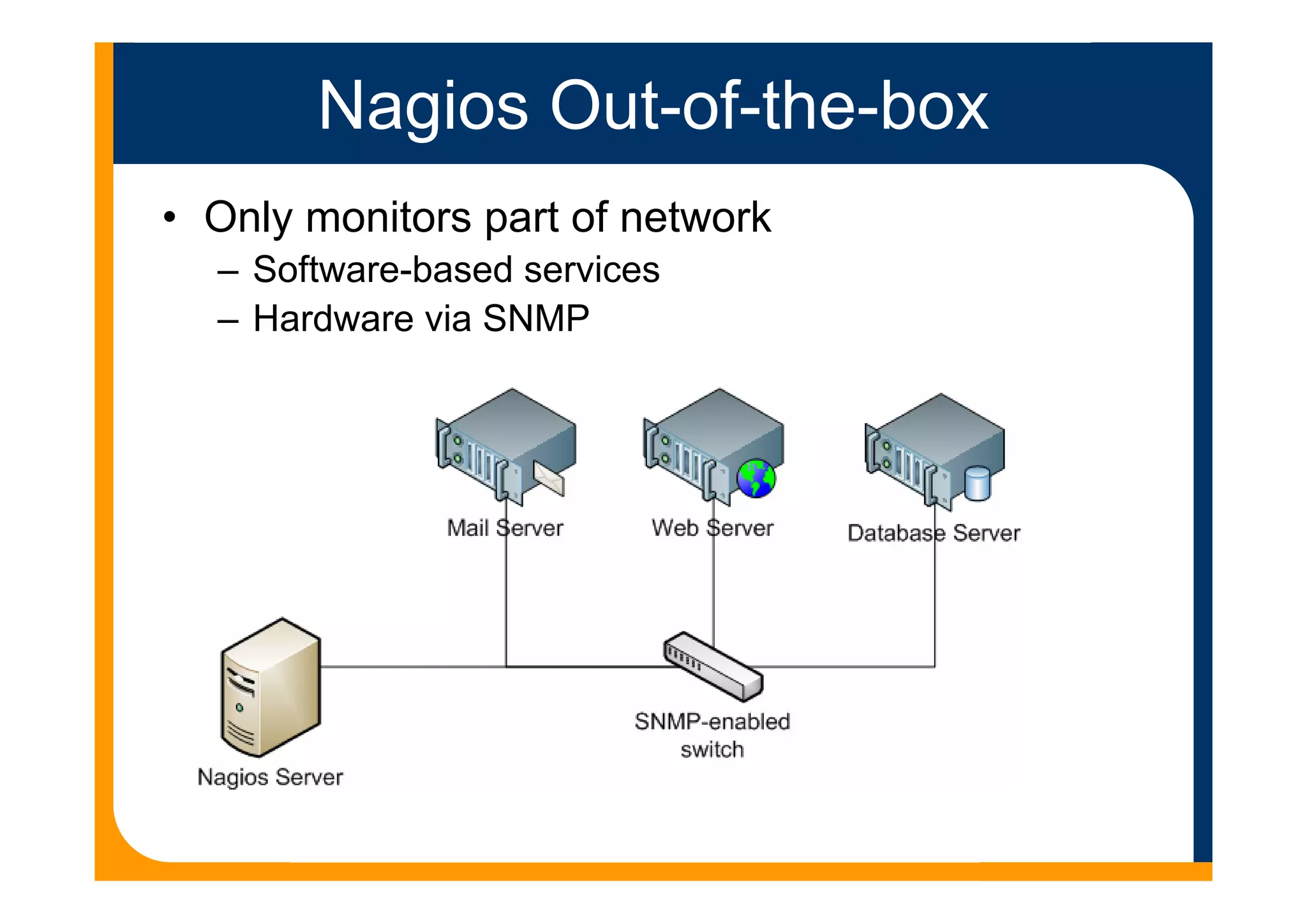
Nagios Out-of-the-box
• Only monitors part of network
– Software-based services
– Hardware via SNMP
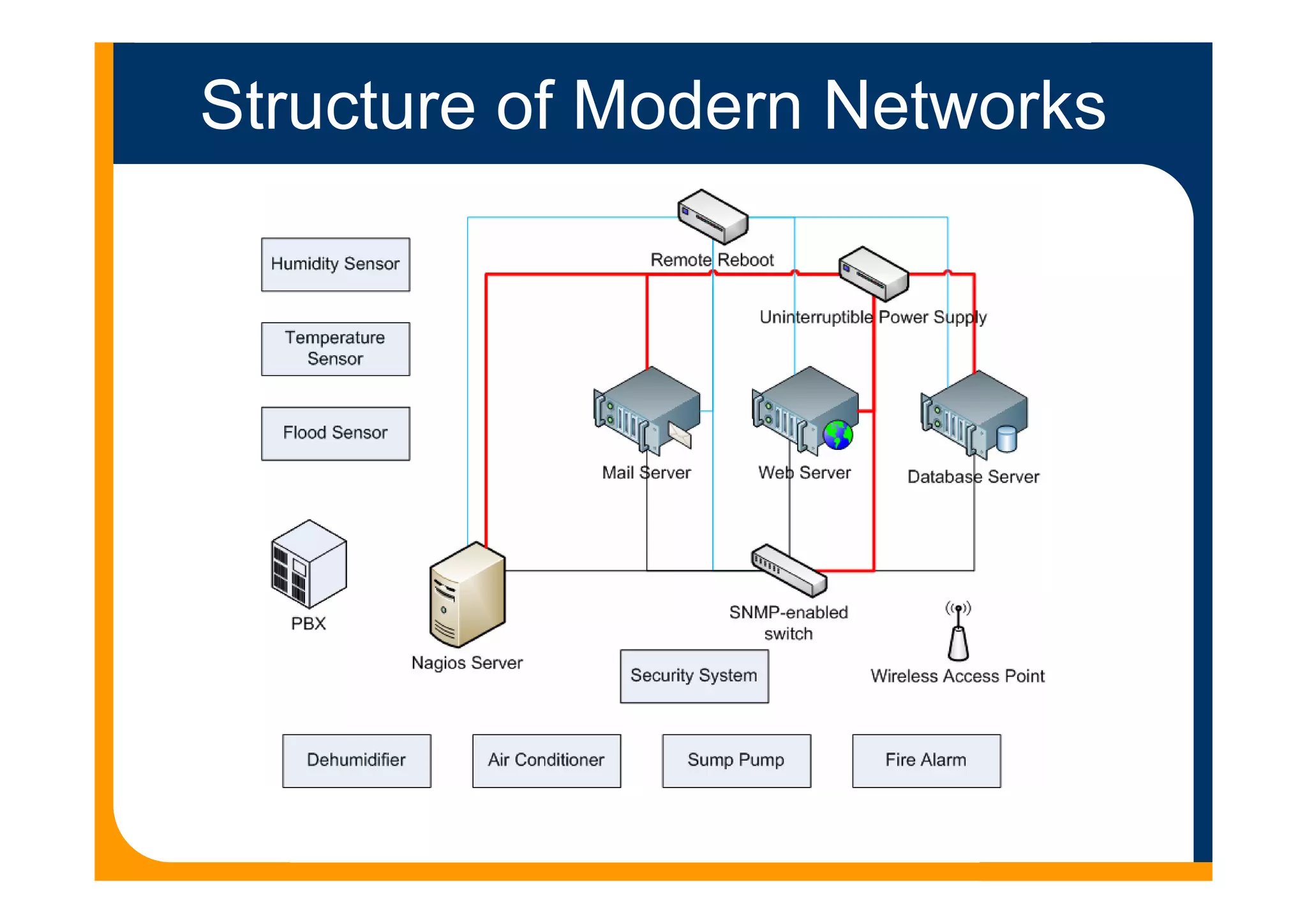
Structure of Modern Networks
Need for Hardware Plugins
• Necessary for total network coverage
• Monitor non-network services
• Take corrective action with hardware
SNMP isn’t Enough
• Difficult for complex operations
• MIB management can be a hassle
• Security
– Non-existent security until SNMPv3
– May require holes in firewall
• Need hardware-specific plugins
Nagios as Mediator
• Register event handlers with checks
• Execute event handlers due to
checks
• Schedule checks based on event
handlers
• Simple checks, simple event handlers
Hardware-based Plugins
• Handle complex interactions
• Provide semantic meaning
• Provide hardware-specific error messages
Web Service-enabled Hardware
• Standards-defined interface (W3C)
• Supports most modern programming
languages
• Lower cost of client support
• Lower cost for client development
Web Service Security
• Use SSL channel (HTTPS)
• Use HTTP authentication methods
• No special firewall rules needed
Vendor Value Proposition
• Push complex monitoring to 3rd party
• Support widely deployed monitoring
app
• Potential for community contributions
Nagios Value Proposition
• Total network coverage
• Push development off to vendor
• Competitive advantage against other
monitoring applications
What Can Nagios Do?
• Can’t develop plugins for everything
• Register support with vendors
• Perhaps ship packaged up plugins
– Simpler for end users
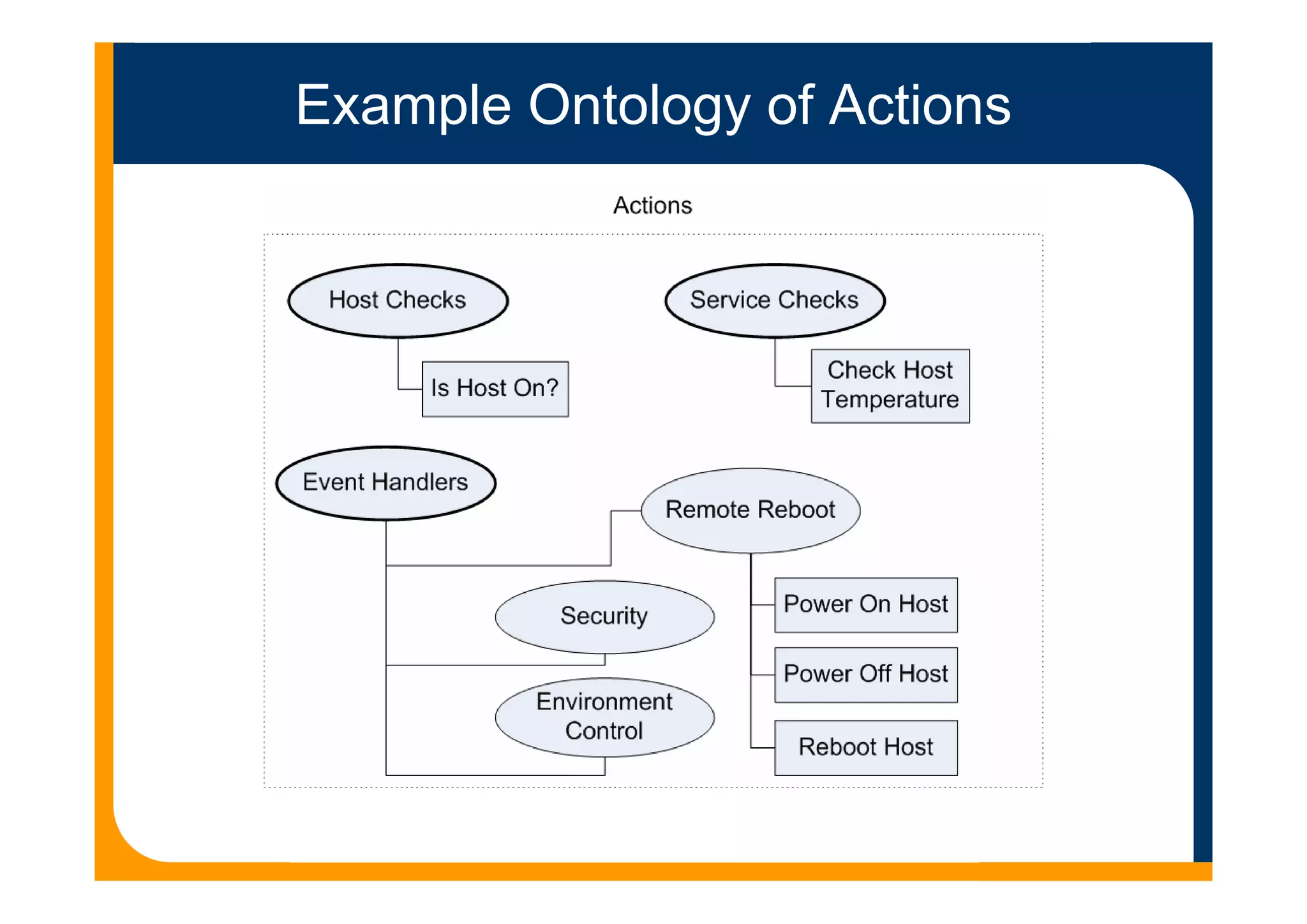
• Develop an ontology of actions
Example Ontology of Actions
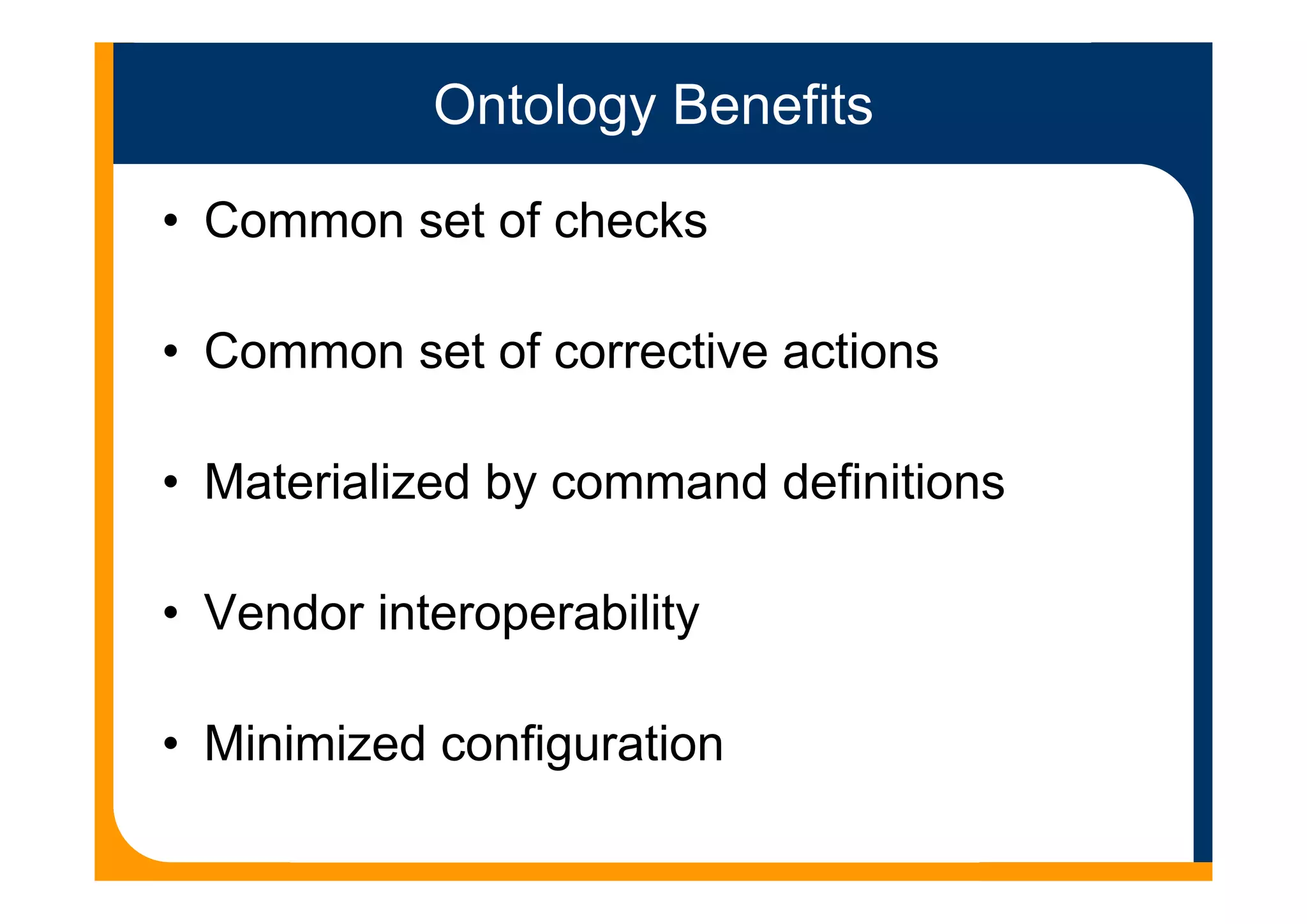
Ontology Benefits
• Common set of checks
• Common set of corrective actions
• Materialized by command definitions
• Vendor interoperability
• Minimized configuration
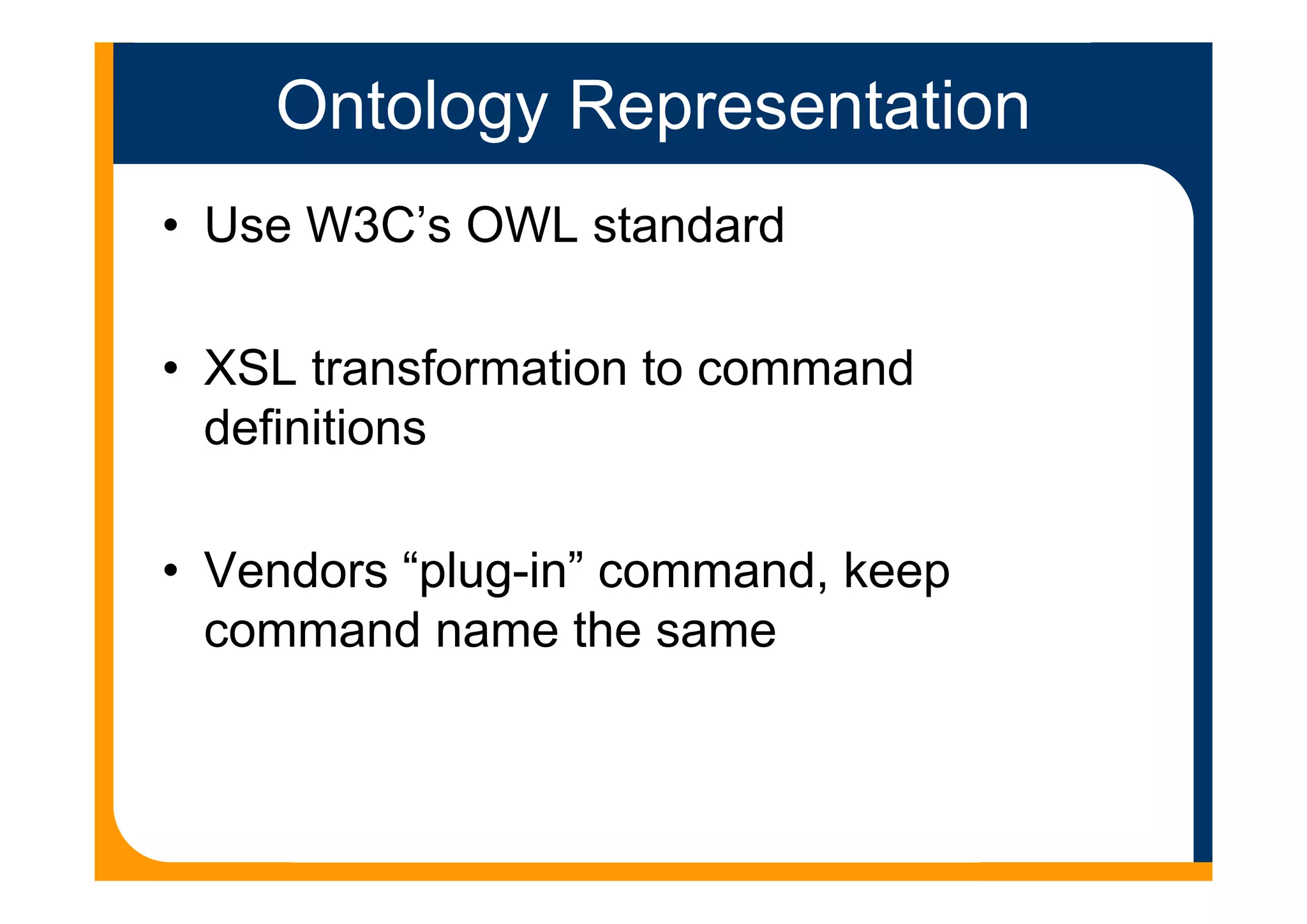
Ontology Representation
• Use W3C’s OWL standard
• XSL transformation to command
definitions
• Vendors “plug-in” command, keep
command name the same
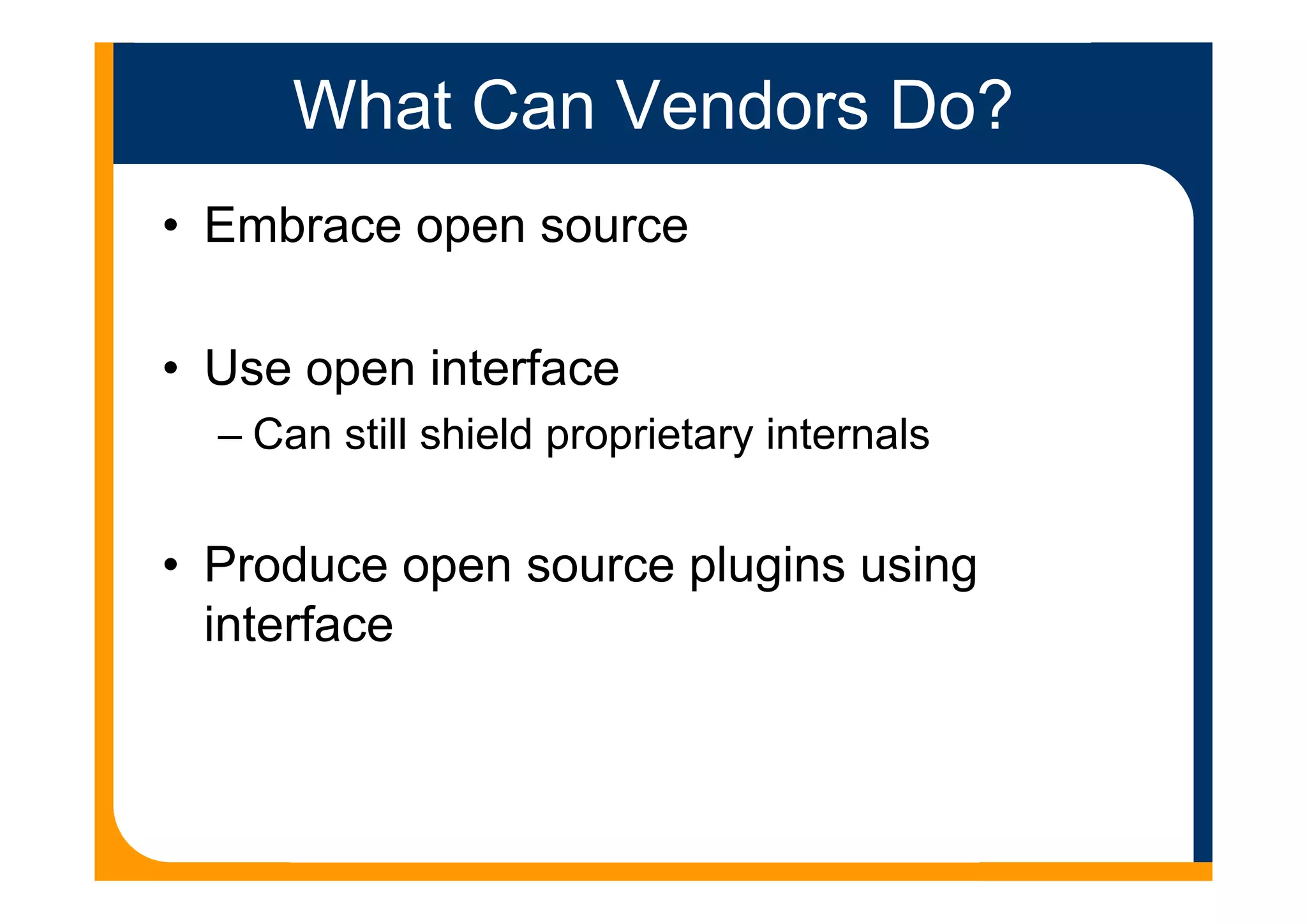
What Can Vendors Do?
• Embrace open source
• Use open interface
– Can still shield proprietary internals
• Produce open source plugins using
interface
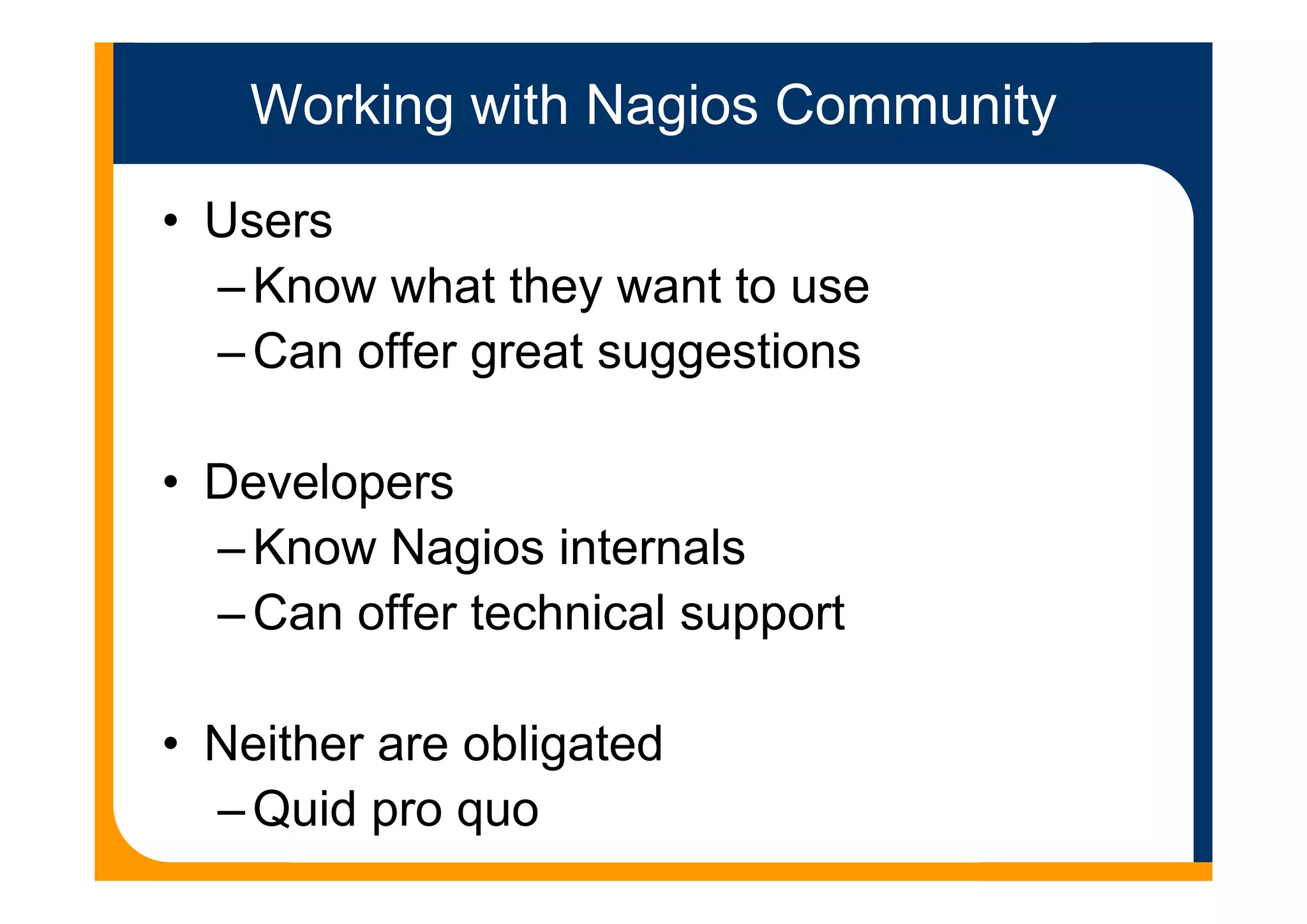
Working with Nagios Community
• Users
–Know what they want to use
–Can offer great suggestions
• Developers
–Know Nagios internals
–Can offer technical support
• Neither are obligated
–Quid pro quo
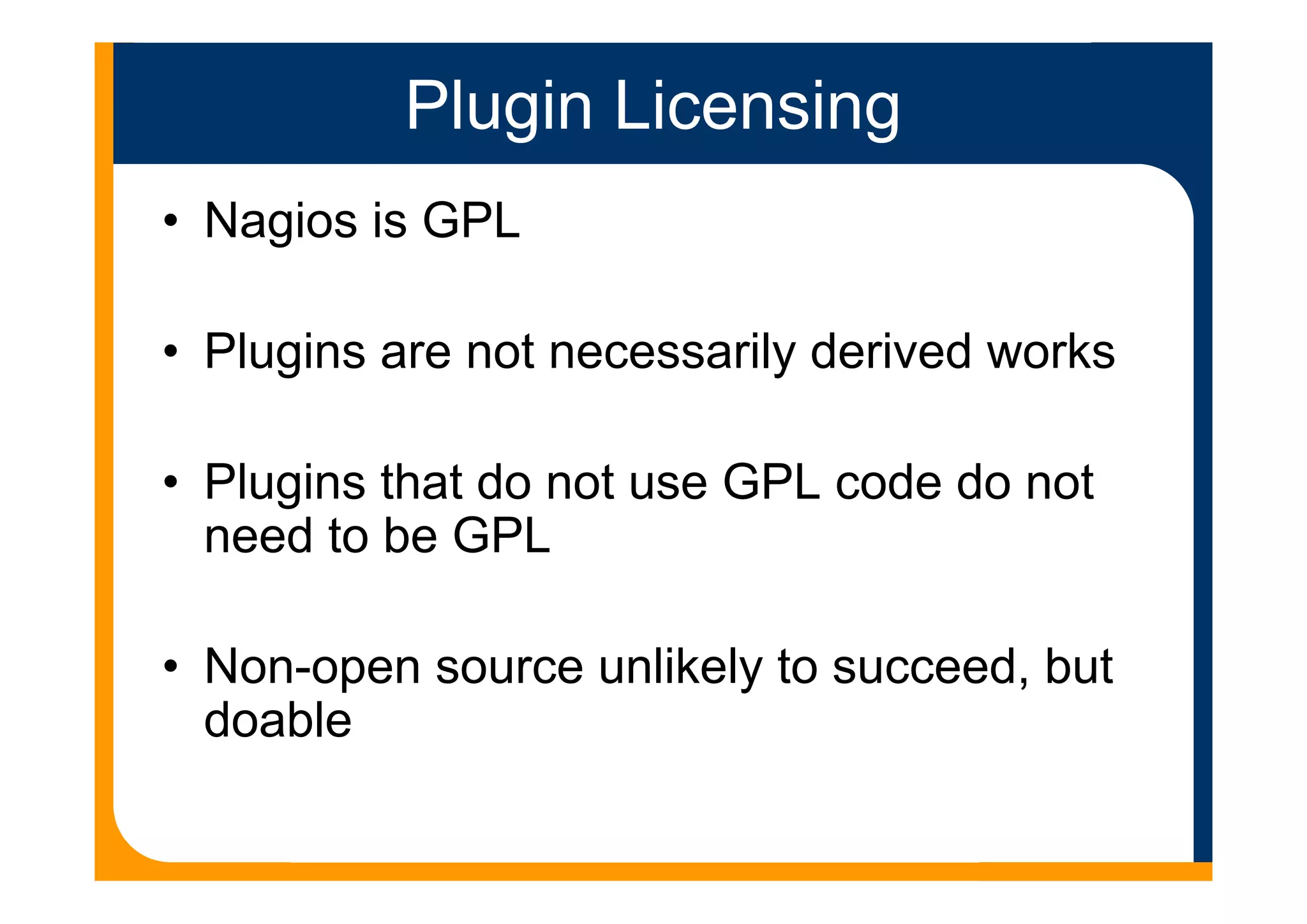
Plugin Licensing
• Nagios is GPL
• Plugins are not necessarily derived works
• Plugins that do not use GPL code do not
need to be GPL
• Non-open source unlikely to succeed, but
doable
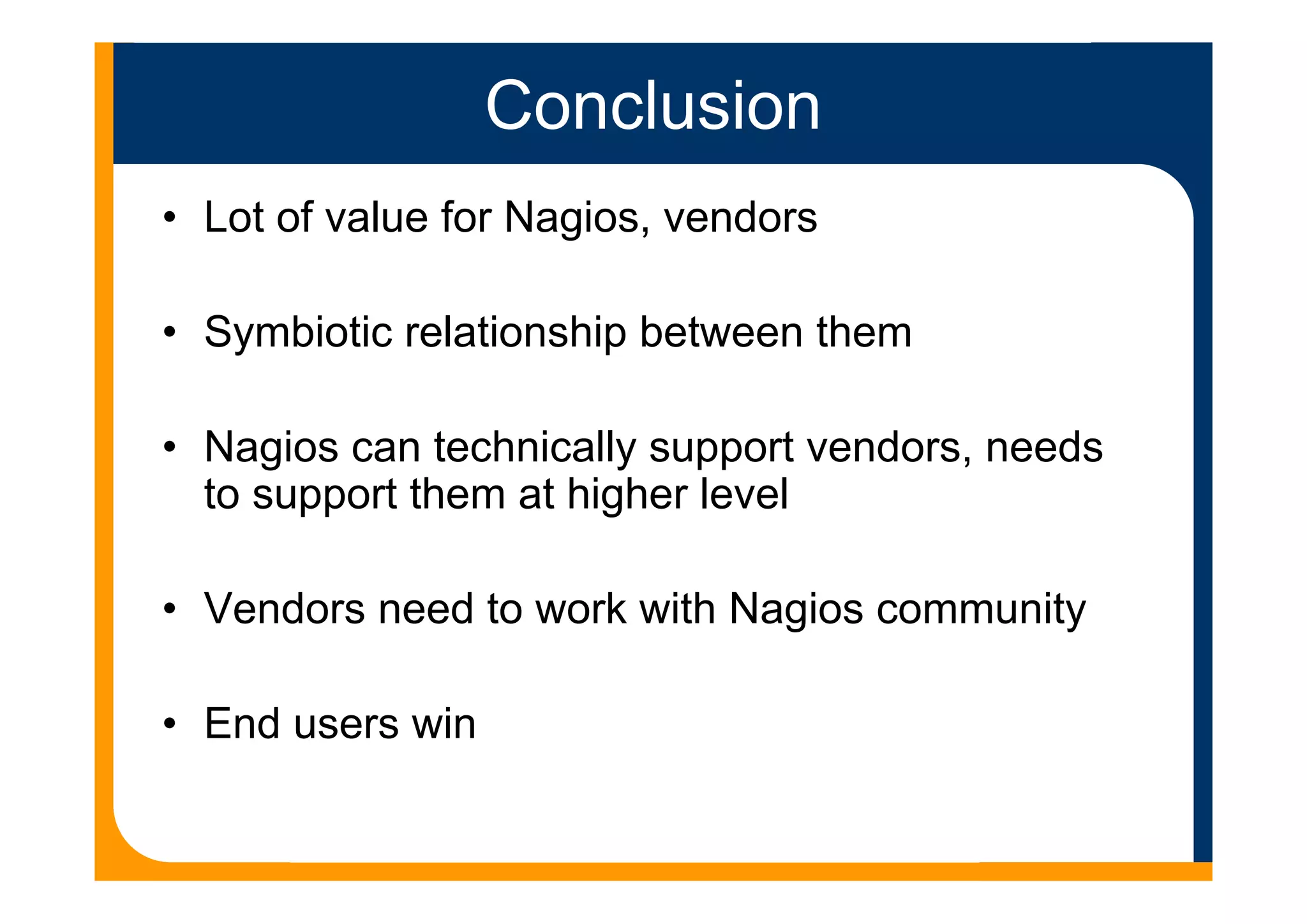
Conclusion
• Lot of value for Nagios, vendors
• Symbiotic relationship between them
• Nagios can technically support vendors, needs
to support them at higher level
• Vendors need to work with Nagios community
• End users win
References
Ernesto Damiani, Sabrina De Capitani di
Vimercati, Stefano Paraboschi, and
Pierangela Samarati. Fine grained access
control for soap e-services. In WWW ’01:
Proceedings of the 10th international
conference on World Wide Web, pages
504–513, New York, NY, USA, 2001. ACM
Press.
The Apache Software Foundation. Apache
license, version 2.0, 2004.
Free Software Foundation Inc. Gnu general
public license, version 2, 1991.
Paul Fremantle, Sanjiva Weerawarana, and
Rania Khalaf. Enterprise services. Commun.
ACM, 45(10):77–82, 2002.
Erich Gamma, Richard Helm, Ralph Johnson,
and John Vlissides. Design Patterns:
Elements of Reusable Object-Oriented
Software. Addison Wesley, 1995.
Bruce Perens. Open standards: Principles and
practices.
Khoi Anh Phan, Zahir Tari, and Peter Bertok. A
benchmark on soap’s transport protocols
performance for mobile applications. In SAC
’06: Proceedings of the 2006 ACM
symposium on Applied computing, pages
1139–1144, New York, NY, USA, 2006.
ACM Press.
John Soldatos and Dimitris Alexopoulos. Web
services-based network management:
approaches and the wsnet system. Int. J.
Netw. Manag., 17(1):33–50, 2007.
Douglas B. Terry and Venugopalan
Ramasubramanian. Caching xml web
services for mobility. Queue, 1(3):70–78,
2003.
Robert van Engelen. Code generation
techniques for developing lightweight xml
web services for embedded devices. In SAC
’04: Proceedings of the 2004 ACM
symposium on Applied computing, pages
854–861, New York, NY, USA, 2004. ACM
Press.
Acknowledgements
• Nagios community
• Netways
• Servprise staff
• Special thanks to:
– Melanie Bolduc
– Ethan Galstad

Nagios Conference 2007 | A Framework for Hardware-based Monitoring by Kevin Menard

  • 1.
    Kevin Menard Servprise International,Inc. kmenard@servprise.com +1 508.892.3823 x308 Nagios: A Framework for Hardware-based Monitoring October 11, 2007 ®
  • 2.
    Nagios Out-of-the-box • Onlymonitors part of network – Software-based services – Hardware via SNMP
  • 3.
  • 4.
    Need for HardwarePlugins • Necessary for total network coverage • Monitor non-network services • Take corrective action with hardware
  • 5.
    SNMP isn’t Enough •Difficult for complex operations • MIB management can be a hassle • Security – Non-existent security until SNMPv3 – May require holes in firewall • Need hardware-specific plugins
  • 6.
    Nagios as Mediator •Register event handlers with checks • Execute event handlers due to checks • Schedule checks based on event handlers • Simple checks, simple event handlers
  • 7.
    Hardware-based Plugins • Handlecomplex interactions • Provide semantic meaning • Provide hardware-specific error messages
  • 8.
    Web Service-enabled Hardware •Standards-defined interface (W3C) • Supports most modern programming languages • Lower cost of client support • Lower cost for client development
  • 9.
    Web Service Security •Use SSL channel (HTTPS) • Use HTTP authentication methods • No special firewall rules needed
  • 10.
    Vendor Value Proposition •Push complex monitoring to 3rd party • Support widely deployed monitoring app • Potential for community contributions
  • 11.
    Nagios Value Proposition •Total network coverage • Push development off to vendor • Competitive advantage against other monitoring applications
  • 12.
    What Can NagiosDo? • Can’t develop plugins for everything • Register support with vendors • Perhaps ship packaged up plugins – Simpler for end users • Develop an ontology of actions
  • 13.
  • 14.
    Ontology Benefits • Commonset of checks • Common set of corrective actions • Materialized by command definitions • Vendor interoperability • Minimized configuration
  • 15.
    Ontology Representation • UseW3C’s OWL standard • XSL transformation to command definitions • Vendors “plug-in” command, keep command name the same
  • 16.
    What Can VendorsDo? • Embrace open source • Use open interface – Can still shield proprietary internals • Produce open source plugins using interface
  • 17.
    Working with NagiosCommunity • Users –Know what they want to use –Can offer great suggestions • Developers –Know Nagios internals –Can offer technical support • Neither are obligated –Quid pro quo
  • 18.
    Plugin Licensing • Nagiosis GPL • Plugins are not necessarily derived works • Plugins that do not use GPL code do not need to be GPL • Non-open source unlikely to succeed, but doable
  • 19.
    Conclusion • Lot ofvalue for Nagios, vendors • Symbiotic relationship between them • Nagios can technically support vendors, needs to support them at higher level • Vendors need to work with Nagios community • End users win
  • 20.
    References Ernesto Damiani, SabrinaDe Capitani di Vimercati, Stefano Paraboschi, and Pierangela Samarati. Fine grained access control for soap e-services. In WWW ’01: Proceedings of the 10th international conference on World Wide Web, pages 504–513, New York, NY, USA, 2001. ACM Press. The Apache Software Foundation. Apache license, version 2.0, 2004. Free Software Foundation Inc. Gnu general public license, version 2, 1991. Paul Fremantle, Sanjiva Weerawarana, and Rania Khalaf. Enterprise services. Commun. ACM, 45(10):77–82, 2002. Erich Gamma, Richard Helm, Ralph Johnson, and John Vlissides. Design Patterns: Elements of Reusable Object-Oriented Software. Addison Wesley, 1995. Bruce Perens. Open standards: Principles and practices. Khoi Anh Phan, Zahir Tari, and Peter Bertok. A benchmark on soap’s transport protocols performance for mobile applications. In SAC ’06: Proceedings of the 2006 ACM symposium on Applied computing, pages 1139–1144, New York, NY, USA, 2006. ACM Press. John Soldatos and Dimitris Alexopoulos. Web services-based network management: approaches and the wsnet system. Int. J. Netw. Manag., 17(1):33–50, 2007. Douglas B. Terry and Venugopalan Ramasubramanian. Caching xml web services for mobility. Queue, 1(3):70–78, 2003. Robert van Engelen. Code generation techniques for developing lightweight xml web services for embedded devices. In SAC ’04: Proceedings of the 2004 ACM symposium on Applied computing, pages 854–861, New York, NY, USA, 2004. ACM Press.
  • 21.
    Acknowledgements • Nagios community •Netways • Servprise staff • Special thanks to: – Melanie Bolduc – Ethan Galstad