UNDERSTANDING RECIPROCAL EXCHANGES
ACROSS NATIONS AND INSTITUTIONS
NAFSA ANNUAL CONFERENCE
SAN DIEGO
FRIDAY 30 MAY 2014
Dawn J. Moyer, Oregon State University
Soraya Campbell, Duke University
Rachel Jessop, De Montfort University, UK
Paul R. Dorres, Oregon State University
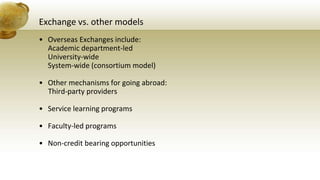
Exchange vs. other models
• Overseas Exchanges include:
Academic department-led
University-wide
System-wide (consortium model)
• Other mechanisms for going abroad:
Third-party providers
• Service learning programs
• Faculty-led programs
• Non-credit bearing opportunities
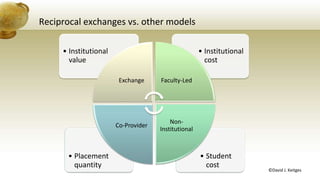
Reciprocal exchanges vs. other models
• Student
cost
• Placement
quantity
• Institutional
cost
• Institutional
value
Exchange Faculty-Led
Non-
Institutional
Co-Provider
©David J. Keitges
UK global student mobility
• Vast majority of global student mobility is via exchanges
• Large numbers of study/work abroad is via Erasmus+ within Europe
• UK students are typically interested in
• Destinations outside Europe
• English-speaking countries
• Growth in government-supported programs
• Faculty-led programs in the minority
• Use of third party providers very uncommon
• The UK approach to internationalization is changing
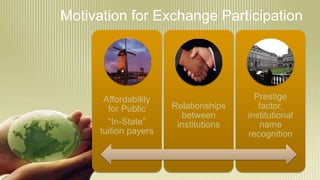
Motivation for Exchange Participation
Affordability
for Public
“In-State”
tuition payers
Relationships
between
institutions
Prestige
factor,
institutional
name
recognition
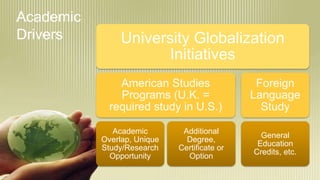
Academic
Drivers University Globalization
Initiatives
American Studies
Programs (U.K. =
required study in U.S.)
Academic
Overlap, Unique
Study/Research
Opportunity
Additional
Degree,
Certificate or
Option
Foreign
Language
Study
General
Education
Credits, etc.
National
Initiatives
UK
•International experience
initiatives e.g. #DMUglobal
Globally
•Governments developing
international education
strategies
Student Exchanges: Survey Results
UK US
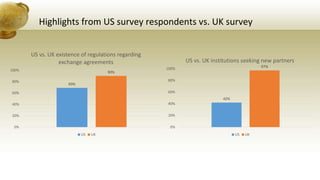
Highlights from US survey respondents vs. UK survey
69%
90%
0%
20%
40%
60%
80%
100%
US vs. UK existence of regulations regarding
exchange agreements
US UK
42%
97%
0%
20%
40%
60%
80%
100%
US vs. UK institutions seeking new partners
US UK
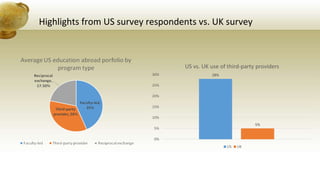
Highlights from US survey respondents vs. UK survey
32%
5%
0%
5%
10%
15%
20%
25%
30%
35%
US vs. UK use of third-party providers
US UK
Institutional faculty-
led programs
38%
International
campuses owned by
or affiliated with
your institution
6%
Third-party provider
programs (programs
organized and
managed by an
outside agency or
institution)
32%
Institutional
reciprocal student
exchanges
19%
Other
5%
Average US Education Abroad Portfolio by Program Type
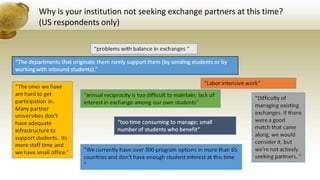
Why is your institution not seeking exchange partners at this time?
(US respondents only)
Changes in the revenue generation model in the UK
• Tuition fees were introduced in the UK in 1998: up to £1,000/year
• Tuition fees increased since then from £3,000/year to £9,000/year
• Different rules for Scotland, Northern Ireland and Wales
• Reduced tuition fees possible for those who study/work abroad as
part of their degree program, depending on the university
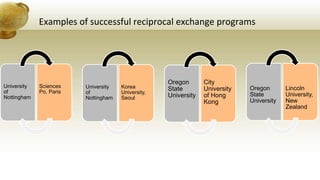
Examples of successful reciprocal exchange programs
University
of
Nottingham
Korea
University,
Seoul
University
of
Nottingham
Sciences
Po, Paris
Oregon
State
University
Lincoln
University,
New
Zealand
Oregon
State
University
City
University
of Hong
Kong
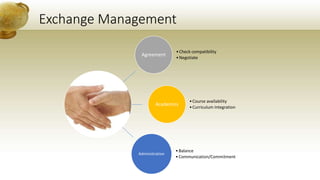
Exchange Management
Agreement
•Check compatibility
•Negotiate
Academics
•Course availability
•Curriculum Integration
Administration
•Balance
•Communication/Commitment
Who manages exchanges?
• Departments - greater ‘ownership’ of
exchange vs. resources
• Main international office - mandate as
‘gatekeeper’ role
• Conflicts from interpretations of
maintaining the exchange balance vs.
value of the exchange partnership to
the department
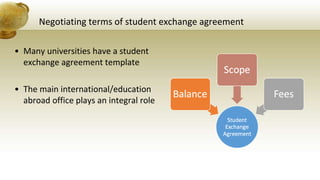
Negotiating terms of student exchange agreement
• Many universities have a student
exchange agreement template
• The main international/education
abroad office plays an integral role
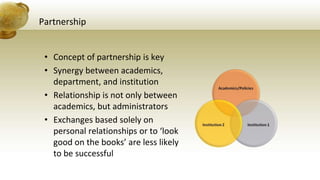
Partnership
• Concept of partnership is key
• Synergy between academics,
department, and institution
• Relationship is not only between
academics, but administrators
• Exchanges based solely on
personal relationships or to ‘look
good on the books’ are less likely
to be successful
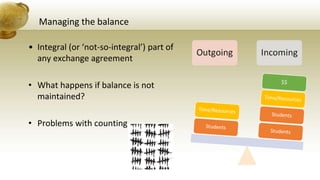
Managing the balance
• Integral (or ‘not-so-integral’) part of
any exchange agreement
• What happens if balance is not
maintained?
• Problems with counting
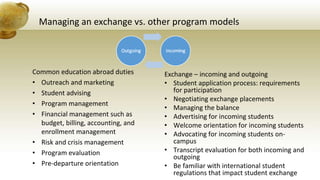
Managing an exchange vs. other program models
Common education abroad duties
• Outreach and marketing
• Student advising
• Program management
• Financial management such as
budget, billing, accounting, and
enrollment management
• Risk and crisis management
• Program evaluation
• Pre-departure orientation
Exchange – incoming and outgoing
• Student application process: requirements
for participation
• Negotiating exchange placements
• Managing the balance
• Advertising for incoming students
• Welcome orientation for incoming students
• Advocating for incoming students on-
campus
• Transcript evaluation for both incoming and
outgoing
• Be familiar with international student
regulations that impact student exchange
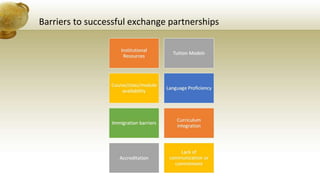
Barriers to successful exchange partnerships
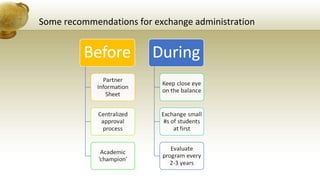
Some recommendations for exchange administration
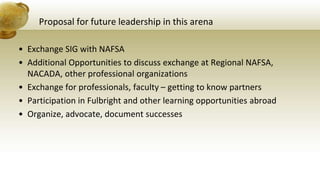
Proposal for future leadership in this arena
• Exchange SIG with NAFSA
• Additional Opportunities to discuss exchange at Regional NAFSA,
NACADA, other professional organizations
• Exchange for professionals, faculty – getting to know partners
• Participation in Fulbright and other learning opportunities abroad
• Organize, advocate, document successes
THANK YOU!

Understanding Reciprocal Exchanges Across Nations and Institutions

  • 1.
    UNDERSTANDING RECIPROCAL EXCHANGES ACROSSNATIONS AND INSTITUTIONS NAFSA ANNUAL CONFERENCE SAN DIEGO FRIDAY 30 MAY 2014
  • 2.
    Dawn J. Moyer,Oregon State University Soraya Campbell, Duke University Rachel Jessop, De Montfort University, UK Paul R. Dorres, Oregon State University
  • 3.
    Exchange vs. othermodels • Overseas Exchanges include: Academic department-led University-wide System-wide (consortium model) • Other mechanisms for going abroad: Third-party providers • Service learning programs • Faculty-led programs • Non-credit bearing opportunities
  • 4.
    Reciprocal exchanges vs.other models • Student cost • Placement quantity • Institutional cost • Institutional value Exchange Faculty-Led Non- Institutional Co-Provider ©David J. Keitges
  • 5.
    UK global studentmobility • Vast majority of global student mobility is via exchanges • Large numbers of study/work abroad is via Erasmus+ within Europe • UK students are typically interested in • Destinations outside Europe • English-speaking countries • Growth in government-supported programs • Faculty-led programs in the minority • Use of third party providers very uncommon • The UK approach to internationalization is changing
  • 6.
    Motivation for ExchangeParticipation Affordability for Public “In-State” tuition payers Relationships between institutions Prestige factor, institutional name recognition
  • 7.
    Academic Drivers University Globalization Initiatives AmericanStudies Programs (U.K. = required study in U.S.) Academic Overlap, Unique Study/Research Opportunity Additional Degree, Certificate or Option Foreign Language Study General Education Credits, etc.
  • 8.
    National Initiatives UK •International experience initiatives e.g.#DMUglobal Globally •Governments developing international education strategies
  • 9.
  • 10.
    Highlights from USsurvey respondents vs. UK survey 69% 90% 0% 20% 40% 60% 80% 100% US vs. UK existence of regulations regarding exchange agreements US UK 42% 97% 0% 20% 40% 60% 80% 100% US vs. UK institutions seeking new partners US UK
  • 11.
    Highlights from USsurvey respondents vs. UK survey 32% 5% 0% 5% 10% 15% 20% 25% 30% 35% US vs. UK use of third-party providers US UK Institutional faculty- led programs 38% International campuses owned by or affiliated with your institution 6% Third-party provider programs (programs organized and managed by an outside agency or institution) 32% Institutional reciprocal student exchanges 19% Other 5% Average US Education Abroad Portfolio by Program Type
  • 12.
    Why is yourinstitution not seeking exchange partners at this time? (US respondents only)
  • 13.
    Changes in therevenue generation model in the UK • Tuition fees were introduced in the UK in 1998: up to £1,000/year • Tuition fees increased since then from £3,000/year to £9,000/year • Different rules for Scotland, Northern Ireland and Wales • Reduced tuition fees possible for those who study/work abroad as part of their degree program, depending on the university
  • 14.
    Examples of successfulreciprocal exchange programs University of Nottingham Korea University, Seoul University of Nottingham Sciences Po, Paris Oregon State University Lincoln University, New Zealand Oregon State University City University of Hong Kong
  • 15.
    Exchange Management Agreement •Check compatibility •Negotiate Academics •Courseavailability •Curriculum Integration Administration •Balance •Communication/Commitment
  • 16.
    Who manages exchanges? •Departments - greater ‘ownership’ of exchange vs. resources • Main international office - mandate as ‘gatekeeper’ role • Conflicts from interpretations of maintaining the exchange balance vs. value of the exchange partnership to the department
  • 17.
    Negotiating terms ofstudent exchange agreement • Many universities have a student exchange agreement template • The main international/education abroad office plays an integral role
  • 18.
    Partnership • Concept ofpartnership is key • Synergy between academics, department, and institution • Relationship is not only between academics, but administrators • Exchanges based solely on personal relationships or to ‘look good on the books’ are less likely to be successful
  • 19.
    Managing the balance •Integral (or ‘not-so-integral’) part of any exchange agreement • What happens if balance is not maintained? • Problems with counting
  • 20.
    Managing an exchangevs. other program models Common education abroad duties • Outreach and marketing • Student advising • Program management • Financial management such as budget, billing, accounting, and enrollment management • Risk and crisis management • Program evaluation • Pre-departure orientation Exchange – incoming and outgoing • Student application process: requirements for participation • Negotiating exchange placements • Managing the balance • Advertising for incoming students • Welcome orientation for incoming students • Advocating for incoming students on- campus • Transcript evaluation for both incoming and outgoing • Be familiar with international student regulations that impact student exchange
  • 21.
    Barriers to successfulexchange partnerships
  • 22.
    Some recommendations forexchange administration
  • 23.
    Proposal for futureleadership in this arena • Exchange SIG with NAFSA • Additional Opportunities to discuss exchange at Regional NAFSA, NACADA, other professional organizations • Exchange for professionals, faculty – getting to know partners • Participation in Fulbright and other learning opportunities abroad • Organize, advocate, document successes
  • 24.

Editor's Notes

  • #4 b. It is common practice for UK universities to work with third party providers such as Arcadia to offer fee-paying “study abroad” places. This provides all the benefits of being on an exchange programme but with the safety net of the third party provider organising the practical arrangements and providing an interface between the student and the host university. Alternatively it’s possible to have an agreement with both exchange and study abroad places. When the exchange places have been used up, places can be offered on a fee-paying study abroad basis. For the US, it’s sometimes the same price or cheaper for a student to pay the study abroad fee to a UK institution rather than come to the UK as an exchange student.
  • #6 ERASMUS+ Mainly for language students as mentioned Although numbers of students taking part in the Erasmus programme are constantly increasing, there are imbalances between specific countries. Spain sent out the most Erasmus students for both studies and placements (39 545), followed by Germany (33 363) and France (33 269). Spain was also the most popular destination country with 39 300 incoming students, followed by France (28 964) and Germany (27 872). The UK is significantly surpassed by Spain, France, Germany, Italy and Poland. In 2011/12, the United Kingdom hosted almost twice as many students (25 760) as it sent abroad (13 662). This is due to: language: students from other European countries want to come to the UK to learn English UK students are typically more interested in destinations outside Europe if they have the option The vast majority of outgoing Erasmus students from the UK are language students who have a compulsory third year abroad. The number of UK-based students who opt to study or work abroad in Europe is relatively low. many UK Erasmus agreements set up by schools/departments was based on “my friend who works at X university” and were not necessarily good student destinations. Since the introduction of tuition fees, this situation is typically leading to institutions having to cut Erasmus agreements where there have been incoming students for many years and no outgoing students. But in future, universities are also realising that the exchange agreement is not the only way to work with another European university cf. partnerships, double degrees, staff exchange etc. and there is a need to educate academics in some cases. GOVERNMENT SUPPORTED PROGRAMMES Study China, Study India, Generation UK FACULTY-LED PROGRAMMES Often referred to as “field trips” in the UK; for specific degree courses only Faculty are not paid to take additional programmes over and above normal teaching Erasmus Teacher Mobility is an individual activity not with a group of students THIRD PARTY PROVIDERS You cannot add credit to UK degree programmes, they are defined by length. A standard degree programme is three years long with 120 credits to be completed in the year. It is not possible to undertake summer schools or additional study abroad periods to add credit and graduate earlier. Students who go on summer schools do not get credit as it’s not possible to gain more than 120 credits per year.   The secondary reason is that UK students do not historically pay tuition fees: the culture is not that of HE being paid for. Students would not be prepared to pay to attend a summer school for instance – tuition fees are typically waived via an agreement with the partner university. This situation will only change if and when the UK decides to move towards a credit model as in the US. Then, the 3rd party provider market would begin to grow here. The traditional UK university approach to internationalisation focussed almost exclusively on international student recruitment and, in the study abroad and exchange arena, on reciprocal exchange agreements. Given the tuition fee model, the removal of Student Numbers Cap (SNC) in 2015/16 and a more globalised approach to HE, universities must think outside the box. Alumni funding: annual alumni participation in many US universities is over 60% whereas for most UK universities it is under 2%. A growth area of UK universities, especially working with international alumni. Business engagement to increase Emerging markets for international student recruitment: “the market…will continue to grow, and Britain remains well placed to benefit from the continued globalisation of higher education. Its reputation for quality and the advantages offered by our native language remain key assets. However the market will become more competitive as new providers enter and the quality of higher education in some of the large source countries improves.” David Greenaway Times Higher Education 21 April 2010 Changes to the international offer for domestic students: DMU is developing faculty-led programmes, internships and short term study abroad opportunities.
  • #8 Both US and UK institutions require students who study modern foreign languages to study/work abroad. In the UK in the vast majority of cases this is for one full academic year as part of a four year programme. There are at least 16 UK universities which offer American and/or Canadian Studies degrees which include a compulsory study abroad year or semester as part of the programme. All of these opportunities are offered via reciprocal exchange agreements. The year abroad is most common for outgoing students from the UK, whereas one semester is most common for incoming students to the UK. This effectively means that a UK university needs to recruit double the number of students in order to keep the exchange viable. The issue with these kinds of degrees is that as study abroad is guaranteed to all of the students on the cohort, there is a risk of recruiting too many students in one year as compared to the number of places available two years later. Another issue is that students latch on to one particular destination rather than realising that it’s a competitive process and places can’t be guaranteed: it’s crucial to manage student expectations. University World News 19 May 2014 http://www.universityworldnews.com/article.php?story=20140130155355392 Universities which require all students to study abroad Goucher College, Maryland Soka University of America, California Goucher College in Maryland and Soka University of America in California require every student to spend time abroad before they graduate. The two universities top the list of schools with the most students studying abroad. http://www.usnews.com/education/best-colleges/the-short-list-college/articles/2013/02/26/10-colleges-where-the-most-students-study-abroad http://www.nafsa.org/_/file/_/internationaleducator/voicesjanfeb.pdf re Goucher College
  • #9 INTERNATIONAL EDUCATION STRATEGIES Recently developed international education strategies or policy statements from Canada, the UK, and Australia all make explicit calls for augmenting the numbers of their students pursuing educational experiences abroad. Within Europe, where bi-directional student mobility is enshrined through the Bologna Process, Erasmus, and other European Union programmes, an emerging area of consideration is “balanced mobility”, that is, the cultivation of equal student flows between countries.  Control and regulation of domestic students leaving the country, financing and provision, and the ease of obtaining foreign student visas play a key role in determining student flows. Government policies on providing scholarships or financial aid for domestic or foreign students are a key factor, as is the opportunity to stay on a country post-graduation. “universities will have to make tough decisions on the balance between providing courses that are popular with foreign students and therefore potentially attractive money spinners on the one hand, while on the other maintaining the semblance of a balanced menu of courses that meet economic needs”, The International Mobility of Students in Asia and the Pacific, UNESCO’s Asia-Pacific regional bureau for education in Bangkok. #DMUglobal aims to offer a meaningful international experience to 50% of DMU students over the next 5 years. The programme has been developed because of: The 2012 CBI Education and Skills survey identified that 55% of UK businesses were dissatisfied with graduates’ foreign language skills and 47% were dissatisfied with levels of cultural awareness The needs and expectations of UK and international businesses are growing in a fiercely competitive global marketplace According to Government figures, only 6% of UK students travel overseas as part of their studies The UK Government has committed to 20% of all domestic HE students being overseas for a minimum of 3 months by 2020
  • #12 A survey on reciprocal exchanges was undertaken by contacting individual international educators via the SECUSS-L Listserv and the NAFSA EA forum. Participation rates vary per question; though we solicited participation from non-US institutions, 90% of respondents indicated they worked for US-based institutions (US-based = 81, Non-US based = 9 (n=90)). To facilitate comparison, we have noted if results pertain only to US-based institutions in the summary below. Another survey of reciprocal exchanges was undertaken in the UK by contacting institutions who are members of BUTEX (British Universities Transatlantic Exchange Association). 51 UK institutions responded representing all types of HEI in the UK (Russell Group, pre-92, post-92 and others).
  • #14 Gradually the cost of a degree in England has been transferred from the taxpayer to the student. Rather than serving as an add-on to the system, loans are underpinning the majority of state funding for the teaching of Higher Education. There have been many protests from students and the National Union of Students about this fundamental change to the funding of HE in England.   Tuition fees were first introduced across the entire United Kingdom in September 1998 as a means of funding tuition to undergraduate and postgraduate certificate students at universities, with students being required to pay up to £1,000 a year for tuition. In England, in January 2004 the UK government increased the level of tuition fees that universities were allowed to charge, to £3,000 a year. By 2010/11, maximum fees had increased to £3,290. In 2009, further calls for more funding to be made available to universities resulted in the commissioning of a report from the former chairman of BP John Browne to look into the future of higher education funding: the Browne review. Published on 12 October 2010 and contained proposals to remove the cap on tuition fees. The government won a vote in the House of Commons which would result in universities eventually being able to charge students up to £9,000 a year for the annual tuition costs of students. 64 universities announced their intention to charge the full £9,000 allowed by the government from 2012, with the remaining 59 all charging at least £6,000. Scottish students studying in Scotland don’t pay any tuition fees. In Northern Ireland and Wales, fees are charged to a maximum of £3,290. A tuition fee loan and a living cost loan to help with the costs of accommodation and food etc. Depending on household income students can also receive a living cost grant which is non-repayable. Fees are not payable upfront. All loans are paid back post graduation once graduates are earning a minimum of £21,000. Loans are to be written off after 30 years if this threshold has not been reached, the person dies or is judged unfit to work. There are questions around whether the government has underestimated how much it will cost to fund loans to students who are paying vastly higher tuition fees, and how easy it will be to recover loans from European Union students.   The Erasmus fee waiver is in existence up to and including 2013/14 which gives UK students who are studying or working abroad for 24 weeks minimum a tuition fee waiver for that year. From 2014/15 however this will no longer be in existence.   Some UK universities are choosing to charge a reduced tuition fee to students who study or work abroad as part of their degree programme as a recruitment tool and a way of helping students with the additional cost of going abroad. At Nottingham for example home students who are going abroad for the full year are paying £1350 rather than £9000, or £6300 for one semester.
  • #17 Many universities have a student exchange agreement template Who does the negotiating? The main international/education abroad office plays an integral role
  • #20 Some institutions pay very close attention to this detail Maintaining balance is a real dollars and cents issue to an institution Perfect, one-to-one balance is usually not realistic Both parties need to reevaluate the relationship The program is suspended on one or both sides A plan is put in place to balance the ratio Different agencies in control of counting No systematic central data collection Varying definitions of mobility Different terminology Inconsistency of data Data is not comparable across different countries due to different education systems Overseas branch campuses MOOCs
  • #24 Proposal for future leadership in this arena