Initiating and Sustaining a School-based International Exchange Program   Caryn Stedman July 11, 2008
Today… INDIVIDUAL  Summer, semester, academic-year SCHOOL SPONSORED TRAVEL   TEACHER EXCHANGE FUNDING
Hosting Easy way to get started Makes it possible for every student in your school to have an authentic international experience Exchange organizations more willing to help with scholarships and financial aid if school hosts Some scholarships are reserved for students whose families have hosted Tax credit for families who host students U.S. Department of State   (Bureau of Educational and Cultural Affairs, Citizen Exchanges, Youth Programs Division)   h ttp://exchanges.state.gov/education/citizens/students/
Develop Relationships Contact local representatives Invite them to your school Identify group of families as likely hosts and put them in contact with local representatives  Work closely with representative and families Welcome and celebrate international students
Getting Students Abroad Review/ develop policies Start small, identify students Hold meeting with representative & students Have a person who is responsible for helping students through application process Advocate for your students  with organization(s) Celebrate students going abroad and returning
Scholarships YFU  –  many scholarships for under-represented groups, esp. Japan & Germany  ( www.yfu-usa.org  ) AFS  –  Awards for Excellence, Congress Bundestag ( www.afs.org ) CIEE   (High School Abroad in Spain Teaching award)  http://www.ciee.org/hsabroad/apply/index.html   AYUSA  (Intrax)  (Youth Leader Scholarship)  http://www.intraxstudyabroad.com/scholarships   Rotary International
Hold or Join an International Exchange Fair Invite local/regional representatives of CSIET listed exchange organizations Consider other specialty exchange organizations (Laurasian Institute, Experiment in International Living,  People-to-People, iEARN) Invite parents, students, teachers, exchange students
Arrangements for standardized tests (AP, SAT, etc)? Questions for a School to Consider* * From “Administering Youth Exchange” (CSIET, 2007)
School Sponsored Exchange Group travel arranged and run by intermediary organizations School-arranged group travel
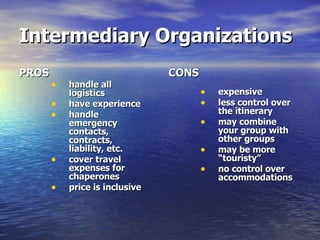
Intermediary Organizations PROS handle all logistics have experience handle emergency contacts, contracts, liability, etc. cover travel expenses for chaperones price is inclusive CONS expensive  less control over the itinerary may combine your group with other groups may be more “touristy” no control over accommodations
Working with Tour Organizations Ask for contacts in local schools that have used the organization’s services recently  Start early so students have time to fundraise Make sure all students have legal travel documents
Work with your representative (negotiate) Pay attention to “fine print” re: pricing and refunds Plan a series of meetings for students and parents School should have clear policy on participation Working with Tour Organizations
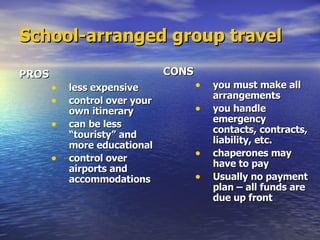
School-arranged group travel PROS less expensive control over your own itinerary can be less “touristy” and more educational  control over airports and accommodations CONS   you must make all arrangements you handle emergency contacts, contracts, liability, etc. chaperones may have to pay Usually no payment plan – all funds are due up front
Arranging your own program Application, waiver forms, statements of expectations should be cleared by legal staff Require all students and chaperones to purchase evacuation and repatriation insurance & to carry proof of international health insurance Contacts “on the ground”  essential
Arranging your own program Start early so students have time to fundraise Make sure all students have legal travel documents Plan a series of meetings for students and parents
Teacher Exchange Consider a policy for teacher exchange – individual or as chaperones – to get as many teachers involved as possible Consider teacher exchange a contribution to school Have exchange coordinator contact organizations on list to receive email updates and to forward notices to teachers
Teacher Exchange Have international exchange coordinator subscribe to such e-letters as Global TeachNet and the Yale-PIER mailing lists  Hold a professional development program on teacher educational travel & exchange
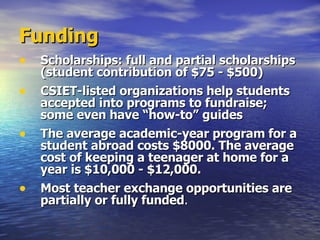
Funding Scholarships: full and partial scholarships (student contribution of $75 - $500) CSIET-listed organizations help students accepted into programs to fundraise; some even have “how-to” guides The average academic-year program for a student abroad costs $8000. The average cost of keeping a teenager at home for a year is $10,000 - $12,000. Most teacher exchange opportunities are partially or fully funded .
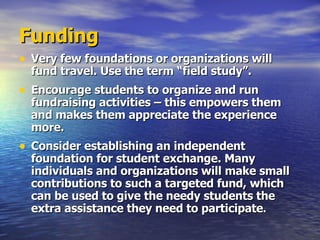
Funding Very few foundations or organizations will fund travel. Use the term “field study”. Encourage students to organize and run fundraising activities – this empowers them and makes them appreciate the experience more. Consider establishing an independent foundation for student exchange. Many individuals and organizations will make small contributions to such a targeted fund, which can be used to give the needy students the extra assistance they need to participate .

Stedman Exchanges

  • 1.
    Initiating and Sustaininga School-based International Exchange Program Caryn Stedman July 11, 2008
  • 2.
    Today… INDIVIDUAL Summer, semester, academic-year SCHOOL SPONSORED TRAVEL TEACHER EXCHANGE FUNDING
  • 3.
    Hosting Easy wayto get started Makes it possible for every student in your school to have an authentic international experience Exchange organizations more willing to help with scholarships and financial aid if school hosts Some scholarships are reserved for students whose families have hosted Tax credit for families who host students U.S. Department of State (Bureau of Educational and Cultural Affairs, Citizen Exchanges, Youth Programs Division) h ttp://exchanges.state.gov/education/citizens/students/
  • 4.
    Develop Relationships Contactlocal representatives Invite them to your school Identify group of families as likely hosts and put them in contact with local representatives Work closely with representative and families Welcome and celebrate international students
  • 5.
    Getting Students AbroadReview/ develop policies Start small, identify students Hold meeting with representative & students Have a person who is responsible for helping students through application process Advocate for your students with organization(s) Celebrate students going abroad and returning
  • 6.
    Scholarships YFU – many scholarships for under-represented groups, esp. Japan & Germany ( www.yfu-usa.org ) AFS – Awards for Excellence, Congress Bundestag ( www.afs.org ) CIEE (High School Abroad in Spain Teaching award) http://www.ciee.org/hsabroad/apply/index.html AYUSA (Intrax) (Youth Leader Scholarship) http://www.intraxstudyabroad.com/scholarships Rotary International
  • 7.
    Hold or Joinan International Exchange Fair Invite local/regional representatives of CSIET listed exchange organizations Consider other specialty exchange organizations (Laurasian Institute, Experiment in International Living, People-to-People, iEARN) Invite parents, students, teachers, exchange students
  • 8.
    Arrangements for standardizedtests (AP, SAT, etc)? Questions for a School to Consider* * From “Administering Youth Exchange” (CSIET, 2007)
  • 9.
    School Sponsored ExchangeGroup travel arranged and run by intermediary organizations School-arranged group travel
  • 10.
    Intermediary Organizations PROShandle all logistics have experience handle emergency contacts, contracts, liability, etc. cover travel expenses for chaperones price is inclusive CONS expensive less control over the itinerary may combine your group with other groups may be more “touristy” no control over accommodations
  • 11.
    Working with TourOrganizations Ask for contacts in local schools that have used the organization’s services recently Start early so students have time to fundraise Make sure all students have legal travel documents
  • 12.
    Work with yourrepresentative (negotiate) Pay attention to “fine print” re: pricing and refunds Plan a series of meetings for students and parents School should have clear policy on participation Working with Tour Organizations
  • 13.
    School-arranged group travelPROS less expensive control over your own itinerary can be less “touristy” and more educational control over airports and accommodations CONS you must make all arrangements you handle emergency contacts, contracts, liability, etc. chaperones may have to pay Usually no payment plan – all funds are due up front
  • 14.
    Arranging your ownprogram Application, waiver forms, statements of expectations should be cleared by legal staff Require all students and chaperones to purchase evacuation and repatriation insurance & to carry proof of international health insurance Contacts “on the ground” essential
  • 15.
    Arranging your ownprogram Start early so students have time to fundraise Make sure all students have legal travel documents Plan a series of meetings for students and parents
  • 16.
    Teacher Exchange Considera policy for teacher exchange – individual or as chaperones – to get as many teachers involved as possible Consider teacher exchange a contribution to school Have exchange coordinator contact organizations on list to receive email updates and to forward notices to teachers
  • 17.
    Teacher Exchange Haveinternational exchange coordinator subscribe to such e-letters as Global TeachNet and the Yale-PIER mailing lists Hold a professional development program on teacher educational travel & exchange
  • 18.
    Funding Scholarships: fulland partial scholarships (student contribution of $75 - $500) CSIET-listed organizations help students accepted into programs to fundraise; some even have “how-to” guides The average academic-year program for a student abroad costs $8000. The average cost of keeping a teenager at home for a year is $10,000 - $12,000. Most teacher exchange opportunities are partially or fully funded .
  • 19.
    Funding Very fewfoundations or organizations will fund travel. Use the term “field study”. Encourage students to organize and run fundraising activities – this empowers them and makes them appreciate the experience more. Consider establishing an independent foundation for student exchange. Many individuals and organizations will make small contributions to such a targeted fund, which can be used to give the needy students the extra assistance they need to participate .