Electronic
Alternatives to
Textbooks for
Your Students
Teri Gallaway & Jim Hobbs, Loyola University New Orleans
Learning with LOUIS
March 23, 2015
Electronic Alternatives to
Textbooks for Your Students
• Goal: To learn about the changing
textbook world with a case study of how
Loyola librarians worked with teaching
faculty to provide alternatives to
purchasing expensive textbooks for
students.
Background issues
• Textbook cost challenges many students
• Average cost: $1250
• Cost of college and student loan debt
• Challenging employment market
• Value of higher education under attack
• Emphasis on assessment and productivity
Loyola’s response
• Encourage faculty to adopt open textbooks
• Invite faculty to make more use of
electronic reserves
• Request copies of print textbooks from
faculty
• Purchase the most-needed print textbooks
Current situation
• Textbook market and student costs/debt
• Higher education funding in decline
• First-generation students with higher
financial need
• Assumption: “Everything is free online”
• Government budget and policy changes
• State-supported institutions budgets down with no end in sight
Differing models
• E-book general and subject collections,
e.g., EBSCO, Project Muse
• Online only and downloadable
• E-textbooks: commercial or open
textbooks
Nomenclature
• E-books: individual titles and collections
• E-textbooks: a type of e-book published by a textbook
publisher—can be commercial or open access
• Open educational resources (OERs): open textbooks, test
questions, study guides, images, audio and video in digital or
non-digital formats that can be used by students, teachers and
researchers with the explicit right to reuse, redistribute and
adapt or “remix” materials
• Open textbooks: a type of OER
• Open textbook repository: a collection of open textbooks and
other OERs
● Impact unclear: no counts of those
available, who and how many in use
● Some information on satisfaction and
impact on grades
● Publisher response
State of Open E-Textbooks
Open texts: gratis or libre?
• “Free as in beer:” zero price (aka “gratis”);
free to use
• “Free as in speech:” little or no restriction
(aka “libre”); provides more rights than
gratis: to redistribute, to change, to add
• University-wide task force
• Academic and Career Support Services
• Withdrawal triggers
• Promote a reduction in student textbook
expenses through faculty adoption of open
access textbooks
Student Success Forum
● Library materials acquisitions
● Library student employment
● Information literacy
● Circulation statistics
● Use of the building
● Student satisfaction
● Trigger events
Retention Efforts and the
Library
● Joined liaisons to visit each department
● Present scenario of textbook costs
● Review existing library and campus
services
● Present information on available open
access texts
● Follow-up with a link to a research guide
Departmental Visits
• Why doesn’t the library buy textbooks?
• New philosophy of collection development
• Development of evaluation criteria
New Service Needs
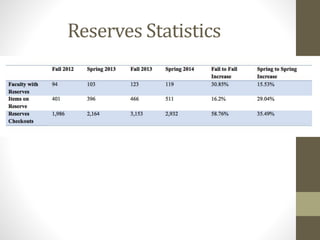
Reserves Statistics
● Faculty reticence: no support to write
including credit for promotion and
tenure, little time to select
● Difficulty finding suitable texts at all levels
in all subjects
● Ease of use
● Lack of standards and best practices
Barriers to Adoption
● Faculty survey of interest
● Identifying adoption rates
● Faculty satisfaction
● Student satisfaction
● Coordination of bookstore data and SIS
Assessment Plans
● Continuing to encourage faculty to provide
textbooks to library
● Evaluate impact of library purchased textbooks
● Establish role for library in bookstore contact
negotiation
● Advocate as librarian liaisons
● Advocate as members of the university
● State-wide advocacy
● Large collections of monographs and edited
volumes
● National participation
Future Programs and Librarian
Advocacy
References:
http://loyno.edu/~gallaway/openaccess/references.pdf
Further Reading
Research Guides:
http://researchguides.loyno.edu/opentextbooks
http://researchguides.loyno.edu/openaccess
Further Reading
• Gallaway, Teri Oaks; Hobbs, James B. "Open
access for student success." in Enhancing
Teaching and Learning in the 21st-Century
Academic Library: Successful Innovations That
Make a Difference. Lanham, MD: Rowman &
Littlefield, 2015.
• New Media Consortium. “Horizon Report : 2015
Higher Education Edition.” Austin, TX: New
Media Consortium, 2015. Web. March 20,
2015. < http://www.nmc.org/publication/nmc-
horizon-report-2015-higher-education-edition/>
Questions
gallaway@loyno.edu
hobbs@loyno.edu

Electronic Alternatives to Textbooks for Your Students: Learning with LOUIS 20150323

  • 1.
    Electronic Alternatives to Textbooks for YourStudents Teri Gallaway & Jim Hobbs, Loyola University New Orleans Learning with LOUIS March 23, 2015
  • 2.
    Electronic Alternatives to Textbooksfor Your Students • Goal: To learn about the changing textbook world with a case study of how Loyola librarians worked with teaching faculty to provide alternatives to purchasing expensive textbooks for students.
  • 3.
    Background issues • Textbookcost challenges many students • Average cost: $1250 • Cost of college and student loan debt • Challenging employment market • Value of higher education under attack • Emphasis on assessment and productivity
  • 4.
    Loyola’s response • Encouragefaculty to adopt open textbooks • Invite faculty to make more use of electronic reserves • Request copies of print textbooks from faculty • Purchase the most-needed print textbooks
  • 5.
    Current situation • Textbookmarket and student costs/debt • Higher education funding in decline • First-generation students with higher financial need • Assumption: “Everything is free online” • Government budget and policy changes • State-supported institutions budgets down with no end in sight
  • 6.
    Differing models • E-bookgeneral and subject collections, e.g., EBSCO, Project Muse • Online only and downloadable • E-textbooks: commercial or open textbooks
  • 7.
    Nomenclature • E-books: individualtitles and collections • E-textbooks: a type of e-book published by a textbook publisher—can be commercial or open access • Open educational resources (OERs): open textbooks, test questions, study guides, images, audio and video in digital or non-digital formats that can be used by students, teachers and researchers with the explicit right to reuse, redistribute and adapt or “remix” materials • Open textbooks: a type of OER • Open textbook repository: a collection of open textbooks and other OERs
  • 8.
    ● Impact unclear:no counts of those available, who and how many in use ● Some information on satisfaction and impact on grades ● Publisher response State of Open E-Textbooks
  • 9.
    Open texts: gratisor libre? • “Free as in beer:” zero price (aka “gratis”); free to use • “Free as in speech:” little or no restriction (aka “libre”); provides more rights than gratis: to redistribute, to change, to add
  • 10.
    • University-wide taskforce • Academic and Career Support Services • Withdrawal triggers • Promote a reduction in student textbook expenses through faculty adoption of open access textbooks Student Success Forum
  • 11.
    ● Library materialsacquisitions ● Library student employment ● Information literacy ● Circulation statistics ● Use of the building ● Student satisfaction ● Trigger events Retention Efforts and the Library
  • 12.
    ● Joined liaisonsto visit each department ● Present scenario of textbook costs ● Review existing library and campus services ● Present information on available open access texts ● Follow-up with a link to a research guide Departmental Visits
  • 13.
    • Why doesn’tthe library buy textbooks? • New philosophy of collection development • Development of evaluation criteria New Service Needs
  • 14.
  • 15.
    ● Faculty reticence:no support to write including credit for promotion and tenure, little time to select ● Difficulty finding suitable texts at all levels in all subjects ● Ease of use ● Lack of standards and best practices Barriers to Adoption
  • 16.
    ● Faculty surveyof interest ● Identifying adoption rates ● Faculty satisfaction ● Student satisfaction ● Coordination of bookstore data and SIS Assessment Plans
  • 17.
    ● Continuing toencourage faculty to provide textbooks to library ● Evaluate impact of library purchased textbooks ● Establish role for library in bookstore contact negotiation ● Advocate as librarian liaisons ● Advocate as members of the university ● State-wide advocacy ● Large collections of monographs and edited volumes ● National participation Future Programs and Librarian Advocacy
  • 18.
  • 19.
    Further Reading • Gallaway,Teri Oaks; Hobbs, James B. "Open access for student success." in Enhancing Teaching and Learning in the 21st-Century Academic Library: Successful Innovations That Make a Difference. Lanham, MD: Rowman & Littlefield, 2015. • New Media Consortium. “Horizon Report : 2015 Higher Education Edition.” Austin, TX: New Media Consortium, 2015. Web. March 20, 2015. < http://www.nmc.org/publication/nmc- horizon-report-2015-higher-education-edition/>
  • 20.