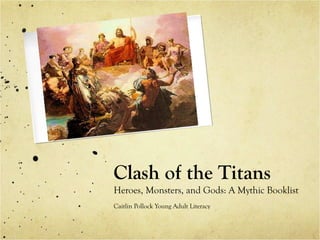
Clash of the Titans
Heroes, Monsters, and Gods: A Mythic Booklist
Caitlin Pollock Young Adult Literacy
Nonfiction

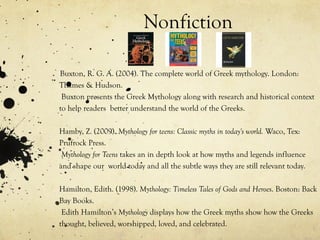
Buxton, R. G. A. (2004). The complete world of Greek mythology. London:
Thames & Hudson.
 Buxton presents the Greek Mythology along with research and historical context
to help readers better understand the world of the Greeks.

Hamby, Z. (2009). Mythology for teens: Classic myths in today's world. Waco, Tex:
Prufrock Press.
 Mythology for Teens takes an in depth look at how myths and legends influence
and shape our world today and all the subtle ways they are still relevant today.

Hamilton, Edith. (1998). Mythology: Timeless Tales of Gods and Heroes. Boston: Back
Bay Books.
 Edith Hamilton’s Mythology displays how the Greek myths show how the Greeks
thought, believed, worshipped, loved, and celebrated.
Poetry
Block, F. L. (2006). Psyche in a dress. New York: Joanna Cotler Books.
Block tells the Greek Myths—the tales of Psyche, Narcissus, Demeter and Persephone—set in our
modern Los Angeles in detailed, flowing, poetic verse.

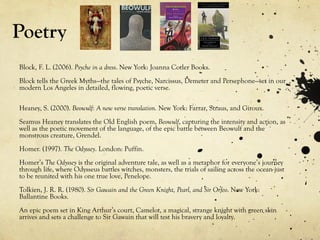
Heaney, S. (2000). Beowulf: A new verse translation. New York: Farrar, Straus, and Giroux.
Seamus Heaney translates the Old English poem, Beowulf, capturing the intensity and action, as
well as the poetic movement of the language, of the epic battle between Beowulf and the
monstrous creature, Grendel.
Homer. (1997). The Odyssey. London: Puffin.
Homer’s The Odyssey is the original adventure tale, as well as a metaphor for everyone’s journey
through life, where Odysseus battles witches, monsters, the trials of sailing across the ocean just
to be reunited with his one true love, Penelope.
Tolkien, J. R. R. (1980). Sir Gawain and the Green Knight, Pearl, and Sir Orfeo. New York:
Ballantine Books.
An epic poem set in King Arthur’s court, Camelot, a magical, strange knight with green skin
arrives and sets a challenge to Sir Gawain that will test his bravery and loyalty.
Fiction
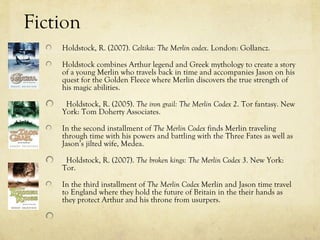
    Holdstock, R. (2007). Celtika: The Merlin codex. London: Gollancz.

    Holdstock combines Arthur legend and Greek mythology to create a story
    of a young Merlin who travels back in time and accompanies Jason on his
    quest for the Golden Fleece where Merlin discovers the true strength of
    his magic abilities.

     Holdstock, R. (2005). The iron grail: The Merlin Codex 2. Tor fantasy. New
    York: Tom Doherty Associates.

    In the second installment of The Merlin Codex finds Merlin traveling
    through time with his powers and battling with the Three Fates as well as
    Jason’s jilted wife, Medea.

     Holdstock, R. (2007). The broken kings: The Merlin Codex 3. New York:
    Tor.

    In the third installment of The Merlin Codex Merlin and Jason time travel
    to England where they hold the future of Britain in the their hands as
    they protect Arthur and his throne from usurpers.
Fiction
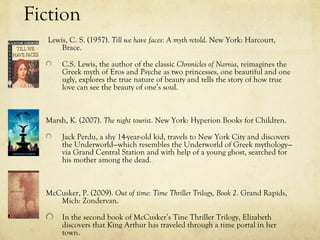
  Lewis, C. S. (1957). Till we have faces: A myth retold. New York: Harcourt,
      Brace.

       C.S. Lewis, the author of the classic Chronicles of Narnia, reimagines the
       Greek myth of Eros and Psyche as two princesses, one beautiful and one
       ugly, explores the true nature of beauty and tells the story of how true
       love can see the beauty of one’s soul.


  Marsh, K. (2007). The night tourist. New York: Hyperion Books for Children.

       Jack Perdu, a shy 14-year-old kid, travels to New York City and discovers
       the Underworld—which resembles the Underworld of Greek mythology—
       via Grand Central Station and with help of a young ghost, searched for
       his mother among the dead.


  McCusker, P. (2009). Out of time: Time Thriller Trilogy, Book 2. Grand Rapids,
     Mich: Zondervan.

       In the second book of McCusker’s Tine Thriller Trilogy, Elizabeth
       discovers that King Arthur has traveled through a time portal in her
       town.
Fiction
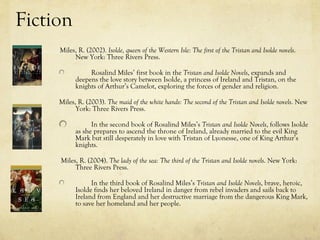
     Miles, R. (2002). Isolde, queen of the Western Isle: The first of the Tristan and Isolde novels.
          New York: Three Rivers Press.

                Rosalind Miles’ first book in the Tristan and Isolde Novels, expands and
           deepens the love story between Isolde, a princess of Ireland and Tristan, on the
           knights of Arthur’s Camelot, exploring the forces of gender and religion.

     Miles, R. (2003). The maid of the white hands: The second of the Tristan and Isolde novels. New
           York: Three Rivers Press.

                 In the second book of Rosalind Miles’s Tristan and Isolde Novels, follows Isolde
           as she prepares to ascend the throne of Ireland, already married to the evil King
           Mark but still desperately in love with Tristan of Lyonesse, one of King Arthur’s
           knights.

     Miles, R. (2004). The lady of the sea: The third of the Tristan and Isolde novels. New York:
          Three Rivers Press.

                 In the third book of Rosalind Miles’s Tristan and Isolde Novels, brave, heroic,
           Isolde finds her beloved Ireland in danger from rebel invaders and sails back to
           Ireland from England and her destructive marriage from the dangerous King Mark,
           to save her homeland and her people.
Fiction: Percy Jackson and the
          Olympians
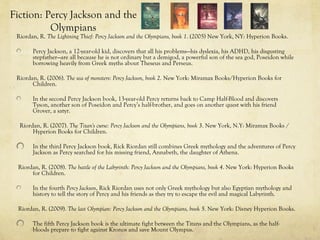
 Riordan, R. The Lightning Thief: Percy Jackson and the Olympians, book 1. (2005) New York, NY: Hyperion Books.

       Percy Jackson, a 12-year-old kid, discovers that all his problems—his dyslexia, his ADHD, his disgusting
       stepfather—are all because he is not ordinary but a demigod, a powerful son of the sea god, Poseidon while
       borrowing heavily from Greek myths about Theseus and Perseus.

 Riordan, R. (2006). The sea of monsters: Percy Jackson, book 2. New York: Miramax Books/Hyperion Books for
       Children.

       In the second Percy Jackson book, 13-year-old Percy returns back to Camp Half-Blood and discovers
       Tyson, another son of Poseidon and Percy’s half-brother, and goes on another quest with his friend
       Grover, a satyr.

  Riordan, R. (2007). The Titan's curse: Percy Jackson and the Olympians, book 3. New York, N.Y: Miramax Books /
       Hyperion Books for Children.

       In the third Percy Jackson book, Rick Riordan still combines Greek mythology and the adventures of Percy
       Jackson as Percy searched for his missing friend, Annabeth, the daughter of Athena.

 Riordan, R. (2008). The battle of the Labyrinth: Percy Jackson and the Olympians, book 4. New York: Hyperion Books
      for Children.

       In the fourth Percy Jackson, Rick Riordan uses not only Greek mythology but also Egyptian mythology and
       history to tell the story of Percy and his friends as they try to escape the evil and magical Labyrinth.

 Riordan, R. (2009). The last Olympian: Percy Jackson and the Olympians, book 5. New York: Disney Hyperion Books.

       The fifth Percy Jackson book is the ultimate fight between the Titans and the Olympians, as the half-
       bloods prepare to fight against Kronos and save Mount Olympus.
Fiction
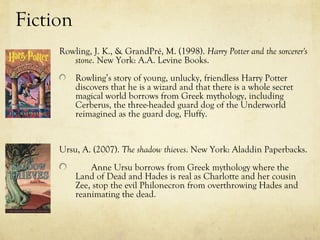
     Rowling, J. K., & GrandPré, M. (1998). Harry Potter and the sorcerer's
        stone. New York: A.A. Levine Books.
          Rowling’s story of young, unlucky, friendless Harry Potter
          discovers that he is a wizard and that there is a whole secret
          magical world borrows from Greek mythology, including
          Cerberus, the three-headed guard dog of the Underworld
          reimagined as the guard dog, Fluffy.


     Ursu, A. (2007). The shadow thieves. New York: Aladdin Paperbacks.
              Anne Ursu borrows from Greek mythology where the
          Land of Dead and Hades is real as Charlotte and her cousin
          Zee, stop the evil Philonecron from overthrowing Hades and
          reanimating the dead.
Graphic Novels
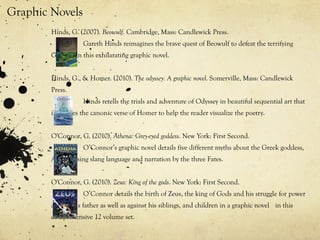
        Hinds, G. (2007). Beowulf. Cambridge, Mass: Candlewick Press.
                    Gareth Hinds reimagines the brave quest of Beowulf to defeat the terrifying
        Grendel in this exhilarating graphic novel.


        Hinds, G., & Homer. (2010). The odyssey: A graphic novel. Somerville, Mass: Candlewick
        Press.
                    Hinds retells the trials and adventure of Odyssey in beautiful sequential art that
        illustrates the canonic verse of Homer to help the reader visualize the poetry.


        O'Connor, G. (2010). Athena: Grey-eyed goddess. New York: First Second.
                    O’Connor’s graphic novel details five different myths about the Greek goddess,
        Athena using slang language and narration by the three Fates.


        O'Connor, G. (2010). Zeus: King of the gods. New York: First Second.
                    O’Connor details the birth of Zeus, the king of Gods and his struggle for power
        against his father as well as against his siblings, and children in a graphic novel in this
        comprehensive 12 volume set.
Graphic Novels
   Happy Reading!

Mythic booklist

  • 1.
    Clash of theTitans Heroes, Monsters, and Gods: A Mythic Booklist Caitlin Pollock Young Adult Literacy
  • 2.
    Nonfiction Buxton, R. G.A. (2004). The complete world of Greek mythology. London: Thames & Hudson. Buxton presents the Greek Mythology along with research and historical context to help readers better understand the world of the Greeks. Hamby, Z. (2009). Mythology for teens: Classic myths in today's world. Waco, Tex: Prufrock Press. Mythology for Teens takes an in depth look at how myths and legends influence and shape our world today and all the subtle ways they are still relevant today. Hamilton, Edith. (1998). Mythology: Timeless Tales of Gods and Heroes. Boston: Back Bay Books. Edith Hamilton’s Mythology displays how the Greek myths show how the Greeks thought, believed, worshipped, loved, and celebrated.
  • 3.
    Poetry Block, F. L.(2006). Psyche in a dress. New York: Joanna Cotler Books. Block tells the Greek Myths—the tales of Psyche, Narcissus, Demeter and Persephone—set in our modern Los Angeles in detailed, flowing, poetic verse. Heaney, S. (2000). Beowulf: A new verse translation. New York: Farrar, Straus, and Giroux. Seamus Heaney translates the Old English poem, Beowulf, capturing the intensity and action, as well as the poetic movement of the language, of the epic battle between Beowulf and the monstrous creature, Grendel. Homer. (1997). The Odyssey. London: Puffin. Homer’s The Odyssey is the original adventure tale, as well as a metaphor for everyone’s journey through life, where Odysseus battles witches, monsters, the trials of sailing across the ocean just to be reunited with his one true love, Penelope. Tolkien, J. R. R. (1980). Sir Gawain and the Green Knight, Pearl, and Sir Orfeo. New York: Ballantine Books. An epic poem set in King Arthur’s court, Camelot, a magical, strange knight with green skin arrives and sets a challenge to Sir Gawain that will test his bravery and loyalty.
  • 4.
    Fiction Holdstock, R. (2007). Celtika: The Merlin codex. London: Gollancz. Holdstock combines Arthur legend and Greek mythology to create a story of a young Merlin who travels back in time and accompanies Jason on his quest for the Golden Fleece where Merlin discovers the true strength of his magic abilities. Holdstock, R. (2005). The iron grail: The Merlin Codex 2. Tor fantasy. New York: Tom Doherty Associates. In the second installment of The Merlin Codex finds Merlin traveling through time with his powers and battling with the Three Fates as well as Jason’s jilted wife, Medea. Holdstock, R. (2007). The broken kings: The Merlin Codex 3. New York: Tor. In the third installment of The Merlin Codex Merlin and Jason time travel to England where they hold the future of Britain in the their hands as they protect Arthur and his throne from usurpers.
  • 5.
    Fiction Lewis,C. S. (1957). Till we have faces: A myth retold. New York: Harcourt, Brace. C.S. Lewis, the author of the classic Chronicles of Narnia, reimagines the Greek myth of Eros and Psyche as two princesses, one beautiful and one ugly, explores the true nature of beauty and tells the story of how true love can see the beauty of one’s soul. Marsh, K. (2007). The night tourist. New York: Hyperion Books for Children. Jack Perdu, a shy 14-year-old kid, travels to New York City and discovers the Underworld—which resembles the Underworld of Greek mythology— via Grand Central Station and with help of a young ghost, searched for his mother among the dead. McCusker, P. (2009). Out of time: Time Thriller Trilogy, Book 2. Grand Rapids, Mich: Zondervan. In the second book of McCusker’s Tine Thriller Trilogy, Elizabeth discovers that King Arthur has traveled through a time portal in her town.
  • 6.
    Fiction Miles, R. (2002). Isolde, queen of the Western Isle: The first of the Tristan and Isolde novels. New York: Three Rivers Press. Rosalind Miles’ first book in the Tristan and Isolde Novels, expands and deepens the love story between Isolde, a princess of Ireland and Tristan, on the knights of Arthur’s Camelot, exploring the forces of gender and religion. Miles, R. (2003). The maid of the white hands: The second of the Tristan and Isolde novels. New York: Three Rivers Press. In the second book of Rosalind Miles’s Tristan and Isolde Novels, follows Isolde as she prepares to ascend the throne of Ireland, already married to the evil King Mark but still desperately in love with Tristan of Lyonesse, one of King Arthur’s knights. Miles, R. (2004). The lady of the sea: The third of the Tristan and Isolde novels. New York: Three Rivers Press. In the third book of Rosalind Miles’s Tristan and Isolde Novels, brave, heroic, Isolde finds her beloved Ireland in danger from rebel invaders and sails back to Ireland from England and her destructive marriage from the dangerous King Mark, to save her homeland and her people.
  • 7.
    Fiction: Percy Jacksonand the Olympians Riordan, R. The Lightning Thief: Percy Jackson and the Olympians, book 1. (2005) New York, NY: Hyperion Books. Percy Jackson, a 12-year-old kid, discovers that all his problems—his dyslexia, his ADHD, his disgusting stepfather—are all because he is not ordinary but a demigod, a powerful son of the sea god, Poseidon while borrowing heavily from Greek myths about Theseus and Perseus. Riordan, R. (2006). The sea of monsters: Percy Jackson, book 2. New York: Miramax Books/Hyperion Books for Children. In the second Percy Jackson book, 13-year-old Percy returns back to Camp Half-Blood and discovers Tyson, another son of Poseidon and Percy’s half-brother, and goes on another quest with his friend Grover, a satyr. Riordan, R. (2007). The Titan's curse: Percy Jackson and the Olympians, book 3. New York, N.Y: Miramax Books / Hyperion Books for Children. In the third Percy Jackson book, Rick Riordan still combines Greek mythology and the adventures of Percy Jackson as Percy searched for his missing friend, Annabeth, the daughter of Athena. Riordan, R. (2008). The battle of the Labyrinth: Percy Jackson and the Olympians, book 4. New York: Hyperion Books for Children. In the fourth Percy Jackson, Rick Riordan uses not only Greek mythology but also Egyptian mythology and history to tell the story of Percy and his friends as they try to escape the evil and magical Labyrinth. Riordan, R. (2009). The last Olympian: Percy Jackson and the Olympians, book 5. New York: Disney Hyperion Books. The fifth Percy Jackson book is the ultimate fight between the Titans and the Olympians, as the half- bloods prepare to fight against Kronos and save Mount Olympus.
  • 8.
    Fiction Rowling, J. K., & GrandPré, M. (1998). Harry Potter and the sorcerer's stone. New York: A.A. Levine Books. Rowling’s story of young, unlucky, friendless Harry Potter discovers that he is a wizard and that there is a whole secret magical world borrows from Greek mythology, including Cerberus, the three-headed guard dog of the Underworld reimagined as the guard dog, Fluffy. Ursu, A. (2007). The shadow thieves. New York: Aladdin Paperbacks. Anne Ursu borrows from Greek mythology where the Land of Dead and Hades is real as Charlotte and her cousin Zee, stop the evil Philonecron from overthrowing Hades and reanimating the dead.
  • 9.
    Graphic Novels Hinds, G. (2007). Beowulf. Cambridge, Mass: Candlewick Press. Gareth Hinds reimagines the brave quest of Beowulf to defeat the terrifying Grendel in this exhilarating graphic novel. Hinds, G., & Homer. (2010). The odyssey: A graphic novel. Somerville, Mass: Candlewick Press. Hinds retells the trials and adventure of Odyssey in beautiful sequential art that illustrates the canonic verse of Homer to help the reader visualize the poetry. O'Connor, G. (2010). Athena: Grey-eyed goddess. New York: First Second. O’Connor’s graphic novel details five different myths about the Greek goddess, Athena using slang language and narration by the three Fates. O'Connor, G. (2010). Zeus: King of the gods. New York: First Second. O’Connor details the birth of Zeus, the king of Gods and his struggle for power against his father as well as against his siblings, and children in a graphic novel in this comprehensive 12 volume set.
  • 10.
    Graphic Novels Happy Reading!