
AN OVERVIEW TO MYSQL
   STORAGE ENGINES


      P.R.KARTHIK
       MySQL DBA
STORAGE ENGINES

Storage engines are the programs that are integrated with a
MySQL database management to manage the data tables. MySQL
supports different storage engines that handles different tables.

Some of the important storage engines are
 • MyISAM
 • INNODB
 • MERGE
 • MEMEORY
 • CSV
 • EXAMPLE
 • FEDRATED
 • BLACKHOLE
 • ARCHIVE


                                                                    2
The selection of the storage engine depends on users table type and its
Purpose.
 • Each engine has its own purpose.
 • They have their own advantages and disadvantages.
 • One can select the engine for the table even at the time of creating a table.
 • There are three main factors that affects the selection of a storage engine

They are as follows
i) Transaction and concurrency
ii) Backups
iii) Special features


                                                                            3
MyISAM


MyISAM is the default storage engine in Linux while installation.
 • MyISAM is based on the older ISAM code.
 • ISAM stands for Indexed Sequential Access Method.
 • It was released by IBM.
 • MySQL implements and extends ISAM as MyISAM.
 • Index are used by all databases.
 • It is simple to understand and implement.
 • It is a non-transactional support database system.
                transactional
 • It has full text searching capability.
 • It has good concurrency i,e) when several computations are executing
   simultaneously.


                                                                          4
MyISAM File Format


• If you are opting to make a table that is read more than we should
        go for MyISAM
        Each MyISAM table is stored in the disk as three files.
        (e.g) Consider a table name INDIA.
        i)INDIA.frm stores the table format.
        ii)INDIA.MYD stores the data.
        iii)INDIA.MYI stores the index.
• MyISAM is non-transactional support storage engine.
                    transactional
• It is mostly is used in web applications widely.
• It offers faster data storage and retrival.


                                                                       5
LOCKING MECHANISM IN MySQL

• MyISAM uses table level locking.
• To achieve very high speed locking it uses table locking.
• MyISAM has very good speed comparing to the Innodb.
  Table level enables many sessions to read a same table at a time.But issues
  will arise in case during the update query. All the other queries have to until
  the update is done on that table . Write lock is enabled during the updation.
• MyISAM is best suited when your table not so contented.
• The locking mechanism depends on the application and different application
  needs different locking.


                                                                           6
LOCKING MECHANISM

• MyISAM tables are deadlock free due to table table-locking feature.
• If there is no lock on the table it puts the write lock on it, if
  there is no write lock it puts the read lock on it.
• Table updates are given higher priority than the table retrievals so
  when a lock released the table will be found available for the update
  request with the write lock queue.
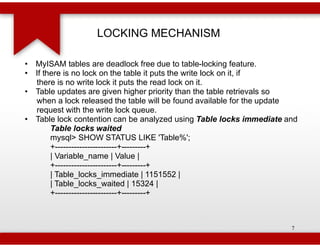
• Table lock contention can be analyzed using Table locks immediate and
       Table locks waited
       mysql> SHOW STATUS LIKE 'Table%';
       +-----------------------+---------+
       | Variable_name | Value |
       +-----------------------+---------+
       | Table_locks_immediate | 1151552 |
       | Table_locks_waited | 15324 |
       +-----------------------+---------+


                                                                     7
• For the better performance of the system the Table locks waited
  must be less.
• MyISAM tables have the concurrent inserts which enables the
  reading(select) and insert of the table at the same time.
• The concurrent inserts can be enabled in server system variables.
  It can enabled in the command line –concurrent_inserts=1

Disadvantages.

• If a select query takes a long time to execute and another session
  issues update on the same table it will waits until the selects complete.
• If another session issues select command on the same table it have to wait
  until the update completes.


                                                                       8
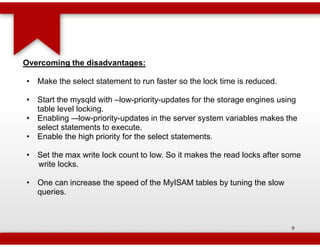
Overcoming the disadvantages:

• Make the select statement to run faster so the lock time is reduced.

• Start the mysqld with –low-priority--updates for the storage engines using
  table level locking.
• Enabling –-low-priority-updates in the server system variables makes the
                          updates
  select statements to execute.
• Enable the high priority for the select statements.

• Set the max write lock count to low. So it makes the read locks after some
  write locks.

• One can increase the speed of the MyISAM tables by tuning the slow
  queries.


                                                                          9
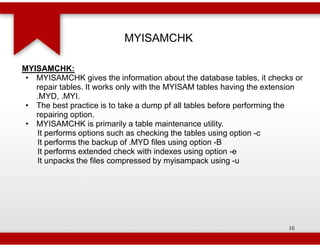
MYISAMCHK

MYISAMCHK:
 • MYISAMCHK gives the information about the database tables, it checks or
   repair tables. It works only with the MYISAM tables having the extension
   .MYD, .MYI.
 • The best practice is to take a dump pf all tables before performing the
   repairing option.
 • MYISAMCHK is primarily a table maintenance utility.
   It performs options such as checking the tables using option -c
   It performs the backup of .MYD files using option -B
   It performs extended check with indexes using option -e
   It unpacks the files compressed by myisampack using -u


                                                                       10
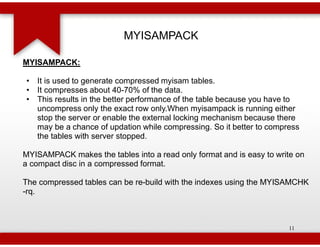
MYISAMPACK

MYISAMPACK:

• It is used to generate compressed myisam tables.
• It compresses about 40-70% of the data.
                            70%
• This results in the better performance of the table because you have to
  uncompress only the exact row only.When myisampack is running either
  stop the server or enable the external locking mechanism because there
  may be a chance of updation while compressing. So it better to compress
  the tables with server stopped.

MYISAMPACK makes the tables into a read only format and is easy to write on
a compact disc in a compressed format.

The compressed tables can be re-build with the indexes using the MYISAMCHK
                                build
-rq.


                                                                      11
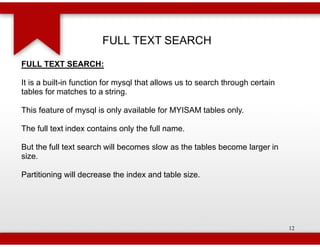
FULL TEXT SEARCH
FULL TEXT SEARCH:

It is a built-in function for mysql that allows us to search through certain
              in
tables for matches to a string.

This feature of mysql is only available for MYISAM tables only.

The full text index contains only the full name.

But the full text search will becomes slow as the tables become larger in
size.

Partitioning will decrease the index and table size.


                                                                               12
TABLE STORAGE FORMATS

STORAGE FORMATS:

 • MyISAM has three types of storage formats namely,
      i)Fixed(static)
      ii)Dynamic
      iii)Compressed (made by myisampack utility)

 • FIXED FORMAT:

* Each row is stored using the fixed bytes.
* Static is the simplest and the secure one and less prone to corruption.
* It has no variable length columns.
* It is easy to recover using the MyISAMCHK -r.
* It occupies more disk space than the dynamic format.


                                                                            13
DYNAMIC FORMAT:
*It is used when MyISAM needs a variable length columns.
 It
*It uses much less disk space then the static format.
 It
*They use as much space as required.
 They
*More difficult to reconstruct after crash because rows may be fragmented
into many lines.

COMPRESSED FORMAT:
*They are the read only format generated by the MyISAMPACK tool.
*They take little disk space and helpful in slow disk like CD’s.
*Compressed tables can be uncompressed using the MyISAMCHK tool.


                                                                            14
MERGE STORAGE ENGINE

MERGE CHARACTERISTICS:
*Merge is a collection of identical myisam tables.
 Merge

*They must have the same column and index information.

*These tables can be compressed by using the myisampack utility.

*Merge tables are stored as two files on the disk
       I) .frm stores the table format.
       II) .MRG contains the name of the underlying MyISAM tables.

*The underlying table and merge table must have the same number of
 columns.


                                                                     15
MERGE advantages:
* Performs more efficient search .

* MyISAM tables have limit while merge tables do not have limit in storage.

* Faster performance by splitting the identical tables large read only table and
then put individual money on the different disk.

MERGE disadvantages:
*FULL TEXT index can’t be used in the merge tables.

*Only identical MyISAM tables can be used for Merge tables.
 Only


                                                                             16
MEMORY(HEAP) STORAGE ENGINE


MEMORY ENGINE:

* The MEMORY storage engine creates tables with contents that are stored in
  RAM.

* The file name begins with the table name and has an extension of .frm to
  indicate that it stores the table definition.

*They are very faster as they stored in the Ram.

* when the server shuts down, all rows stored in MEMORY tables are lost.

* The server needs sufficient memory to maintain all MEMORY tables that are
  in use at the same time.


                                                                             17
BDB STORAGE ENGINE

BDB ENGINE:
* Sleepycat Software has provided MySQL with the Berkeley DB transactional
storage engine.

* They are also used in transaction based tables.

* Binary installation supports BDB where as in the source installation we have
configure it.

* BDB table is stored on disk in two files. An .frm file stores the table format, and
a .db file contains the table data and indexes.

* It is not possible to move BDB table because each BDB table stores in its .db file
the path to the file as it was created. This is done to enable detection of locks.


                                                                               18
EXAMPLE STORAGE ENGINE

EXAMPLE ENGINE:

* The EXAMPLE storage engine is a stub engine that does nothing.

* Binary installation supports it where as in the source installation we have
  configure it.

* It creates tables and stored under database dir with .frm extension.
   But no file is created and no data can be stored into it.

* It is primarily of interest to developers.


                                                                                19
FEDRATED STORAGE ENGINE

FEDRATED ENGINE:

*It creates tables and stored under database dir with .frm extension.
  But no file is created and no data can be stored into it.

*It is a storage engine that accesses data in tables of remote databases rather
  than in local tables.

*No data is stored on the local tables.

*There is no support for transactions.


                                                                           20
ARCHIVE STORAGE ENGINE

ARCHIVE ENGINE:

*The ARCHIVE storage engine is used for storing large amounts of data without
indexes.

*Each ARCHIVE table is stored in the disk as three files.
       (e.g) Consider a table name INDIA.

        i)INDIA.frm stores the table format.
        ii)INDIA.ARZ stores the data.
        iii)INDIA.ARM stores the metadata.

*Binary installation supports it where as in the source installation we have
configure it.


                                                                               21
CSV STORAGE ENGINE

CSV ENGINE:

*The CSV storage engine stores data in text files using comma
                                                        comma-separated
values format.

* It creates tables and stored under database dir with .frm extension having
the table format and the data file with .CSV extension.

* The data file is a plain text file.

* The CSV storage engine does not support indexing.

* It supports spread sheet applications.


                                                                           22
BLACK HOLE STORAGE ENGINE

BLACK HOLE ENGINE:

* The BLACKHOLE storage engine acts as a “black hole” that accepts data but
  does not store it.

* It creates tables and stored under database dir with .frm extension.

* The BLACKHOLE storage engine supports all kinds of indexes. That is, you
can include index declarations in the table definition.

* The Blackhole engine is a no-op engine. Any operations performed on a
                                op
table using Blackhole will have no effect.


                                                                          23
THANK YOU


            24

MySQL Storage Engines

  • 1.
    AN OVERVIEW TOMYSQL STORAGE ENGINES P.R.KARTHIK MySQL DBA
  • 2.
    STORAGE ENGINES Storage enginesare the programs that are integrated with a MySQL database management to manage the data tables. MySQL supports different storage engines that handles different tables. Some of the important storage engines are • MyISAM • INNODB • MERGE • MEMEORY • CSV • EXAMPLE • FEDRATED • BLACKHOLE • ARCHIVE 2
  • 3.
    The selection ofthe storage engine depends on users table type and its Purpose. • Each engine has its own purpose. • They have their own advantages and disadvantages. • One can select the engine for the table even at the time of creating a table. • There are three main factors that affects the selection of a storage engine They are as follows i) Transaction and concurrency ii) Backups iii) Special features 3
  • 4.
    MyISAM MyISAM is thedefault storage engine in Linux while installation. • MyISAM is based on the older ISAM code. • ISAM stands for Indexed Sequential Access Method. • It was released by IBM. • MySQL implements and extends ISAM as MyISAM. • Index are used by all databases. • It is simple to understand and implement. • It is a non-transactional support database system. transactional • It has full text searching capability. • It has good concurrency i,e) when several computations are executing simultaneously. 4
  • 5.
    MyISAM File Format •If you are opting to make a table that is read more than we should go for MyISAM Each MyISAM table is stored in the disk as three files. (e.g) Consider a table name INDIA. i)INDIA.frm stores the table format. ii)INDIA.MYD stores the data. iii)INDIA.MYI stores the index. • MyISAM is non-transactional support storage engine. transactional • It is mostly is used in web applications widely. • It offers faster data storage and retrival. 5
  • 6.
    LOCKING MECHANISM INMySQL • MyISAM uses table level locking. • To achieve very high speed locking it uses table locking. • MyISAM has very good speed comparing to the Innodb. Table level enables many sessions to read a same table at a time.But issues will arise in case during the update query. All the other queries have to until the update is done on that table . Write lock is enabled during the updation. • MyISAM is best suited when your table not so contented. • The locking mechanism depends on the application and different application needs different locking. 6
  • 7.
    LOCKING MECHANISM • MyISAMtables are deadlock free due to table table-locking feature. • If there is no lock on the table it puts the write lock on it, if there is no write lock it puts the read lock on it. • Table updates are given higher priority than the table retrievals so when a lock released the table will be found available for the update request with the write lock queue. • Table lock contention can be analyzed using Table locks immediate and Table locks waited mysql> SHOW STATUS LIKE 'Table%'; +-----------------------+---------+ | Variable_name | Value | +-----------------------+---------+ | Table_locks_immediate | 1151552 | | Table_locks_waited | 15324 | +-----------------------+---------+ 7
  • 8.
    • For thebetter performance of the system the Table locks waited must be less. • MyISAM tables have the concurrent inserts which enables the reading(select) and insert of the table at the same time. • The concurrent inserts can be enabled in server system variables. It can enabled in the command line –concurrent_inserts=1 Disadvantages. • If a select query takes a long time to execute and another session issues update on the same table it will waits until the selects complete. • If another session issues select command on the same table it have to wait until the update completes. 8
  • 9.
    Overcoming the disadvantages: •Make the select statement to run faster so the lock time is reduced. • Start the mysqld with –low-priority--updates for the storage engines using table level locking. • Enabling –-low-priority-updates in the server system variables makes the updates select statements to execute. • Enable the high priority for the select statements. • Set the max write lock count to low. So it makes the read locks after some write locks. • One can increase the speed of the MyISAM tables by tuning the slow queries. 9
  • 10.
    MYISAMCHK MYISAMCHK: • MYISAMCHKgives the information about the database tables, it checks or repair tables. It works only with the MYISAM tables having the extension .MYD, .MYI. • The best practice is to take a dump pf all tables before performing the repairing option. • MYISAMCHK is primarily a table maintenance utility. It performs options such as checking the tables using option -c It performs the backup of .MYD files using option -B It performs extended check with indexes using option -e It unpacks the files compressed by myisampack using -u 10
  • 11.
    MYISAMPACK MYISAMPACK: • It isused to generate compressed myisam tables. • It compresses about 40-70% of the data. 70% • This results in the better performance of the table because you have to uncompress only the exact row only.When myisampack is running either stop the server or enable the external locking mechanism because there may be a chance of updation while compressing. So it better to compress the tables with server stopped. MYISAMPACK makes the tables into a read only format and is easy to write on a compact disc in a compressed format. The compressed tables can be re-build with the indexes using the MYISAMCHK build -rq. 11
  • 12.
    FULL TEXT SEARCH FULLTEXT SEARCH: It is a built-in function for mysql that allows us to search through certain in tables for matches to a string. This feature of mysql is only available for MYISAM tables only. The full text index contains only the full name. But the full text search will becomes slow as the tables become larger in size. Partitioning will decrease the index and table size. 12
  • 13.
    TABLE STORAGE FORMATS STORAGEFORMATS: • MyISAM has three types of storage formats namely, i)Fixed(static) ii)Dynamic iii)Compressed (made by myisampack utility) • FIXED FORMAT: * Each row is stored using the fixed bytes. * Static is the simplest and the secure one and less prone to corruption. * It has no variable length columns. * It is easy to recover using the MyISAMCHK -r. * It occupies more disk space than the dynamic format. 13
  • 14.
    DYNAMIC FORMAT: *It isused when MyISAM needs a variable length columns. It *It uses much less disk space then the static format. It *They use as much space as required. They *More difficult to reconstruct after crash because rows may be fragmented into many lines. COMPRESSED FORMAT: *They are the read only format generated by the MyISAMPACK tool. *They take little disk space and helpful in slow disk like CD’s. *Compressed tables can be uncompressed using the MyISAMCHK tool. 14
  • 15.
    MERGE STORAGE ENGINE MERGECHARACTERISTICS: *Merge is a collection of identical myisam tables. Merge *They must have the same column and index information. *These tables can be compressed by using the myisampack utility. *Merge tables are stored as two files on the disk I) .frm stores the table format. II) .MRG contains the name of the underlying MyISAM tables. *The underlying table and merge table must have the same number of columns. 15
  • 16.
    MERGE advantages: * Performsmore efficient search . * MyISAM tables have limit while merge tables do not have limit in storage. * Faster performance by splitting the identical tables large read only table and then put individual money on the different disk. MERGE disadvantages: *FULL TEXT index can’t be used in the merge tables. *Only identical MyISAM tables can be used for Merge tables. Only 16
  • 17.
    MEMORY(HEAP) STORAGE ENGINE MEMORYENGINE: * The MEMORY storage engine creates tables with contents that are stored in RAM. * The file name begins with the table name and has an extension of .frm to indicate that it stores the table definition. *They are very faster as they stored in the Ram. * when the server shuts down, all rows stored in MEMORY tables are lost. * The server needs sufficient memory to maintain all MEMORY tables that are in use at the same time. 17
  • 18.
    BDB STORAGE ENGINE BDBENGINE: * Sleepycat Software has provided MySQL with the Berkeley DB transactional storage engine. * They are also used in transaction based tables. * Binary installation supports BDB where as in the source installation we have configure it. * BDB table is stored on disk in two files. An .frm file stores the table format, and a .db file contains the table data and indexes. * It is not possible to move BDB table because each BDB table stores in its .db file the path to the file as it was created. This is done to enable detection of locks. 18
  • 19.
    EXAMPLE STORAGE ENGINE EXAMPLEENGINE: * The EXAMPLE storage engine is a stub engine that does nothing. * Binary installation supports it where as in the source installation we have configure it. * It creates tables and stored under database dir with .frm extension. But no file is created and no data can be stored into it. * It is primarily of interest to developers. 19
  • 20.
    FEDRATED STORAGE ENGINE FEDRATEDENGINE: *It creates tables and stored under database dir with .frm extension. But no file is created and no data can be stored into it. *It is a storage engine that accesses data in tables of remote databases rather than in local tables. *No data is stored on the local tables. *There is no support for transactions. 20
  • 21.
    ARCHIVE STORAGE ENGINE ARCHIVEENGINE: *The ARCHIVE storage engine is used for storing large amounts of data without indexes. *Each ARCHIVE table is stored in the disk as three files. (e.g) Consider a table name INDIA. i)INDIA.frm stores the table format. ii)INDIA.ARZ stores the data. iii)INDIA.ARM stores the metadata. *Binary installation supports it where as in the source installation we have configure it. 21
  • 22.
    CSV STORAGE ENGINE CSVENGINE: *The CSV storage engine stores data in text files using comma comma-separated values format. * It creates tables and stored under database dir with .frm extension having the table format and the data file with .CSV extension. * The data file is a plain text file. * The CSV storage engine does not support indexing. * It supports spread sheet applications. 22
  • 23.
    BLACK HOLE STORAGEENGINE BLACK HOLE ENGINE: * The BLACKHOLE storage engine acts as a “black hole” that accepts data but does not store it. * It creates tables and stored under database dir with .frm extension. * The BLACKHOLE storage engine supports all kinds of indexes. That is, you can include index declarations in the table definition. * The Blackhole engine is a no-op engine. Any operations performed on a op table using Blackhole will have no effect. 23
  • 24.