+
Myanmar’s Health Infrastructure:
the Evolving Context for Foreign
Engagement
March 22, 2013
www.AsiaHealthcareBlog.com
www.RubiconStrategyGroup.com
+
Discussion Topics
 What does Myanmar's health system look like now, and how is it
changing in the context of such dynamic political changes?
 How "open" is the country in reality, and how is that openness
making an impact on the health system?
 Do sound distribution channels for pharmaceuticals, medical
devices, and diagnostics exist? What about regulation for medical
products?
 What domestic and foreign private players currently have a
footprint in the system? How might that footprint shift in the near
and long term?
 Would the country's health system benefit from engagement from
more multinational companies?
www.AsiaHealthcareBlog.com
+
Why So Much Interest?
 Closure.
 Regionally, this leaves North Korea as the last isolated and closed-off Asia country.
 Myanmar’s opening is another victory for the Washington model.
 Market Opportunity.
 MNCs can access approximately 60m new consumers.
 In the mid 1900’s, Myanmar was the wealthiest country in Asia.
 Culture
 Muscle memory of the British legal and education systems still exist.
 Accessible and beguiling culture.
 Sense that the people are flexible, tolerant, easy to work with.
 Regional Impact
 China wants Myanmar’s oil and natural gas, hydropower, and metal mining.
 China wants access to at least one, maybe two, possible deep sea ports.
 India wants one deep sea port.
 Will Myanmar lean towards India or China?
www.AsiaHealthcareBlog.com
+
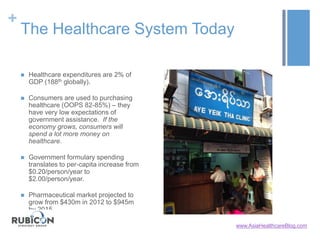
The Healthcare System Today
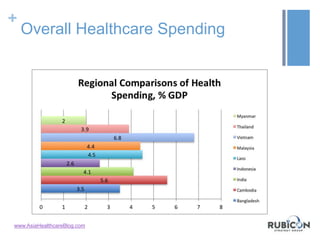
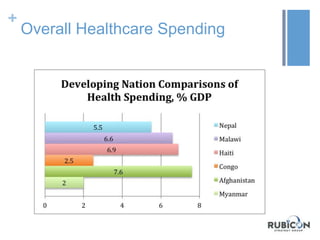
 Healthcare expenditures are 2% of
GDP (188th globally).
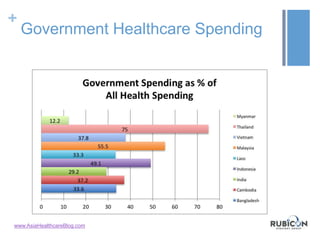
 Consumers are used to purchasing
healthcare (OOPS 82-85%) – they
have very low expectations of
government assistance. If the
economy grows, consumers will
spend a lot more money on
healthcare.
 Government formulary spending
translates to per-capita increase from
$0.20/person/year to
$2.00/person/year.
 Pharmaceutical market projected to
grow from $430m in 2012 to $945m
by 2015.
www.AsiaHealthcareBlog.com
+
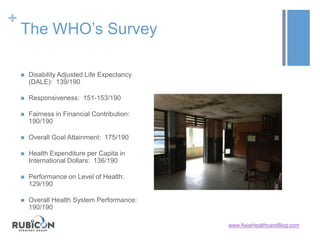
The WHO’s Survey
 Disability Adjusted Life Expectancy
(DALE): 139/190
 Responsiveness: 151-153/190
 Fairness in Financial Contribution:
190/190
 Overall Goal Attainment: 175/190
 Health Expenditure per Capita in
International Dollars: 136/190
 Performance on Level of Health:
129/190
 Overall Health System Performance:
190/190
www.AsiaHealthcareBlog.com
+
Overall Healthcare Spending
www.AsiaHealthcareBlog.com
+
Overall Healthcare Spending
+
Government Healthcare Spending
www.AsiaHealthcareBlog.com
+
The Healthcare System Today
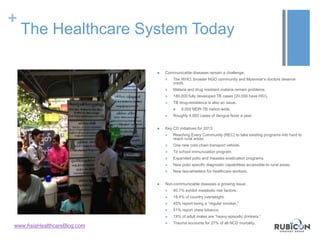
 Communicable diseases remain a challenge.
 The WHO, broader NGO community and Myanmar’s doctors deserve
credit.
 Malaria and drug resistant malaria remain problems.
 180,000 fully developed TB cases (20,000 have HIV).
 TB drug-resistance is also an issue.
 9,000 MDR-TB nation-wide.
 Roughly 4,000 cases of dengue fever a year.
 Key CD initiatives for 2013:
 Reaching Every Community (REC) to take existing programs into hard to
reach rural areas.
 One new cold-chain transport vehicle.
 Td school immunization program.
 Expanded polio and measles eradication programs.
 New polio specific diagnostic capabilities accessible to rural areas.
 New two-wheelers for healthcare workers.
 Non-communicable diseases a growing issue:
 40.7% exhibit metabolic risk factors.
 18.4% of country overweight.
 45% report being a “regular smoker.”
 51% report chew tobacco.
 19% of adult males are “heavy episodic drinkers.”
 Trauma accounts for 27% of all NCD mortality.
www.AsiaHealthcareBlog.com
+
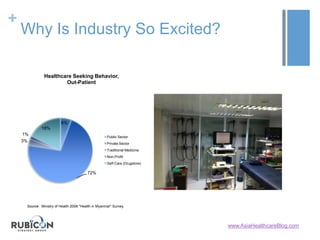
Why Is Industry So Excited?
6%
72%
3%
1%
18%
Healthcare Seeking Behavior,
Out-Patient
Public Sector
Private Sector
Traditional Medicine
Non-Profit
Self-Care (Drugstore)
Source: Ministry of Health 2008 "Health in Myanmar" Survey.
www.AsiaHealthcareBlog.com
+
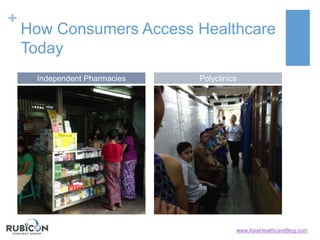
How Consumers Access Healthcare
Today
Independent Pharmacies Polyclinics
www.AsiaHealthcareBlog.com
+
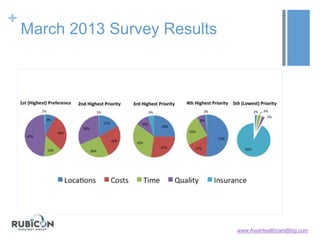
March 2013 Survey Results
www.AsiaHealthcareBlog.com
+
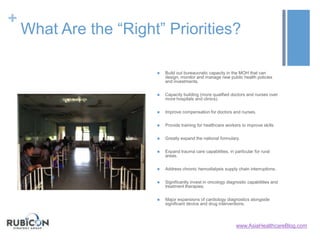
What Are the “Right” Priorities?
 Build out bureaucratic capacity in the MOH that can
design, monitor and manage new public health policies
and investments.
 Capacity building (more qualified doctors and nurses over
more hospitals and clinics).
 Improve compensation for doctors and nurses.
 Provide training for healthcare workers to improve skills.
 Greatly expand the national formulary.
 Expand trauma care capabilities, in particular for rural
areas.
 Address chronic hemodialysis supply chain interruptions.
 Significantly invest in oncology diagnostic capabilities and
treatment therapies.
 Major expansions of cardiology diagnostics alongside
significant device and drug interventions.
www.AsiaHealthcareBlog.com
+
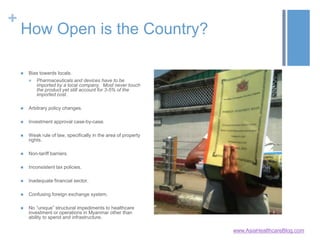
How Open is the Country?
 Bias towards locals.
 Pharmaceuticals and devices have to be
imported by a local company. Most never touch
the product yet still account for 3-5% of the
imported cost.
 Arbitrary policy changes.
 Investment approval case-by-case.
 Weak rule of law, specifically in the area of property
rights.
 Non-tariff barriers.
 Inconsistent tax policies.
 Inadequate financial sector.
 Confusing foreign exchange system.
 No “unique” structural impediments to healthcare
investment or operations in Myanmar other than
ability to spend and infrastructure.
www.AsiaHealthcareBlog.com
+
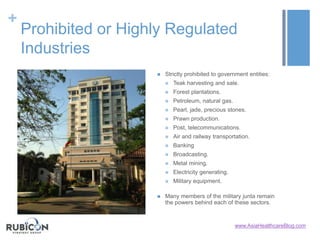
Prohibited or Highly Regulated
Industries
 Strictly prohibited to government entities:
 Teak harvesting and sale.
 Forest plantations.
 Petroleum, natural gas.
 Pearl, jade, precious stones.
 Prawn production.
 Post, telecommunications.
 Air and railway transportation.
 Banking
 Broadcasting.
 Metal mining.
 Electricity generating.
 Military equipment.
 Many members of the military junta remain
the powers behind each of these sectors.
www.AsiaHealthcareBlog.com
+
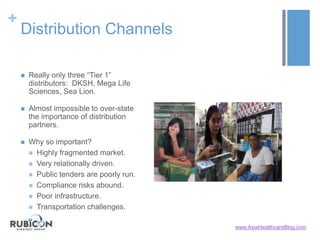
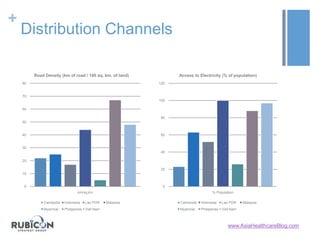
Distribution Channels
 Really only three “Tier 1”
distributors: DKSH, Mega Life
Sciences, Sea Lion.
 Almost impossible to over-state
the importance of distribution
partners.
 Why so important?
 Highly fragmented market.
 Very relationally driven.
 Public tenders are poorly run.
 Compliance risks abound.
 Poor infrastructure.
 Transportation challenges.
www.AsiaHealthcareBlog.com
+
Distribution Channels
0
20
40
60
80
100
120
% Population
Access to Electricity (% of population)
Cambodia Indonesia Lao PDR Malaysia
Myanmar Philippines Viet Nam
0
10
20
30
40
50
60
70
80
km/sq km
Road Density (km of road / 100 sq. km. of land)
Cambodia Indonesia Lao PDR Malaysia
Myanmar Philippines Viet Nam
www.AsiaHealthcareBlog.com
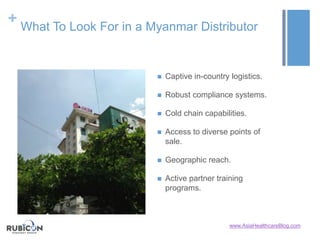
+ What To Look For in a Myanmar Distributor
 Captive in-country logistics.
 Robust compliance systems.
 Cold chain capabilities.
 Access to diverse points of
sale.
 Geographic reach.
 Active partner training
programs.
www.AsiaHealthcareBlog.com
+
Notes of Caution
 Current reforms are widely understood –
within and without the country – as being a
“point of no return.”
 The 2015 elections are key: will the military
really allow them to take place peacefully
and the results to be followed?
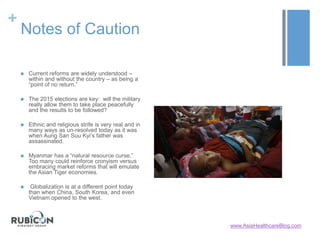
 Ethnic and religious strife is very real and in
many ways as un-resolved today as it was
when Aung San Suu Kyi’s father was
assassinated.
 Myanmar has a “natural resource curse.”
Too many could reinforce cronyism versus
embracing market reforms that will emulate
the Asian Tiger economies.
 Globalization is at a different point today
than when China, South Korea, and even
Vietnam opened to the west.
www.AsiaHealthcareBlog.com

Myanmar Healthcare Presentation 05-22-13

  • 1.
    + Myanmar’s Health Infrastructure: theEvolving Context for Foreign Engagement March 22, 2013 www.AsiaHealthcareBlog.com www.RubiconStrategyGroup.com
  • 2.
    + Discussion Topics  Whatdoes Myanmar's health system look like now, and how is it changing in the context of such dynamic political changes?  How "open" is the country in reality, and how is that openness making an impact on the health system?  Do sound distribution channels for pharmaceuticals, medical devices, and diagnostics exist? What about regulation for medical products?  What domestic and foreign private players currently have a footprint in the system? How might that footprint shift in the near and long term?  Would the country's health system benefit from engagement from more multinational companies? www.AsiaHealthcareBlog.com
  • 3.
    + Why So MuchInterest?  Closure.  Regionally, this leaves North Korea as the last isolated and closed-off Asia country.  Myanmar’s opening is another victory for the Washington model.  Market Opportunity.  MNCs can access approximately 60m new consumers.  In the mid 1900’s, Myanmar was the wealthiest country in Asia.  Culture  Muscle memory of the British legal and education systems still exist.  Accessible and beguiling culture.  Sense that the people are flexible, tolerant, easy to work with.  Regional Impact  China wants Myanmar’s oil and natural gas, hydropower, and metal mining.  China wants access to at least one, maybe two, possible deep sea ports.  India wants one deep sea port.  Will Myanmar lean towards India or China? www.AsiaHealthcareBlog.com
  • 4.
    + The Healthcare SystemToday  Healthcare expenditures are 2% of GDP (188th globally).  Consumers are used to purchasing healthcare (OOPS 82-85%) – they have very low expectations of government assistance. If the economy grows, consumers will spend a lot more money on healthcare.  Government formulary spending translates to per-capita increase from $0.20/person/year to $2.00/person/year.  Pharmaceutical market projected to grow from $430m in 2012 to $945m by 2015. www.AsiaHealthcareBlog.com
  • 5.
    + The WHO’s Survey Disability Adjusted Life Expectancy (DALE): 139/190  Responsiveness: 151-153/190  Fairness in Financial Contribution: 190/190  Overall Goal Attainment: 175/190  Health Expenditure per Capita in International Dollars: 136/190  Performance on Level of Health: 129/190  Overall Health System Performance: 190/190 www.AsiaHealthcareBlog.com
  • 6.
  • 7.
  • 8.
  • 9.
    + The Healthcare SystemToday  Communicable diseases remain a challenge.  The WHO, broader NGO community and Myanmar’s doctors deserve credit.  Malaria and drug resistant malaria remain problems.  180,000 fully developed TB cases (20,000 have HIV).  TB drug-resistance is also an issue.  9,000 MDR-TB nation-wide.  Roughly 4,000 cases of dengue fever a year.  Key CD initiatives for 2013:  Reaching Every Community (REC) to take existing programs into hard to reach rural areas.  One new cold-chain transport vehicle.  Td school immunization program.  Expanded polio and measles eradication programs.  New polio specific diagnostic capabilities accessible to rural areas.  New two-wheelers for healthcare workers.  Non-communicable diseases a growing issue:  40.7% exhibit metabolic risk factors.  18.4% of country overweight.  45% report being a “regular smoker.”  51% report chew tobacco.  19% of adult males are “heavy episodic drinkers.”  Trauma accounts for 27% of all NCD mortality. www.AsiaHealthcareBlog.com
  • 10.
    + Why Is IndustrySo Excited? 6% 72% 3% 1% 18% Healthcare Seeking Behavior, Out-Patient Public Sector Private Sector Traditional Medicine Non-Profit Self-Care (Drugstore) Source: Ministry of Health 2008 "Health in Myanmar" Survey. www.AsiaHealthcareBlog.com
  • 11.
    + How Consumers AccessHealthcare Today Independent Pharmacies Polyclinics www.AsiaHealthcareBlog.com
  • 12.
    + March 2013 SurveyResults www.AsiaHealthcareBlog.com
  • 13.
    + What Are the“Right” Priorities?  Build out bureaucratic capacity in the MOH that can design, monitor and manage new public health policies and investments.  Capacity building (more qualified doctors and nurses over more hospitals and clinics).  Improve compensation for doctors and nurses.  Provide training for healthcare workers to improve skills.  Greatly expand the national formulary.  Expand trauma care capabilities, in particular for rural areas.  Address chronic hemodialysis supply chain interruptions.  Significantly invest in oncology diagnostic capabilities and treatment therapies.  Major expansions of cardiology diagnostics alongside significant device and drug interventions. www.AsiaHealthcareBlog.com
  • 14.
    + How Open isthe Country?  Bias towards locals.  Pharmaceuticals and devices have to be imported by a local company. Most never touch the product yet still account for 3-5% of the imported cost.  Arbitrary policy changes.  Investment approval case-by-case.  Weak rule of law, specifically in the area of property rights.  Non-tariff barriers.  Inconsistent tax policies.  Inadequate financial sector.  Confusing foreign exchange system.  No “unique” structural impediments to healthcare investment or operations in Myanmar other than ability to spend and infrastructure. www.AsiaHealthcareBlog.com
  • 15.
    + Prohibited or HighlyRegulated Industries  Strictly prohibited to government entities:  Teak harvesting and sale.  Forest plantations.  Petroleum, natural gas.  Pearl, jade, precious stones.  Prawn production.  Post, telecommunications.  Air and railway transportation.  Banking  Broadcasting.  Metal mining.  Electricity generating.  Military equipment.  Many members of the military junta remain the powers behind each of these sectors. www.AsiaHealthcareBlog.com
  • 16.
    + Distribution Channels  Reallyonly three “Tier 1” distributors: DKSH, Mega Life Sciences, Sea Lion.  Almost impossible to over-state the importance of distribution partners.  Why so important?  Highly fragmented market.  Very relationally driven.  Public tenders are poorly run.  Compliance risks abound.  Poor infrastructure.  Transportation challenges. www.AsiaHealthcareBlog.com
  • 17.
    + Distribution Channels 0 20 40 60 80 100 120 % Population Accessto Electricity (% of population) Cambodia Indonesia Lao PDR Malaysia Myanmar Philippines Viet Nam 0 10 20 30 40 50 60 70 80 km/sq km Road Density (km of road / 100 sq. km. of land) Cambodia Indonesia Lao PDR Malaysia Myanmar Philippines Viet Nam www.AsiaHealthcareBlog.com
  • 18.
    + What ToLook For in a Myanmar Distributor  Captive in-country logistics.  Robust compliance systems.  Cold chain capabilities.  Access to diverse points of sale.  Geographic reach.  Active partner training programs. www.AsiaHealthcareBlog.com
  • 19.
    + Notes of Caution Current reforms are widely understood – within and without the country – as being a “point of no return.”  The 2015 elections are key: will the military really allow them to take place peacefully and the results to be followed?  Ethnic and religious strife is very real and in many ways as un-resolved today as it was when Aung San Suu Kyi’s father was assassinated.  Myanmar has a “natural resource curse.” Too many could reinforce cronyism versus embracing market reforms that will emulate the Asian Tiger economies.  Globalization is at a different point today than when China, South Korea, and even Vietnam opened to the west. www.AsiaHealthcareBlog.com