WHAT’S WORKING, WHAT ISN’T?
Tuesday, May 24, 2016
Shanghai, China
PART 1 - INTRODUCTION
CHINA’SSENIORHOUSINGSECTOR
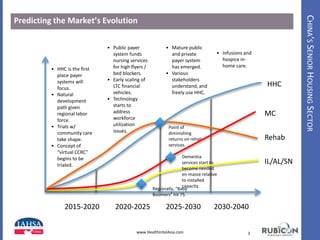
Predicting the Market’s Evolution
3www.HealthIntelAsia.com
2015-2020 2020-2025 2025-2030 2030-2040
HHC
• HHC is the first
place payer
systems will
focus.
• Natural
development
path given
regional labor
force.
• Trials w/
community care
take shape.
• Concept of
“virtual CCRC”
begins to be
trialed.
• Public payer
system funds
nursing services
for high flyers /
bed blockers.
• Early scaling of
LTC financial
vehicles.
• Technology
starts to
address
workforce
utilization
issues.
• Mature public
and private
payer system
has emerged.
• Various
stakeholders
understand, and
freely use HHC.
• Infusions and
hospice in-
home care.
IL/AL/SN
Regionally, “Baby
Boomers” hit 75.
Rehab
Point of
diminishing
returns on rehab
services.
MC
Dementia
services start to
become needed
en-masse relative
to installed
capacity.
PART 2 – KEY FINDINGS FROM RUBICON’S MARKET ANALYSIS
CHINA’SSENIORHOUSINGSECTOR
Key Findings
• Real estate developers view senior living as another way to keep doing
what they’ve been doing for 20+ years.
• Party cadre mentality at the municipal government level is driving a lot
of movement around approvals of domestic and foreign senior living.
• Exception is around healthcare-specific (medical service) assets, which
remain subject to uncertain approval periods.
• Life insurance companies view senior living as something they are
invested in long term:
• They will develop new LTC vehicles.
• Provide care as stipulated in these LTC products via senior care
facilities they own and operate.
• They will use existing balance sheet resources to invest in senior
living real estate assets (CCRCs).
• Real estate remains the easiest investment channel for them and
a pressing need given their investment mandate.
5www.HealthIntelAsia.com
CHINA’SSENIORHOUSINGSECTOR
Key Findings
• Profit is elusive.
• At least one of the largest American senior living operators has
dramatically scaled back their senior living plans in favor of more
direct healthcare opportunities.
• Growth in appraised value of developed land lubricates much of the
positive view of senior living assets thus far.
• HNWI market is much narrower than many originally assumed; products
will need to be developed that allow for price points accessible to the
middle class.
• Aging in place and home healthcare remain significant opportunities
assuming questions specific to client acquisition costs, logistics and
rationalized spending behaviors can be addressed.
6www.HealthIntelAsia.com
CHINA’SSENIORHOUSINGSECTOR
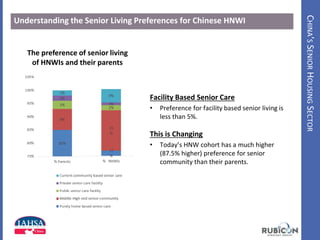
Understanding the Senior Living Preferences for Chinese HNWI
The preference of senior living
of HNWIs and their parents
Facility Based Senior Care
• Preference for facility based senior living is
less than 5%.
This is Changing
• Today’s HNW cohort has a much higher
(87.5% higher) preference for senior
community than their parents.
PART 3 – MARKET PENETRATION RATES
CHINA’SSENIORHOUSINGSECTOR
Important to Reinforce
• Less than 11% of HNWIs in China mention senior care services as a
spending priority.
• Preference for facility-based senior care (versus respite or home
healthcare) is less than 5%.
• This is changing: the next generation of HNWIs have a strong lifestyle
preference for senior living (88% higher than their parents’ preference).
• People do not want to move away from their home city full time.
• 67% want to stay in their home city.
• 39% want to move to an “excellent tourism city.”
• Only 27% are willing to move from a T1 to T2 city.
• HNWIs have a very strong bias in favor of senior living that is integrated
with a full continuum of care.
9www.HealthIntelAsia.com
CHINA’SSENIORHOUSINGSECTOR
Demographics & Site Selection – What Are We Looking For?
10www.HealthIntelAsia.com
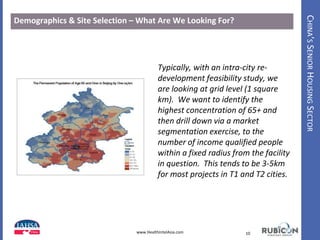
Typically, with an intra-city re-
development feasibility study, we
are looking at grid level (1 square
km). We want to identify the
highest concentration of 65+ and
then drill down via a market
segmentation exercise, to the
number of income qualified people
within a fixed radius from the facility
in question. This tends to be 3-5km
for most projects in T1 and T2 cities.
CHINA’SSENIORHOUSINGSECTOR
Example: Regional Demographics - Nanjing
11
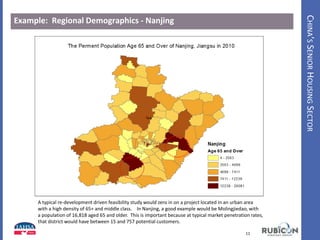
A typical re-development driven feasibility study would zero in on a project located in an urban area
with a high density of 65+ and middle class. In Nanjing, a good example would be Molingjiedao, with
a population of 16,818 aged 65 and older. This is important because at typical market penetration rates,
that district would have between 15 and 757 potential customers.
CHINA’SSENIORHOUSINGSECTOR
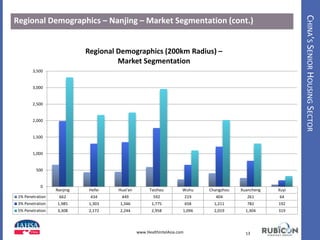
Regional Demographics – Nanjing – Market Segmentation
12www.HealthIntelAsia.com
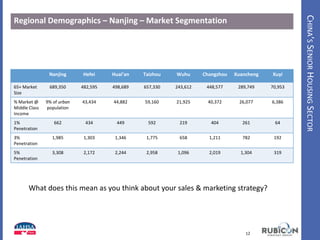
Nanjing Hefei Huai’an Taizhou Wuhu Changzhou Xuancheng Xuyi
65+ Market
Size
689,350 482,595 498,689 657,330 243,612 448,577 289,749 70,953
% Market @
Middle Class
Income
9% of urban
population
43,434 44,882 59,160 21,925 40,372 26,077 6,386
1%
Penetration
662 434 449 592 219 404 261 64
3%
Penetration
1,985 1,303 1,346 1,775 658 1,211 782 192
5%
Penetration
3,308 2,172 2,244 2,958 1,096 2,019 1,304 319
What does this mean as you think about your sales & marketing strategy?
CHINA’SSENIORHOUSINGSECTOR
Regional Demographics – Nanjing – Market Segmentation (cont.)
13www.HealthIntelAsia.com
Nanjing Hefei Huai'an Taizhou Wuhu Changzhou Xuancheng Xuyi
1% Penetration 662 434 449 592 219 404 261 64
3% Penetration 1,985 1,303 1,346 1,775 658 1,211 782 192
5% Penetration 3,308 2,172 2,244 2,958 1,096 2,019 1,304 319
0
500
1,000
1,500
2,000
2,500
3,000
3,500
Regional Demographics (200km Radius) –
Market Segmentation
PART 4 – REGULATORY ANALYSIS
CHINA’SSENIORHOUSINGSECTOR
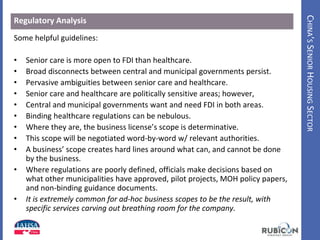
Regulatory Analysis
Some helpful guidelines:
• Senior care is more open to FDI than healthcare.
• Broad disconnects between central and municipal governments persist.
• Pervasive ambiguities between senior care and healthcare.
• Senior care and healthcare are politically sensitive areas; however,
• Central and municipal governments want and need FDI in both areas.
• Binding healthcare regulations can be nebulous.
• Where they are, the business license’s scope is determinative.
• This scope will be negotiated word-by-word w/ relevant authorities.
• A business’ scope creates hard lines around what can, and cannot be done
by the business.
• Where regulations are poorly defined, officials make decisions based on
what other municipalities have approved, pilot projects, MOH policy papers,
and non-binding guidance documents.
• It is extremely common for ad-hoc business scopes to be the result, with
specific services carving out breathing room for the company.
CHINA’SSENIORHOUSINGSECTOR
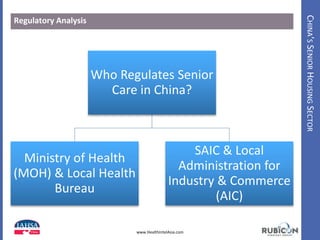
Regulatory Analysis
Who Regulates Senior
Care in China?
Ministry of Health
(MOH) & Local Health
Bureau
SAIC & Local
Administration for
Industry & Commerce
(AIC)
www.HealthIntelAsia.com
PART 5 – WHAT IS WORKING, WHAT IS NOT?
CHINA’SSENIORHOUSINGSECTOR
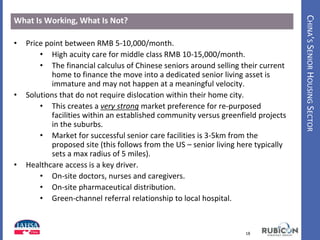
What Is Working, What Is Not?
• Price point between RMB 5-10,000/month.
• High acuity care for middle class RMB 10-15,000/month.
• The financial calculus of Chinese seniors around selling their current
home to finance the move into a dedicated senior living asset is
immature and may not happen at a meaningful velocity.
• Solutions that do not require dislocation within their home city.
• This creates a very strong market preference for re-purposed
facilities within an established community versus greenfield projects
in the suburbs.
• Market for successful senior care facilities is 3-5km from the
proposed site (this follows from the US – senior living here typically
sets a max radius of 5 miles).
• Healthcare access is a key driver.
• On-site doctors, nurses and caregivers.
• On-site pharmaceutical distribution.
• Green-channel referral relationship to local hospital.
18www.HealthIntelAsia.com
CHINA’SSENIORHOUSINGSECTOR
What Is Working, What Is Not?
• Rethinking what is meant by the “trans-generational housing model.”
• Proximity to, versus living w/, parents & grandparents.
• Dual key concept.
• Integration into planned community with distinct living spaces.
• Even at the best in class Chinese-run senior living assets, service remains inadequate
when measured to similarly positioned western assets.
• Worst case: senior living as a real estate play leads to inadequate emphasis
on the operational side of senior living.
• Typical case: care needs are driven by symptoms not assessment or care
plans.
• Best case: Customer service is spotty and amenities are available but not
managed.
• Significant investment in marketing.
• Traditional real estate sales and marketing is of limited use.
• Seniors and their families need lots of help understanding what senior living
is as a concept and how it will benefit them.
• Platform investments that echo the infrastructure of China’s budget hotels.
• IT systems.
• Training platform.
• Management dashboards.
19www.HealthIntelAsia.com
CHINA’SSENIORHOUSINGSECTOR
What is Working, What is Not?
• Re-development versus greenfield.
• Hub and spoke model focused on centralized post-acute services,
community care, day care, activity center, gymnasium, palliative /
hospice care, memory care.
• Hub has “green channel” referral relationship with large local public
hospital.
• Spokes connected to 200-300 unit re-purposed hotels or apartment
buildings that serve couples.
• Couples typically present when one needs AL services, and one is still
fully ambulatory.
• Real versus perceived healthcare capabilities.
• Many of the “successful” Chinese real estate developer projects have
gone out of their way to advertise their AL/SN/MC capabilities.
• Very few have the operational ability to deliver these.
• Given the average age at move-in of their current residents (78), this
is going to quickly become a problem.
• This is why most Chinese players have inquiries into western senior
living operators as partners to provide the know-how around these
areas.
20www.HealthIntelAsia.com
CHINA’SSENIORHOUSINGSECTOR
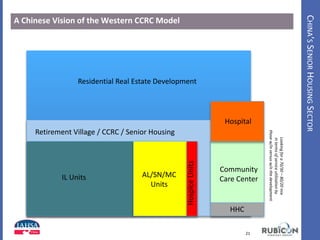
A Chinese Vision of the Western CCRC Model
Residential Real Estate Development
Retirement Village / CCRC / Senior Housing
IL Units AL/SN/MC
Units
Community
Care Center
HospiceUnits
HHC
Hospital
Lookingfora70/30–80/20mix
intermsofserviceutilizationby
thosew/inversusw/othedevelopment.
21
QUESTIONS?
China Office:
15/F, Office Building A,
Parkview Green
9 Dongdaqiao Road
Chaoyang District,
Beijing 100020 P.R. China
Phone: 86-10-5730-6216
Fax: 86-10-5730-6222
22
For more information:
Rubicon Strategy Group, LLC
2018 156th Avenue NE,
Suite 100, Building F
Bellevue, WA 98007
Phone: 1-888-610-7138
Email: info@rubiconstrategygroup.com
www.RubiconStrategyGroup.com
www.HealthIntelAsia.com

IAHSA Shanghai Presentation

  • 1.
    WHAT’S WORKING, WHATISN’T? Tuesday, May 24, 2016 Shanghai, China
  • 2.
    PART 1 -INTRODUCTION
  • 3.
    CHINA’SSENIORHOUSINGSECTOR Predicting the Market’sEvolution 3www.HealthIntelAsia.com 2015-2020 2020-2025 2025-2030 2030-2040 HHC • HHC is the first place payer systems will focus. • Natural development path given regional labor force. • Trials w/ community care take shape. • Concept of “virtual CCRC” begins to be trialed. • Public payer system funds nursing services for high flyers / bed blockers. • Early scaling of LTC financial vehicles. • Technology starts to address workforce utilization issues. • Mature public and private payer system has emerged. • Various stakeholders understand, and freely use HHC. • Infusions and hospice in- home care. IL/AL/SN Regionally, “Baby Boomers” hit 75. Rehab Point of diminishing returns on rehab services. MC Dementia services start to become needed en-masse relative to installed capacity.
  • 4.
    PART 2 –KEY FINDINGS FROM RUBICON’S MARKET ANALYSIS
  • 5.
    CHINA’SSENIORHOUSINGSECTOR Key Findings • Realestate developers view senior living as another way to keep doing what they’ve been doing for 20+ years. • Party cadre mentality at the municipal government level is driving a lot of movement around approvals of domestic and foreign senior living. • Exception is around healthcare-specific (medical service) assets, which remain subject to uncertain approval periods. • Life insurance companies view senior living as something they are invested in long term: • They will develop new LTC vehicles. • Provide care as stipulated in these LTC products via senior care facilities they own and operate. • They will use existing balance sheet resources to invest in senior living real estate assets (CCRCs). • Real estate remains the easiest investment channel for them and a pressing need given their investment mandate. 5www.HealthIntelAsia.com
  • 6.
    CHINA’SSENIORHOUSINGSECTOR Key Findings • Profitis elusive. • At least one of the largest American senior living operators has dramatically scaled back their senior living plans in favor of more direct healthcare opportunities. • Growth in appraised value of developed land lubricates much of the positive view of senior living assets thus far. • HNWI market is much narrower than many originally assumed; products will need to be developed that allow for price points accessible to the middle class. • Aging in place and home healthcare remain significant opportunities assuming questions specific to client acquisition costs, logistics and rationalized spending behaviors can be addressed. 6www.HealthIntelAsia.com
  • 7.
    CHINA’SSENIORHOUSINGSECTOR Understanding the SeniorLiving Preferences for Chinese HNWI The preference of senior living of HNWIs and their parents Facility Based Senior Care • Preference for facility based senior living is less than 5%. This is Changing • Today’s HNW cohort has a much higher (87.5% higher) preference for senior community than their parents.
  • 8.
    PART 3 –MARKET PENETRATION RATES
  • 9.
    CHINA’SSENIORHOUSINGSECTOR Important to Reinforce •Less than 11% of HNWIs in China mention senior care services as a spending priority. • Preference for facility-based senior care (versus respite or home healthcare) is less than 5%. • This is changing: the next generation of HNWIs have a strong lifestyle preference for senior living (88% higher than their parents’ preference). • People do not want to move away from their home city full time. • 67% want to stay in their home city. • 39% want to move to an “excellent tourism city.” • Only 27% are willing to move from a T1 to T2 city. • HNWIs have a very strong bias in favor of senior living that is integrated with a full continuum of care. 9www.HealthIntelAsia.com
  • 10.
    CHINA’SSENIORHOUSINGSECTOR Demographics & SiteSelection – What Are We Looking For? 10www.HealthIntelAsia.com Typically, with an intra-city re- development feasibility study, we are looking at grid level (1 square km). We want to identify the highest concentration of 65+ and then drill down via a market segmentation exercise, to the number of income qualified people within a fixed radius from the facility in question. This tends to be 3-5km for most projects in T1 and T2 cities.
  • 11.
    CHINA’SSENIORHOUSINGSECTOR Example: Regional Demographics- Nanjing 11 A typical re-development driven feasibility study would zero in on a project located in an urban area with a high density of 65+ and middle class. In Nanjing, a good example would be Molingjiedao, with a population of 16,818 aged 65 and older. This is important because at typical market penetration rates, that district would have between 15 and 757 potential customers.
  • 12.
    CHINA’SSENIORHOUSINGSECTOR Regional Demographics –Nanjing – Market Segmentation 12www.HealthIntelAsia.com Nanjing Hefei Huai’an Taizhou Wuhu Changzhou Xuancheng Xuyi 65+ Market Size 689,350 482,595 498,689 657,330 243,612 448,577 289,749 70,953 % Market @ Middle Class Income 9% of urban population 43,434 44,882 59,160 21,925 40,372 26,077 6,386 1% Penetration 662 434 449 592 219 404 261 64 3% Penetration 1,985 1,303 1,346 1,775 658 1,211 782 192 5% Penetration 3,308 2,172 2,244 2,958 1,096 2,019 1,304 319 What does this mean as you think about your sales & marketing strategy?
  • 13.
    CHINA’SSENIORHOUSINGSECTOR Regional Demographics –Nanjing – Market Segmentation (cont.) 13www.HealthIntelAsia.com Nanjing Hefei Huai'an Taizhou Wuhu Changzhou Xuancheng Xuyi 1% Penetration 662 434 449 592 219 404 261 64 3% Penetration 1,985 1,303 1,346 1,775 658 1,211 782 192 5% Penetration 3,308 2,172 2,244 2,958 1,096 2,019 1,304 319 0 500 1,000 1,500 2,000 2,500 3,000 3,500 Regional Demographics (200km Radius) – Market Segmentation
  • 14.
    PART 4 –REGULATORY ANALYSIS
  • 15.
    CHINA’SSENIORHOUSINGSECTOR Regulatory Analysis Some helpfulguidelines: • Senior care is more open to FDI than healthcare. • Broad disconnects between central and municipal governments persist. • Pervasive ambiguities between senior care and healthcare. • Senior care and healthcare are politically sensitive areas; however, • Central and municipal governments want and need FDI in both areas. • Binding healthcare regulations can be nebulous. • Where they are, the business license’s scope is determinative. • This scope will be negotiated word-by-word w/ relevant authorities. • A business’ scope creates hard lines around what can, and cannot be done by the business. • Where regulations are poorly defined, officials make decisions based on what other municipalities have approved, pilot projects, MOH policy papers, and non-binding guidance documents. • It is extremely common for ad-hoc business scopes to be the result, with specific services carving out breathing room for the company.
  • 16.
    CHINA’SSENIORHOUSINGSECTOR Regulatory Analysis Who RegulatesSenior Care in China? Ministry of Health (MOH) & Local Health Bureau SAIC & Local Administration for Industry & Commerce (AIC) www.HealthIntelAsia.com
  • 17.
    PART 5 –WHAT IS WORKING, WHAT IS NOT?
  • 18.
    CHINA’SSENIORHOUSINGSECTOR What Is Working,What Is Not? • Price point between RMB 5-10,000/month. • High acuity care for middle class RMB 10-15,000/month. • The financial calculus of Chinese seniors around selling their current home to finance the move into a dedicated senior living asset is immature and may not happen at a meaningful velocity. • Solutions that do not require dislocation within their home city. • This creates a very strong market preference for re-purposed facilities within an established community versus greenfield projects in the suburbs. • Market for successful senior care facilities is 3-5km from the proposed site (this follows from the US – senior living here typically sets a max radius of 5 miles). • Healthcare access is a key driver. • On-site doctors, nurses and caregivers. • On-site pharmaceutical distribution. • Green-channel referral relationship to local hospital. 18www.HealthIntelAsia.com
  • 19.
    CHINA’SSENIORHOUSINGSECTOR What Is Working,What Is Not? • Rethinking what is meant by the “trans-generational housing model.” • Proximity to, versus living w/, parents & grandparents. • Dual key concept. • Integration into planned community with distinct living spaces. • Even at the best in class Chinese-run senior living assets, service remains inadequate when measured to similarly positioned western assets. • Worst case: senior living as a real estate play leads to inadequate emphasis on the operational side of senior living. • Typical case: care needs are driven by symptoms not assessment or care plans. • Best case: Customer service is spotty and amenities are available but not managed. • Significant investment in marketing. • Traditional real estate sales and marketing is of limited use. • Seniors and their families need lots of help understanding what senior living is as a concept and how it will benefit them. • Platform investments that echo the infrastructure of China’s budget hotels. • IT systems. • Training platform. • Management dashboards. 19www.HealthIntelAsia.com
  • 20.
    CHINA’SSENIORHOUSINGSECTOR What is Working,What is Not? • Re-development versus greenfield. • Hub and spoke model focused on centralized post-acute services, community care, day care, activity center, gymnasium, palliative / hospice care, memory care. • Hub has “green channel” referral relationship with large local public hospital. • Spokes connected to 200-300 unit re-purposed hotels or apartment buildings that serve couples. • Couples typically present when one needs AL services, and one is still fully ambulatory. • Real versus perceived healthcare capabilities. • Many of the “successful” Chinese real estate developer projects have gone out of their way to advertise their AL/SN/MC capabilities. • Very few have the operational ability to deliver these. • Given the average age at move-in of their current residents (78), this is going to quickly become a problem. • This is why most Chinese players have inquiries into western senior living operators as partners to provide the know-how around these areas. 20www.HealthIntelAsia.com
  • 21.
    CHINA’SSENIORHOUSINGSECTOR A Chinese Visionof the Western CCRC Model Residential Real Estate Development Retirement Village / CCRC / Senior Housing IL Units AL/SN/MC Units Community Care Center HospiceUnits HHC Hospital Lookingfora70/30–80/20mix intermsofserviceutilizationby thosew/inversusw/othedevelopment. 21
  • 22.
    QUESTIONS? China Office: 15/F, OfficeBuilding A, Parkview Green 9 Dongdaqiao Road Chaoyang District, Beijing 100020 P.R. China Phone: 86-10-5730-6216 Fax: 86-10-5730-6222 22 For more information: Rubicon Strategy Group, LLC 2018 156th Avenue NE, Suite 100, Building F Bellevue, WA 98007 Phone: 1-888-610-7138 Email: info@rubiconstrategygroup.com www.RubiconStrategyGroup.com www.HealthIntelAsia.com www.HealthIntelAsia.com