@ IJTSRD | Available Online @ www.ijtsrd.com
ISSN No: 2456
International
Research
Myanmar Alphabet Recognition System
Based o
Lecturer, Department of Information Technology, Techn
Republic of the Union of Myanmar
ABSTRACT
This paper describes Myanmar Alphabet Recognition
System Based on Neural Network. Typical
recognition systems are designed using two parts. The
first part is a feature extractor that finds features
within the data, which are specific to the task being
solved. Edge detection method is used to extract
image’s features. It may be grouped i
categories, gradient and Laplacian. The gradient
method (Roberts, Prewitt, Sobel) detects the edges by
looking for the maximum and minimum in the first
derivative of the image. In this paper, Sobel edge
operator is chosen because it can generate th
significant features for Myanmar Alphabet than other
techniques. The second part is the classifier;
Multilayer Perceptron Network is designed for
recognition purpose. It is used to train the train data
set and classify the test data set that it is shown
its result box and sound. These data sets are composed
of all Myanmar alphabets. For programming and
simulation of this paper, MATLAB Programming
Language is used for implementation.
Keyword: Myanmar Alphabet Recognition System,
Edge detection method, Multilayer Perceptron
Network , MATLAB programming Language
I. INTRODUCTION
Character recognition is becoming more and more
important in the modern world. It helps humans ease
their jobs and solve more complex problems. It also is
one of the popular application toolboxes. Toolboxes
are comprehensive collections of MATLAB functions
(M-files) that extend the MATLAB environment to
solve particular classes of problem. Areas in which
toolboxes are available include signal processing,
control systems, neural network, fuzzy logic,
@ IJTSRD | Available Online @ www.ijtsrd.com | Volume – 2 | Issue – 5 | Jul-Aug 2018
ISSN No: 2456 - 6470 | www.ijtsrd.com | Volume
International Journal of Trend in Scientific
Research and Development (IJTSRD)
International Open Access Journal
mar Alphabet Recognition System
on Artificial Neural Network
Myat Thida Tun
of Information Technology, Technological University (Thanlyin),
Republic of the Union of Myanmar, Banbwegon, Myanmar (Burma)
This paper describes Myanmar Alphabet Recognition
System Based on Neural Network. Typical pattern
recognition systems are designed using two parts. The
first part is a feature extractor that finds features
within the data, which are specific to the task being
solved. Edge detection method is used to extract
image’s features. It may be grouped into two
categories, gradient and Laplacian. The gradient
method (Roberts, Prewitt, Sobel) detects the edges by
looking for the maximum and minimum in the first
derivative of the image. In this paper, Sobel edge
operator is chosen because it can generate the
significant features for Myanmar Alphabet than other
techniques. The second part is the classifier;
Multilayer Perceptron Network is designed for
recognition purpose. It is used to train the train data
set and classify the test data set that it is shown with
its result box and sound. These data sets are composed
of all Myanmar alphabets. For programming and
simulation of this paper, MATLAB Programming
Myanmar Alphabet Recognition System,
d, Multilayer Perceptron
Network , MATLAB programming Language
Character recognition is becoming more and more
important in the modern world. It helps humans ease
their jobs and solve more complex problems. It also is
one of the popular application toolboxes. Toolboxes
are comprehensive collections of MATLAB functions
files) that extend the MATLAB environment to
solve particular classes of problem. Areas in which
toolboxes are available include signal processing,
control systems, neural network, fuzzy logic,
wavelets, simulation, and many others Artificial
Neural Networks is used to train and identify
Myanmar alphabet. A Neural Networks is an
information-processing paradigm that is inspired by
the way biological nervous systems, such as brain,
process information. There are different types of
Neural Networks such as Perceptron's Network,
Linear Network, Back propagation Network,
Dynamic Network, Radial Basis Network, etc.
Perceptron Network is chosen for this paper.
Perceptron is the simplest form of Neural Networks
and function as a pattern classifier. To simulate
recognition system, MATLAB programming
language is studied. In this paper, firstly, Myanmar
Alphabet image files are created and saved as xx.gif
file. These files are separated as train data set and test
data set. Textural features: pattern, spatial fr
homogeneity, etc. The extracted feature sets are saved
as xx.txt file format. Finally, the neural networks
program is applied to train files set and classify the
tests data files.
II. PROPOSED IMPLEMENTATION
STEPS OF MYANMAR
ALPHABET RECOGNITION
The steps needed for the implementation of Myanmar
alphabet recognition systems are described in the
following articles.
A. Database Creation
Creating a database consisting of a train set and a test
set. Table 1 shows file classes and numbers of tra
and test files.
Aug 2018 Page: 1343
6470 | www.ijtsrd.com | Volume - 2 | Issue – 5
Scientific
(IJTSRD)
International Open Access Journal
mar Alphabet Recognition System
ological University (Thanlyin),
Banbwegon, Myanmar (Burma)
wavelets, simulation, and many others Artificial
Networks is used to train and identify
Myanmar alphabet. A Neural Networks is an
processing paradigm that is inspired by
the way biological nervous systems, such as brain,
process information. There are different types of
s Perceptron's Network,
Linear Network, Back propagation Network,
Dynamic Network, Radial Basis Network, etc.
Perceptron Network is chosen for this paper.
Perceptron is the simplest form of Neural Networks
and function as a pattern classifier. To simulate the
recognition system, MATLAB programming
language is studied. In this paper, firstly, Myanmar
Alphabet image files are created and saved as xx.gif
file. These files are separated as train data set and test
data set. Textural features: pattern, spatial frequency,
homogeneity, etc. The extracted feature sets are saved
as xx.txt file format. Finally, the neural networks
program is applied to train files set and classify the
PROPOSED IMPLEMENTATION
ON
The steps needed for the implementation of Myanmar
alphabet recognition systems are described in the
Creating a database consisting of a train set and a test
set. Table 1 shows file classes and numbers of train
International Journal of Trend in Scientific Research and Development (IJTSRD) ISSN: 2456-6470
@ IJTSRD | Available Online @ www.ijtsrd.com | Volume – 2 | Issue – 5 | Jul-Aug 2018 Page: 1344
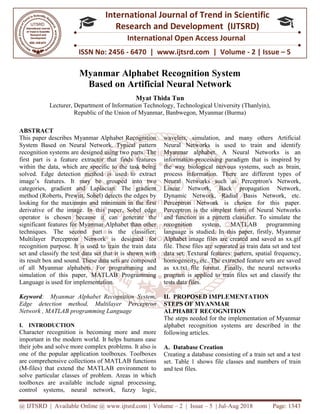
Table 1 Image Database Table
Sr.
No.
File Class
No: of Train
File
No: of Test
File
1 ka. gji 15 16
2 kha.gwei 15 16
3 ga. nge 15 16
4 ga. gji 15 16
5 nga 15 16
.
.
.
.
.
.
.
.
.
.
.
.
31 ha 15 16
32 la. gyi 15 16
33 a 15 16
Figure1. Images in Ka Gji File of Train Set
B. Programming Parts
There are two program parts in Software
Implementation for Myanmar Alphabet Recognition
System: feature extraction and Neural Networks
programs. These programs are written in M-file of
MATLAB. The user must be prepared a database
consisting of train, test and target files before the
programs start in MATLAB command window. In
feature extraction portion, Robert, Prettwit and Sobel
operators are testd to detect edges of images. By
comparing the extracted features, Sobel operator is
found that it can generate the most significant features
for each alphabet. Table 2 shows the example of
extracted features which are grouped in every 5
degree bins for ka. gji and ga. nge alphabets. Based on
these facts, sobel operator is selected in feature
extraction program.
Table 2 Types of Operators and Features of
Images
Operators
Features of Image
ka. gji ga. nge
Robert
0, 0, 6, 21, 5, 20,
17, 4, 0, 0, 7, 14,
17, 1, 11, 9, 0, 0, 0,
0, 7, 12, 2, 13, 16,
7, 0, 299, 5, 13, 30,
6, 13, 6, 0, 0
0, 0, 4, 4, 1, 9, 4,
4, 0, 0, 4, 4 8, 3,
4, 1, 0, 0, 0, 0, 7,
7, 3, 9, 12, 2, 0,
245, 2, 10, 20, 5,
12, 2, 0, 0
Prewitt 3, 26, 28, 20, 14, 4, 13, 7, 14, 3, 22,
45, 22, 30, 2, 3, 21,
21, 53, 15, 25, 35,
29, 3, 4, 26, 18, 17,
9, 45, 24, 21, 0,
109, 20, 17, 31, 9,
15, 22, 21, 5
8, 12, 0, 1, 12, 14,
23, 6, 19, 21, 15,
1, 1, 22, 14, 18, 9,
32, 13, 12, 3, 68,
8, 9, 18, 5, 3, 15,
7, 5
Sobel
8, 20, 27, 56, 13,
23, 24, 25, 0, 0, 18,
26, 26, 10, 61, 33,
37, 7, 8, 25, 12, 51,
6, 22, 30, 15, 0,
115, 19, 22, 8, 11,
38, 19, 24, 9
7, 7, 10, 21, 8, 14,
1, 6, 0, 0, 11, 12,
17, 13, 30, 17, 10,
5, 6, 20, 14, 38,
12, 12, 12, 18, 0,
71, 7, 7, 12, 6, 19,
10, 10, 4
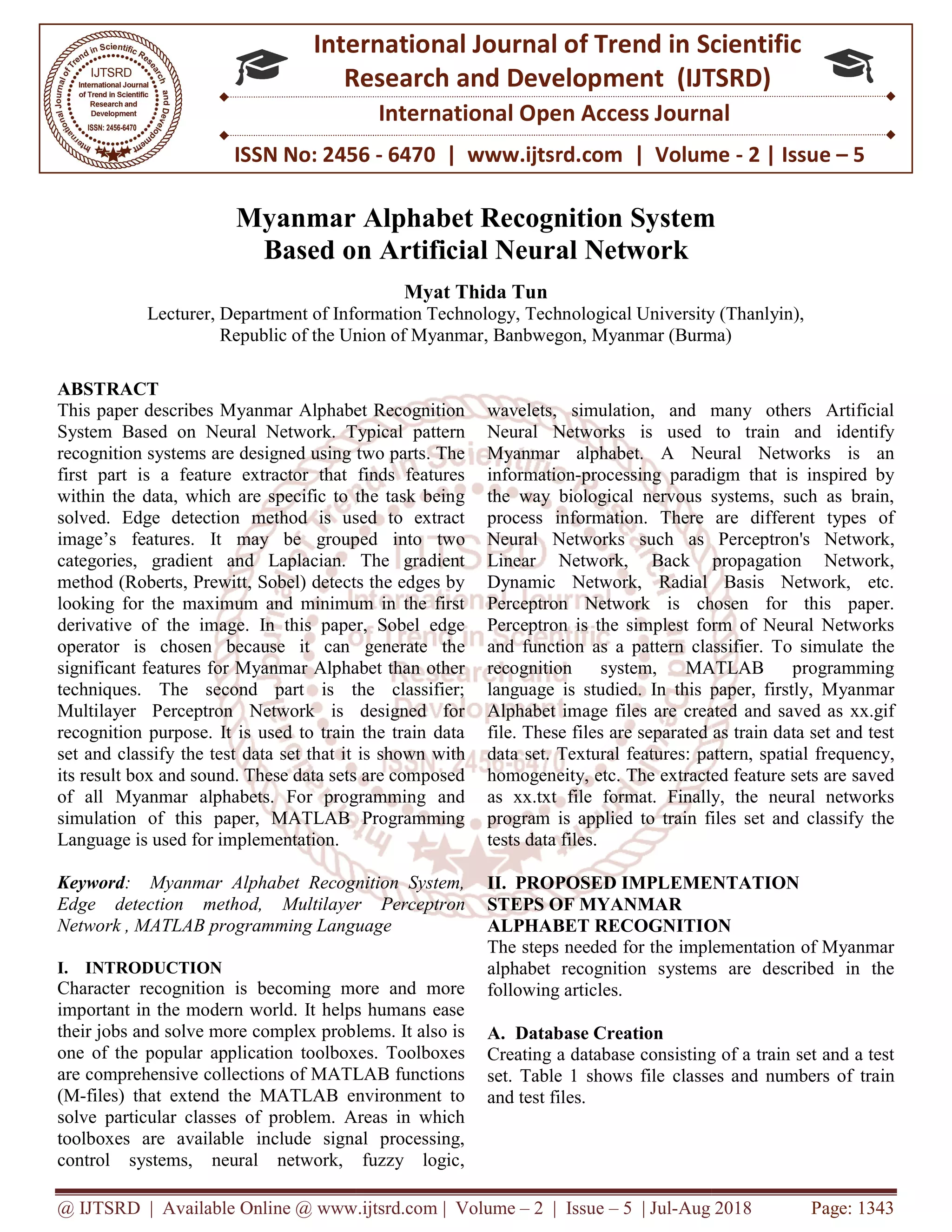
Sobel operator is shown in Figure 2.Neural Network
Program executes the classification of images on the
basis of the set of features have been extracted. This
program applies Multilayer Perceptron Network
because it is the simplest method for classification.
The hard limit transfer function in this method is used
to set the output and create neurons that classify
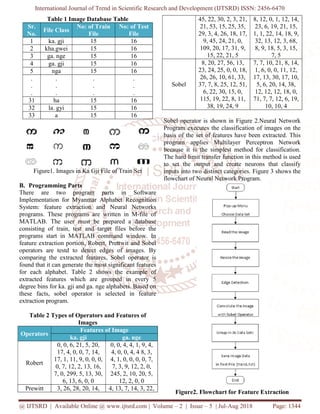
inputs into two distinct categories. Figure 3 shows the
flowchart of Neural Network Program.
Figure2. Flowchart for Feature Extraction
International Journal of Trend in Scientific Research and Development (IJTSRD) ISSN: 2456-6470
@ IJTSRD | Available Online @ www.ijtsrd.com | Volume – 2 | Issue – 5 | Jul-Aug 2018 Page: 1345
III.EXPERIMENTAL PARAMETERS
The purpose of this program is to extract features of
images in train and test files. When this program runs,
a menu box appears asking the user whether the user
want to run the algorithm on test or train sets. If the
user chooses train set, the second menu will appears
for the user to choose the type of character files.
These menu boxes are shown in Figure 4.
(b)
Figure3. Flowchart for Neural Network Program
(a)
Figure4. Pop-up Menus: (a) Image File Menu and
(b) Database Set Menu
One type of character files is chosen and then the user
must input the numbers of images in train file. A for
loop is used to read an entire file of images as strings
and store them in MATLAB’s memory. The image
string is resized to 150×140 pixels. This size is the
optimal for enough detail while keeping the
processing time low. The original image and resized
image of ka. gji are shown in Figure 5.
(a)
(b)
Figure5. Images: (a) Original Image and (b) Resize
Image
International Journal of Trend in Scientific Research and Development (IJTSRD) ISSN: 2456-6470
@ IJTSRD | Available Online @ www.ijtsrd.com | Volume – 2 | Issue – 5 | Jul-Aug 2018 Page: 1346
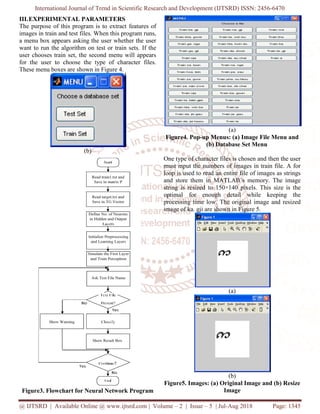
The next step is to detect the edges of images using
Sobel operator. The images and this operator are
convoluted in x- and y-directions, and the gradient of
images is estimated. Then, the direction of gradient is
calculated and the resulting matrix is rearranged into a
column vector by using im2col MATLAB function.
Finally, the column is converted from the radians to
the degrees. The orientation magnitude is read every 5
degrees and summed to form a bin for the orientation
histograms. The numbers of histogram bin are 36 bins
because the actual resolution of each bin is set to 5
degree. These bins are stored in train1.txt file to feed
to the Neural Network. If the user chooses test set, the
set but the features of test set is automatic stored in
text file. MATLAB Programming develops this
algorithm that is feature extraction method.
IV.EXPERIMENTAL RESULT
Neural Network Programming Steps: There are many
steps in Neural Network program. If the user wants to
run this program, the following command has to type
in command window of MATLAB.
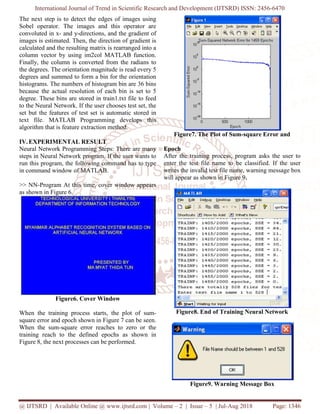
>> NN-Program At this time, cover window appears
as shown in Figure 6.
Figure6. Cover Window
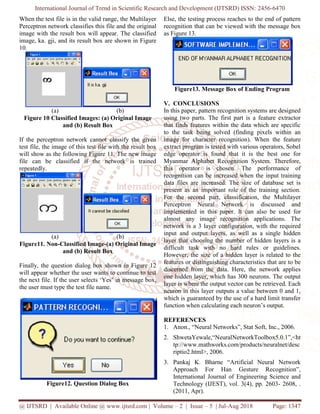
When the training process starts, the plot of sum-
square error and epoch shown in Figure 7 can be seen.
When the sum-square error reaches to zero or the
training reach to the defined epochs as shown in
Figure 8, the next processes can be performed.
Figure7. The Plot of Sum-square Error and
Epoch
After the training process, program asks the user to
enter the test file name to be classified. If the user
writes the invalid test file name, warning message box
will appear as shown in Figure 9.
Figure8. End of Training Neural Network
Figure9. Warning Message Box
International Journal of Trend in Scientific Research and Development (IJTSRD) ISSN:
@ IJTSRD | Available Online @ www.ijtsrd.com
When the test file is in the valid range, the Multilayer
Perceptron network classifies this file and the original
image with the result box will appear. The classified
image, ka. gji, and its result box are sho
10.
(a) (b)
Figure 10 Classified Images: (a) Original Image
and (b) Result Box
If the perceptron network cannot classify the given
test file, the image of this test file with the result box
will show as the following Figure 11. The new image
file can be classified if the network is trained
repeatedly.
(a) (b)
Figure11. Non-Classified Image-(a) Original Image
and (b) Result Box
Finally, the question dialog box shown in Figure 12
will appear whether the user wants to continue to test
the next file. If the user selects ‘Yes’ in message box,
the user must type the test file name.
Figure12. Question Dialog Box
International Journal of Trend in Scientific Research and Development (IJTSRD) ISSN:
Available Online @ www.ijtsrd.com | Volume – 2 | Issue – 5 | Jul-Aug 2018
When the test file is in the valid range, the Multilayer
Perceptron network classifies this file and the original
image with the result box will appear. The classified
image, ka. gji, and its result box are shown in Figure
(b)
: (a) Original Image
If the perceptron network cannot classify the given
test file, the image of this test file with the result box
the following Figure 11. The new image
file can be classified if the network is trained
(b)
(a) Original Image
Finally, the question dialog box shown in Figure 12
will appear whether the user wants to continue to test
the next file. If the user selects ‘Yes’ in message box,
12. Question Dialog Box
Else, the testing process reaches to the end of pattern
recognition that can be viewed with the message box
as Figure 13.
Figure13. Message Box of Ending Program
V. CONCLUSIONS
In this paper, pattern recognition systems are designed
using two parts. The first part is a feature extractor
that finds features within the data which are specific
to the task being solved (finding pixels within an
image for character recognition). When
extract program is tested with various operators, Sobel
edge operator is found that it is the best one for
Myanmar Alphabet Recognition System. Therefore,
this operator is chosen. The performance of
recognition can be increased when the input t
data files are increased. The size of database set is
present as an important role of the training section.
For the second part, classification, the Multilayer
Perceptron Neural Network is discussed and
implemented in this paper. It can also be use
almost any image recognition applications. The
network is a 3 layer configuration, with the required
input and output layers, as well as a single hidden
layer that choosing the number of hidden layers is a
difficult task with no hard rules or guideli
However, the size of a hidden layer is related to the
features or distinguishing characteristics that are to be
discerned from the data. Here, the network applies
one hidden layer, which has 300 neurons. The output
layer is where the output vector can
neuron in this layer outputs a value between 0 and 1,
which is guaranteed by the use of a hard limit transfer
function when calculating each neuron’s output.
REFERENCES
1. Anon., “Neural Networks”, Stat Soft,
2. ShwetaYewale,“NeuralNetworkToolbox5.0.1”,<ht
tp://www.mathworks.com/products/neuralnet/desc
riptio2.html>, 2006.
3. Pankaj K. Bharne “Artificial Neural Network
Approach For Han Gesture Recognition”,
International Journal of Engineering Science and
Technology (IJEST), vol. 3(4), pp. 2603
(2011, Apr).
International Journal of Trend in Scientific Research and Development (IJTSRD) ISSN: 2456-6470
Aug 2018 Page: 1347
Else, the testing process reaches to the end of pattern
recognition that can be viewed with the message box
Figure13. Message Box of Ending Program
In this paper, pattern recognition systems are designed
using two parts. The first part is a feature extractor
that finds features within the data which are specific
to the task being solved (finding pixels within an
image for character recognition). When the feature
extract program is tested with various operators, Sobel
edge operator is found that it is the best one for
Myanmar Alphabet Recognition System. Therefore,
this operator is chosen. The performance of
recognition can be increased when the input training
data files are increased. The size of database set is
present as an important role of the training section.
For the second part, classification, the Multilayer
Perceptron Neural Network is discussed and
implemented in this paper. It can also be used for
almost any image recognition applications. The
network is a 3 layer configuration, with the required
input and output layers, as well as a single hidden
layer that choosing the number of hidden layers is a
difficult task with no hard rules or guidelines.
However, the size of a hidden layer is related to the
features or distinguishing characteristics that are to be
discerned from the data. Here, the network applies
one hidden layer, which has 300 neurons. The output
layer is where the output vector can be retrieved. Each
neuron in this layer outputs a value between 0 and 1,
which is guaranteed by the use of a hard limit transfer
function when calculating each neuron’s output.
Anon., “Neural Networks”, Stat Soft, Inc., 2006.
ShwetaYewale,“NeuralNetworkToolbox5.0.1”,<ht
tp://www.mathworks.com/products/neuralnet/desc
Pankaj K. Bharne “Artificial Neural Network
Approach For Han Gesture Recognition”,
International Journal of Engineering Science and
IJEST), vol. 3(4), pp. 2603- 2608, .
International Journal of Trend in Scientific Research and Development (IJTSRD) ISSN: 2456-6470
@ IJTSRD | Available Online @ www.ijtsrd.com | Volume – 2 | Issue – 5 | Jul-Aug 2018 Page: 1348
4. Ankit Chaudhary, J. L. Raheja, Karen Das, and
Sonia Raheja “Intelligent Approaches to interact
with Machines using Hand Gesture Recognition in
Natural way A Survey,” International Journal of
Computer Science & Engineering Survey
(IJCSES), vol. 2, . (2011, Feb).
5. Pradeep, J. et al.―Diagonal based feature
extraction for handwritten alphabet recognition
system using neural network, International Journal
of Computer Science and Information
Technology, Vol.3, No.1, pp. 27, 2011
6. Khurana,P., Singh, V. A model for human
cognition,‖ International Journal of Computing
and Business Research, Vol.2, Issue.3, 2011
7. Kurian, C, Balakriahnan, K, Continuous speech
recognition system for Malayalam language using
PLP cepstral coefficient,‖ Journal of Computing
and Business Research, Vol.3, Issue.1, 2012
8. Sivanandam, S. N, Deepa, S.N., Principle s of Soft
Computing,‖ Wiley-India publisher, 2nd edition,
ISBN: 978-81-265-2741-0, 2011
9. Proceeding of 8th International Symposium on
Intelligent Systems and Informatics (SISY),
pp.249-251, 2010
10. Dash, T., "Time Efficient Approach to Offline
Hand Written Character Recognition using
Associative Memory Net"‖, International Journal
of Computing and Business Research, ISSN: 2229
–6166, Vol. 3, Issue-3, 2012.
11. Dash, T., Chattopadhyay, S. Nayak T.,
Handwritten Signature Verification using
Adaptive Resonance Theory Type-2 (ART-2)
Net‖. Journal of Global Research in Computer
Science, vol. 3, issue 8, pp. 2125, 2012
12. Dash, T., Nayak, T., Chattopadhyay, S., ―Offline
Verification of Hand Written Signature Using
Adaptive Resonance Theory Net (Type-1)‖, in
Proc: IEEE Int. Conf. Electronics Computer
Technology (ICECT), Vol-2, pp. 205-210, 2012.
13. Ravina Mithe, Supriya Indalkar, Nilam Divekar
“Optical Character Recognition” International
Journal of Recent Technology and Engineering
(IJRTE) ISSN: 2277-3878,Volume-2, Issue-1,
March 2013
14. Parappa S.N. and Singh M.P., “Performance
Analysis of Conjugate Descent Learning Rulof
Feed Forward Neural Networks for Pattern
Classification”, International Journal of
Multidisciplinary and Current Research, pg. 723-
725, Vol. 3, 2015
15. Kumar Prodhan, Md. Farukuzzaman Khan
“Implementation of Back-Propagatio Neural
Network for Isolated Bangla Speec Recognition”
International Journal of Information Sciences and
Techniques (IJIST)Vol.3, No.4, July 2013
16. Farjana Yeasmin Omee, Shiam Shabbir Himel “A
Complete Workflow for Development of Bangla
OCR” International Journal of Computer
Applications (0975 – 8887) Volume 21– No.9,
May 2011
17. Md. Abul hasnat “Research Report on Bangla
OCR training and testing method” Conference on
Artificial Intelligence and Soft Computing,
Marlbella Spain, ACTA press 2004.
18. GOLABI, S.SAADAT, S- HELFROUSH, M.
S.TASHK, A.: A novel thinning algorithm with
fingerprint minutiae extraction capability,
International Journal of Computer Theory and
Engineering 4 (2012),no. 4, 514–517.
19. E. Robust feature extraction in fingerprint images
using ridge model tracking, Center for Embedded
Systems for Critical Applications, Bradley
Department of Electrical and Computer
Engineering (2014).
20. SUANDI, S.A.: Finger Code for identity
verification using fingerprint and smart card in:
10th Asian Control Conference (2015),
6p.em_Classification_UsingTransformation_Base
d_Feature_Extraction_Methods [accessed Jul 07
2018]

Myanmar Alphabet Recognition System Based on Artificial Neural Network

  • 1.
    @ IJTSRD |Available Online @ www.ijtsrd.com ISSN No: 2456 International Research Myanmar Alphabet Recognition System Based o Lecturer, Department of Information Technology, Techn Republic of the Union of Myanmar ABSTRACT This paper describes Myanmar Alphabet Recognition System Based on Neural Network. Typical recognition systems are designed using two parts. The first part is a feature extractor that finds features within the data, which are specific to the task being solved. Edge detection method is used to extract image’s features. It may be grouped i categories, gradient and Laplacian. The gradient method (Roberts, Prewitt, Sobel) detects the edges by looking for the maximum and minimum in the first derivative of the image. In this paper, Sobel edge operator is chosen because it can generate th significant features for Myanmar Alphabet than other techniques. The second part is the classifier; Multilayer Perceptron Network is designed for recognition purpose. It is used to train the train data set and classify the test data set that it is shown its result box and sound. These data sets are composed of all Myanmar alphabets. For programming and simulation of this paper, MATLAB Programming Language is used for implementation. Keyword: Myanmar Alphabet Recognition System, Edge detection method, Multilayer Perceptron Network , MATLAB programming Language I. INTRODUCTION Character recognition is becoming more and more important in the modern world. It helps humans ease their jobs and solve more complex problems. It also is one of the popular application toolboxes. Toolboxes are comprehensive collections of MATLAB functions (M-files) that extend the MATLAB environment to solve particular classes of problem. Areas in which toolboxes are available include signal processing, control systems, neural network, fuzzy logic, @ IJTSRD | Available Online @ www.ijtsrd.com | Volume – 2 | Issue – 5 | Jul-Aug 2018 ISSN No: 2456 - 6470 | www.ijtsrd.com | Volume International Journal of Trend in Scientific Research and Development (IJTSRD) International Open Access Journal mar Alphabet Recognition System on Artificial Neural Network Myat Thida Tun of Information Technology, Technological University (Thanlyin), Republic of the Union of Myanmar, Banbwegon, Myanmar (Burma) This paper describes Myanmar Alphabet Recognition System Based on Neural Network. Typical pattern recognition systems are designed using two parts. The first part is a feature extractor that finds features within the data, which are specific to the task being solved. Edge detection method is used to extract image’s features. It may be grouped into two categories, gradient and Laplacian. The gradient method (Roberts, Prewitt, Sobel) detects the edges by looking for the maximum and minimum in the first derivative of the image. In this paper, Sobel edge operator is chosen because it can generate the significant features for Myanmar Alphabet than other techniques. The second part is the classifier; Multilayer Perceptron Network is designed for recognition purpose. It is used to train the train data set and classify the test data set that it is shown with its result box and sound. These data sets are composed of all Myanmar alphabets. For programming and simulation of this paper, MATLAB Programming Myanmar Alphabet Recognition System, d, Multilayer Perceptron Network , MATLAB programming Language Character recognition is becoming more and more important in the modern world. It helps humans ease their jobs and solve more complex problems. It also is one of the popular application toolboxes. Toolboxes are comprehensive collections of MATLAB functions files) that extend the MATLAB environment to solve particular classes of problem. Areas in which toolboxes are available include signal processing, control systems, neural network, fuzzy logic, wavelets, simulation, and many others Artificial Neural Networks is used to train and identify Myanmar alphabet. A Neural Networks is an information-processing paradigm that is inspired by the way biological nervous systems, such as brain, process information. There are different types of Neural Networks such as Perceptron's Network, Linear Network, Back propagation Network, Dynamic Network, Radial Basis Network, etc. Perceptron Network is chosen for this paper. Perceptron is the simplest form of Neural Networks and function as a pattern classifier. To simulate recognition system, MATLAB programming language is studied. In this paper, firstly, Myanmar Alphabet image files are created and saved as xx.gif file. These files are separated as train data set and test data set. Textural features: pattern, spatial fr homogeneity, etc. The extracted feature sets are saved as xx.txt file format. Finally, the neural networks program is applied to train files set and classify the tests data files. II. PROPOSED IMPLEMENTATION STEPS OF MYANMAR ALPHABET RECOGNITION The steps needed for the implementation of Myanmar alphabet recognition systems are described in the following articles. A. Database Creation Creating a database consisting of a train set and a test set. Table 1 shows file classes and numbers of tra and test files. Aug 2018 Page: 1343 6470 | www.ijtsrd.com | Volume - 2 | Issue – 5 Scientific (IJTSRD) International Open Access Journal mar Alphabet Recognition System ological University (Thanlyin), Banbwegon, Myanmar (Burma) wavelets, simulation, and many others Artificial Networks is used to train and identify Myanmar alphabet. A Neural Networks is an processing paradigm that is inspired by the way biological nervous systems, such as brain, process information. There are different types of s Perceptron's Network, Linear Network, Back propagation Network, Dynamic Network, Radial Basis Network, etc. Perceptron Network is chosen for this paper. Perceptron is the simplest form of Neural Networks and function as a pattern classifier. To simulate the recognition system, MATLAB programming language is studied. In this paper, firstly, Myanmar Alphabet image files are created and saved as xx.gif file. These files are separated as train data set and test data set. Textural features: pattern, spatial frequency, homogeneity, etc. The extracted feature sets are saved as xx.txt file format. Finally, the neural networks program is applied to train files set and classify the PROPOSED IMPLEMENTATION ON The steps needed for the implementation of Myanmar alphabet recognition systems are described in the Creating a database consisting of a train set and a test set. Table 1 shows file classes and numbers of train
  • 2.
    International Journal ofTrend in Scientific Research and Development (IJTSRD) ISSN: 2456-6470 @ IJTSRD | Available Online @ www.ijtsrd.com | Volume – 2 | Issue – 5 | Jul-Aug 2018 Page: 1344 Table 1 Image Database Table Sr. No. File Class No: of Train File No: of Test File 1 ka. gji 15 16 2 kha.gwei 15 16 3 ga. nge 15 16 4 ga. gji 15 16 5 nga 15 16 . . . . . . . . . . . . 31 ha 15 16 32 la. gyi 15 16 33 a 15 16 Figure1. Images in Ka Gji File of Train Set B. Programming Parts There are two program parts in Software Implementation for Myanmar Alphabet Recognition System: feature extraction and Neural Networks programs. These programs are written in M-file of MATLAB. The user must be prepared a database consisting of train, test and target files before the programs start in MATLAB command window. In feature extraction portion, Robert, Prettwit and Sobel operators are testd to detect edges of images. By comparing the extracted features, Sobel operator is found that it can generate the most significant features for each alphabet. Table 2 shows the example of extracted features which are grouped in every 5 degree bins for ka. gji and ga. nge alphabets. Based on these facts, sobel operator is selected in feature extraction program. Table 2 Types of Operators and Features of Images Operators Features of Image ka. gji ga. nge Robert 0, 0, 6, 21, 5, 20, 17, 4, 0, 0, 7, 14, 17, 1, 11, 9, 0, 0, 0, 0, 7, 12, 2, 13, 16, 7, 0, 299, 5, 13, 30, 6, 13, 6, 0, 0 0, 0, 4, 4, 1, 9, 4, 4, 0, 0, 4, 4 8, 3, 4, 1, 0, 0, 0, 0, 7, 7, 3, 9, 12, 2, 0, 245, 2, 10, 20, 5, 12, 2, 0, 0 Prewitt 3, 26, 28, 20, 14, 4, 13, 7, 14, 3, 22, 45, 22, 30, 2, 3, 21, 21, 53, 15, 25, 35, 29, 3, 4, 26, 18, 17, 9, 45, 24, 21, 0, 109, 20, 17, 31, 9, 15, 22, 21, 5 8, 12, 0, 1, 12, 14, 23, 6, 19, 21, 15, 1, 1, 22, 14, 18, 9, 32, 13, 12, 3, 68, 8, 9, 18, 5, 3, 15, 7, 5 Sobel 8, 20, 27, 56, 13, 23, 24, 25, 0, 0, 18, 26, 26, 10, 61, 33, 37, 7, 8, 25, 12, 51, 6, 22, 30, 15, 0, 115, 19, 22, 8, 11, 38, 19, 24, 9 7, 7, 10, 21, 8, 14, 1, 6, 0, 0, 11, 12, 17, 13, 30, 17, 10, 5, 6, 20, 14, 38, 12, 12, 12, 18, 0, 71, 7, 7, 12, 6, 19, 10, 10, 4 Sobel operator is shown in Figure 2.Neural Network Program executes the classification of images on the basis of the set of features have been extracted. This program applies Multilayer Perceptron Network because it is the simplest method for classification. The hard limit transfer function in this method is used to set the output and create neurons that classify inputs into two distinct categories. Figure 3 shows the flowchart of Neural Network Program. Figure2. Flowchart for Feature Extraction
  • 3.
    International Journal ofTrend in Scientific Research and Development (IJTSRD) ISSN: 2456-6470 @ IJTSRD | Available Online @ www.ijtsrd.com | Volume – 2 | Issue – 5 | Jul-Aug 2018 Page: 1345 III.EXPERIMENTAL PARAMETERS The purpose of this program is to extract features of images in train and test files. When this program runs, a menu box appears asking the user whether the user want to run the algorithm on test or train sets. If the user chooses train set, the second menu will appears for the user to choose the type of character files. These menu boxes are shown in Figure 4. (b) Figure3. Flowchart for Neural Network Program (a) Figure4. Pop-up Menus: (a) Image File Menu and (b) Database Set Menu One type of character files is chosen and then the user must input the numbers of images in train file. A for loop is used to read an entire file of images as strings and store them in MATLAB’s memory. The image string is resized to 150×140 pixels. This size is the optimal for enough detail while keeping the processing time low. The original image and resized image of ka. gji are shown in Figure 5. (a) (b) Figure5. Images: (a) Original Image and (b) Resize Image
  • 4.
    International Journal ofTrend in Scientific Research and Development (IJTSRD) ISSN: 2456-6470 @ IJTSRD | Available Online @ www.ijtsrd.com | Volume – 2 | Issue – 5 | Jul-Aug 2018 Page: 1346 The next step is to detect the edges of images using Sobel operator. The images and this operator are convoluted in x- and y-directions, and the gradient of images is estimated. Then, the direction of gradient is calculated and the resulting matrix is rearranged into a column vector by using im2col MATLAB function. Finally, the column is converted from the radians to the degrees. The orientation magnitude is read every 5 degrees and summed to form a bin for the orientation histograms. The numbers of histogram bin are 36 bins because the actual resolution of each bin is set to 5 degree. These bins are stored in train1.txt file to feed to the Neural Network. If the user chooses test set, the set but the features of test set is automatic stored in text file. MATLAB Programming develops this algorithm that is feature extraction method. IV.EXPERIMENTAL RESULT Neural Network Programming Steps: There are many steps in Neural Network program. If the user wants to run this program, the following command has to type in command window of MATLAB. >> NN-Program At this time, cover window appears as shown in Figure 6. Figure6. Cover Window When the training process starts, the plot of sum- square error and epoch shown in Figure 7 can be seen. When the sum-square error reaches to zero or the training reach to the defined epochs as shown in Figure 8, the next processes can be performed. Figure7. The Plot of Sum-square Error and Epoch After the training process, program asks the user to enter the test file name to be classified. If the user writes the invalid test file name, warning message box will appear as shown in Figure 9. Figure8. End of Training Neural Network Figure9. Warning Message Box
  • 5.
    International Journal ofTrend in Scientific Research and Development (IJTSRD) ISSN: @ IJTSRD | Available Online @ www.ijtsrd.com When the test file is in the valid range, the Multilayer Perceptron network classifies this file and the original image with the result box will appear. The classified image, ka. gji, and its result box are sho 10. (a) (b) Figure 10 Classified Images: (a) Original Image and (b) Result Box If the perceptron network cannot classify the given test file, the image of this test file with the result box will show as the following Figure 11. The new image file can be classified if the network is trained repeatedly. (a) (b) Figure11. Non-Classified Image-(a) Original Image and (b) Result Box Finally, the question dialog box shown in Figure 12 will appear whether the user wants to continue to test the next file. If the user selects ‘Yes’ in message box, the user must type the test file name. Figure12. Question Dialog Box International Journal of Trend in Scientific Research and Development (IJTSRD) ISSN: Available Online @ www.ijtsrd.com | Volume – 2 | Issue – 5 | Jul-Aug 2018 When the test file is in the valid range, the Multilayer Perceptron network classifies this file and the original image with the result box will appear. The classified image, ka. gji, and its result box are shown in Figure (b) : (a) Original Image If the perceptron network cannot classify the given test file, the image of this test file with the result box the following Figure 11. The new image file can be classified if the network is trained (b) (a) Original Image Finally, the question dialog box shown in Figure 12 will appear whether the user wants to continue to test the next file. If the user selects ‘Yes’ in message box, 12. Question Dialog Box Else, the testing process reaches to the end of pattern recognition that can be viewed with the message box as Figure 13. Figure13. Message Box of Ending Program V. CONCLUSIONS In this paper, pattern recognition systems are designed using two parts. The first part is a feature extractor that finds features within the data which are specific to the task being solved (finding pixels within an image for character recognition). When extract program is tested with various operators, Sobel edge operator is found that it is the best one for Myanmar Alphabet Recognition System. Therefore, this operator is chosen. The performance of recognition can be increased when the input t data files are increased. The size of database set is present as an important role of the training section. For the second part, classification, the Multilayer Perceptron Neural Network is discussed and implemented in this paper. It can also be use almost any image recognition applications. The network is a 3 layer configuration, with the required input and output layers, as well as a single hidden layer that choosing the number of hidden layers is a difficult task with no hard rules or guideli However, the size of a hidden layer is related to the features or distinguishing characteristics that are to be discerned from the data. Here, the network applies one hidden layer, which has 300 neurons. The output layer is where the output vector can neuron in this layer outputs a value between 0 and 1, which is guaranteed by the use of a hard limit transfer function when calculating each neuron’s output. REFERENCES 1. Anon., “Neural Networks”, Stat Soft, 2. ShwetaYewale,“NeuralNetworkToolbox5.0.1”,<ht tp://www.mathworks.com/products/neuralnet/desc riptio2.html>, 2006. 3. Pankaj K. Bharne “Artificial Neural Network Approach For Han Gesture Recognition”, International Journal of Engineering Science and Technology (IJEST), vol. 3(4), pp. 2603 (2011, Apr). International Journal of Trend in Scientific Research and Development (IJTSRD) ISSN: 2456-6470 Aug 2018 Page: 1347 Else, the testing process reaches to the end of pattern recognition that can be viewed with the message box Figure13. Message Box of Ending Program In this paper, pattern recognition systems are designed using two parts. The first part is a feature extractor that finds features within the data which are specific to the task being solved (finding pixels within an image for character recognition). When the feature extract program is tested with various operators, Sobel edge operator is found that it is the best one for Myanmar Alphabet Recognition System. Therefore, this operator is chosen. The performance of recognition can be increased when the input training data files are increased. The size of database set is present as an important role of the training section. For the second part, classification, the Multilayer Perceptron Neural Network is discussed and implemented in this paper. It can also be used for almost any image recognition applications. The network is a 3 layer configuration, with the required input and output layers, as well as a single hidden layer that choosing the number of hidden layers is a difficult task with no hard rules or guidelines. However, the size of a hidden layer is related to the features or distinguishing characteristics that are to be discerned from the data. Here, the network applies one hidden layer, which has 300 neurons. The output layer is where the output vector can be retrieved. Each neuron in this layer outputs a value between 0 and 1, which is guaranteed by the use of a hard limit transfer function when calculating each neuron’s output. Anon., “Neural Networks”, Stat Soft, Inc., 2006. ShwetaYewale,“NeuralNetworkToolbox5.0.1”,<ht tp://www.mathworks.com/products/neuralnet/desc Pankaj K. Bharne “Artificial Neural Network Approach For Han Gesture Recognition”, International Journal of Engineering Science and IJEST), vol. 3(4), pp. 2603- 2608, .
  • 6.
    International Journal ofTrend in Scientific Research and Development (IJTSRD) ISSN: 2456-6470 @ IJTSRD | Available Online @ www.ijtsrd.com | Volume – 2 | Issue – 5 | Jul-Aug 2018 Page: 1348 4. Ankit Chaudhary, J. L. Raheja, Karen Das, and Sonia Raheja “Intelligent Approaches to interact with Machines using Hand Gesture Recognition in Natural way A Survey,” International Journal of Computer Science & Engineering Survey (IJCSES), vol. 2, . (2011, Feb). 5. Pradeep, J. et al.―Diagonal based feature extraction for handwritten alphabet recognition system using neural network, International Journal of Computer Science and Information Technology, Vol.3, No.1, pp. 27, 2011 6. Khurana,P., Singh, V. A model for human cognition,‖ International Journal of Computing and Business Research, Vol.2, Issue.3, 2011 7. Kurian, C, Balakriahnan, K, Continuous speech recognition system for Malayalam language using PLP cepstral coefficient,‖ Journal of Computing and Business Research, Vol.3, Issue.1, 2012 8. Sivanandam, S. N, Deepa, S.N., Principle s of Soft Computing,‖ Wiley-India publisher, 2nd edition, ISBN: 978-81-265-2741-0, 2011 9. Proceeding of 8th International Symposium on Intelligent Systems and Informatics (SISY), pp.249-251, 2010 10. Dash, T., "Time Efficient Approach to Offline Hand Written Character Recognition using Associative Memory Net"‖, International Journal of Computing and Business Research, ISSN: 2229 –6166, Vol. 3, Issue-3, 2012. 11. Dash, T., Chattopadhyay, S. Nayak T., Handwritten Signature Verification using Adaptive Resonance Theory Type-2 (ART-2) Net‖. Journal of Global Research in Computer Science, vol. 3, issue 8, pp. 2125, 2012 12. Dash, T., Nayak, T., Chattopadhyay, S., ―Offline Verification of Hand Written Signature Using Adaptive Resonance Theory Net (Type-1)‖, in Proc: IEEE Int. Conf. Electronics Computer Technology (ICECT), Vol-2, pp. 205-210, 2012. 13. Ravina Mithe, Supriya Indalkar, Nilam Divekar “Optical Character Recognition” International Journal of Recent Technology and Engineering (IJRTE) ISSN: 2277-3878,Volume-2, Issue-1, March 2013 14. Parappa S.N. and Singh M.P., “Performance Analysis of Conjugate Descent Learning Rulof Feed Forward Neural Networks for Pattern Classification”, International Journal of Multidisciplinary and Current Research, pg. 723- 725, Vol. 3, 2015 15. Kumar Prodhan, Md. Farukuzzaman Khan “Implementation of Back-Propagatio Neural Network for Isolated Bangla Speec Recognition” International Journal of Information Sciences and Techniques (IJIST)Vol.3, No.4, July 2013 16. Farjana Yeasmin Omee, Shiam Shabbir Himel “A Complete Workflow for Development of Bangla OCR” International Journal of Computer Applications (0975 – 8887) Volume 21– No.9, May 2011 17. Md. Abul hasnat “Research Report on Bangla OCR training and testing method” Conference on Artificial Intelligence and Soft Computing, Marlbella Spain, ACTA press 2004. 18. GOLABI, S.SAADAT, S- HELFROUSH, M. S.TASHK, A.: A novel thinning algorithm with fingerprint minutiae extraction capability, International Journal of Computer Theory and Engineering 4 (2012),no. 4, 514–517. 19. E. Robust feature extraction in fingerprint images using ridge model tracking, Center for Embedded Systems for Critical Applications, Bradley Department of Electrical and Computer Engineering (2014). 20. SUANDI, S.A.: Finger Code for identity verification using fingerprint and smart card in: 10th Asian Control Conference (2015), 6p.em_Classification_UsingTransformation_Base d_Feature_Extraction_Methods [accessed Jul 07 2018]