A

             COMPREHENSIVE PROJECT REPORT

                              ON

    “CUSTOMER PERCEPTION TOWARDS SBI MUTUAL FUND”

                         Submitted to:
                        SHWETA PATEL

Late Smt. Shardaben Ghanshyambhai Patel Institute of Management

             IN PARTIAL FULFILLMENT OF THE
      REQUIREMENT OF THE AWARD FOR THE DEGREE OF
          MASTER OF BUSINESS ASMINISTRATION
                            In
              Gujarat Technological University

                  UNDER THE GUIDANCE OF
                       Faculty Guide:
                      SHWETA PATEL

                             Submitted by
                            VISHAL S. SHAH
           [Batch : 2011-13, Enrollment No.:117330592034]
                          MBA SEMESTER III/IV
Late Smt. Shardaben Ghanshyambhai Patel Institute of Management
                           MBA PROGRAMME
             Affiliated to Gujarat Technological University
                               Ahmedabad
                               Month, Year
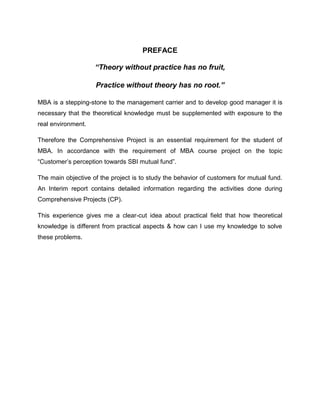
PREFACE

                    “Theory without practice has no fruit,

                    Practice without theory has no root.”

MBA is a stepping-stone to the management carrier and to develop good manager it is
necessary that the theoretical knowledge must be supplemented with exposure to the
real environment.

Therefore the Comprehensive Project is an essential requirement for the student of
MBA. In accordance with the requirement of MBA course project on the topic
“Customer‟s perception towards SBI mutual fund”.

The main objective of the project is to study the behavior of customers for mutual fund.
An Interim report contains detailed information regarding the activities done during
Comprehensive Projects (CP).

This experience gives me a clear-cut idea about practical field that how theoretical
knowledge is different from practical aspects & how can I use my knowledge to solve
these problems.
ACKNOWLEDGEMENT


Ships are safer in harbor but they are not meant for that purpose. This is a universal fact
and derives home the importance of practical training essential in each and every facet
of life. Project is also a part of practical where we can put concept into action.

Words are insufficient to express my gratitude towards Miss. Shweta Patel Madam and
Mr. Brahamachari Sir for their immense help and invaluable guidance in conduction of
this study from its conception to its completion.

And last but not the least I am thankful to my Parents, Family members and my dear
Friends for helping me in preparing the comprehensive project report for that they are
supporting me in all the ways with cheer face without showing the time.


                                                                             Shah Vishal
S
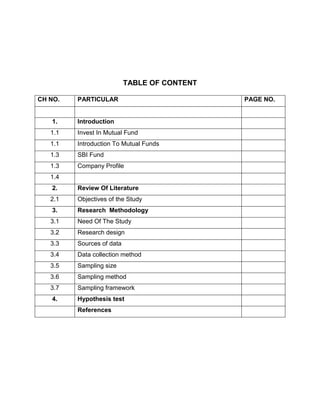
TABLE OF CONTENT

CH NO.   PARTICULAR                           PAGE NO.


   1.    Introduction
   1.1   Invest In Mutual Fund
   1.1   Introduction To Mutual Funds
   1.3   SBI Fund
   1.3   Company Profile
   1.4
   2.    Review Of Literature
   2.1   Objectives of the Study
   3.    Research Methodology
   3.1   Need Of The Study
   3.2   Research design
   3.3   Sources of data
   3.4   Data collection method
   3.5   Sampling size
   3.6   Sampling method
   3.7   Sampling framework
   4.    Hypothesis test
         References
Abstract


In my comprehensive project, I will study on Customer Perception towards SBI
Mutual Fund.

I have study on the SBI mutual fund is the most person use this fund. It is helps to
increase returns of person they have invested in mutual fund.

I have doing survey and know they what are the customer perception to invest in SBI
mutual fund is higher risk or a given the return is they expected.

I will study on primary & secondary data. I will fill up the questioner for customers who
invest in mutual fund. I select the city of Baroda to fill up the questioner.


      Write on your outcome of the project
      What u willing to like study.
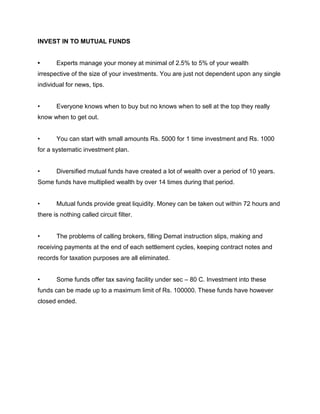
INVEST IN TO MUTUAL FUNDS


•      Experts manage your money at minimal of 2.5% to 5% of your wealth
irrespective of the size of your investments. You are just not dependent upon any single
individual for news, tips.


•      Everyone knows when to buy but no knows when to sell at the top they really
know when to get out.


•      You can start with small amounts Rs. 5000 for 1 time investment and Rs. 1000
for a systematic investment plan.


•      Diversified mutual funds have created a lot of wealth over a period of 10 years.
Some funds have multiplied wealth by over 14 times during that period.


•      Mutual funds provide great liquidity. Money can be taken out within 72 hours and
there is nothing called circuit filter.


•      The problems of calling brokers, filling Demat instruction slips, making and
receiving payments at the end of each settlement cycles, keeping contract notes and
records for taxation purposes are all eliminated.


•      Some funds offer tax saving facility under sec – 80 C. Investment into these
funds can be made up to a maximum limit of Rs. 100000. These funds have however
closed ended.
GROWTH OF MUTUAL FUNDS IN INDIA:


Some facts:-


•      100 % growth in the last 6 years
•      Number of foreign AMC‟s are in the queue to enter the Indian markets like
Fidelity investments, US based, with over US$1 trillion assets under management
worldwide.
•      Our saving rate is over 23 % highest in the world. Only channel zing these
savings in mutual funds sector is required.
•      We have approximately 29 mutual funds which is must less than US having more
than 800. There is a big scope for expansion.
•      „B‟ and „C‟ class cities are growing rapidly. Today most of the mutual funds are
concentrating on the „A‟ class cities. Soon they will find scope in the growing cities.
•      Mutual funds can penetrate rural like the Indian insurance industry with simple
and limited products.
•      SEBI allowing the MF‟s to launch commodity mutual funds.
•      Emphasis on better corporate governance.
•      Trying to curb the late trading practices.
•      Introduction of financial planners who can provide need based advice.
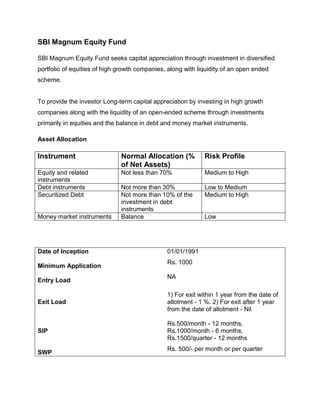
SBI Magnum Equity Fund

SBI Magnum Equity Fund seeks capital appreciation through investment in diversified
portfolio of equities of high growth companies, along with liquidity of an open ended
scheme.


To provide the investor Long-term capital appreciation by investing in high growth
companies along with the liquidity of an open-ended scheme through investments
primarily in equities and the balance in debt and money market instruments.

Asset Allocation

Instrument                    Normal Allocation (%           Risk Profile
                              of Net Assets)
Equity and related            Not less than 70%              Medium to High
instruments
Debt instruments              Not more than 30%              Low to Medium
Securitized Debt              Not more than 10% of the       Medium to High
                              investment in debt
                              instruments
Money market instruments      Balance                        Low


Date of Inception                              01/01/1991
                                               Rs. 1000
Minimum Application
                                               NA
Entry Load

                                               1) For exit within 1 year from the date of
Exit Load                                      allotment - 1 %. 2) For exit after 1 year
                                               from the date of allotment - Nil

                                               Rs.500/month - 12 months,
SIP                                            Rs.1000/month - 6 months,
                                               Rs.1500/quarter - 12 months
                                               Rs. 500/- per month or per quarter
SWP
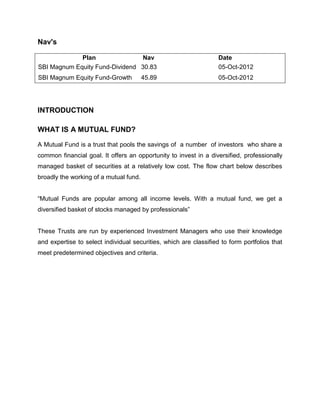
Nav's

             Plan                Nav                               Date
SBI Magnum Equity Fund-Dividend 30.83                              05-Oct-2012
SBI Magnum Equity Fund-Growth           45.89                      05-Oct-2012


INTRODUCTION

WHAT IS A MUTUAL FUND?

A Mutual Fund is a trust that pools the savings of a number of investors who share a
common financial goal. It offers an opportunity to invest in a diversified, professionally
managed basket of securities at a relatively low cost. The flow chart below describes
broadly the working of a mutual fund.


“Mutual Funds are popular among all income levels. With a mutual fund, we get a
diversified basket of stocks managed by professionals”


These Trusts are run by experienced Investment Managers who use their knowledge
and expertise to select individual securities, which are classified to form portfolios that
meet predetermined objectives and criteria.
ADVANTAGES OF MUTUAL FUNDS

       Portfolio Diversification:

Mutual Funds normally, invest in a well-diversified portfolio or securities. MF enables
investors to hold a diversified investment portfolio even with a small amount of
investment.

       Reduction of Risk:

Investors in a mutual fund acquire a diversified portfolio, no matter how small his
investment. Diversification reduces the risk of loss, as compared to investing directly in
one or two shares, debentures, or others instruments. When investors invest directly, all
the risk of potential loss is his own. A fund investor also reduces his risk in another
way.

        Reduction transaction cost:

What is true of risk is also true of the transaction cost a direct investors bears all the
cost of investing such as brokerage or custody of securities when going through a fund
he has the benefit of economies of scale the funs pay lesser cost because of larger
volumes, a benefit passed on to its investors.

       Liquidity:

Often Investors hold shares or bonds they cannot directly easily and quickly sell.
Investment in a mutual fund on the other hand is more liquid investors can liquidate the
investment by selling the unit to the fund.

        Convince & Flexibility :

Mutual Fund management companies offered many investors services that a direct
market investor cannot get. Investors can easily transfer their holdings from one
scheme to the other and can get up date market information.
DISADVANTAGE OF MUTUAL FUNDS

        No Control Over Cost:

An investor in a mutual fund has no control over the overall cost of investing. His
investment management fees as long as he remains with the funds, albeit in returns for
the professional management and research.           A mutual fund investor also pays
distribution cost which he would not incur in the direct investing. However this
shortcoming only means that there is a cost obtains the benefits of mutual services.

        No tailor made portfolio:

Investors who invest their own can build their own portfolios of shares, bonds and other
securities. Investing through funds means he delegates this decision to the fund
manager.

The very high net worth individuals or large corporate investors may find this to be a
constraint in achieving their objectives however most mutual funds help investors to
overcome this constraint by offering miles of schemes- a large number of different
schemes within the same fund an investor can choose from different investment plans
and construct a portfolio of his choice.

        Managing a Portfolio of funds:

Availability of large number of funds can actually mean too much choice for the
investors

He may again need advice on how to select a fund to achieve his objective quite similar
to the situation when he has to select individual shares or bonds to invest in.
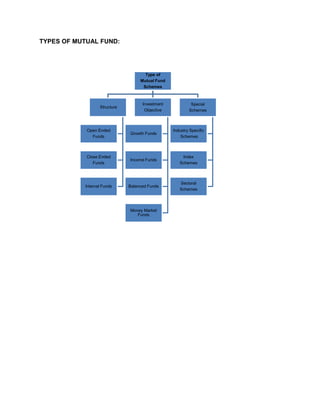
TYPES OF MUTUAL FUND:


                                     Type of
                                   Mutual Fund
                                    Schemes


                                    Investment            Special
                  Structure
                                     Objective           Schemes


            Open Ended                           Industry Specific
                              Growth Funds
              Funds                                  Schemes


            Close Ended                              Index
                              Income Funds
               Funds                                Schemes


                                                    Sectoral
           Interval Funds     Balanced Funds
                                                    Schemes


                              Money Market
                                 Funds
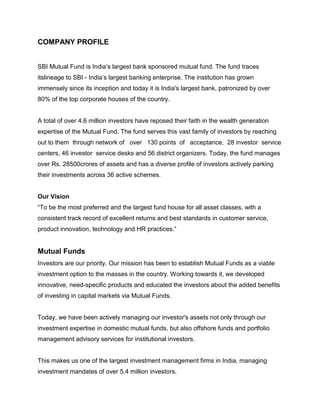
COMPANY PROFILE


SBI Mutual Fund is India‟s largest bank sponsored mutual fund. The fund traces
itslineage to SBI - India‟s largest banking enterprise. The institution has grown
immensely since its inception and today it is India's largest bank, patronized by over
80% of the top corporate houses of the country.


A total of over 4.6 million investors have reposed their faith in the wealth generation
expertise of the Mutual Fund. The fund serves this vast family of investors by reaching
out to them through network of over 130 points of acceptance, 28 investor service
centers, 46 investor service desks and 56 district organizers. Today, the fund manages
over Rs. 28500crores of assets and has a diverse profile of investors actively parking
their investments across 36 active schemes.


Our Vision
“To be the most preferred and the largest fund house for all asset classes, with a
consistent track record of excellent returns and best standards in customer service,
product innovation, technology and HR practices.”


Mutual Funds
Investors are our priority. Our mission has been to establish Mutual Funds as a viable
investment option to the masses in the country. Working towards it, we developed
innovative, need-specific products and educated the investors about the added benefits
of investing in capital markets via Mutual Funds.


Today, we have been actively managing our investor's assets not only through our
investment expertise in domestic mutual funds, but also offshore funds and portfolio
management advisory services for institutional investors.


This makes us one of the largest investment management firms in India, managing
investment mandates of over 5.4 million investors.
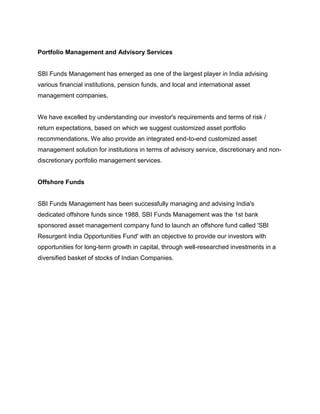
Portfolio Management and Advisory Services


SBI Funds Management has emerged as one of the largest player in India advising
various financial institutions, pension funds, and local and international asset
management companies.


We have excelled by understanding our investor's requirements and terms of risk /
return expectations, based on which we suggest customized asset portfolio
recommendations. We also provide an integrated end-to-end customized asset
management solution for institutions in terms of advisory service, discretionary and non-
discretionary portfolio management services.


Offshore Funds


SBI Funds Management has been successfully managing and advising India's
dedicated offshore funds since 1988. SBI Funds Management was the 1st bank
sponsored asset management company fund to launch an offshore fund called 'SBI
Resurgent India Opportunities Fund' with an objective to provide our investors with
opportunities for long-term growth in capital, through well-researched investments in a
diversified basket of stocks of Indian Companies.
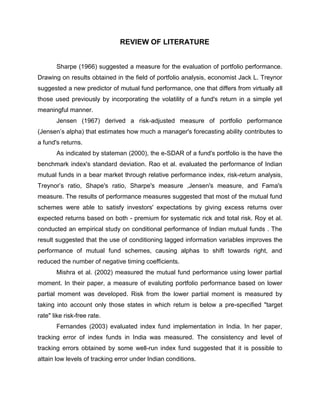
REVIEW OF LITERATURE


       Sharpe (1966) suggested a measure for the evaluation of portfolio performance.
Drawing on results obtained in the field of portfolio analysis, economist Jack L. Treynor
suggested a new predictor of mutual fund performance, one that differs from virtually all
those used previously by incorporating the volatility of a fund's return in a simple yet
meaningful manner.
       Jensen (1967) derived a risk-adjusted measure of portfolio performance
(Jensen‟s alpha) that estimates how much a manager's forecasting ability contributes to
a fund's returns.
       As indicated by stateman (2000), the e-SDAR of a fund's portfolio is the have the
benchmark index's standard deviation. Rao et al. evaluated the performance of Indian
mutual funds in a bear market through relative performance index, risk-return analysis,
Treynor‟s ratio, Shape's ratio, Sharpe's measure ,Jensen's measure, and Fama's
measure. The results of performance measures suggested that most of the mutual fund
schemes were able to satisfy investors' expectations by giving excess returns over
expected returns based on both - premium for systematic rick and total risk. Roy et al.
conducted an empirical study on conditional performance of Indian mutual funds . The
result suggested that the use of conditioning lagged information variables improves the
performance of mutual fund schemes, causing alphas to shift towards right, and
reduced the number of negative timing coefficients.
       Mishra et al. (2002) measured the mutual fund performance using lower partial
moment. In their paper, a measure of evaluting portfolio performance based on lower
partial moment was developed. Risk from the lower partial moment is measured by
taking into account only those states in which return is below a pre-specified "target
rate" like risk-free rate.
       Fernandes (2003) evaluated index fund implementation in India. In her paper,
tracking error of index funds in India was measured. The consistency and level of
tracking errors obtained by some well-run index fund suggested that it is possible to
attain low levels of tracking error under Indian conditions.
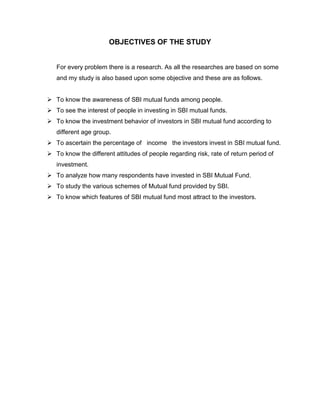
OBJECTIVES OF THE STUDY


   For every problem there is a research. As all the researches are based on some
   and my study is also based upon some objective and these are as follows.


 To know the awareness of SBI mutual funds among people.
 To see the interest of people in investing in SBI mutual funds.
 To know the investment behavior of investors in SBI mutual fund according to
   different age group.
 To ascertain the percentage of income the investors invest in SBI mutual fund.
 To know the different attitudes of people regarding risk, rate of return period of
   investment.
 To analyze how many respondents have invested in SBI Mutual Fund.
 To study the various schemes of Mutual fund provided by SBI.
 To know which features of SBI mutual fund most attract to the investors.
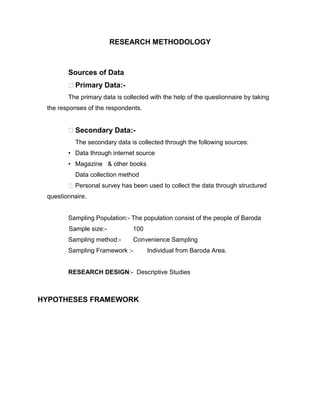
RESEARCH METHODOLOGY


        Sources of Data
        Primary Data:-
        The primary data is collected with the help of the questionnaire by taking
 the responses of the respondents.


        Secondary Data:-
           The secondary data is collected through the following sources:
        • Data through internet source
        • Magazine & other books
           Data collection method
         Personal survey has been used to collect the data through structured
 questionnaire.


        Sampling Population:- The population consist of the people of Baroda
        Sample size:-          100
        Sampling method:-       Convenience Sampling
        Sampling Framework :-        Individual from Baroda Area.


        RESEARCH DESIGN:- Descriptive Studies


HYPOTHESES FRAMEWORK
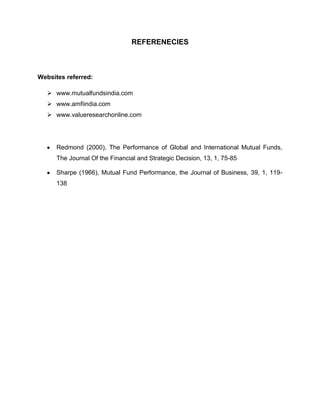
REFERENECIES


Websites referred:

    www.mutualfundsindia.com
    www.amfiindia.com
    www.valueresearchonline.com


      Redmond (2000), The Performance of Global and International Mutual Funds,
      The Journal Of the Financial and Strategic Decision, 13, 1, 75-85

      Sharpe (1966), Mutual Fund Performance, the Journal of Business, 39, 1, 119-
      138

117330592034 sbi

  • 1.
    A COMPREHENSIVE PROJECT REPORT ON “CUSTOMER PERCEPTION TOWARDS SBI MUTUAL FUND” Submitted to: SHWETA PATEL Late Smt. Shardaben Ghanshyambhai Patel Institute of Management IN PARTIAL FULFILLMENT OF THE REQUIREMENT OF THE AWARD FOR THE DEGREE OF MASTER OF BUSINESS ASMINISTRATION In Gujarat Technological University UNDER THE GUIDANCE OF Faculty Guide: SHWETA PATEL Submitted by VISHAL S. SHAH [Batch : 2011-13, Enrollment No.:117330592034] MBA SEMESTER III/IV Late Smt. Shardaben Ghanshyambhai Patel Institute of Management MBA PROGRAMME Affiliated to Gujarat Technological University Ahmedabad Month, Year
  • 2.
    PREFACE “Theory without practice has no fruit, Practice without theory has no root.” MBA is a stepping-stone to the management carrier and to develop good manager it is necessary that the theoretical knowledge must be supplemented with exposure to the real environment. Therefore the Comprehensive Project is an essential requirement for the student of MBA. In accordance with the requirement of MBA course project on the topic “Customer‟s perception towards SBI mutual fund”. The main objective of the project is to study the behavior of customers for mutual fund. An Interim report contains detailed information regarding the activities done during Comprehensive Projects (CP). This experience gives me a clear-cut idea about practical field that how theoretical knowledge is different from practical aspects & how can I use my knowledge to solve these problems.
  • 3.
    ACKNOWLEDGEMENT Ships are saferin harbor but they are not meant for that purpose. This is a universal fact and derives home the importance of practical training essential in each and every facet of life. Project is also a part of practical where we can put concept into action. Words are insufficient to express my gratitude towards Miss. Shweta Patel Madam and Mr. Brahamachari Sir for their immense help and invaluable guidance in conduction of this study from its conception to its completion. And last but not the least I am thankful to my Parents, Family members and my dear Friends for helping me in preparing the comprehensive project report for that they are supporting me in all the ways with cheer face without showing the time. Shah Vishal S
  • 4.
    TABLE OF CONTENT CHNO. PARTICULAR PAGE NO. 1. Introduction 1.1 Invest In Mutual Fund 1.1 Introduction To Mutual Funds 1.3 SBI Fund 1.3 Company Profile 1.4 2. Review Of Literature 2.1 Objectives of the Study 3. Research Methodology 3.1 Need Of The Study 3.2 Research design 3.3 Sources of data 3.4 Data collection method 3.5 Sampling size 3.6 Sampling method 3.7 Sampling framework 4. Hypothesis test References
  • 5.
    Abstract In my comprehensiveproject, I will study on Customer Perception towards SBI Mutual Fund. I have study on the SBI mutual fund is the most person use this fund. It is helps to increase returns of person they have invested in mutual fund. I have doing survey and know they what are the customer perception to invest in SBI mutual fund is higher risk or a given the return is they expected. I will study on primary & secondary data. I will fill up the questioner for customers who invest in mutual fund. I select the city of Baroda to fill up the questioner. Write on your outcome of the project What u willing to like study.
  • 6.
    INVEST IN TOMUTUAL FUNDS • Experts manage your money at minimal of 2.5% to 5% of your wealth irrespective of the size of your investments. You are just not dependent upon any single individual for news, tips. • Everyone knows when to buy but no knows when to sell at the top they really know when to get out. • You can start with small amounts Rs. 5000 for 1 time investment and Rs. 1000 for a systematic investment plan. • Diversified mutual funds have created a lot of wealth over a period of 10 years. Some funds have multiplied wealth by over 14 times during that period. • Mutual funds provide great liquidity. Money can be taken out within 72 hours and there is nothing called circuit filter. • The problems of calling brokers, filling Demat instruction slips, making and receiving payments at the end of each settlement cycles, keeping contract notes and records for taxation purposes are all eliminated. • Some funds offer tax saving facility under sec – 80 C. Investment into these funds can be made up to a maximum limit of Rs. 100000. These funds have however closed ended.
  • 7.
    GROWTH OF MUTUALFUNDS IN INDIA: Some facts:- • 100 % growth in the last 6 years • Number of foreign AMC‟s are in the queue to enter the Indian markets like Fidelity investments, US based, with over US$1 trillion assets under management worldwide. • Our saving rate is over 23 % highest in the world. Only channel zing these savings in mutual funds sector is required. • We have approximately 29 mutual funds which is must less than US having more than 800. There is a big scope for expansion. • „B‟ and „C‟ class cities are growing rapidly. Today most of the mutual funds are concentrating on the „A‟ class cities. Soon they will find scope in the growing cities. • Mutual funds can penetrate rural like the Indian insurance industry with simple and limited products. • SEBI allowing the MF‟s to launch commodity mutual funds. • Emphasis on better corporate governance. • Trying to curb the late trading practices. • Introduction of financial planners who can provide need based advice.
  • 8.
    SBI Magnum EquityFund SBI Magnum Equity Fund seeks capital appreciation through investment in diversified portfolio of equities of high growth companies, along with liquidity of an open ended scheme. To provide the investor Long-term capital appreciation by investing in high growth companies along with the liquidity of an open-ended scheme through investments primarily in equities and the balance in debt and money market instruments. Asset Allocation Instrument Normal Allocation (% Risk Profile of Net Assets) Equity and related Not less than 70% Medium to High instruments Debt instruments Not more than 30% Low to Medium Securitized Debt Not more than 10% of the Medium to High investment in debt instruments Money market instruments Balance Low Date of Inception 01/01/1991 Rs. 1000 Minimum Application NA Entry Load 1) For exit within 1 year from the date of Exit Load allotment - 1 %. 2) For exit after 1 year from the date of allotment - Nil Rs.500/month - 12 months, SIP Rs.1000/month - 6 months, Rs.1500/quarter - 12 months Rs. 500/- per month or per quarter SWP
  • 9.
    Nav's Plan Nav Date SBI Magnum Equity Fund-Dividend 30.83 05-Oct-2012 SBI Magnum Equity Fund-Growth 45.89 05-Oct-2012 INTRODUCTION WHAT IS A MUTUAL FUND? A Mutual Fund is a trust that pools the savings of a number of investors who share a common financial goal. It offers an opportunity to invest in a diversified, professionally managed basket of securities at a relatively low cost. The flow chart below describes broadly the working of a mutual fund. “Mutual Funds are popular among all income levels. With a mutual fund, we get a diversified basket of stocks managed by professionals” These Trusts are run by experienced Investment Managers who use their knowledge and expertise to select individual securities, which are classified to form portfolios that meet predetermined objectives and criteria.
  • 10.
    ADVANTAGES OF MUTUALFUNDS Portfolio Diversification: Mutual Funds normally, invest in a well-diversified portfolio or securities. MF enables investors to hold a diversified investment portfolio even with a small amount of investment. Reduction of Risk: Investors in a mutual fund acquire a diversified portfolio, no matter how small his investment. Diversification reduces the risk of loss, as compared to investing directly in one or two shares, debentures, or others instruments. When investors invest directly, all the risk of potential loss is his own. A fund investor also reduces his risk in another way. Reduction transaction cost: What is true of risk is also true of the transaction cost a direct investors bears all the cost of investing such as brokerage or custody of securities when going through a fund he has the benefit of economies of scale the funs pay lesser cost because of larger volumes, a benefit passed on to its investors. Liquidity: Often Investors hold shares or bonds they cannot directly easily and quickly sell. Investment in a mutual fund on the other hand is more liquid investors can liquidate the investment by selling the unit to the fund. Convince & Flexibility : Mutual Fund management companies offered many investors services that a direct market investor cannot get. Investors can easily transfer their holdings from one scheme to the other and can get up date market information.
  • 11.
    DISADVANTAGE OF MUTUALFUNDS No Control Over Cost: An investor in a mutual fund has no control over the overall cost of investing. His investment management fees as long as he remains with the funds, albeit in returns for the professional management and research. A mutual fund investor also pays distribution cost which he would not incur in the direct investing. However this shortcoming only means that there is a cost obtains the benefits of mutual services. No tailor made portfolio: Investors who invest their own can build their own portfolios of shares, bonds and other securities. Investing through funds means he delegates this decision to the fund manager. The very high net worth individuals or large corporate investors may find this to be a constraint in achieving their objectives however most mutual funds help investors to overcome this constraint by offering miles of schemes- a large number of different schemes within the same fund an investor can choose from different investment plans and construct a portfolio of his choice. Managing a Portfolio of funds: Availability of large number of funds can actually mean too much choice for the investors He may again need advice on how to select a fund to achieve his objective quite similar to the situation when he has to select individual shares or bonds to invest in.
  • 12.
    TYPES OF MUTUALFUND: Type of Mutual Fund Schemes Investment Special Structure Objective Schemes Open Ended Industry Specific Growth Funds Funds Schemes Close Ended Index Income Funds Funds Schemes Sectoral Interval Funds Balanced Funds Schemes Money Market Funds
  • 13.
    COMPANY PROFILE SBI MutualFund is India‟s largest bank sponsored mutual fund. The fund traces itslineage to SBI - India‟s largest banking enterprise. The institution has grown immensely since its inception and today it is India's largest bank, patronized by over 80% of the top corporate houses of the country. A total of over 4.6 million investors have reposed their faith in the wealth generation expertise of the Mutual Fund. The fund serves this vast family of investors by reaching out to them through network of over 130 points of acceptance, 28 investor service centers, 46 investor service desks and 56 district organizers. Today, the fund manages over Rs. 28500crores of assets and has a diverse profile of investors actively parking their investments across 36 active schemes. Our Vision “To be the most preferred and the largest fund house for all asset classes, with a consistent track record of excellent returns and best standards in customer service, product innovation, technology and HR practices.” Mutual Funds Investors are our priority. Our mission has been to establish Mutual Funds as a viable investment option to the masses in the country. Working towards it, we developed innovative, need-specific products and educated the investors about the added benefits of investing in capital markets via Mutual Funds. Today, we have been actively managing our investor's assets not only through our investment expertise in domestic mutual funds, but also offshore funds and portfolio management advisory services for institutional investors. This makes us one of the largest investment management firms in India, managing investment mandates of over 5.4 million investors.
  • 14.
    Portfolio Management andAdvisory Services SBI Funds Management has emerged as one of the largest player in India advising various financial institutions, pension funds, and local and international asset management companies. We have excelled by understanding our investor's requirements and terms of risk / return expectations, based on which we suggest customized asset portfolio recommendations. We also provide an integrated end-to-end customized asset management solution for institutions in terms of advisory service, discretionary and non- discretionary portfolio management services. Offshore Funds SBI Funds Management has been successfully managing and advising India's dedicated offshore funds since 1988. SBI Funds Management was the 1st bank sponsored asset management company fund to launch an offshore fund called 'SBI Resurgent India Opportunities Fund' with an objective to provide our investors with opportunities for long-term growth in capital, through well-researched investments in a diversified basket of stocks of Indian Companies.
  • 15.
    REVIEW OF LITERATURE Sharpe (1966) suggested a measure for the evaluation of portfolio performance. Drawing on results obtained in the field of portfolio analysis, economist Jack L. Treynor suggested a new predictor of mutual fund performance, one that differs from virtually all those used previously by incorporating the volatility of a fund's return in a simple yet meaningful manner. Jensen (1967) derived a risk-adjusted measure of portfolio performance (Jensen‟s alpha) that estimates how much a manager's forecasting ability contributes to a fund's returns. As indicated by stateman (2000), the e-SDAR of a fund's portfolio is the have the benchmark index's standard deviation. Rao et al. evaluated the performance of Indian mutual funds in a bear market through relative performance index, risk-return analysis, Treynor‟s ratio, Shape's ratio, Sharpe's measure ,Jensen's measure, and Fama's measure. The results of performance measures suggested that most of the mutual fund schemes were able to satisfy investors' expectations by giving excess returns over expected returns based on both - premium for systematic rick and total risk. Roy et al. conducted an empirical study on conditional performance of Indian mutual funds . The result suggested that the use of conditioning lagged information variables improves the performance of mutual fund schemes, causing alphas to shift towards right, and reduced the number of negative timing coefficients. Mishra et al. (2002) measured the mutual fund performance using lower partial moment. In their paper, a measure of evaluting portfolio performance based on lower partial moment was developed. Risk from the lower partial moment is measured by taking into account only those states in which return is below a pre-specified "target rate" like risk-free rate. Fernandes (2003) evaluated index fund implementation in India. In her paper, tracking error of index funds in India was measured. The consistency and level of tracking errors obtained by some well-run index fund suggested that it is possible to attain low levels of tracking error under Indian conditions.
  • 16.
    OBJECTIVES OF THESTUDY For every problem there is a research. As all the researches are based on some and my study is also based upon some objective and these are as follows.  To know the awareness of SBI mutual funds among people.  To see the interest of people in investing in SBI mutual funds.  To know the investment behavior of investors in SBI mutual fund according to different age group.  To ascertain the percentage of income the investors invest in SBI mutual fund.  To know the different attitudes of people regarding risk, rate of return period of investment.  To analyze how many respondents have invested in SBI Mutual Fund.  To study the various schemes of Mutual fund provided by SBI.  To know which features of SBI mutual fund most attract to the investors.
  • 17.
    RESEARCH METHODOLOGY Sources of Data Primary Data:- The primary data is collected with the help of the questionnaire by taking the responses of the respondents. Secondary Data:- The secondary data is collected through the following sources: • Data through internet source • Magazine & other books Data collection method  Personal survey has been used to collect the data through structured questionnaire. Sampling Population:- The population consist of the people of Baroda Sample size:- 100 Sampling method:- Convenience Sampling Sampling Framework :- Individual from Baroda Area. RESEARCH DESIGN:- Descriptive Studies HYPOTHESES FRAMEWORK
  • 18.
    REFERENECIES Websites referred:  www.mutualfundsindia.com  www.amfiindia.com  www.valueresearchonline.com Redmond (2000), The Performance of Global and International Mutual Funds, The Journal Of the Financial and Strategic Decision, 13, 1, 75-85 Sharpe (1966), Mutual Fund Performance, the Journal of Business, 39, 1, 119- 138