Creating music is a universal
human trait that traces further
back than 35,000 years ago. The
Prehistoric Era is the first known
musical influence to humans. So,
sure you might think you know all
about music nowadays. But, do
you really know how it all started
Creating music is a universal
human trait that traces further
back than 35,000 years ago. The
Prehistoric Era is the first known
musical influence to humans. So,
sure you might think you know all
about music nowadays. But, do
you really know how it all started
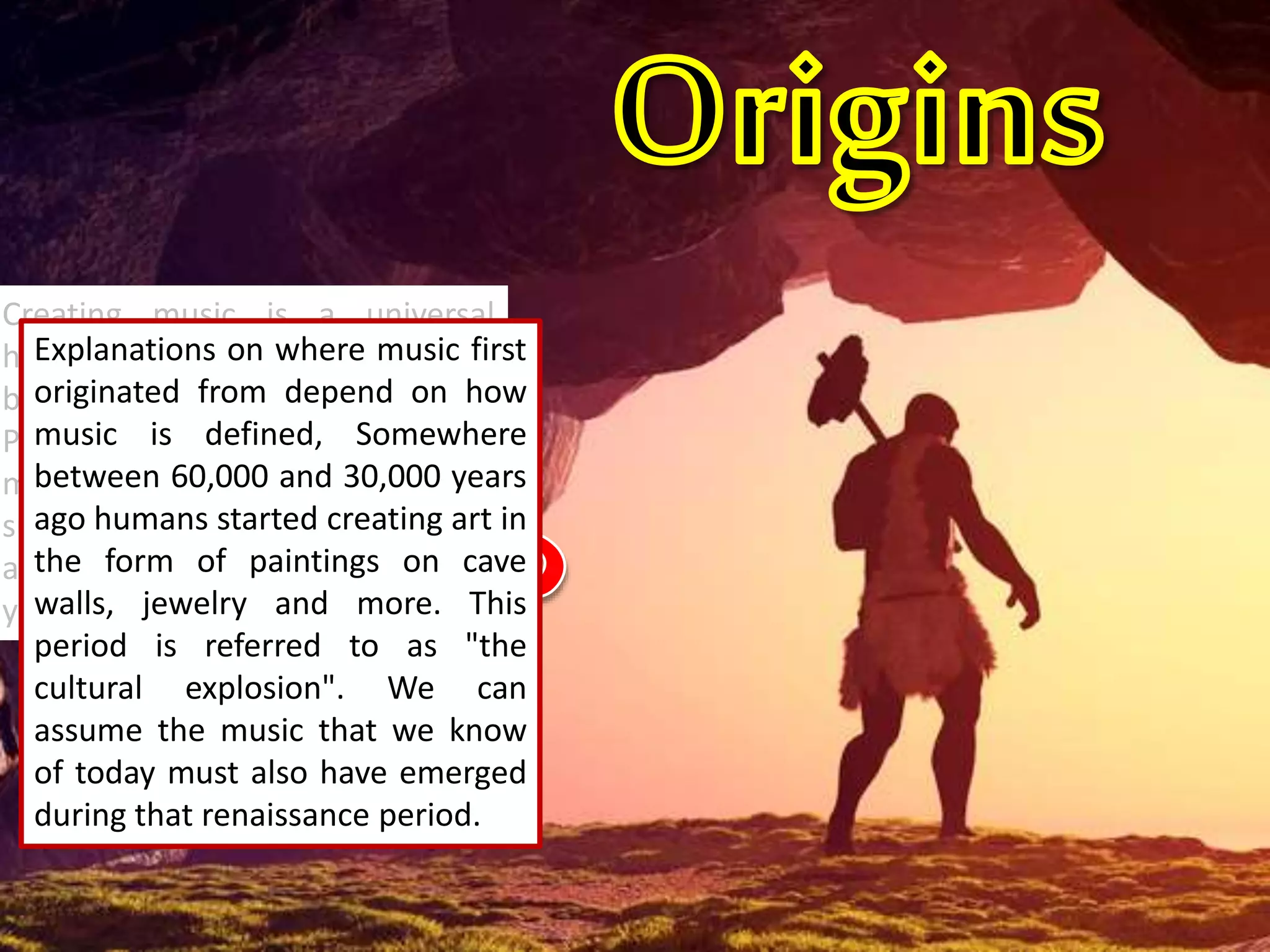
Explanations on where music first
originated from depend on how
music is defined, Somewhere
between 60,000 and 30,000 years
ago humans started creating art in
the form of paintings on cave
walls, jewelry and more. This
period is referred to as "the
cultural explosion". We can
assume the music that we know
of today must also have emerged
during that renaissance period.
Creating music is a universal
human trait that traces further
back than 35,000 years ago. The
Prehistoric Era is the first known
musical influence to humans. So,
sure you might think you know all
about music nowadays. But, do
you really know how it all started
Explanations on where music first
originated from depend on how
music is defined, Somewhere
between 60,000 and 30,000 years
ago humans started creating art in
the form of paintings on cave
walls, jewelry and more. This
period is referred to as "the
cultural explosion". We can
assume the music that we know
of today must also have emerged
during that renaissance period.
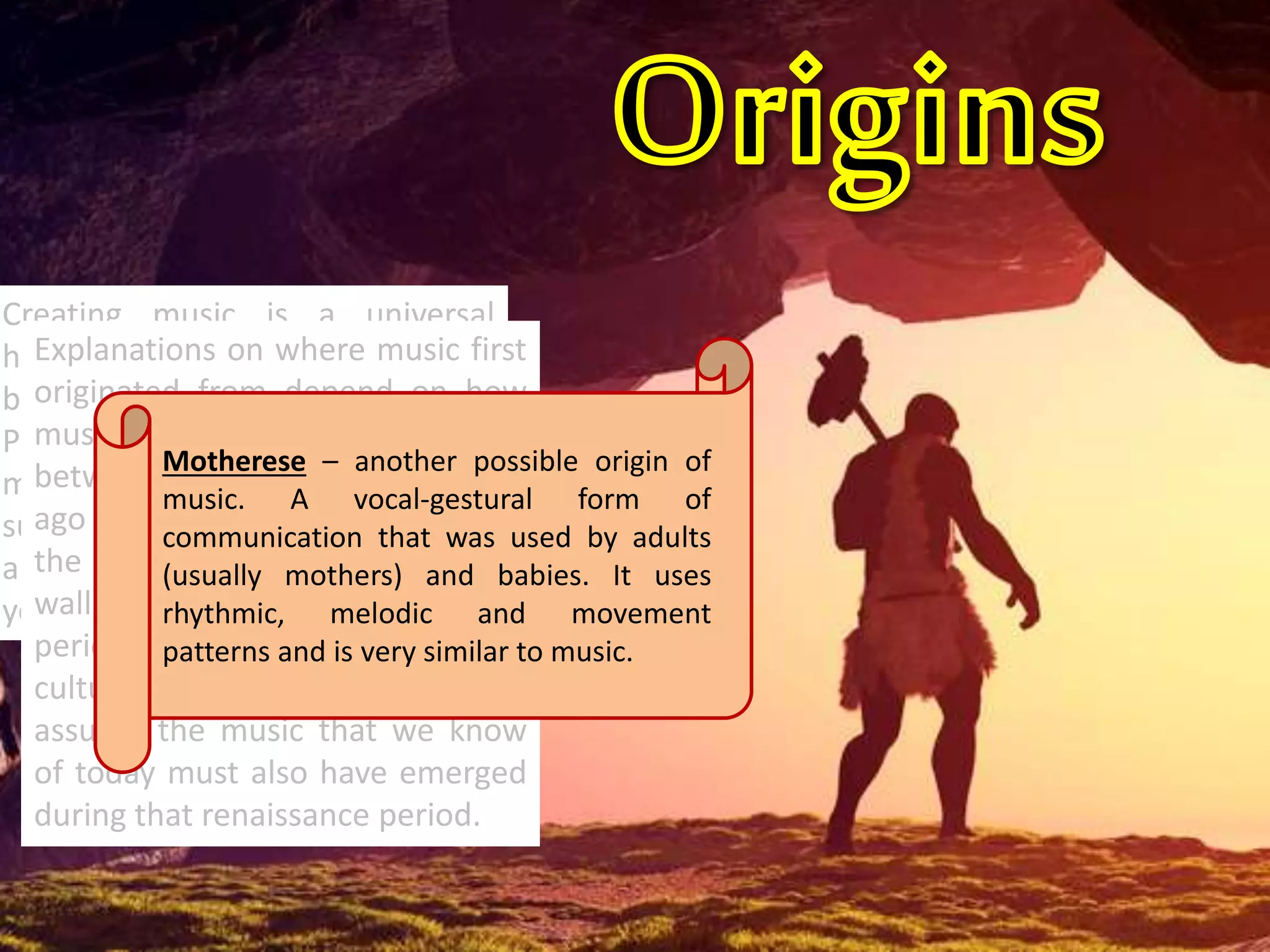
Motherese – another possible origin of
music. A vocal-gestural form of
communication that was used by adults
(usually mothers) and babies. It uses
rhythmic, melodic and movement
patterns and is very similar to music.
Fragment of a Paleolithic flute
Divje Babe flute - Believed to be the oldest
known flute that was discovered in the Divje
Babe cave (Slovania) in 1995. In general,
these instruments were made of hollowed
bone, incised with stone tools to form air
holes that changed the pitch.
Fragment of a Paleolithic flute
For a while, archeologists thought that
ancient humans were too primitive to create
sophisticated music, but then these flutes
started showing up in more archeological
sites. One in Germany was found to be
36,000 years old, helping to prove that
ancient humans were as intellectually astute
as modern humans. After all, the task of
creating, tuning, and systematically using
instruments requires a high degree of
mental acumen. Since then, other flutes
have been found dating as far back as
45,000 BCE in Germany, France, Turkey, and
India.
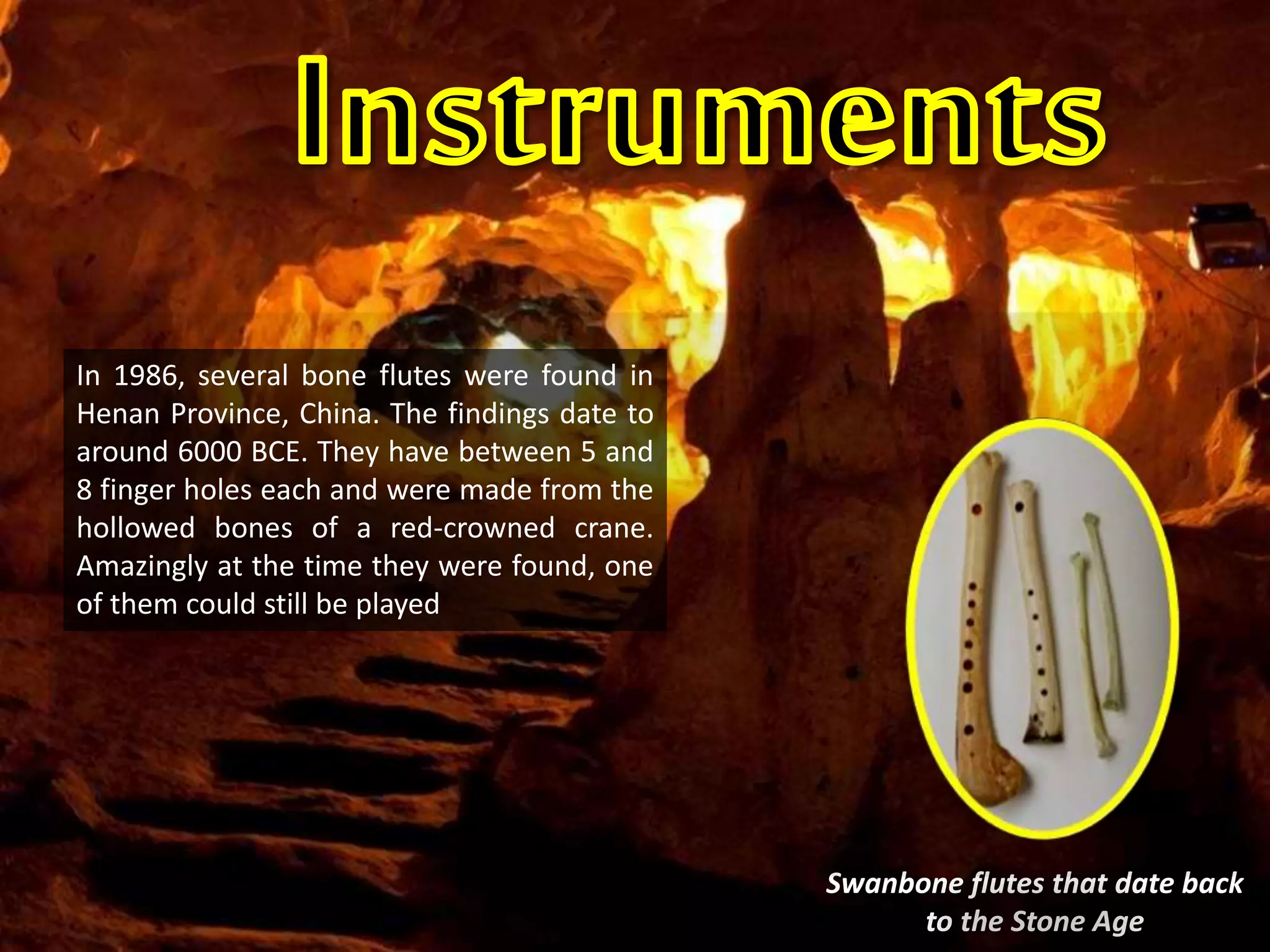
Swanbone flutes that date back
to the Stone Age
In 1986, several bone flutes were found in
Henan Province, China. The findings date to
around 6000 BCE. They have between 5 and
8 finger holes each and were made from the
hollowed bones of a red-crowned crane.
Amazingly at the time they were found, one
of them could still be played
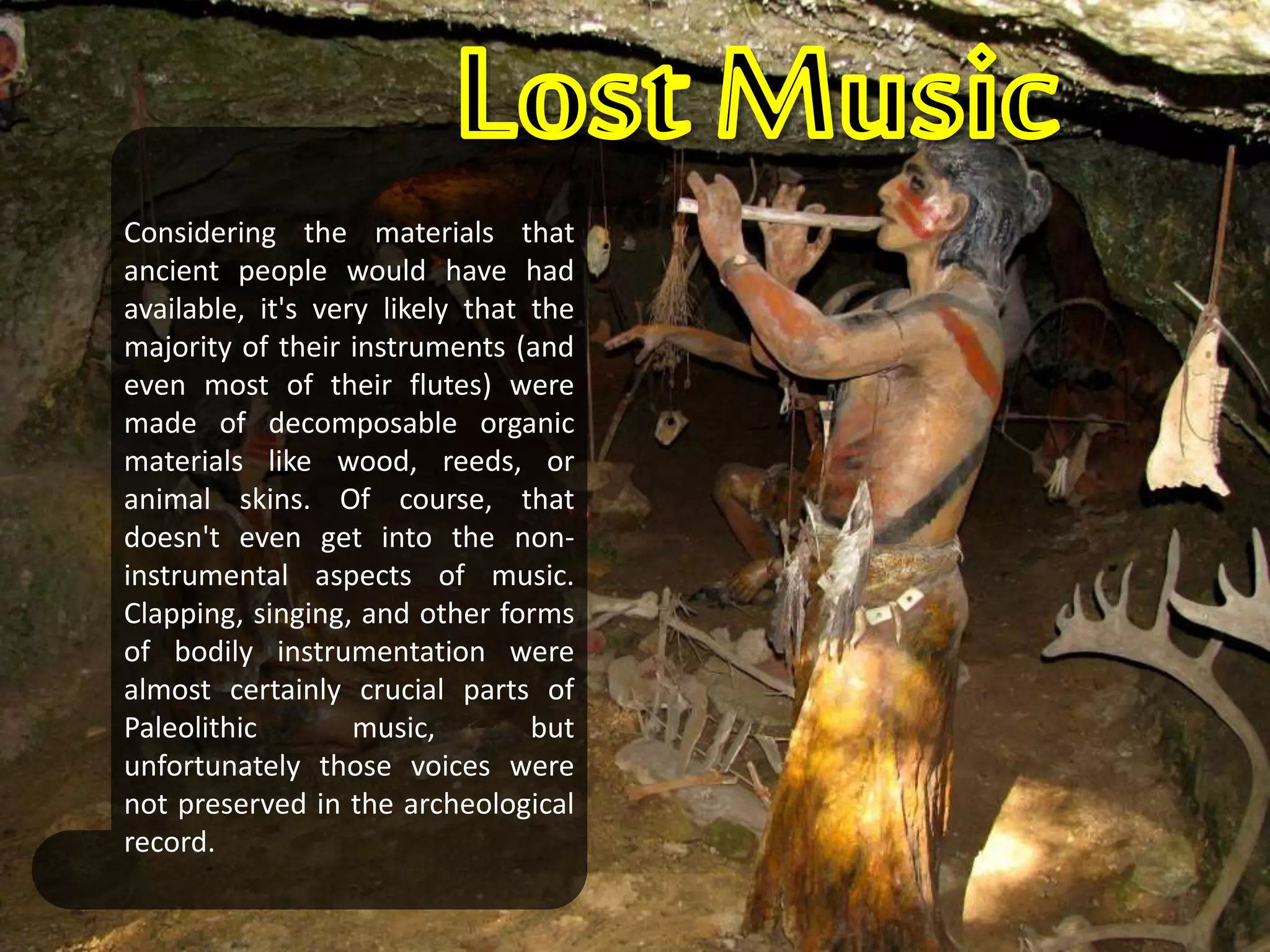
Considering the materials that
ancient people would have had
available, it's very likely that the
majority of their instruments (and
even most of their flutes) were
made of decomposable organic
materials like wood, reeds, or
animal skins. Of course, that
doesn't even get into the non-
instrumental aspects of music.
Clapping, singing, and other forms
of bodily instrumentation were
almost certainly crucial parts of
Paleolithic music, but
unfortunately those voices were
not preserved in the archeological
record.
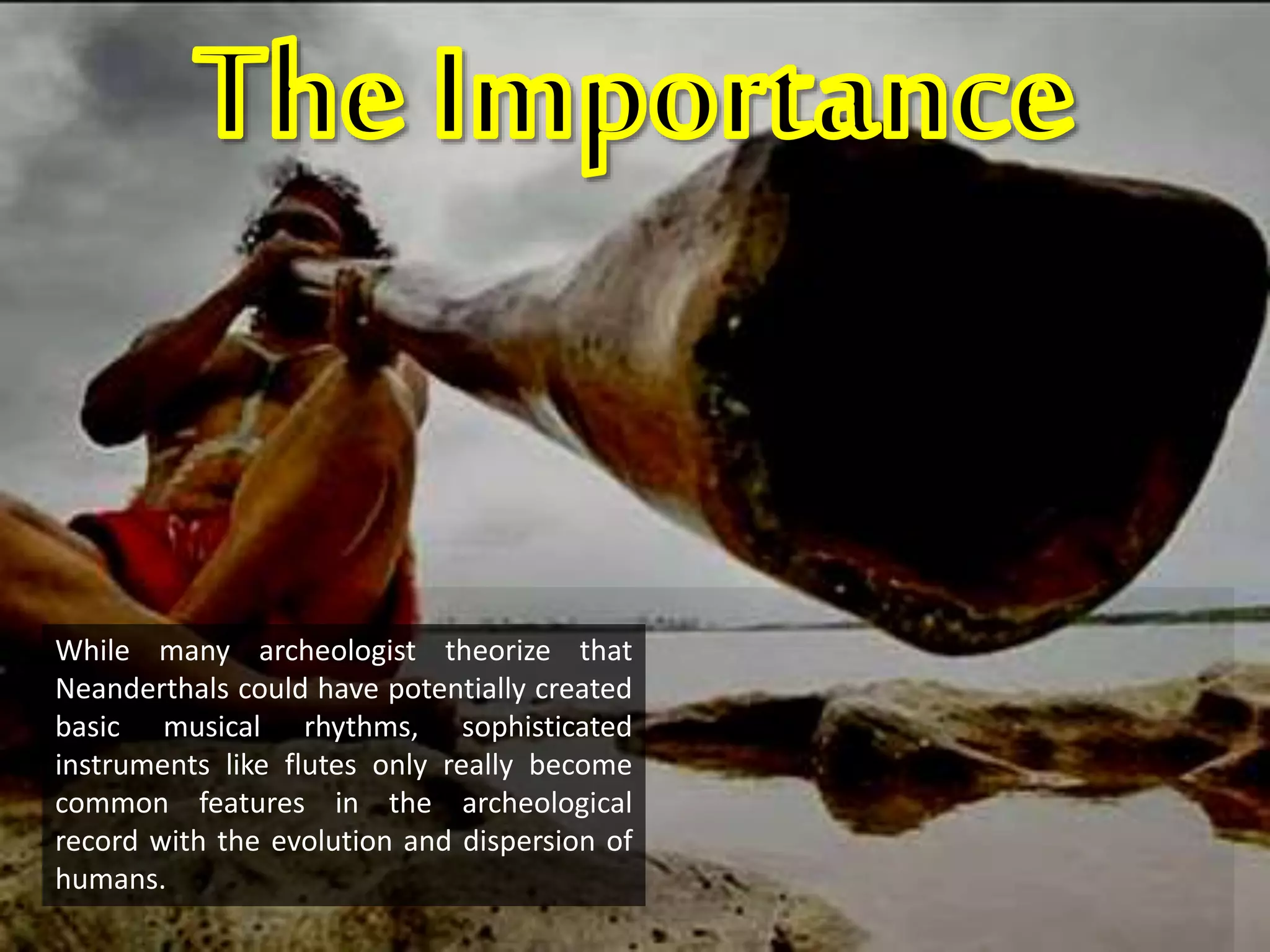
While many archeologist theorize that
Neanderthals could have potentially created
basic musical rhythms, sophisticated
instruments like flutes only really become
common features in the archeological
record with the evolution and dispersion of
humans.
Music during stone age

Music during stone age

  • 2.
    Creating music isa universal human trait that traces further back than 35,000 years ago. The Prehistoric Era is the first known musical influence to humans. So, sure you might think you know all about music nowadays. But, do you really know how it all started
  • 3.
    Creating music isa universal human trait that traces further back than 35,000 years ago. The Prehistoric Era is the first known musical influence to humans. So, sure you might think you know all about music nowadays. But, do you really know how it all started Explanations on where music first originated from depend on how music is defined, Somewhere between 60,000 and 30,000 years ago humans started creating art in the form of paintings on cave walls, jewelry and more. This period is referred to as "the cultural explosion". We can assume the music that we know of today must also have emerged during that renaissance period.
  • 4.
    Creating music isa universal human trait that traces further back than 35,000 years ago. The Prehistoric Era is the first known musical influence to humans. So, sure you might think you know all about music nowadays. But, do you really know how it all started Explanations on where music first originated from depend on how music is defined, Somewhere between 60,000 and 30,000 years ago humans started creating art in the form of paintings on cave walls, jewelry and more. This period is referred to as "the cultural explosion". We can assume the music that we know of today must also have emerged during that renaissance period. Motherese – another possible origin of music. A vocal-gestural form of communication that was used by adults (usually mothers) and babies. It uses rhythmic, melodic and movement patterns and is very similar to music.
  • 5.
    Fragment of aPaleolithic flute Divje Babe flute - Believed to be the oldest known flute that was discovered in the Divje Babe cave (Slovania) in 1995. In general, these instruments were made of hollowed bone, incised with stone tools to form air holes that changed the pitch.
  • 6.
    Fragment of aPaleolithic flute For a while, archeologists thought that ancient humans were too primitive to create sophisticated music, but then these flutes started showing up in more archeological sites. One in Germany was found to be 36,000 years old, helping to prove that ancient humans were as intellectually astute as modern humans. After all, the task of creating, tuning, and systematically using instruments requires a high degree of mental acumen. Since then, other flutes have been found dating as far back as 45,000 BCE in Germany, France, Turkey, and India.
  • 7.
    Swanbone flutes thatdate back to the Stone Age In 1986, several bone flutes were found in Henan Province, China. The findings date to around 6000 BCE. They have between 5 and 8 finger holes each and were made from the hollowed bones of a red-crowned crane. Amazingly at the time they were found, one of them could still be played
  • 8.
    Considering the materialsthat ancient people would have had available, it's very likely that the majority of their instruments (and even most of their flutes) were made of decomposable organic materials like wood, reeds, or animal skins. Of course, that doesn't even get into the non- instrumental aspects of music. Clapping, singing, and other forms of bodily instrumentation were almost certainly crucial parts of Paleolithic music, but unfortunately those voices were not preserved in the archeological record.
  • 9.
    While many archeologisttheorize that Neanderthals could have potentially created basic musical rhythms, sophisticated instruments like flutes only really become common features in the archeological record with the evolution and dispersion of humans.