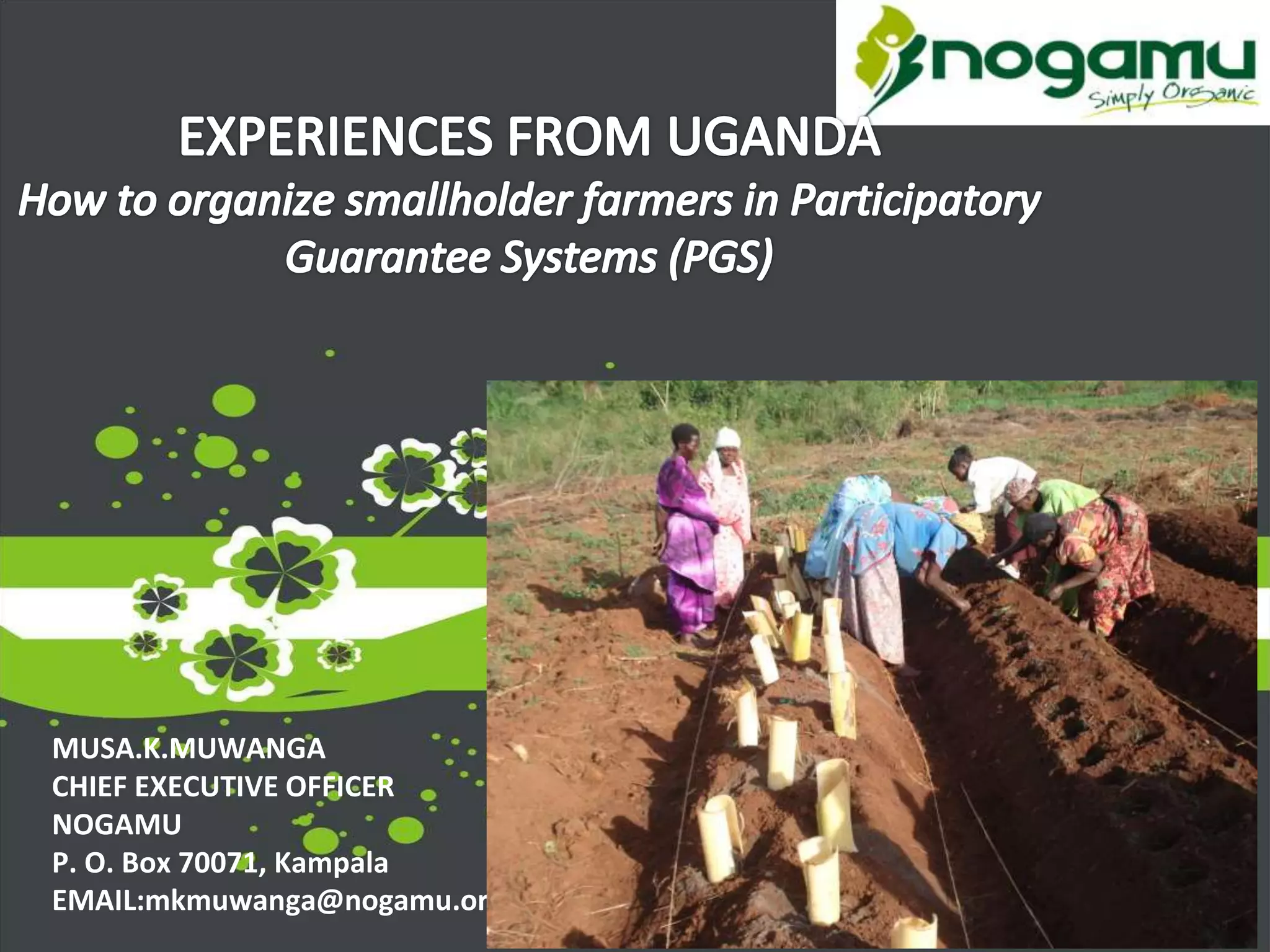
MUSA.K.MUWANGA
CHIEF EXECUTIVE OFFICER
NOGAMU
P. O. Box 70071, Kampala
EMAIL:mkmuwanga@nogamu.org.ug
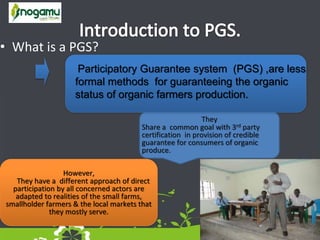
• What is a PGS?
They
Share a common goal with 3rd party
certification in provision of credible
guarantee for consumers of organic
produce.
Participatory Guarantee system (PGS) ,are less
formal methods for guaranteeing the organic
status of organic farmers production.
However,
They have a different approach of direct
participation by all concerned actors are
adapted to realities of the small farms,
smallholder farmers & the local markets that
they mostly serve.
• PGS concept gained recognition in meeting in 2004 in Brazil organised
by IFOAM.
• Representatives worldwide came together to present different
verification systems of grass root farmer initiatives !
• After meeting PGS Concept was formalised by IFOAM!
• PGS started in Uganda in 2007 after the launching of the East African
Organic Products standard (EAOPS) in Dar es salaam.
• It was adopted as an alternative of facilitating organic products
certification for local marketing in Uganda as compared to more costly
and rigorous 3rd party(external) certification procedures.
• It’s a more appropriate approach to the smallholder farming practices
that are synonymous with most local and regional OA marketing
activities in Uganda.
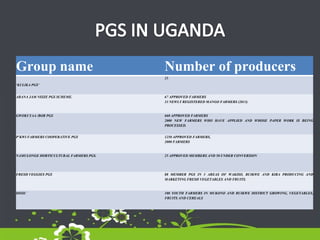
Group name Number of producers
‘KULIKA PGS’
23
ABANA JAM NSIZE PGS SCHEME. 67 APPROVED FARMERS
33 NEWLY REGISTERED MANGO FARMERS (2013)
GWOKUYAA /BOR PGS 660 APPROVED FARMERS
2000 NEW FARMERS WHO HAVE APPLIED AND WHOSE PAPER WORK IS BEING
PROCESSED.
P’KWI FARMERS COOPERATIVE PGS 1250 APPROVED FARMERS,
2000 FARMERS
NAMULONGE HORTICULTURAL FARMERS PGS. 25 APPROVED MEMBERS AND 50 UNDER CONVERSION
FRESH VEGGIES PGS 88 MEMBER PGS IN 3 AREAS OF WAKISO, BUIKWE AND KIRA PRODUCING AND
MARKETING FRESH VEGETABLES AND FRUITS.
DISSC 100 YOUTH FARMERS IN MUKONO AND BUIKWE DISTRICT GROWING, VEGETABLES,
FRUITS AND CEREALS
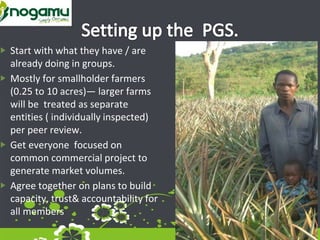
Start with what they have / are
already doing in groups.
Mostly for smallholder farmers
(0.25 to 10 acres)— larger farms
will be treated as separate
entities ( individually inspected)
per peer review.
Get everyone focused on
common commercial project to
generate market volumes.
Agree together on plans to build
capacity, trust& accountability for
all members
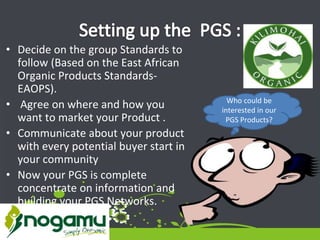
• Decide on the group Standards to
follow (Based on the East African
Organic Products Standards-
EAOPS).
• Agree on where and how you
want to market your Product .
• Communicate about your product
with every potential buyer start in
your community
• Now your PGS is complete
concentrate on information and
building your PGS Networks.
Who could be
interested in our
PGS Products?
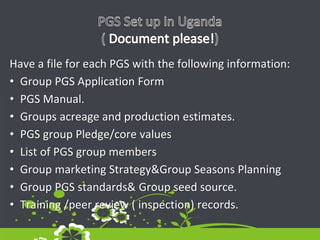
Have a file for each PGS with the following information:
• Group PGS Application Form
• PGS Manual.
• Groups acreage and production estimates.
• PGS group Pledge/core values
• List of PGS group members
• Group marketing Strategy&Group Seasons Planning
• Group PGS standards& Group seed source.
• Training /peer review ( inspection) records.
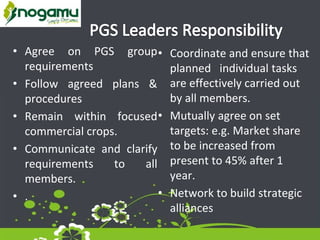
• Agree on PGS group
requirements
• Follow agreed plans &
procedures
• Remain within focused
commercial crops.
• Communicate and clarify
requirements to all
members.
• .
• Coordinate and ensure that
planned individual tasks
are effectively carried out
by all members.
• Mutually agree on set
targets: e.g. Market share
to be increased from
present to 45% after 1
year.
• Network to build strategic
alliances
• All people along supply chain &outsiders i.e. local
priests, politicians & farmers ,inspectors , sellers,
consumers actively involved.
• Organic products are gaining popularity as healthy &
safe food for babies and the elite class in Uganda!
• Current PGS Groups have strong leadership &
common set of values.
• .Ugandans are ‘’Organic’ by nature – most traditional
farming practices blend well with OA
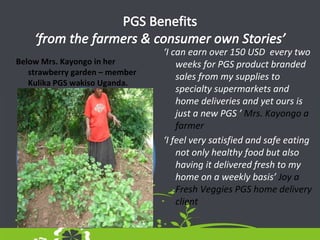
Below Mrs. Kayongo in her
strawberry garden – member
Kulika PGS wakiso Uganda.
‘I can earn over 150 USD every two
weeks for PGS product branded
sales from my supplies to
specialty supermarkets and
home deliveries and yet ours is
just a new PGS ’ Mrs. Kayongo a
farmer
‘I feel very satisfied and safe eating
not only healthy food but also
having it delivered fresh to my
home on a weekly basis’ Joy a
Fresh Veggies PGS home delivery
client
• Local consumers still not adequately sensitised about benefits
of PGS branded organic products!
• Majority of farmers still prefer to work as individuals
especially yet PGS requires groups.
• PGS new concept by the consumers & implementers thus lot
of publicity required.
• Many un-genuine Self-claims of organic with substandard
products stain the image of growing PGS products.
BEST PRACTICES HANDBOOK
Participatory Guarantee System (PGS) for
smallholder organic farmers.
PGS link on NOGAMU website for Relevant PGS
issues such IFOAM Publications, List of PGS
Approved groups in Uganda
For additional info: Email: pgs@nogamu.org.ug
Thank you for your Attenti
mkmuwanga@nogamu.org.u
pgs@nogamu.org.ug

Musa pgs experiences uganda 2014

  • 1.
    MUSA.K.MUWANGA CHIEF EXECUTIVE OFFICER NOGAMU P.O. Box 70071, Kampala EMAIL:mkmuwanga@nogamu.org.ug
  • 3.
    • What isa PGS? They Share a common goal with 3rd party certification in provision of credible guarantee for consumers of organic produce. Participatory Guarantee system (PGS) ,are less formal methods for guaranteeing the organic status of organic farmers production. However, They have a different approach of direct participation by all concerned actors are adapted to realities of the small farms, smallholder farmers & the local markets that they mostly serve.
  • 4.
    • PGS conceptgained recognition in meeting in 2004 in Brazil organised by IFOAM. • Representatives worldwide came together to present different verification systems of grass root farmer initiatives ! • After meeting PGS Concept was formalised by IFOAM! • PGS started in Uganda in 2007 after the launching of the East African Organic Products standard (EAOPS) in Dar es salaam. • It was adopted as an alternative of facilitating organic products certification for local marketing in Uganda as compared to more costly and rigorous 3rd party(external) certification procedures. • It’s a more appropriate approach to the smallholder farming practices that are synonymous with most local and regional OA marketing activities in Uganda.
  • 5.
    Group name Numberof producers ‘KULIKA PGS’ 23 ABANA JAM NSIZE PGS SCHEME. 67 APPROVED FARMERS 33 NEWLY REGISTERED MANGO FARMERS (2013) GWOKUYAA /BOR PGS 660 APPROVED FARMERS 2000 NEW FARMERS WHO HAVE APPLIED AND WHOSE PAPER WORK IS BEING PROCESSED. P’KWI FARMERS COOPERATIVE PGS 1250 APPROVED FARMERS, 2000 FARMERS NAMULONGE HORTICULTURAL FARMERS PGS. 25 APPROVED MEMBERS AND 50 UNDER CONVERSION FRESH VEGGIES PGS 88 MEMBER PGS IN 3 AREAS OF WAKISO, BUIKWE AND KIRA PRODUCING AND MARKETING FRESH VEGETABLES AND FRUITS. DISSC 100 YOUTH FARMERS IN MUKONO AND BUIKWE DISTRICT GROWING, VEGETABLES, FRUITS AND CEREALS
  • 6.
    Start with whatthey have / are already doing in groups. Mostly for smallholder farmers (0.25 to 10 acres)— larger farms will be treated as separate entities ( individually inspected) per peer review. Get everyone focused on common commercial project to generate market volumes. Agree together on plans to build capacity, trust& accountability for all members
  • 7.
    • Decide onthe group Standards to follow (Based on the East African Organic Products Standards- EAOPS). • Agree on where and how you want to market your Product . • Communicate about your product with every potential buyer start in your community • Now your PGS is complete concentrate on information and building your PGS Networks. Who could be interested in our PGS Products?
  • 8.
    Have a filefor each PGS with the following information: • Group PGS Application Form • PGS Manual. • Groups acreage and production estimates. • PGS group Pledge/core values • List of PGS group members • Group marketing Strategy&Group Seasons Planning • Group PGS standards& Group seed source. • Training /peer review ( inspection) records.
  • 9.
    • Agree onPGS group requirements • Follow agreed plans & procedures • Remain within focused commercial crops. • Communicate and clarify requirements to all members. • . • Coordinate and ensure that planned individual tasks are effectively carried out by all members. • Mutually agree on set targets: e.g. Market share to be increased from present to 45% after 1 year. • Network to build strategic alliances
  • 10.
    • All peoplealong supply chain &outsiders i.e. local priests, politicians & farmers ,inspectors , sellers, consumers actively involved. • Organic products are gaining popularity as healthy & safe food for babies and the elite class in Uganda! • Current PGS Groups have strong leadership & common set of values. • .Ugandans are ‘’Organic’ by nature – most traditional farming practices blend well with OA
  • 11.
    Below Mrs. Kayongoin her strawberry garden – member Kulika PGS wakiso Uganda. ‘I can earn over 150 USD every two weeks for PGS product branded sales from my supplies to specialty supermarkets and home deliveries and yet ours is just a new PGS ’ Mrs. Kayongo a farmer ‘I feel very satisfied and safe eating not only healthy food but also having it delivered fresh to my home on a weekly basis’ Joy a Fresh Veggies PGS home delivery client
  • 12.
    • Local consumersstill not adequately sensitised about benefits of PGS branded organic products! • Majority of farmers still prefer to work as individuals especially yet PGS requires groups. • PGS new concept by the consumers & implementers thus lot of publicity required. • Many un-genuine Self-claims of organic with substandard products stain the image of growing PGS products.
  • 13.
    BEST PRACTICES HANDBOOK ParticipatoryGuarantee System (PGS) for smallholder organic farmers. PGS link on NOGAMU website for Relevant PGS issues such IFOAM Publications, List of PGS Approved groups in Uganda For additional info: Email: pgs@nogamu.org.ug
  • 15.
    Thank you foryour Attenti mkmuwanga@nogamu.org.u pgs@nogamu.org.ug