Multiscale Structural TopologyOptimization 1st
Edition Liang Xia download pdf
https://ebookmass.com/product/multiscale-structural-topology-
optimization-1st-edition-liang-xia/
Visit ebookmass.com today to download the complete set of
ebook or textbook!
2.
Here are somerecommended products for you. Click the link to
download, or explore more at ebookmass.com
Fundamentals of Multiscale Modeling of Structural
Materials Wenjie Xia
https://ebookmass.com/product/fundamentals-of-multiscale-modeling-of-
structural-materials-wenjie-xia/
Topology Optimization in Engineering Structure Design 1st
Edition Edition Weihong Zhang
https://ebookmass.com/product/topology-optimization-in-engineering-
structure-design-1st-edition-edition-weihong-zhang/
Topology 2nd Edition James Munkres
https://ebookmass.com/product/topology-2nd-edition-james-munkres/
Multiscale Modeling Approaches for Composites 1st Edition
George Chatzigeorgiou
https://ebookmass.com/product/multiscale-modeling-approaches-for-
composites-1st-edition-george-chatzigeorgiou/
3.
Multiscale Biomechanics: TheoryAnd Applications 1st
Edition Soheil Mohammadi
https://ebookmass.com/product/multiscale-biomechanics-theory-and-
applications-1st-edition-soheil-mohammadi/
Point-Set Topology with Topics: Basic General Topology for
Graduate Studies Robert Andre
https://ebookmass.com/product/point-set-topology-with-topics-basic-
general-topology-for-graduate-studies-robert-andre/
Topology, 2/E James Munkres
https://ebookmass.com/product/topology-2-e-james-munkres/
Handbook of Structural Heart Interventions 1st Edition
Rihal
https://ebookmass.com/product/handbook-of-structural-heart-
interventions-1st-edition-rihal/
Tidal Energy Systems: Design, Optimization and Control 1st
Edition
https://ebookmass.com/product/tidal-energy-systems-design-
optimization-and-control-1st-edition/
Introduction
In this chapter,the background and motivations of the book are first
presented in section I.1. Literature reviews on related subjects, including
linear and nonlinear topology optimization, multiscale modeling methods,
model reduction strategies in multiscale modeling and simultaneous structure
and materials design, are given in section I.2. Finally, the outline of the book
is presented in section I.3.
I.1. Background and motivations
Various optimization methods for structural size, shape and topology
designs have been developed and widely employed in engineering
applications. Among these, topology optimization has been recognized as one
of the most effective tools for least-weight and performance design, especially
in aeronautics and aerospace engineering [ZHU 15]. Most existing research
of topology optimization focuses on the design of monoscale structures; in
other words, the considered structures are made of homogeneous materials.
In the recent years, there is an increasing use of high-performance
heterogeneous materials such as fibrous composite, concrete, metallic porous
material and metal alloy for their advantageous overall characteristics, which
result in superior structural mechanical responses and service performance.
Although from the structural level point of view these materials can be
considered homogeneous and conventional design approaches for
homogeneous structures can still be used, the pronounced heterogeneities
9.
x Multiscale StructuralTopology Optimization
have significant impacts on the structural behavior. Therefore, in order to
allow for reliable mechanical designs, we need to account for material
microscopic heterogeneities and constituent behaviors so as to accurately
assess structural performance.
Meanwhile, the fast progress made in the field of materials science allows
us to control the material microstructure composition to an unprecedented
extent [FUL 10]. The overall behavior of heterogeneous materials depends
strongly on the size, shape, spatial distribution and properties of the
constituents. With all these in mind, we come up naturally with the idea that
designing materials simultaneously along with the design of structures would
result in higher performance structures. In addition, the recently emerging and
rapidly developing techniques of three-dimensional (3D) printing or additive
manufacturing, such as fused deposition modeling, stereolithography and
selective laser sintering, provide the capability of manufacturing extremely
fine and complex microstructures, which make it possible to generate more
innovative, lightweight and structurally efficient designs.
I.1.1. Motivation 1
The primary motivation of the book is to make a first attempt toward
topology optimization design of nonlinear highly heterogeneous structures.
Generally speaking, topology optimization design of multiscale structures
(Figure I.1) can be viewed as an extension of conventional monoscale design
except that the material constitutive law is governed by one or multiple
representative volume elements (RVEs) defined at the microscopic scale. In
the case of linear elasticity, topology optimization design of a structure made
of the RVE is a rather straightforward application of conventional linear
design routine [SIG 01, HUA 10a], because the effective or homogenized
constitutive behavior of the considered RVEs can be explicitly determined by
homogenization analysis.
When nonlinearities are present at the microscopic scale, i.e. nonlinear
RVEs under consideration, topology optimization design of such multiscale
structures is a rather challenging task. First, as will be discussed subsequently
in section I.2.1, nonlinear topology optimization is not at all a trivial task even
for homogeneous structures due to the increased computing cost and the
required solution stabilization schemes, not to mention highly heterogeneous
10.
Introduction xi
multiscale structures.Second, the multiscale dilemma in terms of heavy
computational burden (see section I.2.2) is even more pronounced in topology
optimization: not only is it required to solve the time-consuming multiscale
problem once, but for many different realizations of the structural topology.
For these reasons, there has been very limited research in the literature on
topology optimization design of multiscale nonlinear structures before the
recent works from the author and his collaborators [XIA 14b, XIA 15c,
FRI 15b].
Element RVE
Topology Optimization
fext fext
Figure I.1. Illustration of topology optimization
of multiscale structures [XIA 14b]
I.1.2. Motivation 2
The second motivation of the book is to design the topologies of both
macroscopic structure and microscopic materials simultaneously. In other
words, by topology optimization one determines not only the optimal spatial
material layout distribution at the macroscopic structural scale, but also the
optimal local use of the cellular material at the microscopic scale, as
schematically shown in Figure I.2. The subject of simultaneous topology
optimization design of both structure and materials can be found in earlier
works [THE 99, ROD 02, ZHA 06]. In this book, we revisit the subject with
an emphasis on solving the nonlinear scale interface equilibrium within a
multiscale analysis framework [XIA 14a, XIA 15b].
Concerning simultaneous design, the microscale material topologies are
optimized in response to the macroscale equilibrium solution; the optimized
materials in turn result in a variation of the macroscale constitutive behavior.
The equilibrium of the scale interface is therefore nonlinear, which has been
well acknowledged [THE 99, BEN 03]. However, in practice it has never
11.
xii Multiscale StructuralTopology Optimization
been specifically dealt with in previous works [XIA 14a, XIA 15b]; in
particular, the microscale material design is treated integrally as a generalized
nonlinear constitutive behavior and the nonlinear equilibrium due to the
locally optimized or adapted materials is solved within a nonlinear multiscale
analysis framework. One particular advantage of doing so is that we can
improve the design efficiency by straightforward application of the existing
model reduction strategies for nonlinear heterogeneous materials [XIA 15b].
Macro structure
x1
x2
ρ(x) = 0 or 1
Micro cellular materials
point A
point B
y1
y2
η(xA, y) = 0 or 1
η(xB, y) = 0 or 1
y1
y2
Ω
ΩxA
ΩxB
Figure I.2. Illustration of simultaneous topology optimization of
structure and materials [XIA 14a]
I.1.3. Motivation 3
The third motivation of the book is to develop computer codes for the
designs of nonlinear structures and materials with extreme constitutive
properties. The compactly developed codes including all ingredients for
topology optimization would be beneficial in terms of presenting the methods
and attracting more research interests. In addition, the compactness and
extensibility of the codes make it possible to serve for further academic
researches and also for educational purposes.
This motivation is inspired by the 99-line Matlab code in the seminal
article by Sigmund [SIG 01] and other subsequent educational codes
[HUA 10a, CHA 10, AND 11, TAL 12a], which have significantly
contributed to the popularity and to the development of topology
12.
Introduction xiii
optimization. Wehave also benefited from these educational papers. For
instance, in Chapter 2 [XIA 14b] we apply the discrete level set method
[CHA 10] to carry out topology optimization. Chapters 1 and 3 on the design
of multiscale structures [XIA 15c, FRI 15b] and Chapters 4 and 5 on the
simultaneous design of structure and materials [XIA 14a, XIA 15b] are all
built on top of the 88-line code framework [AND 11] along with the
evolutionary design scheme [HUA 10a]. In the Appendix, we provide one of
the developed codes for the design of extreme materials in Matlab.
I.2. Literature review on related subjects
In the following, section I.2.1 gives a literature review on the
developments of linear and nonlinear topology optimization. Section I.2.2
presents multiscale modeling methods and the reduced-order modeling
(ROM) strategies for them. Section I.2.3 reviews conventional approaches on
simultaneous topology optimization of structure and materials together with
our recently proposed alternative approach.
I.2.1. Topology optimization
Since the seminal paper by Bendsøe and Kikuchi [BEN 88], topology
optimization has undergone a remarkable development in both academic
research [BEN 03, HUA 10b, DEA 14] and industrial applications [ZHU 15].
Various approaches have been proposed, such as density-based methods
[BEN 89, ZHO 91], evolutionary procedures [XIE 93, XIE 97, ZHU 07,
HUA 09] and level set methods [SET 00, WAN 03, ALL 04b, BUR 04], all
with the same purpose of finding an optimal structural topology or material
layout within a given design domain subjected to constraints and boundary
conditions as is shown in Figure I.3. The key merit of this approach over
shape or sizing optimizations is that it does not require a presumed topology.
Originally, topology optimization was considered as a 0-1 discrete
problem or a binary design setting, which is known as ill conditioned upon
Kohn and Strang [KOH 86]. The major challenge lies in solving a large-scale
integer programing problem, where the high computing cost typically
precludes the use of gradient-free algorithms. Bendsøe and Kikuchi [BEN 88]
relaxed the problem by assuming porous microstructures at a lower separated
scale. Similar treatments were followed in [GUE 90, SUZ 91, ALL 04a].
13.
xiv Multiscale StructuralTopology Optimization
Shortly after, Bendsøe proposed another density-based method with a much
more simplified assumption [BEN 89], also known as solid isotropic material
with penalty (SIMP) [ZHO 91, ROZ 01].
Design region Ω
ΓD ΓN
?
ΓD ΓN
Ω
Figure I.3. Illustration of structural topology optimization [XIA 15c]
Another popular approach, named evolutionary structural optimization
(ESO), was initially proposed by Xie and Steven [XIE 93] based on a
heuristic element removal strategy. It has been reported that the ESO method
corresponds to a sequential linear programing approximate method for certain
cases [TAN 02]. Despite its popularity [XIE 97], the ESO method was also
largely argued [SIG 01] or even criticized [ZHO 01] mainly for lacking
restitution mechanisms for material removal. To circumvent the deficiencies,
bidirectional evolutionary structural optimization (BESO) [QUE 00, ZHU 07,
HUA 09] and soft-killing BESO [HUA 10a, HUA 10b] were later developed,
allowing both material removal and addition.
Apart from the abovementioned approaches, there exist several alternative
approaches such as the bubble method [ESC 94], topological derivative
[SOK 99], level-set method, [SET 00, WAN 03, ALL 04b, BUR 04, VAN 13]
and phase filed method [BOU 03]. For a more critical review and detailed
comparison of the various design approaches, the reader may refer to
[SIG 13].
Early works on topology optimization were restricted to linear structural
designs. Continuous efforts have been conducted to extend topology
optimization to nonlinear structural designs considering various sources of
nonlinearity, such as geometrical nonlinearity [BUH 00, GEA 01, PED 01,
BRU 03, YOO 05, WAN 14a, LUO 15], material nonlinearity [YUG 95,
BEN 96, MAU 98, YUG 99, SCH 01, YOO 07, BOG 12] and both
14.
Introduction xv
geometrical andmaterial nonlinearities simultaneously [JUN 04, HUA 07b,
HUA 08]. In the case of geometrical nonlinearity, the main difficulty of
nonlinear topology optimization arises primarily from the existence of
compliant or ersatz materials at void regions. The excessively distorted
elements at void regions during topology optimization result in the instability
of Newton–Raphson (NR) solution process [BUH 00, PED 01, BRU 03,
YOO 05]. To stabilize the numerical solution, several remedy schemes have
been proposed by, for instance, excluding internal forces of void elements
[BUH 00], removing low-density elements [BRU 03], including additional
connectivity parameterization [YOO 05] or, recently, a variant interpolation
scheme [WAN 14a]. In the case of material nonlinearity, such as plasticity, we
need to define material interpolations between the intermediate density values
and elastic material modulus, plastic hardening modulus and yield stress
when employing density-based methods [MAU 98, YUG 99, SCH 01,
YOO 07, BOG 12, KAT 15]. These material interpolation models need to be
adjusted carefully so as to guarantee optimization solutions, while the choice
of them lacks physical interpretation. As compared to continuously defined
methods, ESO-type methods [HUA 10b] and discrete level-set methods
[CHA 10, WEI 10] naturally omit the definition of supplementing
pseudo-relationships between intermediate densities and their constitutive
behaviors for the sake of their discrete nature, resulting in algorithmic
advantages. The robustness and performance of discrete methods have been
shown for the design of nonlinear structures [HUA 07b, HUA 08] and
recently for nonlinear multiscale structures [XIA 14b, XIA 15c, FRI 15b].
I.2.2. Multiscale modeling
Brute force approaches such as directly modeling the microstructure at the
coarse scale model are practically not feasible because of the prohibitive
computational expense. Instead, homogenization is usually applied to bridge
both structural and material scales [GUE 90, HAS 98a, HAS 98b, MIC 99].
The key hypotheses of homogenization are the separation of scales and the
periodicity, as is shown in Figure I.4. It is assumed that the microscopic
length scale is much smaller than the macroscopic length scale such that the
RVE model can be considered as periodically ordered pattern, while the RVE
is large enough to be dealt with using the continuum mechanics theory. By
means of homogenization, we may evaluate the effective or homogenized
15.
Visit https://ebookmass.com todayto explore
a vast collection of ebooks across various
genres, available in popular formats like
PDF, EPUB, and MOBI, fully compatible with
all devices. Enjoy a seamless reading
experience and effortlessly download high-
quality materials in just a few simple steps.
Plus, don’t miss out on exciting offers that
let you access a wealth of knowledge at the
best prices!
16.
xvi Multiscale StructuralTopology Optimization
constitutive behavior of the considered RVE and then use it to serve
marcroscale assessment [GUE 08, XU 11, XU 12, XIA 13a].
Figure I.4. Illustration of a two-scale structure and periodically
patterned RVE [XIA 14b]
However, this approach encounters difficulties when geometrical and
physical nonlinearities are present at the material scale. For this reason,
computational homogenization approaches have been proposed
[SMI 98, MIE 99, FEY 00, KOU 01, GHO 01, MIE 02, IBR 03, IBR 10] and
largely developed in the last decade [GEE 10] in order to assess the
macroscopic influence of microscopic heterogeneities and nonlinearities.
Note that within the finite element analysis framework, this approach is also
known as the FE square (FE2) method [FEY 00]. In general, it asserts that
each point of the macroscopic discretization is associated with a RVE of the
(nonlinear) microstructured material. Then for each macroscopic equilibrium
iteration, a nonlinear load increment needs to be computed for each of the
(many) RVEs. In return, the average stress across the RVE is then used as the
macroscopic stress tensor without requiring explicit constitutive relations at
the macroscopic scale.
A downside of this very general FE2 method is the high computational
burden. First, many nonlinear load steps need to be computed at the
microscopic level that leads to a prohibitive amount of computing time.
Second, when path-dependent constitutive behaviors are considered at the
microscopic scale, the microscopic degrees of freedom and the history
variables describing the material state need to be stored for each point within
17.
Introduction xvii
each RVE,which leads to a significant amount of additional storage
requirements. One straightforward solution to alleviate the computational
requirements is parallel computing [FEY 00, MOS 14], as microscale
problems are independent and embarrassingly parallel. Note that the
implementation of parallel computing contributes significantly in terms of
limiting the computing time, but does not necessarily reduce the computing
cost due to additional interchanges between the two scales. For this reason,
we need to turn to alternative strategies by means of model reduction or
simplification.
ROM has been systematically researched and widely used in the fields of
computational mechanics in order to reduce computing cost, data storage
requirements and computing time [QUE 05, FOR 09]. Some other
applications can also be found for the representation of material
mircrostructure [GAN 07, XIA 13a] and structural optimization design
[XIA 10, RAG 13]. In terms of reducing the computing effort for the
evaluation of nonlinear RVEs at the microscopic scale, numerous ROMs can
be found in the literature for the representation or approximation of the
effective constitutive behavior of nonlinear heterogeneous materials, using
reduction strategies such as proper orthogonal decomposition (POD)
[YVO 07], proper generalized decomposition [LAM 10, ELH 13, CRE 13],
hyper reduction [MIL 13, HER 14], material map model [TEM 07b], eigen
deformation-based reduction [OSK 07, YUA 09], nonuniform transformation
field analysis (NTFA) [MIC 03, MIC 04] and numerical explicit potentials
(NEXP) [YVO 09, YVO 13, LE 15]. Note that, by simultaneous use of
parallel computing and ROM [FRI 13b], a further reduction in computational
time can be achieved in multiscale analysis [FRI 14].
In the case of elasticity, the database-type methods, such as the material
map model [TEM 07b, TEM 07a] and NEXP [YVO 09], have shown
promising performances in terms of both modeling accuracy and computing
efficiency. The general idea of this type of methods is to compute off-line a
certain number of RVE problems as a database, then the effective RVE
behavior is approximated using the precomputed database by means of
interpolation schemes. The on-line macroscale computation then directly uses
the cheaper approximated constitutive behavior of the RVE without
demanding to solve full-scale RVE problems. These methods apply for
viscoelastic materials [TRA 11] and nonlinear hyperelastic materials
18.
xviii Multiscale StructuralTopology Optimization
[TEM 07b, TEM 07a, YVO 13], and have also been extended for stochastic
nonlinear elastic materials [CLÉ 12, CLÉ 13]. The development of ROMs for
the representation of RVE involving path-dependent constitutive laws, such as
plasticity, is a more challenging subject under development. Here, we refer to
the NTFA method [MIC 03, MIC 04, FRI 11, FRI 13a] and adaptive POD
approach as implemented in [MIL 13, HER 14]. In particular, NTFA reduces
the inelastic strain field found in a microstructured material to a finite
dimensional but spatially heterogeneous basis of nonuniform transformation
strains. Generally speaking, all these established ROMs apply
straightforwardly to topology optimization of multiscale nonlinear structures
as long as the macroscopic equilibrium solution is provided.
I.2.3. Simultaneous structure and materials design
Topology optimization has not only been applied for structural designs,
but also for material microstructural design [CAD 13]. By means of inverse
homogenization, the SIMP method has also been used for designing material
microstructures with prescribed constitutive properties [SIG 94, SIG 00],
extreme thermal expansion coefficients [SIG 97, GIB 00], extreme
viscoelastic behavior [YI 00, AND 14a, CHE 14, HUA 15], maximum
stiffness and fluid permeability [GUE 06, GUE 07] and, recently, hyperelastic
properties [WAN 14b]. Similar problems have also been addressed by
level-set methods [CHA 08, CHA 12] and ESO-type methods
[HUA 11, HUA 12]. Some other works [NEV 00, FUJ 01, NEV 02, ZHA 07,
NIU 09, SU 10, GU 12, KAT 14, AND 14b] also fall within this context. Up
until now, topology optimization design of materials with extreme constitutive
properties (Figure I.5) has followed a rather standard routine [XIA 15a].
Figure I.5. Material microstructures (50% porosity): the first two with
extreme bulk moduli, the third with extreme shear modulus and the last
one with negative Poisson’s ratio [XIA 15a]
19.
Introduction xix
With theestablished material microstructural design models, we naturally
came up with the idea of simultaneous or integrated designs of both material
and structure. The most commonly applied strategy is designing a universal
material microstructure at the microscopic scale either for a fixed
[SU 10, HUA 13] or simultaneously changed [DEN 13, ZUO 13, YAN 14,
XU 15, GUO 15] structure at the macroscopic scale. Zhang et al. [ZHA 06]
went a step further by designing several different cellular materials for
different layers of a layered structure. In fact, an earlier attempt can be traced
back to [ROD 02], where simultaneous optimal designs were performed for
both structure and element wisely varying cellular materials following a
decomposed design procedure [BEN 95, THE 99]. This work has later been
extended to 3D [COE 08] and to account for hyperelasticity [NAK 13]. Some
more specific simultaneous designs can be found in [SET 05, SET 06,
LIU 12, GAO 12, GAO 13, COE 15] for structural topology and composite
laminate orientations and in [LV 14] for structural topology and closed liquid
cell materials. Another recent work, in [ALE 15], demonstrates the efficient
solution of the design problem by using a spectral coarse basis preconditioner
and without assuming the separation of length scales.
Due to the intensive computational cost, the nonlinear scale-interface
equilibrium [THE 99, BEN 03] of the locally optimized or adapted materials
was neglected in early works [ROD 02, COE 08, ZHA 06], conjecturing that
both scale design variables were updated simultaneously and no converged
local material design results were required for macroscopic structural
equilibrium. Unlike previous design approaches, this nonlinearity has not
been neglected but is specially addressed in our recent work [XIA 14a]
treating the microscale material design integrally as a generalized nonlinear
constitutive behavior, and in which the nonlinear scale-interface equilibrium
problem is resolved by the FE2 method. In precise, complete microscale
optimizations are solved for each macroscale displacement increment. The
nonlinear scale-interface equilibrium is searched by means of the NR method
using the effective stresses evaluated on the optimized material
microstructural topologies. It has been shown that this FE2-based design
approach can provide similar topology solutions in comparison to the iterative
design approach [HUA 13, YAN 14], while requiring much less computing
cost due to the reduced interchange between the two scales. Another
advantage of treating the material optimization process as a generalized
constitutive behavior is that the existing model reduction strategies for
20.
xx Multiscale StructuralTopology Optimization
nonlinear heterogeneous materials can be applied straightforwardly to
improve design efficiency, as we have shown in [XIA 15b].
I.3. Outline of the book
This book is organized as follows:
In this chapter, we have presented our motivations and the attempts we
will make to move toward topology optimization design of multiscale
nonlinear structures, including design of highly heterogeneous structures,
material microstructural design and simultaneous design of structure and
materials. We have also reviewed the state of the art of the related subjects,
which appears in [XIA 15c].
In Chapter 1, we primarily develop a multiscale design framework for
topology optimization of multiscale nonlinear structures. Highly
heterogeneous structures made up of nonlinear elastic RVE are considered.
Conventional first-order computational homogenization FE2 method is
adopted to bridge the two separate scales. Topology optimization is carried
out using the BESO method for macroscopic structural stiffness
maximization with a constraint on material volume usage. For the sake of its
discrete nature, the BESO method naturally omits the definition of
supplementing pseudo-relationships between intermediate densities and the
moduli as required when employing SIMP-type models, resulting in
algorithmic advantages, especially in dealing with multiscale nonlinear
structures. In contrast to the conventional nonlinear design of homogeneous
structures, this design framework provides an automatic design tool by which
the considered material models can be governed directly by the realistic
microstructural geometry and the microscopic constitutive models. The
content of this chapter comes primarily from [XIA 14b] and [XIA 15c].
Intending to alleviate the heavy computational burden of the design
framework presented in Chapter 1, we develop a POD-based adaptive
surrogate model in Chapter 2 for the RVE solutions at the microscopic scale.
We note that the optimization process requires multiple design loops
involving similar or even repeated computations at the microscopic scale,
which perfectly suits the surrogate learning process. The surrogate model is
constructed in an on-line manner: initially built by the first design iteration is
then updated adaptively in the subsequent design iterations. The displacement
21.
Introduction xxi
fields aretreated as snapshots and a reduced basis is obtained by snapshot
POD. The surrogate model is built by interpolating the POD projection
coefficients in terms of the effective strain using diffuse approximation. The
surrogate model has shown promising performance in terms of reducing
computing cost and modeling accuracy when applied to the design framework
for nonlinear elastic cases. The content of this chapter has been given in
[XIA 14b].
In Chapter 3, we take a step further toward the design of multiscale
elastoviscoplastic structures. In order to realize the design in realistic
computing time and with affordable memory requirement, we directly employ
an established method, the potential-based reduced basis model order
reduction (pRBMOR) with graphics processing unit (GPU) acceleration
[FRI 14], to resolve the microscopic problems for this severe material
nonlinearity. The pRBMOR implementation allows for memory and CPU
time savings by factors of 105 and beyond with respect to FE simulations.
With regard to topology optimization, the sensitivities of the design variables
for nonlinear dissipative problems are derived in a clear and rigorous manner
using the adjoint method. In addition, a stabilization scheme controlling the
number of recovered elements is implemented to enhance previous versions
of BESO updating scheme for linear designs. The content of this chapter has
been given in [FRI 15b].
So far we have always assumed a fixed material microstructure at the
microscopic scale. In Chapter 4, we are focused on the simultaneous design
of both macroscopic structure and microscopic materials. Within the same
established multiscale design framework, we define topology variables and
volume fraction constraints at both scales. In this model, the material
microstructures are optimized in response to the macroscopic solution, which
results in the nonlinearity of the equilibrium problem of the interface of the
two scales. This model treats the optimization process of material
microstructure as a generalized nonlinear constitutive behavior, and the
nonlinear equilibrium problem can be resolved naturally within the multiscale
design framework by the FE2 method. The proposed model allows us to
obtain optimal structures with spatially varying properties realized by the
simultaneous design of microstructures at the microscopic scale. Note that the
designed structure with varying constitutive behaviors due to the
microstructures are in fact constituted by only one base material, which
22.
xxii Multiscale StructuralTopology Optimization
greatly favors 3D printing setting that a single material can usually be used
for fabrication. The content of this chapter has been given in [XIA 14a].
Treating the material optimization process as a generalized constitutive
behavior (Chapter 4) allows us to improve the design efficiency drastically by
straightforward application of the existing ROMs for nonlinear materials. In
Chapter 5 we apply a reduced database model, NEXP [YVO 09], to
approximate this generalized constitutive behavior. By this model, we build
a priori a database from a set of numerical experiments in the space of
effective strain. Each value in the database corresponds to the strain energy
density evaluated on a material microstructure, optimized in accordance to the
imposed effective strain value. By tensor decomposition, a continuous
representation of the strain energy density is built as a sum of products of
one-dimensional interpolation functions. As a result of this off-line phase, we
have the effective strain–energy and stress–strain relations required for the
macroscopic equilibrium solution given in the explicit manner. The explicit
NEXP approximation can serve the simultaneous design purpose providing
ultraresolution structures at a significantly reduced computational cost. The
content of this chapter has been given in [XIA 15b].
In section 5.7, we conclude the book and give perspectives on future
research.
The developments in the book have given rise to a number of prototype
computer codes. We include in the Appendix our recent educational article
[XIA 15a] regarding design of materials using topology optimization and
energy-based homogenization approach together with a Matlab code.
The chapters are presented in order of progressive difficulty: from linear
to nonlinear problems, from uniform to spatially varying heterogeneity with
progressive introduction of reduced-order modeling strategies. However, each
chapter is given independency, where physical definitions and assumptions are
reinvoked when necessary at the beginning of successive chapters.
23.
1
Topology Optimization Frameworkfor
Multiscale Nonlinear Structures
This chapter introduces a topology optimization framework for multiscale
nonlinear structures. As an extension of the conventional monoscale design,
except that the material constitutive law is governed by one or multiple RVEs
defined at the microscopic scale, the developed general multiscale design
framework is made up of two key ingredients: multiscale modeling for
structural performance simulation and topology optimization for structural
design. This framework will serve as a basis for the developments presented
in the subsequent chapters.
With regard to the first ingredient, we employ the first-order computational
homogenization method FE2 [FEY 00] to bridge structural and material
scales. By this method, a clear separation of scales is asserted and periodicity
is assumed at the microscopic scale. With regard to the second ingredient, we
apply the BESO method for its robustness and the performance of the
resulting structures in nonlinear designs [HUA 08, HUA 10b]. The BESO
method is based on an evolutionary mechanism that the topological change is
realized by gradual material removal and addition.
In the following, in section 1.1 we first summarize and review the FE2
method. The implementation of a unified periodic boundary condition (PBC)
[XIA 03] is given in section 1.2. Finite element discretization formulations
are presented in section 1.3. The FE2-based nonlinear topology optimization
model using the BESO method is given in section 1.4. The summarized general
multiscale design framework is presented in section 1.5. Section 1.6 carries out
24.
2 Multiscale StructuralTopology Optimization
the designs of a two-scale cantilever structure made of periodically patterned
anisotropic short-fiber reinforced composite with nonlinear elastic behaviors
and the nonlinear design results are compared with monoscale design results
of the corresponding homogeneous structures. We give concluding remarks in
section 1.7.
1.1. FE2 method
The FE2 method assumes the hypothesis of the separation of scales and
periodicity as already shown in Figure I.4. By finite element analysis (FEA),
each material point (Gauss integration point) at the macroscopic scale is
attributed with a prescribed RVE. At the macroscopic scale, the material
appears to be homogeneous but with unknown mechanical properties. These
mechanical properties are related to the heterogeneities of the RVE at the
microscopic scale, which contribute strongly to the overall mechanical
response observed at the larger scale.
Let x and y denote the position of a point at the macro- and microscales,
respectively. Within the macroscopic domain Ω, the macroscopic
displacement ū(x), the macroscopic strain ε̄(x) and the macroscopic stress
σ̄(x) are considered. Their microscopic counterparts at the microscopic scale
are the displacement u(x, y), the infinitesimal strain ε(x, y) and the stress
σ(x, y). While the constitutive model for each material phase of the RVE at
the microscopic scale is assumed to be known, the explicit macroscale
constitutive relations that can account for the microstructural heterogeneities
are rarely ever at hand. Therefore, the macroscale stress can often only be
computed as a function of the microscale stress state by means of volume
averaging over the associated RVE domain Ωx through
σ̄(x) = σ(x, y) =
1
|Ωx|
Ωx
σ(x, y) dΩx, [1.1]
in which σ(x, y) is evaluated by solving the boundary value problem of the
RVE by constraining ε(x, y) equal to ε̄(x), i.e.,
ε̄(x) = ε(x, y) =
1
|Ωx|
Ωx
ε(x, y) dΩx, [1.2]
25.
Topology Optimization Frameworkfor Multiscale Nonlinear Structures 3
where PBC are usually applied to define this constraint in accordance with the
assumed periodicity assumption. Note that when cracks, voids and rigid
inhomogeneities are present in the RVE, the foregoing definitions for the
macroscopic stress and stain tensors need to be extended [MIC 99].
In addition to the scale bridging relations [1.1] and [1.2], the macroscopic
stress σ̄ needs to be in equilibrium with the external tractions t̄∗ on the
Neumann boundary ∂ΩN (body forces are out of consideration) and the
displacements have to satisfy the Dirichlet conditions ū = ū∗ on ∂ΩD:
div σ̄(x) = 0 in Ω, σ̄ · n̄ = t̄ = t̄∗ on ∂ΩN, ū = ū∗ on ∂ΩD. [1.3]
A schematic illustration of the FE2 method is given in Figure 1.1 and can
also be seen later in Figure 1.3. In summary, the FE2 method consists of the
following steps:
1) evaluate the macroscale strain ε̄(x) with an initially defined setting;
2) define PBC on the associated RVE according to ε̄(x);
3) evaluate the microscale stress σ(x, y) by solving the RVE problem;
4) compute the macroscale stress σ̄(x) via volume averaging σ(x, y);
5) evaluate the tangent stiffness tensor C̄tan(x) at the macroscale point x;
6) update the displacement ū(x) using the NR method;
7) repeat steps 2–6 until the macroscale equilibrium is achieved.
Note that it is usual that there exists no explicit closed-form expression of
C̄tan at the macroscopic scale when nonlinearities are present at the
microscopic scale. One possible but time-consuming solution is to
approximate it using a perturbation method [FEY 00]. To be precise, the
structural response is evaluated for a small strain variation δε at the
converged solution. The tangent stiffness tensor C̄tan could be reconstructed
by exciting each of the components of δε. An alternative perturbation
approach based on nodal condensation is given in [KOU 01]. It is worth
noting that computing the tangent stiffness tensor by the perturbation method
requires solving the RVE problem four (in 2D) or six (in 3D) additional times,
the cost of which is not negligible. For this reason, it is also suggested to use
the initial elastic stiffness tensor during the NR solution process
[FEY 00, YVO 07].
26.
Visit https://ebookmass.com todayto explore
a vast collection of ebooks across various
genres, available in popular formats like
PDF, EPUB, and MOBI, fully compatible with
all devices. Enjoy a seamless reading
experience and effortlessly download high-
quality materials in just a few simple steps.
Plus, don’t miss out on exciting offers that
let you access a wealth of knowledge at the
best prices!
Zebulon and Napthalin,where “darkness covered the land and gross
darkness the people.”
The appeal that is made for the American Missionary Association, in
the name of the witness to the gospel, and in the name of Christian
patriotism, gains its height when it is made in the name of Christ.
Every argument by which this work appeals to us to-day, is a
prophecy of its success in our hands. Work among the despised
races, work that sets the seal of power on the Christianity of our
time, work that is to realize God’s thought for the land, work so
Christly cannot fail!
The American Missionary Association, to which this work is
committed of God and the churches, needs but one thing of you.
That is, money? No! It is but needed that there should be such
incomes of the Holy Ghost into Christian hearts as shall lift up church
membership from membership in a religious club to its true dignity
of citizenship in the kingdom of God; such incomes of the Spirit as
shall fill the heart of each citizen with the grand thought of the
kingdom—brotherhood. Then, consecrated purses will be opened,
and gold and silver, and greenbacks and bonds, will flow into the full
treasury of the Lord.
29.
ITEMS FROM CHURCHESAND SCHOOLS.
McLeansville, N. C.—Five persons joined the church the last Sunday
in June. Eighty-three communicants were present, all but three
members of this church.
Dudley, N. C.—Seventeen united with the church, Rev. D. Peebles,
pastor, June 16. This church numbers over eighty members. Mr.
George S. Smith, of Raleigh, and Miss Carrie Waugh, of Woodbridge,
assisted in revival work.
Orangeburg, S. C.—A deep religious interest is reported in this church.
The school was closed June 18th, with appropriate exercises, and in
the presence of a crowded audience.
Atlanta, Ga.—On the third Sabbath in June six young people united
with the college church upon profession, and as many more will
probably unite during the vacation with churches at their homes. It
has been a good year in the religious culture of the school, and a
great gain is manifest in the earnestness and steadiness of Christian
character attained. The Sabbath-school at this church found itself
last Sabbath with eleven less teachers than the week before; the
reason being that nearly that number of young people had gone into
the country to teach summer schools for three months. The fact
suggests one of the sources of influence such a church has, as well
as one of the difficulties of carrying it on.
—Mr. S. P. Smith, of Chicago Seminary, has taken up the work with
the First Church, during Mr. Ashley’s vacation, under very favorable
auspices. The people are united and hopeful.
Golding’s Grove, Ga.—School closed June 20th.
Cuthbert, Ga.—The school at this place, re-opened two years ago,
reports a good year’s work. Over a hundred pupils have been in
attendance, some of them adults and elders and deacons of
churches. A reading-room has been kept up. A large attendance
30.
witnessed the examinationsand closing exercises. Mr. R. R. Wright,
from Atlanta, is the teacher.
Woodville, Ga.—“Little Aubor (one of our school girls) is very ill.
During the late revival she had made up her mind to become a
Christian, but her father was a stumbling-block in her way. He gave
her a severe whipping, and kept her away from the protracted
meetings. Shortly afterward she was taken ill, and said to him, ‘Oh,
father, I wanted to give my heart to Christ, but you have kept me
away.’ Yesterday, when I asked her if she was praying, she answered
in a whisper, ‘I am praying, I am praying, I am praying.’”
Anniston, Ala.—Rev. Peter J. McIntosh was ordained pastor of this
church June 18th. Sermon by Rev. D. L. Hickok, of Talladega. The
proprietor of the hotel showed his good-will by giving free
entertainment to all the white visitors. The indications for spiritual
prosperity are encouraging.
Childersburg, Ala.—Rev. Alfred Jones was ordained June 20th. The
church building has just been plastered. A series of special services
are in contemplation. Congregations average from fifty-six to eighty.
Talladega, Ala.—The following indicates the vacation work of some of
the students for the next three months: J. D. Smith goes to preach
at Savannah, Ga.; H. S. Williams to Montgomery; Andrew Headen to
Selma, to begin work at once; J. B. Sims to Marietta, Ga., to begin
the last Sunday in June. P. W. Young has charge of the church at
Kingston; John Strong, of the Lawson Church, organized last
summer; Barbour Grant of the Cove Church; Thornton Benson of the
church at Alabama Furnace. They receive from $20 to $25 a month.
Peter J. McIntosh was ordained pastor of the church at Anniston,
and Alfred Jones at Childersburg, and are referred to in Rev. Mr. Hill’s
letter.
Mobile, Ala.—Emerson Institute finds its new building admirably
adapted to its uses; has received evidences of increasing favor with
the white citizens of Mobile; is under great obligations to Dr. Morrell
for placing his professional skill as a physician at the disposal of the
31.
teachers, and refusingall compensation. Its teachers are doing good
service in the various Sunday-schools of the city.
Memphis, Tenn.—A permanent library, to which the colored people
may have free access, has been begun by the faculty of Le Moyne
Normal School. Some hundreds of books have been secured, and
during the coming summer vacation a commodious reading-room is
to be fitted up. More volumes will be added from time to time, as
means are secured, and it is confidently expected that the near
future will see this excellent project firmly established, and doing the
work for which it is designed. During the closing week at the school
the junior-class gave an exhibition, the proceeds of which are to be
used for the library. Donations of books are solicited.
32.
GENERAL NOTES.
The Freedmen.
—TheCongregationalist says, in its report of the examination of the
students of Andover Theological Seminary: “One of the best
recitations made in Greek was by a young man from Atlanta
University, a suggestive item for the churches interested in that
institution.”
—The Presbyterian General Assembly has transferred its eighty
colored churches from the Board of Home Missions back to the
Committee on Freedmen. The committee, having somewhat
enlarged its educational work, appeals to the Presbyterian churches
for more liberal and more general contributions.
—The Southern Presbyterian General Assembly reported as
contributed for the evangelization of the colored people, during the
last year, $416.75, to which the Reformed (Dutch) Church added
$359.25.
—The Christian at Work describes a colored church, south, of which
it says: “It was an aristocratic institution, as it seemed, and a failure.
The preacher read his sermon, the singing was operatic, and the
whole thing a ludicrous burlesque. White people go to an unhealthy
extreme, often, in suppressing emotion, but for the colored folks to
imitate this folly is death outright.”
—The same correspondent says of a missionary to the freedmen,
whom he chanced to meet: “I said to him, as we were taking our
leave, ‘It takes a good deal of grit and grace to stand the pressure
here, don’t it?’ ‘One can get very near the Lord here,’ he replied;
‘indeed, he has to get very near Him to do any good.’”
—A Louisiana correspondent sums up a letter to the
Congregationalist thus: “In spite of all drawbacks, the tendency of
the colored churches in Louisiana is upward. The Sunday-schools are
33.
well attended, andproperly taught. The church members are orderly
and industrious citizens, respected in the communities in which they
live, and ready and willing to contribute, to the full extent of their
means, for any Christian purposes. Take them altogether, the
progress of the colored churches has been sufficiently rapid to
gratify any one who prays that the beams of the Sun of
Righteousness may illumine the dark corners of the earth.”
—“There is no teacher so wholesome as personal necessity. In South
Carolina a few men and many women cling absolutely to the past,
learning nothing, forgetting nothing. But the bulk of thinking men
see that the old Southern society is as absolutely annihilated as the
feudal system, and that there is no other form of society now
possible except such as prevails at the North and West. The dream
of re-enslaving the negro, if it ever existed, is like the negro’s dream,
if he ever had it, of five acres and a mule from the government.
Both races have long since come down to the stern reality of self-
support. No sane Southerner would now take back as slaves, were
they offered, a race of men who have been for a dozen years
freemen and voters.”—Col. Higginson in the Atlantic.
Africa.
—The barque Azor, which sailed April 21st for Africa, arrived at
Sierra Leone, May 19th. There were several cases of measles before
the sailing, and this malady spread rapidly. The ship fever, which
came from overcrowding, was worse, however, and increased by
scantiness of water and lack of proper medical attendance. Twenty-
three of the emigrants died on the way. The barque was towed to
Monrovia by an English steamer.
—A despatch to the Herald represents the emigrants as being almost
destitute of money, some of them holding notes of the Exodus
Association, which is said to be unable to meet its obligations.
34.
—Another ship loadof freedmen are waiting at Charleston to take
passage as soon as the Azor returns. She is probably on her way
before this date.
—It is a gratifying fact to the friends of the American Colonization
Society that in sending over 160 expeditions to Liberia, no serious
casualty has happened either to vessel or emigrants. Special care
has been taken to make their passage safe and comfortable, and
kind Providence has given prosperity. The last expedition of the
society left New York, June 19, with sixty-nine emigrants on board
the barque Liberia from Virginia, North Carolina and Florida. When
four days out, in a heavy fog, she collided with an Austrian vessel,
and, losing her bowsprit, put back for repairs. She left again,
Monday, July 1st.
—France has just appropriated 100,000 francs for a scientific
expedition to Central Africa, under M. L’Abbé Debaize. He is a young
man of thirty-three, of fine education and attainments, familiar with
Arabic, Coptic and some East African languages; and having passed
special courses in divinity, astronomy and natural history, much is
anticipated from his investigations. He sailed from Marseilles about
two months ago, and is now probably at Zanzibar, fitting out for the
proposed journey across Equatorial Africa.
The Indian.
We reprint the following from the N. Y. Tribune, as giving the best and most
consecutive account of the reported outbreaks among the Indians of
Oregon, Washington Territory and Idaho, which we have been able to find.
It ascribes the origin of the difficulty to the lack and scantiness of
appropriations for the Indian Service. We do not vouch for the exactness of
the report. It accords with the dispatches received from day to day:
The last report of the Commissioner of Indian Affairs shows that the
savage tribes of Idaho and Eastern Oregon, which are taking part,
more or less, in the present war, number about 7,400 souls. They
are capable of sending into the field 2,500 warriors; and the
35.
telegraph dispatches, printedabove, indicate that about that number
of savages have already joined the two great war parties which are
menacing the settlements of that region, and with which a heavy
battle may be fought any day now by the troops under command of
General Howard. The census of the tribes is as follows:
Fort Hall Agency Bannocks, Shoshones 1,507
Lemhi Agency
Sheepeaters, Bannocks,
Shoshones 940
Idaho Indians, not under an
agent
Pend d’Oreilles, Kootenais
600
Grande Ronde Agency 819
Malhewr Agency Piutes, Snakes 759
Umatilla Agency
Walla-Wallas, Cayuses,
Umatillas 849
Roving Indians on the Columbia, renegades, etc. 2,000
The Indians at these agencies have been kept in a state of constant
agitation for more than a year by the singular delay of Congress in
making appropriations for the Indian service, and by the scantiness
of the appropriations when made. For the Malhewr Agency in
Oregon, the Indians of which have gone to war, the appropriation
was $50,000 in 1873, and $40,000 for the two successive years; but
in 1876 it was reduced to $25,000, and in 1877 to $20,000. The
agent begged that if Congress intended to persist in this course it
would build a saw and grist-mill for the Indians, but it was not done.
At the Fort Hall and Lemhi Agency in Idaho, where the present
uprising began, the Indians were nearly starved by the government.
About 500 had to leave Fort Hall to hunt up a subsistence for
themselves; and last May the agent at Lemhi was studying how to
remove the band to a new location, to protect it from the
government. The outbreak on the part of the Nez Percès, a year
ago, did not affect these Indians at the time. They all remained quiet
and loyal, but they have had their own troubles since, and have
grown impatient at the failure of the government to feed them.
36.
The present outbreakbegan the latter part of May, when Buffalo
Horn, a noted scout, took out 200 Bannocks, and camped in the lava
beds between Big Camas Prairie and Snake River, in the southern
part of Idaho. The news of this rising spread over Idaho and Eastern
Oregon very quickly, and, in a fortnight’s time, all the Indians of that
region were in a state of excitement, and began raiding the valleys
and driving off and killing stock by the hundred head. The United
States troops in that region consisted of a few companies of cavalry
and infantry, scattered about the two territories at the military posts.
This was an insufficient protection, and the citizens of Boise City, in
Idaho, Walla-Walla, in Oregon, Camp Harney and elsewhere, formed
themselves into volunteer companies for active operations. About
June 1, Colonel Bernard, with seventy cavalry and twenty citizens,
started on a forced march to Big Camas Prairie. The Indians did not
await them there, but began moving westward along Idaho River in
straggling bands, dining off the stock and killing occasional settlers
on the march. Howard sent orders at once to Bernard to return,
which he did, pursuing the Bannocks into the Owyhee country in the
southeast corner of Oregon. One incident of this movement on the
part of the Indians was a fight between seventeen citizens and
about 100 Indians, about June 6, in which two volunteers and eight
Indians were killed.
A concentration of Indians took place in Southeastern Oregon, and,
on June 23, Bernard came upon a camp of them 1,500 strong. He
had only 200 men, but he surprised the camp, routed it and chased
the band for ten miles. A large number of Indians were killed.
Bernard lost four killed and three wounded. The savages retreated to
Stein’s Mountain. General Howard arrived on the field after the fight,
with Miles and Downey, having marched forty-five miles a day to
catch up with Bernard. From Stein’s Mountain the Indians moved
northward toward Camp Harney and Canyon City. They attacked
neither place, but concentrated on John Day River, where they are in
camp, 1,500 strong, according to the dispatches printed above.
The other band of hostile Indians is on what is called Camas Prairie,
north of the Salmon river, in Central Idaho, the scene of the
37.
outbreak by Joseph’sband of Nez Percès last year. The dispatches
just received state that this party is composed chiefly of Snakes, and
is about 1,000 strong.
The Klamaths at the agency in Southwestern Oregon began to
commit depredations about June 25. The band then numbered
about 800.
—Some of those most intelligent in Indian affairs believe that a
general Indian war is an impossibility, unless the General
Government shall adopt some strangely unwise and hostile policy.
Even then the various tribes would not unite, but fight
independently, so much stronger are their mutual antipathies and
feuds than their hatred of the whites.
—The transfer of the Indians to the War Department has not been
accomplished. The whole matter has been referred to a joint
committee, consisting of three members of the Senate and five
members of the House, to investigate and report next January upon
the expediency of such a transfer.
—The Advance says: “If the report shall be in its favor, the transfer
will be because the religious press and the friends of the peace
policy neglect their duty. It is stated that a majority of the House
branch of the Commission is opposed to the change.”
—The Christian Union offers this suggestion: “The various missionary
bodies ought now to confer with each other, agree, if possible, on
the policy to be pursued toward the Indians, and then send to
Washington a delegation of the ablest men of the respective
denominations to urge its adoption. The fact that Secretary Schurz is
out of favor with Congress, is a poor reason for shifting the Indians
from his department, and we have yet to see any better one
assigned. The simple question is: How can the Indian tribes be most
easily civilized and Christianized, and so brought into assimilation
with Americans? And that is a question on which the churches of
America ought to have something to say.”
38.
—The Independent givesits testimony thus: “It is entirely clear to
our minds that the peace policy adopted in 1869, for which great
credit is due to General Grant, and which, not without some
imperfections, has been pursued ever since, is the best that ever
was adopted in this country, and in its principles and purpose the
only one that ever should be adopted. The statistics show that the
condition of the Indians, in all the elements that go to make up the
idea of civilization, has immensely improved within the last ten
years, under the benign influence of this policy. Our idea on this
subject is, that it is best to let well enough alone, especially since we
cannot make it better. Let us do right by the Indian for the present,
observing our treaties with him, dealing justly by him, and fighting
him only when compelled to do so by a stern necessity, and then
trust the providence of God for the future.”
39.
THE FREEDMEN.
VIRGINIA.
Religious Interestat Hampton—Missionary Zeal.
REV. RICHARD TOLMAN, HAMPTON.
Six of our students united with the church by profession June 9th,
the last Sabbath of the school-year, making twenty-seven who have
joined us since November 1st, besides those who have connected
themselves with other churches. After Commencement, May 23d,
two more of the graduating-class came out on “the Lord’s side,” so
that all but four of the boarding-pupils of that class are hopefully
Christian; and one of these four seems now “not far from the
kingdom of God.”
An interesting example of what Christian faith and perseverance may
accomplish, is that of a colored brother connected with our printing-
office. About a year since, he proposed starting a Sabbath-school in
a destitute neighborhood, but was told that it would be of no use.
He determined to try. Beginning with three pupils, the number has
constantly increased, until now he has a school of more than eighty
deeply-interested members. We need many such laborers in these
harvest-fields.
40.
NORTH CAROLINA.
The Church—Contrastsand Progress—Two Prayers.
REV. D. D. DODGE, WILMINGTON.
Our church-work is distinct from the school, the latter being not in
any sense sectarian. We think we see marked improvement in the
character of those who have been longest members of the church.
They seem to hunger for truth for the purpose of living it, and their
progress is, of course, steady and rapid. We are often thrilled by the
rich experience as manifested by unconscious expressions in the
prayer-meetings. We have received six new members during the
year:
It may be well to hear what impression is made upon a new comer,
so I quote from one of our teachers who has been with us only a
year.
“To hear of the degradation of the colored people of the South is to
know but little of it, for ‘the half can ne’er be told.’ It is humiliating to
think that in our own beloved land there exists so much of barbarism
and heathenish superstition. This is realized by looking at the homes
and home-life of the poor people, but much more by noticing their
form of religion.
“I had visited lowly cots and abodes of poverty, seeming devoid of
even the bare necessaries of life. Sometimes, in one small house
several families huddled together, the little ones swarming in the
yard like bees from the hive on a sunny day. I had seen poor sewing
women trying to earn a bare subsistence—trying to keep by that
little weapon, the needle, the wolf from the door. And I had thought
what must life be worth to such suffering ones? And yet the
degradation of this poor people never came to me with such force as
when, for the first time, I entered a colored church, and witnessed
41.
scenes such asI had heard of, but never could realize without
seeing.
“The meeting was in progress when we entered, many talking or
standing ready for a chance to be heard, others jumping and
clapping their hands. One man, who gesticulated fiercely and
screamed hoarsely, exhorted the brethren and sisters to ‘look out for
the devil—he’s after yer—he’ll run yer inter the briers, but yer mus’
put on yer shoes—he’ll knock yer down, but yer mus’ get up an’ run,
an’ put on yer shoes.’ Finally, in his frenzy, we could distinguish
nothing except, in broken utterances, ‘put on yer shoes! put on yer
shoes! put on yer shoes!’ amid the shouts of laughter and cheers
which urged him on, coming chiefly from the female portion of the
audience. He at length sat down exhausted, when a woman rose in
mid-air, with a wild scream, coming down head-foremost, while all
around were others shouting or jumping up and down. This, with
variations, continued amidst quavering, weird music, the big cape
bonnets bobbing to and fro, keeping time. At length the minister,
who seemed to prefer order, wished to close the meeting, when
immediately the people began to disperse, he calling to them to
keep their places until after the benediction should be given, but
they paid no heed. Whereupon he proceeded to lecture them on this
wise: ‘If I were at one of your houses and should take my hat and
leave without saying good day, you would think it was a piece of
very ill politeness,’—and more to the same effect; but the tide not
being stayed, he called upon a fine-looking young man to pronounce
the benediction, which he did with such an air of ease and grace as
contrasted strangely with all the surroundings, and I turned away in
silent wonder at him, as being one of such a crowd. I never felt so
truly thankful for a better way that is opened to them, and that even
a few are struggling to elevate themselves,—are found sitting
‘clothed and in their right mind,’ learning truth.
“For there is a brighter side, and it is only by keeping in mind the
motto, ‘look on the bright side’ that there is encouragement to make
continued efforts for the uplifting of those who do not wish it for
themselves. That there are noble exceptions we are glad and
42.
thankful. The littlechurch planted here, as a branch from the true
vine, though in number small, is noble in its strength of purpose,
and the willingness of heart found in each member. So eager to
learn, so thankful to be taught, it has been a pleasure to teach them
as they have come to our night-school.”
At the closing session of our Sabbath-school, five young men made
short addresses. Their words were hearty and stirring, and
expressed a deep satisfaction with what they had gained in the
school, as they looked back over the time they had attended, one of
them adding modestly, “Not that I would have you think that I have
learned so much of the Bible, for I don’t know anything of any great
account.” Ah! but what he has learned he has practiced so faithfully
that he is a shining light to all who know him, and his words are
eloquent with the power behind them of a consistent life. All of
these young men are a power for good in the city. Two others,
members of the church, are not in town, but we believe they are
living true lives elsewhere.
I close by giving you the quaint words of two prayers, offered when
the family was away, and jotted down by the one teacher who was
left in charge. The excellent spirit shines through the strange
clothing:
“O, Lord! please make us wise enough to see sin before we get to it,
that we may shun it; and won’t you please cause people to fall out
wi’ their ways and accept your ways.”
For the teachers gone North:
“Bless those who is absent; be with ’em and keep an eye on ’em,
and bless ’em week in and week out; bless those who is afflicted and
isn’t feeling well; help ’em to get out of the state which they is in;
prop ’em up in strength and also in grace, and prepare ’em for the
work they is calkerlated for. Teach us Thy way, and make us more
wiser in reading Thy word. Help us to grow more steadfaster, more
loviner, more sincerer, and more wiser.”
43.
SOUTH CAROLINA.
Brewer NormalSchool—The Year’s Work.
J.D. BACKENSTOSE, GREENWOOD.
This institution has just closed the best year of its history, and looks
out upon the year to come more hopefully than ever before. The
examinations on Tuesday and Wednesday were close, and eminently
satisfactory to all present, and there was a good attendance.
The great day, July 4th, dawned. The morning was a little cloudy,
the air was cool and delightful. A great crowd of people assembled
at eleven o’clock in the morning, to hear orations from four of our
former students: W. W. Frazier, R. J. Holloway, B. H. Wimms and L.
C. Waller, who are now engaged in teaching. The young men
acquitted themselves nobly, and all who were present speak highly
of them.
The dinner given by the patrons and friends of the institution
equalled anything of the kind ever given in this place. The table was
loaded with everything that heart could wish for and that loving
hands could provide. An exhibition, consisting of speeches,
recitations and dialogues, interspersed with singing, took place in
the evening. The house was filled to its utmost capacity, and it was
with difficulty that the speakers could make their way to the stage.
All present seemed delighted with the exercises.
Prizes were awarded to Miss Louise Griffin and Miss Maria Logan for
being the best speakers.
Several of the white citizens of the place, including Rev. Mr. Smart,
of the M. E. Church south, and Prof. Hodges, of the Male Academy of
this place, were present at the exhibition, and expressed themselves
as pleased with what they saw and heard. All the colored pastors of
the place, with the exception of the African Methodist, were present
44.
during most ofthe exercises, and seemed delighted with the
proficiency exhibited.
During the year the students’ rooms have been neatly furnished, and
are now quite comfortable. The students have made gratifying
progress in their studies, and we feel that a year’s advancement has
been made. Twenty-six of our students are now engaged in
teaching, and over eleven hundred pupils are under their care.
We have met with hindrances. We have been accused of prejudicing
our students against their church, and of punishing them if they did
not attend our Sunday-school; but, despite all this, our school has
been unusually full, and our Sunday-school large and interesting.
The students have all gone to their homes, or to some work, to
make preparation for their return next fall.
45.
GEORGIA.
Atlanta University—Examinations andCommencement.
REPORT AND COMMENTS BY A GEORGIA EDITOR.
[From the Macon Telegraph and Messenger.]
For several days the Board of Visitors, appointed by the Governor to
the State University, have been diligently attending the recitations of
the several classes of this colored seat of learning, and are greatly
pleased with what they have seen.
The pupils are perfectly orderly, well behaved and respectful in their
demeanor, and not a few are good scholars, and give satisfactory
evidences of progress.
A large preponderance are of mixed blood, and several would pass
for white anywhere. There is no perceptible difference, in the
aptness to learn, between the mulatto and his coal-black associate.
Perhaps the latter sticks closest to the text-book, and is less
disposed to investigate. But this may be owing to his superior
tractability and habits of obedience. Some of the best students, male
and female, are full-blooded Africans.
They read Greek and Latin, demonstrated problems in mathematics,
discoursed upon international law and the Constitution, recited
history, geography and grammar, and, in short, pursued successfully
the curriculum of our highest schools.
To the questions propounded by the Board, too, they usually gave
sensible and intelligent replies, showing powers of thought and self-
reliance not commonly attributed to our colored people. Indeed,
while it would be wrong to say that the recitations were perfect, yet
it can truly be affirmed that they were highly creditable, and
compared well with the examinations of our white institutions. Again
we repeat, the decorum and behavior of the entire body of students
46.
indicated a mostmarked improvement, as compared with former
years, and was unexceptionable.
The teachers are inferior to none in the State for thoroughness,
patience and skill in imparting knowledge. They possess the
confidence of the pupils, and, under the wise administration of
President Ware, everything moves like clockwork, and no serious
outbreak has ever occurred.
The discipline is mild, but resolute and excellent. We could detect,
after seven years’ operation, not a stain upon the spotless floors,
and no pencil defacement or knife-marks upon walls or furniture,
while, on the contrary, everything was in print throughout the
building.
There are now in attendance upon the Atlanta University 244
students in its various classes and departments, as follows: Regular
College Students—Seniors 4, Juniors 10, Sophomores 3, Freshmen
7; total 24. In the Scientific School there are 6 students; in the
Preparatory Department, 37. In the High Normal School, 72. In the
Normal School proper, 104, and one post-graduate student. These
sum up 244 pupils, as above stated.
Thirty-seven Alumni have gone forth from the University, thirty of
whom are engaged in teaching, four are ministers or pastors of
churches, two are mothers of young families, and one has deceased.
It is a noteworthy fact, also, that every graduate is a professor of
religion.
The resources of the University are derived from the annual
appropriation of $8,000 made by the State, the donations of the
American Missionary Association, amounting in the past year to
$1,615.28, and one permanent scholarship of $300. Board per
month, including tuition, room, fuel, lights and washing, is only
twelve dollars, hardly sufficient to cover bare expenses, and certainly
not affording one cent of revenue.
The students are required to sign a pledge to abstain from the use
of liquor and tobacco; they enjoy the advantages of an excellent
47.
miscellaneous library, whichcontains some illustrated volumes and
standard works very rare, and of great value. It was for the most
part the gift of the late R. R. Graves, Esq., of New York, and contains
5,000 volumes.
On Tuesday, His Excellency, General A. H. Colquitt, was pleased to
spend the morning in attendance upon the examinations of the
University, and expressed himself highly gratified with the progress
made by the pupils. At the close of the day’s exercises, President
Ware invited him to address the assembled school. The Governor
responded, in one of his emphatic, eloquent, sensible and touching
talks, which was listened to with breathless attention, and
repeatedly elicited unbounded applause. His advice to the pupils was
paternal and faithful, while as a Christian he did not fail to point out
to them the value and supreme necessity of the salvation of their
immortal souls. It was an address that reflected more credit upon
our worthy and popular chief magistrate than the grandest oration
pronounced before the most august assemblage in the land. After he
had concluded, several members of the Board of Visitors were
invited to make remarks. Among those who responded were Judge
W. D. Harden and Rev. T. G. Pond.
The exercises of the University of Atlanta closed June 27th with the
usual commencement programme, and the delivery of diplomas and
certificates to fifteen graduates.
The Lloyd Street Church was probably as closely jammed and
artistically packed as ever were the contents of a sardine box. There
were no vacant spaces, no possible squeezing in of another auditor,
no interstice, window or aisle opening that did not have two
occupants where one only could be comfortably accommodated. As
a rule, too, the colored assemblage was well dressed and orderly,
barring the occasional plaintive wails and impassioned screams of
sundry pickaninnies who their mothers would insist should have a
place in the picture.
The writer, unavoidably detained by other duties, did not arrive upon
the scene until the exercises were considerably advanced. Then
48.
came the tugof war to reach his associates on the stage. He
charged two or three times, but was ignominiously repulsed and
hurled back, like chaff before the wind. But the bonhommie of those
simple people was excellent, and tumbled and panting for breath,
your correspondent at length reached the rostrum, and obtained a
comfortable seat hard by.
It is sufficient to say that those it was our privilege to hear acquitted
themselves with credit, and their enunciation and training as
elocutionists evinced much care and skill on the part of the teachers
of belles lettres in the University.
Some of the graduates, both male and female, are intelligent looking
young people, and really exhibited powers of original thought in
their essays and speeches that would have done no discredit to any
institution in the country. Their manner and demeanor, too, was
uniformly courteous and unexceptionable, and we confess to a very
deep interest in their future welfare and career.
It is just as well that our people should at once fully grasp and
comprehend the problem of the negro’s future. He is a citizen both
of the United States and of the Commonwealth of Georgia, and
possessed of equal rights and privileges with the most favored of the
Anglo Saxon race. No law can be enacted which does not include
and apply to him, and the freedman is now an essential and integral
portion of the community. Hence, it should ever be the mission and
duty of the superior race to treat him kindly, and to spare no pains
to elevate this new element to its proper place in the body politic.
They, equally with ourselves, help to make the law-givers and rulers
of the country, and how can they act intelligently in the premises
unless educated and duly qualified for the responsible trust, which,
doubtless, was prematurely and unadvisedly thrust upon them by
the gift of the ballot.
We must deal with circumstances as we find them, and not look
backward, but forward and upwards. The negro race is a fixture in
the South and will never die out, either by emigration to Liberia or
from natural causes. It is susceptible of great improvement, and can
49.
be made largelyconducive to the welfare and prosperity of the
country.
The exercises over, President Ware, after a short, but singularly
appropriate address, delivered the diplomas and certificates of
scholarship to the fifteen graduates, remarking, that as they were
printed in English they would not be in the predicament of some
bachelors of arts who could not translate their own Latin diplomas.
Thus ended the examinations and commencement of the Atlanta
University.
We cannot, in all candor, pass on without again commending this
institution to the good will and sympathy of the white people of
Georgia. It is conducted upon proper and conservative principles. Its
president and corps of instructors are honest, faithful and capable.
Its pupils well behaved and exemplary. Its influence, we fully
believe, will be for good to the African race, and it is to be hoped
that the State will ever continue to bestow her patronage upon a
foundation which is doing more than any other to elevate and bless
the African race, which is destined to form an important element in
the future politics and government of the country.
50.
Lewis High Schoolat Macon. Examinations and
Entertainments.
MISS ANNETTE LYNCH.
It has been my happy privilege to visit this institution, after an
absence of two years, and note the progress made by the pupils, as
shown in the recent examinations and closing exercises of the
school-year of 1878.
As a former teacher in the school, I was better able to judge of that
progress than a stranger; and truly, looking back to those who were
promising pupils then, but in lower classes, and seeing so many of
them now in the highest class, and doing credit to themselves and
teachers, is not only gratifying, but an encouragement to all who
have taken an interest in the work here through all its vicissitudes.
The school is now under the very able management of Rev. M. O.
Harrington and wife, with Miss L. A. Abbott as assistant, and has
ninety-three pupils enrolled. It is answering well the purpose of its
establishment, viz.: To provide for colored pupils at Macon and
surrounding places a higher education than the common-school,
without the expense of going elsewhere.
The examinations on the 13th and 14th were listened to by a large
number of the more intelligent of the colored patrons and friends of
the school. Members of the press were also present, and showed
themselves highly pleased. The pupils went through their
examinations in all their various studies in a manner which showed
they were perfectly familiar with all they had gone over in their text-
books. All showed thoroughness and promptness, from the lowest to
the highest class. Problems in algebra were demonstrated, axioms
given, translations from Latin and English sentences analyzed and
parsed, in a manner that did credit to teachers and scholars.
On the night of the 14th, a literary entertainment was given by the
pupils, which included vocal and instrumental music, with essays,
declamations, etc. Two allegories, “The Pilgrim’s Choice,” and “Light
51.
Hearts’ Pilgrimage,” deservespecial notice, for not only the beautiful
manner in which they were rendered, but for the life-lessons they
taught, and the mental power developed by those who had so
successfully learned their long and difficult parts. The essays,
“Missed Lessons,” and “Little by Little,” and “No Excellence without
Labor,” showed marked ability in the pupils, and a strong desire to
aim high and persevere in their efforts to obtain greater
advancement. The quartette singing was listened to with almost
breathless attention; and, indeed, one could not help thinking that
here was a band that, with proper training, might in time rival the
famous Jubilee Singers. I am sure little Miss Kitchen, the youngest of
the singers, would even now create a sensation in any audience; her
fearlessly clear, high tones give promise of a “star” singer, could she
have proper training.
Teachers and scholars deserve great credit for their efforts, and their
merit is appreciated to that degree that they have been called upon
to repeat the entertainment on the 17th.
52.
A Bright Dayin Athens.
MR. JOHN MCINTOSH.
May 24th, the closing exercises of my school came off. Between the
hours of nine and four o’clock, over two hundred persons gathered
into the Knox’s Institute, to witness the closing exercises and a
spelling-match between my school and another from a different
section of the city. Prof. A. Brumby, of the Georgia University, and
the Mayor of Athens, were present. These distinguished visitors
remained some hours, and, on leaving, spoke very encouragingly to
my pupils and patrons. They said that they noticed many indications
of progress and thoroughness.
Prof. Brumby said he was perfectly astonished, and so were his
pupils who came with him. He said good work was being done at the
Knox’s Institute, and he hoped that this work would continue. The
Mayor said many good things, among which were these words: “You
are not only being taught lessons in books, but also lessons of virtue
and morality.” He bade us go on. My school beat in the spelling-
match, and this encouraged my pupils greatly. The Athenians are
awake. I shall return the latter part of June to labor for three months
under the free-school system.
53.
The Religious Workin Georgia.
REV. F. MARKHAM, SAVANNAH.
The religious work of the A. M. A. in Savannah and the vicinity has
never been in as prosperous a condition since I have been here as at
the present. The increase in the congregations and the membership
has been greater than any previous year.
At Savannah, twenty-four have united with the church; fourteen
children have been baptized. The Sabbath-school has more than
doubled in numbers. Over two hundred scholars are enrolled; the
average attendance is about one hundred and sixty.
Ogeechee Church, which is ten miles from Savannah, has received
nineteen members. Brother McLean has the confidence and support
of his people. He is doing a good work in the Sabbath-school. His
wife is a good worker, and a great help, especially in the Sabbath-
school. There are about fifty scholars in the school. They also teach
a day-school and a night-school.
Plymouth Church, at Woodville, three miles west of Savannah, Rev.
J. H. H. Sengstacke, pastor, has had an interesting work of grace in
the Sabbath-school. Twenty-eight united with the church, mostly
from the Sabbath-school, which has about seventy-five scholars. The
day-school numbers now about fifty; in the winter it had a hundred;
now the children have to work.
East Savannah is two-and-a-half miles from the city—a little village
of colored people. A few whites are there, who live by selling liquor
to the colored people. There are nearly three hundred children in
that vicinity. The A. M. A., by the assistance of a Boston friend, built
a little church there. J. H. Stephens, a student in my theological
class, started a Sabbath-school, and preaches to the people. The
children are very wild, though some have bright intellects, and can
make useful men and women; but they are as uncultivated as the
children in the centre of Africa. It is very hard to keep the attention
54.
of such children,and secure a regular attendance at school. Mrs.
Markham and Hattie B. Markham and Mr. Floyd have been going out
regularly every Sabbath to work in the East Savannah Sabbath-
school. Sometimes they have had eighty or ninety scholars, then
only forty or fifty; the average has been about sixty.
I can see a decided improvement in the conduct of the scholars.
They come in and go out orderly, pay better attention, and begin to
understand what a Sabbath-school is for; when they leave for home,
they do not make such hideous noises, but go along the street more
quietly. They have to be taught everything. There are thousands
upon thousands of children in Georgia in the same condition. We
hope soon to be able to organize a church at East Savannah, of
twelve or fifteen members.
Belmont is four miles south-west from Savannah. The church here is
supplied by Wilson Callen, a very faithful man of God. The church
suffered here by a bad man, who preached for them, but was last
year expelled from church. He claims to be a preacher still, and is
doing what he can to draw the people away. The work is gradually
improving, both in the church and Sabbath-school.
Louisville, two miles south-west of Savannah, has a church of about
twenty-five, and a Sabbath-school of about the same number.
Brother Callen supplies this work also, and is growing in the
confidence of the people, and his school and congregation are
increasing. We hope for a revival here.
Midway Church, in Liberty Co., is about thirty miles from Savannah;
Rev. J. E. Smith, a graduate of Atlanta University, is pastor. This
church is in a healthy and prosperous state. Since Rev. Floyd Snelson
left here, to go to Africa, there have been added nine members. I
hear many encouraging things about Brother Smith’s work there.
There are now about two hundred and forty members. Here is a fine
opportunity to do good. The most of the people are securing
permanent homes. The colored people need to be taught to act and
think for themselves, and feel responsibility.
55.
There is greatneed of more help here. The day-school ought to
have additional help. There is a necessity for a woman of cultivation.
All mission work is like a child—it must grow or die. I hope the
people at the North are not willing we shall die.
56.
ALABAMA.
Two Ordinations atTalladega—How Churches Begin and
Grow.
REV. GEO. E. HILL, MARION.
I have just had the pleasure of attending two ordinations of colored
men, the first of the kind I ever witnessed. These young men were
recent graduates of Talladega College, and, having only last week
attended the examinations in the Theological Department of this
institution, in charge of Prof. Andrews, I was prepared for at least a
respectable appearance on their part.
But the event exceeded expectation. In the first instance the
examination of the candidate continued through two hours and was
very searching and thorough, the council consisting in part of three
college professors.
The young brother maintained his self-possession, and appeared
almost as much at home in theology as if he had been a professor
himself. Indeed, I may say of both these brethren, in all my
remembrance of ordinations at the North, I have seldom seen a
candidate for the sacred office appear better on the whole.
It is truly inspiring to behold the work which such a college as this is
doing for the colored race, not only in providing good schools and
teachers, but in raising up an intelligent ministry, and in planting the
right kind of Christian churches.
Here, for example, at A., where we were the other day, there is the
old established Episcopal Church, for white folks, and, perhaps, a
colored church or two, where “faith” is more insisted on than
“works.” A new order now comes in, which is at first looked upon
with distrust as an innovation. A church is organized with eight or
ten members. Preaching is statedly kept up by students from the
college. The congregation steadily increases; and, in three years,
57.
partly through theexertions of the members, and partly by the
kindly aid of the “Iron Company,” a neat little chapel is built, with a
miniature parsonage alongside. A pastor is called, and an ordination
takes place, conducted with as much solemnity and decorum as if it
were in the suburbs of New York or Boston. The people outside look
on. Strangers are attracted in. Distrust gives place to respect. The
influence is contagious. Shiftlessness and immorality have been
exchanged for industry and thrift. Society is reconstructed. “The tree
is known by its fruits.”
May the good work go on, and such trees and such fruit be
multiplied a thousand fold!
I was grieved to learn that, in the case of one of these young
pastors, with a wife and child, all the pay he expects to receive is
fifteen dollars a month from the A. M. A.
58.
Closing Days ofEmerson Institute—Algebra—“Lower
’Strumties” and the Ledger.
MISS S. J. IRWIN, MOBILE.
The school at Mobile closed satisfactorily. Public examinations were
held on the last two days. The interest manifested by the attendance
of the people was highly gratifying, and as some of the examinations
were beyond the understanding of the majority of the audience, it
was noticeable that they should have remained during the day at the
expense of their dinners, and a number of the working men at the
expense of a day’s income, in order to show their appreciation of
what was being done for their children.
There were examinations in all studies pursued during the year; and
the commendable degree of faithfulness and zeal which has been
the marked characteristic of the scholars, was evinced at the close.
The advanced grammar-class ended its lesson with the correction,
on the black-board, of a letter by a colored candidate for office,
recently published; the class gave rules for its criticisms and
explanations.
An algebra-class was reported by a Southern lady of high
intelligence, who had taught that branch for a number of years, as
the best she ever heard, doing credit to any class or grade of
scholars.
The exercises of the primary room, also, elicited much comment on
the careful drill that had been bestowed in the endeavor to convey
the spirit of study, and not alone the “letter” thereof, although the
“Busy Bees” were not far in advance of that fundamental branch of
education. They could readily grasp the fact, in the physiological
lecture, of the different parts of the body, although their
undeveloped articulation could only pronounce the arms and limbs
as the “upper” and “lower ’strumties.”
59.
A white gentlemanof much educational experience, who has charge
of an academy for young men, left his own duties to be present
during the last day; and his final address to the pupils was pleasingly
commendatory of their progress and attainments.
In his original and epigrammatic manner he told them to go ahead,
and get beyond these lazy white boys, who liked to have so much
done for them—for you can do it! He had tried to shame his boys
before, by telling what the Emerson Institute scholars could do, and
he surely could now. He concluded, urging them not to forget to
bring, and the parents to send, the little tuition money which came
due once in a while, and was so small a recompense for what they
received.
A paper was read by two of the oldest scholars, entitled “Emerson
Institute Ledger,” for which the subscription price was readily paid,
which was announced to be “undivided attention, payable in
advance.” Some members of the audience offered to pay for the
paper if it could be regularly issued.
Addresses by ministers and others followed the examinations; the
school sang “Gathering Home”; the circulars announcing the next
year’s school-work were distributed; the hope was expressed of
seeing the familiar faces again after these intervening months of
vacation; the Lord’s Prayer chanted; the benediction; warm and
tearful words of farewell between pupils and teachers, and the doors
closed upon another year’s work.
60.
Welcome to ourwebsite – the perfect destination for book lovers and
knowledge seekers. We believe that every book holds a new world,
offering opportunities for learning, discovery, and personal growth.
That’s why we are dedicated to bringing you a diverse collection of
books, ranging from classic literature and specialized publications to
self-development guides and children's books.
More than just a book-buying platform, we strive to be a bridge
connecting you with timeless cultural and intellectual values. With an
elegant, user-friendly interface and a smart search system, you can
quickly find the books that best suit your interests. Additionally,
our special promotions and home delivery services help you save time
and fully enjoy the joy of reading.
Join us on a journey of knowledge exploration, passion nurturing, and
personal growth every day!
ebookmasss.com




![Introduction
In this chapter, the background and motivations of the book are first
presented in section I.1. Literature reviews on related subjects, including
linear and nonlinear topology optimization, multiscale modeling methods,
model reduction strategies in multiscale modeling and simultaneous structure
and materials design, are given in section I.2. Finally, the outline of the book
is presented in section I.3.
I.1. Background and motivations
Various optimization methods for structural size, shape and topology
designs have been developed and widely employed in engineering
applications. Among these, topology optimization has been recognized as one
of the most effective tools for least-weight and performance design, especially
in aeronautics and aerospace engineering [ZHU 15]. Most existing research
of topology optimization focuses on the design of monoscale structures; in
other words, the considered structures are made of homogeneous materials.
In the recent years, there is an increasing use of high-performance
heterogeneous materials such as fibrous composite, concrete, metallic porous
material and metal alloy for their advantageous overall characteristics, which
result in superior structural mechanical responses and service performance.
Although from the structural level point of view these materials can be
considered homogeneous and conventional design approaches for
homogeneous structures can still be used, the pronounced heterogeneities](https://image.slidesharecdn.com/34815-250617030218-02c6acf6/85/Multiscale-Structural-Topology-Optimization-1st-Edition-Liang-Xia-8-320.jpg)
![x Multiscale Structural Topology Optimization
have significant impacts on the structural behavior. Therefore, in order to
allow for reliable mechanical designs, we need to account for material
microscopic heterogeneities and constituent behaviors so as to accurately
assess structural performance.
Meanwhile, the fast progress made in the field of materials science allows
us to control the material microstructure composition to an unprecedented
extent [FUL 10]. The overall behavior of heterogeneous materials depends
strongly on the size, shape, spatial distribution and properties of the
constituents. With all these in mind, we come up naturally with the idea that
designing materials simultaneously along with the design of structures would
result in higher performance structures. In addition, the recently emerging and
rapidly developing techniques of three-dimensional (3D) printing or additive
manufacturing, such as fused deposition modeling, stereolithography and
selective laser sintering, provide the capability of manufacturing extremely
fine and complex microstructures, which make it possible to generate more
innovative, lightweight and structurally efficient designs.
I.1.1. Motivation 1
The primary motivation of the book is to make a first attempt toward
topology optimization design of nonlinear highly heterogeneous structures.
Generally speaking, topology optimization design of multiscale structures
(Figure I.1) can be viewed as an extension of conventional monoscale design
except that the material constitutive law is governed by one or multiple
representative volume elements (RVEs) defined at the microscopic scale. In
the case of linear elasticity, topology optimization design of a structure made
of the RVE is a rather straightforward application of conventional linear
design routine [SIG 01, HUA 10a], because the effective or homogenized
constitutive behavior of the considered RVEs can be explicitly determined by
homogenization analysis.
When nonlinearities are present at the microscopic scale, i.e. nonlinear
RVEs under consideration, topology optimization design of such multiscale
structures is a rather challenging task. First, as will be discussed subsequently
in section I.2.1, nonlinear topology optimization is not at all a trivial task even
for homogeneous structures due to the increased computing cost and the
required solution stabilization schemes, not to mention highly heterogeneous](https://image.slidesharecdn.com/34815-250617030218-02c6acf6/85/Multiscale-Structural-Topology-Optimization-1st-Edition-Liang-Xia-9-320.jpg)
![Introduction xi
multiscale structures. Second, the multiscale dilemma in terms of heavy
computational burden (see section I.2.2) is even more pronounced in topology
optimization: not only is it required to solve the time-consuming multiscale
problem once, but for many different realizations of the structural topology.
For these reasons, there has been very limited research in the literature on
topology optimization design of multiscale nonlinear structures before the
recent works from the author and his collaborators [XIA 14b, XIA 15c,
FRI 15b].
Element RVE
Topology Optimization
fext fext
Figure I.1. Illustration of topology optimization
of multiscale structures [XIA 14b]
I.1.2. Motivation 2
The second motivation of the book is to design the topologies of both
macroscopic structure and microscopic materials simultaneously. In other
words, by topology optimization one determines not only the optimal spatial
material layout distribution at the macroscopic structural scale, but also the
optimal local use of the cellular material at the microscopic scale, as
schematically shown in Figure I.2. The subject of simultaneous topology
optimization design of both structure and materials can be found in earlier
works [THE 99, ROD 02, ZHA 06]. In this book, we revisit the subject with
an emphasis on solving the nonlinear scale interface equilibrium within a
multiscale analysis framework [XIA 14a, XIA 15b].
Concerning simultaneous design, the microscale material topologies are
optimized in response to the macroscale equilibrium solution; the optimized
materials in turn result in a variation of the macroscale constitutive behavior.
The equilibrium of the scale interface is therefore nonlinear, which has been
well acknowledged [THE 99, BEN 03]. However, in practice it has never](https://image.slidesharecdn.com/34815-250617030218-02c6acf6/85/Multiscale-Structural-Topology-Optimization-1st-Edition-Liang-Xia-10-320.jpg)
![xii Multiscale Structural Topology Optimization
been specifically dealt with in previous works [XIA 14a, XIA 15b]; in
particular, the microscale material design is treated integrally as a generalized
nonlinear constitutive behavior and the nonlinear equilibrium due to the
locally optimized or adapted materials is solved within a nonlinear multiscale
analysis framework. One particular advantage of doing so is that we can
improve the design efficiency by straightforward application of the existing
model reduction strategies for nonlinear heterogeneous materials [XIA 15b].
Macro structure
x1
x2
ρ(x) = 0 or 1
Micro cellular materials
point A
point B
y1
y2
η(xA, y) = 0 or 1
η(xB, y) = 0 or 1
y1
y2
Ω
ΩxA
ΩxB
Figure I.2. Illustration of simultaneous topology optimization of
structure and materials [XIA 14a]
I.1.3. Motivation 3
The third motivation of the book is to develop computer codes for the
designs of nonlinear structures and materials with extreme constitutive
properties. The compactly developed codes including all ingredients for
topology optimization would be beneficial in terms of presenting the methods
and attracting more research interests. In addition, the compactness and
extensibility of the codes make it possible to serve for further academic
researches and also for educational purposes.
This motivation is inspired by the 99-line Matlab code in the seminal
article by Sigmund [SIG 01] and other subsequent educational codes
[HUA 10a, CHA 10, AND 11, TAL 12a], which have significantly
contributed to the popularity and to the development of topology](https://image.slidesharecdn.com/34815-250617030218-02c6acf6/85/Multiscale-Structural-Topology-Optimization-1st-Edition-Liang-Xia-11-320.jpg)
![Introduction xiii
optimization. We have also benefited from these educational papers. For
instance, in Chapter 2 [XIA 14b] we apply the discrete level set method
[CHA 10] to carry out topology optimization. Chapters 1 and 3 on the design
of multiscale structures [XIA 15c, FRI 15b] and Chapters 4 and 5 on the
simultaneous design of structure and materials [XIA 14a, XIA 15b] are all
built on top of the 88-line code framework [AND 11] along with the
evolutionary design scheme [HUA 10a]. In the Appendix, we provide one of
the developed codes for the design of extreme materials in Matlab.
I.2. Literature review on related subjects
In the following, section I.2.1 gives a literature review on the
developments of linear and nonlinear topology optimization. Section I.2.2
presents multiscale modeling methods and the reduced-order modeling
(ROM) strategies for them. Section I.2.3 reviews conventional approaches on
simultaneous topology optimization of structure and materials together with
our recently proposed alternative approach.
I.2.1. Topology optimization
Since the seminal paper by Bendsøe and Kikuchi [BEN 88], topology
optimization has undergone a remarkable development in both academic
research [BEN 03, HUA 10b, DEA 14] and industrial applications [ZHU 15].
Various approaches have been proposed, such as density-based methods
[BEN 89, ZHO 91], evolutionary procedures [XIE 93, XIE 97, ZHU 07,
HUA 09] and level set methods [SET 00, WAN 03, ALL 04b, BUR 04], all
with the same purpose of finding an optimal structural topology or material
layout within a given design domain subjected to constraints and boundary
conditions as is shown in Figure I.3. The key merit of this approach over
shape or sizing optimizations is that it does not require a presumed topology.
Originally, topology optimization was considered as a 0-1 discrete
problem or a binary design setting, which is known as ill conditioned upon
Kohn and Strang [KOH 86]. The major challenge lies in solving a large-scale
integer programing problem, where the high computing cost typically
precludes the use of gradient-free algorithms. Bendsøe and Kikuchi [BEN 88]
relaxed the problem by assuming porous microstructures at a lower separated
scale. Similar treatments were followed in [GUE 90, SUZ 91, ALL 04a].](https://image.slidesharecdn.com/34815-250617030218-02c6acf6/85/Multiscale-Structural-Topology-Optimization-1st-Edition-Liang-Xia-12-320.jpg)
![xiv Multiscale Structural Topology Optimization
Shortly after, Bendsøe proposed another density-based method with a much
more simplified assumption [BEN 89], also known as solid isotropic material
with penalty (SIMP) [ZHO 91, ROZ 01].
Design region Ω
ΓD ΓN
?
ΓD ΓN
Ω
Figure I.3. Illustration of structural topology optimization [XIA 15c]
Another popular approach, named evolutionary structural optimization
(ESO), was initially proposed by Xie and Steven [XIE 93] based on a
heuristic element removal strategy. It has been reported that the ESO method
corresponds to a sequential linear programing approximate method for certain
cases [TAN 02]. Despite its popularity [XIE 97], the ESO method was also
largely argued [SIG 01] or even criticized [ZHO 01] mainly for lacking
restitution mechanisms for material removal. To circumvent the deficiencies,
bidirectional evolutionary structural optimization (BESO) [QUE 00, ZHU 07,
HUA 09] and soft-killing BESO [HUA 10a, HUA 10b] were later developed,
allowing both material removal and addition.
Apart from the abovementioned approaches, there exist several alternative
approaches such as the bubble method [ESC 94], topological derivative
[SOK 99], level-set method, [SET 00, WAN 03, ALL 04b, BUR 04, VAN 13]
and phase filed method [BOU 03]. For a more critical review and detailed
comparison of the various design approaches, the reader may refer to
[SIG 13].
Early works on topology optimization were restricted to linear structural
designs. Continuous efforts have been conducted to extend topology
optimization to nonlinear structural designs considering various sources of
nonlinearity, such as geometrical nonlinearity [BUH 00, GEA 01, PED 01,
BRU 03, YOO 05, WAN 14a, LUO 15], material nonlinearity [YUG 95,
BEN 96, MAU 98, YUG 99, SCH 01, YOO 07, BOG 12] and both](https://image.slidesharecdn.com/34815-250617030218-02c6acf6/85/Multiscale-Structural-Topology-Optimization-1st-Edition-Liang-Xia-13-320.jpg)
![Introduction xv
geometrical and material nonlinearities simultaneously [JUN 04, HUA 07b,
HUA 08]. In the case of geometrical nonlinearity, the main difficulty of
nonlinear topology optimization arises primarily from the existence of
compliant or ersatz materials at void regions. The excessively distorted
elements at void regions during topology optimization result in the instability
of Newton–Raphson (NR) solution process [BUH 00, PED 01, BRU 03,
YOO 05]. To stabilize the numerical solution, several remedy schemes have
been proposed by, for instance, excluding internal forces of void elements
[BUH 00], removing low-density elements [BRU 03], including additional
connectivity parameterization [YOO 05] or, recently, a variant interpolation
scheme [WAN 14a]. In the case of material nonlinearity, such as plasticity, we
need to define material interpolations between the intermediate density values
and elastic material modulus, plastic hardening modulus and yield stress
when employing density-based methods [MAU 98, YUG 99, SCH 01,
YOO 07, BOG 12, KAT 15]. These material interpolation models need to be
adjusted carefully so as to guarantee optimization solutions, while the choice
of them lacks physical interpretation. As compared to continuously defined
methods, ESO-type methods [HUA 10b] and discrete level-set methods
[CHA 10, WEI 10] naturally omit the definition of supplementing
pseudo-relationships between intermediate densities and their constitutive
behaviors for the sake of their discrete nature, resulting in algorithmic
advantages. The robustness and performance of discrete methods have been
shown for the design of nonlinear structures [HUA 07b, HUA 08] and
recently for nonlinear multiscale structures [XIA 14b, XIA 15c, FRI 15b].
I.2.2. Multiscale modeling
Brute force approaches such as directly modeling the microstructure at the
coarse scale model are practically not feasible because of the prohibitive
computational expense. Instead, homogenization is usually applied to bridge
both structural and material scales [GUE 90, HAS 98a, HAS 98b, MIC 99].
The key hypotheses of homogenization are the separation of scales and the
periodicity, as is shown in Figure I.4. It is assumed that the microscopic
length scale is much smaller than the macroscopic length scale such that the
RVE model can be considered as periodically ordered pattern, while the RVE
is large enough to be dealt with using the continuum mechanics theory. By
means of homogenization, we may evaluate the effective or homogenized](https://image.slidesharecdn.com/34815-250617030218-02c6acf6/85/Multiscale-Structural-Topology-Optimization-1st-Edition-Liang-Xia-14-320.jpg)

![xvi Multiscale Structural Topology Optimization
constitutive behavior of the considered RVE and then use it to serve
marcroscale assessment [GUE 08, XU 11, XU 12, XIA 13a].
Figure I.4. Illustration of a two-scale structure and periodically
patterned RVE [XIA 14b]
However, this approach encounters difficulties when geometrical and
physical nonlinearities are present at the material scale. For this reason,
computational homogenization approaches have been proposed
[SMI 98, MIE 99, FEY 00, KOU 01, GHO 01, MIE 02, IBR 03, IBR 10] and
largely developed in the last decade [GEE 10] in order to assess the
macroscopic influence of microscopic heterogeneities and nonlinearities.
Note that within the finite element analysis framework, this approach is also
known as the FE square (FE2) method [FEY 00]. In general, it asserts that
each point of the macroscopic discretization is associated with a RVE of the
(nonlinear) microstructured material. Then for each macroscopic equilibrium
iteration, a nonlinear load increment needs to be computed for each of the
(many) RVEs. In return, the average stress across the RVE is then used as the
macroscopic stress tensor without requiring explicit constitutive relations at
the macroscopic scale.
A downside of this very general FE2 method is the high computational
burden. First, many nonlinear load steps need to be computed at the
microscopic level that leads to a prohibitive amount of computing time.
Second, when path-dependent constitutive behaviors are considered at the
microscopic scale, the microscopic degrees of freedom and the history
variables describing the material state need to be stored for each point within](https://image.slidesharecdn.com/34815-250617030218-02c6acf6/85/Multiscale-Structural-Topology-Optimization-1st-Edition-Liang-Xia-16-320.jpg)
![Introduction xvii
each RVE, which leads to a significant amount of additional storage
requirements. One straightforward solution to alleviate the computational
requirements is parallel computing [FEY 00, MOS 14], as microscale
problems are independent and embarrassingly parallel. Note that the
implementation of parallel computing contributes significantly in terms of
limiting the computing time, but does not necessarily reduce the computing
cost due to additional interchanges between the two scales. For this reason,
we need to turn to alternative strategies by means of model reduction or
simplification.
ROM has been systematically researched and widely used in the fields of
computational mechanics in order to reduce computing cost, data storage
requirements and computing time [QUE 05, FOR 09]. Some other
applications can also be found for the representation of material
mircrostructure [GAN 07, XIA 13a] and structural optimization design
[XIA 10, RAG 13]. In terms of reducing the computing effort for the
evaluation of nonlinear RVEs at the microscopic scale, numerous ROMs can
be found in the literature for the representation or approximation of the
effective constitutive behavior of nonlinear heterogeneous materials, using
reduction strategies such as proper orthogonal decomposition (POD)
[YVO 07], proper generalized decomposition [LAM 10, ELH 13, CRE 13],
hyper reduction [MIL 13, HER 14], material map model [TEM 07b], eigen
deformation-based reduction [OSK 07, YUA 09], nonuniform transformation
field analysis (NTFA) [MIC 03, MIC 04] and numerical explicit potentials
(NEXP) [YVO 09, YVO 13, LE 15]. Note that, by simultaneous use of
parallel computing and ROM [FRI 13b], a further reduction in computational
time can be achieved in multiscale analysis [FRI 14].
In the case of elasticity, the database-type methods, such as the material
map model [TEM 07b, TEM 07a] and NEXP [YVO 09], have shown
promising performances in terms of both modeling accuracy and computing
efficiency. The general idea of this type of methods is to compute off-line a
certain number of RVE problems as a database, then the effective RVE
behavior is approximated using the precomputed database by means of
interpolation schemes. The on-line macroscale computation then directly uses
the cheaper approximated constitutive behavior of the RVE without
demanding to solve full-scale RVE problems. These methods apply for
viscoelastic materials [TRA 11] and nonlinear hyperelastic materials](https://image.slidesharecdn.com/34815-250617030218-02c6acf6/85/Multiscale-Structural-Topology-Optimization-1st-Edition-Liang-Xia-17-320.jpg)
![xviii Multiscale Structural Topology Optimization
[TEM 07b, TEM 07a, YVO 13], and have also been extended for stochastic
nonlinear elastic materials [CLÉ 12, CLÉ 13]. The development of ROMs for
the representation of RVE involving path-dependent constitutive laws, such as
plasticity, is a more challenging subject under development. Here, we refer to
the NTFA method [MIC 03, MIC 04, FRI 11, FRI 13a] and adaptive POD
approach as implemented in [MIL 13, HER 14]. In particular, NTFA reduces
the inelastic strain field found in a microstructured material to a finite
dimensional but spatially heterogeneous basis of nonuniform transformation
strains. Generally speaking, all these established ROMs apply
straightforwardly to topology optimization of multiscale nonlinear structures
as long as the macroscopic equilibrium solution is provided.
I.2.3. Simultaneous structure and materials design
Topology optimization has not only been applied for structural designs,
but also for material microstructural design [CAD 13]. By means of inverse
homogenization, the SIMP method has also been used for designing material
microstructures with prescribed constitutive properties [SIG 94, SIG 00],
extreme thermal expansion coefficients [SIG 97, GIB 00], extreme
viscoelastic behavior [YI 00, AND 14a, CHE 14, HUA 15], maximum
stiffness and fluid permeability [GUE 06, GUE 07] and, recently, hyperelastic
properties [WAN 14b]. Similar problems have also been addressed by
level-set methods [CHA 08, CHA 12] and ESO-type methods
[HUA 11, HUA 12]. Some other works [NEV 00, FUJ 01, NEV 02, ZHA 07,
NIU 09, SU 10, GU 12, KAT 14, AND 14b] also fall within this context. Up
until now, topology optimization design of materials with extreme constitutive
properties (Figure I.5) has followed a rather standard routine [XIA 15a].
Figure I.5. Material microstructures (50% porosity): the first two with
extreme bulk moduli, the third with extreme shear modulus and the last
one with negative Poisson’s ratio [XIA 15a]](https://image.slidesharecdn.com/34815-250617030218-02c6acf6/85/Multiscale-Structural-Topology-Optimization-1st-Edition-Liang-Xia-18-320.jpg)
![Introduction xix
With the established material microstructural design models, we naturally
came up with the idea of simultaneous or integrated designs of both material
and structure. The most commonly applied strategy is designing a universal
material microstructure at the microscopic scale either for a fixed
[SU 10, HUA 13] or simultaneously changed [DEN 13, ZUO 13, YAN 14,
XU 15, GUO 15] structure at the macroscopic scale. Zhang et al. [ZHA 06]
went a step further by designing several different cellular materials for
different layers of a layered structure. In fact, an earlier attempt can be traced
back to [ROD 02], where simultaneous optimal designs were performed for
both structure and element wisely varying cellular materials following a
decomposed design procedure [BEN 95, THE 99]. This work has later been
extended to 3D [COE 08] and to account for hyperelasticity [NAK 13]. Some
more specific simultaneous designs can be found in [SET 05, SET 06,
LIU 12, GAO 12, GAO 13, COE 15] for structural topology and composite
laminate orientations and in [LV 14] for structural topology and closed liquid
cell materials. Another recent work, in [ALE 15], demonstrates the efficient
solution of the design problem by using a spectral coarse basis preconditioner
and without assuming the separation of length scales.
Due to the intensive computational cost, the nonlinear scale-interface
equilibrium [THE 99, BEN 03] of the locally optimized or adapted materials
was neglected in early works [ROD 02, COE 08, ZHA 06], conjecturing that
both scale design variables were updated simultaneously and no converged
local material design results were required for macroscopic structural
equilibrium. Unlike previous design approaches, this nonlinearity has not
been neglected but is specially addressed in our recent work [XIA 14a]
treating the microscale material design integrally as a generalized nonlinear
constitutive behavior, and in which the nonlinear scale-interface equilibrium
problem is resolved by the FE2 method. In precise, complete microscale
optimizations are solved for each macroscale displacement increment. The
nonlinear scale-interface equilibrium is searched by means of the NR method
using the effective stresses evaluated on the optimized material
microstructural topologies. It has been shown that this FE2-based design
approach can provide similar topology solutions in comparison to the iterative
design approach [HUA 13, YAN 14], while requiring much less computing
cost due to the reduced interchange between the two scales. Another
advantage of treating the material optimization process as a generalized
constitutive behavior is that the existing model reduction strategies for](https://image.slidesharecdn.com/34815-250617030218-02c6acf6/85/Multiscale-Structural-Topology-Optimization-1st-Edition-Liang-Xia-19-320.jpg)
![xx Multiscale Structural Topology Optimization
nonlinear heterogeneous materials can be applied straightforwardly to
improve design efficiency, as we have shown in [XIA 15b].
I.3. Outline of the book
This book is organized as follows:
In this chapter, we have presented our motivations and the attempts we
will make to move toward topology optimization design of multiscale
nonlinear structures, including design of highly heterogeneous structures,
material microstructural design and simultaneous design of structure and
materials. We have also reviewed the state of the art of the related subjects,
which appears in [XIA 15c].
In Chapter 1, we primarily develop a multiscale design framework for
topology optimization of multiscale nonlinear structures. Highly
heterogeneous structures made up of nonlinear elastic RVE are considered.
Conventional first-order computational homogenization FE2 method is
adopted to bridge the two separate scales. Topology optimization is carried
out using the BESO method for macroscopic structural stiffness
maximization with a constraint on material volume usage. For the sake of its
discrete nature, the BESO method naturally omits the definition of
supplementing pseudo-relationships between intermediate densities and the
moduli as required when employing SIMP-type models, resulting in
algorithmic advantages, especially in dealing with multiscale nonlinear
structures. In contrast to the conventional nonlinear design of homogeneous
structures, this design framework provides an automatic design tool by which
the considered material models can be governed directly by the realistic
microstructural geometry and the microscopic constitutive models. The
content of this chapter comes primarily from [XIA 14b] and [XIA 15c].
Intending to alleviate the heavy computational burden of the design
framework presented in Chapter 1, we develop a POD-based adaptive
surrogate model in Chapter 2 for the RVE solutions at the microscopic scale.
We note that the optimization process requires multiple design loops
involving similar or even repeated computations at the microscopic scale,
which perfectly suits the surrogate learning process. The surrogate model is
constructed in an on-line manner: initially built by the first design iteration is
then updated adaptively in the subsequent design iterations. The displacement](https://image.slidesharecdn.com/34815-250617030218-02c6acf6/85/Multiscale-Structural-Topology-Optimization-1st-Edition-Liang-Xia-20-320.jpg)
![Introduction xxi
fields are treated as snapshots and a reduced basis is obtained by snapshot
POD. The surrogate model is built by interpolating the POD projection
coefficients in terms of the effective strain using diffuse approximation. The
surrogate model has shown promising performance in terms of reducing
computing cost and modeling accuracy when applied to the design framework
for nonlinear elastic cases. The content of this chapter has been given in
[XIA 14b].
In Chapter 3, we take a step further toward the design of multiscale
elastoviscoplastic structures. In order to realize the design in realistic
computing time and with affordable memory requirement, we directly employ
an established method, the potential-based reduced basis model order
reduction (pRBMOR) with graphics processing unit (GPU) acceleration
[FRI 14], to resolve the microscopic problems for this severe material
nonlinearity. The pRBMOR implementation allows for memory and CPU
time savings by factors of 105 and beyond with respect to FE simulations.
With regard to topology optimization, the sensitivities of the design variables
for nonlinear dissipative problems are derived in a clear and rigorous manner
using the adjoint method. In addition, a stabilization scheme controlling the
number of recovered elements is implemented to enhance previous versions
of BESO updating scheme for linear designs. The content of this chapter has
been given in [FRI 15b].
So far we have always assumed a fixed material microstructure at the
microscopic scale. In Chapter 4, we are focused on the simultaneous design
of both macroscopic structure and microscopic materials. Within the same
established multiscale design framework, we define topology variables and
volume fraction constraints at both scales. In this model, the material
microstructures are optimized in response to the macroscopic solution, which
results in the nonlinearity of the equilibrium problem of the interface of the
two scales. This model treats the optimization process of material
microstructure as a generalized nonlinear constitutive behavior, and the
nonlinear equilibrium problem can be resolved naturally within the multiscale
design framework by the FE2 method. The proposed model allows us to
obtain optimal structures with spatially varying properties realized by the
simultaneous design of microstructures at the microscopic scale. Note that the
designed structure with varying constitutive behaviors due to the
microstructures are in fact constituted by only one base material, which](https://image.slidesharecdn.com/34815-250617030218-02c6acf6/85/Multiscale-Structural-Topology-Optimization-1st-Edition-Liang-Xia-21-320.jpg)
![xxii Multiscale Structural Topology Optimization
greatly favors 3D printing setting that a single material can usually be used
for fabrication. The content of this chapter has been given in [XIA 14a].
Treating the material optimization process as a generalized constitutive
behavior (Chapter 4) allows us to improve the design efficiency drastically by
straightforward application of the existing ROMs for nonlinear materials. In
Chapter 5 we apply a reduced database model, NEXP [YVO 09], to
approximate this generalized constitutive behavior. By this model, we build
a priori a database from a set of numerical experiments in the space of
effective strain. Each value in the database corresponds to the strain energy
density evaluated on a material microstructure, optimized in accordance to the
imposed effective strain value. By tensor decomposition, a continuous
representation of the strain energy density is built as a sum of products of
one-dimensional interpolation functions. As a result of this off-line phase, we
have the effective strain–energy and stress–strain relations required for the
macroscopic equilibrium solution given in the explicit manner. The explicit
NEXP approximation can serve the simultaneous design purpose providing
ultraresolution structures at a significantly reduced computational cost. The
content of this chapter has been given in [XIA 15b].
In section 5.7, we conclude the book and give perspectives on future
research.
The developments in the book have given rise to a number of prototype
computer codes. We include in the Appendix our recent educational article
[XIA 15a] regarding design of materials using topology optimization and
energy-based homogenization approach together with a Matlab code.
The chapters are presented in order of progressive difficulty: from linear
to nonlinear problems, from uniform to spatially varying heterogeneity with
progressive introduction of reduced-order modeling strategies. However, each
chapter is given independency, where physical definitions and assumptions are
reinvoked when necessary at the beginning of successive chapters.](https://image.slidesharecdn.com/34815-250617030218-02c6acf6/85/Multiscale-Structural-Topology-Optimization-1st-Edition-Liang-Xia-22-320.jpg)
![1
Topology Optimization Framework for
Multiscale Nonlinear Structures
This chapter introduces a topology optimization framework for multiscale
nonlinear structures. As an extension of the conventional monoscale design,
except that the material constitutive law is governed by one or multiple RVEs
defined at the microscopic scale, the developed general multiscale design
framework is made up of two key ingredients: multiscale modeling for
structural performance simulation and topology optimization for structural
design. This framework will serve as a basis for the developments presented
in the subsequent chapters.
With regard to the first ingredient, we employ the first-order computational
homogenization method FE2 [FEY 00] to bridge structural and material
scales. By this method, a clear separation of scales is asserted and periodicity
is assumed at the microscopic scale. With regard to the second ingredient, we
apply the BESO method for its robustness and the performance of the
resulting structures in nonlinear designs [HUA 08, HUA 10b]. The BESO
method is based on an evolutionary mechanism that the topological change is
realized by gradual material removal and addition.
In the following, in section 1.1 we first summarize and review the FE2
method. The implementation of a unified periodic boundary condition (PBC)
[XIA 03] is given in section 1.2. Finite element discretization formulations
are presented in section 1.3. The FE2-based nonlinear topology optimization
model using the BESO method is given in section 1.4. The summarized general
multiscale design framework is presented in section 1.5. Section 1.6 carries out](https://image.slidesharecdn.com/34815-250617030218-02c6acf6/85/Multiscale-Structural-Topology-Optimization-1st-Edition-Liang-Xia-23-320.jpg)
![2 Multiscale Structural Topology Optimization
the designs of a two-scale cantilever structure made of periodically patterned
anisotropic short-fiber reinforced composite with nonlinear elastic behaviors
and the nonlinear design results are compared with monoscale design results
of the corresponding homogeneous structures. We give concluding remarks in
section 1.7.
1.1. FE2 method
The FE2 method assumes the hypothesis of the separation of scales and
periodicity as already shown in Figure I.4. By finite element analysis (FEA),
each material point (Gauss integration point) at the macroscopic scale is
attributed with a prescribed RVE. At the macroscopic scale, the material
appears to be homogeneous but with unknown mechanical properties. These
mechanical properties are related to the heterogeneities of the RVE at the
microscopic scale, which contribute strongly to the overall mechanical
response observed at the larger scale.
Let x and y denote the position of a point at the macro- and microscales,
respectively. Within the macroscopic domain Ω, the macroscopic
displacement ū(x), the macroscopic strain ε̄(x) and the macroscopic stress
σ̄(x) are considered. Their microscopic counterparts at the microscopic scale
are the displacement u(x, y), the infinitesimal strain ε(x, y) and the stress
σ(x, y). While the constitutive model for each material phase of the RVE at
the microscopic scale is assumed to be known, the explicit macroscale
constitutive relations that can account for the microstructural heterogeneities
are rarely ever at hand. Therefore, the macroscale stress can often only be
computed as a function of the microscale stress state by means of volume
averaging over the associated RVE domain Ωx through
σ̄(x) = σ(x, y) =
1
|Ωx|
Ωx
σ(x, y) dΩx, [1.1]
in which σ(x, y) is evaluated by solving the boundary value problem of the
RVE by constraining ε(x, y) equal to ε̄(x), i.e.,
ε̄(x) = ε(x, y) =
1
|Ωx|
Ωx
ε(x, y) dΩx, [1.2]](https://image.slidesharecdn.com/34815-250617030218-02c6acf6/85/Multiscale-Structural-Topology-Optimization-1st-Edition-Liang-Xia-24-320.jpg)
![Topology Optimization Framework for Multiscale Nonlinear Structures 3
where PBC are usually applied to define this constraint in accordance with the
assumed periodicity assumption. Note that when cracks, voids and rigid
inhomogeneities are present in the RVE, the foregoing definitions for the
macroscopic stress and stain tensors need to be extended [MIC 99].
In addition to the scale bridging relations [1.1] and [1.2], the macroscopic
stress σ̄ needs to be in equilibrium with the external tractions t̄∗ on the
Neumann boundary ∂ΩN (body forces are out of consideration) and the
displacements have to satisfy the Dirichlet conditions ū = ū∗ on ∂ΩD:
div σ̄(x) = 0 in Ω, σ̄ · n̄ = t̄ = t̄∗ on ∂ΩN, ū = ū∗ on ∂ΩD. [1.3]
A schematic illustration of the FE2 method is given in Figure 1.1 and can
also be seen later in Figure 1.3. In summary, the FE2 method consists of the
following steps:
1) evaluate the macroscale strain ε̄(x) with an initially defined setting;
2) define PBC on the associated RVE according to ε̄(x);
3) evaluate the microscale stress σ(x, y) by solving the RVE problem;
4) compute the macroscale stress σ̄(x) via volume averaging σ(x, y);
5) evaluate the tangent stiffness tensor C̄tan(x) at the macroscale point x;
6) update the displacement ū(x) using the NR method;
7) repeat steps 2–6 until the macroscale equilibrium is achieved.
Note that it is usual that there exists no explicit closed-form expression of
C̄tan at the macroscopic scale when nonlinearities are present at the
microscopic scale. One possible but time-consuming solution is to
approximate it using a perturbation method [FEY 00]. To be precise, the
structural response is evaluated for a small strain variation δε at the
converged solution. The tangent stiffness tensor C̄tan could be reconstructed
by exciting each of the components of δε. An alternative perturbation
approach based on nodal condensation is given in [KOU 01]. It is worth
noting that computing the tangent stiffness tensor by the perturbation method
requires solving the RVE problem four (in 2D) or six (in 3D) additional times,
the cost of which is not negligible. For this reason, it is also suggested to use
the initial elastic stiffness tensor during the NR solution process
[FEY 00, YVO 07].](https://image.slidesharecdn.com/34815-250617030218-02c6acf6/85/Multiscale-Structural-Topology-Optimization-1st-Edition-Liang-Xia-25-320.jpg)





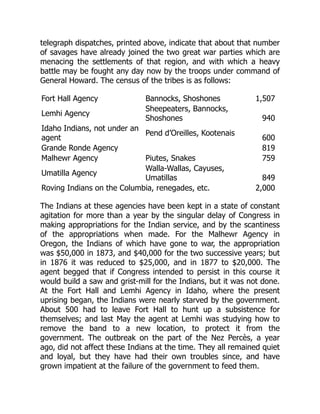







![GEORGIA.
Atlanta University—Examinations and Commencement.
REPORT AND COMMENTS BY A GEORGIA EDITOR.
[From the Macon Telegraph and Messenger.]
For several days the Board of Visitors, appointed by the Governor to
the State University, have been diligently attending the recitations of
the several classes of this colored seat of learning, and are greatly
pleased with what they have seen.
The pupils are perfectly orderly, well behaved and respectful in their
demeanor, and not a few are good scholars, and give satisfactory
evidences of progress.
A large preponderance are of mixed blood, and several would pass
for white anywhere. There is no perceptible difference, in the
aptness to learn, between the mulatto and his coal-black associate.
Perhaps the latter sticks closest to the text-book, and is less
disposed to investigate. But this may be owing to his superior
tractability and habits of obedience. Some of the best students, male
and female, are full-blooded Africans.
They read Greek and Latin, demonstrated problems in mathematics,
discoursed upon international law and the Constitution, recited
history, geography and grammar, and, in short, pursued successfully
the curriculum of our highest schools.
To the questions propounded by the Board, too, they usually gave
sensible and intelligent replies, showing powers of thought and self-
reliance not commonly attributed to our colored people. Indeed,
while it would be wrong to say that the recitations were perfect, yet
it can truly be affirmed that they were highly creditable, and
compared well with the examinations of our white institutions. Again
we repeat, the decorum and behavior of the entire body of students](https://image.slidesharecdn.com/34815-250617030218-02c6acf6/85/Multiscale-Structural-Topology-Optimization-1st-Edition-Liang-Xia-45-320.jpg)