News Reporting
& new writing
Presented to:
Sir Ali Haider
Presented by:
Fabiha Ijaz(602)
Sheryar Sajid (624)
Mahnoor Noor (611)
Manahil Fatima (614)
Talha Qazi(605)
BS4B
Manahil Fatima Zameer (614)
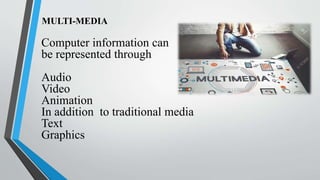
MULTI-MEDIA
Computer information can
be represented through
Audio
Video
Animation
In addition to traditional media
Text
Graphics
What is Multimedia?
Multimedia is a media that uses multiple form of information
content and information processing.
Multimedia is the field concerned with the computer controlled
integration of text, graphics, drawings, still and moving images
(Video), animation, audio, and any other media where every type of
information can be represented, stored, transmitted and processed
digitally
Basic Elements of Multimedia
Text
Graphic
Animation
Video Audio
The Basic Elements of Multimedia
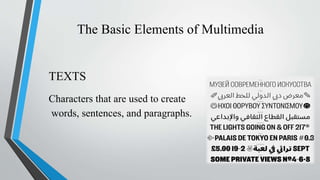
TEXTS
Characters that are used to create
words, sentences, and paragraphs.
The Basic Elements of Multimedia
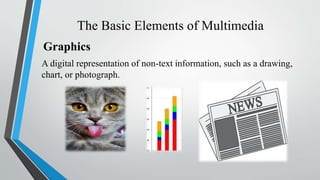
Graphics
A digital representation of non-text information, such as a drawing,
chart, or photograph.
The Basic Elements of Multimedia
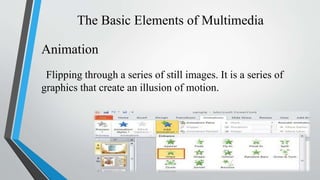
Animation
Flipping through a series of still images. It is a series of
graphics that create an illusion of motion.
Fabiha Ijaz(602)
The Basic Elements of Multimedia
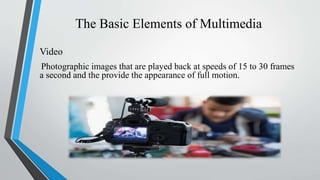
Video
Photographic images that are played back at speeds of 15 to 30 frames
a second and the provide the appearance of full motion.
Photojournalism
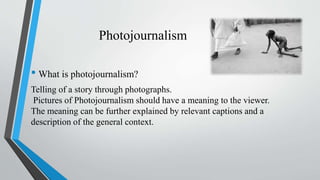
• What is photojournalism?
Telling of a story through photographs.
Pictures of Photojournalism should have a meaning to the viewer.
The meaning can be further explained by relevant captions and a
description of the general context.
Photojournalism
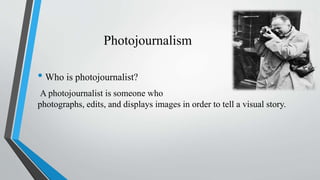
• Who is photojournalist?
A photojournalist is someone who
photographs, edits, and displays images in order to tell a visual story.
Photojournalism
• Difference between photojournalism and photography:
• Photojournalism:
A communicative photography to tell a story.
Photojournalist has the same responsibilities as any other reporter, i.e.
to tell the story without prejudice or preference. Just the truth.
Mahnoor Noor (611)
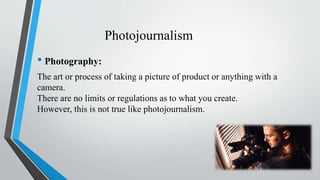
Photojournalism
• Photography:
The art or process of taking a picture of product or anything with a
camera.
There are no limits or regulations as to what you create.
However, this is not true like photojournalism.
Photojournalism
• Purpose of Photojournalism:
It’s all about informing about events as quickly as possible.
Photojournalism
• Characteristics of Photojournalism:
• Following are the characteristics of photojournalism ;
• Photojournalism is relevant
• Photojournalism is timely
• Photojournalism is objective
• Photojournalism is Narrative
Photojournalism
• Photojournalism is relevant:
The main objective of photojournalism is to tell a story better than the
text or write-up that usually accompanies the photos. Therefore, it
should capture images that have meaning or relevance to the story
being told.
Talha Qazi(605)
Photojournalism
• Photojournalism is timely:
Photojournalism should tackle current issues. It should feature
something that’s on the news, or something people are talking about.
This will make the images more interesting to the audience or reader.
Photojournalism
• Photojournalism is objective:
Photojournalism is not biased. It does not take sides.
Therefore, the images should accurately show events as they are.
Some photographers, however, argue that to be completely objective is
quite difficult. According to them, the term “honest” is more appropriate
in describing photojournalism. No matter what a photojournalist believes
in; whether he prefers to be objective or honest, the most important thing
is for him to present the images as is.
Layout Design
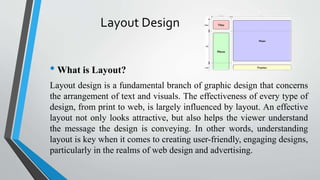
• What is Layout?
Layout design is a fundamental branch of graphic design that concerns
the arrangement of text and visuals. The effectiveness of every type of
design, from print to web, is largely influenced by layout. An effective
layout not only looks attractive, but also helps the viewer understand
the message the design is conveying. In other words, understanding
layout is key when it comes to creating user-friendly, engaging designs,
particularly in the realms of web design and advertising.
Shehryar Sajid (624)
Layout and Design
• Principles of layout design and composition:
Layout is interwoven with other fundamental principles of graphic
design, such as color, contrast, repetition, texture, and typography.
Layout design also encapsulates the principles of hierarchy, balance,
alignment, proximity, and space. Let's take a look at these elements in
more detail so that we can better understand how each contributes to
effective layout design.
Layout and Design
• Layout design elements :
In graphic design, layouts may contain a number of different elements.
Below are some of the most common design elements that contribute to
layout;
• Text:
Text elements include titles, headings, and paragraphs. In text-heavy
designs, these elements should be laid out in an intuitive way that's easy to
read.
Layout and Design
• Images:
Photographs and other visuals, such as illustrations, help to break up
text and communicate certain messages. They are particularly effective
at engaging viewers through emotion.
• Lines: Lines are used to divide sections. They can also add emphasis
to text.
Layout and design
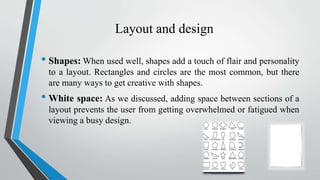
• Shapes: When used well, shapes add a touch of flair and personality
to a layout. Rectangles and circles are the most common, but there
are many ways to get creative with shapes.
• White space: As we discussed, adding space between sections of a
layout prevents the user from getting overwhelmed or fatigued when
viewing a busy design.
THANKYOU class

Multimedia, Photojournalism, layout and design

  • 1.
  • 2.
    Presented to: Sir AliHaider Presented by: Fabiha Ijaz(602) Sheryar Sajid (624) Mahnoor Noor (611) Manahil Fatima (614) Talha Qazi(605) BS4B
  • 3.
  • 4.
    MULTI-MEDIA Computer information can berepresented through Audio Video Animation In addition to traditional media Text Graphics
  • 5.
    What is Multimedia? Multimediais a media that uses multiple form of information content and information processing. Multimedia is the field concerned with the computer controlled integration of text, graphics, drawings, still and moving images (Video), animation, audio, and any other media where every type of information can be represented, stored, transmitted and processed digitally
  • 6.
    Basic Elements ofMultimedia Text Graphic Animation Video Audio
  • 7.
    The Basic Elementsof Multimedia TEXTS Characters that are used to create words, sentences, and paragraphs.
  • 8.
    The Basic Elementsof Multimedia Graphics A digital representation of non-text information, such as a drawing, chart, or photograph.
  • 9.
    The Basic Elementsof Multimedia Animation Flipping through a series of still images. It is a series of graphics that create an illusion of motion.
  • 10.
  • 11.
    The Basic Elementsof Multimedia Video Photographic images that are played back at speeds of 15 to 30 frames a second and the provide the appearance of full motion.
  • 12.
    Photojournalism • What isphotojournalism? Telling of a story through photographs. Pictures of Photojournalism should have a meaning to the viewer. The meaning can be further explained by relevant captions and a description of the general context.
  • 13.
    Photojournalism • Who isphotojournalist? A photojournalist is someone who photographs, edits, and displays images in order to tell a visual story.
  • 14.
    Photojournalism • Difference betweenphotojournalism and photography: • Photojournalism: A communicative photography to tell a story. Photojournalist has the same responsibilities as any other reporter, i.e. to tell the story without prejudice or preference. Just the truth.
  • 15.
  • 16.
    Photojournalism • Photography: The artor process of taking a picture of product or anything with a camera. There are no limits or regulations as to what you create. However, this is not true like photojournalism.
  • 17.
    Photojournalism • Purpose ofPhotojournalism: It’s all about informing about events as quickly as possible.
  • 18.
    Photojournalism • Characteristics ofPhotojournalism: • Following are the characteristics of photojournalism ; • Photojournalism is relevant • Photojournalism is timely • Photojournalism is objective • Photojournalism is Narrative
  • 19.
    Photojournalism • Photojournalism isrelevant: The main objective of photojournalism is to tell a story better than the text or write-up that usually accompanies the photos. Therefore, it should capture images that have meaning or relevance to the story being told.
  • 20.
  • 21.
    Photojournalism • Photojournalism istimely: Photojournalism should tackle current issues. It should feature something that’s on the news, or something people are talking about. This will make the images more interesting to the audience or reader.
  • 22.
    Photojournalism • Photojournalism isobjective: Photojournalism is not biased. It does not take sides. Therefore, the images should accurately show events as they are. Some photographers, however, argue that to be completely objective is quite difficult. According to them, the term “honest” is more appropriate in describing photojournalism. No matter what a photojournalist believes in; whether he prefers to be objective or honest, the most important thing is for him to present the images as is.
  • 23.
    Layout Design • Whatis Layout? Layout design is a fundamental branch of graphic design that concerns the arrangement of text and visuals. The effectiveness of every type of design, from print to web, is largely influenced by layout. An effective layout not only looks attractive, but also helps the viewer understand the message the design is conveying. In other words, understanding layout is key when it comes to creating user-friendly, engaging designs, particularly in the realms of web design and advertising.
  • 24.
  • 25.
    Layout and Design •Principles of layout design and composition: Layout is interwoven with other fundamental principles of graphic design, such as color, contrast, repetition, texture, and typography. Layout design also encapsulates the principles of hierarchy, balance, alignment, proximity, and space. Let's take a look at these elements in more detail so that we can better understand how each contributes to effective layout design.
  • 26.
    Layout and Design •Layout design elements : In graphic design, layouts may contain a number of different elements. Below are some of the most common design elements that contribute to layout; • Text: Text elements include titles, headings, and paragraphs. In text-heavy designs, these elements should be laid out in an intuitive way that's easy to read.
  • 27.
    Layout and Design •Images: Photographs and other visuals, such as illustrations, help to break up text and communicate certain messages. They are particularly effective at engaging viewers through emotion. • Lines: Lines are used to divide sections. They can also add emphasis to text.
  • 28.
    Layout and design •Shapes: When used well, shapes add a touch of flair and personality to a layout. Rectangles and circles are the most common, but there are many ways to get creative with shapes. • White space: As we discussed, adding space between sections of a layout prevents the user from getting overwhelmed or fatigued when viewing a busy design.
  • 29.