What is the multi-matrix brain game?
“Develop the brain through integration of multiple senses
within a 3-dimensional motor challenge. Special letter,
number, dot, and symbol dice are combined with brain loads
to maximize sensory development. Used by occupational
therapists, teachers, and parents worldwide, this popular
game is a great developmental tool that can be modified to
create hundreds of games.”
- multimatrixbraingame.com
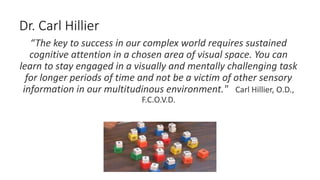
Dr. Carl Hillier
“The key to success in our complex world requires sustained
cognitive attention in a chosen area of visual space. You can
learn to stay engaged in a visually and mentally challenging task
for longer periods of time and not be a victim of other sensory
information in our multitudinous environment." Carl Hillier, O.D.,
F.C.O.V.D.
About Dr. Carl Hillier
 Became a Doctor of Optometry in 1982.
 Founded the Vision Rehabilitation Clinic at the San Diego
Rehabilitation Institute at Alvarado Hospital.
 He often guest lectures about brain injury at various
hospitals around the United States.
 Currently resides in San Diego with his wife (also an
Optometrist) and together they created the San Diego Center
for Vision Care.
What MMBG can address
● Memory Development
● Visual Perceptual Skills
● Ocular-Motor Skills
● Motor Control
● Sequential Planning
● Sustained Attention
MMBG Targets...
★ Eye-Hand Coordination
★ Visual Tracking
★ Visual Discrimination
★ Peripheral Vision
★ Binocularity
★ Eye Movement Control
★ Vestibular System
★ Motor Control
★ Reading Skills
★ Memory Development
★ Pattern Recognition
★ Spatial Awareness
★ Sustained Attention
★ Whole Brain Learning
★ Sequential Planning
★ Perceptual Learning
★ Vestibular Development
Use The MMBG With
● TBI
● CVA
● Visual field damage
● Convergence insufficiency
● Memory loss
● Ocular-motor deficits
● ADD/ADHD
The MMBG: How It Works
● 25 colored blocks; 25 white blocks
○ Each set with one blank block
○ Letters, numbers, dots, & symbols
● Start with a basic 5x5 grid
○ Bigger colored blocks on bottom with blank side up
■ This eliminates any confusion or distraction
○ Smaller white blocks on top
■ Set aside the blank white block
The MMBG: How It Works
● Move one of the white blocks, in order, on to the next
empty color block
o You can start with fewer blocks, or a smaller grid, to
get used to...then increase until you use all blocks
o Go slowly, then challenge the player to go faster
● Once the player is used to the basic, ask them to use
both hands by alternating each move
o Crossing midline, visual tracking, spatial awareness,
bi-hemisphere integration
Adding Challenges to The MMBG
● Choose a set-up
o 5x5 Grid: spatial organization, sequential processing
o Circle: peripheral awareness, visual field
o Horizontal Line: left/right scanning, repetitive midline
crossing
 Brain injury, visual field, proprioceptive or
differentiation problems
o Vertical Line: peripheral upper/lower fields, focus on
moving eyes vs. head
o Random: memory development
Brain Loads
Language:
• Wordfinding – Naming various objects based off the
color dice being moved to.
• Naming various objects based off the letter being
moved.
• Naming various objects based off of the first letter
of the colored dice that the white dice is landing
on.
Brain Loads
Math: numbers face up on both big and small
dice.
•Ask the player to add, subract, multiply, or divide
numbers on blocks that are being moved.
•Ask the player to say only odd or even numbers
that are moved.
•Adding, multiplying, dividing, or subrtracting only
odd or even numbers moved.
Vestibular
•Have player turn head to look at something
behind after each dice is moved.
•After each dice is moved spin chair once in full
360 degree circle -- increases eye control (typically
used with child)
•Have player alternate between playing game in
front of body and behind body.
Brain Loads
Motor:
• Place dice closer together for increased FMC
• Place colored dice on top of white dice to increase motor
control concentration
• Place dice further apart to increase gross motor control
and upper extremity endurance
• Ask player to pick up dice using various opposition with
fingers
• Ask player to move one or two upper extremities or lower
extremities after each move
• Ask player to use adapted chop sticks to move dice
Brain Loads
Auditory:
• Add auditory stimulus to the environment while the
player concentrates on the task
• Have a conversation with another person in the room
while asking the player to concentrate on the task
• Ask the player a question after each move is made
• Auditory brain load increases the ability for the
player to process multi-sensory inputs
Brain Loads
Bi-hemispherical integration: integrating the
right and left sides of the brain
•Ask the player to alternate upper extremities
during activity
•Ask the player to alternate upper extremities
while moving opposite lower extremities
•Set up dice in one horizontal line to promote
crossing midline
Brain Load
• Visual Perceptual
• Cards included in the MMBG to address:
• Visual tracking: the eyes moving in harmony with each other
from one object to another
• Visual figure-ground: the ability to identify a figure from the
background
• Visual closure: the ability to visualize a whole object when
given an incomplete picture or partial information
• Visual closure can effect someone’s reading speed and
accuracy.
• Someone with a deficit in visual closure may mistake words
that have similar beginnings and endings.
The 80/20 Challenge
The 80/20 challenge is finding the “just right” challenge for
the patient.
• 80 percent of what you ask the patient to do should
come fairly easily, while 20 percent should require
complete concentration. The 80/20 challenge allows the
patient to feel accomplished while still being
challenged.
CE/PDUs Offered
● Sensory Integration Techniques for Healthcare
Providers - all-video online course
o CE/PDU’s for OT, RN, LVN, APN, Nurse
Educator, Rehab Nurse, Social Workers
● Participants will discover a plethora of SI
techniques using The MMBG as a tool for visual,
cognitive, motor, and language development.
CE/PDUs
● $99 Course Includes:
o Award winning online video course
o The Multi-Matrix therapy game
o Certificate of completion for 4.0 contact hours
● Course Requirements:
o Completion of online course
o Course evaluation
o Post-test with score of 80% or greater
To Purchase
● multimatrixgame.com
○ Cost: $44.95 + SH
○ Includes: magnetic box, 25 colored dice, 25
white dice, 3 pattern cards, and access to
training videos online.

Multi-Matrix- The Brain Game

  • 2.
    What is themulti-matrix brain game? “Develop the brain through integration of multiple senses within a 3-dimensional motor challenge. Special letter, number, dot, and symbol dice are combined with brain loads to maximize sensory development. Used by occupational therapists, teachers, and parents worldwide, this popular game is a great developmental tool that can be modified to create hundreds of games.” - multimatrixbraingame.com
  • 3.
    Dr. Carl Hillier “Thekey to success in our complex world requires sustained cognitive attention in a chosen area of visual space. You can learn to stay engaged in a visually and mentally challenging task for longer periods of time and not be a victim of other sensory information in our multitudinous environment." Carl Hillier, O.D., F.C.O.V.D.
  • 4.
    About Dr. CarlHillier  Became a Doctor of Optometry in 1982.  Founded the Vision Rehabilitation Clinic at the San Diego Rehabilitation Institute at Alvarado Hospital.  He often guest lectures about brain injury at various hospitals around the United States.  Currently resides in San Diego with his wife (also an Optometrist) and together they created the San Diego Center for Vision Care.
  • 5.
    What MMBG canaddress ● Memory Development ● Visual Perceptual Skills ● Ocular-Motor Skills ● Motor Control ● Sequential Planning ● Sustained Attention
  • 6.
    MMBG Targets... ★ Eye-HandCoordination ★ Visual Tracking ★ Visual Discrimination ★ Peripheral Vision ★ Binocularity ★ Eye Movement Control ★ Vestibular System ★ Motor Control ★ Reading Skills ★ Memory Development ★ Pattern Recognition ★ Spatial Awareness ★ Sustained Attention ★ Whole Brain Learning ★ Sequential Planning ★ Perceptual Learning ★ Vestibular Development
  • 7.
    Use The MMBGWith ● TBI ● CVA ● Visual field damage ● Convergence insufficiency ● Memory loss ● Ocular-motor deficits ● ADD/ADHD
  • 8.
    The MMBG: HowIt Works ● 25 colored blocks; 25 white blocks ○ Each set with one blank block ○ Letters, numbers, dots, & symbols ● Start with a basic 5x5 grid ○ Bigger colored blocks on bottom with blank side up ■ This eliminates any confusion or distraction ○ Smaller white blocks on top ■ Set aside the blank white block
  • 9.
    The MMBG: HowIt Works ● Move one of the white blocks, in order, on to the next empty color block o You can start with fewer blocks, or a smaller grid, to get used to...then increase until you use all blocks o Go slowly, then challenge the player to go faster ● Once the player is used to the basic, ask them to use both hands by alternating each move o Crossing midline, visual tracking, spatial awareness, bi-hemisphere integration
  • 10.
    Adding Challenges toThe MMBG ● Choose a set-up o 5x5 Grid: spatial organization, sequential processing o Circle: peripheral awareness, visual field o Horizontal Line: left/right scanning, repetitive midline crossing  Brain injury, visual field, proprioceptive or differentiation problems o Vertical Line: peripheral upper/lower fields, focus on moving eyes vs. head o Random: memory development
  • 11.
    Brain Loads Language: • Wordfinding– Naming various objects based off the color dice being moved to. • Naming various objects based off the letter being moved. • Naming various objects based off of the first letter of the colored dice that the white dice is landing on.
  • 12.
    Brain Loads Math: numbersface up on both big and small dice. •Ask the player to add, subract, multiply, or divide numbers on blocks that are being moved. •Ask the player to say only odd or even numbers that are moved. •Adding, multiplying, dividing, or subrtracting only odd or even numbers moved.
  • 13.
    Vestibular •Have player turnhead to look at something behind after each dice is moved. •After each dice is moved spin chair once in full 360 degree circle -- increases eye control (typically used with child) •Have player alternate between playing game in front of body and behind body.
  • 14.
    Brain Loads Motor: • Placedice closer together for increased FMC • Place colored dice on top of white dice to increase motor control concentration • Place dice further apart to increase gross motor control and upper extremity endurance • Ask player to pick up dice using various opposition with fingers • Ask player to move one or two upper extremities or lower extremities after each move • Ask player to use adapted chop sticks to move dice
  • 15.
    Brain Loads Auditory: • Addauditory stimulus to the environment while the player concentrates on the task • Have a conversation with another person in the room while asking the player to concentrate on the task • Ask the player a question after each move is made • Auditory brain load increases the ability for the player to process multi-sensory inputs
  • 16.
    Brain Loads Bi-hemispherical integration:integrating the right and left sides of the brain •Ask the player to alternate upper extremities during activity •Ask the player to alternate upper extremities while moving opposite lower extremities •Set up dice in one horizontal line to promote crossing midline
  • 17.
    Brain Load • VisualPerceptual • Cards included in the MMBG to address: • Visual tracking: the eyes moving in harmony with each other from one object to another • Visual figure-ground: the ability to identify a figure from the background • Visual closure: the ability to visualize a whole object when given an incomplete picture or partial information • Visual closure can effect someone’s reading speed and accuracy. • Someone with a deficit in visual closure may mistake words that have similar beginnings and endings.
  • 18.
    The 80/20 Challenge The80/20 challenge is finding the “just right” challenge for the patient. • 80 percent of what you ask the patient to do should come fairly easily, while 20 percent should require complete concentration. The 80/20 challenge allows the patient to feel accomplished while still being challenged.
  • 19.
    CE/PDUs Offered ● SensoryIntegration Techniques for Healthcare Providers - all-video online course o CE/PDU’s for OT, RN, LVN, APN, Nurse Educator, Rehab Nurse, Social Workers ● Participants will discover a plethora of SI techniques using The MMBG as a tool for visual, cognitive, motor, and language development.
  • 20.
    CE/PDUs ● $99 CourseIncludes: o Award winning online video course o The Multi-Matrix therapy game o Certificate of completion for 4.0 contact hours ● Course Requirements: o Completion of online course o Course evaluation o Post-test with score of 80% or greater
  • 21.
    To Purchase ● multimatrixgame.com ○Cost: $44.95 + SH ○ Includes: magnetic box, 25 colored dice, 25 white dice, 3 pattern cards, and access to training videos online.