Multifunctional Surfactants
Essential ingredients for efficient cleaning products
Sorel Muresan, Jinnan Liu
R&D Cleaning applications
Q&A
Summary
Applications and performance data
Multifunctional Surfactants
AkzoNobel at a glance
Outlook
Surface Chemistry | CCIA 2016 2
Company presentation 2016 3
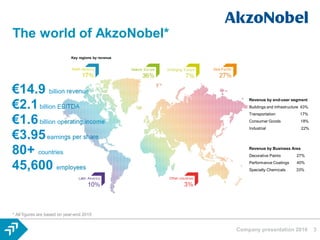
The world of AkzoNobel*
€14.9 billion revenue
€2.1billion EBITDA
€1.6billion operating income
€3.95earnings per share
80+ countries
45,600 employees
Revenue by end-user segment
Buildings and Infrastructure 43%
Transportation 17%
Consumer Goods 18%
Industrial 22%
Revenue by Business Area
Decorative Paints 27%
Performance Coatings 40%
Specialty Chemicals 33%
North America
17%
Mature Europe
36%
Asia Pacific
27%
Other countries
3%
Emerging Europe
7%
Latin America
10%
Key regions by revenue
* All figures are based on year-end 2015
4Company presentation 2016
Our sustainability strategy
20%
of revenue by 2020 from products
that are more sustainable for
our customers than those of our
competitors
25-30%
more efficient resource and energy
use across the entire value chain by
2020 (measured by cradle-to-grave
carbon footprint reduction)
>4 out of 5
Employee engagement score,
as measured by Gallup Q12
Sustainable
business
Resource
efficiency
Capable, engaged
people
Sustainable innovation
4,000AkzoNobel scientists work closely with customers around the world
to develop sustainable solutions for the challenges people face every day
.
€346 million
is the amount we invested in research and development in 2015
20%of our innovations will provide distinct sustainability benefits for our
customers and their value chains, according to targets we have set
Expanding our expertise
We recently opened a new technology center in Shanghai:
The company's largest research
facility in China
Supports product innovation and development of next
generation paints, coatings and specialty chemicals
Currently employs
150 scientists
Will help to drive our innovation agenda as we continue
to build a resilient portfolio of more sustainable products
The €6.5 million center is
located in Songjiang
Essential
color
Essential
ingredients
Essential
protection
WE CREATE
EVERYDAY
ESSENTIALS TO
MAKE PEOPLE’S
LIVES MORE
LIVEABLE AND
INSPIRING
Water based cleaning products are continuously
evolving driven by several factors
increased performance and safety demands from
consumers
challenging regulatory requirements
cost
Multifunctional surfactants bring additional value to
cleaning products
high performance at low concentration
foam control, tolerance to alkali and electrolytes,
thickening
minimal impact on the environment and low human
and aquatic toxicity
Surface Chemistry | CCIA 2016 8
Multifunctional surfactants
Narrow range fatty alcohol ethoxylates
Hydrotropic cosurfactants
Cationic thickeners
Surface Chemistry | CCIA 2016 9
Multifunctional surfactants
Surface Chemistry | CCIA 2016 10
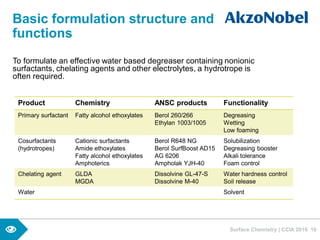
Basic formulation structure and
functions
To formulate an effective water based degreaser containing nonionic
surfactants, chelating agents and other electrolytes, a hydrotrope is
often required.
Product Chemistry ANSC products Functionality
Primary surfactant Fatty alcohol ethoxylates Berol 260/266
Ethylan 1003/1005
Degreasing
Wetting
Low foaming
Cosurfactants
(hydrotropes)
Cationic surfactants
Amide ethoxylates
Fatty alcohol ethoxylates
Amphoterics
Berol R648 NG
Berol SurfBoost AD15
AG 6206
Ampholak YJH-40
Solubilization
Degreasing booster
Alkali tolerance
Foam control
Chelating agent GLDA
MGDA
Dissolvine GL-47-S
Dissolvine M-40
Water hardness control
Soil release
Water Solvent
Surface Chemistry | CCIA 2016 11
What are you looking for in an
alcohol ethoxylate?
Highly targeted performance
Effective at very low concentrations
Low residual free alcohol
Better low temperature handling
Low foam profile
Wide range of applications
Surface Chemistry | CCIA 2016 12
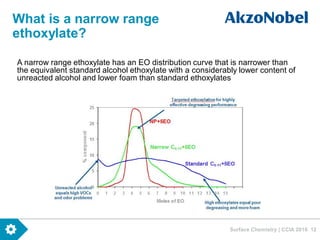
What is a narrow range
ethoxylate?
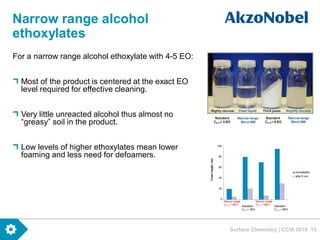
A narrow range ethoxylate has an EO distribution curve that is narrower than
the equivalent standard alcohol ethoxylate with a considerably lower content of
unreacted alcohol and lower foam than standard ethoxylates
Surface Chemistry | CCIA 2016 13
Narrow range alcohol
ethoxylates
For a narrow range alcohol ethoxylate with 4-5 EO:
Most of the product is centered at the exact EO
level required for effective cleaning.
Very little unreacted alcohol thus almost no
“greasy” soil in the product.
Low levels of higher ethoxylates mean lower
foaming and less need for defoamers.
Surface Chemistry | CCIA 2016 14
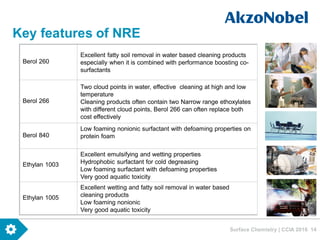
Key features of NRE
Berol 260
Excellent fatty soil removal in water based cleaning products
especially when it is combined with performance boosting co-
surfactants
Berol 266
Two cloud points in water, effective cleaning at high and low
temperature
Cleaning products often contain two Narrow range ethoxylates
with different cloud points, Berol 266 can often replace both
cost effectively
Berol 840
Low foaming nonionic surfactant with defoaming properties on
protein foam
Ethylan 1003
Excellent emulsifying and wetting properties
Hydrophobic surfactant for cold degreasing
Low foaming surfactant with defoaming properties
Very good aquatic toxicity
Ethylan 1005
Excellent wetting and fatty soil removal in water based
cleaning products
Low foaming nonionic
Very good aquatic toxicity
Surface Chemistry | CCIA 2016 15
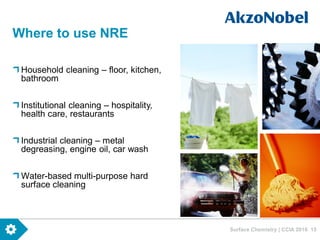
Where to use NRE
Household cleaning – floor, kitchen,
bathroom
Institutional cleaning – hospitality,
health care, restaurants
Industrial cleaning – metal
degreasing, engine oil, car wash
Water-based multi-purpose hard
surface cleaning
Surface Chemistry | CCIA 2016 16
Hydrotropes
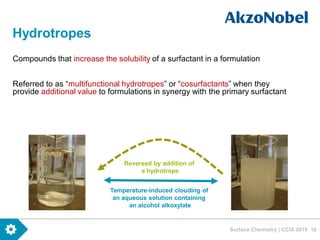
Compounds that increase the solubility of a surfactant in a formulation
Referred to as “multifunctional hydrotropes” or “cosurfactants” when they
provide additional value to formulations in synergy with the primary surfactant
Temperature-induced clouding of
an aqueous solution containing
an alcohol alkoxylate
Reversed by addition of
a hydrotrope
Surface Chemistry | CCIA 2016 17
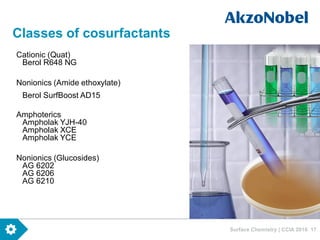
Classes of cosurfactants
Cationic (Quat)
Berol R648 NG
Nonionics (Amide ethoxylate)
Berol SurfBoost AD15
Amphoterics
Ampholak YJH-40
Ampholak XCE
Ampholak YCE
Nonionics (Glucosides)
AG 6202
AG 6206
AG 6210
Surface Chemistry | CCIA 2016 18
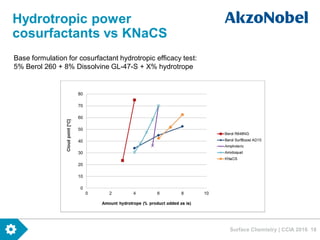
Hydrotropic power
cosurfactants vs KNaCS
Base formulation for cosurfactant hydrotropic efficacy test:
5% Berol 260 + 8% Dissolvine GL-47-S + X% hydrotrope
Surface Chemistry | CCIA 2016 19
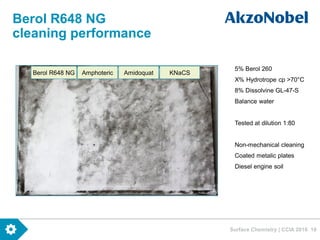
Berol R648 NG
cleaning performance
5% Berol 260
X% Hydrotrope cp >70°C
8% Dissolvine GL-47-S
Balance water
Tested at dilution 1:80
Non-mechanical cleaning
Coated metalic plates
Diesel engine soil
Berol R648 NG Amphoteric Amidoquat KNaCS
Surface Chemistry | CCIA 2016 20
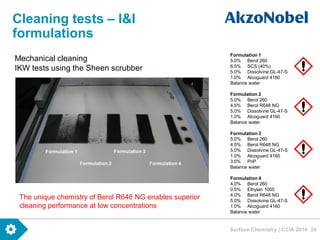
Cleaning tests – I&I
formulations
Formulation 1
Formulation 2
Formulation 3
Formulation 4
Formulation 1
5.0% Berol 260
6.5% SCS (40%)
5.0% Dissolvine GL-47-S
1.0% Alcoguard 4160
Balance water
Formulation 2
5.0% Berol 260
4.5% Berol R648 NG
5.0% Dissolvine GL-47-S
1.0% Alcoguard 4160
Balance water
Formulation 3
5.0% Berol 260
4.5% Berol R648 NG
5.0% Dissolvine GL-47-S
1.0% Alcoguard 4160
3.0% PnP
Balance water
Formulation 4
4.0% Berol 260
0.5% Ethylan 1005
4.0% Berol R648 NG
5.0% Dissolvine GL-47-S
1.0% Alcoguard 4160
Balance water
Mechanical cleaning
IKW tests using the Sheen scrubber
The unique chemistry of Berol R648 NG enables superior
cleaning performance at low concentrations
Surface Chemistry | CCIA 2016 21
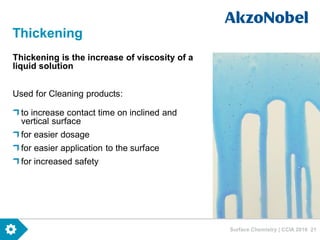
Thickening
Thickening is the increase of viscosity of a
liquid solution
Used for Cleaning products:
to increase contact time on inclined and
vertical surface
for easier dosage
for easier application to the surface
for increased safety
Surface Chemistry | CCIA 2016 22
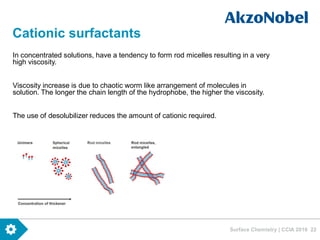
Cationic surfactants
In concentrated solutions, have a tendency to form rod micelles resulting in a very
high viscosity.
Viscosity increase is due to chaotic worm like arrangement of molecules in
solution. The longer the chain length of the hydrophobe, the higher the viscosity.
The use of desolubilizer reduces the amount of cationic required.
Surface Chemistry | CCIA 2016 23
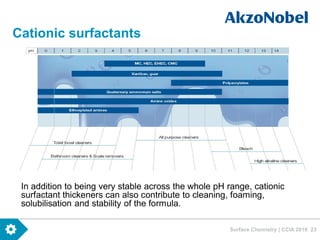
Cationic surfactants
In addition to being very stable across the whole pH range, cationic
surfactant thickeners can also contribute to cleaning, foaming,
solubilisation and stability of the formula.
Surface Chemistry | CCIA 2016 24
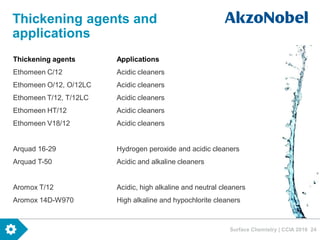
Thickening agents and
applications
Thickening agents Applications
Ethomeen C/12 Acidic cleaners
Ethomeen O/12, O/12LC Acidic cleaners
Ethomeen T/12, T/12LC Acidic cleaners
Ethomeen HT/12 Acidic cleaners
Ethomeen V18/12 Acidic cleaners
Arquad 16-29 Hydrogen peroxide and acidic cleaners
Arquad T-50 Acidic and alkaline cleaners
Aromox T/12 Acidic, high alkaline and neutral cleaners
Aromox 14D-W970 High alkaline and hypochlorite cleaners
Surface Chemistry | CCIA 2016 25
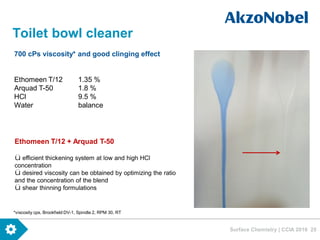
Toilet bowl cleaner
700 cPs viscosity* and good clinging effect
Ethomeen T/12 1.35 %
Arquad T-50 1.8 %
HCl 9.5 %
Water balance
Ethomeen T/12 + Arquad T-50
ü efficient thickening system at low and high HCl
concentration
ü desired viscosity can be obtained by optimizing the ratio
and the concentration of the blend
ü shear thinning formulations
*viscosity cps, Brookfield DV-1, Spindle 2, RPM 30, RT
Surface Chemistry | CCIA 2016 26
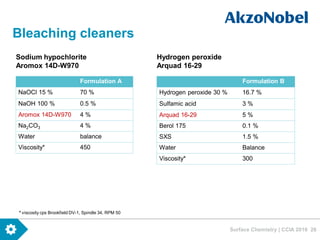
Bleaching cleaners
Formulation A
NaOCl 15 % 70 %
NaOH 100 % 0.5 %
Aromox 14D-W970 4 %
Na2CO3 4 %
Water balance
Viscosity* 450
Sodium hypochlorite
Aromox 14D-W970
* viscosity cps Brookfield DV-1, Spindle 34, RPM 50
Formulation B
Hydrogen peroxide 30 % 16.7 %
Sulfamic acid 3 %
Arquad 16-29 5 %
Berol 175 0.1 %
SXS 1.5 %
Water Balance
Viscosity* 300
Hydrogen peroxide
Arquad 16-29
27Surface Chemistry | CCIA 2016
Summary
Surface Chemistry | CCIA 2016 28
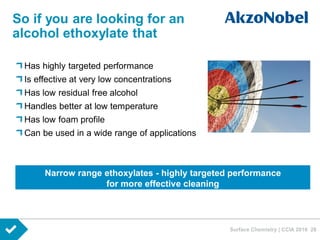
So if you are looking for an
alcohol ethoxylate that
Has highly targeted performance
Is effective at very low concentrations
Has low residual free alcohol
Handles better at low temperature
Has low foam profile
Can be used in a wide range of applications
Narrow range ethoxylates - highly targeted performance
for more effective cleaning
Surface Chemistry | CCIA 2016 29
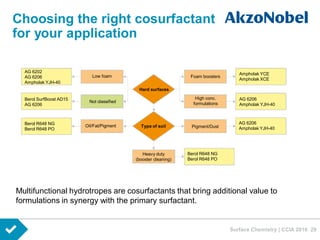
Choosing the right cosurfactant
for your application
Multifunctional hydrotropes are cosurfactants that bring additional value to
formulations in synergy with the primary surfactant.
AG 6202
AG 6206
Ampholak YJH-40
Berol SurfBoost AD15
AG 6206
Oil/Fat/Pigment
Low foam
Not classified
High conc.
formulations
Hard surfaces
Pigment/Dust
Heavy duty
(booster cleaning)
Foam boosters
Type of soil
Berol R648 NG
Berol R648 PO
Berol R648 NG
Berol R648 PO
AG 6206
Ampholak YJH-40
AG 6206
Ampholak YJH-40
Ampholak YCE
Ampholak XCE
Surface Chemistry | CCIA 2016 30
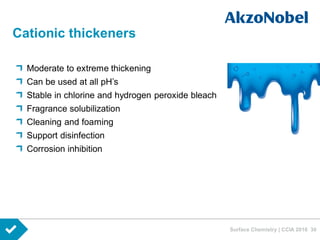
Cationic thickeners
Moderate to extreme thickening
Can be used at all pH’s
Stable in chlorine and hydrogen peroxide bleach
Fragrance solubilization
Cleaning and foaming
Support disinfection
Corrosion inhibition
Thank you
Surface Chemistry | CCIA 2016 32
Legal disclaimer

Multifunctional Surfactants - Essential ingredients for efficient cleaning products

  • 1.
    Multifunctional Surfactants Essential ingredientsfor efficient cleaning products Sorel Muresan, Jinnan Liu R&D Cleaning applications
  • 2.
    Q&A Summary Applications and performancedata Multifunctional Surfactants AkzoNobel at a glance Outlook Surface Chemistry | CCIA 2016 2
  • 3.
    Company presentation 20163 The world of AkzoNobel* €14.9 billion revenue €2.1billion EBITDA €1.6billion operating income €3.95earnings per share 80+ countries 45,600 employees Revenue by end-user segment Buildings and Infrastructure 43% Transportation 17% Consumer Goods 18% Industrial 22% Revenue by Business Area Decorative Paints 27% Performance Coatings 40% Specialty Chemicals 33% North America 17% Mature Europe 36% Asia Pacific 27% Other countries 3% Emerging Europe 7% Latin America 10% Key regions by revenue * All figures are based on year-end 2015
  • 4.
    4Company presentation 2016 Oursustainability strategy 20% of revenue by 2020 from products that are more sustainable for our customers than those of our competitors 25-30% more efficient resource and energy use across the entire value chain by 2020 (measured by cradle-to-grave carbon footprint reduction) >4 out of 5 Employee engagement score, as measured by Gallup Q12 Sustainable business Resource efficiency Capable, engaged people
  • 5.
    Sustainable innovation 4,000AkzoNobel scientistswork closely with customers around the world to develop sustainable solutions for the challenges people face every day . €346 million is the amount we invested in research and development in 2015 20%of our innovations will provide distinct sustainability benefits for our customers and their value chains, according to targets we have set
  • 6.
    Expanding our expertise Werecently opened a new technology center in Shanghai: The company's largest research facility in China Supports product innovation and development of next generation paints, coatings and specialty chemicals Currently employs 150 scientists Will help to drive our innovation agenda as we continue to build a resilient portfolio of more sustainable products The €6.5 million center is located in Songjiang
  • 7.
  • 8.
    Water based cleaningproducts are continuously evolving driven by several factors increased performance and safety demands from consumers challenging regulatory requirements cost Multifunctional surfactants bring additional value to cleaning products high performance at low concentration foam control, tolerance to alkali and electrolytes, thickening minimal impact on the environment and low human and aquatic toxicity Surface Chemistry | CCIA 2016 8 Multifunctional surfactants
  • 9.
    Narrow range fattyalcohol ethoxylates Hydrotropic cosurfactants Cationic thickeners Surface Chemistry | CCIA 2016 9 Multifunctional surfactants
  • 10.
    Surface Chemistry |CCIA 2016 10 Basic formulation structure and functions To formulate an effective water based degreaser containing nonionic surfactants, chelating agents and other electrolytes, a hydrotrope is often required. Product Chemistry ANSC products Functionality Primary surfactant Fatty alcohol ethoxylates Berol 260/266 Ethylan 1003/1005 Degreasing Wetting Low foaming Cosurfactants (hydrotropes) Cationic surfactants Amide ethoxylates Fatty alcohol ethoxylates Amphoterics Berol R648 NG Berol SurfBoost AD15 AG 6206 Ampholak YJH-40 Solubilization Degreasing booster Alkali tolerance Foam control Chelating agent GLDA MGDA Dissolvine GL-47-S Dissolvine M-40 Water hardness control Soil release Water Solvent
  • 11.
    Surface Chemistry |CCIA 2016 11 What are you looking for in an alcohol ethoxylate? Highly targeted performance Effective at very low concentrations Low residual free alcohol Better low temperature handling Low foam profile Wide range of applications
  • 12.
    Surface Chemistry |CCIA 2016 12 What is a narrow range ethoxylate? A narrow range ethoxylate has an EO distribution curve that is narrower than the equivalent standard alcohol ethoxylate with a considerably lower content of unreacted alcohol and lower foam than standard ethoxylates
  • 13.
    Surface Chemistry |CCIA 2016 13 Narrow range alcohol ethoxylates For a narrow range alcohol ethoxylate with 4-5 EO: Most of the product is centered at the exact EO level required for effective cleaning. Very little unreacted alcohol thus almost no “greasy” soil in the product. Low levels of higher ethoxylates mean lower foaming and less need for defoamers.
  • 14.
    Surface Chemistry |CCIA 2016 14 Key features of NRE Berol 260 Excellent fatty soil removal in water based cleaning products especially when it is combined with performance boosting co- surfactants Berol 266 Two cloud points in water, effective cleaning at high and low temperature Cleaning products often contain two Narrow range ethoxylates with different cloud points, Berol 266 can often replace both cost effectively Berol 840 Low foaming nonionic surfactant with defoaming properties on protein foam Ethylan 1003 Excellent emulsifying and wetting properties Hydrophobic surfactant for cold degreasing Low foaming surfactant with defoaming properties Very good aquatic toxicity Ethylan 1005 Excellent wetting and fatty soil removal in water based cleaning products Low foaming nonionic Very good aquatic toxicity
  • 15.
    Surface Chemistry |CCIA 2016 15 Where to use NRE Household cleaning – floor, kitchen, bathroom Institutional cleaning – hospitality, health care, restaurants Industrial cleaning – metal degreasing, engine oil, car wash Water-based multi-purpose hard surface cleaning
  • 16.
    Surface Chemistry |CCIA 2016 16 Hydrotropes Compounds that increase the solubility of a surfactant in a formulation Referred to as “multifunctional hydrotropes” or “cosurfactants” when they provide additional value to formulations in synergy with the primary surfactant Temperature-induced clouding of an aqueous solution containing an alcohol alkoxylate Reversed by addition of a hydrotrope
  • 17.
    Surface Chemistry |CCIA 2016 17 Classes of cosurfactants Cationic (Quat) Berol R648 NG Nonionics (Amide ethoxylate) Berol SurfBoost AD15 Amphoterics Ampholak YJH-40 Ampholak XCE Ampholak YCE Nonionics (Glucosides) AG 6202 AG 6206 AG 6210
  • 18.
    Surface Chemistry |CCIA 2016 18 Hydrotropic power cosurfactants vs KNaCS Base formulation for cosurfactant hydrotropic efficacy test: 5% Berol 260 + 8% Dissolvine GL-47-S + X% hydrotrope
  • 19.
    Surface Chemistry |CCIA 2016 19 Berol R648 NG cleaning performance 5% Berol 260 X% Hydrotrope cp >70°C 8% Dissolvine GL-47-S Balance water Tested at dilution 1:80 Non-mechanical cleaning Coated metalic plates Diesel engine soil Berol R648 NG Amphoteric Amidoquat KNaCS
  • 20.
    Surface Chemistry |CCIA 2016 20 Cleaning tests – I&I formulations Formulation 1 Formulation 2 Formulation 3 Formulation 4 Formulation 1 5.0% Berol 260 6.5% SCS (40%) 5.0% Dissolvine GL-47-S 1.0% Alcoguard 4160 Balance water Formulation 2 5.0% Berol 260 4.5% Berol R648 NG 5.0% Dissolvine GL-47-S 1.0% Alcoguard 4160 Balance water Formulation 3 5.0% Berol 260 4.5% Berol R648 NG 5.0% Dissolvine GL-47-S 1.0% Alcoguard 4160 3.0% PnP Balance water Formulation 4 4.0% Berol 260 0.5% Ethylan 1005 4.0% Berol R648 NG 5.0% Dissolvine GL-47-S 1.0% Alcoguard 4160 Balance water Mechanical cleaning IKW tests using the Sheen scrubber The unique chemistry of Berol R648 NG enables superior cleaning performance at low concentrations
  • 21.
    Surface Chemistry |CCIA 2016 21 Thickening Thickening is the increase of viscosity of a liquid solution Used for Cleaning products: to increase contact time on inclined and vertical surface for easier dosage for easier application to the surface for increased safety
  • 22.
    Surface Chemistry |CCIA 2016 22 Cationic surfactants In concentrated solutions, have a tendency to form rod micelles resulting in a very high viscosity. Viscosity increase is due to chaotic worm like arrangement of molecules in solution. The longer the chain length of the hydrophobe, the higher the viscosity. The use of desolubilizer reduces the amount of cationic required.
  • 23.
    Surface Chemistry |CCIA 2016 23 Cationic surfactants In addition to being very stable across the whole pH range, cationic surfactant thickeners can also contribute to cleaning, foaming, solubilisation and stability of the formula.
  • 24.
    Surface Chemistry |CCIA 2016 24 Thickening agents and applications Thickening agents Applications Ethomeen C/12 Acidic cleaners Ethomeen O/12, O/12LC Acidic cleaners Ethomeen T/12, T/12LC Acidic cleaners Ethomeen HT/12 Acidic cleaners Ethomeen V18/12 Acidic cleaners Arquad 16-29 Hydrogen peroxide and acidic cleaners Arquad T-50 Acidic and alkaline cleaners Aromox T/12 Acidic, high alkaline and neutral cleaners Aromox 14D-W970 High alkaline and hypochlorite cleaners
  • 25.
    Surface Chemistry |CCIA 2016 25 Toilet bowl cleaner 700 cPs viscosity* and good clinging effect Ethomeen T/12 1.35 % Arquad T-50 1.8 % HCl 9.5 % Water balance Ethomeen T/12 + Arquad T-50 ü efficient thickening system at low and high HCl concentration ü desired viscosity can be obtained by optimizing the ratio and the concentration of the blend ü shear thinning formulations *viscosity cps, Brookfield DV-1, Spindle 2, RPM 30, RT
  • 26.
    Surface Chemistry |CCIA 2016 26 Bleaching cleaners Formulation A NaOCl 15 % 70 % NaOH 100 % 0.5 % Aromox 14D-W970 4 % Na2CO3 4 % Water balance Viscosity* 450 Sodium hypochlorite Aromox 14D-W970 * viscosity cps Brookfield DV-1, Spindle 34, RPM 50 Formulation B Hydrogen peroxide 30 % 16.7 % Sulfamic acid 3 % Arquad 16-29 5 % Berol 175 0.1 % SXS 1.5 % Water Balance Viscosity* 300 Hydrogen peroxide Arquad 16-29
  • 27.
    27Surface Chemistry |CCIA 2016 Summary
  • 28.
    Surface Chemistry |CCIA 2016 28 So if you are looking for an alcohol ethoxylate that Has highly targeted performance Is effective at very low concentrations Has low residual free alcohol Handles better at low temperature Has low foam profile Can be used in a wide range of applications Narrow range ethoxylates - highly targeted performance for more effective cleaning
  • 29.
    Surface Chemistry |CCIA 2016 29 Choosing the right cosurfactant for your application Multifunctional hydrotropes are cosurfactants that bring additional value to formulations in synergy with the primary surfactant. AG 6202 AG 6206 Ampholak YJH-40 Berol SurfBoost AD15 AG 6206 Oil/Fat/Pigment Low foam Not classified High conc. formulations Hard surfaces Pigment/Dust Heavy duty (booster cleaning) Foam boosters Type of soil Berol R648 NG Berol R648 PO Berol R648 NG Berol R648 PO AG 6206 Ampholak YJH-40 AG 6206 Ampholak YJH-40 Ampholak YCE Ampholak XCE
  • 30.
    Surface Chemistry |CCIA 2016 30 Cationic thickeners Moderate to extreme thickening Can be used at all pH’s Stable in chlorine and hydrogen peroxide bleach Fragrance solubilization Cleaning and foaming Support disinfection Corrosion inhibition
  • 31.
  • 32.
    Surface Chemistry |CCIA 2016 32 Legal disclaimer