Service mesh together
with API management
Surat MuleSoft Meetup Group
June 23, 2022
Safe Harbour Statement
● Both the speaker and the host are organizing this meet-up in individual capacity only. We are
not representing our companies here.
● This presentation is strictly for learning purposes only. Organizer/Presenter do not hold any
responsibility that same solution will work for your business requirements.
● This presentation is not meant for any promotional activities.
2
A recording of this meetup will be uploaded to events page within 24 hours.
Questions can be submitted/asked at any time in the Chat/Questions & AnswersTab.
Make it more Interactive!!!
Give us feedback! Rate this meetup session by filling feedback form at the end of theday.
We Love Feedbacks!!! Its Bread & Butter for Meetup.
Housekeeping
3
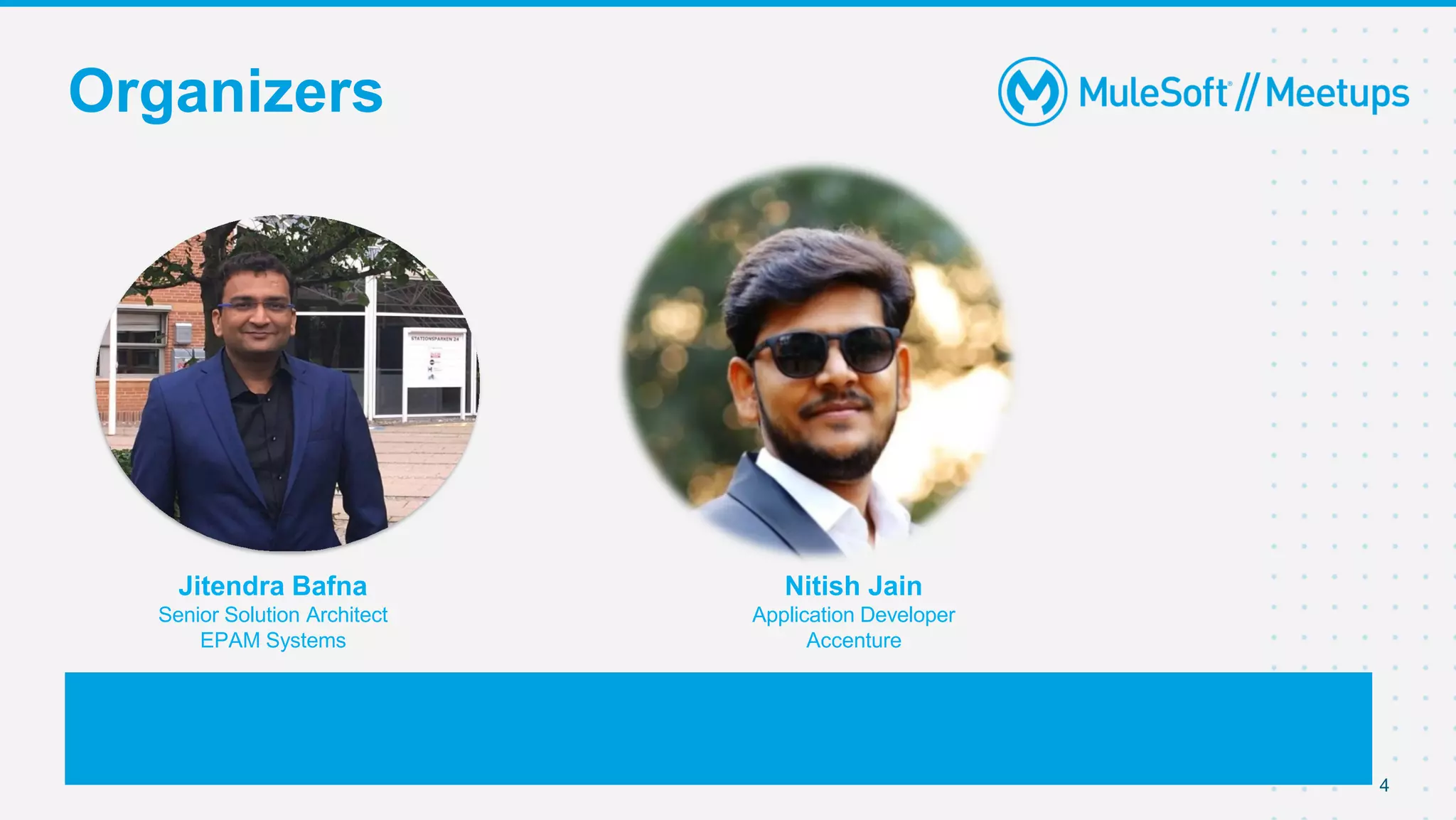
Organizers
4
Jitendra Bafna
Senior Solution Architect
EPAM Systems
Nitish Jain
Application Developer
Accenture
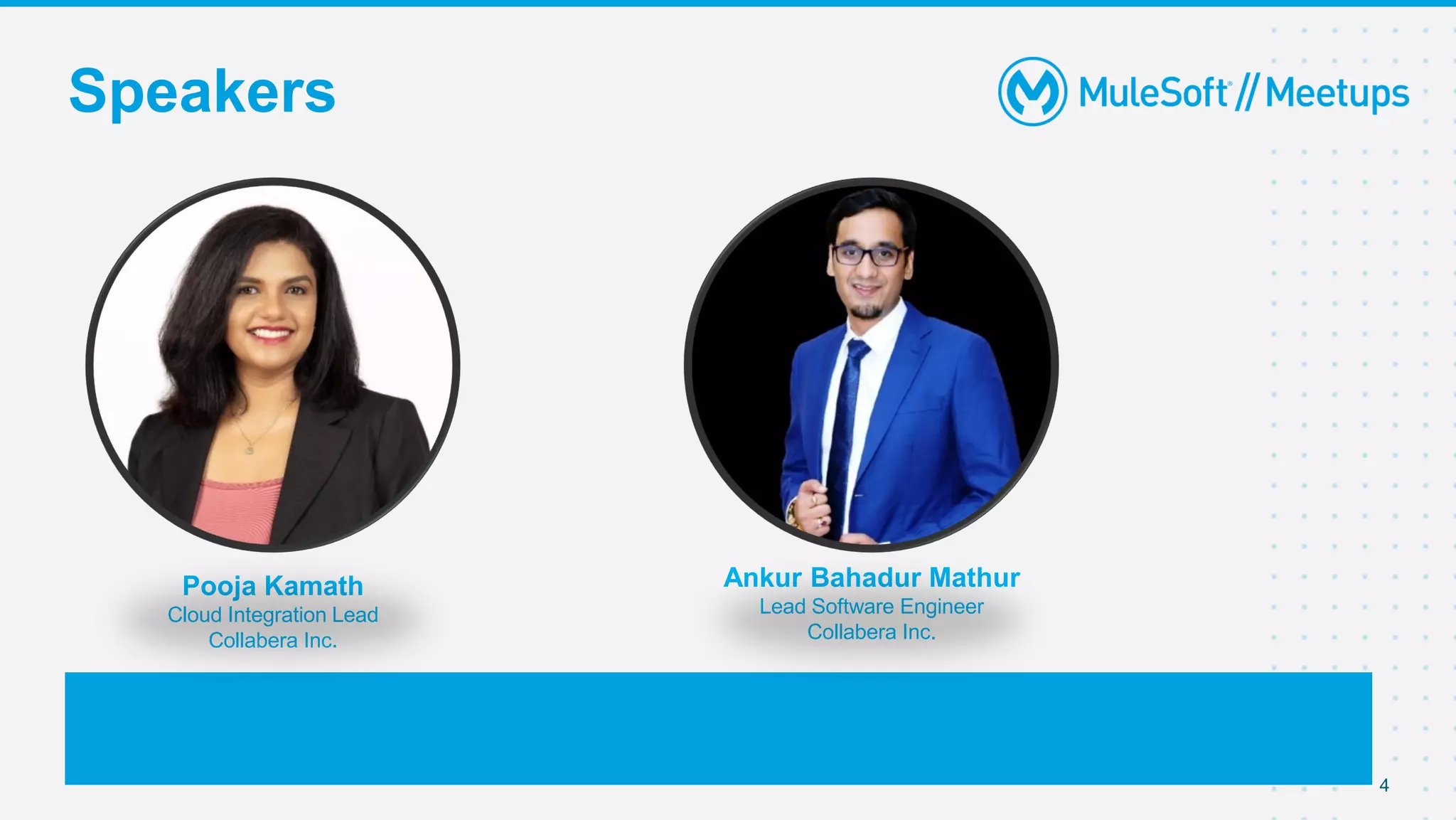
Speakers
4
Pooja Kamath
Cloud Integration Lead
Collabera Inc.
Ankur Bahadur Mathur
Lead Software Engineer
Collabera Inc.
6
1. Microservices
2. Challenges with Microservices
3. How can Service Mesh help?
4. API management and its role.
5. Building app network on Anypoint platform
6. Extending the app network using service Mesh
Agenda
What’s up with all the microservices?
8
9
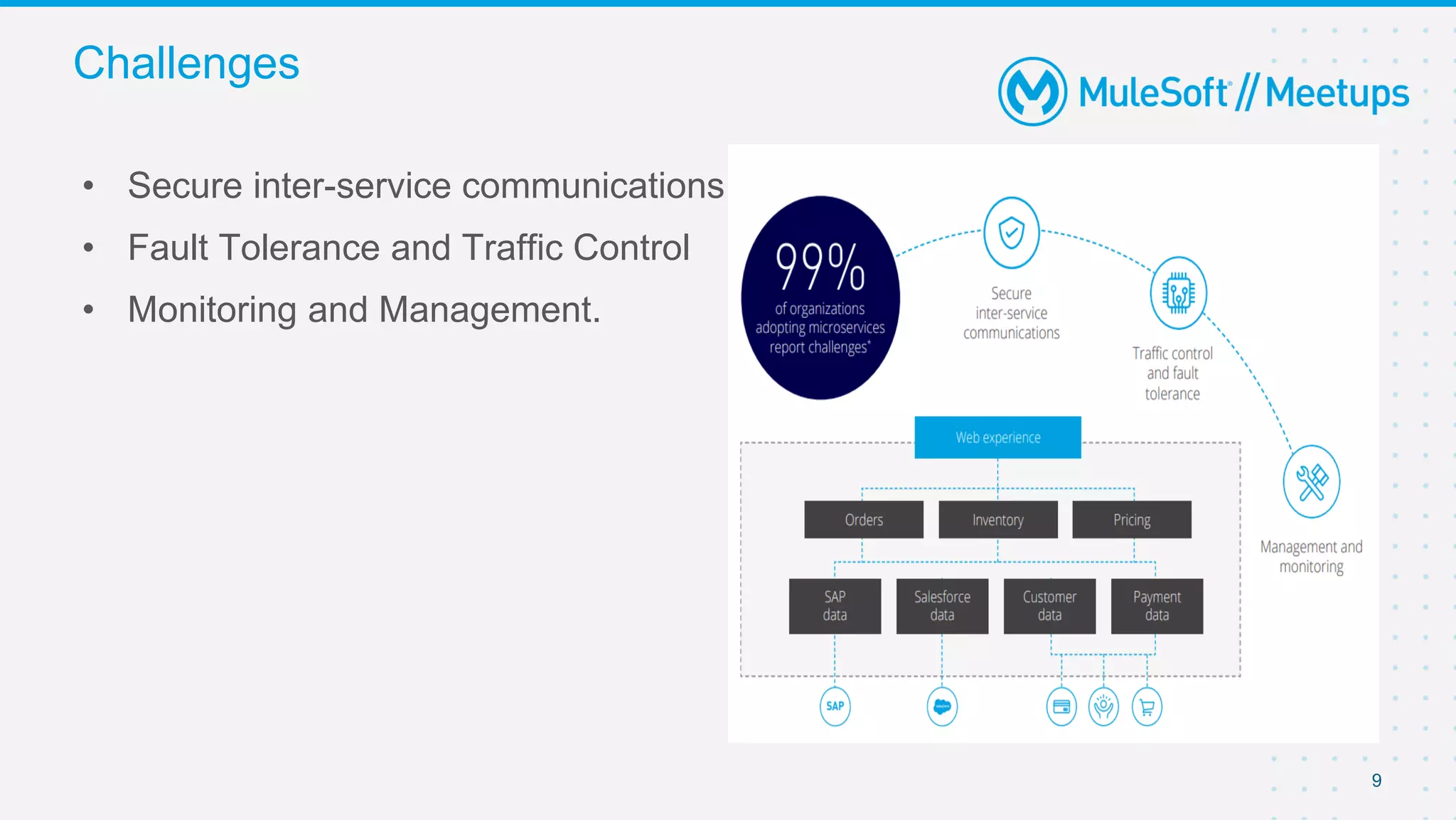
• Secure inter-service communications
• Fault Tolerance and Traffic Control
• Monitoring and Management.
Challenges
10
• To solve these challenges, many organizations are forced to Custom code
governance considerations behind microservices into the service code itself.
This complexity can stifle innovation and agility, negating the promise of
microservices.
Solving for Challenges
Service Mesh
12
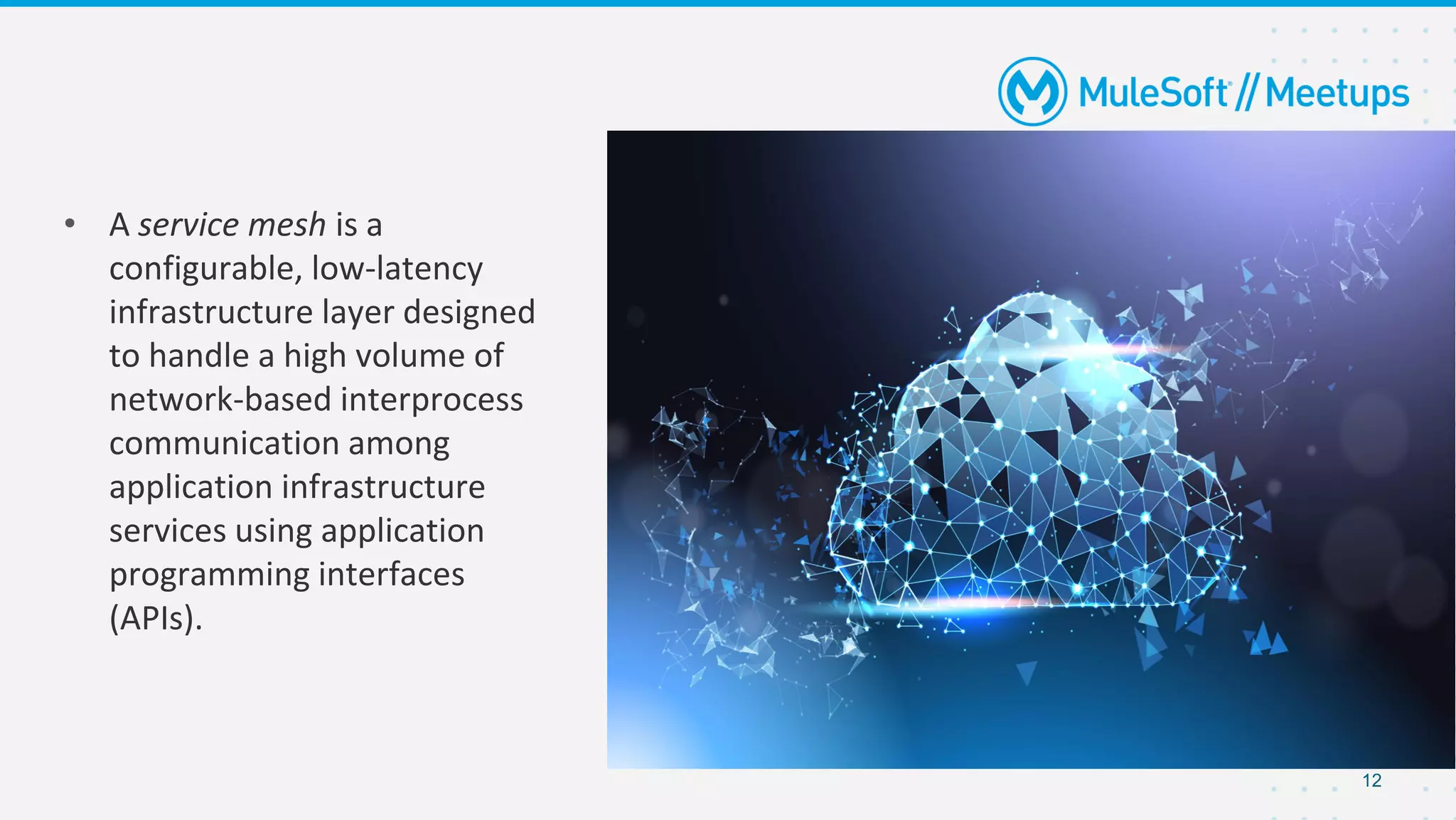
• A service mesh is a
configurable, low-latency
infrastructure layer designed
to handle a high volume of
network-based interprocess
communication among
application infrastructure
services using application
programming interfaces
(APIs).
13
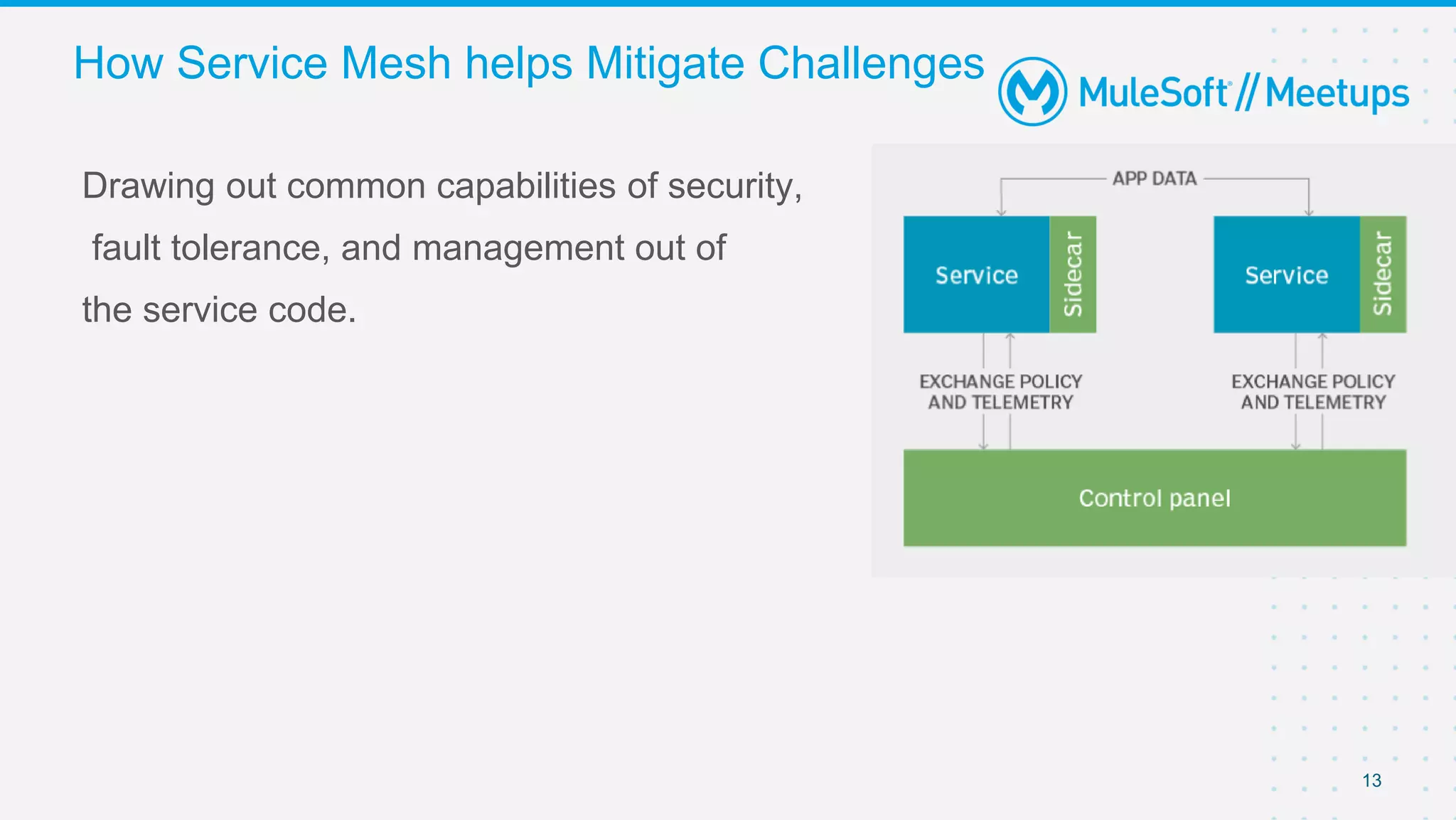
Drawing out common capabilities of security,
fault tolerance, and management out of
the service code.
How Service Mesh helps Mitigate Challenges
14
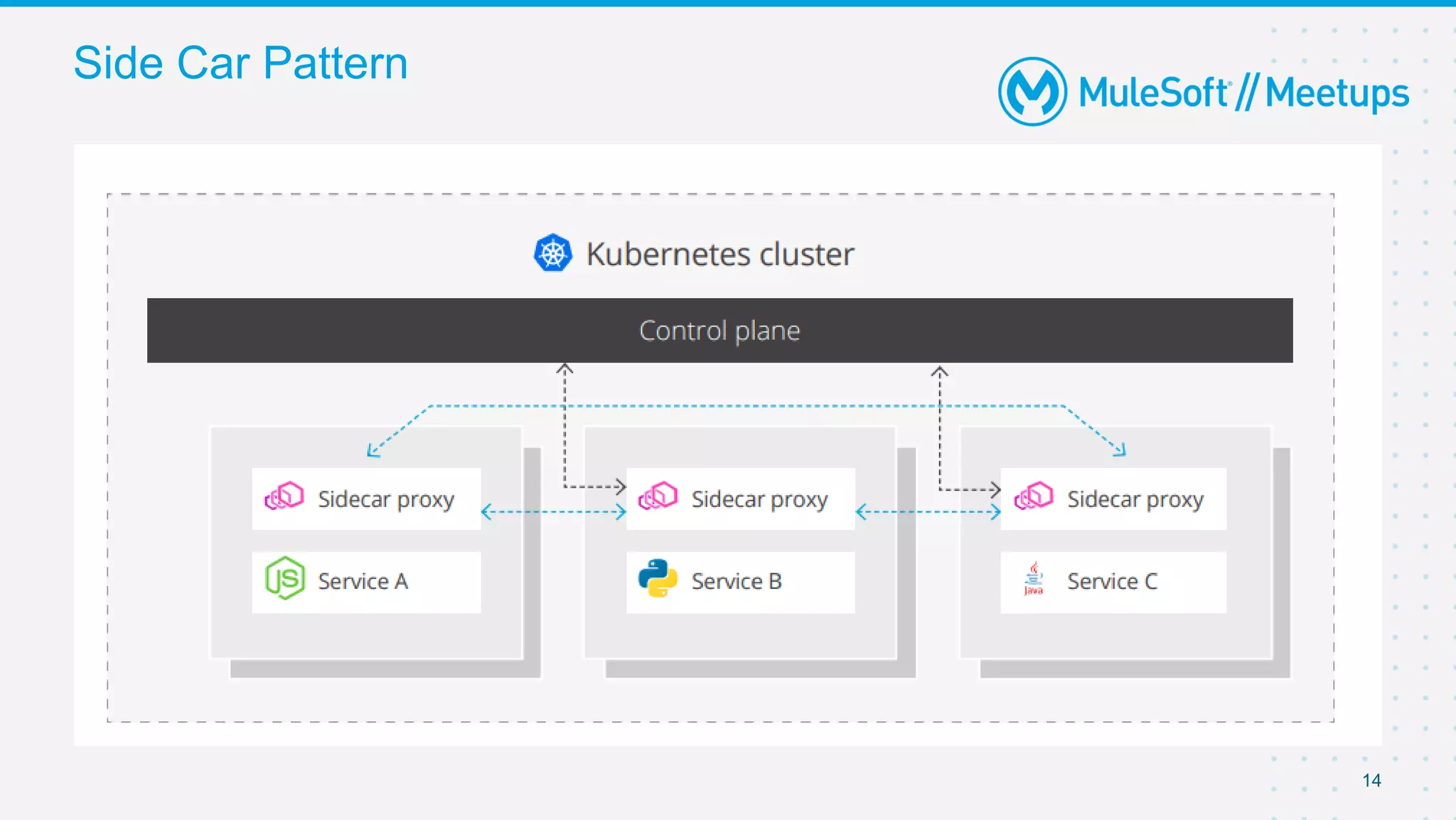
Side Car Pattern
15
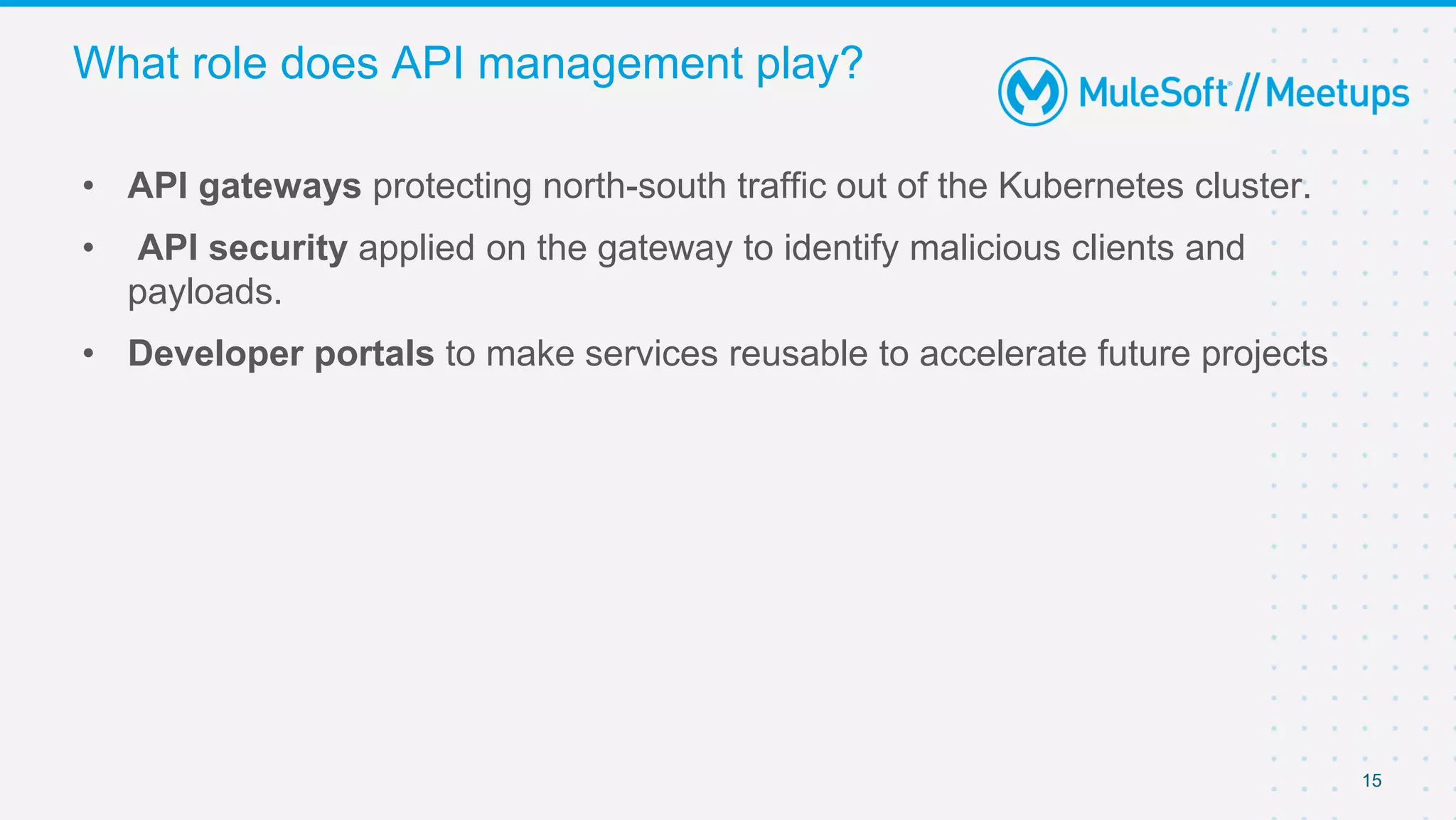
• API gateways protecting north-south traffic out of the Kubernetes cluster.
• API security applied on the gateway to identify malicious clients and
payloads.
• Developer portals to make services reusable to accelerate future projects
What role does API management play?
16
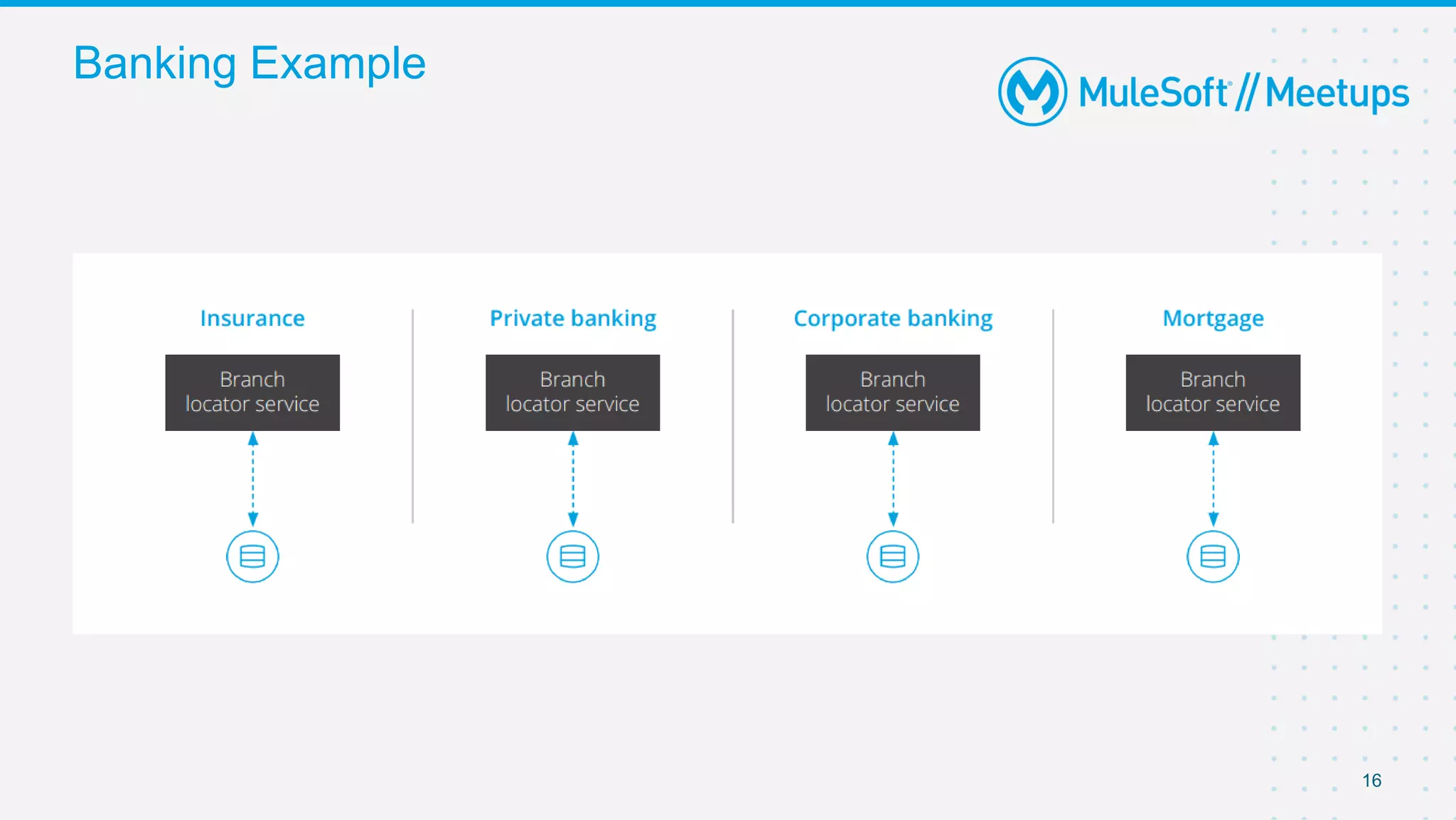
Banking Example
17
With Anypoint Platform, you can empower your business to:
• Connect any system, app, or data source using prebuilt connectors,
templates and drag-and-drop tools to integrate anything.
• Securely unlock your data, wherever it resides, with APIs, and enable teams
to self-serve at scale through a central marketplace.
Application Network with Anypoint Platform
18
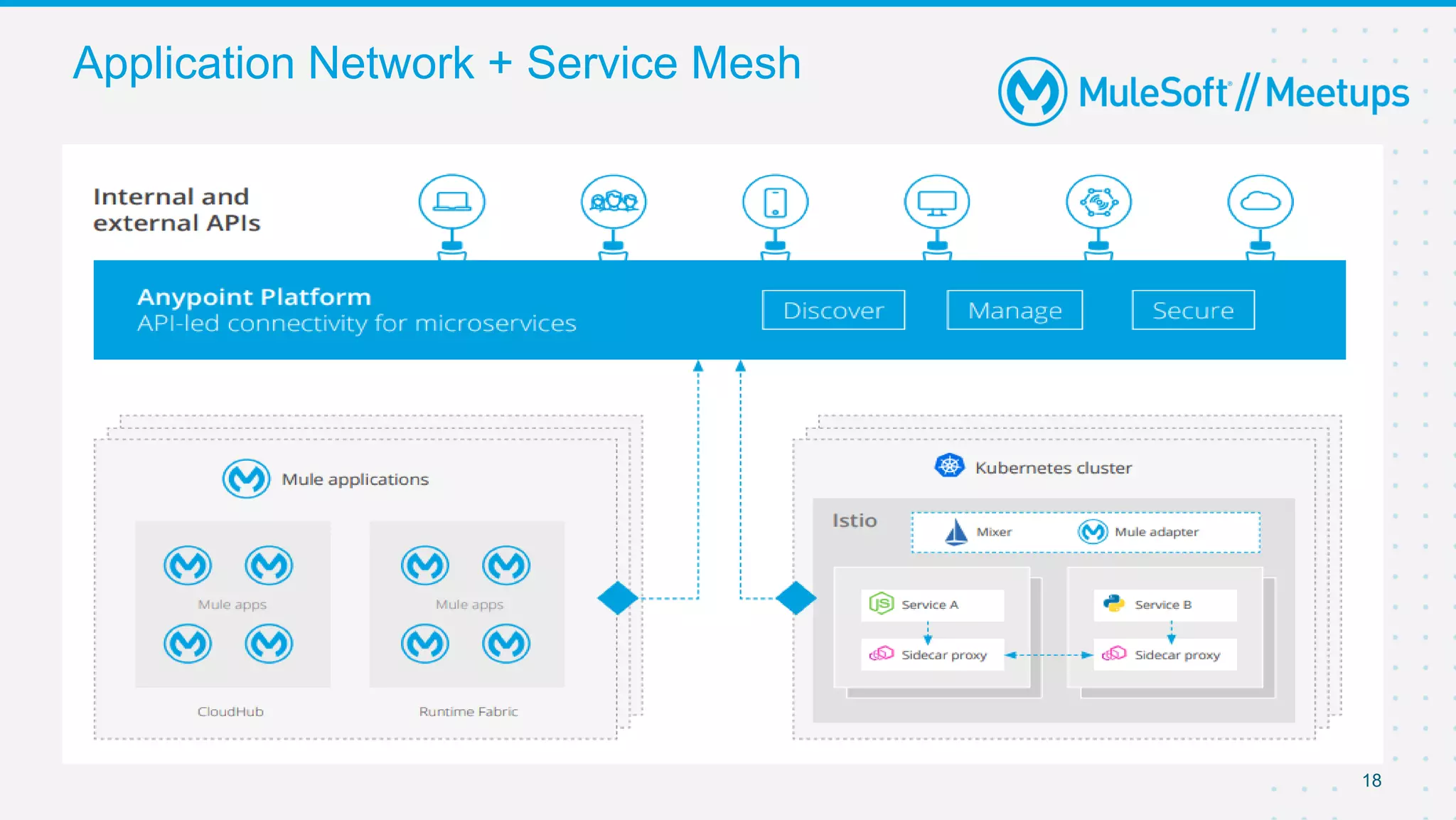
Application Network + Service Mesh
19
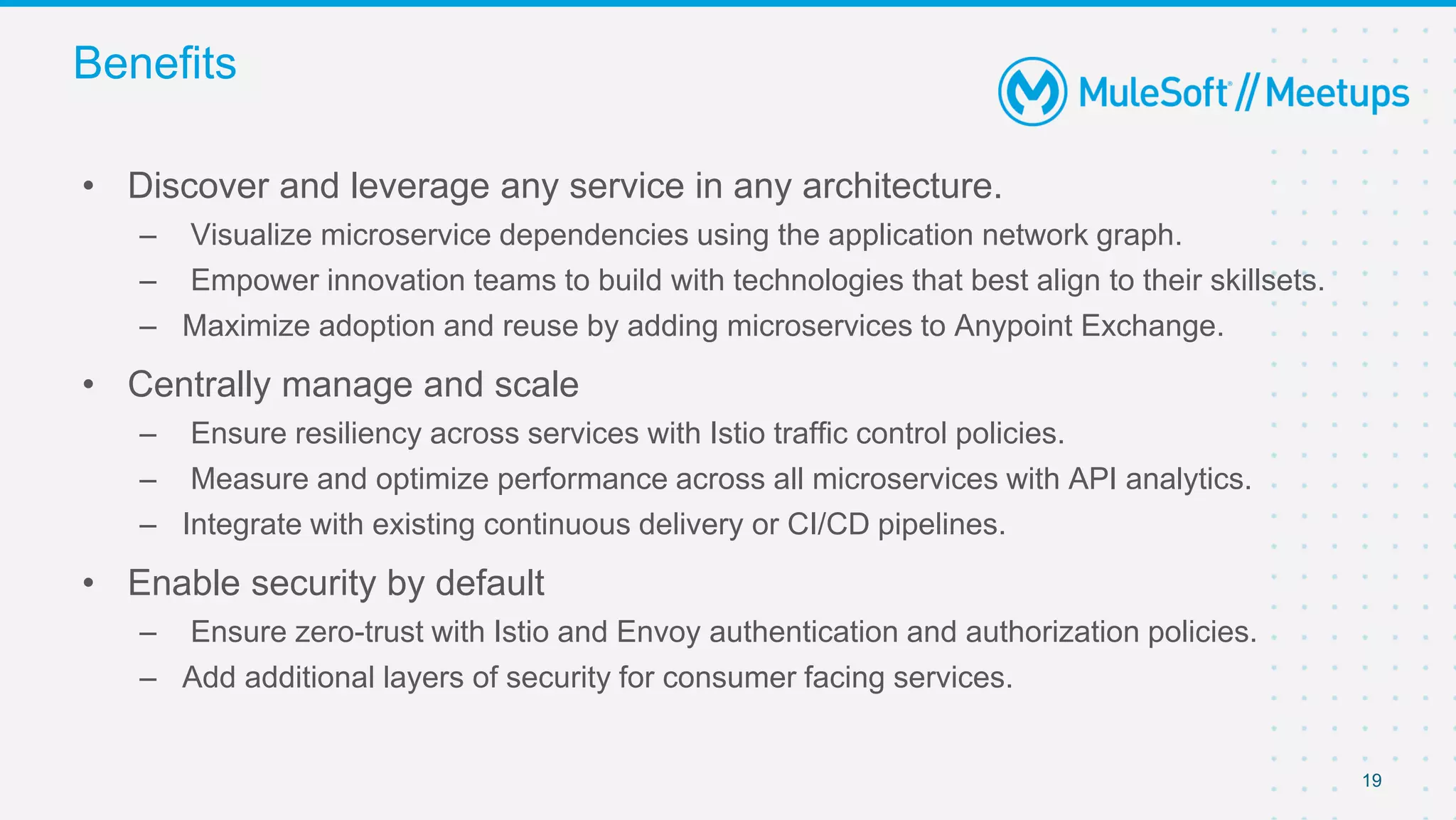
• Discover and leverage any service in any architecture.
– Visualize microservice dependencies using the application network graph.
– Empower innovation teams to build with technologies that best align to their skillsets.
– Maximize adoption and reuse by adding microservices to Anypoint Exchange.
• Centrally manage and scale
– Ensure resiliency across services with Istio traffic control policies.
– Measure and optimize performance across all microservices with API analytics.
– Integrate with existing continuous delivery or CI/CD pipelines.
• Enable security by default
– Ensure zero-trust with Istio and Envoy authentication and authorization policies.
– Add additional layers of security for consumer facing services.
Benefits
20
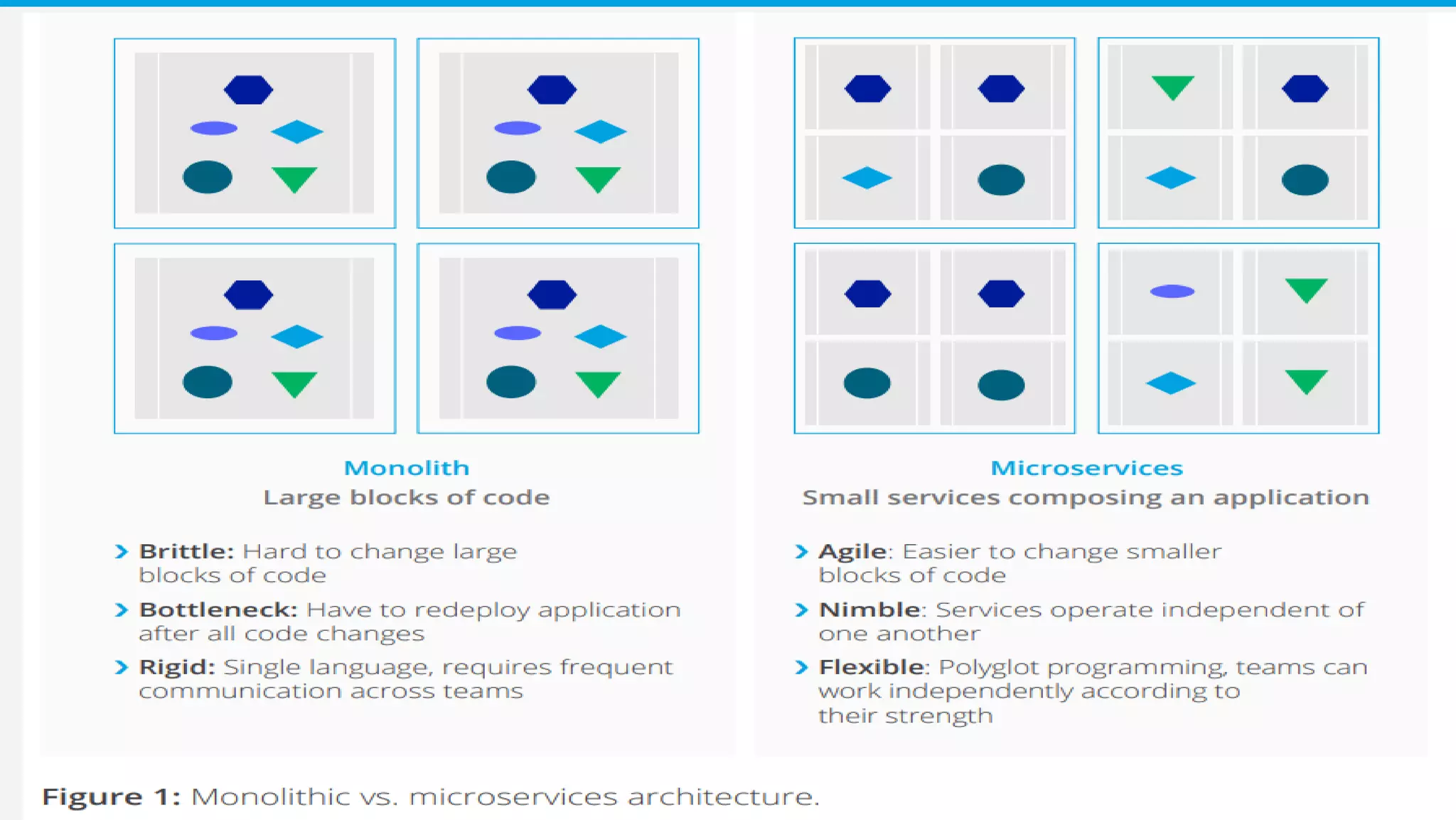
• Microservices are important.
• Microservices alone are not enough for Security, Governance.
• Service Mesh can solve many security and governance issues.
• When you combine microservices with service mesh using a API
Management tool, it is possible to centrally manage and scale microservices.
Summary
Q&A
Kubernetes
Cluster
Kubernetes
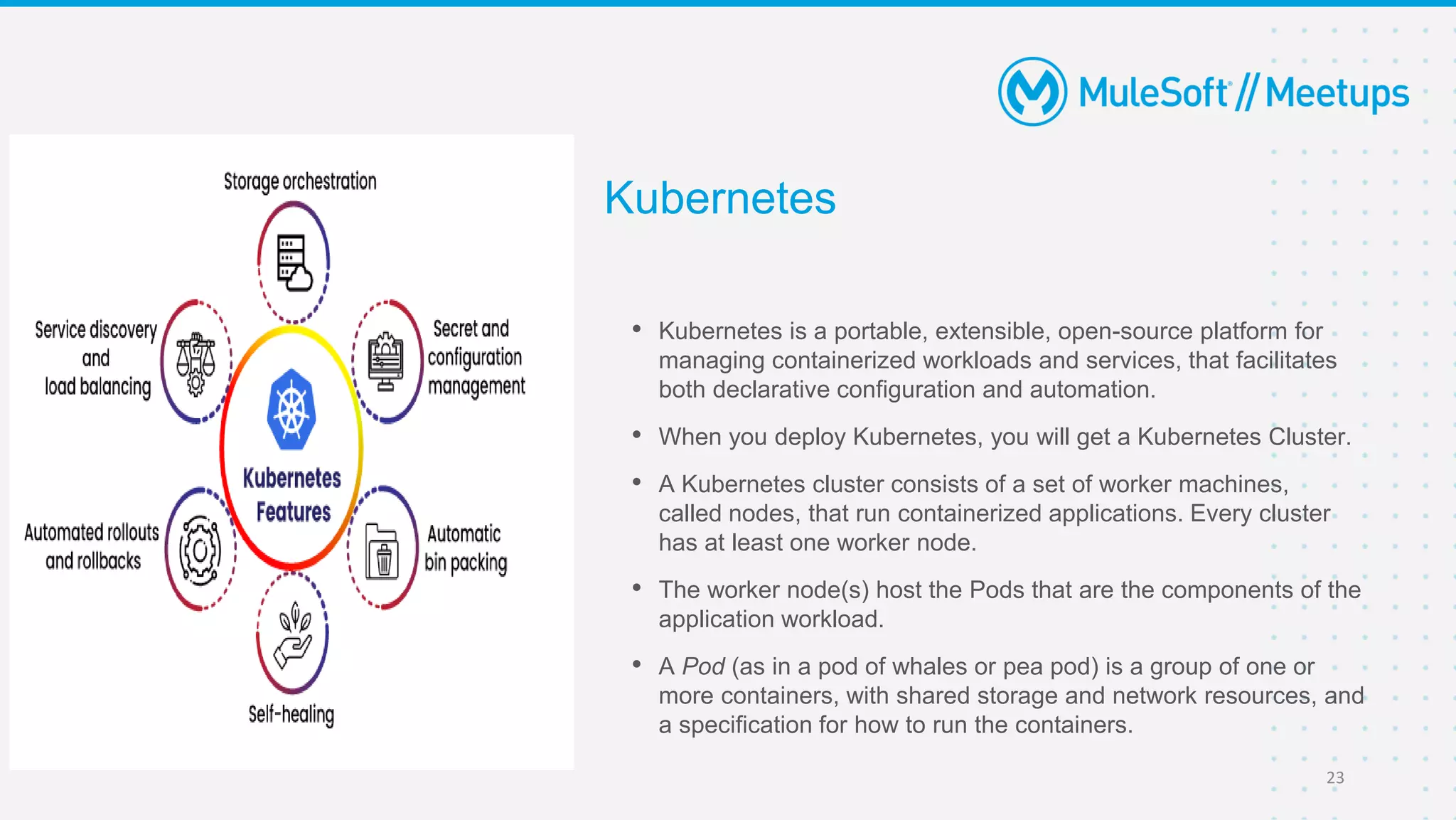
• Kubernetes is a portable, extensible, open-source platform for
managing containerized workloads and services, that facilitates
both declarative configuration and automation.
• When you deploy Kubernetes, you will get a Kubernetes Cluster.
• A Kubernetes cluster consists of a set of worker machines,
called nodes, that run containerized applications. Every cluster
has at least one worker node.
• The worker node(s) host the Pods that are the components of the
application workload.
• A Pod (as in a pod of whales or pea pod) is a group of one or
more containers, with shared storage and network resources, and
a specification for how to run the containers.
23
MiniKube
MiniKube
25
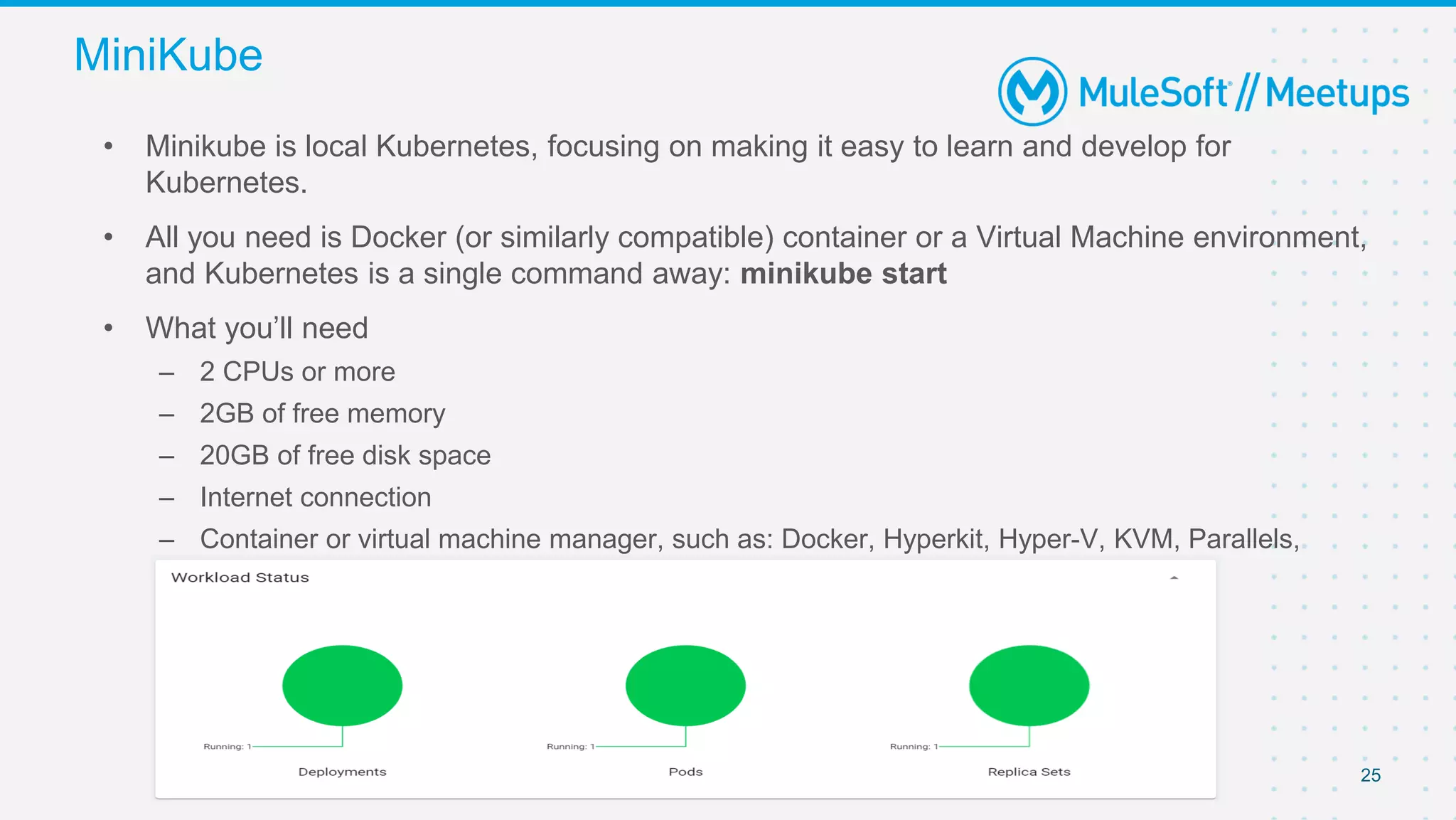
• Minikube is local Kubernetes, focusing on making it easy to learn and develop for
Kubernetes.
• All you need is Docker (or similarly compatible) container or a Virtual Machine environment,
and Kubernetes is a single command away: minikube start
• What you’ll need
– 2 CPUs or more
– 2GB of free memory
– 20GB of free disk space
– Internet connection
– Container or virtual machine manager, such as: Docker, Hyperkit, Hyper-V, KVM, Parallels,
Podman, VirtualBox, or VMware Fusion/Workstation
Istio
Istio
27
• Istio is an open-source service mesh that layers transparently onto existing distributed
applications.
• Istio's control plane provides an abstraction layer over the underlying cluster management
platform, such as Kubernetes
• Istio’s control plane runs on Kubernetes, and you can add applications deployed in that cluster
to your mesh, extend the mesh to other clusters, or even connect VMs or other endpoints
running outside of Kubernetes.
• Istio has two components:
– Data plane: is the communication between services. Without a service mesh, the network doesn’t
understand the traffic being sent over, and can’t make any decisions based on what type of traffic it is,
or who it is from or to
– Control plane: takes your desired configuration, and its view of the services, and dynamically
programs the proxy servers, updating them as the rules or the environment changes
Q & A Session
Take a stand !
18
●Nominate yourself for the next meetup speaker and suggest a topic as well.
20
● Share:
○ Tweet using the hashtag #MuleSoftMeetups
○ Invite your network to join: https://meetups.mulesoft.com/engineering-student-
group/
● Feedback:
○ Fill out the survey feedback and suggest topics for upcoming events
○ Contact MuleSoft at meetups@mulesoft.com for ways to improve the program
What’s next?
20
● 30th June 2022 - Implementing and Understanding SAGA (Orchestration and
Choreography) Patterns With MuleSoft
● 9th July 2022 - Driving Digital Transformation in Banking Industries With
MuleSoft
Upcoming Meetups
Quiz Time
Get ready to WIN a Special Gift from MuleSoft Community
Thank you

MuleSoft Surat Meetup#43 - Combine Service Mesh With Anypoint API Management to power Microservices Surat

  • 1.
    Service mesh together withAPI management Surat MuleSoft Meetup Group June 23, 2022
  • 2.
    Safe Harbour Statement ●Both the speaker and the host are organizing this meet-up in individual capacity only. We are not representing our companies here. ● This presentation is strictly for learning purposes only. Organizer/Presenter do not hold any responsibility that same solution will work for your business requirements. ● This presentation is not meant for any promotional activities. 2
  • 3.
    A recording ofthis meetup will be uploaded to events page within 24 hours. Questions can be submitted/asked at any time in the Chat/Questions & AnswersTab. Make it more Interactive!!! Give us feedback! Rate this meetup session by filling feedback form at the end of theday. We Love Feedbacks!!! Its Bread & Butter for Meetup. Housekeeping 3
  • 4.
    Organizers 4 Jitendra Bafna Senior SolutionArchitect EPAM Systems Nitish Jain Application Developer Accenture
  • 5.
    Speakers 4 Pooja Kamath Cloud IntegrationLead Collabera Inc. Ankur Bahadur Mathur Lead Software Engineer Collabera Inc.
  • 6.
    6 1. Microservices 2. Challengeswith Microservices 3. How can Service Mesh help? 4. API management and its role. 5. Building app network on Anypoint platform 6. Extending the app network using service Mesh Agenda
  • 7.
    What’s up withall the microservices?
  • 8.
  • 9.
    9 • Secure inter-servicecommunications • Fault Tolerance and Traffic Control • Monitoring and Management. Challenges
  • 10.
    10 • To solvethese challenges, many organizations are forced to Custom code governance considerations behind microservices into the service code itself. This complexity can stifle innovation and agility, negating the promise of microservices. Solving for Challenges
  • 11.
  • 12.
    12 • A servicemesh is a configurable, low-latency infrastructure layer designed to handle a high volume of network-based interprocess communication among application infrastructure services using application programming interfaces (APIs).
  • 13.
    13 Drawing out commoncapabilities of security, fault tolerance, and management out of the service code. How Service Mesh helps Mitigate Challenges
  • 14.
  • 15.
    15 • API gatewaysprotecting north-south traffic out of the Kubernetes cluster. • API security applied on the gateway to identify malicious clients and payloads. • Developer portals to make services reusable to accelerate future projects What role does API management play?
  • 16.
  • 17.
    17 With Anypoint Platform,you can empower your business to: • Connect any system, app, or data source using prebuilt connectors, templates and drag-and-drop tools to integrate anything. • Securely unlock your data, wherever it resides, with APIs, and enable teams to self-serve at scale through a central marketplace. Application Network with Anypoint Platform
  • 18.
  • 19.
    19 • Discover andleverage any service in any architecture. – Visualize microservice dependencies using the application network graph. – Empower innovation teams to build with technologies that best align to their skillsets. – Maximize adoption and reuse by adding microservices to Anypoint Exchange. • Centrally manage and scale – Ensure resiliency across services with Istio traffic control policies. – Measure and optimize performance across all microservices with API analytics. – Integrate with existing continuous delivery or CI/CD pipelines. • Enable security by default – Ensure zero-trust with Istio and Envoy authentication and authorization policies. – Add additional layers of security for consumer facing services. Benefits
  • 20.
    20 • Microservices areimportant. • Microservices alone are not enough for Security, Governance. • Service Mesh can solve many security and governance issues. • When you combine microservices with service mesh using a API Management tool, it is possible to centrally manage and scale microservices. Summary
  • 21.
  • 22.
  • 23.
    Kubernetes • Kubernetes isa portable, extensible, open-source platform for managing containerized workloads and services, that facilitates both declarative configuration and automation. • When you deploy Kubernetes, you will get a Kubernetes Cluster. • A Kubernetes cluster consists of a set of worker machines, called nodes, that run containerized applications. Every cluster has at least one worker node. • The worker node(s) host the Pods that are the components of the application workload. • A Pod (as in a pod of whales or pea pod) is a group of one or more containers, with shared storage and network resources, and a specification for how to run the containers. 23
  • 24.
  • 25.
    MiniKube 25 • Minikube islocal Kubernetes, focusing on making it easy to learn and develop for Kubernetes. • All you need is Docker (or similarly compatible) container or a Virtual Machine environment, and Kubernetes is a single command away: minikube start • What you’ll need – 2 CPUs or more – 2GB of free memory – 20GB of free disk space – Internet connection – Container or virtual machine manager, such as: Docker, Hyperkit, Hyper-V, KVM, Parallels, Podman, VirtualBox, or VMware Fusion/Workstation
  • 26.
  • 27.
    Istio 27 • Istio isan open-source service mesh that layers transparently onto existing distributed applications. • Istio's control plane provides an abstraction layer over the underlying cluster management platform, such as Kubernetes • Istio’s control plane runs on Kubernetes, and you can add applications deployed in that cluster to your mesh, extend the mesh to other clusters, or even connect VMs or other endpoints running outside of Kubernetes. • Istio has two components: – Data plane: is the communication between services. Without a service mesh, the network doesn’t understand the traffic being sent over, and can’t make any decisions based on what type of traffic it is, or who it is from or to – Control plane: takes your desired configuration, and its view of the services, and dynamically programs the proxy servers, updating them as the rules or the environment changes
  • 28.
    Q & ASession
  • 29.
    Take a stand! 18 ●Nominate yourself for the next meetup speaker and suggest a topic as well.
  • 30.
    20 ● Share: ○ Tweetusing the hashtag #MuleSoftMeetups ○ Invite your network to join: https://meetups.mulesoft.com/engineering-student- group/ ● Feedback: ○ Fill out the survey feedback and suggest topics for upcoming events ○ Contact MuleSoft at meetups@mulesoft.com for ways to improve the program What’s next?
  • 31.
    20 ● 30th June2022 - Implementing and Understanding SAGA (Orchestration and Choreography) Patterns With MuleSoft ● 9th July 2022 - Driving Digital Transformation in Banking Industries With MuleSoft Upcoming Meetups
  • 32.
    Quiz Time Get readyto WIN a Special Gift from MuleSoft Community
  • 33.