


API-led Connectivity
2
Key Challenges
Companies must embrace digital transformation in order to stay
relevant to their customers, else risk ceding market share to
competitors who are able to adapt more quickly.
• At its core, digital transformation is driving companies to reframe their
relationships with their customers, suppliers and employees through
leveraging new technologies to engage in ways that were not possible
before.
• These new technologies - SaaS, mobile, and the Internet of Things
(IoT) - demand a new level of connectivity that cannot be achieved with
yesterday’s integration approaches.
3
RECOMMENDATIONS
Providing an External HTTP or HTTPS Port
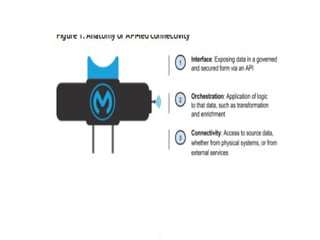
• Adopt an API-led connectivity approach that packages underlying
connectivity and orchestration services as easily discoverable and
reusable building blocks, exposed by APIs.
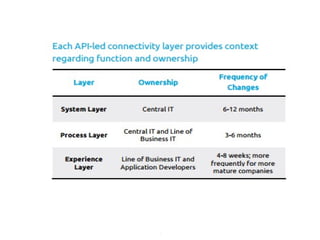
• Structure these building blocks across distinct systems, process
and
experience layers, to achieve both greater organizational agility and
greater control.
• Drive technology change holistically across people, processes and
systems in an incremental fashion.
4
MICROSERVICES
Providing an External HTTP or HTTPS Port
Microservices are a hot topic amongst enterprise architecture
leaders. In our view, we believe that microservices not only
validate a service oriented approach but are in fact one
interpretation of how that approach should be implemented, by
taking the need for well-defined services and re-usability to an
extreme. In doing so, it highlights the need for governance,
and that successful implementation must also consider
nontechnology
factors such as development processes and
methodologies. In this way, the principles and approach
behind API-led connectivity are entirely consistent with a
Microservices approach and vice versa.
5
API-LED CONNECTIVITY
Providing an External HTTP or HTTPS Port
The evolution of SOA
While connectivity demands have changed, the central tenets of SOA
have not, that is, the distillation of software into services that are
welldefined,
re-usable and discoverable.
This vision is perhaps even more important given the proliferation of
endpoints. The complexity of providing multiple stakeholders
customized
views of the same underlying data source, whether it be a core
banking
system or an ERP system, increases exponentially with the number of
channels through which that data must be provided. It also reinforces
the need for data at the point of consumption to be decoupled and
independent from the source data in the system of record, becoming
variously more coarse-grained or fine-grained as the use case
requires.
6
7
THANK YOU

MULE-Api led connectivity

  • 1.
  • 2.
    2 Key Challenges Companies mustembrace digital transformation in order to stay relevant to their customers, else risk ceding market share to competitors who are able to adapt more quickly. • At its core, digital transformation is driving companies to reframe their relationships with their customers, suppliers and employees through leveraging new technologies to engage in ways that were not possible before. • These new technologies - SaaS, mobile, and the Internet of Things (IoT) - demand a new level of connectivity that cannot be achieved with yesterday’s integration approaches.
  • 3.
    3 RECOMMENDATIONS Providing an ExternalHTTP or HTTPS Port • Adopt an API-led connectivity approach that packages underlying connectivity and orchestration services as easily discoverable and reusable building blocks, exposed by APIs. • Structure these building blocks across distinct systems, process and experience layers, to achieve both greater organizational agility and greater control. • Drive technology change holistically across people, processes and systems in an incremental fashion.
  • 4.
    4 MICROSERVICES Providing an ExternalHTTP or HTTPS Port Microservices are a hot topic amongst enterprise architecture leaders. In our view, we believe that microservices not only validate a service oriented approach but are in fact one interpretation of how that approach should be implemented, by taking the need for well-defined services and re-usability to an extreme. In doing so, it highlights the need for governance, and that successful implementation must also consider nontechnology factors such as development processes and methodologies. In this way, the principles and approach behind API-led connectivity are entirely consistent with a Microservices approach and vice versa.
  • 5.
    5 API-LED CONNECTIVITY Providing anExternal HTTP or HTTPS Port The evolution of SOA While connectivity demands have changed, the central tenets of SOA have not, that is, the distillation of software into services that are welldefined, re-usable and discoverable. This vision is perhaps even more important given the proliferation of endpoints. The complexity of providing multiple stakeholders customized views of the same underlying data source, whether it be a core banking system or an ERP system, increases exponentially with the number of channels through which that data must be provided. It also reinforces the need for data at the point of consumption to be decoupled and independent from the source data in the system of record, becoming variously more coarse-grained or fine-grained as the use case requires.
  • 6.
  • 7.
  • 8.