1
Building a DevOps Culture
2016 MTUG IT Summit and Tradeshow, June 2nd 2016
The Scoop
2
• What is DevOps
• Why DevOps
• Developing a DevOps Mindset
• Crafting a DevOps Journey
• The DOs and DON’Ts of DevOps
• Common DevOps Use Cases
• Tools of the Trade
3
What is DevOps
4
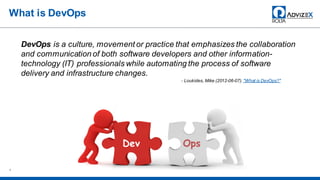
DevOps is a culture, movement or practice that emphasizes the collaboration
and communication of both software developers and other information-
technology (IT) professionals while automating the process of software
delivery and infrastructure changes.
- Loukides, Mike (2012-06-07). "What is DevOps?"
What is DevOps
5
Understanding of the interdependencies
between application development and It
Operations
Aims to help organizations rapidly produce
quality applications, products and services
Responds to the dynamic business needs and
demands of the stakeholders
Supports the use of agile development
processes
What is DevOps Not
6
A role, person or organization
A set of task performed by system
administrators or developers
Writing Chef or Puppet Scripts
Application or set of automation
tools
Characteristics of DevOps
7
Same team develops and operates the
solution.
Focus on business goals
Pragmatic automation
High value placed on learning by
experimentation
Rapid innovation cycles
Measure and monitor everything !!!
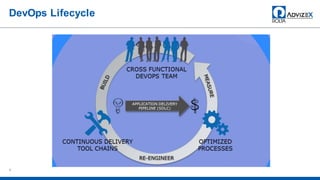
DevOps Lifecycle
8
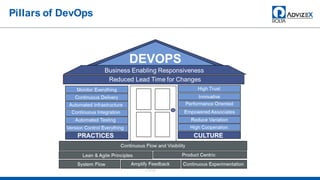
Pillars of DevOps
10
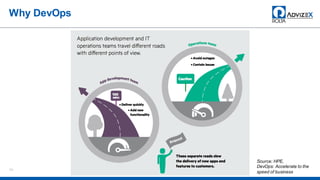
Why DevOps
11
Source: HPE,
DevOps: Accelerate to the
speed of business
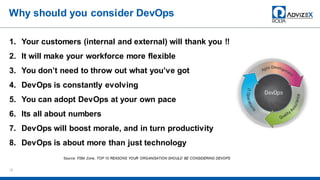
Why should you consider DevOps
12
1. Your customers (internal and external) will thank you !!
2. It will make your workforce more flexible
3. You don’t need to throw out what you’ve got
4. DevOps is constantly evolving
5. You can adopt DevOps at your own pace
6. Its all about numbers
7. DevOps will boost morale, and in turn productivity
8. DevOps is about more than just technology
Source: ITSM Zone, TOP 10 REASONS YOUR ORGANISATION SHOULD BE CONSIDERING DEVOPS
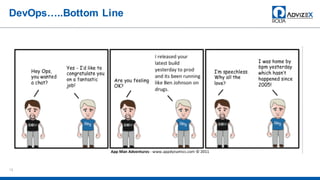
DevOps…..Bottom Line
13
14
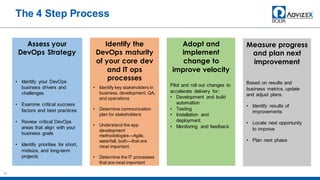
The 4 Step Process
15
Assess your
DevOps Strategy
• Identify your DevOps
business drivers and
challenges
• Examine critical success
factors and best practices
• Review critical DevOps
areas that align with your
business goals
• Identify priorities for short,
midsize, and long-term
projects
Identify the
DevOps maturity
of your core dev
and IT ops
processes
• Identify key stakeholders in
business, development, QA,
and operations
• Determine communication
plan for stakeholders
• Understand the app
development
methodologies—Agile,
waterfall, both—that are
most important
• Determine the IT processes
that are most important
Adopt and
implement
change to
improve velocity
Pilot and roll out changes to
accelerate delivery for:
• Development and build
automation
• Testing
• Installation and
deployment
• Monitoring and feedback
Measure progress
and plan next
improvement
Based on results and
business metrics, update
and adjust plans.
• Identify results of
improvements
• Locate next opportunity
to improve
• Plan next phase
16
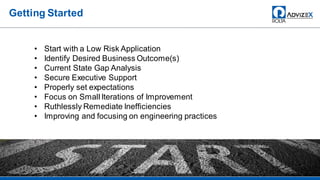
Getting Started
17
• Start with a Low Risk Application
• Identify Desired Business Outcome(s)
• Current State Gap Analysis
• Secure Executive Support
• Properly set expectations
• Focus on Small Iterations of Improvement
• Ruthlessly Remediate Inefficiencies
• Improving and focusing on engineering practices
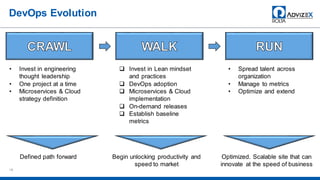
DevOps Evolution
18
• Invest in engineering
thought leadership
• One project at a time
• Microservices & Cloud
strategy definition
Defined path forward
Invest in Lean mindset
and practices
DevOps adoption
Microservices & Cloud
implementation
On-demand releases
Establish baseline
metrics
Begin unlocking productivity and
speed to market
• Spread talent across
organization
• Manage to metrics
• Optimize and extend
Optimized. Scalable site that can
innovate at the speed of business
19
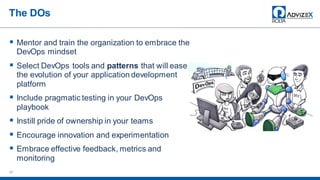
The DOs
Mentor and train the organization to embrace the
DevOps mindset
Select DevOps tools and patterns that will ease
the evolution of your application development
platform
Include pragmatic testing in your DevOps
playbook
Instill pride of ownership in your teams
Encourage innovation and experimentation
Embrace effective feedback, metrics and
monitoring
20
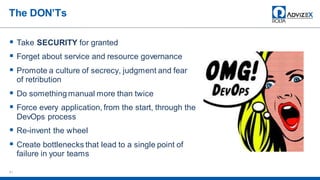
The DON’Ts
Take SECURITY for granted
Forget about service and resource governance
Promote a culture of secrecy, judgment and fear
of retribution
Do something manual more than twice
Force every application, from the start, through the
DevOps process
Re-invent the wheel
Create bottlenecks that lead to a single point of
failure in your teams
21
22
What is Application Modernization?
23
Application modernization is
the refactoring, re-purposing
or consolidation of legacy
applications to align more
closely with current business
needs.
What Are Your Application Modernization Goals?
Improve Reliability - Antifragility
Reduce Costs
Alignment of IT and Business Goals
Easier Compliance Audits
I’m Just Generally Masochistic
Improve Speed/Agility
Improve Performance
Improve UI/Features/Functionality
Reduce Learning Curve
24
25
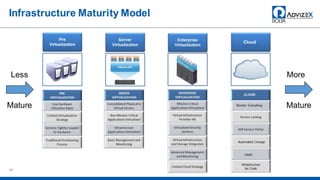
Infrastructure Maturity Model
26
Less
Mature
More
Mature
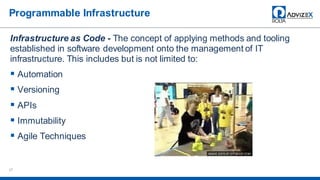
Programmable Infrastructure
Infrastructure as Code - The concept of applying methods and tooling
established in software development onto the management of IT
infrastructure. This includes but is not limited to:
Automation
Versioning
APIs
Immutability
Agile Techniques
27
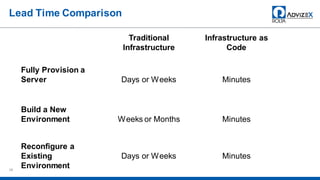
Lead Time Comparison
28
Traditional
Infrastructure
Infrastructure as
Code
Fully Provision a
Server Days or Weeks Minutes
Build a New
Environment Weeks or Months Minutes
Reconfigure a
Existing
Environment
Days or Weeks Minutes
29
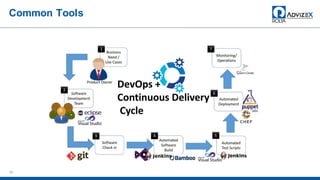
Common Tools
30
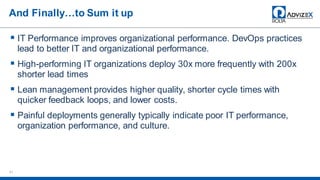
And Finally…to Sum it up
IT Performance improves organizational performance. DevOps practices
lead to better IT and organizational performance.
High-performing IT organizations deploy 30x more frequently with 200x
shorter lead times
Lean management provides higher quality, shorter cycle times with
quicker feedback loops, and lower costs.
Painful deployments generally typically indicate poor IT performance,
organization performance, and culture.
31
32
DEVOPS
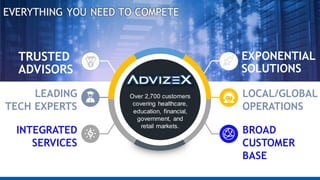
EVERYTHING YOU NEED TO COMPETE
LEADING
TECH EXPERTS
INTEGRATED
SERVICES
EXPONENTIAL
SOLUTIONS
LOCAL/GLOBAL
OPERATIONS
BROAD
CUSTOMER
BASE
TRUSTED
ADVISORS
Over 2,700 customers
covering healthcare,
education, financial,
government, and
retail markets.
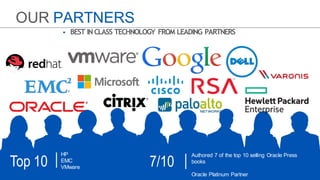
BEST IN CLASS TECHNOLOGY FROM LEADING PARTNERS
OUR PARTNERS
HP
EMC
VMwareTop 10
Authored 7 of the top 10 selling Oracle Press
books
Oracle Platinum Partner
7/10
35

Mtug dev ops

  • 1.
    1 Building a DevOpsCulture 2016 MTUG IT Summit and Tradeshow, June 2nd 2016
  • 2.
    The Scoop 2 • Whatis DevOps • Why DevOps • Developing a DevOps Mindset • Crafting a DevOps Journey • The DOs and DON’Ts of DevOps • Common DevOps Use Cases • Tools of the Trade
  • 3.
  • 4.
    What is DevOps 4 DevOpsis a culture, movement or practice that emphasizes the collaboration and communication of both software developers and other information- technology (IT) professionals while automating the process of software delivery and infrastructure changes. - Loukides, Mike (2012-06-07). "What is DevOps?"
  • 5.
    What is DevOps 5 Understandingof the interdependencies between application development and It Operations Aims to help organizations rapidly produce quality applications, products and services Responds to the dynamic business needs and demands of the stakeholders Supports the use of agile development processes
  • 6.
    What is DevOpsNot 6 A role, person or organization A set of task performed by system administrators or developers Writing Chef or Puppet Scripts Application or set of automation tools
  • 7.
    Characteristics of DevOps 7 Sameteam develops and operates the solution. Focus on business goals Pragmatic automation High value placed on learning by experimentation Rapid innovation cycles Measure and monitor everything !!!
  • 8.
  • 9.
  • 10.
  • 11.
    Why DevOps 11 Source: HPE, DevOps:Accelerate to the speed of business
  • 12.
    Why should youconsider DevOps 12 1. Your customers (internal and external) will thank you !! 2. It will make your workforce more flexible 3. You don’t need to throw out what you’ve got 4. DevOps is constantly evolving 5. You can adopt DevOps at your own pace 6. Its all about numbers 7. DevOps will boost morale, and in turn productivity 8. DevOps is about more than just technology Source: ITSM Zone, TOP 10 REASONS YOUR ORGANISATION SHOULD BE CONSIDERING DEVOPS
  • 13.
  • 14.
  • 15.
    The 4 StepProcess 15 Assess your DevOps Strategy • Identify your DevOps business drivers and challenges • Examine critical success factors and best practices • Review critical DevOps areas that align with your business goals • Identify priorities for short, midsize, and long-term projects Identify the DevOps maturity of your core dev and IT ops processes • Identify key stakeholders in business, development, QA, and operations • Determine communication plan for stakeholders • Understand the app development methodologies—Agile, waterfall, both—that are most important • Determine the IT processes that are most important Adopt and implement change to improve velocity Pilot and roll out changes to accelerate delivery for: • Development and build automation • Testing • Installation and deployment • Monitoring and feedback Measure progress and plan next improvement Based on results and business metrics, update and adjust plans. • Identify results of improvements • Locate next opportunity to improve • Plan next phase
  • 16.
  • 17.
    Getting Started 17 • Startwith a Low Risk Application • Identify Desired Business Outcome(s) • Current State Gap Analysis • Secure Executive Support • Properly set expectations • Focus on Small Iterations of Improvement • Ruthlessly Remediate Inefficiencies • Improving and focusing on engineering practices
  • 18.
    DevOps Evolution 18 • Investin engineering thought leadership • One project at a time • Microservices & Cloud strategy definition Defined path forward Invest in Lean mindset and practices DevOps adoption Microservices & Cloud implementation On-demand releases Establish baseline metrics Begin unlocking productivity and speed to market • Spread talent across organization • Manage to metrics • Optimize and extend Optimized. Scalable site that can innovate at the speed of business
  • 19.
  • 20.
    The DOs Mentor andtrain the organization to embrace the DevOps mindset Select DevOps tools and patterns that will ease the evolution of your application development platform Include pragmatic testing in your DevOps playbook Instill pride of ownership in your teams Encourage innovation and experimentation Embrace effective feedback, metrics and monitoring 20
  • 21.
    The DON’Ts Take SECURITYfor granted Forget about service and resource governance Promote a culture of secrecy, judgment and fear of retribution Do something manual more than twice Force every application, from the start, through the DevOps process Re-invent the wheel Create bottlenecks that lead to a single point of failure in your teams 21
  • 22.
  • 23.
    What is ApplicationModernization? 23 Application modernization is the refactoring, re-purposing or consolidation of legacy applications to align more closely with current business needs.
  • 24.
    What Are YourApplication Modernization Goals? Improve Reliability - Antifragility Reduce Costs Alignment of IT and Business Goals Easier Compliance Audits I’m Just Generally Masochistic Improve Speed/Agility Improve Performance Improve UI/Features/Functionality Reduce Learning Curve 24
  • 25.
  • 26.
  • 27.
    Programmable Infrastructure Infrastructure asCode - The concept of applying methods and tooling established in software development onto the management of IT infrastructure. This includes but is not limited to: Automation Versioning APIs Immutability Agile Techniques 27
  • 28.
    Lead Time Comparison 28 Traditional Infrastructure Infrastructureas Code Fully Provision a Server Days or Weeks Minutes Build a New Environment Weeks or Months Minutes Reconfigure a Existing Environment Days or Weeks Minutes
  • 29.
  • 30.
  • 31.
    And Finally…to Sumit up IT Performance improves organizational performance. DevOps practices lead to better IT and organizational performance. High-performing IT organizations deploy 30x more frequently with 200x shorter lead times Lean management provides higher quality, shorter cycle times with quicker feedback loops, and lower costs. Painful deployments generally typically indicate poor IT performance, organization performance, and culture. 31
  • 32.
  • 33.
    EVERYTHING YOU NEEDTO COMPETE LEADING TECH EXPERTS INTEGRATED SERVICES EXPONENTIAL SOLUTIONS LOCAL/GLOBAL OPERATIONS BROAD CUSTOMER BASE TRUSTED ADVISORS Over 2,700 customers covering healthcare, education, financial, government, and retail markets.
  • 34.
    BEST IN CLASSTECHNOLOGY FROM LEADING PARTNERS OUR PARTNERS HP EMC VMwareTop 10 Authored 7 of the top 10 selling Oracle Press books Oracle Platinum Partner 7/10
  • 35.