Chapter 6

            POVERTY ALLEVIATION PROGRAMMES

        Eradication of poverty remains a major challenge of planned economic
development. Experiences of different states with economic growth and poverty
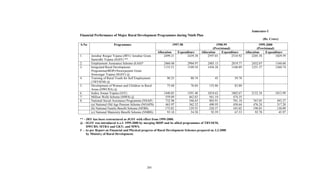
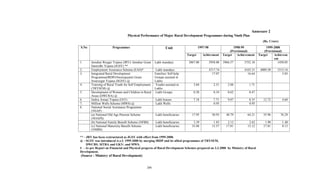
reduction have been so varied that it is difficult to offer any general policy prescription.
There are states that followed the path of high agricultural growth and succeeded in
reducing poverty (Punjab and Haryana) and states that focused on human resource
development and reduced poverty (Kerala). There have been states that implemented
land reforms with vigour, empowered the panchayats, mobilised the poor and
implemented poverty-alleviation programmes effectively (West Bengal) and states that
brought about reduction in poverty by direct public intervention in the form of public
distribution of foodgrains (Andhra Pradesh).
2.      Poverty had declined substantially in 1980s. However, recent estimates suggest
that projections on reduction of proportion and number of people below poverty line
made in the Ninth Plan have not been realised in the first two years of the plan period.
While this calls for a much more rigorous analysis, the possible factors that might have
contributed to this could be:
   ¾   fiscal crisis faced by State Governments resulting in lower spending on social
       sectors,
   ¾   slowing down of and less dispersed agricultural growth, especially foodgrains,
   ¾   decline in employment intensity in the agricultural sector with a small increase
       in real wages,
   ¾   failure of Targeted Public Distribution System (TPDS) to reach the poorest in
       northern and eastern states,
   ¾   a negligible expansion in the non-farm sector, and
   ¾   indifferent functioning of the poverty alleviation and watershed development
       schemes .
3.      Given the enormity and complexity of the task, the Ninth Five Year Plan
envisaged a multi-pronged approach. Besides recognising the role of high economic
growth in tackling poverty, the strategy comprised creation of entitlements (through
self-employment and wage-employment schemes, food security and social security)
and building up of capabilities (through basic minimum services like education, health
and housing). The issues of governance also engaged the attention of the Plan, which
envisaged greater participation of the Panchayati Raj Institutions as the most effective
delivery mechanism for poverty reduction. This chapter discusses the effectiveness of
programmes of the Ministry of Rural Development in alleviating poverty.


Integrated Rural Development Programme
4.     The Integrated Rural Development Programme (IRDP) was started in 1980-81
in all blocks of the country and continued as a major self-employment scheme till
April 1, 1999. Then, it was restructured as the Swarnjayanti Gram Swarozgar Yojana
                                          205
(SGSY) which aimed at self-employment of the rural poor. The objective will be
achieved through acquisition of productive assets or appropriate skills that would
generate an additional income on a sustained basis to enable them to cross poverty line.
Rural poor families have remained constant in number at 55 million in the last 20 years
despite high growth and high investment in IRDP and wage-giving programmes. Since
the inception of the programme till 1998-99, 53.50 million families have been covered
under IRDP at an expenditure of Rs.13,700 crore. During first two years of the Ninth
Plan (1997-98 and 1998-99), about 3.37 million families are reported to have been
covered of which 46 per cent were Scheduled Castes/Scheduled Tribes and 35 per cent
women. The total investment during this period has been Rs.6,431 crore including a
subsidy of Rs 2,266 crore.
5.       IRDP has been extensively evaluated by researchers, scholars, various national
institutions and international organisations. They have all pointed out several
conceptual and administrative problems with it. IRDP has several allied programmes
like Training of Rural Youth for Self-Employment (TRYSEM), Development of
Women and Children in Rural Areas (DWCRA), Ganga Kalyan Yojana (GKY),
Million Wells Scheme (MWS) and Supply of Improved Toolkits to Rural Artisans
(SITRA). Together, they presented a matrix of multiple programmes without desired
linkages. These were implemented as separate programmes without keeping in mind
the overall objective of generating sustainable incomes. For instance, only 3 per cent of
IRDP beneficiaries received training under TRYSEM and only 23 per cent of those
trained thus were assisted under IRDP.
6.      Not only are there no linkages between different programmes, there has been
lack of coordination with other departments as well. IRDP and the allied ones are not
sufficiently enmeshed in the overall strategy of sustainable agricultural development or
rural industrialisation strategy or with the resource-base of the area. In fact very few
loans have been given for buying land. This absence of integration together with lack of
technological and institutional capabilities puts a question mark on the very strategy
and design of the programmes.
7.      The average investment per family remained at sub-critical levels, too
inadequate to generate income of Rs.2,000 per family per month as the programmes
had set out to do. Such investment at the beginning of the Eighth Plan was Rs.7,889.
Even the investment at the beginning of Ninth Plan of Rs.16,753 was not much higher
in real terms. Such low per-family investment in the face of inflationary trends and
rising cost of assets cannot finance viable projects to offer adequate incomes on a
sustained basis.
8.       The management of such inherently unviable projects was in the hands of often
illiterate and unskilled beneficiaries with little or no past experience of managing an
enterprise. There was, however, an implicit assumption that the prospective
beneficiaries possessed information and skills to choose viable options, had access to
raw materials and were aware of nature of the product and factor markets. This was not
the case. IRDP did not take into account the disabilities from which the poor suffer,
notably their exclusion from the community decision- making. As a result, many
beneficiaries could not retain the asset for long; for some who did retain it the income
generated was not enough to cross the poverty line. On the contrary, where
infrastructure was in place and markets were well developed, IRDP met with greater
success. These were the regions where many people even without the subsidy would
have taken to entrepreneurial activities.

                                         206
9.      The delivery of credit by banks has also been a constraint. The fear of default
meant that banks lent to the better-off applicants who could make their projects work,
or to the unscrupulous who would pocket the subsidy element and repay the loan in
connivance with the bank. Furthermore, the bureaucratic procedures were also too
complex and beyond the comprehension of beneficiaries.
10.     Lack of imagination and planning led to overcrowding of lending for certain
projects. For quite sometime, IRDP was seen as a scheme for distributing milch
animals without any concern whether so much of feed and fodder and veterinary care
would be available or not and whether there was any demand or market for the
products. As a result, the same cattle changed hands several times with the involvement
of banks, block officials and the beneficiaries in collecting the subsidy. Situation has
changed; now there is greater emphasis on secondary and tertiary sector activities.
However, the profitable activities in these sectors get saturated very fast as a result of
over-lending. The basic problems of lack of demand analysis and availability of inputs
remain.
11.      IRDP has been a poorly targeted programme notwithstanding the elaborate
criteria of identification of ‘below poverty line (BPL)’ families by the Gram Panchayat.
Instances of non-poor getting selected and the poor being left out have not been
infrequent.
12.     Leakages, misappropriation of funds, violation of programme guidelines,
selection of the non-poor as target group, absence of proper maintenance of accounts
and poor quality of assets – all these have been documented in various studies (see Box
1).
                         Box. 1 IRDP Funds Go to Non-poor
Reports of corruption and payoffs to middlemen were pervasive, and few households
claimed to have utilized loans for productive purposes. For instance, a review of the
experience of 394 poor households in Bankura District in West Bengal found various kinds
of misconduct under IRDP that penalized the target group. Banks in the sample improperly
deducted 10 percent of the loan as charges, and most beneficiaries were told or perceived
that they did not have to repay the loan portion.
Additionally, middlemen “captured” subsidies of credit-based anti-poverty programmes,
effectively increasing the cost of such transactions. A sampling of 312 “weak” borrowers in
Tamil Nadu showed “incidental expenses” and “speed/quick or push money” amounting to
Rs.21 for every Rs.100 of subsidy. About two-thirds of this sample also reported
“working” for the subsidy and producing “quick money” in addition to covering normal
expenses. Such “fixed” transaction costs, even if legitimate, were not only high but
inherently regressive as well.
In another case study (Gangajalghati and Ranibandh), almost no IRDP beneficiary satisfied
the eligibility criteria. Their participation in the programme came about through political
interference; lack of proper information systems and decisions by some bank officials to
ignore poor repayment records, among other reasons. Once the programme participants
obtained the loan in the form of goats, the animals were sold and the proceeds used for
other purposes. Further, the shortage of goats in the area was such that the planned number
of goat loans could not be met. Other schemes like blacksmithing and carpentry faced such
difficulties as scant supplies of raw materials and absence of proper marketing facilities.
Source : Rural Finance Report, World Bank, 1998.


                                          207
13.     A disturbing feature of IRDP in several states has been the rising indebtedness
of its beneficiaries. In many cases, the beneficiaries have had to borrow money at much
higher interest to repay the IRDP loan and avoid legal action. This unintended outcome
of IRDP has raised serious doubts about the projects’ ability to lift the beneficiary
above the poverty line.


14.     The rise in indebtedness has two reasons. Firstly, the programme overlooks
consumption requirements of the beneficiaries; this leads to diversion of the project
loan for consumption needs. Secondly, once micro-enterprises are established there is
no mechanism to look at how these enterprises tackle problems of marketing or
working capital. As a result, many of these units become unviable and leave the
beneficiary in debt.


15.     The scope of poverty reduction through IRDP is limited both by debt-capacity
of the poor and by the high cost of appraising, monitoring and enforcing small loan
agreements. The first limitation is in theory offset by subsidy, but it attracts rich
borrowers to the scheme and thus raises political and administrative problems. The
subsidy element has led to large scale corruption, it is reported, on the part of lower
level functionaries (who certify that beneficiaries are below the poverty line), by bank
staff and by borrowers themselves. Some of the borrowers sell off their assets and
pocket the subsidy and others borrow by proxy for target group borrowers.


16.     Large numbers of milch animals are often bought for beneficiaries at the same
time in cattle fairs, pushing up their price. The difference in the price and quality of
financed assets over their market price, along with cost of time, out-of-pocket expenses
and payments to middlemen raises transaction cost to the borrower by an estimated 20
per cent. Thus, although the interest rate on bank loans under the programme is 12 per
cent, the effective rate is between 30 per cent and 35 percent . This entirely nullifies
benefits of average subsidy amount of one-third.


17.    Failure by the poor to use assets profitably stems from several factors, of which
control over markets is an important factor. The poor are not able to secure economies
of scale because of indivisibilities in marketing costs and in insurance opportunities.
Low price received by the poor for their products is also because of interlocked output
and capital markets, lack of value addition technologies, poor organisational base and at
times government policies which adversely affect the poor. These problems need to be
addressed by making concerted efforts to involve all stakeholders including non-
governmental organizations.


18.     Most poor people operate in very limited segments of highly segmented product
and labour markets, and therefore the demand for their products gets saturated fast. The
programme had better success in infrastructure-rich regions and for economically
better-off people.
                                         208
19.     On the whole, the basic concept of IRDP remains flawed. The massive amount
spent on subsidies which have by and large not accrued to beneficiaries would be much
better spent on watershed development, rural infrastructure and social security. Growth
in first two of these is an essential concomitant of credit and the third an alternative to
credit for those who for reasons of old age or disability have few if any productive
micro-enterprise opportunities.


20.     Second, IRDP suffers from the basic misconception that provision of credit is
one-time event rather than a continuing relationship between lender and borrower. It is
unrealistic to expect the larger share of borrowers to “graduate” just on the basis of an
“injection” of credit (the medical terminology is significant). Unlike IRDP, in Gramin
Bank, most loanees start with small loans and as the relationship with it improves, the
Bank hands out more loan to the same person – recovery oft goes hand in hand with
fresh loans. This practice also improves capability of the poor to utilise the loan
profitably. His stake in repayment becomes higher.


21.     Third, there is still an under-emphasis on activities which require no fixed assets
such as trading, service and even simple processing activities. Unlike India, other large
micro-enterprise programmes in Bangladesh, the Philippines and Nepal finance a much
larger component of petty trading and service activities. Such mix of activities suitable
to the poorest of the poor is discouraged in India because of an obsession with asset
formation. The Indian practice has restricted the type of livelihood activities that can be
financed (milch animals, for instance) making these overcrowded. . Instead of
responding to a demand-led pattern of lending opportunities, banks are still restricted to
a list of “approved” activities. On the demand side, certain profitable enterprises
quickly saturate because of too many loans. In U.P. a bank gave 20 loans for setting up
shops in a village of 143 households.


22.     Fourth, IRDP totally neglects savings on the mistaken belief that the poor
cannot save at all. The distinction by banks between acceptable use of credit for
productive purposes and its unacceptable use in consumption is artificial one in the
context of poverty. About two-thirds of the borrowing of the Indian poor is for
consumption purposes (all of it from the informal sector) of which three-quarters is for
illnesses and household needs in the lean season. In the absence of any system for
encouraging even minuscule savings a great deal of IRDP credit gets diverted to
emergency consumption needs.


23.     Fifth, IRDP does not look into problems of already established micro-
enterprises. How can one enthuse the rural poor to become tailors, weavers,
shopkeepers, or cattle owners if problems faced by owners of those existing assets are
ignored? Rather than give subsidy to new enterprises, it would be far better to help the
existing units tackle their problems , be they in design, marketing or working capital.

                                          209
24.     Lastly, IRDP totally lacks “social intermediation,” a process by which poor
borrowers are encouraged to organize themselves into groups, are given awareness
training on the importance of regular savings and credit discipline and are instilled a
sense of self-confidence. This function is conducted by the bank itself in several
countries – as Grameen Bank and some co-operative banks do in India -- and by
intermediating Non Governmental Organisations (NGOs). In India the self-help group
(SHG) movement is seeking to provide social intermediation through th Rashtriya
Mahila Kosh (RMK) and Women’s Development Corporations, though they are still
small compared to IRDP.


25.     While some poor may have made moderate gains, not more than one in five
have succeeded in crossing the poverty line as a direct result of IRDP. Although 5
million cattle were distributed during the Sixth Plan period, this did not get reflected in
cattle census numbers. Little attention has been paid to main issues in cattle
programme: adequate protection from inclement weather, poor access to grazing lands
and veterinary services. These problems can be minimized by group lending which will
raise debt-capacity and cut transaction costs. Intermediation by voluntary agencies may
also help.


26.     Despite attempts to expand          public participation in identification of
beneficiaries, IRDP remains a highly bureaucratic programme. Benefits could be made
far more cost-effective by reforming regular credit delivery system on the one hand and
by strengthening credit reception systems through the SHG movement on the other.


27.     IRDP has expanded on a scale which has outstripped the capacity of
government and banks to implement it. The administrative machinery to monitor local
physical investment opportunities against which credit disbursement targets can be
fixed simply does not exist. There is consequently over-investment and recycling of
dairy animals. Inadequate appraisal and reported political interference contribute to
poor recovery and high rates of default. To lift profitability of rural banking in India,
there have been suggestions that the power over loan disbursement vest in local banks,
free from influence by government and politicians.


28.    Because of a distortion of objectives, IRDP’s lending policy has tended to be
driven by availability of subsidised funds rather than any effective demand for credit.
Indicators for monitoring are based on target; they are not achievement-based. In the
event, retention and profitability of assets purchased are never monitored.


                                          210
Box 2: Poverty Programmes: Study Faults 3 States
 ,QFLGHQFH RI SRYHUW LV KLJKHVW LQ %LKDU 2ULVVD DQG 8WWDU 3UDGHVK %XW WKH PDQQHU LQ ZKLFK SRYHUW DOOHYLDWLRQ SURJUDPPHV DUH

LPSOHPHQWHG LQ WKHVH 6WDWHV ZRXOG VKRZ KRZ QRW WR LPSOHPHQW VXFK SURJUDPPHV (YDOXDWLRQ VWXGLHV RQ GLIIHUHQW SURJUDPPHV LQ

'LVWULFWV    RI     %DODVRUH    2ULVVD
KKDSUD    %LKDU
DQG   0HHUXW   8WWDU   3UDGHVK
ZHUH   FRPPLVVLRQHG     E     0LQLVWU   RI   5XUDO

'HYHORSPHQW DQG WKH ILQGLQJV UHYHDO WKDW LPSOHPHQWDWLRQ ZDV                    IUDXJKW ZLWK VHYHUH DGPLQLVWUDWLYH SUREOHPV OLPLWLQJ DQ        RYHUDOO

LPSDFW


 7KH VWXG RQ %DODVRUH IRXQG WKDW SDUW SROLWLFV DQG PRQHWDU FRQVLGHUDWLRQV LQIOXHQFHG VHOHFWLRQ RI ,5'3 EHQHILFLDULHV DQG LQ

PRVW FDVHV VHOHFWLRQ JXLGHOLQHV ZHUH QRW IROORZHG 7KH VHOHFWLRQ ZDV QRW GRQH LQ WKH JUDP SDQFKDDWV ,Q -DZDKDU 5R]JDURMDQD

-5
DQG (PSORPHQW $VVXUDQFH 6FKHPH ($6
WKH ZRUN ZDV H[HFXWHG E FRQWUDFWRUV IORXWLQJ                           WKH JXLGHOLQHV 7KH ZRUN ZDV

DOVR RI SRRU TXDOLW :KDW LV RI JUHDWHU          FRQFHUQ LV VWXG·V ILQGLQJ WKDW WKHUH KDG EHHQ GLYHUVLRQ DQG PLVDSSURSULDWLRQ RI IXQGV E

RIILFLDOV DQG SXEOLF UHSUHVHQWDWLYHV LQ DOO SURJUDPPHV 0DQLSXODWLRQ LQ GRFXPHQWV PHDVXUHPHQW ERRNV DQG PXVWHU UROOV
DQG

UDPSDQW FRUUXSWLRQ KDYH DOVR EHHQ UHSRUWHG                 ,Q FDVH RI ,$ SXEOLF UHSUHVHQWDWLYHV DQG EORFN RIILFLDOV GHPDQGHG 5V  WR 5V

 WR SURYLGH KRXVHV DFFRUGLQJ WR WKH VWXG ,W KDV VWDWHG                  WKDW ,5'3   KDG IDLOHG WR DFKLHYH LWV REMHFWLYH    DQG DGGV       LW LV D

SURJUDPPH LQ ZKLFK EHQHILFLDU JHWV PRQH HTXLYDOHQW WR VXEVLG ZLWKRXW DQ OLDELOLW RI UHSDPHQW FUHGLW PDQDJHU HQVXUHV

UHSDPHQW E REWDLQLQJ SRVWGDWHG GHSRVLW DQG ZLWKGUDZDO VOLSV
DQG WKH PLGGOHPDQ JHWV KLV FRPPLVVLRQ IURP WKH EHQHILFLDU


 7KH KKDSUD VWXG DWWULEXWHV SRRU LPSOHPHQWDWLRQ RI UXUDO GHYHORSPHQW SURJUDPPHV WR ODFN RI UHFHSWLYH HQYLURQPHQW DQG

GHFOLQH RI SROLWLFDO DQG VRFLDO LQVWLWXWLRQV (YLGHQFH RI DOOURXQG KHOSOHVVQHVV DQG FRUQHULQJ RI WKH EHQHILWV IURP UXUDO GHYHORSPHQW

SURJUDPPHV          E   WKH   UXUDO ULFK KDYH FUHDWHG VRFLDO WHQVLRQV DQG GLVEHOLHI LQ WKH DGPLQLVWUDWLYH VVWHP LW VWDWHV                 3HRSOH·V

SDUWLFLSDWLRQ KDV EHHQ EORFNHG E DQ             LQVWLWXWLRQDO IUDPHZRUN GRPLQDWHG E WKH UXUDO HOLWH $V D UHVXOW WKH VWXG VDV WKH RYHUDOO

LPSDFW RI WKHVH SURJUDPPHV LQ KHOSLQJ                 EHQHILFLDULHV FURVV WKH SRYHUW OLQH KDV EHHQ D OLPLWHG RQH WKRXJK FUHDWLRQ RI XVHIXO

FRPPXQLW DVVHWV DSSHDUV WR KDYH EHHQ D SRVLWLYH RXWFRPH (YHQ KHUH PDLQWHQDQFH RI DVVHWV OHDYHV PXFK WR EH GHVLUHG 8QGHU

-5 D SHUVRQ JRW HPSORPHQW IRU OHVV WKDQ  GDV GXULQJ WKH ODVW WKUHH HDUV 7KH ODERXUHUV QHLWKHU JRW VXIILFLHQW ZRUN QRU

UHFHLYHG SUHYDLOLQJ ORFDO ZDJHV :RPHQ ZHUH                 HLWKHU QRW JLYHQ DQ ZRUN XQGHU -5     RU   GHSULYHG   ZDJHV HTXDO WR PHQ ,Q IODJUDQW

YLRODWLRQ RI WKH JXLGHOLQHV FRQWUDFWRUV DQG PLGGOHPHQ ZHUH LQYROYHG LQ D ELJ ZD DQG WKH ODERXUPDWHULDO QRUPV ZHUH IORXWHG LQ

PRVW RI WKH ZRUNV ($6 ZDV LPSOHPHQWHG PXFK OLNH -5                  ZLWKRXW DQ GLVWLQFWLRQ 8QGHU ($6 QRW D VLQJOH SHUVRQ DPRQJ WKH 

IDPLOLHV LQWHUYLHZHG FRXOG JHW DQ ZRUN ,5'3 EHQHILFLDULHV IDLOHG WR JHW IXOO DPRXQW RI FUHGLW H[WHQGHG WR WKHP                   WKH KDG WR VKHOO

RXW  SHU FHQW RU PRUH RI WKH DPRXQW DV FXWV VKDUHG E EDQN DQG EORFN RIILFLDOV (YDOXDWLRQ RI 756(0 VFKHPH LQ KKDSUD LV

TXLWH UHYHDOLQJ ,W UHSRUWV WKDW WKH RXWK VXSSRVHG WR KDYH EHHQ WUDLQHG UHFHLYHG QHLWKHU WUDLQLQJ QRU DQ VWLSHQG 3ODFHV VKRZQ

DV ¶WUDLQLQJ FHQWUHV· ZHUH QRQH[LVWHQW ,W DSSHDUV WKDW WKH VWLSHQG DQG WKH UDZ PDWHULDO PRQH ZHUH SRFNHWHG E                               YHVWHG

LQWHUHVWV LQFOXGLQJ EORFN RIILFLDOV ,UUHJXODU VHOHFWLRQ FRUUXSWLRQ DQG SRRU TXDOLW RI FRQVWUXFWLRQ ZHUH VRPH RI WKH SUREOHPV

UHSRUWHG LQ WKH LPSOHPHQWDWLRQ RI ,$ ':5$ DOVR IDLOHG LQ WKH 'LVWULFW GXH WR KLJK IHPDOH LOOLWHUDF DQG D PDOHGRPLQDWLRQ WKDW

DOORZHG QR ZRPHQ           WR WDNH XS DQ DYRFDWLRQ 9LOODJHUV FRXOG QRW EHQHILW IURP 1DWLRQDO 6RFLDO $VVLVWDQFH 3URJUDPPH 16$3
GXH

WR   ODFN   RI   DZDUHQHVV      3HRSOH·V   SDUWLFLSDWLRQ   LQ WKH SURJUDPPHV ZDV UHSRUWHG          PLQLPDO GXH WR DEVHQFH RI 3DQFKDDWL 5DM

,QVWLWXWLRQV


7KH 0HHUXW 6WXG PDNHV D TXLFN HYDOXDWLRQ RI UXUDO GHYHORSPHQW SURJUDPPHV DQG UHSRUWV RI                        -5   WKDW ZRUNV ZHUH H[HFXWHG         DV

ELDVHG WRZDUGV EHQHILWLQJ JHQHUDO FDVWH DUHDV WKH GHGXFHG PDWHULDOODERXU UDWLR RI                         LQGLFDWLQJ JUHDWHU SURSHQVLW WR

VSHQG RQ PDWHULDOV TXDOLW RI ZRUNV ZDV EDG LQ WKUHH RXW RI ILYH VDPSOH YLOODJHV LQDGHTXDF RI IXQGV DW JUDP SDQFKDDW OHYHO OHG

WR ULVH RI SUHVVXUH JURXSV IUDJPHQWLQJ WKH YLOODJH VRFLHW WKHUH ZDV ODFN RI WUDQVSDUHQF DQG WKH ERRNNHHSLQJ ZDV DOVR SRRU

ORFDO ODERXU ZDV QRW DYDLODEOH IRU -5 ZRUNV PDUNHW ZDJHV ZHUH KLJKHU WKDQ WKH ZDJHV SDLG RQ WKHVH ZRUNV DQG ODERXU

FRQWUDFWRUV XVXDOO IXGJH PXVWHU UROOV H[WHQGLQJ WKH DFWXDO GDV RI ZRUN GRQH ($6 ZDV E DQG ODUJH UHGXQGDQW VFKHPH LQ D

ODERXUGHILFLW GLVWULFW OLNH 0HHUXW 8WLOLVDWLRQ RI IXQGV XQGHU WKLV VFKHPH ZDV YHU SRRU $OPRVW DOO ZRUNV ZHUH EHLQJ H[HFXWHG

WKURXJK FRQWUDFWRUV 1RQH RI WKH UHJLVWHUHG ZRUNHUV KDG IDPLO FDUGV ZLWK WKHP ,Q PDQ FDVHV ODERXU ZDV DUUDQJHG IURP RXWVLGH

WKH EORFN GHSDUWLQJ IURP QRUPV ,$ IXQGV ZHUH H[FOXVLYHO UHVHUYHG IRU 6 FRPPXQLW 2QO RQHWKLUG RI EHQHILFLDULHV ZHUH EHORZ

SRYHUW     OLQH   0RVW   RI   WKH   EHQHILFLDULHV   UHSRUWHG KDYLQJ SDLG EULEH WR JHW WKHLU DSSOLFDWLRQV SURFHVVHG ,QWHUHVWLQJO ,5'3

SHUIRUPDQFH KDV EHHQ JHQGHU VHQVLWLYH DV RYHU  SHU FHQW RI EHQHILFLDULHV ZHUH ZRPHQ %XW FRUUXSWLRQ ZDV UDPSDQW DQG ORDQV

ZHUH JLYHQ WR QRWVRSRRU EHQHILFLDULHV $V SHU %3/ VXUYH WKH QXPEHU RI HOLJLEOH IDPLOLHV KDV EHFRPH VPDOO DV PRVW YLOODJHV

KDYH UHDFKHG D VDWXUDWLRQ SRLQW ':5$ JURXSV ZHUH UHSRUWHG WR EH XQVWDEOH GXH WR KLJK GURSRXW UDWH %DQNV ZHUH UHOXFWDQW WR

OHQG WR WKHVH JURXSV LQ WKH DEVHQFH RI FROODWHUDO $FWLYLWLHV XQGHU WKH VFKHPH GLG QRW LHOG VXIILFLHQW UHWXUQV 10%6 EHQHILFLDULHV

JRW WKH PRQH DIWHU GHOLYHU DQG YHU IHZ DFWXDOO VSHQW LW RQ LPSURYLQJ WKHLU GLHW 7KH ZDQWHG IRRG WR EH JLYHQ LQ SODFH RI FDVK

12$36 EHQHILFLDULHV ZDQWHG WKHLU SHQVLRQ DW D VKRUWHU LQWHUYDO WKDQ VL[ PRQWKV DV DW SUHVHQW 16$3 ZDV JHQHUDOO D EULEHUIUHH

SURJUDPPH


6RXUFH
(YDOXDWLRQ 6WXG 5HSRUW RQ WKH ,PSOHPHQWDWLRQ RI YDULRXV 6FKHPHV RI 0LQLVWU RI 5XUDO 'HYHORSPHQW LQ %DODVRUH

'LVWULFW 2ULVVD
$GYDQWDJH ,QGLD RPPXQLW 'HYHORSPHQW 3YW /WG 1HZ 'HOKL -XQH
,PSDFW $VVHVVPHQW 6WXG RI 5XUDO

'HYHORSPHQW 3URJUDPPHV LQ KKDSUD 'LVWULFW %LKDU
$VLD 3DFLILF 6RFLR(FRQRPLF 5HVHDUFK ,QVWLWXWH 1HZ 'HOKL $XJXVW
5DSLG $VVHVVPHQW RI ,PSOHPHQWDWLRQ RI 3RYHUW $OOHYLDWLRQ 3URJUDPPHV LQ 0HHUXW 'LVWULFW RI 83 25*                      , July 1998.


                                                                         211
ALLIED PROGRAMMES
29.     One of IRDP’s facilitating components, TRYSEM was aimed at providing basic
technical and entrepreneurial skills to the rural poor in the age group of 18-35 years to
take up income-generating activities. The concurrent evaluation of IRDP (1992-93)
showed that less than 4 per cent of beneficiaries received training under TRYSEM. The
rural youth so trained were only interested in the stipends; they had not used the
knowledge gained under the programme for furthering self-employment prospects.
TRYSEM had a weak link with the overall strategy for self-employment in rural areas
and with industrial policy. The training was not related to capacity or aptitude of
trainees nor to demand for the respective skill. It was impossible for trained rural youth
to run a self-employment enterprise, given the poor technological base and uncertainty
over availability of credit.
30.     Launched in 1992, SITRA was a sub-scheme of IRDP in selected districts but
was later extended to all the districts of the country. Under this scheme, a variety of
artisans were supplied with kit of improved hand-tools. It was all within a financial
ceiling of Rs.2,000, of which the artisans had to pay 10 per cent and the rest was
subsidy from the Central Government. Reports indicate that the scheme has been well
received by rural artisans and they are able to raise their income levels by use of
improved tools.
             Box 3: Self-Help Movement in Andhra Pradesh
  Andhra Pradesh has taken up empowerment of women under DWCRA. The programme is in the nature
of a mass movement by Self Help Groups (SHGs) through thrift and savings and promises to be a potent
tool to tackle socio-economic poverty. Here is an opportunity for the women to participate in other
programmes like family welfare as well and improve educational and nutritional status of their children.
The programme creates in them an awareness about environment and public health and hygiene. There are
79,000 women-formed SHGs covering about 11.25 lakh of them. A 1997-98 survey by DWCRA/SHGs
spoke of the programme’s positive impact on the size of the family and number of children going to school.
 Not just an allied programme of IRDP, DWCRA in Andhra Pradesh is shaping as a vehicle by which
women are encouraged to unleash their inherent potential in the manner they did during the famous anti-
arrack movement – but this time to battle for socio-economic development. . A mass savings movement
(Podupulaxmi) was launched among women and this has come to give every DWCRA member higher
income than non-members.
 One of several success stories told in a State Government document is of a group of landless women in
Bathalapalli village (District Anantapur) who organised themselves into SHGs, raised bank loan and
obtained subsidy through District Rural Development Agency (DRDA) to purchase land. The members
created irrigation facility through a bore well from their savings fund. Now, they grow vegetables which
yield for each family a monthly income of Rs 1,000-1,500, much improved quality of life and higher
status in the society.
  Importantly, these SHGs have spread out their efforts into several social programmes covering literacy,
health, nutrition and so on. Although DWCRA as a separate programme no longer exists as it got subsumed
in SGSY with effect from 1st April 1999, the self-help movement has taken deep roots and works for better
implementation of anti-poverty programmes in the state.
(Source: DWCRA and Women’s Empowerment: A Success Story of Self-Help Movement in Andhra
Pradesh, Panchayati Raj and Rural Development Department, Government of Andhra Pradesh, Dec 1998)


31.     DWCRA aimed at strengthening the gender component of IRDP. During the
Eighth Plan, it benefited about 22.67 lakh women who were assisted at an expenditure
of Rs.190.72 crore. DWCRA was directed at improving the living conditions of women
and thereby of children by offering opportunities for self-employment and access to
basic social services. It sought to encourage collective work in the form of group
                                                212
activities that were known to work better and were more sustainable than the individual
effort. In the Eighth Plan, DWCRA received a fillip with the government taking several
initiatives to strengthen the programme. Some States like Andhra Pradesh (see Box 3),
Kerala, Tripura and Gujarat performed very well contrast to most others. The range of
activity pursued by DWCRA groups was fairly diverse. However, several groups
became defunct over time due to their improper selection, lack of homogeneity among
the group members, selection of non-viable activities, poor backward and forward
linkages, lack of institutional financial support and professional approach and
inadequacy of staff and their insufficient training and motivation.


Swarnjayanti Gram Swarozgar Yojana (SGSY)
32.            IRDP and allied programmes such as TRYSEM, DWCRA, SITRA 
GKY along with MWS were merged into a single programme under Swarnjayanti
Gram Swarozgar Yojana w.e.f. April, 1999. The SGSY is a holistic programme and
aims at covering all aspects of self-employment, namely, organisation of rural poor,
training, participatory approach to planning of self-employment ventures and provision
of infrastructure facilities, technology, credit and marketing arrangements. The scheme
is yet to be firmly grounded.
33.     However, SGSY is still a credit-cum-subsidy programme and suffers from
several of IRDP’s ills (already listed above) which would have to be rectified as the
micro-credit based activities pick up.


Jawahar Rozgar Yojana (JRY)
34.     JRY was launched as Centrally Sponsored Scheme on 1st April, 1989 by
merging National Rural Employment Programme (NREP) and Rural Landless
Employment Guarantee Programme (RLEGP). Its main objective was generation of
additional gainful employment for the unemployed and under-employed people in rural
areas through the creation of rural economic infrastructure, community and social
assets with the aim of improving the quality of life of the rural poor.
35.    An important role was envisaged for the panchayats in JRY’s implementation.
The funds devolved to village panchayats, intermediate panchayats and district
panchayats in the ratio of 70:15:15. The panchayats were responsible for planning and
execution of projects under JRY. The programme has encouraged elected
representatives to take interest in the selection and implementation of rural works.
36.     Evaluation studies of the programme reveal that the employment generated per
person was too inadequate to bring about any meaningful increase in the earnings of the
beneficiaries. According to a concurrent evaluation carried out by the Ministry of Rural
Development during June 1993-May 1994, roughly 11 days of employment was
generated per person. At this level, the programme could not have made any significant
impact on the income levels of the beneficiaries. It fell far short of the need to create
enough employment in the rural areas to remove unemployment / underemployment.
37.    The resources available were spread thinly so as to increase the coverage of
areas/beneficiaries without any concern for duration of employment. Projects selected
bore no relationship to the local needs or the agricultural development strategy. Neither
the location of such works nor their timing was in accordance with the spirit of the
programme. As a result, needless projects were taken up to avoid lapse of funds. A
                                         213
study in Uttar Pradesh reports that the timing of works coincided with peak agricultural
season and that the selection of works was not done in the gram sabha as required.
38.     It appears that the villagers perceived this programme as an asset-building
programme rather than as a wage-employment programme. Hence the entire focus was
on creation of assets. The works undertaken involved high material cost and were not
particularly labour intensive. Instances of violation of materials-labour norm prescribed
under the programme were very common. In many areas these norms themselves were
considered unrealistic, given the high cost of material.
39.    Wage-employment programmes, by effectively intervening in the labour
markets, were expected to exert upward pressure on the market wages. This could not
happen because of insufficient employment provided by these programmes. However,
in a study on poverty alleviation in Uttar Pradesh, the workers engaged under JRY
confirmed that they received the stipulated minimum wage.
40.     In flagrant violation of the guidelines, in many States projects were executed by
contractors who sometimes hired outside labourers at lower wages. They also used
trucks and tractors instead of more labour intensive approaches. Instances have also
come to notice of projects shown to have been executed in a scheduled caste locality
while in fact they had been carried out in upper class area.
41.     Women have complained that employment was provided only for the
Pradhan’s personal supporters or workers willing to sign for higher wages than what
was actually received. Such instances of violations abound.
42.    The share of women in employment generated under the programme was only
17 per cent. Large number of works could not be completed in time on account of
shortage of funds. There have also been instances of differential wages paid to male
and female workers.
43.     JRY and similar rural works programmes have tended to breed corruption. The
fudging of muster rolls and of measurement books is very common resulting in huge
loss of funds that could otherwise have been invested in building rural infrastructure.
During a field visit to Nuapada (Orissa) it was reported that the documents were found
fudged to cover excess payment involved in transporting the materials. There is need to
penalise districts that prepare bogus muster rolls by blacklisting them and stopping
further development assistance from the Ministry of Rural Development.
44.     Notwithstanding some of the problems cited above, two positive aspects of the
programme stand out. Firstly, the programme did succeed in creating durable
community assets in rural areas. Although this was also not without problems like poor
quality, inappropriate assets etc, the villagers generally appeared to have liked the idea
of building up rural infrastructure especially when the assets were directly relevant to
the community such as school building. Secondly, the programme led to empowerment
of panchayats as the funds were placed at their disposal along with power to get the
works executed through line departments. This was good training for panchayats in
planning and execution of local works and financial management. Due to growing
awareness among people about JRY and other programmes and pressure on elected
representatives, the panchayats are likely to implement these programmes more
efficiently than bureaucrats. Fear of being voted out may make panchayat leaders more
responsive to people’s needs.
45.     The empowerment of panchayats mentioned above is, however, limited by the
fact that the panchayats are still dependent on the bureaucracy for technical appraisal
                                         214
after completion of the project. Unless technical officials are also transferred to the
panchayats along with funds and functions, such dependence on bureaucracy will
continue and will not be in the interest of effective implementation of anti-poverty
programmes. This process has started in some States as a part of the process of
empowerment of Panchayats.
46.     For greater transparency in the functioning of Panchayati Raj Institutions (PRIs)
and proper utilisation of funds, there is need to put in place a system of ‘social audit’.
Under this system, it should be ensured that all concerned have information about
release of funds by DRDAs / Zilla Parishads to Blocks / Panchayats through press
notes; similar information should be given to the general public by the implementing
departments when they receive funds. Gram Panchayats must display on their notice
board information about the works executed, their value, employment generated,
payments made along with the list of beneficiaries. This information must be verified at
a meeting of the Gram Sabha. Payments made by executing agencies for the materials
should also be similarly made transparent to the public. .


Jawahar Gram Samridhi Yojana
47.           Under Jawahar Rozgar Yojana (JGSY), an overriding priority was given
to creating wage employment. An evaluation of JRY programme proposed that
development of village infrastructure needed to be given greater focus. Accordingly,
JRY has been strengthened and restructured as Jawahar Gram Samridhi Yojana w.e.f.
1st April, 1999.
48.         JGSY aims at creation of demand-driven community village infrastructure
that would enable rural poor to increase opportunities for sustained employment.
Employment generation is a secondary objective. JGSY projects would be implemented
by village panchayats with the approval of Gram Sabha. DRDA/Zilla Parishad and
Panchayat Samities will be responsible for overall guidance, coordination, supervision
and monitoring of the projects.


Employment Assurance Scheme (EAS)
49.    Launched on Gandhi Jayanti Day (2nd October) in 1993, the Employment
Assurance Scheme (EAS) was initially in operation in 1772 backward blocks. The
blocks were identified in drought prone areas, deserts, tribal areas and hill region areas
where the Revamped Public Distribution System (RPDS) was in operation. Gradually,
EAS was extended to other blocks and by 1997-98 the scheme was being
implemented in country’s 5448 rural blocks in all.
50.      As its primary objective, EAS is set to create additional wage employment
opportunities during a period of acute shortage through manual work for the rural poor.
The secondary objective is the creation of durable community, social and economic
assets for sustained employment and development. Though open to all rural poor, the
programme is expected to attract only unskilled people below the poverty line because
it offers only the minimum wages.
51.    Though EAS funds were meant to be utilised as a last resort, things had not
happened that way. An universal coverage triggered increased demand for funds from
States beyond their available budgetary resources. Till 1st April 1999, the scheme was

                                         215
of a demand-driven nature and better-off states grabbed a lion’s share of funds while
the needy ones were left out. To rectify this, it was decided that with effect from 1st
April 1999, the scheme would involve specific allocations to each state based on
poverty.
52.    As experience showed, employment provided under EAS was meagre. The
Third Report of 1995 of the Comptroller and Auditor General stated that on an average
each person was provided 18 days and 16 days of employment during 1994-95 and
1995-96 respectively.
53.     According to a comprehensive evaluation by the Programme Evaluation
Organisation (PEO) of Planning Commission in 14 States, EAS is being executed
through contractors in most States in violation of central guidelines; the norm of 60:40
for wage and material is not maintained; genuine muster rolls are not being maintained
by the Gram Panchayats. Family cards have not been issued; the system of registration
of job seekers with Gram Panchayats is not in vogue; and even though Central
allocation seems to have been made on the basis of minimum notional requirement, a
vast majority of the Blocks did not get this allocation. This could be due to the inability
of the States to contribute their matching share in the pooled fund for EAS.
54.     As to EAS’ impact, the study found that the estimated proportion of registered
job seekers who actually got any employment was as low as 25 per cent in sample
villages. The average number of days of employment per person per year was less than
53 as per official records. However, information gathered from the beneficiaries
reveals that 69 per cent of them got less than 30 days of employment and another 17
per cent between 30 days and 50 days. The overall average for the sample States works
out to 31 days.
55.     Even in the matter of asset creation, the study finds that Central norms have not
been followed. For example, none of the sample States has earmarked 40 per cent of
funds for watershed development and 20 per cent for minor irrigation, link roads and
buildings for schools and anganwadis. In Bihar, 69 per cent of EAS funds were
allocated to activities like school buildings/anganwadis which are not labour-intensive.
Similarly, in Gujarat, Haryana and West Bengal the unit cost of employment generation
in school buildings / anganwadis is abnormally high (Rs 200 to Rs 300). It is difficult to
justify allocation of funds to such activities under employment generation scheme. No
inventory of assets was kept and it was difficult to know whether the asset created was
community asset or private one.
56.     A profile of the EAS beneficiaries shows that over 78 per cent belonged to
daily wage earning class. To that extent the scheme appears to have been well-targeted.
Although bulk of EAS beneficiaries were illiterate or below matriculation level, some
skilled and semi-skilled workers were also among them. This is further supported by
the wide variation in wage rates paid in some states (for instance, Rs 25-100 in
Rajasthan, Rs 22-150 in Tamil Nadu and Rs 20-80 in Madhya Pradesh). This could also
be a reflection of the involvement of contractors who may have shown their employees
as EAS beneficiaries.
57.     The PEO study concludes that EAS has not realized its objectives of generation
of sustained and gainful employment, supplementing the income of rural wage-earning
class in agricultural lean seasons and improving the well-being of rural poor. With
universalisation of EAS and without an element of assurance of employment of 100
days in a year as initially envisaged, there is practically no difference between JGSY

                                          216
and EAS except that the former is being implemented through PRIs and the latter by
the administrative apparatus. There is, therefore, need to have another look at EAS.
58.     Like other wage and self-employment programmes, EAS will have to be so
designed that it provides short-term employment while it leads to improvement in
productive capacity of individuals and areas so as to make for greater employment on a
sustainable basis. This entails preparation of a district plan based on resource
endowment and felt needs of the people. It is unfortunate that the Ministry in the
revised guidelines for EAS no longer permits watershed development programmes on
the ground these take more than a year to complete. However, these were leading to
sustainable development of agriculture in poor areas leading to creation of job
opportunities in the farm sector on a permanent basis. Works taken up under EAS
should be viable and integrated with development plan of the area. Sectoral
programmes of agricultural development should focus on works that enhance
productivity of land such as soil and moisture conservation and drainage. Sectoral and
wage-employment programmes should not be separate regimes but work as an
integrated programme.
59.     Several lacunae have come to notice in the design and implementation of EAS.
First, bogus reporting. Field staff have learnt to report figures in the manner expected of
them, that is, they must show that targets have been fully achieved irrespective of what
the ground situation is. Collectors are under pressure to furnish utilisation certificates
so that states could draw the next instalment from the Centre. Money is considered to
have been spent once it is allotted from district to panchayats, even when no physical
expenditure has taken place.
60.      Second, employment generation programmes create incomes for the rural poor
but leave no assets behind. Once such programmes are withdrawn, the poor may again
fall below the poverty line in the absence of family based assets.
61.    Third, development of vital infrastructure like road, water supply, electricity,
schools and the like is neither labour-intensive nor results in assets primarily for use by
the poor.
62.    Fourth, employment schemes provide massive funds for road and school
construction, in which villagers become (temporary) state employees of the concerned
departments and thus remain in a continued state of psychological dependence and
expectation from the state.
63.    Lastly, such programmes have encouraged corruption, both at political and
administrative levels.
64.     According to instructions issued by the Ministry, people seeking work in EAS
have to apply and get registered first, a project report is prepared and submitted to the
Collector and then the Collector will seek funds from the Ministry. In practice, this
order is seldom followed and, in many cases, the reverse happens. That is, the Collector
receives funds first, then decides the area where funds would be spent (the choice of
area is often on political grounds), the Department to whom these funds would be
placed follows it by preparation of a project and in the end during execution of the
project the Department gets applications from those actually employed. In this manner,
Collectors have a lot of discretion in deciding the placement of these funds with
Departments such as PWD, Agriculture, Soil Conservation, Rural Engineering Service,
Minor Irrigation etc. An unhealthy race among the Departments for funds can be
checked if the Ministry insists on the correct sequence of activities. In other words,
                                          217

Mta ch6

  • 1.
    Chapter 6 POVERTY ALLEVIATION PROGRAMMES Eradication of poverty remains a major challenge of planned economic development. Experiences of different states with economic growth and poverty reduction have been so varied that it is difficult to offer any general policy prescription. There are states that followed the path of high agricultural growth and succeeded in reducing poverty (Punjab and Haryana) and states that focused on human resource development and reduced poverty (Kerala). There have been states that implemented land reforms with vigour, empowered the panchayats, mobilised the poor and implemented poverty-alleviation programmes effectively (West Bengal) and states that brought about reduction in poverty by direct public intervention in the form of public distribution of foodgrains (Andhra Pradesh). 2. Poverty had declined substantially in 1980s. However, recent estimates suggest that projections on reduction of proportion and number of people below poverty line made in the Ninth Plan have not been realised in the first two years of the plan period. While this calls for a much more rigorous analysis, the possible factors that might have contributed to this could be: ¾ fiscal crisis faced by State Governments resulting in lower spending on social sectors, ¾ slowing down of and less dispersed agricultural growth, especially foodgrains, ¾ decline in employment intensity in the agricultural sector with a small increase in real wages, ¾ failure of Targeted Public Distribution System (TPDS) to reach the poorest in northern and eastern states, ¾ a negligible expansion in the non-farm sector, and ¾ indifferent functioning of the poverty alleviation and watershed development schemes . 3. Given the enormity and complexity of the task, the Ninth Five Year Plan envisaged a multi-pronged approach. Besides recognising the role of high economic growth in tackling poverty, the strategy comprised creation of entitlements (through self-employment and wage-employment schemes, food security and social security) and building up of capabilities (through basic minimum services like education, health and housing). The issues of governance also engaged the attention of the Plan, which envisaged greater participation of the Panchayati Raj Institutions as the most effective delivery mechanism for poverty reduction. This chapter discusses the effectiveness of programmes of the Ministry of Rural Development in alleviating poverty. Integrated Rural Development Programme 4. The Integrated Rural Development Programme (IRDP) was started in 1980-81 in all blocks of the country and continued as a major self-employment scheme till April 1, 1999. Then, it was restructured as the Swarnjayanti Gram Swarozgar Yojana 205
  • 2.
    (SGSY) which aimedat self-employment of the rural poor. The objective will be achieved through acquisition of productive assets or appropriate skills that would generate an additional income on a sustained basis to enable them to cross poverty line. Rural poor families have remained constant in number at 55 million in the last 20 years despite high growth and high investment in IRDP and wage-giving programmes. Since the inception of the programme till 1998-99, 53.50 million families have been covered under IRDP at an expenditure of Rs.13,700 crore. During first two years of the Ninth Plan (1997-98 and 1998-99), about 3.37 million families are reported to have been covered of which 46 per cent were Scheduled Castes/Scheduled Tribes and 35 per cent women. The total investment during this period has been Rs.6,431 crore including a subsidy of Rs 2,266 crore. 5. IRDP has been extensively evaluated by researchers, scholars, various national institutions and international organisations. They have all pointed out several conceptual and administrative problems with it. IRDP has several allied programmes like Training of Rural Youth for Self-Employment (TRYSEM), Development of Women and Children in Rural Areas (DWCRA), Ganga Kalyan Yojana (GKY), Million Wells Scheme (MWS) and Supply of Improved Toolkits to Rural Artisans (SITRA). Together, they presented a matrix of multiple programmes without desired linkages. These were implemented as separate programmes without keeping in mind the overall objective of generating sustainable incomes. For instance, only 3 per cent of IRDP beneficiaries received training under TRYSEM and only 23 per cent of those trained thus were assisted under IRDP. 6. Not only are there no linkages between different programmes, there has been lack of coordination with other departments as well. IRDP and the allied ones are not sufficiently enmeshed in the overall strategy of sustainable agricultural development or rural industrialisation strategy or with the resource-base of the area. In fact very few loans have been given for buying land. This absence of integration together with lack of technological and institutional capabilities puts a question mark on the very strategy and design of the programmes. 7. The average investment per family remained at sub-critical levels, too inadequate to generate income of Rs.2,000 per family per month as the programmes had set out to do. Such investment at the beginning of the Eighth Plan was Rs.7,889. Even the investment at the beginning of Ninth Plan of Rs.16,753 was not much higher in real terms. Such low per-family investment in the face of inflationary trends and rising cost of assets cannot finance viable projects to offer adequate incomes on a sustained basis. 8. The management of such inherently unviable projects was in the hands of often illiterate and unskilled beneficiaries with little or no past experience of managing an enterprise. There was, however, an implicit assumption that the prospective beneficiaries possessed information and skills to choose viable options, had access to raw materials and were aware of nature of the product and factor markets. This was not the case. IRDP did not take into account the disabilities from which the poor suffer, notably their exclusion from the community decision- making. As a result, many beneficiaries could not retain the asset for long; for some who did retain it the income generated was not enough to cross the poverty line. On the contrary, where infrastructure was in place and markets were well developed, IRDP met with greater success. These were the regions where many people even without the subsidy would have taken to entrepreneurial activities. 206
  • 3.
    9. The delivery of credit by banks has also been a constraint. The fear of default meant that banks lent to the better-off applicants who could make their projects work, or to the unscrupulous who would pocket the subsidy element and repay the loan in connivance with the bank. Furthermore, the bureaucratic procedures were also too complex and beyond the comprehension of beneficiaries. 10. Lack of imagination and planning led to overcrowding of lending for certain projects. For quite sometime, IRDP was seen as a scheme for distributing milch animals without any concern whether so much of feed and fodder and veterinary care would be available or not and whether there was any demand or market for the products. As a result, the same cattle changed hands several times with the involvement of banks, block officials and the beneficiaries in collecting the subsidy. Situation has changed; now there is greater emphasis on secondary and tertiary sector activities. However, the profitable activities in these sectors get saturated very fast as a result of over-lending. The basic problems of lack of demand analysis and availability of inputs remain. 11. IRDP has been a poorly targeted programme notwithstanding the elaborate criteria of identification of ‘below poverty line (BPL)’ families by the Gram Panchayat. Instances of non-poor getting selected and the poor being left out have not been infrequent. 12. Leakages, misappropriation of funds, violation of programme guidelines, selection of the non-poor as target group, absence of proper maintenance of accounts and poor quality of assets – all these have been documented in various studies (see Box 1). Box. 1 IRDP Funds Go to Non-poor Reports of corruption and payoffs to middlemen were pervasive, and few households claimed to have utilized loans for productive purposes. For instance, a review of the experience of 394 poor households in Bankura District in West Bengal found various kinds of misconduct under IRDP that penalized the target group. Banks in the sample improperly deducted 10 percent of the loan as charges, and most beneficiaries were told or perceived that they did not have to repay the loan portion. Additionally, middlemen “captured” subsidies of credit-based anti-poverty programmes, effectively increasing the cost of such transactions. A sampling of 312 “weak” borrowers in Tamil Nadu showed “incidental expenses” and “speed/quick or push money” amounting to Rs.21 for every Rs.100 of subsidy. About two-thirds of this sample also reported “working” for the subsidy and producing “quick money” in addition to covering normal expenses. Such “fixed” transaction costs, even if legitimate, were not only high but inherently regressive as well. In another case study (Gangajalghati and Ranibandh), almost no IRDP beneficiary satisfied the eligibility criteria. Their participation in the programme came about through political interference; lack of proper information systems and decisions by some bank officials to ignore poor repayment records, among other reasons. Once the programme participants obtained the loan in the form of goats, the animals were sold and the proceeds used for other purposes. Further, the shortage of goats in the area was such that the planned number of goat loans could not be met. Other schemes like blacksmithing and carpentry faced such difficulties as scant supplies of raw materials and absence of proper marketing facilities. Source : Rural Finance Report, World Bank, 1998. 207
  • 4.
    13. A disturbing feature of IRDP in several states has been the rising indebtedness of its beneficiaries. In many cases, the beneficiaries have had to borrow money at much higher interest to repay the IRDP loan and avoid legal action. This unintended outcome of IRDP has raised serious doubts about the projects’ ability to lift the beneficiary above the poverty line. 14. The rise in indebtedness has two reasons. Firstly, the programme overlooks consumption requirements of the beneficiaries; this leads to diversion of the project loan for consumption needs. Secondly, once micro-enterprises are established there is no mechanism to look at how these enterprises tackle problems of marketing or working capital. As a result, many of these units become unviable and leave the beneficiary in debt. 15. The scope of poverty reduction through IRDP is limited both by debt-capacity of the poor and by the high cost of appraising, monitoring and enforcing small loan agreements. The first limitation is in theory offset by subsidy, but it attracts rich borrowers to the scheme and thus raises political and administrative problems. The subsidy element has led to large scale corruption, it is reported, on the part of lower level functionaries (who certify that beneficiaries are below the poverty line), by bank staff and by borrowers themselves. Some of the borrowers sell off their assets and pocket the subsidy and others borrow by proxy for target group borrowers. 16. Large numbers of milch animals are often bought for beneficiaries at the same time in cattle fairs, pushing up their price. The difference in the price and quality of financed assets over their market price, along with cost of time, out-of-pocket expenses and payments to middlemen raises transaction cost to the borrower by an estimated 20 per cent. Thus, although the interest rate on bank loans under the programme is 12 per cent, the effective rate is between 30 per cent and 35 percent . This entirely nullifies benefits of average subsidy amount of one-third. 17. Failure by the poor to use assets profitably stems from several factors, of which control over markets is an important factor. The poor are not able to secure economies of scale because of indivisibilities in marketing costs and in insurance opportunities. Low price received by the poor for their products is also because of interlocked output and capital markets, lack of value addition technologies, poor organisational base and at times government policies which adversely affect the poor. These problems need to be addressed by making concerted efforts to involve all stakeholders including non- governmental organizations. 18. Most poor people operate in very limited segments of highly segmented product and labour markets, and therefore the demand for their products gets saturated fast. The programme had better success in infrastructure-rich regions and for economically better-off people. 208
  • 5.
    19. On the whole, the basic concept of IRDP remains flawed. The massive amount spent on subsidies which have by and large not accrued to beneficiaries would be much better spent on watershed development, rural infrastructure and social security. Growth in first two of these is an essential concomitant of credit and the third an alternative to credit for those who for reasons of old age or disability have few if any productive micro-enterprise opportunities. 20. Second, IRDP suffers from the basic misconception that provision of credit is one-time event rather than a continuing relationship between lender and borrower. It is unrealistic to expect the larger share of borrowers to “graduate” just on the basis of an “injection” of credit (the medical terminology is significant). Unlike IRDP, in Gramin Bank, most loanees start with small loans and as the relationship with it improves, the Bank hands out more loan to the same person – recovery oft goes hand in hand with fresh loans. This practice also improves capability of the poor to utilise the loan profitably. His stake in repayment becomes higher. 21. Third, there is still an under-emphasis on activities which require no fixed assets such as trading, service and even simple processing activities. Unlike India, other large micro-enterprise programmes in Bangladesh, the Philippines and Nepal finance a much larger component of petty trading and service activities. Such mix of activities suitable to the poorest of the poor is discouraged in India because of an obsession with asset formation. The Indian practice has restricted the type of livelihood activities that can be financed (milch animals, for instance) making these overcrowded. . Instead of responding to a demand-led pattern of lending opportunities, banks are still restricted to a list of “approved” activities. On the demand side, certain profitable enterprises quickly saturate because of too many loans. In U.P. a bank gave 20 loans for setting up shops in a village of 143 households. 22. Fourth, IRDP totally neglects savings on the mistaken belief that the poor cannot save at all. The distinction by banks between acceptable use of credit for productive purposes and its unacceptable use in consumption is artificial one in the context of poverty. About two-thirds of the borrowing of the Indian poor is for consumption purposes (all of it from the informal sector) of which three-quarters is for illnesses and household needs in the lean season. In the absence of any system for encouraging even minuscule savings a great deal of IRDP credit gets diverted to emergency consumption needs. 23. Fifth, IRDP does not look into problems of already established micro- enterprises. How can one enthuse the rural poor to become tailors, weavers, shopkeepers, or cattle owners if problems faced by owners of those existing assets are ignored? Rather than give subsidy to new enterprises, it would be far better to help the existing units tackle their problems , be they in design, marketing or working capital. 209
  • 6.
    24. Lastly, IRDP totally lacks “social intermediation,” a process by which poor borrowers are encouraged to organize themselves into groups, are given awareness training on the importance of regular savings and credit discipline and are instilled a sense of self-confidence. This function is conducted by the bank itself in several countries – as Grameen Bank and some co-operative banks do in India -- and by intermediating Non Governmental Organisations (NGOs). In India the self-help group (SHG) movement is seeking to provide social intermediation through th Rashtriya Mahila Kosh (RMK) and Women’s Development Corporations, though they are still small compared to IRDP. 25. While some poor may have made moderate gains, not more than one in five have succeeded in crossing the poverty line as a direct result of IRDP. Although 5 million cattle were distributed during the Sixth Plan period, this did not get reflected in cattle census numbers. Little attention has been paid to main issues in cattle programme: adequate protection from inclement weather, poor access to grazing lands and veterinary services. These problems can be minimized by group lending which will raise debt-capacity and cut transaction costs. Intermediation by voluntary agencies may also help. 26. Despite attempts to expand public participation in identification of beneficiaries, IRDP remains a highly bureaucratic programme. Benefits could be made far more cost-effective by reforming regular credit delivery system on the one hand and by strengthening credit reception systems through the SHG movement on the other. 27. IRDP has expanded on a scale which has outstripped the capacity of government and banks to implement it. The administrative machinery to monitor local physical investment opportunities against which credit disbursement targets can be fixed simply does not exist. There is consequently over-investment and recycling of dairy animals. Inadequate appraisal and reported political interference contribute to poor recovery and high rates of default. To lift profitability of rural banking in India, there have been suggestions that the power over loan disbursement vest in local banks, free from influence by government and politicians. 28. Because of a distortion of objectives, IRDP’s lending policy has tended to be driven by availability of subsidised funds rather than any effective demand for credit. Indicators for monitoring are based on target; they are not achievement-based. In the event, retention and profitability of assets purchased are never monitored. 210
  • 7.
    Box 2: PovertyProgrammes: Study Faults 3 States ,QFLGHQFH RI SRYHUW LV KLJKHVW LQ %LKDU 2ULVVD DQG 8WWDU 3UDGHVK %XW WKH PDQQHU LQ ZKLFK SRYHUW DOOHYLDWLRQ SURJUDPPHV DUH LPSOHPHQWHG LQ WKHVH 6WDWHV ZRXOG VKRZ KRZ QRW WR LPSOHPHQW VXFK SURJUDPPHV (YDOXDWLRQ VWXGLHV RQ GLIIHUHQW SURJUDPPHV LQ 'LVWULFWV RI %DODVRUH 2ULVVD
  • 8.
    KKDSUD %LKDU
  • 9.
    DQG 0HHUXW 8WWDU 3UDGHVK
  • 10.
    ZHUH FRPPLVVLRQHG E 0LQLVWU RI 5XUDO 'HYHORSPHQW DQG WKH ILQGLQJV UHYHDO WKDW LPSOHPHQWDWLRQ ZDV IUDXJKW ZLWK VHYHUH DGPLQLVWUDWLYH SUREOHPV OLPLWLQJ DQ RYHUDOO LPSDFW 7KH VWXG RQ %DODVRUH IRXQG WKDW SDUW SROLWLFV DQG PRQHWDU FRQVLGHUDWLRQV LQIOXHQFHG VHOHFWLRQ RI ,5'3 EHQHILFLDULHV DQG LQ PRVW FDVHV VHOHFWLRQ JXLGHOLQHV ZHUH QRW IROORZHG 7KH VHOHFWLRQ ZDV QRW GRQH LQ WKH JUDP SDQFKDDWV ,Q -DZDKDU 5R]JDURMDQD -5
  • 11.
  • 12.
    WKH ZRUN ZDVH[HFXWHG E FRQWUDFWRUV IORXWLQJ WKH JXLGHOLQHV 7KH ZRUN ZDV DOVR RI SRRU TXDOLW :KDW LV RI JUHDWHU FRQFHUQ LV VWXG·V ILQGLQJ WKDW WKHUH KDG EHHQ GLYHUVLRQ DQG PLVDSSURSULDWLRQ RI IXQGV E RIILFLDOV DQG SXEOLF UHSUHVHQWDWLYHV LQ DOO SURJUDPPHV 0DQLSXODWLRQ LQ GRFXPHQWV PHDVXUHPHQW ERRNV DQG PXVWHU UROOV
  • 13.
    DQG UDPSDQW FRUUXSWLRQ KDYHDOVR EHHQ UHSRUWHG ,Q FDVH RI ,$ SXEOLF UHSUHVHQWDWLYHV DQG EORFN RIILFLDOV GHPDQGHG 5V WR 5V WR SURYLGH KRXVHV DFFRUGLQJ WR WKH VWXG ,W KDV VWDWHG WKDW ,5'3 KDG IDLOHG WR DFKLHYH LWV REMHFWLYH DQG DGGV LW LV D SURJUDPPH LQ ZKLFK EHQHILFLDU JHWV PRQH HTXLYDOHQW WR VXEVLG ZLWKRXW DQ OLDELOLW RI UHSDPHQW FUHGLW PDQDJHU HQVXUHV UHSDPHQW E REWDLQLQJ SRVWGDWHG GHSRVLW DQG ZLWKGUDZDO VOLSV
  • 14.
    DQG WKH PLGGOHPDQJHWV KLV FRPPLVVLRQ IURP WKH EHQHILFLDU 7KH KKDSUD VWXG DWWULEXWHV SRRU LPSOHPHQWDWLRQ RI UXUDO GHYHORSPHQW SURJUDPPHV WR ODFN RI UHFHSWLYH HQYLURQPHQW DQG GHFOLQH RI SROLWLFDO DQG VRFLDO LQVWLWXWLRQV (YLGHQFH RI DOOURXQG KHOSOHVVQHVV DQG FRUQHULQJ RI WKH EHQHILWV IURP UXUDO GHYHORSPHQW SURJUDPPHV E WKH UXUDO ULFK KDYH FUHDWHG VRFLDO WHQVLRQV DQG GLVEHOLHI LQ WKH DGPLQLVWUDWLYH VVWHP LW VWDWHV 3HRSOH·V SDUWLFLSDWLRQ KDV EHHQ EORFNHG E DQ LQVWLWXWLRQDO IUDPHZRUN GRPLQDWHG E WKH UXUDO HOLWH $V D UHVXOW WKH VWXG VDV WKH RYHUDOO LPSDFW RI WKHVH SURJUDPPHV LQ KHOSLQJ EHQHILFLDULHV FURVV WKH SRYHUW OLQH KDV EHHQ D OLPLWHG RQH WKRXJK FUHDWLRQ RI XVHIXO FRPPXQLW DVVHWV DSSHDUV WR KDYH EHHQ D SRVLWLYH RXWFRPH (YHQ KHUH PDLQWHQDQFH RI DVVHWV OHDYHV PXFK WR EH GHVLUHG 8QGHU -5 D SHUVRQ JRW HPSORPHQW IRU OHVV WKDQ GDV GXULQJ WKH ODVW WKUHH HDUV 7KH ODERXUHUV QHLWKHU JRW VXIILFLHQW ZRUN QRU UHFHLYHG SUHYDLOLQJ ORFDO ZDJHV :RPHQ ZHUH HLWKHU QRW JLYHQ DQ ZRUN XQGHU -5 RU GHSULYHG ZDJHV HTXDO WR PHQ ,Q IODJUDQW YLRODWLRQ RI WKH JXLGHOLQHV FRQWUDFWRUV DQG PLGGOHPHQ ZHUH LQYROYHG LQ D ELJ ZD DQG WKH ODERXUPDWHULDO QRUPV ZHUH IORXWHG LQ PRVW RI WKH ZRUNV ($6 ZDV LPSOHPHQWHG PXFK OLNH -5 ZLWKRXW DQ GLVWLQFWLRQ 8QGHU ($6 QRW D VLQJOH SHUVRQ DPRQJ WKH IDPLOLHV LQWHUYLHZHG FRXOG JHW DQ ZRUN ,5'3 EHQHILFLDULHV IDLOHG WR JHW IXOO DPRXQW RI FUHGLW H[WHQGHG WR WKHP WKH KDG WR VKHOO RXW SHU FHQW RU PRUH RI WKH DPRXQW DV FXWV VKDUHG E EDQN DQG EORFN RIILFLDOV (YDOXDWLRQ RI 756(0 VFKHPH LQ KKDSUD LV TXLWH UHYHDOLQJ ,W UHSRUWV WKDW WKH RXWK VXSSRVHG WR KDYH EHHQ WUDLQHG UHFHLYHG QHLWKHU WUDLQLQJ QRU DQ VWLSHQG 3ODFHV VKRZQ DV ¶WUDLQLQJ FHQWUHV· ZHUH QRQH[LVWHQW ,W DSSHDUV WKDW WKH VWLSHQG DQG WKH UDZ PDWHULDO PRQH ZHUH SRFNHWHG E YHVWHG LQWHUHVWV LQFOXGLQJ EORFN RIILFLDOV ,UUHJXODU VHOHFWLRQ FRUUXSWLRQ DQG SRRU TXDOLW RI FRQVWUXFWLRQ ZHUH VRPH RI WKH SUREOHPV UHSRUWHG LQ WKH LPSOHPHQWDWLRQ RI ,$ ':5$ DOVR IDLOHG LQ WKH 'LVWULFW GXH WR KLJK IHPDOH LOOLWHUDF DQG D PDOHGRPLQDWLRQ WKDW DOORZHG QR ZRPHQ WR WDNH XS DQ DYRFDWLRQ 9LOODJHUV FRXOG QRW EHQHILW IURP 1DWLRQDO 6RFLDO $VVLVWDQFH 3URJUDPPH 16$3
  • 15.
    GXH WR ODFN RI DZDUHQHVV 3HRSOH·V SDUWLFLSDWLRQ LQ WKH SURJUDPPHV ZDV UHSRUWHG PLQLPDO GXH WR DEVHQFH RI 3DQFKDDWL 5DM ,QVWLWXWLRQV 7KH 0HHUXW 6WXG PDNHV D TXLFN HYDOXDWLRQ RI UXUDO GHYHORSPHQW SURJUDPPHV DQG UHSRUWV RI -5 WKDW ZRUNV ZHUH H[HFXWHG DV ELDVHG WRZDUGV EHQHILWLQJ JHQHUDO FDVWH DUHDV WKH GHGXFHG PDWHULDOODERXU UDWLR RI LQGLFDWLQJ JUHDWHU SURSHQVLW WR VSHQG RQ PDWHULDOV TXDOLW RI ZRUNV ZDV EDG LQ WKUHH RXW RI ILYH VDPSOH YLOODJHV LQDGHTXDF RI IXQGV DW JUDP SDQFKDDW OHYHO OHG WR ULVH RI SUHVVXUH JURXSV IUDJPHQWLQJ WKH YLOODJH VRFLHW WKHUH ZDV ODFN RI WUDQVSDUHQF DQG WKH ERRNNHHSLQJ ZDV DOVR SRRU ORFDO ODERXU ZDV QRW DYDLODEOH IRU -5 ZRUNV PDUNHW ZDJHV ZHUH KLJKHU WKDQ WKH ZDJHV SDLG RQ WKHVH ZRUNV DQG ODERXU FRQWUDFWRUV XVXDOO IXGJH PXVWHU UROOV H[WHQGLQJ WKH DFWXDO GDV RI ZRUN GRQH ($6 ZDV E DQG ODUJH UHGXQGDQW VFKHPH LQ D ODERXUGHILFLW GLVWULFW OLNH 0HHUXW 8WLOLVDWLRQ RI IXQGV XQGHU WKLV VFKHPH ZDV YHU SRRU $OPRVW DOO ZRUNV ZHUH EHLQJ H[HFXWHG WKURXJK FRQWUDFWRUV 1RQH RI WKH UHJLVWHUHG ZRUNHUV KDG IDPLO FDUGV ZLWK WKHP ,Q PDQ FDVHV ODERXU ZDV DUUDQJHG IURP RXWVLGH WKH EORFN GHSDUWLQJ IURP QRUPV ,$ IXQGV ZHUH H[FOXVLYHO UHVHUYHG IRU 6 FRPPXQLW 2QO RQHWKLUG RI EHQHILFLDULHV ZHUH EHORZ SRYHUW OLQH 0RVW RI WKH EHQHILFLDULHV UHSRUWHG KDYLQJ SDLG EULEH WR JHW WKHLU DSSOLFDWLRQV SURFHVVHG ,QWHUHVWLQJO ,5'3 SHUIRUPDQFH KDV EHHQ JHQGHU VHQVLWLYH DV RYHU SHU FHQW RI EHQHILFLDULHV ZHUH ZRPHQ %XW FRUUXSWLRQ ZDV UDPSDQW DQG ORDQV ZHUH JLYHQ WR QRWVRSRRU EHQHILFLDULHV $V SHU %3/ VXUYH WKH QXPEHU RI HOLJLEOH IDPLOLHV KDV EHFRPH VPDOO DV PRVW YLOODJHV KDYH UHDFKHG D VDWXUDWLRQ SRLQW ':5$ JURXSV ZHUH UHSRUWHG WR EH XQVWDEOH GXH WR KLJK GURSRXW UDWH %DQNV ZHUH UHOXFWDQW WR OHQG WR WKHVH JURXSV LQ WKH DEVHQFH RI FROODWHUDO $FWLYLWLHV XQGHU WKH VFKHPH GLG QRW LHOG VXIILFLHQW UHWXUQV 10%6 EHQHILFLDULHV JRW WKH PRQH DIWHU GHOLYHU DQG YHU IHZ DFWXDOO VSHQW LW RQ LPSURYLQJ WKHLU GLHW 7KH ZDQWHG IRRG WR EH JLYHQ LQ SODFH RI FDVK 12$36 EHQHILFLDULHV ZDQWHG WKHLU SHQVLRQ DW D VKRUWHU LQWHUYDO WKDQ VL[ PRQWKV DV DW SUHVHQW 16$3 ZDV JHQHUDOO D EULEHUIUHH SURJUDPPH 6RXUFH
  • 16.
    (YDOXDWLRQ 6WXG 5HSRUWRQ WKH ,PSOHPHQWDWLRQ RI YDULRXV 6FKHPHV RI 0LQLVWU RI 5XUDO 'HYHORSPHQW LQ %DODVRUH 'LVWULFW 2ULVVD
  • 17.
    $GYDQWDJH ,QGLD RPPXQLW'HYHORSPHQW 3YW /WG 1HZ 'HOKL -XQH
  • 18.
    ,PSDFW $VVHVVPHQW 6WXGRI 5XUDO 'HYHORSPHQW 3URJUDPPHV LQ KKDSUD 'LVWULFW %LKDU
  • 19.
    $VLD 3DFLILF 6RFLR(FRQRPLF5HVHDUFK ,QVWLWXWH 1HZ 'HOKL $XJXVW
  • 20.
    5DSLG $VVHVVPHQW RI,PSOHPHQWDWLRQ RI 3RYHUW $OOHYLDWLRQ 3URJUDPPHV LQ 0HHUXW 'LVWULFW RI 83 25* , July 1998. 211
  • 21.
    ALLIED PROGRAMMES 29. One of IRDP’s facilitating components, TRYSEM was aimed at providing basic technical and entrepreneurial skills to the rural poor in the age group of 18-35 years to take up income-generating activities. The concurrent evaluation of IRDP (1992-93) showed that less than 4 per cent of beneficiaries received training under TRYSEM. The rural youth so trained were only interested in the stipends; they had not used the knowledge gained under the programme for furthering self-employment prospects. TRYSEM had a weak link with the overall strategy for self-employment in rural areas and with industrial policy. The training was not related to capacity or aptitude of trainees nor to demand for the respective skill. It was impossible for trained rural youth to run a self-employment enterprise, given the poor technological base and uncertainty over availability of credit. 30. Launched in 1992, SITRA was a sub-scheme of IRDP in selected districts but was later extended to all the districts of the country. Under this scheme, a variety of artisans were supplied with kit of improved hand-tools. It was all within a financial ceiling of Rs.2,000, of which the artisans had to pay 10 per cent and the rest was subsidy from the Central Government. Reports indicate that the scheme has been well received by rural artisans and they are able to raise their income levels by use of improved tools. Box 3: Self-Help Movement in Andhra Pradesh Andhra Pradesh has taken up empowerment of women under DWCRA. The programme is in the nature of a mass movement by Self Help Groups (SHGs) through thrift and savings and promises to be a potent tool to tackle socio-economic poverty. Here is an opportunity for the women to participate in other programmes like family welfare as well and improve educational and nutritional status of their children. The programme creates in them an awareness about environment and public health and hygiene. There are 79,000 women-formed SHGs covering about 11.25 lakh of them. A 1997-98 survey by DWCRA/SHGs spoke of the programme’s positive impact on the size of the family and number of children going to school. Not just an allied programme of IRDP, DWCRA in Andhra Pradesh is shaping as a vehicle by which women are encouraged to unleash their inherent potential in the manner they did during the famous anti- arrack movement – but this time to battle for socio-economic development. . A mass savings movement (Podupulaxmi) was launched among women and this has come to give every DWCRA member higher income than non-members. One of several success stories told in a State Government document is of a group of landless women in Bathalapalli village (District Anantapur) who organised themselves into SHGs, raised bank loan and obtained subsidy through District Rural Development Agency (DRDA) to purchase land. The members created irrigation facility through a bore well from their savings fund. Now, they grow vegetables which yield for each family a monthly income of Rs 1,000-1,500, much improved quality of life and higher status in the society. Importantly, these SHGs have spread out their efforts into several social programmes covering literacy, health, nutrition and so on. Although DWCRA as a separate programme no longer exists as it got subsumed in SGSY with effect from 1st April 1999, the self-help movement has taken deep roots and works for better implementation of anti-poverty programmes in the state. (Source: DWCRA and Women’s Empowerment: A Success Story of Self-Help Movement in Andhra Pradesh, Panchayati Raj and Rural Development Department, Government of Andhra Pradesh, Dec 1998) 31. DWCRA aimed at strengthening the gender component of IRDP. During the Eighth Plan, it benefited about 22.67 lakh women who were assisted at an expenditure of Rs.190.72 crore. DWCRA was directed at improving the living conditions of women and thereby of children by offering opportunities for self-employment and access to basic social services. It sought to encourage collective work in the form of group 212
  • 22.
    activities that wereknown to work better and were more sustainable than the individual effort. In the Eighth Plan, DWCRA received a fillip with the government taking several initiatives to strengthen the programme. Some States like Andhra Pradesh (see Box 3), Kerala, Tripura and Gujarat performed very well contrast to most others. The range of activity pursued by DWCRA groups was fairly diverse. However, several groups became defunct over time due to their improper selection, lack of homogeneity among the group members, selection of non-viable activities, poor backward and forward linkages, lack of institutional financial support and professional approach and inadequacy of staff and their insufficient training and motivation. Swarnjayanti Gram Swarozgar Yojana (SGSY) 32. IRDP and allied programmes such as TRYSEM, DWCRA, SITRA GKY along with MWS were merged into a single programme under Swarnjayanti Gram Swarozgar Yojana w.e.f. April, 1999. The SGSY is a holistic programme and aims at covering all aspects of self-employment, namely, organisation of rural poor, training, participatory approach to planning of self-employment ventures and provision of infrastructure facilities, technology, credit and marketing arrangements. The scheme is yet to be firmly grounded. 33. However, SGSY is still a credit-cum-subsidy programme and suffers from several of IRDP’s ills (already listed above) which would have to be rectified as the micro-credit based activities pick up. Jawahar Rozgar Yojana (JRY) 34. JRY was launched as Centrally Sponsored Scheme on 1st April, 1989 by merging National Rural Employment Programme (NREP) and Rural Landless Employment Guarantee Programme (RLEGP). Its main objective was generation of additional gainful employment for the unemployed and under-employed people in rural areas through the creation of rural economic infrastructure, community and social assets with the aim of improving the quality of life of the rural poor. 35. An important role was envisaged for the panchayats in JRY’s implementation. The funds devolved to village panchayats, intermediate panchayats and district panchayats in the ratio of 70:15:15. The panchayats were responsible for planning and execution of projects under JRY. The programme has encouraged elected representatives to take interest in the selection and implementation of rural works. 36. Evaluation studies of the programme reveal that the employment generated per person was too inadequate to bring about any meaningful increase in the earnings of the beneficiaries. According to a concurrent evaluation carried out by the Ministry of Rural Development during June 1993-May 1994, roughly 11 days of employment was generated per person. At this level, the programme could not have made any significant impact on the income levels of the beneficiaries. It fell far short of the need to create enough employment in the rural areas to remove unemployment / underemployment. 37. The resources available were spread thinly so as to increase the coverage of areas/beneficiaries without any concern for duration of employment. Projects selected bore no relationship to the local needs or the agricultural development strategy. Neither the location of such works nor their timing was in accordance with the spirit of the programme. As a result, needless projects were taken up to avoid lapse of funds. A 213
  • 23.
    study in UttarPradesh reports that the timing of works coincided with peak agricultural season and that the selection of works was not done in the gram sabha as required. 38. It appears that the villagers perceived this programme as an asset-building programme rather than as a wage-employment programme. Hence the entire focus was on creation of assets. The works undertaken involved high material cost and were not particularly labour intensive. Instances of violation of materials-labour norm prescribed under the programme were very common. In many areas these norms themselves were considered unrealistic, given the high cost of material. 39. Wage-employment programmes, by effectively intervening in the labour markets, were expected to exert upward pressure on the market wages. This could not happen because of insufficient employment provided by these programmes. However, in a study on poverty alleviation in Uttar Pradesh, the workers engaged under JRY confirmed that they received the stipulated minimum wage. 40. In flagrant violation of the guidelines, in many States projects were executed by contractors who sometimes hired outside labourers at lower wages. They also used trucks and tractors instead of more labour intensive approaches. Instances have also come to notice of projects shown to have been executed in a scheduled caste locality while in fact they had been carried out in upper class area. 41. Women have complained that employment was provided only for the Pradhan’s personal supporters or workers willing to sign for higher wages than what was actually received. Such instances of violations abound. 42. The share of women in employment generated under the programme was only 17 per cent. Large number of works could not be completed in time on account of shortage of funds. There have also been instances of differential wages paid to male and female workers. 43. JRY and similar rural works programmes have tended to breed corruption. The fudging of muster rolls and of measurement books is very common resulting in huge loss of funds that could otherwise have been invested in building rural infrastructure. During a field visit to Nuapada (Orissa) it was reported that the documents were found fudged to cover excess payment involved in transporting the materials. There is need to penalise districts that prepare bogus muster rolls by blacklisting them and stopping further development assistance from the Ministry of Rural Development. 44. Notwithstanding some of the problems cited above, two positive aspects of the programme stand out. Firstly, the programme did succeed in creating durable community assets in rural areas. Although this was also not without problems like poor quality, inappropriate assets etc, the villagers generally appeared to have liked the idea of building up rural infrastructure especially when the assets were directly relevant to the community such as school building. Secondly, the programme led to empowerment of panchayats as the funds were placed at their disposal along with power to get the works executed through line departments. This was good training for panchayats in planning and execution of local works and financial management. Due to growing awareness among people about JRY and other programmes and pressure on elected representatives, the panchayats are likely to implement these programmes more efficiently than bureaucrats. Fear of being voted out may make panchayat leaders more responsive to people’s needs. 45. The empowerment of panchayats mentioned above is, however, limited by the fact that the panchayats are still dependent on the bureaucracy for technical appraisal 214
  • 24.
    after completion ofthe project. Unless technical officials are also transferred to the panchayats along with funds and functions, such dependence on bureaucracy will continue and will not be in the interest of effective implementation of anti-poverty programmes. This process has started in some States as a part of the process of empowerment of Panchayats. 46. For greater transparency in the functioning of Panchayati Raj Institutions (PRIs) and proper utilisation of funds, there is need to put in place a system of ‘social audit’. Under this system, it should be ensured that all concerned have information about release of funds by DRDAs / Zilla Parishads to Blocks / Panchayats through press notes; similar information should be given to the general public by the implementing departments when they receive funds. Gram Panchayats must display on their notice board information about the works executed, their value, employment generated, payments made along with the list of beneficiaries. This information must be verified at a meeting of the Gram Sabha. Payments made by executing agencies for the materials should also be similarly made transparent to the public. . Jawahar Gram Samridhi Yojana 47. Under Jawahar Rozgar Yojana (JGSY), an overriding priority was given to creating wage employment. An evaluation of JRY programme proposed that development of village infrastructure needed to be given greater focus. Accordingly, JRY has been strengthened and restructured as Jawahar Gram Samridhi Yojana w.e.f. 1st April, 1999. 48. JGSY aims at creation of demand-driven community village infrastructure that would enable rural poor to increase opportunities for sustained employment. Employment generation is a secondary objective. JGSY projects would be implemented by village panchayats with the approval of Gram Sabha. DRDA/Zilla Parishad and Panchayat Samities will be responsible for overall guidance, coordination, supervision and monitoring of the projects. Employment Assurance Scheme (EAS) 49. Launched on Gandhi Jayanti Day (2nd October) in 1993, the Employment Assurance Scheme (EAS) was initially in operation in 1772 backward blocks. The blocks were identified in drought prone areas, deserts, tribal areas and hill region areas where the Revamped Public Distribution System (RPDS) was in operation. Gradually, EAS was extended to other blocks and by 1997-98 the scheme was being implemented in country’s 5448 rural blocks in all. 50. As its primary objective, EAS is set to create additional wage employment opportunities during a period of acute shortage through manual work for the rural poor. The secondary objective is the creation of durable community, social and economic assets for sustained employment and development. Though open to all rural poor, the programme is expected to attract only unskilled people below the poverty line because it offers only the minimum wages. 51. Though EAS funds were meant to be utilised as a last resort, things had not happened that way. An universal coverage triggered increased demand for funds from States beyond their available budgetary resources. Till 1st April 1999, the scheme was 215
  • 25.
    of a demand-drivennature and better-off states grabbed a lion’s share of funds while the needy ones were left out. To rectify this, it was decided that with effect from 1st April 1999, the scheme would involve specific allocations to each state based on poverty. 52. As experience showed, employment provided under EAS was meagre. The Third Report of 1995 of the Comptroller and Auditor General stated that on an average each person was provided 18 days and 16 days of employment during 1994-95 and 1995-96 respectively. 53. According to a comprehensive evaluation by the Programme Evaluation Organisation (PEO) of Planning Commission in 14 States, EAS is being executed through contractors in most States in violation of central guidelines; the norm of 60:40 for wage and material is not maintained; genuine muster rolls are not being maintained by the Gram Panchayats. Family cards have not been issued; the system of registration of job seekers with Gram Panchayats is not in vogue; and even though Central allocation seems to have been made on the basis of minimum notional requirement, a vast majority of the Blocks did not get this allocation. This could be due to the inability of the States to contribute their matching share in the pooled fund for EAS. 54. As to EAS’ impact, the study found that the estimated proportion of registered job seekers who actually got any employment was as low as 25 per cent in sample villages. The average number of days of employment per person per year was less than 53 as per official records. However, information gathered from the beneficiaries reveals that 69 per cent of them got less than 30 days of employment and another 17 per cent between 30 days and 50 days. The overall average for the sample States works out to 31 days. 55. Even in the matter of asset creation, the study finds that Central norms have not been followed. For example, none of the sample States has earmarked 40 per cent of funds for watershed development and 20 per cent for minor irrigation, link roads and buildings for schools and anganwadis. In Bihar, 69 per cent of EAS funds were allocated to activities like school buildings/anganwadis which are not labour-intensive. Similarly, in Gujarat, Haryana and West Bengal the unit cost of employment generation in school buildings / anganwadis is abnormally high (Rs 200 to Rs 300). It is difficult to justify allocation of funds to such activities under employment generation scheme. No inventory of assets was kept and it was difficult to know whether the asset created was community asset or private one. 56. A profile of the EAS beneficiaries shows that over 78 per cent belonged to daily wage earning class. To that extent the scheme appears to have been well-targeted. Although bulk of EAS beneficiaries were illiterate or below matriculation level, some skilled and semi-skilled workers were also among them. This is further supported by the wide variation in wage rates paid in some states (for instance, Rs 25-100 in Rajasthan, Rs 22-150 in Tamil Nadu and Rs 20-80 in Madhya Pradesh). This could also be a reflection of the involvement of contractors who may have shown their employees as EAS beneficiaries. 57. The PEO study concludes that EAS has not realized its objectives of generation of sustained and gainful employment, supplementing the income of rural wage-earning class in agricultural lean seasons and improving the well-being of rural poor. With universalisation of EAS and without an element of assurance of employment of 100 days in a year as initially envisaged, there is practically no difference between JGSY 216
  • 26.
    and EAS exceptthat the former is being implemented through PRIs and the latter by the administrative apparatus. There is, therefore, need to have another look at EAS. 58. Like other wage and self-employment programmes, EAS will have to be so designed that it provides short-term employment while it leads to improvement in productive capacity of individuals and areas so as to make for greater employment on a sustainable basis. This entails preparation of a district plan based on resource endowment and felt needs of the people. It is unfortunate that the Ministry in the revised guidelines for EAS no longer permits watershed development programmes on the ground these take more than a year to complete. However, these were leading to sustainable development of agriculture in poor areas leading to creation of job opportunities in the farm sector on a permanent basis. Works taken up under EAS should be viable and integrated with development plan of the area. Sectoral programmes of agricultural development should focus on works that enhance productivity of land such as soil and moisture conservation and drainage. Sectoral and wage-employment programmes should not be separate regimes but work as an integrated programme. 59. Several lacunae have come to notice in the design and implementation of EAS. First, bogus reporting. Field staff have learnt to report figures in the manner expected of them, that is, they must show that targets have been fully achieved irrespective of what the ground situation is. Collectors are under pressure to furnish utilisation certificates so that states could draw the next instalment from the Centre. Money is considered to have been spent once it is allotted from district to panchayats, even when no physical expenditure has taken place. 60. Second, employment generation programmes create incomes for the rural poor but leave no assets behind. Once such programmes are withdrawn, the poor may again fall below the poverty line in the absence of family based assets. 61. Third, development of vital infrastructure like road, water supply, electricity, schools and the like is neither labour-intensive nor results in assets primarily for use by the poor. 62. Fourth, employment schemes provide massive funds for road and school construction, in which villagers become (temporary) state employees of the concerned departments and thus remain in a continued state of psychological dependence and expectation from the state. 63. Lastly, such programmes have encouraged corruption, both at political and administrative levels. 64. According to instructions issued by the Ministry, people seeking work in EAS have to apply and get registered first, a project report is prepared and submitted to the Collector and then the Collector will seek funds from the Ministry. In practice, this order is seldom followed and, in many cases, the reverse happens. That is, the Collector receives funds first, then decides the area where funds would be spent (the choice of area is often on political grounds), the Department to whom these funds would be placed follows it by preparation of a project and in the end during execution of the project the Department gets applications from those actually employed. In this manner, Collectors have a lot of discretion in deciding the placement of these funds with Departments such as PWD, Agriculture, Soil Conservation, Rural Engineering Service, Minor Irrigation etc. An unhealthy race among the Departments for funds can be checked if the Ministry insists on the correct sequence of activities. In other words, 217