A Study on Customer Reliance on
Social Media As a Source of
Information in Buying Process
1.Introduction
2.Research Methodology
3.Statistical Evaluation
4.Aftermaths of the Pursuit
5.Conclusion
1.Introduction
• Customer Buying decision process
• Social Media as a Information Source
• Social Media Marketing (SMM)
• Reliance on SMI
• Importance of the study
• Limitations of the Study
Customer Buying Decision Process
Social Media as Information Source
• Most used info sources are SM’s like- Facebook, Linkedin, Twitter,
Googleplus, etc.
• More than 2.3 million searches every sec.
• Available 24*7*365 around the globe.
• 4.5 billion likes generated daily as of May 2015.(67% rise since
2014)
• 29.7% of users-Age 25 to 34 is the most common age demographic.
• Highest traffic occurs mid-week between 1 to 3 pm.
• Photo uploads total 300 million per day. (e.g. Vijayawada’s Best DPs)
• Average time spent per Facebook visit is 20 minutes.
• 16 Million local business pages have been created as of May 2015
which is a 100 percent increase from 8 million in June 2014.
• 50% of 18-24 year-olds go on Facebook when they wake up.
• More than 50 Facebook pages in Vijayawada for Online commerce.
Importance of the study
• Present marketing trends
• Latest technological innovations (e.g.. slide &
earn)
• Green Marketing practice
• Data analytics and Cloud computing
• Vijayawada as the growing business hub
• Capital city of Andhra Pradesh
• Narrowcasting of communication
Limitations of the study
• Limited Geographical area of study
• Small sample size of 200
• Biased & incomplete responses
• Language Barrier
• Lack of Awareness
• Time Constraint
2.Research Methodology
• Literature Review
• Research problem
• Objectives of the Study
• Hypothesis formulation
• Research design
• Statistical methods
Literature Review
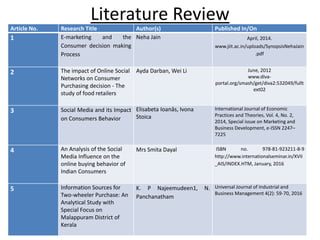
Article No. Research Title Author(s) Published In/On
1 E-marketing and the
Consumer decision making
Process
Neha Jain April, 2014.
www.jiit.ac.in/uploads/SynopsisNehaJain
.pdf
2 The impact of Online Social
Networks on Consumer
Purchasing decision - The
study of food retailers
Ayda Darban, Wei Li June, 2012
www.diva-
portal.org/smash/get/diva2:532049/fullt
ext02
3 Social Media and its Impact
on Consumers Behavior
Elisabeta Ioanăs, Ivona
Stoica
International Journal of Economic
Practices and Theories, Vol. 4, No. 2,
2014, Special issue on Marketing and
Business Development, e-ISSN 2247–
7225
4 An Analysis of the Social
Media Influence on the
online buying behavior of
Indian Consumers
Mrs Smita Dayal ISBN no. 978-81-923211-8-9
http://www.internationalseminar.in/XVII
_AIS/INDEX.HTM, January, 2016
5 Information Sources for
Two-wheeler Purchase: An
Analytical Study with
Special Focus on
Malappuram District of
Kerala
K. P Najeemudeen1, N.
Panchanatham
Universal Journal of Industrial and
Business Management 4(2): 59-70, 2016
Research problem
SOP: ‘Do people of Vijayawada rely and believe
on the information available on the Social
Media for Buying Decisions?’ is the question of
this study which is to be answered in the
conclusion of this quest.
Objectives of the study
• To find out if Customers of Vijayawada
rely/trust on SMI for buying decisions or not.
• To study the qualitative factors of SMI which
makes SMM effective and reliable.
• To analyse the demographic & economic
aspects that influences the Customer Buying
Behaviour (quantitative).
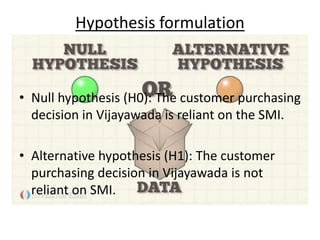
Hypothesis formulation
• Null hypothesis (H0): The customer purchasing
decision in Vijayawada is reliant on the SMI.
• Alternative hypothesis (H1): The customer
purchasing decision in Vijayawada is not
reliant on SMI.
Research design
• Both primary and secondary data are used in
this descriptive study.
• Sources:
* Primary: Questionnaire Survey
* Secondary: Published researches ,
Books & Internet
Sampling technique: Convenience sampling
Sample size: 200 people of Vijayawada
Continued…..
• Time frame of the study: Oct-Nov 2016
• Location for Study: Vijayawada.
• Data collection: Questionnaire via Social
Media ,Emails, Google forms, Linkedin.
• Measuring tool: 5 point Likert scale
• Questions type: Close Ended
• Statistical methods: SPSS, Frequency,
Percentage, Chi-Square test, Bar graph.
3. Statistical Evaluation
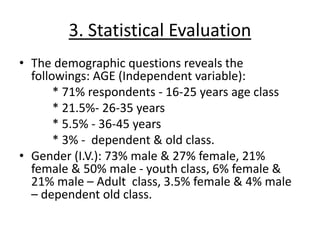
• The demographic questions reveals the
followings: AGE (Independent variable):
* 71% respondents - 16-25 years age class
* 21.5%- 26-35 years
* 5.5% - 36-45 years
* 3% - dependent & old class.
• Gender (I.V.): 73% male & 27% female, 21%
female & 50% male - youth class, 6% female &
21% male – Adult class, 3.5% female & 4% male
– dependent old class.
• Qualifications(I.V.):
*Doctorate-3%, *PG-52.5%, *UG-34%
*Intermediate-7.5%, SSC-0.5%, Other-2.5%
• Income levels (Monthly):
*Less than Rs.10,000=18%
*Rs.20k-40k=21.5%
*Rs.40k-60k=8.5%
*Rs.70k n above=11%
*None = 40.5%
4.Aftermaths of the Pursuit
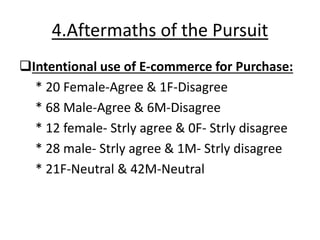
Intentional use of E-commerce for Purchase:
* 20 Female-Agree & 1F-Disagree
* 68 Male-Agree & 6M-Disagree
* 12 female- Strly agree & 0F- Strly disagree
* 28 male- Strly agree & 1M- Strly disagree
* 21F-Neutral & 42M-Neutral
Frequency of Purchase
• Daily – 2% female & 1.5% male
• Weekly - 3% female & 14% male
• Fortnightly – 3% female & 6.5% male
• Monthly- 19% female & 50.5% male
• Other – 0% female & 0.5% male
Reasons for Online purchase
• Choice Variety-27.5% vote
• Convenience-23.5%
• Offers-18%
• Price-22.5%
• Resource Savvy-8.5%
 Reliance on SMI for Buying
decisions
• Strongly Agree- 13%
• Agree-40%
• Neutral-36.5%
• Disagree-7%
• Strongly Disagree- 3.5% only
 Social Media used & preferred to
seek information for buying
decisions
• Facebook-41.5%
• Youtube-22.5%
• E-commerce websites-9%
• Instagram-8%
• Linkedin-7%
• Others-8%
• Twitter-4%
 Features of Social Media impacting
the Buying Decisions
• Popularity-34%
• Reviews-28%
• Accessibiltiy-16.5%
• Security-16%
• Interface-5.5%
 Types of Reviews seen about
Products/services on Social Media
• Positive-33.5%
• Negative-15%
• Both-35%
• Never consider-16.5%
 Judiciousness of Purchase decisions
made using SMI
• Strongly Agree-18.5%
• Agree-46.5%
• Neutral-29%
• Disagree-5.0%
• Strongly Disagree-1.0%
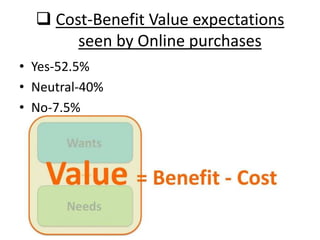
 Cost-Benefit Value expectations
seen by Online purchases
• Yes-52.5%
• Neutral-40%
• No-7.5%
 Recommendation to believe in SMI
for Purchase decisions
• Yes-55.5%
• Neutral-37%
• No-7.5%
5.Conclusion
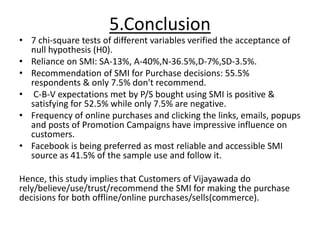
• 7 chi-square tests of different variables verified the acceptance of
null hypothesis (H0).
• Reliance on SMI: SA-13%, A-40%,N-36.5%,D-7%,SD-3.5%.
• Recommendation of SMI for Purchase decisions: 55.5%
respondents & only 7.5% don't recommend.
• C-B-V expectations met by P/S bought using SMI is positive &
satisfying for 52.5% while only 7.5% are negative.
• Frequency of online purchases and clicking the links, emails, popups
and posts of Promotion Campaigns have impressive influence on
customers.
• Facebook is being preferred as most reliable and accessible SMI
source as 41.5% of the sample use and follow it.
Hence, this study implies that Customers of Vijayawada do
rely/believe/use/trust/recommend the SMI for making the purchase
decisions for both offline/online purchases/sells(commerce).
Niraj Thakur
152510139
MBA15C

Mrp ppt

  • 1.
    A Study onCustomer Reliance on Social Media As a Source of Information in Buying Process 1.Introduction 2.Research Methodology 3.Statistical Evaluation 4.Aftermaths of the Pursuit 5.Conclusion
  • 2.
    1.Introduction • Customer Buyingdecision process • Social Media as a Information Source • Social Media Marketing (SMM) • Reliance on SMI • Importance of the study • Limitations of the Study
  • 3.
  • 4.
    Social Media asInformation Source • Most used info sources are SM’s like- Facebook, Linkedin, Twitter, Googleplus, etc. • More than 2.3 million searches every sec. • Available 24*7*365 around the globe. • 4.5 billion likes generated daily as of May 2015.(67% rise since 2014) • 29.7% of users-Age 25 to 34 is the most common age demographic. • Highest traffic occurs mid-week between 1 to 3 pm. • Photo uploads total 300 million per day. (e.g. Vijayawada’s Best DPs) • Average time spent per Facebook visit is 20 minutes. • 16 Million local business pages have been created as of May 2015 which is a 100 percent increase from 8 million in June 2014. • 50% of 18-24 year-olds go on Facebook when they wake up. • More than 50 Facebook pages in Vijayawada for Online commerce.
  • 5.
    Importance of thestudy • Present marketing trends • Latest technological innovations (e.g.. slide & earn) • Green Marketing practice • Data analytics and Cloud computing • Vijayawada as the growing business hub • Capital city of Andhra Pradesh • Narrowcasting of communication
  • 6.
    Limitations of thestudy • Limited Geographical area of study • Small sample size of 200 • Biased & incomplete responses • Language Barrier • Lack of Awareness • Time Constraint
  • 7.
    2.Research Methodology • LiteratureReview • Research problem • Objectives of the Study • Hypothesis formulation • Research design • Statistical methods
  • 8.
    Literature Review Article No.Research Title Author(s) Published In/On 1 E-marketing and the Consumer decision making Process Neha Jain April, 2014. www.jiit.ac.in/uploads/SynopsisNehaJain .pdf 2 The impact of Online Social Networks on Consumer Purchasing decision - The study of food retailers Ayda Darban, Wei Li June, 2012 www.diva- portal.org/smash/get/diva2:532049/fullt ext02 3 Social Media and its Impact on Consumers Behavior Elisabeta Ioanăs, Ivona Stoica International Journal of Economic Practices and Theories, Vol. 4, No. 2, 2014, Special issue on Marketing and Business Development, e-ISSN 2247– 7225 4 An Analysis of the Social Media Influence on the online buying behavior of Indian Consumers Mrs Smita Dayal ISBN no. 978-81-923211-8-9 http://www.internationalseminar.in/XVII _AIS/INDEX.HTM, January, 2016 5 Information Sources for Two-wheeler Purchase: An Analytical Study with Special Focus on Malappuram District of Kerala K. P Najeemudeen1, N. Panchanatham Universal Journal of Industrial and Business Management 4(2): 59-70, 2016
  • 9.
    Research problem SOP: ‘Dopeople of Vijayawada rely and believe on the information available on the Social Media for Buying Decisions?’ is the question of this study which is to be answered in the conclusion of this quest.
  • 10.
    Objectives of thestudy • To find out if Customers of Vijayawada rely/trust on SMI for buying decisions or not. • To study the qualitative factors of SMI which makes SMM effective and reliable. • To analyse the demographic & economic aspects that influences the Customer Buying Behaviour (quantitative).
  • 11.
    Hypothesis formulation • Nullhypothesis (H0): The customer purchasing decision in Vijayawada is reliant on the SMI. • Alternative hypothesis (H1): The customer purchasing decision in Vijayawada is not reliant on SMI.
  • 12.
    Research design • Bothprimary and secondary data are used in this descriptive study. • Sources: * Primary: Questionnaire Survey * Secondary: Published researches , Books & Internet Sampling technique: Convenience sampling Sample size: 200 people of Vijayawada
  • 13.
    Continued….. • Time frameof the study: Oct-Nov 2016 • Location for Study: Vijayawada. • Data collection: Questionnaire via Social Media ,Emails, Google forms, Linkedin. • Measuring tool: 5 point Likert scale • Questions type: Close Ended • Statistical methods: SPSS, Frequency, Percentage, Chi-Square test, Bar graph.
  • 14.
    3. Statistical Evaluation •The demographic questions reveals the followings: AGE (Independent variable): * 71% respondents - 16-25 years age class * 21.5%- 26-35 years * 5.5% - 36-45 years * 3% - dependent & old class. • Gender (I.V.): 73% male & 27% female, 21% female & 50% male - youth class, 6% female & 21% male – Adult class, 3.5% female & 4% male – dependent old class.
  • 15.
    • Qualifications(I.V.): *Doctorate-3%, *PG-52.5%,*UG-34% *Intermediate-7.5%, SSC-0.5%, Other-2.5% • Income levels (Monthly): *Less than Rs.10,000=18% *Rs.20k-40k=21.5% *Rs.40k-60k=8.5% *Rs.70k n above=11% *None = 40.5%
  • 16.
    4.Aftermaths of thePursuit Intentional use of E-commerce for Purchase: * 20 Female-Agree & 1F-Disagree * 68 Male-Agree & 6M-Disagree * 12 female- Strly agree & 0F- Strly disagree * 28 male- Strly agree & 1M- Strly disagree * 21F-Neutral & 42M-Neutral
  • 17.
    Frequency of Purchase •Daily – 2% female & 1.5% male • Weekly - 3% female & 14% male • Fortnightly – 3% female & 6.5% male • Monthly- 19% female & 50.5% male • Other – 0% female & 0.5% male
  • 18.
    Reasons for Onlinepurchase • Choice Variety-27.5% vote • Convenience-23.5% • Offers-18% • Price-22.5% • Resource Savvy-8.5%
  • 19.
     Reliance onSMI for Buying decisions • Strongly Agree- 13% • Agree-40% • Neutral-36.5% • Disagree-7% • Strongly Disagree- 3.5% only
  • 20.
     Social Mediaused & preferred to seek information for buying decisions • Facebook-41.5% • Youtube-22.5% • E-commerce websites-9% • Instagram-8% • Linkedin-7% • Others-8% • Twitter-4%
  • 21.
     Features ofSocial Media impacting the Buying Decisions • Popularity-34% • Reviews-28% • Accessibiltiy-16.5% • Security-16% • Interface-5.5%
  • 22.
     Types ofReviews seen about Products/services on Social Media • Positive-33.5% • Negative-15% • Both-35% • Never consider-16.5%
  • 23.
     Judiciousness ofPurchase decisions made using SMI • Strongly Agree-18.5% • Agree-46.5% • Neutral-29% • Disagree-5.0% • Strongly Disagree-1.0%
  • 24.
     Cost-Benefit Valueexpectations seen by Online purchases • Yes-52.5% • Neutral-40% • No-7.5%
  • 25.
     Recommendation tobelieve in SMI for Purchase decisions • Yes-55.5% • Neutral-37% • No-7.5%
  • 26.
    5.Conclusion • 7 chi-squaretests of different variables verified the acceptance of null hypothesis (H0). • Reliance on SMI: SA-13%, A-40%,N-36.5%,D-7%,SD-3.5%. • Recommendation of SMI for Purchase decisions: 55.5% respondents & only 7.5% don't recommend. • C-B-V expectations met by P/S bought using SMI is positive & satisfying for 52.5% while only 7.5% are negative. • Frequency of online purchases and clicking the links, emails, popups and posts of Promotion Campaigns have impressive influence on customers. • Facebook is being preferred as most reliable and accessible SMI source as 41.5% of the sample use and follow it. Hence, this study implies that Customers of Vijayawada do rely/believe/use/trust/recommend the SMI for making the purchase decisions for both offline/online purchases/sells(commerce).
  • 27.